To Kill a Machine, King’s Head Theatre

To Kill a Machine: Scriptography Productions

How well can you condense Alan Turing’s life and work into one hour? Considering his technologically groundbreaking career, WWII code breaking and conviction for crimes of gross indecency, that’s a lot of source material for precious little time. Catrin Fflur Huws chooses to focus on the man behind the achievements at various pivotal points in his life for To Kill a Machine. From boarding school days to chemical castration shortly before his death, Huws shows the relationships rather than the events that shaped his life. Scenes of naturalism are interspersed with a surreal, presentational game show indicating the factors outside of Turing’s control that dictate his unfortunate fate at the hands of discrimination. Though stylistically dynamic, they are less compelling than the latter. Together, they make a good whole but with so much missing from Turing’s life, the highlights contained in To Kill a Machine shortchange the story of such an important man.

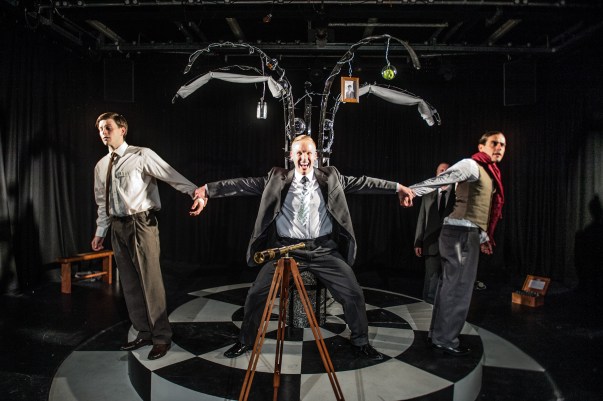
In the centre of a round platform, a wiry, mechanical tree by designer Cordielia Ashwell sprouts important mementos from Turing’s life: a photograph of Christopher, his first love at school, pages of indecipherable code, and the apple that he may or may not have used to kill himself. Its trunk is also a convenient place to store props and costume, but the visual aspect is the most dominant, and strikingly so. The symbol of life manifested in an everlasting, sculptural form against the items that were his downfall is powerful image.

The tree also dictates circular movements from the cast of four, most prominent in the game show scenes and Turing’s sex with his younger lover, Arnold Murray, who eventually betrays him – the moments where his life spirals irrevocably out of control. Alan’s eventual tethering to the tree via medical equipment during his “treatment” is a horrible,  effective reminder of history’s handing of people discovered to be gay and sapping their life force with discriminatory legislation.

Gwydion Rhys as Alan Turing is the anchor in the cast, with a nuanced and sensitive performance that leaves Benedict Cumberbatch’s generic interpretation in the dust. He is complimented well by intimate scenes with François Pandolfo as his school friend Christopher, and older brother John giving him advice in the run up the trial. This latter scene is by far the best in the play.

Though the script is good, it’s short length is unsatisfying and otherwise dwarfed by the performances and design. The structure works as does the lens with which it views Turing’s life, but surely there is more than an hour’s worth of material on the man behind the life-changing mathematician and inventor.

To Kill A Machine runs through 23 April.

The Play’s the Thing UK is committed to covering fringe and progressive theatre in London and beyond. It is run entirely voluntarily and needs regular support to ensure its survival. For more information and to help The Play’s the Thing UK provide coverage of the theatre that needs reviews the most, visit its patreon.

The Broke ‘N’ Beat Collective, Battersea Arts Centre

https://i0.wp.com/www.20storieshigh.org.uk/wp-content/uploads/2016/02/Jack-and-Lateefah-1280x853.jpg

Kids have it tough, especially if they’re poor. Decreasing social mobility, higher costs of education and living, and decreasing welfare are trapping our future generations in inescapable cycles of poverty. They are just as aspirational as young people from more privileged backgrounds and aware of the opportunities they don’t have. They are angry, frustrated and lack the opportunity to constructively express their feelings that often go completely disregarded by more comfortable members of society.

Theatre-Rites and 20 Stories High, seeing validity in their voices, worked with numerous young people in this demographic to devise a gig-theatre show that shares experiences of being a poor teenager in Britain today. The Broke ‘N’ Beat Collective is an empowering, important work that uses fantastic puppetry, mask and music to create a gloriously messy collage of young people’s concerns and issues. Structurally mirroring the rough and ready, fractured existence of urban youth culture, it rebels against theatrical and cultural preconceptions without apology for its flaws.

Elisha Howe’s (aka Elektric) soaring rhymes and Jack Hobbs (aka Hobbit) beatboxing energise the audience and establish a defiant, proud tone that carries through the show. They are not backing down, nor are B-boy Ryan Harson (aka LoGisTics) and puppeteer Mohsen Nouri. They literally zoom in on the tiny model tower blocks and street scenes of urban Britain, replicated in cardboard wonderfully extracted from the plain back wall, creating a landscape of alternating songs with monologues. These set pieces and puppets pass on the otherwise unknown life stories of young people they’ve met.

Omar is an insecure, confrontational grey hoodie that takes the whole show to find his voice. Jack’s a wannabe gangsta who knocks up Latifa (both with cartoonish, cardboard heads) and ditches her and the resulting child that reflects on how that’s shaped his life goals. Joanne is the Papergirl who cuts herself because her mum’s boyfriend abused her. There’s also the incredible Speaker Boy, a rotund, playful chap with a boombox for a head. Each puppet is as unique as the young person behind it, and just as inspiring. (Seriously, go look at the puppets’ photos in the gallery part way down the page; they are some of the most emotionally endowed bits of paper and foam I’ve ever encountered. All of these characters unashamedly demand attention with precise, evocative storytelling and a joyfully visualised presence. These stories are broadcast along side an ever-changing soundtrack with interjections of dance, banter and spoken word, simultaneously creating an atmosphere of celebration and seriousness. Though fun, it never loses the sense of the weight behind the work.

Despite the boldness in the work and the importance of its messages, there are some sloppy transitions that cause the piece to lose momentum. Elektric unnecessarily introduces each number by name, and there are some in-jokes between the performers that, whilst sweet, don’t carry energy with their small scale. This gives the whole piece a choppiness that makes it feel unfinished.

All four performers’ exemplary skillsets and vibrance are fantastic vehicles for the young people of this country seeking escape from the poverty that is so limiting to their ambition. Each moment connects to the next through a theme rather than a storyline, but the effect mirrors modern society: a bit messy, emotional and ambitious for a better life. The fun doesn’t override or trivialize the seriousness, and neither is it too weighty. The unpolished feel is very much ingrained in the gig-theatre style, and though it would be great to learn more about the characters presented, The Broke ‘N’ Beat Collective truly holds a mirror up to nature.

The Broke ‘N’ Beat Collective runs through 2 April.

The Play’s the Thing UK is committed to covering fringe and progressive theatre in London and beyond. It is run entirely voluntarily and needs regular support to ensure its survival. For more information and to help The Play’s the Thing UK provide coverage of the theatre that needs reviews the most, visit its patreon.
Leaper: A Fish Tale, Greenwich Theatre

unspecified

Our oceans are dying. Just yesterday, the news reported that 95% of the Great Barrier Reef has been bleached due to temperature rises. There are huge swathes of sea with high concentrations of microplastics that leach toxins into the water and the food chain. We are overfishing our oceans, causing a myriad of problems to human and sea life.

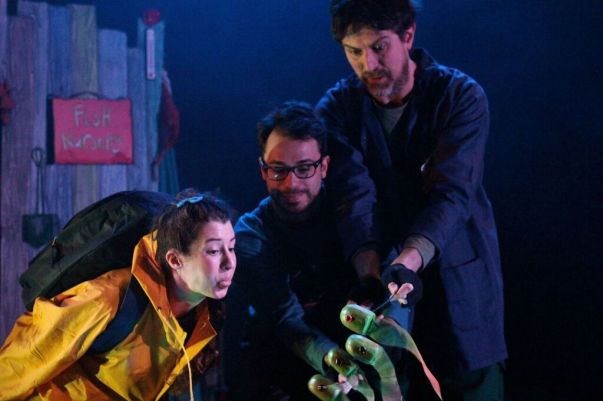
Tucked In is trying to change that through Leaper: A Fish Tale, an adventure story for families about a young girl’s discoveries in the world’s waterways. The unnamed daughter isn’t particularly interested in her dad’s fish farm and wreaks more havoc than anything else. But after falling into the stream in pursuit of a dropped crisp packet, she makes friends with Leaper the salmon on her journey from stream, to river, to ocean and back again. Good puppetry and movement keep younger ones engaged in this surprisingly complex story, though at times it feels a bit too convoluted and the lack of dialogue is unnaturally forced.

With an impressive array of animal puppets by Claire Harvey and Annie Brooks’ transformative set, there’s plenty to look at in the show’s recycled aesthetic. The larger puppets have an excellent range of movements, particularly the duck, seal and big fish. The rubbish monster is the most wonderfully inventive surprise, and the large jellyfish are poetry in motion. The smaller puppets are understandably simpler, but less dynamic with fewer moving parts. The baby fish, though sweet in the way the human characters treat them, are harder to see and not particularly interesting in and of themselves. The design really comes into its own in the middle of the ocean, with atmospheric lighting and sound to match.

Though the show wants to address both overfishing and ocean pollution, the littering is the primary focus. It makes sense as children may struggle with the concept of overfishing, but the plot points on the topic are consequently less engaging. There aren’t many of them though, and the focus is almost solely on the girl’s (Lizzie Franks) journey.

The performances by Franks, Philip Bosworth and Robert Welling are engaging and precise, though the reason for minimising speech is unclear. There are plenty of vocal effects, but character communication and actor impulses feel unnaturally limited. It doesn’t interfere with the story and the children in the audience aren’t bothered, but it doesn’t contribute to the production style.

Leaper: A Fish Tale is visually compelling with some great puppetry and an engaging story for children and adults alike. The performances are good and the story has all the necessary components of a satisfying adventure tale with a clear moral. Though there are some small issues, they don’t interfere with the overall enjoyment of the piece, and this show could play a powerful role in raising engaged, environmentally conscious young people.

Leaper: A Fish Tale is touring schools and theatres in April.

The Play’s the Thing UK is committed to covering fringe and progressive theatre in London and beyond. It is run entirely voluntarily and needs regular support to ensure its survival. For more information and to help The Play’s the Thing UK provide coverage of the theatre that needs reviews the most, visit its patreon.

Rave Space, Camden People’s Theatre

https://www.cptheatre.co.uk/wp-content/uploads/2016/01/Will-Dickie-1-1.jpg

A few hours before the start of the New Year, I found myself alone in a dark room in Battersea Arts Centre with two DJs, Will Dickie and Jeremiah Isaacs. The encounter was intimate, revealing and brief. Twenty minute long The Resolution Studio recorded individual participants’ resolutions for 2016, created a signature dance move, and the two djs and their audience of one had a quick groove session before rejoining the venue’s party. Though I felt self conscious at being the sole centre of these two artists’ attention, it was an event that stuck with me the past few months.

When I received an invitation to Camden People’s Theatre festival Sprint 2016 closing show, Will Dickie’s latest work Rave Space, I jumped at the opportunity to experience more of his work. With The Resolution Studio captivating me with Dickie’s charisma and sensuality for such a short time, I couldn’t resist the offer of an hour-long rave and text hybrid piece in the basement of CPT. I left confused and disappointed, though. There are definitely some wonderful aspects of Rave Space­. Interaction, dance and music meld to make a gig theatre piece with some audience autonomy, but with an actual runtime closer to 90 minutes and lengthy, muddled sequences of text and contemporary dance that only tenuously fit together (if at all), this new piece is much in need of further development.

One-by-one entry, whilst it adds atmosphere and interaction, takes a long time as we each have to ID ourselves and receive a hand stamp. Once we’re in, we can peruse the tiny stations with LED signs, turntables, and random objects assembled like shrines in the corners of the room. Some people are given laser pointers. It’s mysterious, cryptic and exciting, though there isn’t much to actually do or engage with. People are chatting, performers/stewards in hi-vis pepper the space and it feels like a gig is about to start rather than a theatre piece. There are no chairs, and it’s late. The lengthy build-up creates buzz and excitement, but what follows is an anticlimax.

When the music starts, spinning from a pentagonal structure in the middle of the space, a few people get really into it, most others bob heads, some don’t join in at all. That’s ok because there’s no judgement, but watching other people have a great time can be dull. Spoken text over a mic and pre-recorded monologues eventually kick in, but there is a detachment from the music, even though the content is often about music or rave culture. There’s no through-line or any justification for pairing that particular music with those text extracts. Comparing rave culture with the experience of going to church is the most interesting proposal, but it is not investigated further. Also disconnected from any of the topics discussed in the sections of text are sequences of contemporary dance in various styles, including what looks like Butoh. Though a display of adept, emotive physicality akin to a Rodin statue coming to life, these are also detached from everything that has occurred so far.

Though the concept of creating a piece that incorporates rave culture with performance is an excellent one, Will Dickie’s execution leaves much to be desired. There is no denying his charisma and talent, but Rave Space needs to consider its aims and its audience as it grows.

Rave Space was a one-off event at Sprint 2016.

The Play’s the Thing UK is committed to covering fringe and progressive theatre in London and beyond. It is run entirely voluntarily and needs regular support to ensure its survival. For more information and to help The Play’s the Thing UK provide coverage of the theatre that needs reviews the most, visit its patreon.

These Books Are Made For Walking, Jackson’s Lane

https://farm8.staticflickr.com/7398/15871797584_e5b143b72f_b.jpg

Fabrice Dominici is a solitary librarian who takes great pleasure from the books he tenderly looks after. Gently stroking them, he flips to his favourite passages before giving them a sniff and balancing them on shelves made out of ladders. When a pile of books at the top comes to life, revealing a woman who has no intention of leaving and has a musician friend join her, the librarian tries everything to drive off these nonchalant interlopers. As his attempts continue to fail, this simple storyline of These Books Are Made for Walking starts to wander until it completely loses its way at an anti-climactic ending. Though visually dynamic and a nice premise for its aged 6+ target audience, the lack of distinct characterisation and a simple narrative arc is a disappointment to all ages.

Dominici’s nameless librarian draws on clowning to create a somewhat hapless but caring character who endears himself to the audience with his Wile E. Coyote determination. There are regular laughs, and his performance finds a lovely midpoint between over-exaggerated and underplayed. The other two performers lack personality, and it is never made clear what they want other than to hang out and make music on top of the rickety shelves. A love song gives away that they are a couple, but their relationship has no real bearing on the story.

Whilst the librarian’s attempts to get rid of his uninvited guests are entertaining and draw to a close before they become stale and repetitive, his sudden change of heart is inexplicable. He dashes around the stage with ropes and an audience volunteer to set up for the woman’s slack rope routine; after poking her musician friend in the bum with gardening sheers it simply doesn’t make sense. It’s a strange transition, but not as abrupt and unsatisfying as the show’s conclusion.

The set design, presumably by the three devising artists that also perform, is the highlight These Books Are Made for Walking. It’s instability naturally creates tension, though I would not want to be the person that had to risk assess the freestanding structure with performers clambering along the top. Books create a wonderful aesthetic, though watching them tumble to floor and then be trodden on cause several tiny heartbreaks. Christopher McGhee’s lighting works with the set well to create gentle shadows and focus points, though a moment of bright orange rays made the subjects hard to see as they were too close to the source to be lit evenly.

This second production from Bikes & Rabbits shows a promising use of narration in physical and visual theatre with additional elements of circus, but the spectacle’s temptation proves too much and is not properly integrated into the piece’s structure. It’s a lovely idea that doesn’t manage to follow through to a satisfying, clear conclusion.

These Books Are Made For Walking tours until 2 April at various venues.

The Play’s the Thing UK is committed to covering fringe and progressive theatre in London and beyond. It is run entirely voluntarily and needs regular support to ensure its survival. For more information and to help The Play’s the Thing UK provide coverage of the theatre that needs reviews the most, visit its patreon.
How To Survive a Swarm of Bees, Bread & Roses Theatre

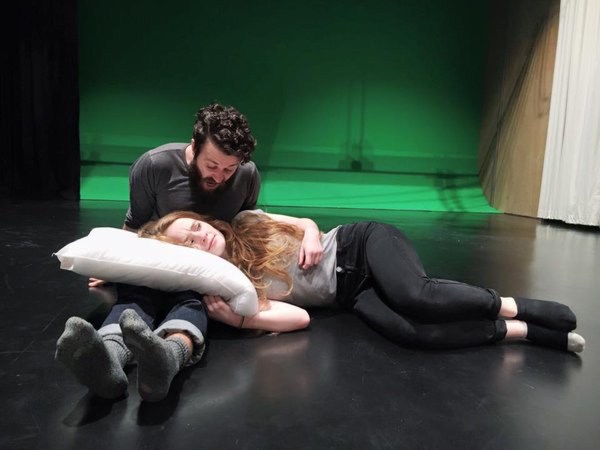
The heaps of white pillows that cover most of the stage make How To Survive a Swarm of Bees look like a slumber party or a kids’ fort, something with a lot of fun and giggles. But Anna Crace’s short play is far from the happy cuddliness implied by the set. With a Scandi aesthetic in both design and dialogue, this austere piece of new writing gives little away except for the looming apocalypse Of a massive storm and a swarm of bees that threatens the existence of two young couples barricaded into their homes. The minimalist text bears more than a passing resemblance to Beckett, but it’s so sparse that there isn’t much depth or substance despite the interesting premise.

The unnamed hetero couples in their early 20s live separately, but their lives and conflicts parallel each other in the moment. Rather than the somewhat disappointing story, the most interesting feature is the intertwining scenes where the characters occasionally swap partners (not that way, pervert) without acknowledging the change. The device is gently disorientating, aiding the distance from reality that creates a state of reflection in the audience. These four are Every Men in the face of a crisis, with fear, anxiety and need that manifest in four different ways. We can relate to them all, but know they are not of our world.

The lack of action and a threadbare story is frustrating, through. The only thing the four do is talk around the problem and argue, and shift pillows around in their confinement. What exactly is going on in the world? Disappearing news broadcasters and friends choosing to live underground are never fully explained. Why is the world reacting so strongly to a storm? Why are these couples fighting about staying in their homes with the buzzing growing ever louder? They allude to consequences of nature creeping into the house and “the nets” failing, but what are these consequences? It’s never revealed, but easily could be by lengthening this script by another twenty minutes or so.

There is some distinction between the different characters, but other than Laurie Ogden’s agoraphobic young woman, the rest are very similar. Should we stay or go? How long can we realistically eat the soup we’ve stockpiled? How will our relationship hold up with our choice? What do we do if one stays and the other leaves? These questions are debated, but never really answered. The end of the play is abrupt and feels like an interval; some audience hang around for a while and then, confused, head into the night.

The four performances are fine, but tend towards minimalist reflection as well. Though inherently theatrical in structure, elements of this script would be great for telly. The intimacy works well in small fringe theatres, but would most likely come across as flat anywhere larger.

Anna Crace is certainly onto some interesting ideas and design concepts in How To Survive a Swarm of Bees, but the need further development and clearer means of communication.

How To Survive a Swarm of Bees runs until 20th March.

The Play’s the Thing UK is committed to covering fringe and progressive theatre in London and beyond. It is run entirely voluntarily and needs regular support to ensure its survival. For more information and to help The Play’s the Thing UK provide coverage of the theatre that needs reviews the most, visit its patreon.

The Marvellous Adventures of Mary Seacole, Rosemary Branch Theatre

I had never heard of Mary Seacole until I began working in UK schools, several years after my arrival to the UK. What a woman!  No wonder her entrepreneurial, caring Victorian spirit is on the National Curriculum and she has been the subject of several plays, including Rosemary Branch co-artistic director Cleo Sylvestre’s one-woman show, The Marvellous Adventures of Mary Seacole. With a simple narrative structure, Sylvestre’s piece focuses on characterisation and biography. It is well performed, though some adjustments to the script and tech could make this an even better solo show.

We are never told who we are, but Seacole treats us like a society or club she has come to lecture about her life.  She speaks in the past tense shortly after her return from the Crimea; we hear her life story starting with her childhood in Jamaica, helping her mother run their Hotel, Blundell Hall and learnt about her “remedies” from foraging. Continuing onto her London, Central America and finally The Crimean War, Sylvestre endows her with a confident, charismatic warmth – no wonder she was so popular with soldiers and civilians alike. Her performance peaks when recalling her mother first teachings her about plants, and later memories of battlefields heaving with wounded soldiers – her “boys.” These are lovely moments to witness, but some of the more mundane content is delivered on autopilot.

Structurally, the script is a simple, linear narrative. This would be an excellent piece to tour to primary schools, as it’s easy to follow and has plenty of captivating anecdotes. The content is interesting enough to hold an adult audience’s attention for nearly an hour, but it would be a refreshing experiment to see this piece as episodic, with more lighting and sound than is presently used to highlight pivotal moments. This is not a new show, and solo performance has evolved since its inception. Sylvestre’s imagery-laden work would suit regularly used bigger projections, detailed soundscapes stronger lighting changes. Even though this is an important story, it is not an innovative production, but it certainly has the potential to be.

Cleo Sylvestre’s performance is the highlight of The Marvellous Adventures of Mary Seacole, but this long-running solo performance needs some revisiting to give it an extra burst of life worthy of such a vibrant character.

Running at The Rosemary Branch, 9-11 April.

The Play’s the Thing UK is committed to covering fringe and progressive theatre in London and beyond. It is run entirely voluntarily and needs regular support to ensure its survival. For more information and to help The Play’s the Thing UK provide coverage of the theatre that needs reviews the most, visit its patreon.

Eggs, Vault Festival

rsz_eggs_florence_keith-roach_and_amarni_zardoe_courtesy_simon_annand_1

Women get the raw end of the deal no matter how young or old they are, how mainstream or alternative. Two late twenty-somethings, acquaintances through a mutual late friend but with completely opposite personalities, end up bonding over important issues but with dry humour and restrained emotion. Despite the content, Eggs avoids catering purely to women. The frank honesty is stereotypically blokey, covering topics such as masturbation, one-night stands and careers – issues that are obviously relevant to women, just not often spotlighted so directly – as well as fertility, marriage and the fear of aging. Structurally episodic and a bit clunky, Eggs is also bitingly funny and poignant, particularly for those of us in our 20s and 30s feeling like we don’t really fit into the world.

Playwright Florence Keith-Roach uses the versatile symbolism of eggs throughout, albeit obviously. Even the set and costume by Clementine Keith-Roach and Lily Ashley are all white and yellowy-orange. It’s an interesting catalyst for written material, and Keith-Roach riffs in numerous directions from that starting point. Fertility is an obvious path, but egg shaped vibrators less so. This makes the events in the story nicely unpredictable, but Keith-Roach does a great job tying up the issues into a satisfying end.

Keith-Roach and Amani Zardoe are girl 1 and girl 2. Girl 1 is a hippy artist fighting the status quo; Girl 2 loves her corporate job and can’t wait to marry and have children. Both performances are heighted and somewhat ‘Sex in the City’-esque, particularly at the beginning, where they feel like chick lit but on stage. Fortunately, both actors settle into more naturalistic performances after a couple of scenes. Unlike the terrible television series, these unnamed women develop depth and genuine conflict, even though they are not the most likeable of characters. Their insecurities and flaws are believably human, as are their prickly, awkward encounters that evolve into a genuine care for each other.

Eggs is heart-warming without being cheesy, and substantial but does not preach. It provides gentle solidarity to women who feel like their lives aren’t everything they’re supposed to be, and even though the earlier scenes feel disconnected from each other, the last third of the play really rings true. It’s a good piece of theatre for a second play and is a pointed reminder of the fact that no one really has their life together.

The Play’s the Thing UK is committed to covering fringe and progressive theatre in London and beyond. It is run entirely voluntarily and needs regular support to ensure its survival. For more information and to help The Play’s the Thing UK provide coverage of the theatre that needs reviews the most, visit its patreon.

What I Learned From Johnny Bevan, Soho Theatre; The Caucasian Chalk Circle, Jack Studio Theatre

Is revolution in the air? Or, are we all so broken and defeated by rising costs and a falling quality of life that all we can do is complain bitterly? Perhaps a bit of both? In any case, this is not the first time that I wonder if theatre is responding to the liberal sense of disaffection recently. Shortly before Christmas I questioned Dominic Cavendish’s assertion that theatre isn’t political enough, and my sentiment still stands, particularly after the coincidence of seeing two highly charged political pieces two nights in a row. Fringe theatre, like grassroots politics, is a place of community, a catalyst for change, and the foundations of revolt, as seen in Lazarus Theatre Company’s The Caucasian Chalk Circle and Luke Wright’s What I Learned From Johnny Bevan.

1997. The eve of the general election. Nick, who’s studying English Literature at a nameless uni stays up all night with his best mate, poet Johnny Bevan, to watch Tony Blair win. It’s the dawn of a new era and change is coming for the working class long oppressed by Thatcherite rule.  Fast forward fifteen years and Nick’s a journalist in London, but Johnny’s student aspirations didn’t come to fruition, and neither have Tony Blair’s. The story of these two lads’ friendship, written and performed by Luke Wright in a blaze of fiery spoken word, is an hour long tale of youthful vigour soured by the realities of adult life. Wright’s delivery and writing is fervent, topical and no moment is out of place in the trendy and on-point What I Learned From Johnny Bevan.

South of the river, an older revolution is taking place. In Soviet Russia, a group of peasants stages a play about a servant girl in Georgia raising the governor’s newborn baby that was abandoned during the family’s escape from a war zone. After a perilous journey, sacrifice for the sake of the infant, and a regime change, everything is put right again by a citizen judge. Lazarus Theatre Company, with its trademarks of a large cast and striking visuals, draws parallels between Brecht’s The Caucasian Chalk Circle and the despair of modern life – but “change is hope”. Energetic and in the round, the characters rally the audience to their side like they do in Wright’s monologue.

There’s optimism in both productions as well as despair, and an underlying current of discontent with the state of the UK’s current socio-political trajectory. Both display humanity’s capability for selflessness and selfishness, and the feeling that nothing has changed from Soviet ruled Eastern Europe, to Labour’s late-90’s victory, to present unviable economic conditions and Tory tyranny. We are undeniably flawed with a fickleness vulnerable to power and money, but as a society we are also deeply unhappy and feel that we lack the power to affect change. This sentiment now seems to be emerging in fringe theatre.

Though completely different in form and structure, both What I Learned From Johnny Bevan and The Caucasian Chalk Circle have plenty to say about the contemporary world from similar angles. What I Learned From Johnny Bevan is the better of the two productions, and  the more progressive. A solo performance delivered in spoken word accompanied by charcoal and watercolour landscape projections, most of the imagery in Wright’s language is precise and evocative. Brecht’s well-known play is linguistically stilted and stuffy in contrast, but it’s characters are just as colourful.

Performance poet Luke Wright is a singular tour de force and What I Learned From Johnny Bevan is politically charged and practically flawless. Lazarus Theatre’s performances vary, but of the ten-strong ensemble, no one was particularly strong or weak. Their choreography is well-rehearsed but director Ricky Dukes normally powerful movement sequences  lack impact in the round. The set components take up a lot of space and are used well occasionally, but otherwise clutter the stage with bright, industrial chaos. Neil McKeown’s sound design hints at atmosphere and mood, but is much too quiet to add the impact it could. It’s certainly not a bad production, but neither is it one of Lazarus’ stronger ones.

If theatre is a mirror held up to the world, then evidence is increasing that change is imminent. But what form will it take? Will the people rally as in The Caucasian Chalk Circle or will we either sell out or run away from it all like Nick or Johnny? Only time will tell.

The Play’s the Thing UK is committed to covering fringe and progressive theatre in London and beyond. It is run entirely voluntarily and needs regular support to ensure its survival. For more information and to help The Play’s the Thing UK provide coverage of the theatre that needs reviews the most, visit its patreon.

One Under, Vault Festival

rsz_img_6902[1]

Amy Fleming’s dad committed suicide when she was four years old. Fleming struggles with mood swings and wonders if she’s “mental,” like her dad. Luckily, she studied Molecular Medicine before becoming an actor so she understands how genetics dictates our characteristics. She also knows that talking about our problems and developing positive habits helps us overcome them. Combining her science and performance backgrounds, Fleming’s One Under is part conversational lecture, part interactive game. She relies on narration, humour and audience involvement to share her message, but the piece as a whole feels unfinished. It’s a nice idea, but it lacks theatricality and detail.

There’s no character, just Fleming and her generally cheerful honesty. She relaxes the audience straight away and easily facilitates discussion. After a frank introduction about her childhood and how genes are passed from parents to child; there’s some framing by her biography and a multi-round game/quiz with easily answerable mental health questions. These two elements aren’t solidly connected to each other, and the piece’s message isn’t spelled out until the very end. Structurally, it’s weak. By that point though, the message is less interesting that the journey we took to get there and the camaraderie that emerges en route.

This solo show isn’t very theatrical, but it’s lovely for its warm cuddliness and playful approach to form. Fleming is clearly passionate about helping people improve their quality of life and their mental health, which is a commendable mission. Her openness and her anti-performance make me feel uncomfortable writing any sort of negative judgement – it’s such a personal piece. But at an hour long, glossing over parts of her past with some audience debate over quiz questions about how to approach mental health issues at work, there’s a noticeable lack of depth.

The Play’s the Thing UK is committed to covering fringe and progressive theatre in London and beyond. It is run entirely voluntarily and needs regular support to ensure its survival. For more information and to help The Play’s the Thing UK provide coverage of the theatre that needs reviews the most, visit its patreon.