Swansong and Road to Huntsville, Edinburgh Festival Fringe

https://files.list.co.uk/images/2016/08/10/road-to-huntsville-lst207084.jpg

Though climate change has long been a problem, political theatre often ignores it. DugOut’s Swansong faces the issue head on, placing four survivors of a global flood in a swan pedalo. A capella songs and situation comedy bring plenty of joy and laughter to the boat, but the enormity of their survival and uncertain future weighs heavy. Will they find land, or will they kill each other first?

Like the start of a joke, hippy vegan Bobby, posh boy Steven, gym bunny Claire and nihilist Adam are on a boat, and have been for at least a little while now. They’ve already worked out exactly how to wind each other up, which generates the comedy that keeps Sadie Spencer and Tom Black’s script from becoming too heavy. The lightness contrasting the serious of their post-apocalyptic waterworld tips more towards comedy, but the balance mostly works. As they make plans for rebuilding the world to the vision they are creating from scratch in Bobby’s journal (obviously with plenty of arguments), there’s a natural progression towards eventuality – will they find land and survive, or will they all die on the pedalo?

The characters are rather stereotypical for the sake of comedy; despite this there are some poignant moments of understanding and empathy. They are effectively performed but somewhat lacking in depth, though sung interludes between scenes and the resolution help negate this unsatisfaction.

This spirited production is a relief from more sombre approaches to political issues, and a good laugh at that despite its shortcomings. Road to Huntsville is an entirely different beast, though the topic is just as infrequent on British stages. Theatre maker Stephanie Ridings stumbles across a documentary about women who fall in love with prisoners on America’s death rows. Thinking this could be the start of a new play, she latches onto the subject and delves into a world that she doesn’t understand, but doesn’t want to judge. As her research leads her further down the rabbit hole, she emerges in the “death penality capital” of the country, Huntsville, Texas.

Road to Huntsville shares Ridings’ process and turns it into a story of itself. More of a documentary, there are no preconceptions – we are in a theatre to hear about her findings. The curious but emotionally detached beginning takes its time to cave into emotional connection with the people she meets who are at the mercy of a state sanctioned killing machine. This show is a slow burner, but by the end, her passion and rage against the death penalty rally the audience to her side. Her frustrated helplessness hangs heavily in the air as she tries to return to normal life, then she does the same to us, sending us out into the busy joy of Summerhall. Though it makes for melancholy, lingering reflection, Ridings’ reminder that not everyone has the privilege of living in a country where the government won’t kill you if you commit a crime.

Swansong runs through 29th August, Road to Huntsville runs through 28th August.

The Play’s the Thing UK is committed to covering fringe and progressive theatre in London and beyond. It is run entirely voluntarily and needs regular support to ensure its survival. For more information and to help The Play’s the Thing UK provide coverage of the theatre that needs reviews the most, visit its patreon.

Agent of Influence: The Secret Life of Pamela More, Edinburgh Festival Fringe

https://i0.wp.com/www.underbellyedinburgh.co.uk/images/made/images/uploads/pamela_more_750_500_60_c1.jpg

Lady Pamela More covers fashion and socialites for The Times and she has no interest in any other topic. As Britain’s involvement in the war becomes certain, her disinterest in politics and international affairs wanes, and her social circles are split into those who support Germany and those who believe the whispered stories coming across the channel. With newfound purpose and contacts, the use of her journalistic skills changes direction to a more practical use – she is recruited to spy on Britain’s elite.

Sarah Sigal reinvents Pamela from her 2014 Park Theatre play World Enough and Time, now making the character the primary subject of a solo performance. Reprised by Rebecca Dunn, Pamela recounts her wartime adventures through past-tense narration and dialogue between herself and impersonated peers. She meets and watches real people from British history, moulding a clear perspective of their wartime activities – this is the most interesting aspect of the narrative. Who the audience is, or why she is telling us her story is never made clear, though. Her tale is interesting enough, but what is it’s point?

The scenes Dunn enacts are more dynamic than the stretches of narration that span the years surrounding the war. She employs accents and an impressive vocal range to differentiate between herself and those she converses with, often with charm and humour. Her storytelling is good enough to maintain attention, but as no moral or message emerges from the text, the ambiguity of the script dwarfs Dunn’s ability.

Agent of Influence: The Secret Life of Pamela More suits a written format much more so than a staged one – it would make a lovely novella what with its detailed description of the setting and characters involved. Though its well performed and a good story in and of itself, theatricality gets in the way, making this solo performance piece fall flat.

Agent of Influence: The Secret Life of Pamela More runs through 28th August.

The Play’s the Thing UK is committed to covering fringe and progressive theatre in London and beyond. It is run entirely voluntarily and needs regular support to ensure its survival. For more information and to help The Play’s the Thing UK provide coverage of the theatre that needs reviews the most, visit its patreon.
Foiled, Edinburgh Festival Fringe

https://theplaysthethinguk.com/wp-content/uploads/2016/08/7cbcd-duckspeak2b-2bfoiled2b2528editorial_promo25292b2528c25292balex2bbrenner252c2bno2busage2bwithout2bcredit2b2528_dsc71542529.jpg

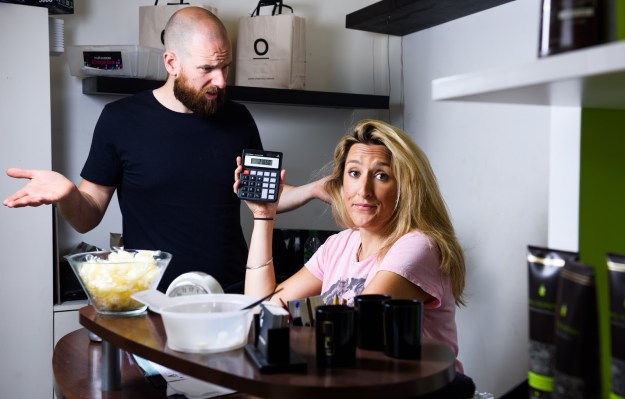
It’s a big day at Bleach for the Stars. The Welsh salon has been nominated salon of the year by Clip Advisor, and dim-but-enthusiastic manageress Sabrina has a lot to do to prepare, like fill out the form to nominate the salon for the award and find money to pay the administration fee. Fed up junior stylist Tanisha does her best to pander to Sabrina’s whims and half-truths, but as the end-of-day deadline for the application looms and a last minute “celebrity” client arrives, Sabrina struggles to keep the business running to the standard that her dad, the owner, expects.

Foiled takes place after hours in a working hair salon, adding a genuine site-specific element to a script that draws on several styles of text-based comedy to entertain its audience. Puns, slapstick, one-liners and Sabrina’s regular misspeaking keep the laughs coming, and two scenarios that raise the stakes drive the action forward. There’s a token sprinkling of musical theatre numbers that feel a bit out of place, but help break up the action nicely.

The intertwining sitcom-esque scenarios hover on the verge of messiness, but writers Beth Granville (who also plays Sabrina) and David Charles keep just enough order in the story for it to not get lost. Staging is a challenge here with the actors racing up and down the narrow salon and sightlines oaccasionally blocked, but the salon is small enough that it’s always easy to hear the dialogue.

Though insubstantial and silly on the surface, Foiled makes pretty powerful comments on social mobility, class and privilege. Tanisha and Sabrina come from very different backgrounds and financial situations which, combined with the two primary plot threads manage to to not feel crowbarred. Foiled is a good laugh, well performed and has a lot to say.

Foiled runs through 29th August.

The Play’s the Thing UK is committed to covering fringe and progressive theatre in London and beyond. It is run entirely voluntarily and needs regular support to ensure its survival. For more information and to help The Play’s the Thing UK provide coverage of the theatre that needs reviews the most, visit its patreon.

Lines, Edinburgh Festival Fringe

http://www.emmanently.com/wp-content/uploads/2015/03/tubemap-2012-12.png

Every Londoner has strong feelings about the tube. They love it, hate it, love to hate it, depend on it, avoid it, sometimes all at once. In Lines, Rose Bruford students pay homage to the underground by extracting individuals from the millions of faces that blur through stations each day. A collage of movement, narration and dialogue captures the diversity of the city with a lovely affection, but the tangled, underdeveloped plot threads that emerge aren’t followed through.

Writer Ian Horgan has numerous lovely ideas but none of them, even the fictional disaster that has the power to unite passengers, is chosen as the narrative spine. Whilst this adds to the montage effect of individual moments, it’s a format that only works for short periods of time. There are certainly some great stories of individual characters and any of them could be short plays in and of themselves, but here they are unsatisfying. The sections of spoken word vary in the quality of delivery, but this is a style that Horgan uses inconsistently. The use of live music is much more regular, and a great contribution to the piece.

There are some great performances, as should be expected from drama school students. No one stands out as a weak link and their time training together has formed a seamless ensemble. Lines also has the distinction of one of the more ethnically diverse productions of the fringe, which in and of itself is hugely commendable.

Though this affectionate tribute to London transport has plenty of potential, it falls short of true excitement or innovation in its current form.

Lines runs through 15th August.

The Play’s the Thing UK is committed to covering fringe and progressive theatre in London and beyond. It is run entirely voluntarily and needs regular support to ensure its survival. For more information and to help The Play’s the Thing UK provide coverage of the theatre that needs reviews the most, visit its patreon.

Blush, Edinburgh Festival Fringe

https://i0.wp.com/www.underbellyedinburgh.co.uk/images/made/images/uploads/15202-BLUSH_750_500_60_c1.jpg

The Criminal Justice and Courts Act 2015 makes sharing explicit images without consent of the person or persons in the images illegal. Though this legislation is progress in fighting revenge porn and posting sexual photos and images online by criminalising it, the problem hasn’t gone away. Charlotte Josephine’s BLUSH tells the stories of five unrelated individuals effected by revenge porn, trolling and the proliferation of easily accessible online pornography. Some of the stories more tenuously link to the theme, but the montage format and frantic, physical interludes provide a wider view of the problem and how people, usually young women, can have their lives ruined by the click of mouse.

Daniel Foxsmith plays a suburban dad with a penchant for teen porn, and a successful app developer invited to speak to young entrepreneurs in New York who makes some bad decisions on a night out. These characters have similar demeanours; Foxsmith could differentiate them further on order make them more distinct. Though they both get themselves into difficult situations, Josephine plays three different women more directly effected by explicit images online. Though two of these characters have anticipated narratives, the third, a ghosted woman with a strong Estuary accent, is a surprise but a great alternative perspective on the issue. All five characters have elements of stereotype, but their responses to their own conflicts reads as genuinely personal through the text and the actors’ interpretations.

Not just interweaving monologues, director Ed Stambollouian incorporates physical sequences that become more frequent and increasingly violent, bleeding into the text. As online and real life blur, emotions intensify, and a photo studio set reminds us that everything we do is on show and ripe for consumption by an anonymous audience of thousands. Josephine has created a good set of characters, though stronger links to the topic would demonstrate the universal risk surrounding revenge porn.

Even though the script is has merit, the use of physical theatre in relation to the issue and the characters’ experiences makes this a much stronger, more evocative production. Without a doubt, this is still an important issue that deserves stage time.

BLUSH runs through 28th August.

The Play’s the Thing UK is committed to covering fringe and progressive theatre in London and beyond. It is run entirely voluntarily and needs regular support to ensure its survival. For more information and to help The Play’s the Thing UK provide coverage of the theatre that needs reviews the most, visit its patreon.

Mr Incredible and Deal With a Dragon, Edinburgh Festival Fringe

https://files.list.co.uk/images/m/mr-incredible-main-image-print-LST209719.jpg

Solo performances are popular at the Fringe, and there are some good ones this year. So far, the best production I’ve seen this year is one-woman show Torch, celebrating womenhood in all of its flaws and glory. To portray men from such a perspective is much harder what with society already granting men more privilege than women, but Camilla Whitehill’s powerful Mr Incredible does just that in order to highlight male entitlement.

Adam and Holly have recently split up, and Adam hates it. Men like him aren’t meant to be single. He has a good job, owns a flat in London and desperately wants marriage and children. Whilst he loves Holly’s youth and fighting spirit, he was glad when she started to mellow and come round to the idea of settling down. But she wouldn’t be tamed by his sedate nights in front of the telly watching trashy programmes. She wants to write about important issues and change the world for good.

Though Adam’s account of Holly betrays an obvious, fundamental incompatibility between the two, Adam is blind to it and his desire for Holly to conform, and it’s infuriating. As he details moments from their relationship and its unravelling, he blindly transfers all blame onto her. The script cleverly paints Adam as a generally good guy, making his privilege initially subtle, then growing until their relationship reaches a horrible end. His ingrained entitlement to Holly and the belief that she should conform to his ideal life is a good capture of male immovability around women’s goals and desires, and hopefully framed in a way that triggers male reflection.

Alistair Donegan fleshes out Adam with genuine grief for the loss of his relationship and fully believed justification of the character’s choices. Whitehill’s script paints Adam overly-simplistically at times, but Donegan makes the character three-dimensional.

As a solo performance, it is initially unclear who Adam is talking to, but this is revealed in the play’s final moments when the severity of their breakup is horrifyingly revealed.This moment is subtle and takes some processing, so perhaps a bit more obvious spelling out will make the intended message stronger. Overall, this is a strong, polished production with acute comment on male privilege over women’s bodies and choices.

Deal With the Dragon also looks at male entitlement, but likely not deliberately and with a hefty dose of absurd fantasy. Bren is a gay dragon who finds vulnerable gay men that need looking after and offers to help, but not without signing a contract. The Faustian pact between Bren and artist Hunter looks at artistic temperament and dependency in the arts with both comedy and gravitas, though Kevin Rolston’s piece is lacking in a concise storyline and clear message.

Rolston is an excellent performer who distinguishes between Hunter, another artist Gandy and Bren with physical skill that is delightful to watch. With no costume or props, it’s perfectly clear that Rolston is a dragon. The transformation is simple, but utterly delightful.

The script has a nice premise – What if you had a gay, German dragon to help you get through the unpleasantness of life – but it’s never made clear what the premise is trying to communicate. Are people eventually better off with Bren’s assistance? Worse? What does it say about life’s obstacles as a whole? Should men have someone at their disposal to do their dirty work? These questions go unanswered. Though Rolston’s ability as a performer is undeniable, Deal With the Dragon never makes a definitive statement.

Mr Incredible runs through 28th August, Deal With the Dragon runs through 29th August.

The Play’s the Thing UK is committed to covering fringe and progressive theatre in London and beyond. It is run entirely voluntarily and needs regular support to ensure its survival. For more information and to help The Play’s the Thing UK provide coverage of the theatre that needs reviews the most, visit its patreon.

Torch, Edinburgh Festival Fringe

https://i0.wp.com/www.underbellyedinburgh.co.uk/images/uploads/Torch_updated_for_web.jpg

We’re in a club toilet. Not a nice one, either  – there’s no loo roll, lipstick and graffiti pepper the cubicle walls and door. Jess Mabel Jones is an unnamed woman out with a friend, but after a lot of vodka and some coke, she feels self-conscious, past it and wants to hide. Reflecting on the life choices that brought her to this newly-single moment of remorse, she chronicles past lovers, committed relationships, eating disorders, panic attacks, and youthful exploits. Whilst longing for her youthful, perkier self with thinner legs and a tighter arse, she manages to celebrate the woman she has grown up to be in all of her flawed glory. Jones is an absolute firecracker of a performer who slams herself around a robust script baring lived female experience in all its rawness.

Phoebe-Éclair Powell’s text is an extended monologue of fragmented experiences and memories punctuated with pop songs. It doesn’t shy away from visceral topics, though the transitions from text to music are abrupt with little lead-in. The character she paints alternates between vulnerable and endearing, and ferociously bold. She is an everywoman with experiences that most women can relate to on some level and reminds us that despite going through moments of absolute despair and self-loathing, women are incredible.

It’s not just about girl power, though. The character’s anecdotes are funny, moving and compelling stories that are accessible to any human that has grown up, had sex, been in a relationship or felt they don’t meet society’s expectations. She is haunted by the woman she hasn’t become and simultaneously unapologetic about her.

Director Jessica Edwards incorporates plenty of movement, though some seems gratuitous it prevents the performance from becoming static. Amelia Jane Hankin’s set is both industrial, messy and glittery, an outward expression of the character’s spirit.

Jones’ performance is what makes this production worth seeing. She has a stunning voice, emotional vulnerability, and electric charisma. The songs she covers become the millennial generation’s torch songs as she delivers them with a power and depth. She rallies the audience to her side despite behaviour that could be viewed disapprovingly by more conservative audience members because her commitment and connection to the script is as truthful as it possibly can be. Torch is not one to miss.

Torch runs through 28th August.

The Play’s the Thing UK is committed to covering fringe and progressive theatre in London and beyond. It is run entirely voluntarily and needs regular support to ensure its survival. For more information and to help The Play’s the Thing UK provide coverage of the theatre that needs reviews the most, visit its patreon.

Generation Zero, Edinburgh Festival Fringe

https://i0.wp.com/static.progressivemediagroup.com/uploads/imagelibrary/nri/power/projects/Princess.jpg

A nameless couple meet online, fall in love and build a life together. Their lives are comfortably boring, with day jobs, road trips to the beach, holidays in a Yorkshire cottage and lazy weekends snuggling in bed, listening to records. They are almost identical to any contemporary middle class, suburban couple, but something’s not quite right.

Their world is just a bit off. They run out of gas, but they can’t go to the shop to top up their gas meter – they aren’t allowed to exceed their monthly allocation. There’s talk of restrictions on travel in order to cut pollution levels. He’s ambivalent about the environment, but she’s a political activist who devotes more and more of her time to a local group campaigning for change. He wants to spend more time with her, but she’s always out in the evenings, planning actions with the group, so he takes action of his own.

Becky Owen-Fisher’s debut play Generation Zero looks at the battle over the environment through the lens of a young couple in a poetic, episodic script that unsettles through it’s familiarity and the complacency with which (most? some?) people approach political issues. The story doesn’t viciously attack climate change, but takes a gentle, sinister approach that gets into your bones. Owen-Fisher has a good instinct for dialogue and imagery-laden narration that easily flows in and out of naturalism, adding just enough variation in style to keep the audience lightly unsettled.

Director Tom Fox attacks the script with lightening fast transitions; these could be slowed a bit for the sake of keeping up with the actions and the to-ing and fro-ing through time. Without sound and lighting signifiers, they would be totally unclear. Some important moments are also rushed, particularly towards the end, causing the gravitas they should have to be glossed over.More stylised physicality would also be welcome to coordinate with the stylistic changes in text.

The two actors are excellent; Jordan Turk and Francesca Dolan have a gorgeous chemistry that’s lovely to watch, made more romantic by dream-like lighting. The sheets and pillows covering strip lighting on the stage’s edge creates a lovely ethereal effect, destroyed by their reveal at a pivotal moment that also reveals the truth of their relationship’s dynamic – a great choice.

Perhaps some adjustments could be made to the script to transform it into more of a propaganda piece and place a stronger emphasis on the environmental collapse that is merely hinted at, but to do so would cause the piece to lose its delicacy. This is a promising play from an emerging writer with an important message that deserves to be heard.

Generation Zero runs through 29th August.

The Play’s the Thing UK is committed to covering fringe and progressive theatre in London and beyond. It is run entirely voluntarily and needs regular support to ensure its survival. For more information and to help The Play’s the Thing UK provide coverage of the theatre that needs reviews the most, visit its patreon.

The Inevitable Heartbreak of Gavin Plimsole, Edinburgh Festival Fringe

https://theplaysthethinguk.com/wp-content/uploads/2016/08/05b71-gavin2bplimsole2b252812529.jpg

Gavin Plimsole is a good enough guy. A bit geeky and nervous but well-meaning, maybe even a bit endearing if you like that sort of thing. After he receives a life-altering diagnosis from the cardiologist and realises his days are numbered, the audience (who have all strapped into heart monitors before the show begins), get to decide his fate. Part choose-your-own adventure, part poignant tale of grief morning people and times long lost, The Inevitable Heartbreak of Gavin Plimsole is a messy but touching reminder to make the most of every moment.

An ever-present projection of the audience members heartbeats overlays three energetic performers and a changing landscape of cardboard boxes. Gavin’s the sort that stores his life in tattered boxes labelled with masking tape, and these boxes now contain relics from his life. They aren’t particularly interesting, but a garden shed with a wonderful contraption that releases a large marble down a slide and into a box every 500 collective heartbeats, is ramshackle but dynamic. It cleverly represents our perpetual approach towards death with a drawn out clattering and eventual silence – a dying person’s last breaths.

Gavin monologues most of his thoughts; there are some interruptions by spunky, supporting actors that help break up the speeches but more of these would be welcome. A wiry (literally, as in made of wires) puppet makes one appearance and is similarly underused – a remarkable creature! The structure is understandable chaos that mirrors the the first couple of days after devastating news, though clearer transitions and a distinct style will help make sense of this emotional journey.

The use of the heart monitors and audience interaction unites the audience and performers, creating intimacy and empathy. It’s a sad story that manages to foster hope instead of gloom, and within the clutter there’s a lot of heart.

The Inevitable Heartbreak of Gavin Plimsole runs through 29th August.

The Play’s the Thing UK is committed to covering fringe and progressive theatre in London and beyond. It is run entirely voluntarily and needs regular support to ensure its survival. For more information and to help The Play’s the Thing UK provide coverage of the theatre that needs reviews the most, visit its patreon.

Extravaganza Macabre, Battersea Arts Centre

https://i0.wp.com/static-2.socialgo.com/cache/10668/image/5125.jpg

On 13th March last year, I couldn’t tear myself away from twitter as news of the Battersea Arts Centre fire spread. The night before, I had taken my school’s GCSE Drama students to see Gecko’s Missing. The students had never seen abstract, physical theatre before and though they had mixed reactions, they talked about it for days afterwards and drew on it as they devised their own physical theatre pieces. As someone twice their age who is drama school trained and a seasoned theatregoer, I still rely on the BAC to foster similar reactions in myself. Whilst there are certainly shows that aren’t to my taste, the venue has consistently expanded my knowledge and understanding of the theatre and performance.  To watch the fire unfold in real time over social media was devastating. Thankfully no one was hurt and I’m certain those that work/have worked there were affected much more than I was, but I thought I was losing a chunk of my own theatrical landscape.

As the news broke that the BAC would open the front part of the building the next day, my heart leapt to know that all was not lost. The resourcefulness, determination and camaraderie of theatre people pulled together to reopen and raise funds. Now, a bit more than a year later, parts of the building closed by the fire are reopening. First were the artists’ bedrooms, now the remarkable, new open-air space, The Courtyard, debuts with Little Bulb’s similarly spirited show, Extravaganza Macabre. Spunky, bouncy and full of heart, this Victorian melodrama with heaps of music, audience interaction, and unadulterated love for their work makes for a delightful opening of the new BAC performance space.

The complete lack of hipster irony makes this show a rare treat. Though heavily stylized with narration and over-the-top performances, the trio of performers fully commit to it rather than commenting on it from a distance. Daylight, fluid actor/audience boundaries and interaction wholly engages the audience with the story, and the reasonably complex structure that never fails to surprise. Songs, narration and scenes alternate and incorporate plenty of slapstick; these combined with the casual outdoor environment makes a fantastic example of popular theatre also suitable for family audiences.

None of the three performers can be singled out as weaker than the others. They are multi-talented actor musicians brimming with infectious joy and exuberance. They fearlessly throw themselves around the ground floor and the gallery, down stairs and trap doors. Their use of space and inclusion of the whole audience regardless of what level they were on is fantastic – no one feels left out, and every bit of the Courtyard is utilised.

The script they created is a bit convoluted, but the narration clearly signposts changes in time and location, as does their multi-rolling. It’s complex enough that adults won’t be bored, but young people in the audience enjoy the warm silliness of the physical comedy within the story. A storm is the catalyst for the separation of a family and an unrelated young couple, all of whom endure much peril and crossed paths in order for everything to be right again. There’s love, violence, grief and death, all of which are treated with extravagance and utmost importance. There are still peaks and troughs in the plot and the emotional range is varied enough that, even though overly exaggerated, doesn’t become mundane.

Both the BAC and Little Bulb display immense passion for their work, and the two marry perfectly to inaugurate the courtyard. Warmth and energy and love radiate from Extravaganza Macabre, and a heavy dose of innocent goofiness makes this production truly something special.

Extravaganza Macabre runs through 26th August.

The Play’s the Thing UK is committed to covering fringe and progressive theatre in London and beyond. It is run entirely voluntarily and needs regular support to ensure its survival. For more information and to help The Play’s the Thing UK provide coverage of the theatre that needs reviews the most, visit its patreon.