World Without Us, Edinburgh Festival Fringe

https://www.thestage.co.uk/wp-content/uploads/2016/08/World-Without-Us-700x455.jpg

Imagine the world if the entire human population disappeared suddenly, without a trace. What would it look like after a day, a month, a century, an era? A lone performer from Belgian company Ontroerend Goed methodically describes how the theatre space we sit in would change as a focal point within the wider world’s transformation. Delivered in a near monotone on a stage bare except for a grey obelisk, World Without Us is a meditative account of our solar system’s lifespan, and humanity’s inconsequence in the great scheme of planetary existence.

Karolien De Bleser quietly narrates this epoch-spanning journey of our planet with matter of fact coolness. What she describes really is remarkable in its compressed state, but the almost total lack of inflection makes the text pedestrian even in its most dramatic moments. Her movement around the space is relaxed and random, to look for meaning in it feels silly what with the story she tells.

With the ability to focus on the story without the mind drifting to topics such as what to have for lunch, the overall effect is a sense of calm acceptance that our lives, whilst impacting the planet immediately, really don’t matter. Our absence has little effect other than the gradual decay and burial of the artefacts we leave behind. Even in periods of environmental turmoil such as we see in the planet’s history, the impact is meaningless.

Even though the sun eventually swells and engulfs the Earth before it dies, all is not lost. Lightyears away, a single human artefact remains with a friendly but assumptive purpose. Its contents are, depending on one’s world view, absurd or incredibly beautiful. Perhaps they are both.The whimsy of human invention is particularly poignant at this moment.

World Without Us is a lovely, contemplative piece of performance and would work particularly well as an audio recording. As theatre, it could come across as flat, or upsetting or remarkable, depending each individual’s world view. Calmly provocative, it is wonderfully wide open to interpretation and effect.

World Without Us is now closed.

The Play’s the Thing UK is committed to covering fringe and progressive theatre in London and beyond. It is run entirely voluntarily and needs regular support to ensure its survival. For more information and to help The Play’s the Thing UK provide coverage of the theatre that needs reviews the most, visit its patreon.


Mule, Edinburgh Festival Fringe

https://www.thestage.co.uk/wp-content/uploads/2016/08/IMG_5602-700x455.jpg

Orla and her sister are close. Even when Orla decided to move from their small Irish town to Ibiza for a summer of working and partying, they still texted everyday. After a sudden cessation in her messages and silence that stretches to ten days, her family starts to worry. A social media campaign turns up a few dead ends and the police are about to launch a full investigation when there’s a phone call.

It’s Orla. She’s in jail with another young woman called Shannon. In Lima.

Based on the real-life Peru Two, Mule fictionalises the pair of young women arrested for drug trafficking in 2013. Using two actors to play all the roles, Mule centres on Orla’s story. A sweet, young woman with little life experience who trusts too easily and struggles to say no, she gets swept up into the Ibiza culture and when she loses her job, she makes some terrible choices. This pacy script by Kat Woods gives a fairly well-rounded picture of the women’s circumstances, but the execution is so rushed that the story is hard to follow.

Scenes are short and snappy, lending an urgency and tension to the story. There are some unexplained gaps in the plot, though – like how they got this job to begin with. Orla and Shannon plan their coverup story early on, but the objective truth is never discussed. Constant character changes give a wide perspective on the story, but the use of voice and physicality as sole signifier of character at the speed and length they maintain isn’t always enough. By the time it becomes clear which character is talking, they have already moved onto another.

Mule is more of a narrative character study than a deeper exploration a chain of events where objective truth is clearly defined. Though the story has a lot packed in – including prison conditions, exploitation, drug use and gender disparity – none of them are fully explored. It has the feel of a documentary, but the character of Orla is the only consistent thread.

It’s a story that has plenty of potential for exploration, but Mule doesn’t go far enough or takes a strong angle, nor does it give enough detail to deem it documentary theatre. The actors’ performances are good and there are some excellent scenes, but Mule feels like it still a work in progress.

Mule runs through 29th August.

The Play’s the Thing UK is committed to covering fringe and progressive theatre in London and beyond. It is run entirely voluntarily and needs regular support to ensure its survival. For more information and to help The Play’s the Thing UK provide coverage of the theatre that needs reviews the most, visit its patreon.

William Shakespeare’s Long Lost First Play (abridged), Edinburgh Festival Fringe

https://i0.wp.com/bloximages.newyork1.vip.townnews.com/southbendtribune.com/content/tncms/assets/v3/editorial/0/fe/0fe0f435-1c5f-5858-af5e-9114b0616351/55c5004c8b770.image.jpg

When I was a teenager, I discovered the Reduced Shakespeare Company’s The Complete Works of William Shakespeare (abridged). My love for Shakespeare had already started to grow, and I thought the script was brilliantly funny and clever. I never saw a professional production of it, or any of the Reduced Shakespeare Company’s subsequent plays, until their newest, William Shakespeare’s Long Lost First Play (Abridged).

I found it hugely disappointing. The humour I found so witty and topical in the mid-90s, though updated, is bound in hackneyed and punny dialogue. The lack of fourth wall is great, but the panto-esque delivery feels cheesy, dated and over long. The script is fine in concept, but its execution is muddy. My tastes have clearly changed over the last twenty years and the Reduced Shakespeare Company’s work is no longer has the impact it once did.

However, the packed house laugh plenty so their style and concept are clearly still popular. Reed Martin and Austin Tichenor’s play is a mashup of most, if not all, of Shakespeare’s plays in one. Found in a Leicester carpark with a pile of bones, this is the never before seen script where Shakespeare tries to fit all his ideas in one in a totally nonsensical story.

Martin, Tichenor and Teddy Spencer are the three performers who play all roles. Their quick changes and timing are most impressive, though they rely on stale stereotypes and basic jokes to generate characters. Ariel from The Tempest becomes the mermaid, a handful of characters are inexplicably gay, and there’s even a joke about Viagra. (Are Viagra jokes even funny anymore?)

The show and the company are still popular after all these years, in spite of shallow, unsophisticated humour. Though the format clearly has staying power and wide appeal, it’s distinctive style in one for those with a penchant for comedy.

William Shakespeare’s Long Lost First Play (abridged) runs through 29th August, then tours.

The Play’s the Thing UK is committed to covering fringe and progressive theatre in London and beyond. It is run entirely voluntarily and needs regular support to ensure its survival. For more information and to help The Play’s the Thing UK provide coverage of the theatre that needs reviews the most, visit its patreon.

Be Prepared, JOAN, Edinburgh Festival Fringe

https://www.thestage.co.uk/wp-content/uploads/2016/05/Joan-Brighton-700x455.jpg

This year, four companies are receiving support from Underbelly to produce and market their latest work. Two of those are Milk Presents and Corner Shop Events, both offering solo performances but radically different in content and style. Each distinctive piece is vibrant and immediate, with moments of power and poignancy. Typical of new work at the fringe, both feel a bit rough and ready but they have a raw, honest emotionality that plucks the heartstrings.

Be Prepared transports the audience to a Quaker funeral for Mr Matthew Chambers, where a man who never actually met him has been invited to speak. Struggling with his own grief, writer/performer Ian Bonar takes on the awkward, unprepared man reduced to a child by his inner turmoil. The character’s biography interweaves with his unconventional encounters with Mr Chambers, spinning a muddled web of good intention that is sweetly moving and honest.

Bonar’s performance is excellent. There’s a simmering anxiety that drives him forward and erupts through the characters ideas that aren’t particularly well-thought through. His underlying focus on his father’s recent death is a constant presence that bubbles through his attempts to talk about Mr Chambers. His pace becomes more frenetic as his stories become increasingly muddled, though this textual choice occasionally interferes with understanding. The script has a seeping rawness that effectively captures the chaos of grief, though there are numerous loose ends that aren’t fully developed.

JOAN addresses rather different themes but has just as much intensity as Be Prepared. This modern Joan of Arc story resonates through it’s father/daughter relationship, and teenaged optimism and arrogance that backfires despite her intentions to save France. Her struggle with gender identity also gets hold of the audience’s empathy and doesn’t release its grip until the curtain call.

Lucy Jane Parkinson’s performance is exquisite. Joan’s hope, determination in the face of adversity and ultimate desperation is skilfully crafted by writer Lucy J Skilbeck. Parkinson fully embodies Joan’s emotional journey and has the audience in the palm of her hand from her initial impersonation of her father, to her final pleas for Saint Catherine’s help.

Though there is an element of drag in the show when Parkinson plays other characters, her depiction of Joan doesn’t come across as drag at all. The character is not sent up, and her struggle with taking on female behaviour and dress is wholly genuine.

Though JOAN is the stronger production of the two, Be Prepared is still a solid production with plenty of merit. Both are moving reflections of aspects of the human condition and powerful pieces of theatre in their own right.

The Play’s the Thing UK is committed to covering fringe and progressive theatre in London and beyond. It is run entirely voluntarily and needs regular support to ensure its survival. For more information and to help The Play’s the Thing UK provide coverage of the theatre that needs reviews the most, visit its patreon.

Lucy, Lucy and Lucy Barfield, Edinburgh Festival Fringe

https://theplaysthethinguk.com/wp-content/uploads/2016/08/e379c-dsc_03212b2528courtesy2bmichelle2bwormleighton2529.jpg

The dedication at the front of The Lion, The Witch and the Wardrobe reads:

My Dear Lucy,

I wrote this story for you, but when I began it I had not realized that girls grow quicker than books. As a result you are already too old for fairy tales, and by the time it is printed and bound you will be older still. But some day you will be old enough to start reading fairy tales again. You can then take it down from some upper shelf, dust it, and tell me what you think of it. I shall probably be too deaf to hear, and too old to understand a word you say but I shall still be, your affectionate Godfather,

C. S. Lewis.

Lucy Grace, long feeling a strong kinship with the book’s protagonist Lucy Pevensie, clung onto the belief in Narnia well into adulthood. When she was 26, the dawning realisation that she would never reach Narnia suddenly hit her. With a sense of crushing loss, she turned to her well-thumbed copy of the book to search for clues that might refresh her once-dependable escape from life’s hardships. Previously skipped pages were poured over for clues, leading to the discovery of the book’s dedication – a revelatory moment for Lucy Grace. There’s a real Lucy! Perhaps she knows more about Narnia and can help her rediscover its wonder as an adult! But who is she?

Lucy, Lucy and Lucy Barfield sweetly documents Grace’s search for the real Lucy, about whom there is little information. This quest leads her down the rabbit hole of contacting Lucy’s father’s estate, researching at the Bodleian Library and interviewing Lucy’s best friend. A research project doesn’t sound like it would make dynamic, compelling theatre, but Grace manages to do so with great success on this solo show.

Grace’s performance is excellent. She has a gleeful charisma and innate sense for storytelling that keeps the audience’s attention. Her childlike wonder at each discovery is infectious. Hints of her background and struggle come through somewhat, though the script is far from self-indulgent.The design, mostly piles of cardboard boxes, lacks the delicacy of the story even though they allude to the archives Grace trawls through searching for details about Lucy’s life.

Lucy Barfield died in 2003 from MS. There is still some mystery around her life, and some of Grace’s findings directly conflict each other. But the creative young woman who danced, wrote poetry and music who inspired one of the country’s greatest writers and academics helps Lucy Grace renew her belief. Lucy, Lucy and Lucy Barfield is a lovely little story of adventure and discovery.

Lucy, Lucy and Lucy Barfield runs through 29th August.

The Play’s the Thing UK is committed to covering fringe and progressive theatre in London and beyond. It is run entirely voluntarily and needs regular support to ensure its survival. For more information and to help The Play’s the Thing UK provide coverage of the theatre that needs reviews the most, visit its patreon.

People of the Eye, Edinburgh Festival Fringe

https://www.thestage.co.uk/wp-content/uploads/2016/08/People-of-the-eye-David-Monteith-Hodge-700x455.jpg

Elizabeth has two daughters. Her youngest is “fine”. Her eldest has profound hearing loss. This diagnosis, in our able-bodied world with all its bias and privilege for those that are “normal”, is a hard one to take. Elizabeth wrestles with guilt, frustration and the never before considered world of adaptation to suit her daughter’s needs.

Theatre maker and actor Erin Siobhan Hutching grew up in a mixed D/deaf and hearing household. Collaborating with the Deaf & Hearing Ensemble, People of the Eye is her story, and those of families everywhere. It tells of parents, siblings, signing and secret languages. Projections and signing facilitates aid accessibility and support storytelling, creating a heartwarming montage of moments. The story is thin, but the message is clear: living in both the D/deaf and hearing world is a blessing.

Emily Howlett performs with Hutching as Elizabeth’s eldest. She signs as well as speaks and takes on several roles: a doctor, a sign language teacher and one of the two central characters. She and Hutching have a lovely chemistry and are generally believable as young siblings. Hutching also switches between Elizabeth and her younger daughter; these transitions are not always clear.

There is an added pedagogic element of Elizabeth taking a sign language class where the audience becomes the rest of the class. Though good fun, it is slightly forced – the story of this family is much more engaging than a lesson.

People of the Eye could certainly do with fleshing out, and its initial premise and structure are robust enough to withstand further development. The performances are engaging and they provide a lovely insight into family life with a disabled family member. The visual structure is a model for other productions seeking to increase their accessibility and can easily be applied to shows where deafness is not specific to the script. It’s a fantastic start with great potential.

People of the Eye runs through 27th August.

The Play’s the Thing UK is committed to covering fringe and progressive theatre in London and beyond. It is run entirely voluntarily and needs regular support to ensure its survival. For more information and to help The Play’s the Thing UK provide coverage of the theatre that needs reviews the most, visit its patreon.
Counting Sheep, Edinburgh Festival Fringe

https://i.guim.co.uk/img/media/23913cc392a98f67736cd3cdca806a6774c8940b/0_0_2048_1363/master/2048.jpg?w=620&q=55&auto=format&usm=12&fit=max&s=1feba80ccb7ff150a5842abd1e15ee76

Just over two years ago, a revolution in Kiev ushered in the downfall of the Ukranian government. Protests against the government’s refusal to sign pro-EU legislation lasting months had several violent outbursts that saw hundred of people injured and 780 killed. Toronto-based Ukrainian musician Marichka Kudriavtseva, in Kiev for work at the time, joined the protesters where she met Mark Marczyk, also based in Canada.

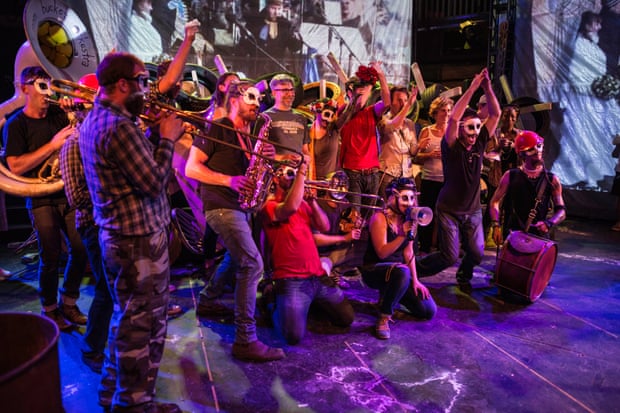
When the two returned from the Ukraine, they teamed up with Marczyk’s Lemon Bucket Orkestra to create Counting Sheep, an immersive “guerrilla folk opera”. A celebration of solidarity and the power of a collective voice, it also mourns those who died in the protests. Told from the perspective of the protesters, little is shared from the other side – but this rallying performance is fitting homage to not just the Ukrainian protesters, but those fighting government tyranny around the world.

Some audience sit around a huge table, whilst others sit on the sides of the space and still others up in a balcony. Klezmer or folk music is playing as the audience enters; there is a convivial atmosphere as the show formally starts. This is a party, or a wedding, or some other huge gathering, until the three screens display news reports of riots and police enter. The tone abruptly shifts, and the world that has been established is dismantled. It’s a wonderful, unsettling surprise.

The space is consistently reformed and redrawn using movement, and the audience is physically moved in the wake of the protesters’ gains and losses. They are willing and unquestioning, the sheep of the title. Though the numbers here obviously pale to those at the actual protest, incorporating the audience in acts such a building barricades and lobbing bricks at police fosters unity from disparate dozens. There is a hint of the solidarity and aggression found in protests, and joy and celebration from the audience who are keen to play. Being served food is also an important enabler that solidifies the unity the show aims to create.

Counting Sheep is hugely effective in its emotional manipulation, and also it’s storytelling through music, movement and projections. Choosing sheep as a metaphor is a curious choice, though. The benign but rather dumb livestock aren’t known for thinking for themselves and are susceptible to herding – otherwise, they wander around unproductively, getting lost and eaten by predators. Whilst the performers are the herders here, they are also in sheep masks, unempowered. Who then are the herders? The government? Unseen forces of political and social unrest? Whatever it is, us human beings are hugely susceptible to it when motivated enough, even if the metaphor isn’t totally clear.

Though sung completely in Ukrainian, there is a clear storyline conveyed through projections and movement. There is little nuance in this piece, but it a playground for the sweeping emotions of popular theatre. It provides at least a hint of the experience that the Ukrainian protesters endured, and powerfully unites the audience through the humanity of collective experience for a common goal. An excellent piece of theatre.

Counting Sheep runs through 29th August.

The Play’s the Thing UK is committed to covering fringe and progressive theatre in London and beyond. It is run entirely voluntarily and needs regular support to ensure its survival. For more information and to help The Play’s the Thing UK provide coverage of the theatre that needs reviews the most, visit its patreon.
Queen Lear, Edinburgh Festival Fringe

https://www.thestage.co.uk/wp-content/uploads/2016/08/Queen-Lear-700x455.jpg

What happened to King Lear’s wife? The woman who birthed the three daughters that he loves so dearly is never mentioned in his title play. Back in the ’80s, the Women’s Theatre Group and Elaine Feinstein created Lear’s Daughters, a flawed, feminist play attempting to reason why Goneril and Regan do what they do by depicting the girls’ upbringing. Their mother is present, but ill and rarely thought upon until her death at the hands of a sex-crazed maniac. Lear and his obsession with having a son cost her her life.

Ronnie Dorsey, perhaps inspired by this version that focused on the daughters rather than their mother, puts the young queen centre stage in Queen Lear. Also a feminist perspective, this script is reflective and revealing, but slow to develop and incorporates a disconnected subplot that results in an unlikely end.

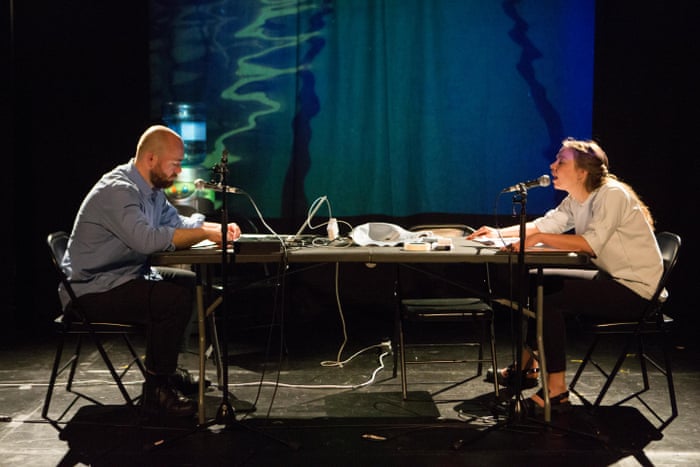
Alice Allemano is the young queen, heavily pregnant with her second child. Goneril and Regan are the daughters of his first wife, a good device that explains the sisters’ disconnect in Shakespeare’s play. Lear’s need for a son translates to her conviction that the child is a boy, but the pregnancy has not gone well. She is overdue, in constant pain, and begs her nurse and the Father overseeing her care to cut the baby from her body. Through her medicated delirium, she reveals her transition from blushing, wide-eyed bride at 16 to an abused incubator. Jane Goddard plays the nurse and Mary McCusker the priest; the trio of women have a warm, maternal chemistry and all are excellent performers.

Dorsey’s script, whilst an interesting premise, has some issues. The dialogue is overwritten and obstructions any natural tension that would arise from the situation. It also slows down narrative progression and often feels clumsy. The secondary plotline, though it has potential to develop into its own story, feels out of place and not fully integrated. The big reveal is barely acknowledged by the other characters, briefly discussed, then forgotten about in light of the queen’s health.

A thorough trimming would do the text a world of good and free up space for more action. The performances are strong and the examination of this forgotten character compelling, but one that could be executed more smoothly.

Queen Lear runs through 29th August.

The Play’s the Thing UK is committed to covering fringe and progressive theatre in London and beyond. It is run entirely voluntarily and needs regular support to ensure its survival. For more information and to help The Play’s the Thing UK provide coverage of the theatre that needs reviews the most, visit its patreon.

Troilus and Cressida, Edinburgh Festival Fringe

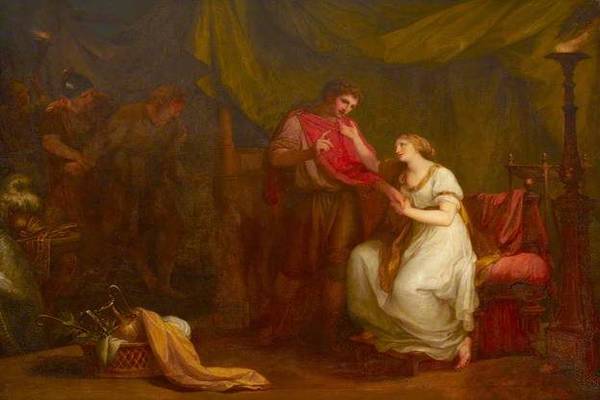
(c) National Trust, Petworth House; Supplied by The Public Catalogue Foundation

There is hardly any Shakespeare at the fringe that isn’t dramatically altered in some way or another. Re-contextualisations abound, as does new work that’s derivative from a story or character. West Country-based Shakespeare on the Level’s Troilus and Cressida is neither of these. It has no gimmicks and no determinedly modern concepts. It is merely the text staged in a clear fashion that serves Shakespeare’s stories, with few divergences. This is not an innovative production and has a few faults, but is remarkably refreshing in its lack of fringe-ness.

Some cross-gendered casting is a welcome choice to improve balance between men and women. There are only three women in the cast of twelve so parity is hardly achieved, but the women in the cast also have the chance to play male roles. Director Kate Littlewood also makes Achilles openly gay, choosing to wile away the days in his tent with his lover, Patroclus. This is a lovely choice that aligns the play with its Greek and Roman roots and doesn’t disrupt the story.

The performances are mixed, with Susie Kimnell’s Helen and Louis Bowen’s Troilus standing out as particularly strong. There are some weak verse speakers who break up the rhythm, others aren’t fully connected to the text and either shout it or approach it too casually.

Littlewood takes a flowing, eastern approach to her costume design, though the Romans and the Greeks are very similar in style. With the multi-rolling necessary to cover the twenty-three characters and varied acting ability, a stronger visual indication of which camp is which would be welcome. She sets Troy in the round, and skilfully uses the diagonals so the audience can always see, and fight director Tom Jordan’s choreography also suits the space.

The story is cut down to a manageable length, maintains clarity and has a clear design concept. Though not a particularly fringe approach to Shakespeare, this is a well-staged production with a cast of emerging talent.

Troilus and Cressida runs through 27th August.

The Play’s the Thing UK is committed to covering fringe and progressive theatre in London and beyond. It is run entirely voluntarily and needs regular support to ensure its survival. For more information and to help The Play’s the Thing UK provide coverage of the theatre that needs reviews the most, visit its patreon.