The Last Five Years, St James Theatre

https://www.thestage.co.uk/wp-content/uploads/2016/11/Samantha-Barks-as-Cathy-in-THE-LAST-FIVE-YEARS-at-St-James-Theatre.jpg

The most moving performances are often largely removed from our day-to-day lives. But every so often you come across a piece of theatre that, whilst it may not be the objective best thing you’ve seen, encapsulates your life so well that you can’t not fall in love with it.

The Last Five Years is good though, even if it’s been a favourite of mine since I discovered it as a student back in 2002. The Jason Robert Brown musical, now 15 years old, is a wonderfully simple (albeit heteronormative) tale of boy and girl meeting, falling in love and falling apart. Framed by the late 90s NYC arts world (that I watched as a teenager in the suburbs and later joined as a drama school student), his story is told in chronological order and hers in reverse. There are two performers; the only time they interact directly is at their wedding, making the songs function more like reflective monologues. Though there is hardly any book, Brown’s lyrics tell the story clearly and sensitively. Dynamic staging and committed performances, like those in this anniversary production that Brown directs, are necessary to keep this quirky little musical from falling flat. It’s a powerful, disarming show when executed effectively, and this production may well be its new definitive.

Jamie is a writer and Cathy is an actor. They are 23 when they meet; neither has had any success yet but both are wide-eyed, bushy tailed, and ready to fall in love. Jamie quickly becomes a bestselling novelist whilst Cathy is left in his wake, waitressing and doing summer theatre in the depths of the Midwest. It’s within this career disparity that their relationship deteriorates, and I find Cathy painfully echoes my own life as a failed actor. The isolation and jealousy that Brown fosters in his songs is wholly believable and all too familiar.

Both characters are flawed but generally likeable and despite reservoirs of love, it’s not enough to save their marriage. Though both characters can be irritating in their own way, their good intentions and fundamental incompatibility also ring true to anyone that’s endured the heartbreak of an ended relationship or marriage. Here is yet another parallel to my past, but this time I’m more like Jamie – I married young and naive and was divorced by 30 as a result of my own mistakes.

Samantha Barks and Jonathan Bailey are Cathy and Jamie. Barks is a stronger singer, but Bailey’s full of charisma and confidently flirts with the audience – it’s a lovely touch. Both have great emotional range and their chemistry is undeniable. Their performances, layered with Brown’s storytelling, reduces many to tears. Sniffling and eye wiping is plentiful in this intimate house.

The small scale of the show is fleshed out with some delightful video design by Jeff Sugg and Derek McLane’s set. These provide the context that’s missing from the script and grounds their story in a real time and place, though its Gabriella Slade’s costumes that indicate the 1990s setting. The videos are simple and cartoon-like, a sweet and charming addition that Brown underuses.

Though more of a song cycle with hardly any spoken dialogue (if you were to listen to the soundtrack you would hear almost the entire show) and arguably rather insubstantial, this one-act show has the ability to burrow into the depths of your guts. It’s a heartfelt love letter to the countless New York City artists doing their best to get by and find meaning in each other, and to everyone that’s every fallen in and out of love. The poignant, timeless story of youthful love and loss has the sorts of songs that you play on loop whilst crying in bed with a heart broken by your own failures (I’ve done this more than I care to admit), and those you can dance to after a brilliant first date or a career win. With the excellent performances and slick design of this production, it’s not one to miss – even if you cry through it.

The Last Five Years runs through 3 December.

The Play’s the Thing UK is committed to covering fringe and progressive theatre in London and beyond. It is run entirely voluntarily and needs regular support to ensure its survival. For more information and to help The Play’s the Thing UK provide coverage of the theatre that needs reviews the most, visit its patreon.

Howl, Rosemary Branch Theatre

https://i0.wp.com/egyptiantheatre.org/wp-content/uploads/2012/08/DSC96451.jpg

With Halloween becoming more and more popular this side of the pond, horror theatre and live events are proliferating. The London Horror Festival is bigger than ever, new scare attractions appear all over the country every year and independent events like Frissonic’s Howl expand the otherworldly and terrifying offers for thrill seekers this time of year. A site specific, immersive performance for an audience of six, Howl is a considered, effective performance that induces plenty of jumps. Though the story of a disappeared sister and mysterious voices is patchy, it is well delivered, and combines audience manipulation with technology to create a delightfully creepy event.

The choice of a small audience generates fear from the beginning – there is less protection with fewer people, particularly when paranormal investigator Rory places us on isolated chairs around a large, long-abandoned storage room. We are there to help Rory look into a something he heard when he was recently alone in the theatre, and we use sound to try evoke it again. Wireless headphones, increasing pace and anxiety, and customised audio content create heavy tension and uncertainly ripe for scares.

The ending in a different room is too rushed and betrayed by the lack of a full blackout. Though there is a clear resolution, the reasoning leading up to that point is never fully explained. How does this voice connect to Rory’s sister who disappeared all those years ago? How did we find him and decide we want to help? Rory is very much a character of the present, but frustratingly little of his past is revealed.

Frissonic nail the scares in Howl with their tech and small-audience approach, but adding flesh to the skeletal story will hugely improve it. Currently running at 40 minutes, another 15 or 20 minutes of text will make this feel more theatrical and less reliant on the scares.

Howl runs through 31 October.

The Play’s the Thing UK is committed to covering fringe and progressive theatre in London and beyond. It is run entirely voluntarily and needs regular support to ensure its survival. For more information and to help The Play’s the Thing UK provide coverage of the theatre that needs reviews the most, visit its patreon.

Songs For the End of the World, Battersea Arts Centre


https://i0.wp.com/www.domcoyote.com/wp-content/uploads/2015/12/millygraphic-2-e1469019899426.jpg

Jim Walters is the first person sent to colonise Mars. But when a global apocalypse occurs, trapping him in the Earth’s orbit and running out of oxygen, he and his guitar are left to broadcast music to the devastation below. Can anyone hear him? Are there any survivors? Will he ever know? Dom Coyote and his band the Bloodmoneys present a post-Brexit apocalypse in the gig-theatre Songs For the End of the World, a piece overly heavy on the ‘gig’ and reliant on a plot constructed of dystopian tropes. Though the story is thin, Dom Coyote’s songs are fantastically varied and plentiful, helping to gloss over any shortcomings in the script.

There’s rockabilly, 90s rock anthems, glam rock, and blues numbers with a touch of connecting story sprinkled in between. Set in Ashley Coombe, the village serves as a window into the attitudes of small, English towns of this dictatorial era – the elderly preacher woman who runs the place condemns foreigners, terrorists and space exploration whilst the rebels put on club nights in an underground bunker. The country is now called New Albion and rather than run by an individual, a corporation dictates all rules and procedures. These plot devices are predictable within a story of a dystopian future, but are simplistic enough to work within the gig-theatre format without needing much explanation. As these two tribes clash, Jim Walters is in space – a symbol of both human progress and arrogant dominion. It’s no surprise which side survives down on Earth, and that the future beyond the end of the show looks particularly bleak.

Though the story is overly familiar, the music is wonderfully varied. David Bowie’s promised influence is clear, but not limiting in style. All of the characters in this Little England kitsch/cold international corporation hybrid are suitably blown out of proportion, but feel eerily familiar in a fundamentalist-driven, isolationist Britain and a world where Donald Trump may become the next leader of its most powerful country. Staging is fairly static as per the usual gig-theatre approach, but there is some variation in movement and costume. The lighting design adds power and hope to the bleak, clinical setting.

A more substantial script and dynamic staging would lend more theatricality to the excellent set of tunes in of Songs For the End of the World; as is, it is overly driven by music and the narrative potential is neglected. That said, it would make a fantastic concept album, and the design is strong – an extra half hour of script would add polish to this fun, vibrant performance piece.

Songs For the End of the World is now closed.

The Play’s the Thing UK is committed to covering fringe and progressive theatre in London and beyond. It is run entirely voluntarily and needs regular support to ensure its survival. For more information and to help The Play’s the Thing UK provide coverage of the theatre that needs reviews the most, visit its patreon.
Kissing the Shotgun Goodnight, Ovalhouse

rsz_kissing_the_shotgun_goodnight_credit_the_other_richard

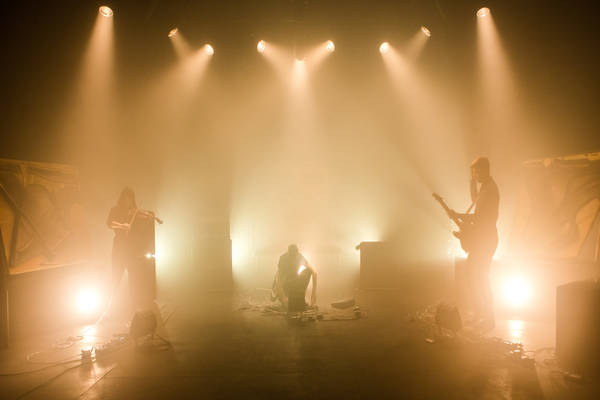
Along with tickets, we are handed earplugs. Considering Christopher Brett Bailey’s first work This Is How We Die, I’m not surprised. A brilliant, relentless barrage of contemporary American myth followed by an encore of noise and light, Bailey isn’t known for doing things by halves, or even singular wholes. The slight, constantly startled-looking Canadian with gravity defying hair attacks performance making with the energy of a supernova. Kissing the Shotgun Goodnight has the same verve, but is otherwise a rather different beast. Whilst This Is How We Die was dominated by language, Kissing the Shotgun Goodnight has very few words – but the earplugs are definitely needed. This anthemic music and light show fills the room with sound, colour and vibration but is the difficult second album to This Is How We Die. Much more of a gig than a piece of theatre, it lacks the satisfaction of characters and narrative, even a hint of one. Bailey’s mind blowing poetry teases with a few tiny fragments, but otherwise leaves us desperately gagging for more of his words.

Though given earplugs, there is the choice of whether or not to use them. Notices state that the sound level is consistently over 100 decibels and that, “if you wear plugs the whole time you might compromise enjoyment of the show. and if you don’t wear them at all you will take home whistling ear canals”. Being one of those people sensitive to loud noises who constantly asks my other half to turn down the telly, I want to play it safe but I don’t want to miss out. So I opt for one plug in, with the other ready. This choice no doubt effects the experience – if I leave them out the whole time and feel discomfort, would I like the show less? Or would I like it more because it’s not actually ‘that’ loud? I use the plugs in response to the volume level – sometimes I have both in, sometimes none. It’s an interesting premise to consider that the experience and quality of the show hinges on these earplugs, adding an additional level of individual, subjective response.

Bailey’s voice, slow and unseen, repeats, “this is a hell dream” in a brief textual introduction. Violinist Alicia Jane Turner uses loop pedals to sculpt a cinematic score reminiscent of mid-90s rock anthems. Her work is wonderfully angry, sweeping and alive. George Percy and Bailey are both on guitar, forming a silhouetted triptych with Bailey soon in the middle – amongst the monolithic speakers and flight cases forming a brutalist, urban landscape, he cuts the figure of a scrappy dystopian overlord. It suits him. If this is what hell is like, it’s fucking glorious.

Behind each performer is a wooden panel of about a metre square made of deconstructed pianos and their strings. These are visually impressive structures in and of themselves; their music evokes the violence and community of tribalism. Combined with excellent sound-responsive lighting (that malfunctioned to the point that the show needing to be stopped briefly), the overall effect is one of epic, soul shaking community.

The title paired with the music evokes the American paradox of a friendly but violent people who love their guns as much as their families. The music’s scale captures the expanse and variation of the North American landscape, and the few words he shares on the experience of waking up from a nightmare to find the world unchanged darkly foreshadow Trump’s America. Whether or not this is an intentional message, it is certainly a powerful one.

Kissing the Shotgun Goodnight is certainly wide open to interpretation and shows Bailey’s ambition and range as a performer of work designed to push the senses to their extremes. His textual dexterity is certainly missed (particularly by the coked up, flailing pair of young women sat next to me commenting on how disappointing this work is compared to his first) and comparatively this piece is somewhat disappointing, but it absolutely has its merits as a visceral, “fuck you/I love you” performance piece.

Kissing the Shotgun Goodnight tours nationally through November.

The Play’s the Thing UK is committed to covering fringe and progressive theatre in London and beyond. It is run entirely voluntarily and needs regular support to ensure its survival. For more information and to help The Play’s the Thing UK provide coverage of the theatre that needs reviews the most, visit its patreon.
Acorn, Courtyard Theatre

acorn-c-hannah-ellis-1

Persephone and Eurydice’s myths are defined by men. What happens when these men are removed and the characters plunged into a modern dreamscape? Maud Dromgoole’s Acorn brings these women and their fates together in a world of fragmented narratives and moments of biting wit, but the worlds that Dromgoole weaves together are so disconnected from each other in this cerebral play that it interferes with its immediacy.

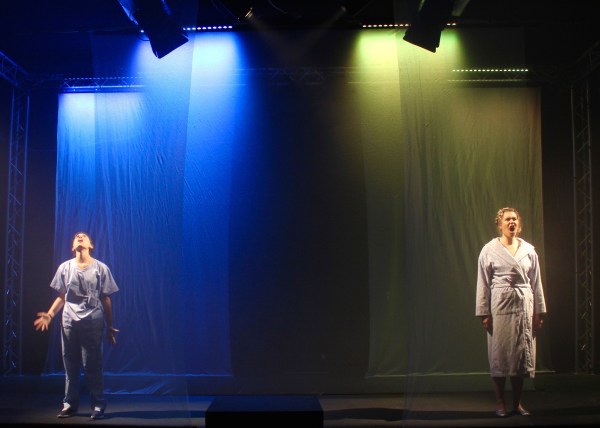
Rather than nurturing plants, this Persephone looks after people – she is a doctor, but one that struggles to connect with her patients. Her opening monologue justifying her disdain for patients’ personal lives is equally hilarious and disturbing, the best scene in the play. Deli Segal brings a simple humanity to this cold character, making her quirky and likeable despite an autistic-like inability to understand others. Lucy Pickles’ Eurydice is a sweet contrast, alternating between a blushing bride and mental health hospital patient. Pickles is no less of a performer, but Persephone has the more dynamic and well-written character.

Dromgoole employs a range of styles, arguably too many for an hour long script. Though this strengthens the ability to relate to the story within individual scenes, the overall effect is one of indecision. An unrelated, recorded dialogue between two men fills transitions unnecessarily and doesn’t link to the women’s stories, then overlapping speech cause dialogue to be missed.

Phil Lindley’s design is simple and precise, allowing for detail and layers to emerge through Jai Morjaria’s lighting and Tom Pearson’s underused projections. The design concepts are most excellently married and add polish to a script that feels under-developed.

Acorn certainly deserves to extending and refining – the characters are excellent, as are the foundations of the stories seen here. Dromgoole uses language well and is clearly confident experimenting with form, style and classical influence, but reinvention with the goal of creating a modern myth doesn’t quite reach the enduring scale of the original material.

Acorn runs through 29 October.

The Play’s the Thing UK is committed to covering fringe and progressive theatre in London and beyond. It is run entirely voluntarily and needs regular support to ensure its survival. For more information and to help The Play’s the Thing UK provide coverage of the theatre that needs reviews the most, visit its patreon.
Macbeth: without words, Edinburgh Festival Fringe

https://i0.wp.com/edinburghfestivalguide.co.uk/wp-content/uploads/2015/11/Macbeth-Without-Words-Ludens-Ensemble-Photo-by-Chrysa-Karagianni.jpg

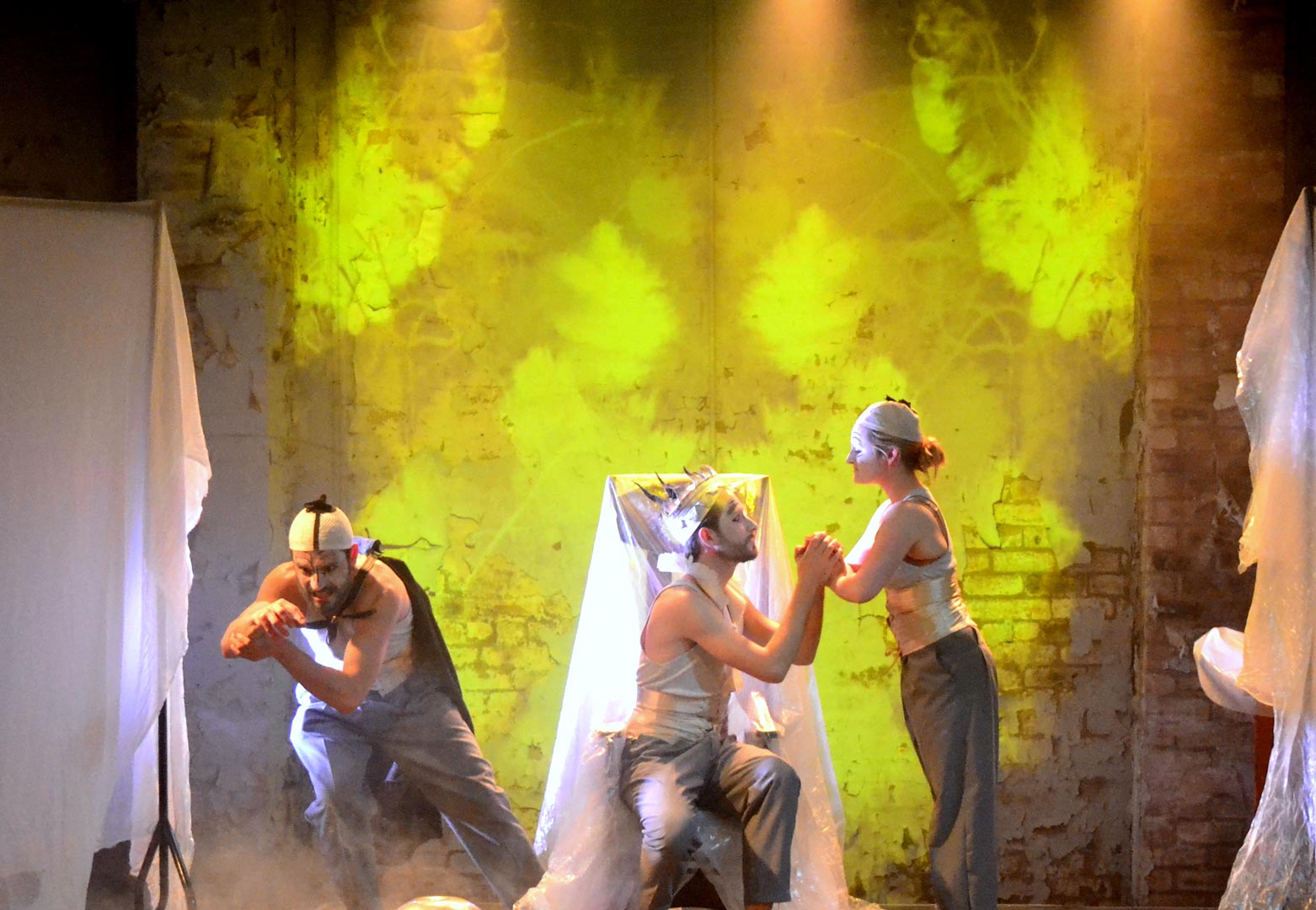
Shakespeare without words. What’s left? In Ludens Ensemble’s Macbeth: without words, plenty. Drawing on the aesthetic of silent films and Victorian gothic with the near-constant use of live sound mixing, a trio of performers playing all roles conveys the story effectively through movement and subtitles. This spooky adaption taps into the heavy darkness and supernatural elements of the story in an easy to follow and visually compelling production.

The design is the most striking element of the show. Greyscale, sexless costumes are the base for elements of victoriana – waspies, a skeletal skirt, capes and papery crowns. Large screens and dust sheets host an array of productions, from silent movie captions to abstract splodges of colour. Haze is used liberally, but it actually feels appropriate to this production to create fog over the heath. The dust sheets are also cleverly used to create ghostly apparitions and shadows, though these could be used more often as a design motif. Two microphones and prerecorded sounds are mixed live to create rich soundscape of suspense and violence, though silence is used to highlight powerful moments of suspense.

The two men and one women are strong physical performers evidently influenced by theatrical clowning and animal work. Their focus and intensity are unwavering, especially as Macbeth’s torment grows. Expressed outwardly, this becomes the centre of the story.

Though there are a few extracts of text, stage directions and summaries projected, Macbeth: without words would be hard to follow without knowing the story already. A freesheet with a plot summary would go a long way to ensure all audience members are catered for. Some of the scenes could use lengthening to reflect their importance to the story, particularly the banquet scene.

This is a visually stunning adaptation of Shakespeare’s play that in no way underserves the original by stripping away the text. Ludens Ensemble create a vocabulary of movement, images and sound that feels just as rich as Shakespeare’s.

Macbeth: without words runs through 29th August.

The Play’s the Thing UK is committed to covering fringe and progressive theatre in London and beyond. It is run entirely voluntarily and needs regular support to ensure its survival. For more information and to help The Play’s the Thing UK provide coverage of the theatre that needs reviews the most, visit its patreon.
Scorched, Edinburgh Festival Fringe

rsz_cn0idouxgaazjdi

Jack, feeble in body and mind, wiles away the days watching news broadcasts from operation Desert Storm. The former WWII soldier, now safe and looked after in a care home, vividly recounts memories from his youth and on the front line. He may not be aware of the present, but his past is ever present and will not let me rest. Solo show Scorched is a moving and honest look at veterans’ experiences of combat and ageing, leaving the troubling feeling that society is not fulfilling its responsibility to this vulnerable demographic.

Lisle Turner’s script, inspired by her grandfather’s life, is an expressionistic snapshot of his thoughts at the twilight of his life. Stationed in Egypt during the war, we hear tales of heat, explosions, and beautiful women interspersed with memories from his childhood. The storyline is loosely constructed; it is episodic rather than wholly linear. This structure works well considering that these are Jack’s memories he plays out for himself rather than for an audience arbitrarily included in the action without being allocated any clear identity.

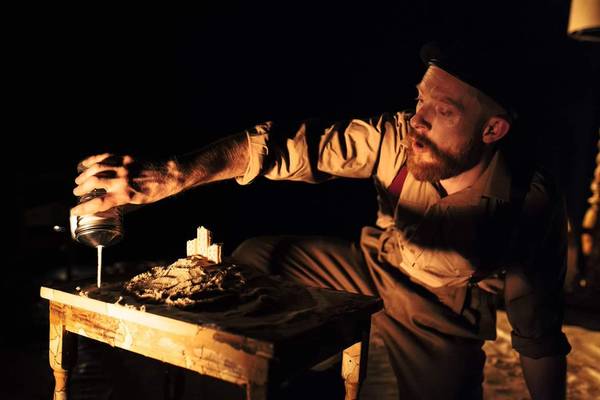
There are some beautiful design elements: Jack remembers tattooing himself and this is projected on his arm rather than shown with makeup. To see something normally considered permanent conveyed through an ephemeral form is a fitting reminder that nothing truly lasts forever and Jack is nearly at the end of his life. The loveliest of other whimsical projections is on a cascade of sand poured from a dinner tray. This sand is everywhere, like the memories that cling onto Jack’s deteriorating mind and are constantly discovered in unsuspecting places – a clever device either by Turner or director Claire Coache. A simple puppet is used well but not enough, as are mundane objects that transform into others more exciting – an umbrella becomes a fishing rod, a footstool is a motorbike. This object manipulation is a lovely surprise and suits Jack’s mental state well, so it could be utilised further to comment on the childhood of old age.

Robin Berry plays Jack with power and pathos, initially with a delicate frailty that gives way to a younger, more powerful man who enjoys boxing, horse riding, dancing and defending his country. Berry has a strong physical presence that is eminently watchable and a range that makes him believe both as the older and younger Jack.

Strengthening and streamlining the staging and theatrical devices will help make the script feel less like a random collection of memories, and reordering some of scenes would also have the same effect. Jack is a fantastic character and the play is a fitting tribute to elderly veterans, though also serves to pay homage to a generation that soon will no longer be with us.

Scorched runs through 29th August.

The Play’s the Thing UK is committed to covering fringe and progressive theatre in London and beyond. It is run entirely voluntarily and needs regular support to ensure its survival. For more information and to help The Play’s the Thing UK provide coverage of the theatre that needs reviews the most, visit its patreon.
A Tale of Two Cities: Blood for Blood, Edinburgh Festival Fringe

rsz_two_cities

A Tale of Two Cities: Blood for Blood is a rather different beast from Charles Dickens’ A Tale of Two Cities. This choppy, convoluted adaptation lacks the detail and finesse of the novel, though adds a lingering threat and gloom that hangs over this story of revenge and espionage that spans two countries. Though not specifically modernised, the set alludes to greater powers and constant obstacles, but dominates the production and interferes with the action. The script is initially confusing and takes time to settle, but the lost opportunity to capture attention from the start causes the production to never really find its feet.

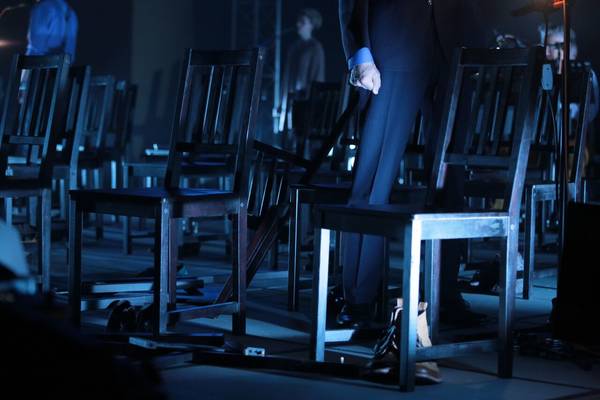
The set is a baffling assemblage of chairs, with a sound desk commanding attention centre stage. There are a lot of chairs; the stage is literally filled with rows of them reminiscent of a large school room, with enough space in between for one person to cautiously pass. This slows movement to a sleepy pace that clashes with the story’s tension, and after the initial visual impact, they are largely unchanging.

Performances are of a good standard across the board with some excellent multi-rolling. The actors do well to keep a high level of vocal energy despite physical limitations caused by the chairs. The selective use of microphones adds distance and authority, though their inconsistent use is more of a muddled hindrance to the performers and themes in the story.

The story naturally has conflict that helps keep it going, but initial exposition doesn’t lay enough groundwork to create solidly increasing tension. With the reliance on text needed to compensate for the staging, its patchiness makes clashes between characters feel sudden and forced.

A Tale of Two Cities: Blood for Blood certainly has some interesting seeds of ideas, but the script needs smoothing and design needs to be re-thought so it helps the action rather than hinders it.

A Tale of Two Cities: Blood for Blood runs through 28th August.

The Play’s the Thing UK is committed to covering fringe and progressive theatre in London and beyond. It is run entirely voluntarily and needs regular support to ensure its survival. For more information and to help The Play’s the Thing UK provide coverage of the theatre that needs reviews the most, visit its patreon.

Mumburger, The Archivist’s Gallery

https://i0.wp.com/livetheatreuk.co.uk/wp-content/uploads/2016/07/image-33.jpeg

Tiffany’s mum just died. Hugh’s wife just died. Together, this father and grown daughter that barely know each other anymore need to arrange a funeral. In the midst of their nonfunctional, chalk and cheese miscommunications, a mysterious delivery of uncooked burger patties arrives on the doorstep of their vegan home. The note on the bag makes them question everything they know about grief, each other and dietary choices.

Sarah Kosar’s Mumburger frames grief within an impossibly absurd scenario but rather than exploiting the potential for comedy, Kosar uses it to bring Tiff and Hugh closer and support their journey through grief and Hugh’s reluctance to let his daughter grow up. Though the episodic structure diffuses the day-to-day struggles, the structure snapshots moments of high tension incredibly well. Good performances support the script’s father/daughter tension that’s as much about a parent learning to let a child go as it is about losing a loved one.

Rosie Wyatt plays Tiffany as a gregarious go-getter with little patience for her non-communicative father (Lindon Alexander). Wearing her heart on her sleeve, her turmoil is completely and believably transparent and an excellent contrast to Alexander’s typically masculine introversion. They both have excellent emotional climaxes endowed with truth and keenly felt by those all too familiar with losing a loved one. Hugh is arguably underwritten for much of the play, though Alexander’s fantastically executed and intimate moment with the tiny slab of his wife’s remains is one the best recent moments on a fringe theatre stage.

Kosar’s script focuses more on the characters and their interactions, but just the right amount of external influence drives the action forward. Some moments feel too brief and the amount of time passing from scene to scene isn’t always clear, but the narrative arc is otherwise strong. The contentious burgers, as disturbing as they are, manage to not tip the entire play into absurdity – great work on the part of Kosar and director Tommo Fowler.

Ruta Irbite’s minimalist design is at odds with the naturalistic dialogue and considering the action solely takes place in one location, comes across as oddly sparse. A chest freezer in the middle of a bare, white stage and a few plain curtains on the back wall keep the budget low, but conflict with the text. Occasional bursts of projected video montages make more sense to the characters’ emotional states, but the lack of domestic furnishings is jarringly surreal.

Kosar’s script is without a doubt a good one, and the performances helped to emphasise its conflict. With clearer staging and transitions this promising one-act could really shine.

Mumburger runs through 24 July.

The Play’s the Thing UK is committed to covering fringe and progressive theatre in London and beyond. It is run entirely voluntarily and needs regular support to ensure its survival. For more information and to help The Play’s the Thing UK provide coverage of the theatre that needs reviews the most, visit its patreon.

Human Animals, Royal Court

https://i0.wp.com/www.officiallondontheatre.co.uk/servlet/file/store5/item365300/version1/fileservice770/365300_770_preview.jpg

I adore animals, certainly more than I like humans, and I think I missed my calling to be a zookeeper or conservationist. I can’t bear any depiction of animals being harmed on stage or film; even mentions of animal abuse is hugely upsetting. So, I found Stef Smith’s Human Animals a pretty horrible ordeal. Smith’s frantic, apocalyptic story captures society’s instinctive, “Must. Destroy. Everything.” response to the natural world threatening contemporary human sovereignty. As the government wreaks havoc on the natural world in the name of security, half a dozen civilians have a range of reactions to the animal population’s invasion of their homes. This visceral, destabilising drama blasts the audience with 75 minutes of shocking, reactive action as the infection spreads across species, but with the fast pace and constant suspense, it’s difficult to relate to any of the characters. Canny design avoids much mess and graphic depictions of the described carnage, but the narrated horror is all too easy enough to imagine from most modern nations, and his highly disturbing on several levels.

Lisa (Lisa McGrills) and Jamie (Ashley Zhangazha) are a young couple supposedly very much in love, though lacking chemistry. Lisa doesn’t like animals much, so isn’t fazed when the government starts killing off the wild ones who are trying to invade people’s homes. She’s had enough of birds smashing into her windows and either dying or injuring themselves. Jamie can’t handle the ruthless killing; his collapse is well written and convincingly performed. Lisa’s boss Si (Sargon Yelda) is one of “them”, a vile, slimy little man profiting from the disaster. Young activist Alex (Natalie Dew) has just returned from travelling abroad, but mum Nancy (Stella Gonet) still tries to treat her as a child. There’s a lot of gorgeous intimacy and tension between them, often diffused by their genial family friend John (Ian Gelder), who clashes with Si regularly in the local boozer. Otherwise, there is little contact between these conflicting personalities, but the reactions from each character to the growing destruction are heartfelt and saddening.

Smith’s best writing is her conflict scenes between the characters. The rest certainly isn’t bad at all, but the storyline requires either depicting the violent extermination of animals or copious narration. Her choice is understandable and, though well incorporated into natural dialogue, there’s a lot of describing. The design team (Camilla Clarke, Lizzie Powell and Mark Melville) work with director Hamish Pirie to break up the text effectively, with sound, lighting, projection and jets of paint constantly interrupting and surprising/startling the audience. Being constantly kept on edge for over an hour is exhausting, with the story causing additional trauma. As horrible as it is, the whole effect is intricately constructed and totes a powerful message.

Also of note is the set design. The cast and audience are inside a zoo-style animal enclosure, disempowering the characters and trivialising their problems because the outside world is dominant and ever watching. Though the set does not literally indicate the characters’ world and gives no hints of the government-ordered extermination and arson that they describe, its tranquillity is calmly sinister.

The production elements and dialogue are excellent, through the relentlessness of Human Animals can alienate – but that’s the point. It’s terrible, clever commentary on contemporary environmentalism, fear of social disorder and individuals’ reactions to what is effectively a civil war and its strong effect will be long remembered by this animal lover.

Human Animals runs through 18 June.

The Play’s the Thing UK is committed to covering fringe and progressive theatre in London and beyond. It is run entirely voluntarily and needs regular support to ensure its survival. For more information and to help The Play’s the Thing UK provide coverage of the theatre that needs reviews the most, visit its patreon.