Hamlet in Bed, Edinburgh Festival Fringe

https://i0.wp.com/www.rattlestick.org/wp-content/uploads/2015/09/hib-2.jpg

Michael, a typical New York City lost soul, is obsessed with Hamlet. He knows the play inside out and pours over every bit of scholarship he can find on it. His neighbourhood secondhand bookseller puts anything aside that he might be interested in and this time, he’s struck gold. A diary from forgotten ex-actor Anna May Miller details her rehearsals for Hamlet, a failed relationship and a child she put up for adoption on the day Michael was born. The orphaned man, desperate for a mother and to enact his perfect version of Hamlet, creates an elaborate scheme to cover both bases in Hamlet in Bed.

What is more of a treatise on Shakespeare’s play than a journey of personal discovery is also a creepy, misogynistic story of stalking and entitlement. The two interweaving storylines are given equal measure by writer Michael Laurence, resulting in neither reaching full potential, though Annette O’Toole gives an electric performance as Anna May.

The imagery-laden beginning of the script is a feast for the ears. Though the start makes for a great aural experience, the best scene is an extended rehearsal for Michael’s Hamlet where a debate on the characters’ intentions becomes a thinly veiled filter for their own issues and insecurities. Also, the scholarship on display in this scene is in-depth and spot-on. An anti-climactic end is a lost opportunity for Anna May to condemn his self-centred exploitation of her weaknesses, which creates an uneasy feeling that his actions are deemed acceptable. There are also entirely too many coincidences to make the story believable, and a few occasions where choices aren’t fully explained or justified.

Though the story revolves around Michael, played by Laurence, O’Toole’s performance completely dominates his. It’s not at all to do with any shortcomings on his part, but a total mastery of craft on hers. The privilege of seeing a stage and screen legend in an intimate venue at least partially alleviates the problems in the script.

With questionable themes and a script that can’t decide what it wants to be about, Hamlet in Bed has several glaring flaws that a re-write would be able to solve. Despite these, O’Toole’s performance is fantastic, and great to watch.

Hamlet in Bed runs through 29th August.

The Play’s the Thing UK is committed to covering fringe and progressive theatre in London and beyond. It is run entirely voluntarily and needs regular support to ensure its survival. For more information and to help The Play’s the Thing UK provide coverage of the theatre that needs reviews the most, visit its patreon.
Scorched, Edinburgh Festival Fringe

rsz_cn0idouxgaazjdi

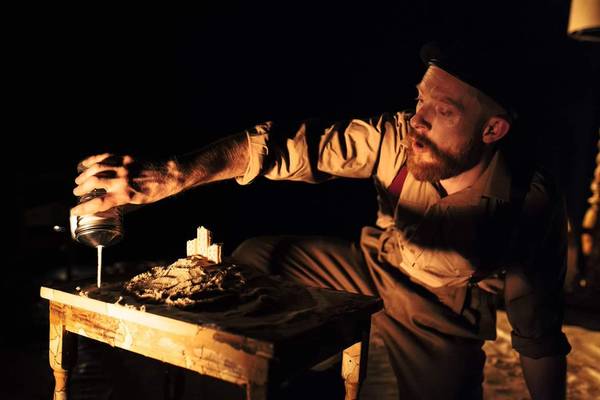
Jack, feeble in body and mind, wiles away the days watching news broadcasts from operation Desert Storm. The former WWII soldier, now safe and looked after in a care home, vividly recounts memories from his youth and on the front line. He may not be aware of the present, but his past is ever present and will not let me rest. Solo show Scorched is a moving and honest look at veterans’ experiences of combat and ageing, leaving the troubling feeling that society is not fulfilling its responsibility to this vulnerable demographic.

Lisle Turner’s script, inspired by her grandfather’s life, is an expressionistic snapshot of his thoughts at the twilight of his life. Stationed in Egypt during the war, we hear tales of heat, explosions, and beautiful women interspersed with memories from his childhood. The storyline is loosely constructed; it is episodic rather than wholly linear. This structure works well considering that these are Jack’s memories he plays out for himself rather than for an audience arbitrarily included in the action without being allocated any clear identity.

There are some beautiful design elements: Jack remembers tattooing himself and this is projected on his arm rather than shown with makeup. To see something normally considered permanent conveyed through an ephemeral form is a fitting reminder that nothing truly lasts forever and Jack is nearly at the end of his life. The loveliest of other whimsical projections is on a cascade of sand poured from a dinner tray. This sand is everywhere, like the memories that cling onto Jack’s deteriorating mind and are constantly discovered in unsuspecting places – a clever device either by Turner or director Claire Coache. A simple puppet is used well but not enough, as are mundane objects that transform into others more exciting – an umbrella becomes a fishing rod, a footstool is a motorbike. This object manipulation is a lovely surprise and suits Jack’s mental state well, so it could be utilised further to comment on the childhood of old age.

Robin Berry plays Jack with power and pathos, initially with a delicate frailty that gives way to a younger, more powerful man who enjoys boxing, horse riding, dancing and defending his country. Berry has a strong physical presence that is eminently watchable and a range that makes him believe both as the older and younger Jack.

Strengthening and streamlining the staging and theatrical devices will help make the script feel less like a random collection of memories, and reordering some of scenes would also have the same effect. Jack is a fantastic character and the play is a fitting tribute to elderly veterans, though also serves to pay homage to a generation that soon will no longer be with us.

Scorched runs through 29th August.

The Play’s the Thing UK is committed to covering fringe and progressive theatre in London and beyond. It is run entirely voluntarily and needs regular support to ensure its survival. For more information and to help The Play’s the Thing UK provide coverage of the theatre that needs reviews the most, visit its patreon.

Lucy McCormick: Triple Threat, Edinburgh Festival Fringe

https://files.list.co.uk/images/2016/08/05/lucy-mccormick-triple-threat-750-500-lst214192.jpg

A cultural relic of its time, the bible is hardly pro-women. Lucy McCormick, here incarnated as one of those vapid pop stars who evangelically (and often inappropriately) rallies for the cause they’re currently backing, wants to turn the spotlight on the new testament’s women. She focuses on their underwritten stories, their emotional involvement in Jesus’ life, and all the fingering and angel snogging that was left out of the text we know so well in Western culture.

Trashy, tasteless, obscene, and absolutely excellent, McCormick’s newest show pushes theatre to to limits of acceptability and beyond – any further and it would be pornographic (arguably it already is), though Lucy McCormick: Triple Threat is still not one for those easily offended. Accompanied by two muscly dancers in Calvins, her three-act play that she dutifully explains scene by scene is the story of Jesus Christ. She plays Mary Magdalene, Jesus’ mother Mary, and Jesus himself, with her backing dancers in the supporting roles. It’s also very funny, though laughter swells from amusement as much as it does from discomfort.

This gig-theatre piece is interspersed with appropriate pop songs at key moments of the story, accompanied by excellent dancing and raw emotional outbursts. Her personal life bleeds into the act as she slowly falls apart in the wake of the pressures of celebrity life. Take all of those public celeb breakdowns and multiply them by hundreds with a lot more nudity and mess, and you get something resembling the whirlwind of in-yer-face chaos that is Lucy’s stage persona in this piece.

Her commitment to her cause is unquestionable, but the fact that her character finds the actions that unfold acceptable is disturbing, yet all too familiar. That we can watch someone fall to bits with no dignity and laugh at their plight, righteously judging them, is a powerful comment on the levels of voyeurism and exhibitionism that are now bombard us through all of media’s incarnations.

Lucy McCormick: Triple Threat, for all its deliberate mess and audience discomfort, is a fantastically considered social commentary executed with precision and high levels of consideration and skill. It’s the epitome of fringe shows, and a great one at that.

Lucy McCormick: Triple Threat runs through 28th August.

The Play’s the Thing UK is committed to covering fringe and progressive theatre in London and beyond. It is run entirely voluntarily and needs regular support to ensure its survival. For more information and to help The Play’s the Thing UK provide coverage of the theatre that needs reviews the most, visit its patreon.

Adler & Gibb, Edinburgh Festival Fringe

https://www.thestage.co.uk/wp-content/uploads/2016/08/Adler-and-Gibb-GIna-Moxley-credit-Richard-Lakos-700x455.jpg

I was gutted when I found out Janet Adler and Margaret Gibb aren’t real. The portrait Tim Crouch paints of this fictional couple and their anti-capitalist approach to their art, in striking contrast to a deranged Method actor and her coach making a film about Adler’s life, is so well-formed that they feel that that they can’t not be real. Even though the reality of these characters is so detailed through their dialogue, Crouch’s staging and choreography is wholly unrealistic and often absurd, a work of art in itself. This rigid stylisation, though eventually giving way, rebels against convention just as the characters do. These two sets of characters and the staging battle for dominance in a wonderfully compelling and disturbing commentary on the ownership, commodification and nature of art and its creators.

A nameless student begins with a lecture, and intersperses scenes with a discourse on Janet Adler’s life and work, shaping and contextualising the woman that actor Louise discusses with zealous devotion. Despite these strong feelings, Louise is unmoving, staring straight ahead. Her teacher Sam is the same; though their voices have some emotion, their bodies are rigid as they stare through they audience. Adler’s widow, Margaret, assumes the same style when she first appears. A boy moves any necessary props, wearing wireless headphones with instructions whispered to him by a woman sitting upstage with a microphone. Some of the props are appropriate to the action, some totally absurd. The boy’s innocence and movement is powerfully accentuated amongst the stillness; though he is a child, he has control of all physical action rather than the adults. The sculptural staging with juxtaposed power becomes a thoughtful commentary on art’s relationship with its audience, something Adler may have approved of.

Though the performances aren’t wooden in the least, the distance they maintain through roughly half of the play is frustrating, albeit canny. It works as a concept within a play about art and the detailed characters are built through dialogue, but the initial lack of connection between them leaves a gaping void.

Cath Whitefield endows Louise with a fanatical “I will stop at nothing” attitude that’s both satisfying to look down on and be disturbed by. Her and Sam’s visit to the house where Adler and Gibb last lived and their subsequent choices are a potent critique of the Method acting technique, as well as any other justification of awful behaviour for the sake of making art. Her character’s abrasiveness effectively generates empathy for Adler’s widow Margaret, ferociously played by Gina Moxley, who also shows moving tenderness when faced with the memories of her partner.

The richness of the characters and the feeling that they live beyond this play is the strength of Crouch’s writing, but the messages contained therein are important to consider. Who does art belong to once it’s in front of an audience? Where are the boundaries of an homage to the dead? Who do any resulting accolades belong to? It’s certainly thought-provoking stuff to consider the lineage of the cultural products we consume. Despite all the good intentions in the world, what damage may have been caused in the research and making of that book/film/play/artwork/song that we consume so casually?

Adler & Gibb runs through 27th August.

The Play’s the Thing UK is committed to covering fringe and progressive theatre in London and beyond. It is run entirely voluntarily and needs regular support to ensure its survival. For more information and to help The Play’s the Thing UK provide coverage of the theatre that needs reviews the most, visit its patreon.

Missing the Mark: Three Shakespeare Appropriations, Edinburgh Festival Fringe

https://i0.wp.com/cdn.spectator.co.uk/content/uploads/2015/12/iStock_000023304291_Small1.jpg

As great as it is to see Shakespeare inspiring contemporary theatre makers to create derivative work, like any new writing it has the chance of missing the mark by a long shot. Annika Nyman’s Romeo and Juliet Post Scriptum poses the question, “What happens and Romeo and Juliet don’t die?” and the answer isn’t pretty, nor well thought out or well-written. Z Theatre Company’s The Female Question gives us Shakespeare and his female alter-ego bickering over whether or not they shortchanged his female characters, from whom we hear a lot of moaning. MacBain, part of Summerhall’s Big In Belgium season, retells Macbeth through a hybrid of drug-addled Kurt Cobain and Courtney Love and Shakespeare’s text, giving us MacBain.

Romeo and Juliet Post Scriptum is such a lovely premise, but the route Nyman takes is inexplicably far from the characters Shakespeare created. Romeo is the main issue here. Nyman presents him as an indecisive coward who now regrets the whole “feigning death and running away” idea. Deciding that family is more important than love, he wants to go home and make up with his dad. Juliet, unimpressed by this, tries to convince him to stick to the plan and when he is unconvinced, they argue for pretty much the rest of the play. They speak in stilted English that isn’t Elizabethan, but it’s certainly not modern either, preventing the actors from connecting their text. The characters partly make up, then they argue again. Wash. Rinse. Repeat. The rushed ending is disconnected from the all the fighting leading up to the moment, making the overarching effect one of pettiness that doesn’t relate to Shakespeare’s characters and no clear message about their actions.

It’s 400 years since Shakespeare died, and he and his female alter ego meet for their annual discussion in his office. She’s trying to convince him of their legacy, but he doesn’t believe her. Hamlet has been bugging him lately, and he’s feeling like he didn’t do his female characters any justice, hence The Female Question. He talk to the skull on his desk, texts on his phone and has a desk covered in books about himself and papers. Quite what is occupying his time since his death is never revealed, neither is how he got a mobile phone, why there are two of him and why Hamlet keeps giving him grief. Some of his characters come in for a chat, but the through-line (that was never really made clear to begin with) only tenuously connects these characters to Shakespeare’s inner dilemma. This could likely be due the fact that there are two of the same dead person and the rest of the characters aren’t real. Whilst the idea to give Shakespeare’s women another crack at the spotlight is admirable, the execution is muddy, badly performed and has no solid resolution or narrative structure.

MacBain has the most promise due to it’s Summerhall location, but this one-trick pony also disappointed. Despite excellently imposing lighting and sound design, the performances of Kurt and Courtney off their heads playing at talk show interviews that randomly morph into a two-person Macbeth with children’s toys is almost completely pointless. There is no commentary on the Macbeths’ power dynamic, sexuality or guilt. The only thing of any interest is the introduction of “the babe that milks me,” a son that eventually committed suicide. Otherwise, the banter between Kurt and Courtney, a powerful, mythic couple in their own right, comes across as self-indulgent stoners. Watching MacBain is like being the only sober person at a party where everyone else is off their nut, having a great time making in-jokes and reminiscing, only truly coherent to each other. When they are finally pinned and silenced beneath a descending sheet of plexiglass covered in vibrating cutlery, it is sweet relief.

In three unrelated productions that have premises with potential to offer fresh insight into Shakespeare and his work, the lack of dramaturgy and clear concept is painfully apparent. None of them managed to have any meaningful follow-through and most ended with an unspoken question hanging in the air – “what was the point of that?”

The Play’s the Thing UK is committed to covering fringe and progressive theatre in London and beyond. It is run entirely voluntarily and needs regular support to ensure its survival. For more information and to help The Play’s the Thing UK provide coverage of the theatre that needs reviews the most, visit its patreon.

A Midsummer Night’s Dreaming, Edinburgh Festival Fringe

https://i0.wp.com/www.pci.leeds.ac.uk/files/2016/08/MJ42723_news.jpg

Tang Xianu and Shakespeare were writing about similar themes at the same time, on opposite sides of the world but never met. Teaming up to create a cross cultural performance, Leeds University and International Business and Economics University (UIBE) in China each took a play from each other’s culture and created a new play inspired by the foreign text. Inspired by the Chinese legend of Sophora, a spirit of the woods associated with visions and dreams, UIBE chose A Midsummer Night’s Dream. Adding multiple levels of reinterpretation, they swap the lovers’ genders and who fancies who in order to comment on gender roles in China and the pressures young people face. Performed in English, the students struggle to connect to the emotion behind the words but their adaptation is a complex and clever commentary on relationships and social expectations.

The Sophora Nest Hotel, run by three nameless staff members with otherworldly powers, is an escape from university studies for glamorous young couple Lysander and Hermia. They are followed by their friend Helena, who’s in love with Lysander, and Helena brings along Demetrius, the geeky, shy boy who will do anything for her. Helena is blind to his love, and instead uses him more as servant than a friend. Mostly in contemporary language, the lovers’ plot thread from the original unfolds but rather than the boys being drugged, its the girls, who then both fall in love with Demetrius. Lysander, who orders Hermia around to no end, needs to learn to not take advantage of her. Helena needs to do the same with her devoted sidekick.

All the chopping and changing from the original is wonderfully refreshing, and effectively communicates our need to open our eyes to those right in front of us rather than focusing on our own wants. Other themes emerge as well, particularly the pressure on women that results from being under their father’s thumb, then their husband’s. All four characters also have the drive to be the sexiest, cleverest and have the fanciest gadgets. Though China is so far away, it’s both comforting and disconcerting that young people feel this the world over.

The three hotel staff add a lovely dynamic. One is purely logical and analyses the hotel guests’ behaviour. A second wants to play tricks, and the third tries to maintain harmony between the first two. The emphasis on balance between this trio and the lovers feels distinctly eastern, and one worth worth considering in the west.

Though still maintaining an amount of student-level execution, the insight these Chinese young people provide through their script is provocative, relevant and culturally eye-opening.

A Midsummer Night’s Dreaming runs through 13th August.

The Play’s the Thing UK is committed to covering fringe and progressive theatre in London and beyond. It is run entirely voluntarily and needs regular support to ensure its survival. For more information and to help The Play’s the Thing UK provide coverage of the theatre that needs reviews the most, visit its patreon.

Swansong and Road to Huntsville, Edinburgh Festival Fringe

https://files.list.co.uk/images/2016/08/10/road-to-huntsville-lst207084.jpg

Though climate change has long been a problem, political theatre often ignores it. DugOut’s Swansong faces the issue head on, placing four survivors of a global flood in a swan pedalo. A capella songs and situation comedy bring plenty of joy and laughter to the boat, but the enormity of their survival and uncertain future weighs heavy. Will they find land, or will they kill each other first?

Like the start of a joke, hippy vegan Bobby, posh boy Steven, gym bunny Claire and nihilist Adam are on a boat, and have been for at least a little while now. They’ve already worked out exactly how to wind each other up, which generates the comedy that keeps Sadie Spencer and Tom Black’s script from becoming too heavy. The lightness contrasting the serious of their post-apocalyptic waterworld tips more towards comedy, but the balance mostly works. As they make plans for rebuilding the world to the vision they are creating from scratch in Bobby’s journal (obviously with plenty of arguments), there’s a natural progression towards eventuality – will they find land and survive, or will they all die on the pedalo?

The characters are rather stereotypical for the sake of comedy; despite this there are some poignant moments of understanding and empathy. They are effectively performed but somewhat lacking in depth, though sung interludes between scenes and the resolution help negate this unsatisfaction.

This spirited production is a relief from more sombre approaches to political issues, and a good laugh at that despite its shortcomings. Road to Huntsville is an entirely different beast, though the topic is just as infrequent on British stages. Theatre maker Stephanie Ridings stumbles across a documentary about women who fall in love with prisoners on America’s death rows. Thinking this could be the start of a new play, she latches onto the subject and delves into a world that she doesn’t understand, but doesn’t want to judge. As her research leads her further down the rabbit hole, she emerges in the “death penality capital” of the country, Huntsville, Texas.

Road to Huntsville shares Ridings’ process and turns it into a story of itself. More of a documentary, there are no preconceptions – we are in a theatre to hear about her findings. The curious but emotionally detached beginning takes its time to cave into emotional connection with the people she meets who are at the mercy of a state sanctioned killing machine. This show is a slow burner, but by the end, her passion and rage against the death penalty rally the audience to her side. Her frustrated helplessness hangs heavily in the air as she tries to return to normal life, then she does the same to us, sending us out into the busy joy of Summerhall. Though it makes for melancholy, lingering reflection, Ridings’ reminder that not everyone has the privilege of living in a country where the government won’t kill you if you commit a crime.

Swansong runs through 29th August, Road to Huntsville runs through 28th August.

The Play’s the Thing UK is committed to covering fringe and progressive theatre in London and beyond. It is run entirely voluntarily and needs regular support to ensure its survival. For more information and to help The Play’s the Thing UK provide coverage of the theatre that needs reviews the most, visit its patreon.

“Just let the wind untie my perfumed hair…” or, Who Is Tahirih?, Edinburgh Festival Fringe

https://i0.wp.com/www.ridikulmagazin.hu/cuccok/storages/thumbnails/2014-06-06/153cc8eec7af4dc9e7fe3737d2192f41/680x0.jpg

A woman sings behind a gauzy white curtain. We cannot see her face, but in her soaring cries we hear her passion. This is Tahirih, born in what is now Iran in the early 1800’s (we don’t know her exact date of birth because authorities burned these documents after her execution). She is a poet, theologist and women’s rights activist, and she has enough followers that the country views her as a national threat to the patriarchal Islam that requires women to be veiled in public.

In the days leading up to her execution, Delia Olam plays people from Tahirih’s life, unfolding her biography, teachings and radical actions. These we see plainly, but Tahirih is always behind the curtain, playing and singing. As the revered and reviled woman is sculpted through the accounts of others whilst her face remains hidden, she becomes mythical and hugely powerful, a revolutionary who’s life is tragically cut short.

Olam’s script and performance meld into a fluid solo performance that is a fitting tribute to such a remarkable woman. Her physical and vocal distinction between the handful of characters she plays is detailed and precise. A servant, Tahirih’s father, an executioner, and a female follower are crafted in detail, and all visited by the audience who go to these people to discover more about this woman who is revolutionary, dangerous, or both. This is excellent clarification of the audience/character relationship in solo performance format – it makes sense with the play’s circumstances and embeds the audience in the action. There is none of the talking out into undefined space or invisible characters that alienates the audience and removes the character from reality, something that often occurs in solo performance. Across these characters in different places and with different relationships to Tahirih, there is still a clear, well-proportioned narrative arc building to an awful end.

The scenes themselves are well-crafted and provide a snapshot of the landscape of attitudes towards women in Iran at the time. They are simply staged and prettily enhanced with candlelight, their simple, calming beauty juxtaposes the inevitable prospect of her death. Transitions are a touch slow; some are smoothed with recorded music whereas others have silent gaps as Olam transforms in and out of Tahirih, who sings and plays between characters. The silences make for a choppy disruption, but this is a minor issue easily forgiven in view of the story’s excellent construction and execution.

To learn about such a remarkable woman through a strong show and performance feels as much of a privilege as it is an education. Olam has fantastic instinct for storytelling and character development, and this detailed show needs hardly any improvement. Do not miss it.

“Just let the wind untie my perfumed hair…” or, Who Is Tahirih? runs through 29th August.

The Play’s the Thing UK is committed to covering fringe and progressive theatre in London and beyond. It is run entirely voluntarily and needs regular support to ensure its survival. For more information and to help The Play’s the Thing UK provide coverage of the theatre that needs reviews the most, visit its patreon.

Mr Incredible and Deal With a Dragon, Edinburgh Festival Fringe

https://files.list.co.uk/images/m/mr-incredible-main-image-print-LST209719.jpg

Solo performances are popular at the Fringe, and there are some good ones this year. So far, the best production I’ve seen this year is one-woman show Torch, celebrating womenhood in all of its flaws and glory. To portray men from such a perspective is much harder what with society already granting men more privilege than women, but Camilla Whitehill’s powerful Mr Incredible does just that in order to highlight male entitlement.

Adam and Holly have recently split up, and Adam hates it. Men like him aren’t meant to be single. He has a good job, owns a flat in London and desperately wants marriage and children. Whilst he loves Holly’s youth and fighting spirit, he was glad when she started to mellow and come round to the idea of settling down. But she wouldn’t be tamed by his sedate nights in front of the telly watching trashy programmes. She wants to write about important issues and change the world for good.

Though Adam’s account of Holly betrays an obvious, fundamental incompatibility between the two, Adam is blind to it and his desire for Holly to conform, and it’s infuriating. As he details moments from their relationship and its unravelling, he blindly transfers all blame onto her. The script cleverly paints Adam as a generally good guy, making his privilege initially subtle, then growing until their relationship reaches a horrible end. His ingrained entitlement to Holly and the belief that she should conform to his ideal life is a good capture of male immovability around women’s goals and desires, and hopefully framed in a way that triggers male reflection.

Alistair Donegan fleshes out Adam with genuine grief for the loss of his relationship and fully believed justification of the character’s choices. Whitehill’s script paints Adam overly-simplistically at times, but Donegan makes the character three-dimensional.

As a solo performance, it is initially unclear who Adam is talking to, but this is revealed in the play’s final moments when the severity of their breakup is horrifyingly revealed.This moment is subtle and takes some processing, so perhaps a bit more obvious spelling out will make the intended message stronger. Overall, this is a strong, polished production with acute comment on male privilege over women’s bodies and choices.

Deal With the Dragon also looks at male entitlement, but likely not deliberately and with a hefty dose of absurd fantasy. Bren is a gay dragon who finds vulnerable gay men that need looking after and offers to help, but not without signing a contract. The Faustian pact between Bren and artist Hunter looks at artistic temperament and dependency in the arts with both comedy and gravitas, though Kevin Rolston’s piece is lacking in a concise storyline and clear message.

Rolston is an excellent performer who distinguishes between Hunter, another artist Gandy and Bren with physical skill that is delightful to watch. With no costume or props, it’s perfectly clear that Rolston is a dragon. The transformation is simple, but utterly delightful.

The script has a nice premise – What if you had a gay, German dragon to help you get through the unpleasantness of life – but it’s never made clear what the premise is trying to communicate. Are people eventually better off with Bren’s assistance? Worse? What does it say about life’s obstacles as a whole? Should men have someone at their disposal to do their dirty work? These questions go unanswered. Though Rolston’s ability as a performer is undeniable, Deal With the Dragon never makes a definitive statement.

Mr Incredible runs through 28th August, Deal With the Dragon runs through 29th August.

The Play’s the Thing UK is committed to covering fringe and progressive theatre in London and beyond. It is run entirely voluntarily and needs regular support to ensure its survival. For more information and to help The Play’s the Thing UK provide coverage of the theatre that needs reviews the most, visit its patreon.

Torch, Edinburgh Festival Fringe

https://i0.wp.com/www.underbellyedinburgh.co.uk/images/uploads/Torch_updated_for_web.jpg

We’re in a club toilet. Not a nice one, either  – there’s no loo roll, lipstick and graffiti pepper the cubicle walls and door. Jess Mabel Jones is an unnamed woman out with a friend, but after a lot of vodka and some coke, she feels self-conscious, past it and wants to hide. Reflecting on the life choices that brought her to this newly-single moment of remorse, she chronicles past lovers, committed relationships, eating disorders, panic attacks, and youthful exploits. Whilst longing for her youthful, perkier self with thinner legs and a tighter arse, she manages to celebrate the woman she has grown up to be in all of her flawed glory. Jones is an absolute firecracker of a performer who slams herself around a robust script baring lived female experience in all its rawness.

Phoebe-Éclair Powell’s text is an extended monologue of fragmented experiences and memories punctuated with pop songs. It doesn’t shy away from visceral topics, though the transitions from text to music are abrupt with little lead-in. The character she paints alternates between vulnerable and endearing, and ferociously bold. She is an everywoman with experiences that most women can relate to on some level and reminds us that despite going through moments of absolute despair and self-loathing, women are incredible.

It’s not just about girl power, though. The character’s anecdotes are funny, moving and compelling stories that are accessible to any human that has grown up, had sex, been in a relationship or felt they don’t meet society’s expectations. She is haunted by the woman she hasn’t become and simultaneously unapologetic about her.

Director Jessica Edwards incorporates plenty of movement, though some seems gratuitous it prevents the performance from becoming static. Amelia Jane Hankin’s set is both industrial, messy and glittery, an outward expression of the character’s spirit.

Jones’ performance is what makes this production worth seeing. She has a stunning voice, emotional vulnerability, and electric charisma. The songs she covers become the millennial generation’s torch songs as she delivers them with a power and depth. She rallies the audience to her side despite behaviour that could be viewed disapprovingly by more conservative audience members because her commitment and connection to the script is as truthful as it possibly can be. Torch is not one to miss.

Torch runs through 28th August.

The Play’s the Thing UK is committed to covering fringe and progressive theatre in London and beyond. It is run entirely voluntarily and needs regular support to ensure its survival. For more information and to help The Play’s the Thing UK provide coverage of the theatre that needs reviews the most, visit its patreon.