Red Riding Hood, Pleasance Theatre

rsz_red_riding_hood_artwork

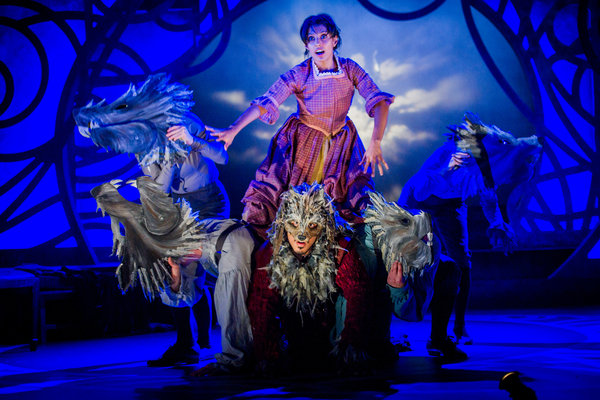
As it’s the run up to Christmas, pantos are saturating our stages. There are the traditional ones and plenty that give themselves another label in the hope of getting attention: boutique, adult and gay spring to mind. Then there are other shows that are close to panto in that they’re family friendly and/or based on fairytales, like Polka Theatre’s Beauty & the Beast. New musical Red Riding Hood, by the team that brought audiences the stage adaptation of The Secret Diary of Adrian Mole, Jake Brunger and Pippa Cleary, also falls into this category. The largely excellent, Disney-style songs are this production’s strongest feature, but unfortunately the cheap-looking set, and now-antiquated style of children’s theatre prevent this show from being a stand-out option this holiday season.

Nazarene Williams excels as Little Red. Clever and feisty, she’s a wonderfully pro-active character for young girls to identify with. Her charming sidekick William the Woodcutter (Matthew Jay-Ryan) is dopey and fun, but a good enabler and supports Red on her quest to save her family’s bakery. Matthew Barrow has more character as the wolf; his dad lacks energy in comparison. Mum Holly-Anna Lloyd is a strong singer, but she looks the same age as her daughter and the character lacks maturity. Patsy Blower completes the cast of five as the witty grandma. All of them are strong singers with that powerful, modern American Broadway tone that kids recognize from Disney films.

The book and design are a let down, though. Brunger’s writing is simplistic and not suitable for children in the upper years of primary school, and there are some unnecessary scenes that seem like they were written to add length rather than the main storyline. Three schools were there, and on several occasions the children got bored and started talking amongst themselves: a powerful indicator of this production’s issues. The story has a well-shaped structure and an interesting plot, but the dialogue isn’t far off that in Town Hall Cherubs, which is pitched to 2-5 year olds. This makes the actors perform in that exaggerated style of performance that used to be the signature of all children’s theatre, but many productions have now become much more sophisticated, even for very young children. The design looks great in dim light and the patchwork tree leaves are a particularly lovely idea, but with the lights up, they look like cheap, enlarged photocopies and the flats themselves are flimsy. The birds in the forest are origami paper cranes that the actors fly around, but there is no movement within the birds themselves. The paper rabbit on a stick slid across the floor has the same disappointing lack of impact. Grandma’s pet parrot, an actual puppet, is a much better use of puppetry. There are obvious budget constraints here, but a simpler approach may have been more effective rather than trying to make the set look grand but not having the materials available to do so.

The songs are excellent though, and there are plenty of them. From moving duets to powerful solos and whole-cast numbers, they pull back the attention every time. There are some trite lyrics here and there, but Pippa Cleary’s music is great. The show isn’t beyond rescue, though. With some re-writes and additional invention (like William’s wonderful magic book) to make it more distinctive and develop the characters, this could be an excellent example of modern children’s theatre.


The Play’s the Thing UK is committed to covering fringe and progressive theatre in London and beyond. It is run entirely voluntarily and needs regular support to ensure its survival. For more information and to help The Play’s the Thing UK provide coverage of the theatre that needs reviews the most, visit its patreon.

Fucking Men, King’s Head Theatre

rsz_richard_de_lisle_&_haydn_whiteside_2__f-cking_men_c_andreas_griegerSchnitzler’s La Ronde has been remade dozens of times and might be coming back into fashion again, what with the recent Hope Theatre production of Hello Again. Joe DiPietro’s Fucking Men follows Schnitzler’s format but sets the 2008 story in gay New York. The show also has the distinction of being the longest running show on the London fringe beginning with it’s 2008 Finborough run and followed by several transfers and extensions. After a brief break, it’s back at The King’s Head. At an hour long, three actors play all ten characters in ten brief scenes, too brief for much character development (with a few exceptions), but an effective snapshot of the ability sex has to cut across social groups.

Performances vary with the character, but the actors’ energy and commitment is consistent. Richard De Lisle excels as the other married guy and the journalist, the latter particularly moving. Harper James entertains as the enthusiastic “straight” soldier who likes to fuck guys and has a satisfying character journey that we see though the adorably sweet Hayden Whiteside as the escort. The short scenes lend themselves to stereotypical performances that are tough to fight against; this is a play that could definitely do with lengthening.

The small stage and Jamie Simmons’ universal set pieces are used well but some of the transitions take too long. His costumes give good character identification, important in scenes that aren’t long enough to have much exposition. Mark Barford’s direction is conservatively sexy: there’s a changing room scene with full frontal, but that’s it. Otherwise, all bits are covered at least with pants, with a bit of bum here and there. A bit more nudity wouldn’t be gratuitous, but neither is it necessary, either.

Despite the sex, this play is about the immediacy of relationships formed in passing encounters and the loneliness they can embody. The LGBT vehicle brings up issues more common in the gay scene (like monogamy and HIV), the overriding desperation for human contact transcends gender and sexuality.

This is a tender, fun production that deserves development and a good counterpoint to the camp Mirror Mirror: A Snow White Pantomime on earlier in the evening. Though not explicitly seasonal, Fucking Men is an important reminder that even during the holidays, some people are still lonely and desperate for even the most fleeting of human contact regardless of how comfortable their lives may be otherwise.


The Play’s the Thing UK is committed to covering fringe and progressive theatre in London and beyond. It is run entirely voluntarily and needs regular support to ensure its survival. For more information and to help The Play’s the Thing UK provide coverage of the theatre that needs reviews the most, visit its patreon.

Mirror Mirror: A Snow White Pantomime, King’s Head Theatre

rsz_tpw3-k1hri_f6bbtm3nyb5zo_ieq3wud5gnorjqw1hmth7eapkugyw_g9qolxtc-nh9sl6jp3piyv_ekam1gf0

They are new to the King’s Head, but Charles Court Opera aren’t new to pantomime. This year’s Mirror Mirror: A Snow White Pantomime is their ninth “boutique” panto. Though an opera company, this show and cast of six are anything but stereotypical opera fare. John Savournin’s script is fresh and witty, the performances are camp and vibrant, and the re-written pop song soundtrack is so well sung that it deserves a cast recording. There’s plenty of typical panto interaction, made easier and more personal in a fringe venue but doesn’t overwhelm the space, either. Though the costumes are detailed and fun, the set is a bit analog and takes up a lot of playing space, restricting movement and choreography. Some of the performances were more genuine than others, but this remains a wonderfully current panto with excellent writing.

Savournin also directs and plays Snow White, the ditzy, ingénue widow of Barry White living with the seven dwarfs, all distinctly and energetically played by Matthew Kellet. Greedy queen Andrea Tweedale uses her mirror (Simon Masterton-Smith) to help her search for a husband, but her plans are thwarted when prince Larry Black (Amy J Payne) and his valet Harry (Nichola Jolly) show up looking for a bride and instead of being impressed by her beauty, Larry falls for Snow. The traditional story veers off in numerous contemporary directions from there, which adds to the audience’s delight and prevents the show from becoming stale or generic. The music is mostly cleverly reworked pop songs, but there’s a bit of musical theatre thrown in and the Act one Finale numbers are fantastic.

No individual performer overshadows the others, instead they are a balanced lot with clear strengths. Payne and Jolly are a charismatic pair, with Kellett’s range of dwarves a hilarious counterpoint to the leads. Savournin’s Snow is shallow but sweet and doesn’t fall short in any of the creative roles he takes on. Tweedale stokes the audiences’ booing and aww-ing brilliantly. The height difference between Savournin and Payne supports the comedy heavily peppering the dialogue, as does the cross-gender casting that goes beyond the dame and principal boy. There is some lovely chemistry between some of the characters but even though it’s a panto, there could be more between Payne and Savournin.

There’s loads of audience interaction and mess, the best being a Great British Bake Off-style competition that results in dough everywhere. Of course, there’s your usual panto call and response but not so much so that the script is otherwise flimsy. The unique visual gags Savournin employs are much more satisfying, anyway (pro tip: look out for Barry). A few give a nod to tradition, but this is definitely a language-focused script. This gives the performance a richness and depth missing from more traditional fare, hence the “boutique” label. Charles Court Opera is certainly onto a winning formula here within London pantomime offerings and is not one panto fans should miss.


The Play’s the Thing UK is committed to covering fringe and progressive theatre in London and beyond. It is run entirely voluntarily and needs regular support to ensure its survival. For more information and to help The Play’s the Thing UK provide coverage of the theatre that needs reviews the most, visit its patreon.

Wilde Without the Boy/The Ballad of Reading Gaol, Rose Playhouse

rsz_wilde-without-the-boy-publicity-shot

Near the end of his two-year imprisonment for gross indecency, Oscar Wilde was a man broken from hard labour, isolation and social disgrace. Until a sympathetic warden at Reading Gaol allowed him restricted writing privileges, he hadn’t been able to write at all. Provided with a single sheet of paper that would be collected and replaced when that one was filled, Wilde penned an 80-page letter of 50,000 words to the selfish lover who was his downfall, Lord Alfred ‘Bosie’ Douglas. Heavily edited and published posthumously by Wilde’s friend and former lover Robbie Ross, the chatty letter was titled “De Profundis”. After Wilde’s release, he wrote poem “The Ballad of Reading Gaol” whilst exiled in Paris; this work details the execution of a fellow inmate.

In Wilde Without the Boy/The Ballad of Reading Gaol, actor Gerard Logan and director/writer Gareth Armstrong team up to create a staged version of these two narratives as a one-man show in two acts. Dramatic in structure and reasonably well performed, this is a text-heavy piece that suits the intimate Rose Playhouse. However, the consistent, even tone and pace that Logan employs has a lulling effect and the verbosity overwhelms with details. There is little to watch; though Wilde Without the Boy gives insight into Wilde’s state of mind at this challenging point in his life, it would make more sense as an audio recording and I cannot discern why it was put on the stage. The Ballad of Reading Gaol is performed with more vocal and physical variation so even though it is the shorter part of the event, it is the more compelling piece.

The set is simple: a bare table and two chairs for the first act, with a stack of documents that are occasionally referenced as letters. The red rope lighting that outlines the Rose’s archaeological remains casts a faint red glow on the walls reminiscent of the passion and anger that constantly burns in Wilde’s heart. Whether or not this was intentional, it effectively contributes to the heavy mood of both pieces. In the second piece, the table is covered with summer linen and a sole green carnation rests there. It is another powerful symbol of Wilde’s homosexuality that is repeatedly denied in Wilde Without the Boy. This show completely ignores the vast space beyond the stage, a decision that suits the script, but it’s still a shame to neglect such a unique feature. The musical score, intermittent in Wilde Without the Boy but a constant presence in The Ballad of Reading Gaol, is latterly a character in itself and Logan’s delivery is impeccably timed to its rise and fall. No programme was supplied, but whoever designed or composed this score deserves acknowledgement.

Though both are interesting pieces of text in that they aren’t normally performed or read by anyone other that Wilde enthusiasts or students, their theatrical potential is limited. Even with Armstrong’s adaptation and edit of the letter, as a one-person show it’s still more of a recitation with a thin story arc detailing Wilde’s views of Bosie and his experiences in prison. Logan has some lovely emotional moments, but it’s not enough to keep the mind from drifting. The Ballad of Reading Gaol has an actual storyline, which is an immense boost to Logan’s performance. He has a compelling stage present and vocal agility, but Wilde Without the Boy is not the best showcase of his abilities, the Rose as a venue or theatre itself.


The Play’s the Thing UK is committed to covering fringe and progressive theatre in London and beyond. It is run entirely voluntarily and needs regular support to ensure its survival. For more information and to help The Play’s the Thing UK provide coverage of the theatre that needs reviews the most, visit its patreon.

Beauty & the Beast, Polka Theatre

Beauty and the Beast - Polka Theatre - 20 November 2015 Writer - Charles Way Director - Roman Stefanski Designer - Laura McEwen Music - Julian Butler

Cold, dark days make me want to see feel-good theatre, especially in the run up to the holidays. Bonus points if it’s colourful, has some depth and at least some non-formulaic elements, even in a classic story. Polka Theatre’s Beauty & the Beast for ages 6-12 meets these criteria with a surprisingly complex storyline that keeps adult attention as well as kids’. Despite the target age range, there is some great humour and a touch of innuendo adults will appreciate (kids definitely won’t get it), sumptuous set and lighting and an adapted, relevant script. Some of the performances are wooden from the dated language and there are some dodgy movement-based transitions, but the school group audience was quiet and focused for most of the nearly two hours with interval.

Charles Way’s adaptation of the traditional story gives a much wider context than the Disney film and is more relatable to a modern, young audience. Belle is still the main character, but we get to know her father, Mr Godwin (Simon Holmes) and sister Cassandra (Géhane Strehler) well. Belle and Cassandra are complete opposites: Belle’s bookish, a visionary and frightened by most things; Cassandra loves boys, pretty dresses and adventures. The two bicker regularly and their money-driven merchant father is tired of it, a family dynamic that many children will recognize. Beginning in London and moving to the remote countryside when Mr Godwin loses his fortune, the girls also have to cope with big life changes and overcome adversity.

The women’s performances are consistently stronger than the men’s. Ritu Arya’s Belle is convincingly performed with a wonderfully dry sense of humour and an excellent character arc that isn’t overly saccharine. She carries the story and its energy well without being a stereotypical children’s performer, dealing with the old fashioned language brilliantly. Géhane Strehler is great contrast, giving young girls two opposite ideals to potentially relate to. Both have flaws, virtues and detail. Emma Cater is a sinister housekeeper for Jason Eddy’s Beast, a gentle man with stylized physicality and an imposing presence. Eddy doesn’t quite manage to carry that through after his transformation, but it’s so close to the end that it doesn’t matter much.

The set is layers of swirling panels that change colour and glow according to location, with the Beast’s castle the richest of them all. Laura McEwen’s set and Ian Scott’s lighting work together in wonderful harmony, with the occasional addition of puppets. Stage combat from RC Annie also adds a visual component, but the fights are slower that fight speed and brief. Some of the transitions lag and have abstract movement to fill the time, but this doesn’t contribute to the story and usually look pretty naff. Costumes, also by McEwen indicate the characters’ circumstances and changes in social class, but the highlight is the headdress and mask for the Beast.

Though there are still age and gender stereotypes, the adapted script empowers the young female characters. The detail and length will occupy adults as well as children and Way’s story is excellently constructed. With wonderfully visual design and a stirring score by Julian Butler, this is a lovely production harking back to the classical story without the glitz of Disney-fication or the panto cheese, and a solid option for a family holiday show.


The Play’s The Thing UK is an independent theatre criticism website maintained voluntarily. Whilst donations are never expected, they are hugely appreciated and will enable more time to be spent reviewing theatre productions of all sizes. Click here to make a donation with PayPal.

Live from Television Centre

On Sunday night, theatre people ( and hopefully others) up and down the country tuned in to BBC Four to watch Battersea Arts Centre and Arts Council England take over the former Television Centre, now a building site for luxury flats. Over two hours, four theatre companies streamed their work for live audiences in the comfort of their homes, to push the boundaries of theatre’s adaptability to the popular small screen and to challenge typical TV programming. I watched in bed and with twitter open so I could keep half an eye on #livefromTVC; it was a gloriously anarchic experiment that I hope ushers in a new era for telly and theatre even though not every element worked as well as it could have – but that’s the point of experimentation.

Gecko’s The Time of Your Life celebrates life cycles in a circular swirling movement with a “Truman Show”-style storyline of meta-television. The close-up nature of telly supports the characters’ intimacy and expressiveness well, but the narrow framing reduced their normally expansive work to a much smaller scale. I didn’t mind the spinning camera work, but twitter buzzed with complaints of dizziness. It was rough and ready, with limbs often out of the frame and movements ahead of the action, but that supports the “liveness”. Their piece wasn’t the most accessible and most suitable to open the evening either; Richard DeDomenici’s Redux Project would have been a more appealing start to non-theatre goers.

The long running Redux Project is adapted for the evening with joyfully irreverent recreations of classic moments from BBC television history. DeDomenici has a friendly, laid-back persona thinly veiling biting political commentary just as sharp as “The Revolution Will Be Televised”, but less blatant and without personal attacks. The live artist aims, “to disrupt the cinema industry by making counterfeit sections of popular films”; he satisfies with powerful alternative perspectives that are funny on the surface, but pose bigger challenges to cinematic convention underneath.

Common Wealth’s No Guts, No Heart, No Glory is a verbatim piece sharing the experiences of young women from Bradford who are Muslim boxers. It’s a powerful piece challenging stereotypes and giving voice to a demographic often ignored at best or stigmatized at worst. This worked brilliantly on telly, capturing the intensity and passion of the characters despite some strange camera angles.

Backstage in Biscuit Land by Touretteshero (Jess Thom) becomes Broadcast from Biscuit Land, the wonderful show that’s inclusive, informative, and contains plenty of biscuits and cats. Thom has a noticeable form of Tourettes that manifests in physical and verbal tics used for comedic effect in her show, and a reminder that understanding for people with disabilities is still lacking. In a more surreal moment, Thom reminisces about a particularly funny tic about Keith Chegwin in a quiet theatre; cameras then reveal Cheggers there in the live studio audience.

The variety of the evening reminds audiences of the power of live performance and its relevance to everyone. I’m certain that anyone who watched would be able to find something appealing in the evening, and hopefully discovered a company or artist previously unknown to them. Even if it was mainly theatre makers and goers that watched, TV can still reach audiences that are otherwise unable to travel to an individual performance. At best, those who don’t consider themselves theatre people will have found pleasure in the event, and there’s hope that the powers that be discover there is room for dancing biscuits, physical theatre and political performance on our small screens as well as our big stages.


The Play’s The Thing UK is an independent theatre criticism website maintained voluntarily. Whilst donations are never expected, they are hugely appreciated and will enable more time to be spent reviewing theatre productions of all sizes. Click here to make a donation with PayPal.

Measure for Measure, Young Vic

https://i0.wp.com/www.officiallondontheatre.co.uk/servlet/file/store5/item336663/version1/fileservice770/336663_770_preview.jpgThere’s a mountain of inflatable sex dolls on the stage. Shiny, blank faces with gaping, toothless mouths, spherical tits and gargantuan cocks everywhere. The pile is so big that the actors have to wade through the dolls, a metaphor for the seedy Viennese streets where Shakespeare sets his Measure for Measure. Director Joe Hill-Gibbins wrenches this world into the present with a symbolism-laden, visually orgasmic production designed by Miriam Buether, and a great performance by Romola Garai as Isabella. Live video feeds, projection and pulsing beats marry a space that has ghosts of Elizabethan theatre structures, but some choices don’t sit well. Though the visuals are relevant and bold, there’s a disappointing tendency towards shouting, and a dubious (to the point of discomfort) characterization choice for infamous pimp Pompey. As the characters physically and emotionally wrestle through the heavily edited, relentless two hours of sex and religion, there is still a strong feeling that this production values style over substance.

Most modernized Shakespeare I see tacks on a more contemporary setting through costuming whilst changing little else. These sorts of adaptations tend to not generate any new insight on the play, its story or characters. This production manages to escape that trap through fully integrated design that cleverly functions on both a practical and representational level. The sex dolls, the most jarring of the updates, are in turn Angelo’s repressed sexuality, the sinners that Isabella (a novice nun) rejects, prisoners, and the duke’s citizens. The live feed is the media and public perception (as it was in the Old Vic’s 2005 Richard II), the duke’s altered perspective of events, and creates clear boundaries between locations. It’s also very Big Brother, and the audience is the all-seeing, both on and off camera. These design elements are grotesquely amplified, with every pore visible as faces are broadcast and projected at a massive size, and the dolls, well, they’re everywhere and thrown around like a cheap commodity to be used and discarded.

The dolls eventually move to a back room, akin to an Elizabethan inner stage, that’s often sealed off by sterile sliding panels, but we are regularly reminded of their presence both on and off camera. The live feed doesn’t let the audience forget about the bad behaviour happening in the concealed prison where Angelo’s offenders await execution. Some of the characters linger on stage even when not in a scene, giving time and space a fluidity but one that is understood to be separate from the action in any given moment. This rejection of set also harks back to Elizabethan performance convention. Projections of medieval art gorgeously juxtapose whirling, close-up photographs of the dolls and projections from the live feed, two worlds colliding in Hill-Gibbins and Buether’s updated Vienna. This contrast pointedly comments on the hypocrisy of modern religious fundamentalism; pro-lifers who are so pro-life that they kill abortion providers immediately spring to mind, though there is a plethora of other examples.

Though Garai’s performance has the power and confidence that Isabella often lacks in more demure interpretations, others in the cast let it down. Zubin Varlo as Duke Vincentio is quick to shout; this soon becomes excessive and a loss of power. Though a great performance from Tom Edden as Pompey the pimp, it’s disturbing that he has been characterized as a stereotypical Jewish New Yorker obsessed with money. However, Ivanno Jeremiah is an excellent Claudio with a quietness that is great contrast to the fiery Isabella. The colour-blind casting proudly shows off the UK’s diverse talent, with a female Sarah Malin as Escalus, PA to the duke and his deputy. Paul Ready as Angelo, the floundering, conservative who covers Vincentio during has absence and tries to bed Isabella in exchange for her brother’s life is definitely despicable but also incredibly conflicted. It’s easy to almost feel pity for him at times.

There is no doubt that this production looks fantastic, particularly in the opening and closing sequences. It updates well and has contemporary relevance on several levels, but there’s little unity across the design elements. This reminds me of Baz Luhrmann’s 1990’s Romeo & Juliet – all angry and dystopian and fast. It’s non-specific to a time and place, just broadly Western contemporary. It’s diverse in race, gender and accent and could easily be London, Paris, New York, or any other sleazy, urban environment. This gives it universality, but also shows laziness. I wonder if the design was initially chosen because it looks lush rather than makes a specific comment. Despite my interpretation of the underlying meaning of the design, I can’t help but to consider that my mind is constructing meaning that isn’t actually there. This was a relentless unease that lingered for the duration of the performance, though it didn’t spoil the experience.


The Play’s The Thing UK is an independent theatre criticism website maintained voluntarily. Whilst donations are never expected, they are hugely appreciated and will enable more time to be spent reviewing theatre productions of all sizes. Click here to make a donation with PayPal.

The Notebook, Battersea Arts Centre

https://i0.wp.com/www.forcedentertainment.com/wp-content/uploads/2014/10/The-Notebook-Forced-Entertainment-Rehearsal-Image-April-2014-photo-Tim-Etchells-DSC04935.jpgNearly everyday we see news of refugees fleeing war torn lands in search of safety abroad. No matter how the press spins objective facts to suit their own agenda and their readers’ opinions, the perspective of these events unfailingly separates “them” from “us”. These people running for their lives are The Other that we must either keep out or allow in. It’s all very black and white, heavily doused with an air of superiority; we either look down on them as vermin that need controlling or as victims that need handling with kid gloves. We never really hear from these refugees, though. It’s all, “me, me, me” and a flamboyant display of either virtue or condemnation.

The Notebook, with a stark simplicity that forces the audience to sit and listen for two unrelenting hours, slowly unpacks the horrors of war that drives people to flee from a first person perspective. It makes us take the focus off ourselves for once and genuinely listen to the stories of those in need. Told by nameless twin boys moved to their grandmother’s home in the Hungarian countryside, they come of age during World War II, the subsequent Russian occupation and descent of the Iron Curtain. Adapted from Agota Kristóf’s novel of the same name, Forced Entertainment strips the story down to a text that’s read from thick notebooks by two identically dressed actors (Robin Arthur and Richard Lowdon) who represent the boys. This is storytelling in its most raw, boiled down form, with language being almost the sole vehicle of communication.

The set is two wooden chairs and the lighting rarely changes. There isn’t much to look at, which makes this show a tough one for those used to constant visual stimulation in both real and theatrical worlds. There were times I internally railed against the form, like a kid with ADD in a lesson that lasts more than three seconds. One woman walked out part way through. Others fidgeted and checked their watches. We just aren’t used to sitting down and just listening for a couple of hours anymore. The story is unquestionably riveting, though. Through use of precisely timed delivery, often in unison, childhood innocence breaks down and is eventually destroyed, despite their mother’s attempts to protect it. Their grandmother’s house is hardly a haven, and they must resort to deplorable behaviour to eek out a sub-par existence even though the bombs are a distant threat. It’s understandable though, considering the abuse they endure from their grandmother, the general public and those in positions of trust. The people in this story are rarely kind; even though it’s unsaid it’s given that it’s not their fault. The human spirit can endure only so much.

The language doesn’t hold anything back. It is often explicitly graphic with appalling acts emphasised by unemotional delivery. The audience inevitably uses their imagination to make up for the lack of visuals; these images are far worse than anything that could be presented on stage. Though the performance could use shortening, it’s soaked with detail and condenses years into hours. Shaving off half an hour would still maintain impact, but it’s not Forced Entertainment’s job to make us comfortable. Director Tim Etchells wants us to think, empathise and listen, really listen, even if the process isn’t easy. The Notebook is a hard production to watch, but the message of acceptance and universal humanity is a vital one.


The Play’s The Thing UK is an independent theatre criticism website maintained voluntarily. Whilst donations are never expected, they are hugely appreciated and will enable more time to be spent reviewing theatre productions of all sizes. Click here to make a donation with PayPal.

Hello Again, Hope Theatre

https://i0.wp.com/grumpygaycritic.co.uk/wp-content/uploads/2015/10/Hello-Again-1402b.jpg

Knickers, bras and other vintage undergarments (oh my!) dangle from the Hope Theatre ceiling in dim light, the discarded ghosts of sexual encounters long past. Arthur Schnitzler’s 1897 Reigen, or La Ronde as it is more commonly known from the French translation, is reinvented in musical form in Michael John LaChiusa’s early 1990s Hello Again. Not content with the original story, LaChiusa spreads Schnitzler’s shags, blowjobs and wanks over the 21st century, updates some of the characters, includes gay relationships and adds a nearly continuous score mostly of duets, with musical influences from a host of eras. The sex is seen rather than just talked about, but otherwise Schnitzler’s format is replicated. Five actors each takes two characters and accompanied by a solitary keyboard, create an intimately filthy but strangely moving chamber musical in one of London’s newest pub theatres.

Hello Again, though titillating, also looks at the desire for sexual satisfaction through entirely unromantic, desperate scenarios. In ten short scenes, we see an array of social classes, professions and sexualities get their jollies before they run out of time; there’s the married housewife in her affair with a student, the soldier and the nurse before he ships out and the gentleman and cabin boy on the sinking Titanic amongst others. One-off and long-running relationships are accompanied by a range of musical styles on a bare bones set, but the minimalism means nothing is held back and it’s practically in your lap if you’re in the front row. Though there’s plenty of bonking, little is seen – a bum here, cleavage there; the acts themselves are staged realistically rather than stylized or hinted at by director Tania Azevedo. In our porno-fied modern culture where hardcore images and video are a couple of clicks away, to show the grunting and thrusting act without the bits strikes an interesting balance between honesty and discretion. With the audience split over three sides, more diagonals could have been used in the staging to improve sightlines for everyone, but otherwise the small space with no backstage is used well.

LaChiusa keeps the scenes short, but this enhances the immediacy and primal nature of sex. There are some good numbers, but the hodge podge of styles prevents much in the way of recurring motifs. The settings and characters are clear and believable, though their brevity needs the characters to get to the point quickly. As we don’t really get to know these people before us, they become an everyman of their character type: they are us, and we could easily be them. The ensemble cast is consistently good, with newcomer Isabella Messarra and veteran Miles Western giving the most striking vocal performances. Messarra’s Nurse is a wonderful force that literally dominates the posh student she cares for, Western is the smug senator exploiting a beautiful but lonely film star.

This is an excellent and largely faithful adaption of Schnitzler’s play that doesn’t shy away from explicitly prurient moments all sexual human beings can relate to. LaChiusa’s characters speak to all of us, even if his music is less satisfying. Azevedo’s direction and multi-roll casting suits the piece, as the intimate venue fits this infrequently staged and rarely seen musical.


The Play’s The Thing UK is an independent theatre criticism website maintained voluntarily. Whilst donations are never expected, they are hugely appreciated and will enable more time to be spent reviewing theatre productions of all sizes. Click here to make a donation with PayPal.

The Tempest, Bloomsbury Festival

circle

By a guest reviewer who wishes to remain anonymous:

This adaptation of The Tempest by Kelly Hunter was a one-off performance as part of the Bloomsbury Festival at the Bloomsbury Studio Theatre. Hunter specifically designed this piece to enable children on the autism spectrum to participate in the show with the actors. These children’s parents/carers are invited to sit and watch.

I think this was the most unique Shakespeare productions I’ve seen. Hunter and her excellent cast of six set themselves the challenge of using The Tempest as a means of interacting and helping several young people on the autism spectrum to improve their self expression and communication with each other. Initially, I was uncertain how this would work as, personally, I’ve always found the Tempest a tricky play to follow. As the story progressed I saw that The Tempest actually lends itself perfectly to this kind of devised, interactive theatre. The play of course deals in magic; there’s also a clear physicality to many of the characters and a certain playfulness which allows the actors to introduce the young participants to the world of the play. This was not a full production of the Tempest and nor did it need to be. Considering its aims, the production was undoubtedly a huge success. All of the participants seemed to benefit hugely from playing simplified versions of various scenes from the play with these very experienced stage actors. More importantly they, along with the parents and carers watching, seemed to really enjoy themselves. When the play ended there was a lovely, warm feeling in the room. Everyone seemed enlivened by the experience, adults and children alike.

I sincerely hope that Flute Theatre will continue its success producing this kind of work in the future. It is extremely important and valuable to non-traditional theatregoers.


The Play’s The Thing UK is an independent theatre criticism website maintained voluntarily. Whilst donations are never expected, they are hugely appreciated and will enable more time to be spent reviewing theatre productions of all sizes. Click here to make a donation with PayPal.