This Is How We Die, Battersea Arts Centre

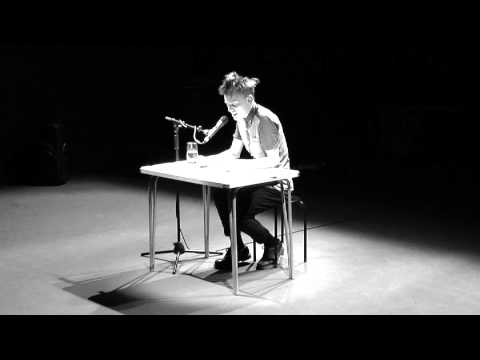
Chris Brett Bailey is a bard of thhqdefaulte modern age. Like Elizabethan theatre the audience went to hear rather than to see, This Is How We Die is a bombardment of the ears rather than the eyes. Using spoken word and beat poetry to tear open the world as we know it, Bailey forces us to confront the horrors and beauty of everyday existence. This piece of theatre moves away from the trend of visual theatre, taking the audience on a self-reflective ride of their lives.

At just over an hour, we are hurtled on a journey through Bailey’s rage against “-isms” and “-ists,” a brutal first meeting with his overly-literal girlfriend’s parents and a Hunter S. Thompson-like roadtrip through the American desert. His delivery is relentless, pausing only for comic effect or to take small sips of water from the glass that sits on his desk. Yes, a desk. He sits at a desk, with his script in front of him. This form rails against the increasingly visual culture we live in but it forces the audience to really and truly listen. He has a lot to say that he feels strongly about and you need to hear it.

Trying to describe what This Is How We Die is about is futile. Anything descriptive about plot or narrative arc will make this piece sound simplistic and trite. The feature that really makes this a must-see is Bailey’s visceral use of language. He savours it, relishes it and throws it away. A sea of sound washes over us, then pummels us, unarmed, in a back alley behind some dingy American bar. His imagery alternates between abstract and concrete, the highlight being his girlfriend’s neo-Nazi father left shaped like a swastika after a car accident.

The last ten minutes or so abandons speech, instead favouring live ambient music and harsh lighting. This is his Elizabethan jig, the audience’s catharsis after the emotional Sturm und Drang of the last hour. There was no point in fighting the journey of This Is How We Die so you may as well join him. Share in his rage, his joy and his passion. Relish the world you live in and the sounds of the words that pour so easily from his mouth. This isn’t about how we die, but how we should live.


The Play’s The Thing UK is an independent theatre criticism website maintained voluntarily. Whilst donations are never expected, they are hugely appreciated and will enable more time to be spent reviewing theatre productions of all sizes. Click here to make a donation with PalPal.

My Initial Response to “This Is How We Die”

Today I gaze at anticipatory faces. Chasing A-stars, they wait.

And wait.

And wait.

I struggle to face the mundane day lazily unwinding in front of me. The bullet train fever dream of last night’s memory rips at my periphery but I have piles of goddamn exam papers to hand out and count down the time for those little eyes lined up in front of me.

“You have seventy-five minutes to complete this exam paper. Raise your hand if you need anything. You must not speak.”

You must not speak.                         You must not speak.                     You must not speak.

The silence of rustling papers and scratching pens and scraping chairs deafens me. Fatigue caresses my face already propped up by tapping, restless fingers frustrated with marking the correctness of the explanation of hot seating and how its used in my year 9 Drama class.

The middle distance pops up, slides in.

I ruminate.

Never had I thought I’d find Shakespeare reincarnate, but he’s there, under the rioting hair of a Canadian paranoiac, raging at the space he faces of pairs of eyes lined up. He bombards, he bashes, he races. The world we know but ignore is exposed. The guts hang out, the greed, the hate. The racism, the fascism, all those “isms” and “ists” that stain and distend, that we block out to keep out tiny, insignificant spheres of existence perfect and quiet and numb.

This bard makes us see.

He stops.                                                                                                           He whispers.

Just him at a desk with a script and a glass and some lights.

And us. We face him. We hear him. We drink in his sounds, his words, his allegorical tales of love found and lost and open road desert adventure. This is confessional. This is a soul ripped open and we are going to ingest it, whether we want that screaming, raw mass inside us or not. Not through our mouths, but with our ears we catch his lightning, eventually blinded by words and light and music.

We are overcome.

We are left.

We are the catalysts of our own change.


The Play’s The Thing UK is an independent theatre criticism website maintained voluntarily. Whilst donations are never expected, they are hugely appreciated and will enable more time to be spent reviewing theatre productions of all sizes. Click here to make a donation with PalPal.

No Take Backs, everything theatre

“What do you do when you’ve lost your dad, your girlfriend dumps you and a stranger breaks into your new flat, handcuffing you to the radiator? Engage in a battle of wits for your freedom of course!

“…Emily (Lucy Litchfield) is handcuffed to a radiator whilst the Lara Croft-esque Megan (Rachel Eireann) lords over her…The pace is almost akin to Beckett, and there are a few moments when I wonder if the action is going to progress…

“During their conversation it emerges that both of these young women carry lots of issues and baggage. The dialogue is mostly rapid fire and both characters are highly intelligent, if emotionally damaged. Power shifts again when Emily’s brother (Daniel Farley) enters the scene and recognises Megan after she beats him up. Things spiral out of control, and after the boss (Sylvie England) has cleaned up the mess the truth behind the whole hostage situation is made amusingly clear…

“The writing is tight, though playwright Michael Eckett could have easily shaved fifteen minutes from the beginning to make it even more pacy. He has a great sense of comic timing and a great understanding of sound dramatic structure, even if the twist at the end felt slightly formulaic…No Take Backs is a strong one-act offering for this years’ Camden Fringe Festival, and shows that not all good theatre relocates to Edinburgh for the summer!”

Read the entire review on everything theatre here.

Respawn, Hackney Attic

logosrespawnI really want to like Stars or Mars latest sci-fi offering, Respawn. Not because I like science fiction – quite the opposite. I really don’t enjoy the genre in any form, be it films, books or television. There isn’t much sci-fi theatre out there, though. The only sci-fi production I can ever recall seeing is Theatre Ad Infinitum’s Light. Light has the distinction of being my first five-star review, and it had nothing to do with the genre. I want to continue bucking my own trend by liking science fiction theatre (if you can call loving one show “bucking a trend”), but it can’t happen with Respawn.

The primary issue with this play is the script, a combination of Pinteresque vagueness and Beckettian lack of action set in a technology-ridden future. I’m sure playwright Susan Gray has an idea in her head of what she wants to communicate to the audience, but it struggles to transfer from page to stage. Her script is set in a world where people become artificial intelligences (AIs) when they die, but no clear message came through the muddled story. Characters were not named, instead referred to with pronouns. This added to the confusion. The programme states that two actors played multiple characters, but not all of the characters were clearly distinguished. Gray herself is credited with playing three roles, but two were so similar they seemed to be the same person. Melanie Crossey had a much clearer performance, playing an AI as a voiceover that lives in a hotel and interacts with living people, and the AI “in person”. Another structural issue lies in this occurrence: if the AIs don’t have bodies, why are we seeing them wearing Phantom of the Opera masks and performed as otherwise completely naturalistic characters? Even if the storyline were to be a clear-cut narrative, there is no overriding theme other than the idea that the AIs want to be human again, but can’t be. It is an interesting idea, but one that can serve as a starting point rather than the crux of an entire play.

Crossey’s performance is a saving grace of this production. With a confident but relaxed stage presence, she holds this convoluted one-act together. She is obviously a skilled performer that deserves the challenge of meaty, contemporary characters. A sound designer is credited, but no director, lighting director or script advisor. These creative roles would be a wise addition to the company’s upcoming Camden Fringe productions.

The Hackney Attic is an unconventional venue, more of a cabaret or comedy venue that a theatre. At the top of a cinema, it is a long, white room with tables rather than rows of seats and a staffed bar in the room. The stage lights are either on or off, the dressing rooms can be seen through a curtain, and a paint job is needed in order to achieve blackout. The space needs some alterations to become suitable for a wider range of performance styles, but the location is great. There was also no signage warning audiences of the strobe light effect that occurred several times in the play.

Furthering the sci-fi theatre genre is certainly a noble pursuit, as it is a genre sorely neglected. LA has Sci-Fest, but London is only this year bringing a celebration of the genre to the fringe at Chelsea Theatre in October. There is huge potential to reach a brand new audience base who spend their weekends at comicons and cosplay events rather than at the theatre. I admire Gray’s aim of developing science fiction theatre, but first she needs to continue refining her own craft.


The Play’s The Thing UK is an independent theatre criticism website maintained voluntarily. Whilst donations are never expected, they are hugely appreciated and will enable more time to be spent reviewing theatre productions of all sizes. Click here to make a donation with PalPal.

The Picture of Dorian Gray, Greenwich Theatre

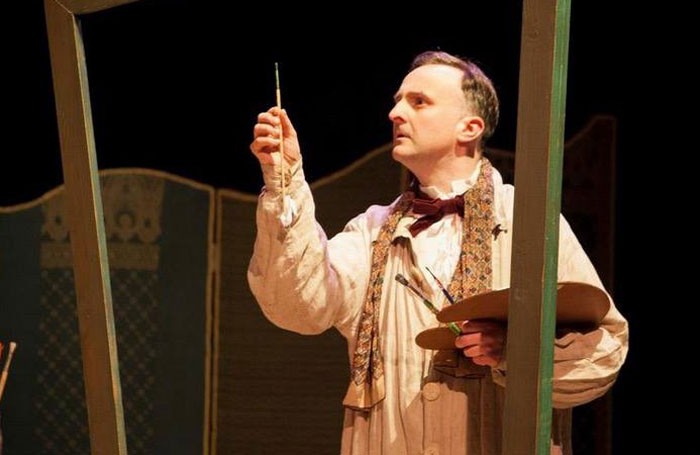
Merlin Holland is the ondorian-gray-700x455ly grandchild of Oscar Wilde. Determined to carry on Wilde’s legacy through research and writing, he adapted a new version of Wilde’s famous and infamous novel, The Picture of Dorian Gray. Touring since April as European Arts Company’s current production, it stops off at Greenwich Theatre for a few days before continuing its perky jaunt around the country.

And perky it is. With only a cast of four, this new adaptation is a largely faithful interpretation of the original story. There is a strong emphasis on artist Basil Hallward’s obsession with young Dorian, capturing the agony of Wilde’s creative and frustratingly closeted life. Played by Rupert Mason, he effectively parallels Wilde’s torment and the use of art as an outlet for homosexual expression, endowing his performance with pathos and depth. Guy Warren-Thomas is the androgynous, camp Dorian who begins as Wilde’s bright-eyed young thing making a vain, innocent wish but who slips into a life of debauchery after discovering his unintended immortality. Warren-Thomas manages to evoke some empathy in his later attempts to be good, but his corruption is a delicious downfall to witness. Gwynfor Jones and Helen Keeley complete the cast, with Lord Henry Wotton and Sybil Vane as their best roles. Warren-Thomas was the only actor to not multirole, but the others did so with great vocal and physical distinction. Cross-gendered performances provide some levity to the dark tale, as does energy and complete commitment to detailed characters.

Though the performances were excellent across the boards, there were some structural choices that did not effectively translate from page to stage. The first act was largely exposition, with Dorian only making the conscious choice to live for pleasure right before the interval. As consequence, the second half felt rushed and the effect of time passing was underplayed, though signified by grey hair in Lord Wotton and Hallward. There was also a jarringly out-of-place dream sequence that Dorian has upon receipt of a mysterious book from Wotton. Stylized and physical with coloured lights and smoke, it was unnecessary and the performers appeared uncomfortable and self-conscious.

The set provided simple but versatile atmosphere. The eponymous portrait was an empty frame that Dorian would grotesquely inhabit from time to time though often left empty and darkly lit. This is a device seen before, but an effective one as it fosters audience imagination. The costumes were sumptuous and indulgent, like Wilde himself and the characters he wrote.

This is a truly lovely production. Little is particularly inventive, but it is a classic story executed very well. The performances are certainly the highlight, as is the fact that Wilde’s grandson aided in the creation of the production. The flaws can certainly be overlooked in favour of focusing on the cast and their chemistry. It continues to tour for most of June, ending with a week at St. James Studio in London.


The Play’s The Thing UK is an independent theatre criticism website maintained voluntarily. Whilst donations are never expected, they are hugely appreciated and will enable more time to be spent reviewing theatre productions of all sizes. Click here to make a donation with PalPal.

Carmen Disruption, Almeida Theatre

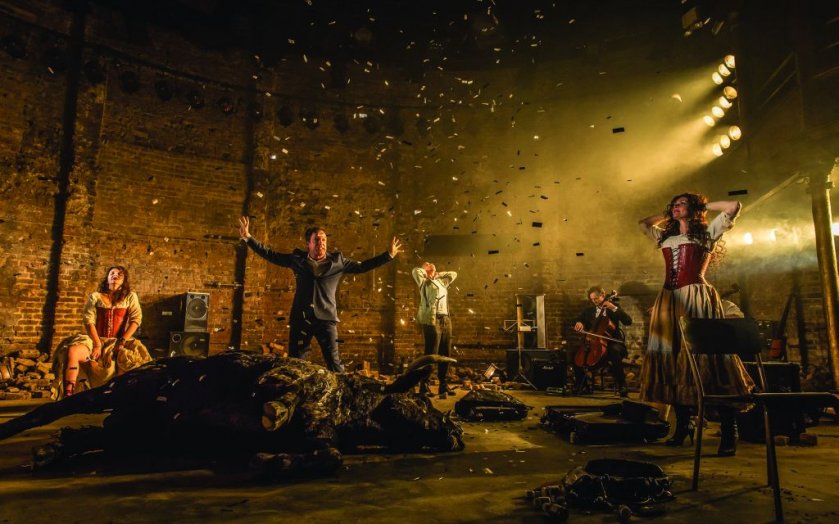
Bricks from disintegrating walls cover the stage.

A hulking, black bull breathes it last.

An aging opera singer arrives in a nameless European city.

A narcissistic rent boy readies for a “date.”

An awkward student is newly single.

A taxi driver prepares to meet the son she walked out on years ago.

A stockbroker travels to an appointment to “take care of” some poor transactions.

The one-woman chorus reaches out to each of them.

Two cellists watch and accompany from the edge.
carmen-disruption-1024x640Smash a mirror on the floor. Go on, do it. Now look at what remains. There are large chunks, long slivers and other bits that are so small they’re practically dust. Each one is uniquely sized and shaped. There is space in between them. Each one those sharp-edged, broken reflective pieces, no matter how large or small, is a person. Alone. Reflecting the world around them. With potential to fit into the pieces around us but. Just. Not. Doing it.

Simon Stephens slingshots Bizet’s Carmen into a wall at a billion mph, creating an explosion of bricks, sparkly confetti, agony, death, black blood, desperation and loneliness. His magnum opus to date, Carmen Disruption is a mess, but one that gloriously mirrors modern life with painful accuracy. Amongst the rubble are characters who are also these broken bits of mirror, pointing at us, mirroring us and paralleling Bizet’s original cast. We are them. They are us. They/we are also the creation of the deteriorating mind of the Singer (Sharon Small), who endlessly travels the world performing the same role over and over, no longer seeing truth in real life but only when she is Her. Carmen. Everyone she sees reflects an archetype from the opera, and not just the characters. Us, too. We are the Stephens’ characters, they are us, two mirrors facing each other. Reflecting infinity.

The five characters all lead radically different lives, intersecting only by chance because of opera and a motorbike accident. They never speak to each other, only to us. Even when they meet their narration is to the audience, about the others. They have no direct contact with anyone other than the observational Chorus (Viktoria Vizin). Fractured monologues weave in and out of each other, building their world that could be any major city, anywhere in the world. Fireflies blinking in the night sky. Their contact with the world filters through mobile phones, a comment on our dependence on our gadgets and urge to document rather than experience. If we take on the role of recorder, we don’t have to engage. Did technology cause the detachment from each other? This question is posed, but never answered, but not a major plot element anyway. By being posed, it makes a statement, calling on us to examine ourselves and our society in which we exist as lonely fragments of a shattered mirror.

Confrontational and omnipresent throughout the stories arising from our characters’ episodic speeches is the dark, hulking carcass of a bull. Its eventual movement surprises, showing a dying struggle rather than death. The actors pick their way around it as the audience did when they entered from the foyer, surprised and disorientated. A creeping pool of black blood eventually consumes. It is a striking visual, the elephant in the room, highlighting the destruction towards which we all hurtle.

The cellists are also fragments, as is their music. An LED surtitle screen adds an operatic element with sporadic, sarcastic content. None of the characters are particularly likeable, instead they evoke pity or disdain. The only thing that brings them together is a terrible accident they witness, but even then they only manage to bounce off of each other and continue spinning into the darkness. Alone. All roles are impeccably performed and the actors engage with each other in the space even without direct interaction.

It doesn’t matter if you know the story of Carmen or not before seeing this production. I don’t know it well at all and may have taken unintended meaning from Stephens’ script, but its ability to communicate Important Messages without having Bizet’s frame of reference attests to Stephens’ skill and the script’s excellence. Every individual will find different aspects of the production incredible and abhorrent, depending on their own frame of reference. John Light’s stockbroker, Escamillo, disgusts me. I am horrified by rent boy Carmen’s (Jack Farthing) details of his rape. I feel sorry for the naïve student (Katie West) who sexts her 63-year-old married lecturer boyfriend and believes their relationship has any love. Or meaning.

I could watch these characters forever. Not having an interval was certainly the right choice for this play. The compact snippets from their lives allude to distinct pasts and futures. Even though the world they inhabit is nameless and featureless, they were flawed, beautiful, unique humans. Smash another mirror. Go on, do it. Each individual fragment is totally unique, unlike those from our previous mirror. Future broken mirrors will be unique as well. Despite the presence of archetypes, the microscopic details of their stories are unrepeatable. On what trajectory would they all continue? I need to know. If Simon Stephens were to make a Synechdoche, New York version of Carmen Disruption, I would happily live in it. Forever.

Though director Michael Longhurst’s creative choices challenge perceptions of contemporary British drama, he could have emphasized the interaction and audience engagement even further. Even though the Almeida is known for its cutting edge work, this is a piece that could have been more fully explored in a large studio setting, without the constraints of a balcony and distinct actor/audience boundaries. I wanted to dance with these characters. I wanted them to move around me. I wanted them to look me directly in the eyes as they relayed their journeying tales and not have any regard for personal space. Carmen Disruption is aggressive, bold and visceral, the sort that is supported by more audience immersion rather than less. At the very least, the audience could have been lit so the actors could see their/our eyes, allowing a connection I craved and they characters clearly yearned for.

Despite this, the effect created was a Brechtian one of alienation and motivation to action. It’s no coincidence that Stephens’ work is popular in Germany. As I picked my way along Friday night’s Upper Street towards the tube station, the stories of those passing by and enjoying their warm, social evenings exploded around me like fireworks. I felt the need to connect. Never has the loneliness of modern life been so starkly emphasized on stage, and afterwards carried through the dark night.


The Play’s The Thing UK is an independent theatre criticism website maintained voluntarily. Whilst donations are never expected, they are hugely appreciated and will enable more time to be spent reviewing theatre productions of all sizes. Click here to make a donation with PalPal.

Killed: July 17th, 1916 for everything theatre

“…On first impressions, the superior set evoked the patriotic idealism of small town England at the start of WWI. It was so well-designed and well made by the talented Dave Benson, that it would easily have been at home on West End stage…

“The play uses a non-linear structure to tell the story of Billy Dean, a volunteer solider from Bradford, sentenced for cowardice in the face of the enemy…The best element of this production is the script and story…Even though the ending is rather abrupt, to alter it would take away from the harsh circumstances.

“The performances are good, but not outstanding. This is mostly because the characters were written without a great deal of depth but they still suit the story as they are…

“The costumes were of a high calibre for fringe theatre…costume designer Lorena Sanchez’ creative talent certainly shined through. Sound designer Max Thompson’s relentless bomb blasts during scene transitions became predictable…We certainly never forgot the world of the play was amidst the front lines of WWI.

“This is a story that definitely needs to be performed again. Director Elizabeth Elstub handled it clearly and simply, without any complex directing trickery…”

Read the entire review on everything theatre here.

Romeo & Juliet, everything theatre

“Lauderdale House is the Elizabethan-era home of a former Lord Mayor of London… Behind the house, Shooting Stars Theatre Company perform their modern take on Shakespeare’s Romeo & Juliet

“Romeo (Joe Sargent) is a sensitive, intellectual hipster who hangs out with Roisin Keogh’s tomboyish Benvolio and Graham Dron’s oversexed, brash Mercutio. They drink, smoke, probably do drugs and generally make a nuisance of themselves…Sargent’s relationship with Emily Loomes’ Juliet is flawless, turning my insides to mush by the interval…

“Rory Fairbairn (Peter/Balthasar) gives us some excellent multi-rolling and physical comedy. Maxwell Tyler has a forbidding presence as the Prince and a sleazy, Cockney Paris. Ruth E. Mortimer, playing Capulet as a cold, corporate businesswoman, is all the more disturbing whilst arranging her daughter’s marriage…The whole cast is fantastic…

“The fight choreography (using flick knives and unarmed combat)…occasionally felt a bit mechanical…

“The second half struggled to find momentum initially…As it got dark, the dimming light reflected the darkening of the action even though it made it harder to see…

This is a truly excellent production with clear, creative directorial vision in a gorgeous setting. Hie thee to Highgate and catch it before it goes.”

Read the entire review on everything theatre here.

Domestic Labour, everything theatre

“…the performance was much more theatre than dance. It addressed a range of themes and ideas drawing on the experiences of the Iranian-British male author: feminism, domestic responsibility/burden, motherhood, revolution, sex, bicycles and headscarves…

“…The dark stage was peppered with old-fashioned hoovers and appliances each lit with a small spotlight. It was a striking visual. As the performance started, three women interacted with these props in a range of ways, from cradling them like a baby to holding them like guns. They showed both affection and aggression, much like the emotional life of a vintage housewife. This sequence showed subtle influence by contemporary dance…

“The performance was incredibly visual, though not without some technical hitches. The lighting design seemed well intentioned, but did not always suit the staging. For example, one moment had the performers’ faces in darkness whilst the rest of them was lit. In another, a light box was not big enough to light all three…These problems were countered by stunning moments, such as creating a stationary bicycle using a small heater, a hoover full of dust and a bike…

“The show was non-linear, passing back and forth through time. An Iranian man marries an English woman in the present day, but Iranian women are emancipated in 1936. Several characters experience a revolution and discuss the withdrawal method of birth control. These women, though indistinct characters, still provoked audience empathy…

Read the entire review on everything theatre here.

Rhesus, everything theatre

“Trinity Buoy Wharf was new to me as a venue, but certainly worth the trip. It is far from a conventional performance space…There is no obvious stage or audience space…Excellent lighting design by Pablo Fernandez-Baz gives this stark, damp basement with challenging sight lines a polished, professional feel. The set by Zahra Mansouri is minimal, but suits the space well and the audience sit amongst it, included in the world of the play…

“…There is absolutely no actor-audience boundary initially, but this changes when the play properly starts. From then on, there is no contact from the performers…

“The text is spoken well and all of the actors seem comfortable with heightened language. The cast is predominately female…Whether or not it was intentional, due to the cast being very young (late teens to early twenties, I’d guess) it carried a disturbing reminder that many who fought in our past wars were young and child soldiers are a very real tragedy in many places around the world today…

“The most notable features in this production are the regular movement sequences between the scenes. Some are abstract, some capture the brutality of battle and killing. All of them are impeccably choreographed and directed by Ailin Conant of Theatre-Temoin

“The performances in this ensemble piece were good, but as is often the case with very young performers, few stood out. No one was particularly weak but neither was anyone outstanding…

“The venue is certainly worth experiencing in this well-designed production of a rarely performed play. Though a showcase, it is certainly not a difficult one to sit through.”

Read the entire review on everything theatre here.