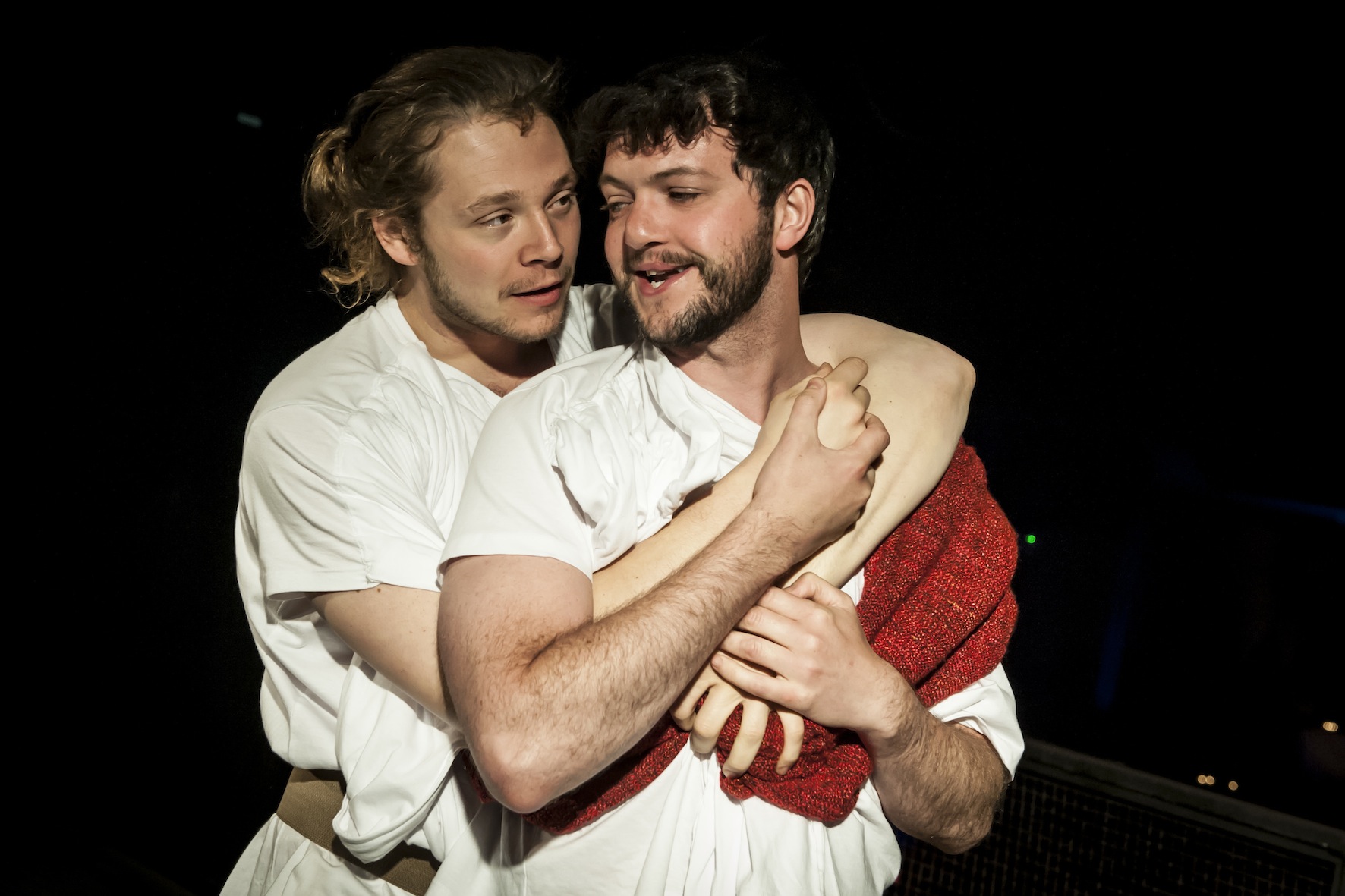
Iphigenia at Tauris, Rose Theatre

by Lidia Crisafulli

by Lidia Crisafulli

At the far edge of the Rose’s pool that preserves the remains of the original theatre, perches the temple of Diana. Blue and purple lighting reflects in the pool; waves are heard lapping at the shore. This is Iphigenia’s world where she serves as a priestess to the goddess on the island of Tauris, ruled by King Thoas. He loves Iphigenia and respects her wishes, but wants to kill the foreigners who turned up on the coast. She wants to not only save them, but escape with them.

Using rich, imagery-laden language, Goethe has adapted Euripides original tragedy, translated into English by Roy Pascal. The austere, Mediterranean set and rich sound design made this production a soothing but rich sensorial feast that compliments Goethe’s text. Unfortunately, unconnected performances and unvarying delivery from some of the cast who seem to focus more on the sound of their own voices rather than communicating their intentions makes a sleep-inducing affair.

The best work comes from Ben Hale as Iphigenia’s brother Orestes and his lifelong “friend” Pylades (Andrew Strafford-Baker). They contribute vibrant performances and excellent chemistry, a welcome respite from the indulgence presented to the audience prior to their entrance. Pylades’ comforting of Orestes as he is tortured by the furies for murdering his mother is the stuff fanfic is made of, it’s that homoerotic and genuinely lovely. Even though their behaviour is rather laddish (they came to Tauris to steal Diana’s statue from her temple), they are charming, passionate and a joy to watch. Their eventual clash with James Barnes’ Thoas is inevitable, but well contrast against Thoas’ steely reserve.

Title role Iphigenia (Suzanne Marie) is a complex character and could even be considered feminist despite the play premiering in 1779. Her reunion with her brother is underplayed, but her longing for her homeland is clear. She eventually uses her manipulation and womanly charms to talk down Thoas from attacking her brother and Pylades, but none of the character’s power comes across in the delivery that hasn’t altered from her opening speech. Marie shows obvious pleasure at speaking Goethe’s words but gives equal weight to most of them, causing much of meaning to be lost. Her pace could have done with being kicked up a few notches in more urgent situations, but her grief for her family was touching.

The staging was an excellent balance of the foreground and the rear of the archaeological site. It was used enough to not be ignored, but not so much that action was lost. The set and lighting from Diana’s temple along the back wall created plenty of atmosphere, even as a backdrop when the action was on the stage. Director Pamela Schermann worked well with designers Gillian Steventon and Petr Vocka to create such an evocative atmosphere. Sound design by Philip Matejtschuk really ties the rest of the design elements together. The constant waves remind on we are by the sea and perfectly suits the large pool that dominates the Rose. A cinematic soundtrack emphasises moments of conflict or suspense, ending in the start of a storm as Thoas relents. The only design letdown is the costumes. They attempt to replicate Greek tunics and robes, but they are obviously altered t-shirts held in with women’s belts and the footwear is painfully modern. Iphigenia’s flowing gown is beautiful though, and suitable to a temple priestess.

It is a play not staged often and one particularly suited for the unique space of the Rose, so it is disappointing that the lead performance let it down. Fortunately two of the supporting actors add life and energy to a beautifully crafted script. This is one of the most effectively staged productions I’ve encountered at the Rose with thoughtful design elements that can easily become the star of the show.


The Play’s The Thing UK is an independent theatre criticism website maintained voluntarily. Whilst donations are never expected, they are hugely appreciated and will enable more time to be spent reviewing theatre productions of all sizes. Click here to make a donation with PalPal.
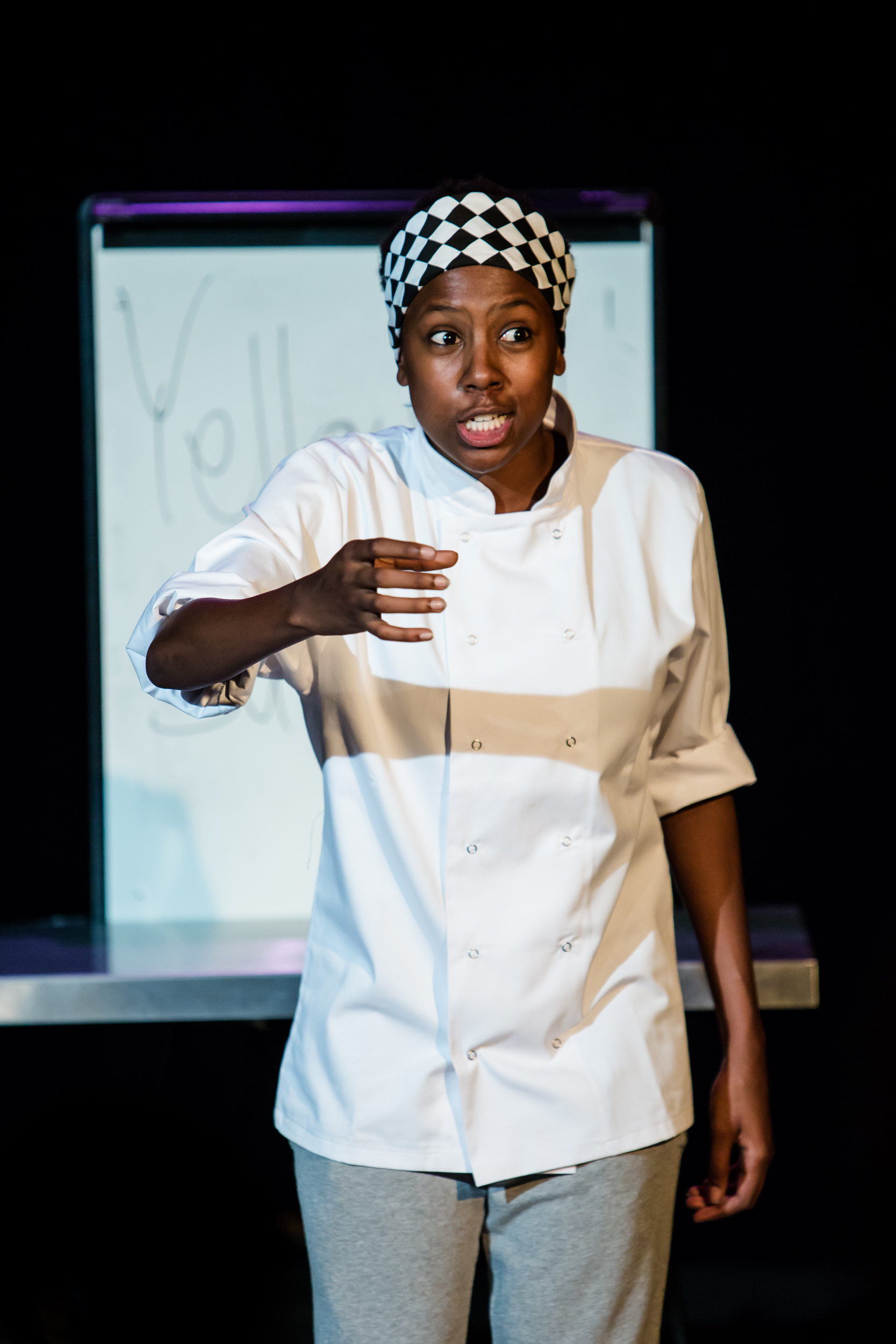
Chef, Soho Theatre

Chef, Ed Fringe 2014, courtesy Richard Davenport 035“Incredible innit, Food.”

Sabrina Mahfouz’s Chef is a one-woman play in the kitchen of a women’s prison. It’s no Orange is the New Black, though. Jade Anouka’s nameless chef shares her passion for food, recipes and stories of broken families and prison life. Anouka’s captivating, nuanced performance and Mahfouz’s poetic, imagery-filled verse holds the audience’s attention for nearly an hour without faltering.

Anouka’s performance is the primary pillar that supports this production’s success. With an innate musicality and unwavering energy, she balances the character’s true love for her work with the traumatic tales of an abusive father, a shady boyfriend and an incident that happened in her prison kitchen yesterday. Her interpretation both honours and personalises Mahfouz’s character, bringing an infectious optimism to a character that has endured so much hardship. Though this play probably works best in intimate theatres like Soho’s upstairs space, it is a great shame to deny larger numbers of people from seeing her performance.

Mahfouz’s writing is the next pillar that makes this story into a great play. Her use of poetry flips back and forth with street slang and swears, a continual reminder that not all inmates have limited vocabulary or intelligence but still keeps her believable. She gives us a truly human character with all flaws and perfections laid bare. She creates devastating empathy for this unnamed young woman doing so well at rising from the ashes of her childhood by becoming a fine dining head chef, only to be locked away for a crime she swears she didn’t commit. (Though all convicts swear their innocence, don’t they?)

Mahfouz and Anouka have worked together previously, on Chef and another play. These two clearly make a fantastic team, but both are excellent, established artists in their own right. Mahfouz is certainly a playwright to watch out for, and Anouka is a performer not to be missed.

Despite the stellar performance and writing, the scene transitions occasionally felt abrupt. Line delivery and technical transitions could have slowed down slightly, though that may have caused energy levels to drop. Another uncertainty is who the audience is in relation to chef. She is in her kitchen alone. They are not questioning her about her suspected involvement in yesterday’s incident, nor do they seem to be fellow inmates. Anouka addresses directly, so they don’t seem to be in her imagination, either. Her story keeps audience focus nonetheless.

As brilliant as Orange is the New Black is, the vibrancy and depth in Mahfouz and Anouka’s chef makes the show feel shallow and stereotyped. Even though it works excellently as a stand-alone short play, this is a character that should be seen again. This is not a production to skip over, despite its diminutive size and the fact it’s a one-woman show.


The Play’s The Thing UK is an independent theatre criticism website maintained voluntarily. Whilst donations are never expected, they are hugely appreciated and will enable more time to be spent reviewing theatre productions of all sizes. Click here to make a donation with PalPal.
Jekyll & Hyde, everything theatre

“…The most immediately striking aspect of this production in the set. The floor and walls are covered in quotes and mathematical equations, floor to ceiling…The set is simple, but effective in evoking Dr Jekyll’s mental torture…

“Rory Fairbairn excellently plays the polite and reserved Dr Jekyll. He easily captures his professional motivation, his fear of Hyde and his love for his friends and family. Especially his relationship with his loving wife Penelope, played by Elizabeth Bryant, is very genuine, which makes her agony over Jekyll’s breakdown truly moving. Her relationship with her father is less credible…

“Wyatt Wendels plays Mr Hyde, Dr Jekyll’s evil alter-ego who is released through Jekyll’s academic research. Always present behind the huge golden frame, he is a constant reminder of the evil within us all. This character needs some refining, though…

“There are a few moments when the staging is effectively used to create suspense and give the audience a scare. Plenty of fog and low lighting add to the spooky atmosphere, but there are plenty of opportunities to make the production scarier that remain untapped, which is a shame particularly in the lead up to Halloween…

“…Some adjustments and development would certainly enhance the experience, but overall Jekyll and Hyde is a fun, creepy play perfectly suited to the chilly autumn nights.”

Read the entire review on everything theatre here.

Mother Courage & Her Children, everything theatre

“Royal Arsenal, a former WWI munitions factory, occupies a huge site bordering the Thames in Woolwich…Teatro Vivo and Greenwich & Lewisham Young People’s Theatre exploit this unique setting to stage an intimate production of Bertolt Brecht’s famous play

“When scene one begins, we meet Mother Courage and her three children who trundle over from the other side of the park with her cart. Mother Courage is played by the excellent Denise Orita, who gives her a more modern, bohemian interpretation with plenty of attitude. Tomi Ogbaro plays her son Eilif and Dane Stephens is her other son, Swiss Cheese…

“Mother Courage’s mute daughter Kattrin, despite being limited to non-speaking vocalisations, evokes the most pity…

“Brechtian staging conventions were adapted effectively by director Sophie Austin. Brecht’s trademark placards are replaced by the Narrator’s jarring interruptions by the loud hailer, providing vital context to a play whose action spans such a large time period.

“There are plenty of songs and the writing leaves us unable to empathise with the cast. Instead, we are disgusted by the world they inhabit and the lack of humanity in the characters themselves…”

Read the entire review on everything theatre here.

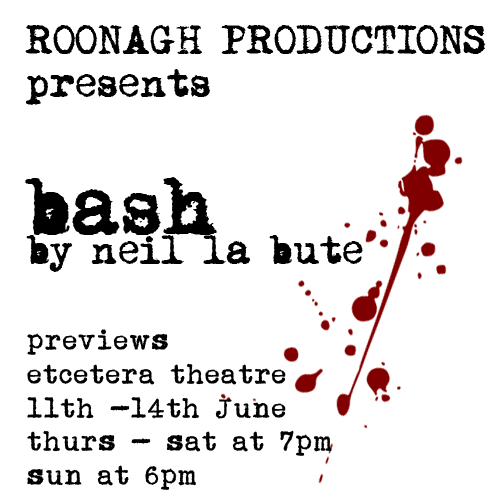
Bash, Etcetera Theatre

BashPoster_DetailsNeil Labute’s Bash is a distinctively 1990’s play containing three unrelated parts that are one-act plays in themselves. The component pieces have enough detail to stand alone and have unrelated characters, but a common theme: all of the characters are Mormon and commit horrific acts of violence. True to LaBute’s style, Bash exhibits the depravity that people sink to, despite these characters living on the supposed religious, moral high ground. This two-hander is the debut of Roonagh Productions, founded by Irish actors Stephen Gibbons And Sarah Purcell who perform all roles.

Act one. An unnamed man sits in his hotel room, sipping a glass of water. He has somehow convinced another guest to join him because he needs someone to talk to. What unfolds is the lengthy filicidal monologue from this fellow who seems to have it all: God, a wife, children, a good job. Gibbons initially plays the part nervously, not fully connecting with his character’s guilt. He finally relaxes when he moves onto talking about work and the fear of losing his job, but the first third of the scene had a constant, restrained delivery. When Gibbons connects his family to this prospect, all the pieces fall into place along with his performance. Though he could have more urgency and energy in the beginning of his speech, he eventually captures this calculatingly despicable man and unapologetically lays him at the audience’s feet for their self-righteous consumption.

Act two. A couple from Boston reminisces about a party in New York City they attended when they were students. Sue is sweet and wholesome; John is an all-American frat boy jock. Both characters are stereotypical and two-dimensional. Though there are two characters together on stage, they never talk to each other. Instead, they relay alternating lines to the audience in past tense, which has potential for tedium but Gibbons’ and Purcell’s work is dynamic and keeps the audience interested. John has a murderous, deliberate story similar to the man in first act, but Sue was asleep in the hotel room after the party and only has fond memories of the evening. The religion is more blatant in this story and a driving factor for John and his friend’s actions in a Central Park toilet at an early hour of the morning. The only particular issue in this part of the play is the choice of costume for Sue. If she’s a practicing Mormon, she certainly would not have worn a strapless dress.

Act three. Called “Medea Redux”, this is another monologue featuring Purcell in a police interview. Her story is by far the most complicated and sympathy-inducing but her crime is just as heinous as the previous two. When the woman was thirteen, she and one of her teachers had an ongoing affair; he then abandoned her when she fell pregnant with his child. She was fourteen. Driven to desperation by her lover’s abandonment of her, she repeats Medea’s final act of vengeance. Yes, her crimes are shocking but what is most frustrating is that she was the only character of the three criminals we’ve met who were caught. This is a much meatier role for Purcell, and she performs it with more nuance than she did Sue. This is the most interesting of the three stories, so fitting LaBute saves it for last.

The performances from the two actors are mostly good. There are a few accent slips and Irish intonations here and there, but perhaps not noticeable to British ears. Bash does feel rather dated now, but the writing and the characters are great. It’s an easy production to mount with little set needed, so a wise choice for a debut production. Purcell and Gibbons are older than your average early twenty-somethings thinking it’s cool to start a theatre company so even though there was nothing risky or inventive in this production, it was well done and chosen to suit their types and strengths. Besides, not all theatre has to be revolutionary. As long as its good theatre performed well, it is still to be commended.


The Play’s The Thing UK is an independent theatre criticism website maintained voluntarily. Whilst donations are never expected, they are hugely appreciated and will enable more time to be spent reviewing theatre productions of all sizes. Click here to make a donation with PalPal.
Pride & Prejudice, The Scoop

Nothing says summer quite like a spot of outdoor performance with a picnic. The Scoop between Tower Bridge and London Bridge is a great spot for such entertainment: a large amphitheatre on the river, with plenty of shops nearby in which to pick up food and drink to bring to the show. Best of all, the entertainment they lay on for the summer is free. The Pantaloons are at the Scoop for a few days before setting off on their summer tour with an adapted Pride & Prejudice is trademark Pantaloons style.

Fans of the novel and its various film and television incarnations are in for a treat, though this is unlike any Pride & Prejudice ever seen before. Five actors take on all the roles and add narration to keep the story moving at a brisk pace. They are decked in Regency costume other than brightly coloured trainers, capturing the feel of the play: genuine with a touch of playful irreverence. With the addition of improvisation, music and audience interaction, this is a jolly production that captures the joie de vivre of historical popular theatre.

Barring Alex Rivers as Elizabeth, the other actors multi-role, playing the more minor characters as panto caricatures. The Bennett girls’ friend Charlotte Lucas is a shallow, tea-drinking gossip. Christopher Smart is an amusingly pompous and geeky Mr Collins. Both Smart and the other male actor Edward Ferrow occasionally take on female roles, like a more sedate version of panto dames. These lighter moments involve much chatting with the audience and self-mocking any line fluffs. Wisely, the silliness is disregarded in favour of sincerity in the longer, more serious scenes. The show has the perfect balance between silly and serious, following Elizabeth and Darcy’s love story despite the compression of the plot. The entire cast give excellent performances, carrying though the challenge of working outdoors and attacking the script with energy and enthusiasm. They clearly love what they do.

Both audience and performers are relaxed and enjoying themselves. The script mocks more traditional versions of the story, but doesn’t take itself too seriously, either. With the audience free to come and go as well as the feel of a summertime community gathering, the event is reminiscent of The Globe, or a team of travelling players on their summer rounds to places great and small. Which is exactly what The Pantaloons are.

The play runs for about two and a half hours, with an interval. Whilst it is satisfying to see a full-length show for free, it began to feel like it could do with being shorter. Though the Scoop is a great venue, sitting on stone in the Thames wind does get rather uncomfortable after awhile. The length is probably more palatable in a sheltered park with deck chairs or blankets. Condensing the original novel to this length is commendable, but could do with being half an hour shorter. Considering the audience freedom, an interval isn’t particularly necessary either.

As The Pantaloons Pride & Prejudice travels through the country stopping off at scenic estates and venues, it is certainly worth catching this excellent example of summer popular theatre. Bring your friends, family and a picnic, and revel in the community enjoying and celebrating theatre accessable for everyone.


The Play’s The Thing UK is an independent theatre criticism website maintained voluntarily. Whilst donations are never expected, they are hugely appreciated and will enable more time to be spent reviewing theatre productions of all sizes. Click here to make a donation with PalPal.

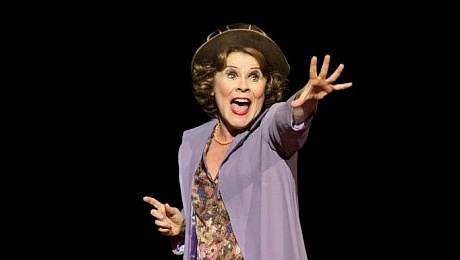
Gypsy, Savoy Theatre

23725_fullWhen you think of musical theatre you think of singing and dancing. Sequins and jazz hands. Sparkling smiles and happiness. More recent musicals have been experimenting hugely with structure and form, but written in the 1950s, Gypsy was ahead of its time. With a focus on the main characters’ journeys rather glitz and glamour, this production creates a new standard for outstanding acting in musical theatre.

Imelda Staunton is without a doubt the star of the show. Rose’s tenacity and gradual unraveling is played with nuance, conviction and unfailing energy. Peter Davison’s Herbie contrasts Rose’s brashness with a quiet devotion, creating a lovely dynamic but that painfully mirrors every failed relationship. Though Lara Pulver’s journey from the shy Louise to the cold Gypsy Rose Lee is inevitable, it taps into the vulnerability of all characters involved. Her naïve devotion completes a charming, though dysfunctional threesome that eventually crumbles. None of these three principal actors relied on hackneyed, two-dimensional characterizations that are so easy to adopt in musical theatre.

The book certainly helps, providing a vigorous, well-constructed skeleton on which the actors lovingly add meat and flesh. The only point when the book lets down the show in the final scene. In this case, the ambiguity is unsatisfying. The show could have ended earlier, when Rose finally comes to terms with her actions, or she could have been left by Louise to face the loneliness of a life alone. Otherwise, this genre-defining book musical holds up wonderfully.

The Savoy is a splendid setting for Gypsy, capturing the grand bygone days of vaudeville and the sort of houses Rose yearns to play. The Savoy juxtaposes the meta-theatrical set of the shabby world of the regional houses Rose’s kids actually play. It’s omnipresent, just out of her reach as a shadow she can’t see properly beyond the footlights, but one that adds to the audience’s visual experience immensely. The sequins and glitter Rose eventually encounters bedeck intimidating, crude burlesque performers signifying the demise of the grand old days of vaudeville and the decent into the more sexualized, desperate world of the Great Depression.

This production is one to see for those people that are not keen on musical theatre but want the experience of brilliant acting and character development. Of course there are songs and dances, but they are not the focal point of the show. This is a musical that brushes the genre, but doesn’t overwhelm with anything other than some of the best British talent gracing the West End musical stage.


The Play’s The Thing UK is an independent theatre criticism website maintained voluntarily. Whilst donations are never expected, they are hugely appreciated and will enable more time to be spent reviewing theatre productions of all sizes. Click here to make a donation with PalPal.

Troilus & Cressida, everything theatre

“A single, long table spans the width of the stage, brightly decorated for a party. As the sixteen strong cast conga in and fill the stage, there is clearly something to celebrate. The Trojans are winning the war and Troy is having a party…

“…Pandarus is Cressida’s camp, matchmaking uncle, well played by Matt Butcher. His performance is the best of the production. Troilus (Nicholas Farr) and Cressida (Colette O’Rourke) follow, with a genuine portrayal of young love and devotion…

“The entire cast is onstage for the whole performance, making transitions instant and effectively enhancing the setting…Due to the extensive cuts, fast pace and the constant presence of the ensemble, the smaller roles are rather indistinct…

“Other standout performances come from Charlotte Mafham as Cassandra and CJ de Mooi as Thersites…The rest of the cast deliver the language fluidly and skillfully. Director Ricky Dukes certainly knows how to choose performers with an innate sense for Shakespeare’s linguistic nuances.

“Dukes is an accomplished director, having been running Lazarus Theatre Company for several years. He is committed to approaching and reinventing Shakespeare for modern audiences…If you want to see high-quality, cutting edge fringe Shakespeare, see one of his productions…”

Read the entire review on everything theatre here.

Feature – Working Artists Far Away from Family: How Do You Start a Family of Your Own?

Lyn Gardner is calling for childcare reform in the theatre industry. In an article in The Guardian, she points out the need for childcare in the evenings to enable those working in theatre to do their jobs. As a parent herself, she states she, “would probably have dropped out too if I hadn’t been lucky enough to have willing parents nearby who could help out.” Natasha Tripney wrote a response in The Stage, interviewing two women working in theatre. The first quickly gives all the credit to her parents. The second, who co-runs a theatre company with her husband, also has childcare support from her parents. What also helps is that both women are established enough to be able to afford nannies and a couple of days at nursery. Parenting whilst working in the arts is clearly a possibility, particularly if you have family willing to share the responsibility of childcare and you are established in your. But what about those that do not have local familial support and do not have consistent work and income?

I am chatting with David, a box office assistant at a West End theatre, about the challenges of being a parent who works in theatre. Though he does not have the added complication of freelance work, shift work and late nights make childcare a micro-managed challenge. He says that as part of a small team, it can be tough to leave a shift even ten minutes early, but so far, he has not needed to make any major or last-minute demands. When I asked if parenting would be impossible without the routine of his partner’s nine-to-five, he replied, “Yes! Absolutely. Without the stability of one parent’s timetable to work around, it would be impossible for the children to manage all the changes shift work requires.”

David and his partner do not have a network of family to call on for childcare support. They rely on a good income and regular hours from one of them to enable the other to work in the arts. But what about the rest of us? Where are the freelancing couples that don’t earn enough to pay for childcare or have immediate family close by? This is a question I contemplate regularly as a thirty-something half of an arts working couple that would like to start a family, not one day, but soon. Sometimes I wonder if I’m fretting over nothing and if I should take the advice of well-intentioned friends and, “just go for it because it will all work out in the end.” Then I remember that my partner and I can’t even afford to rent a one-bedroom flat, let alone one large enough for raising a child. I cannot imagine my housemates would be pleased to share with a newborn.

Surely there must be others out there in similar situations. After a twitter and facebook callout, several responses reassured me that I wasn’t alone and reiterated a need for a cheap or free, flexible solution that those of us without family nearby can use without having to compromise our careers. I spoke to Laura, an actor in London and Sarah, an actor and artistic director of a company she recently founded in Manchester. Neither of them have children, but are in committed, long term relationships and hope to start families within a few years.

When asked what they would need to enable them to have children, Sarah immediately stated, “Access to free childcare! Regular free, or at least cheap, childcare!” Laura looks at the unreliability of her own income. She requires “a huge boost in notoriety…which would enable me to have a larger and more stable regular income or I’d have to give up my career for a family.” Money is clearly the problem. Cheap isn’t good enough, particularly in London with costs of living rising so steeply in comparison to wages. There isn’t much government support for self-employed people either, so financial support during maternity leave and early years is minimal.

What about taking a child to work with you? After all, the arts have the benefit of flexibility. Laura works a range of jobs to keep money coming in, including being “a massage therapist, science teacher, children’s entertainer, cabaret performer, corporate and events actor” in between acting roles. Looking at the responsibilities of these jobs, it’s clear that the majority of these roles would not suit having an infant or small child present. Of course, actors with financial stability and no need to day-job would be less affected by this. Sarah has her own company, but “I work from home…but I’m working, I can’t look after a child at the same time. I can’t be writing an Arts Council application whilst my 2 year old is downstairs putting their finger in a plug socket.” Something has to give, and it’s either work productivity or a level of attentiveness required from a parent.

Cameron’s government wants to increase the availability of childcare for working parents of three and four-year-olds. Whilst I question the sustainability of this in practice due to an already-stretched child workforce, this still doesn’t help aspiring theatre parents of children younger than three. What if you need someone to look after your infant whilst you pop to an audition for a few hours, but you can’t afford a babysitter, your partner’s working and your parents aren’t local? We may like to think we can rely on friends, but considering my own friends’ lives, they will most likely be working, busy or expect some sort of payment that I wouldn’t be able to afford.

Sarah imagines a formalized, local network of parents who work in the arts. When joining, you commit to exchanging free childcare services on an as-needed basis and sharing your contact details with everyone else. “For example, if you have a job last minute you could contact people on the list and see if they could mind your child for free whilst you took the work, then you would return the favour with their child.” There could be meetups, socials and so forth to add an element beneficial to the members’ creative work rather than just focusing on childcare. This model isn’t flawless in practice, however. Such a network would need to be large enough to make the chance of not finding anyone available incredibly slim. Parents would need to have contact details pre-programmed in their phones so they could send one text out to everyone, otherwise it could take up precious time needed to get ready and get to that crucial audition/interview/meeting. The network would need to cover a fairly small geographic area, otherwise the total travel time would become unworkable.

These issues return us to the root causes of this problem: the gap between the cost of living and childcare, and the generally low income of jobbing artists is widening. Government subsidies for the self-employed are not enough, either in quantity or flexibility. Artists who live near their families or earn enough to pay for childcare may not be in the minority of creative parents, but there is an invisible demographic of the arts world that want to start a family but their current circumstances make it impossible to do so without compromising their career aspirations. None of the artists I spoke to had any concrete solutions that would enable them to become a parent whilst maintaining a career in the arts, and neither do I. Meanwhile, I feel like my time to become a parent is rapidly diminishing in a world of ever-increasing financial instability. I therefore need to open the question outwards: what do we do about low-income artists that want to start a family and don’t have family able to assist with childcare?


The Play’s The Thing UK is an independent theatre criticism website maintained voluntarily. Whilst donations are never expected, they are hugely appreciated and will enable more time to be spent reviewing theatre productions of all sizes. Click here to make a donation with PalPal.

So It Goes, Greenwich Theatre

SOITGOES_CMYK_1

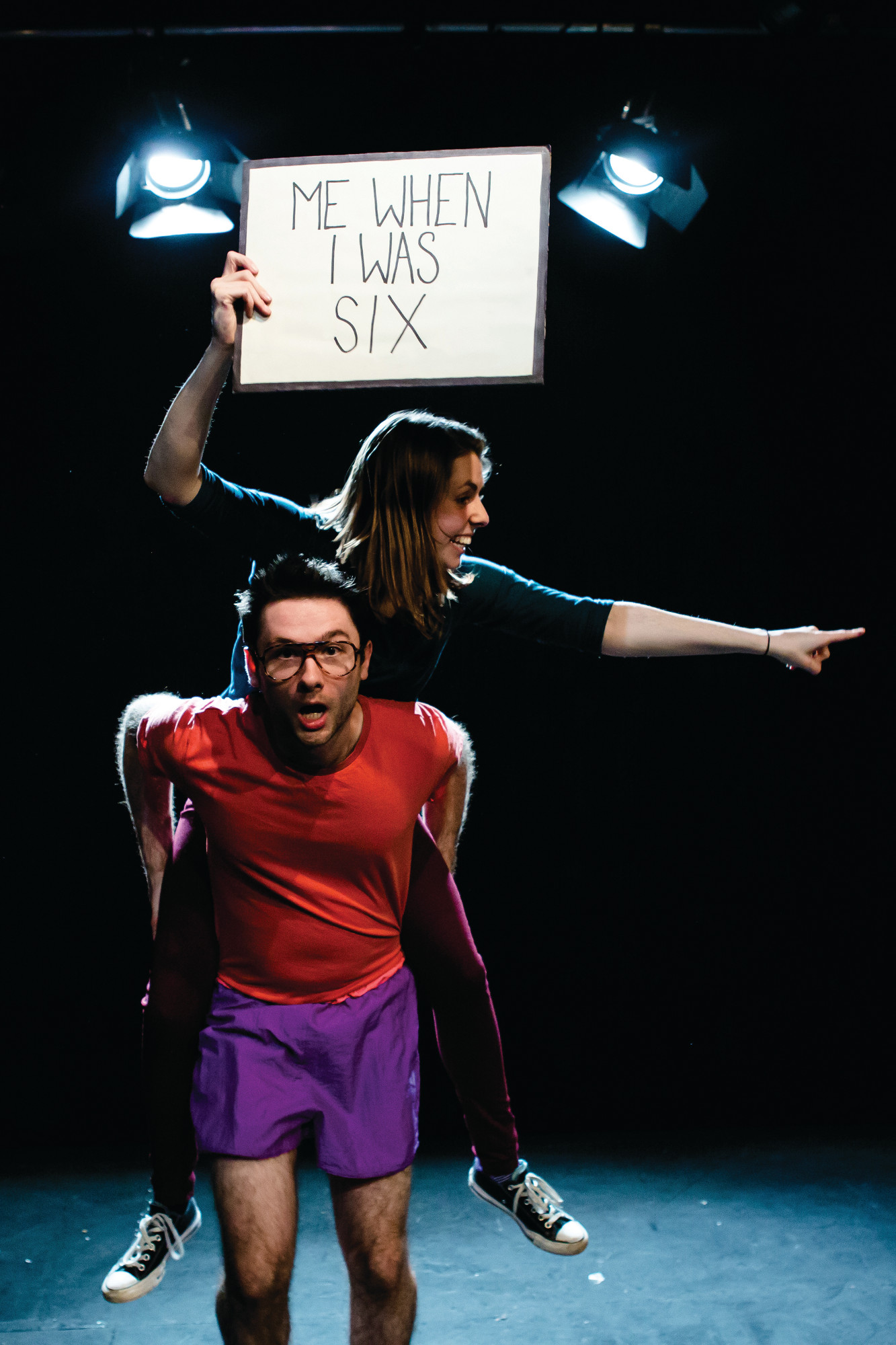
Hannah used to love running with her dad. When she was 17, her dad died and Hannah kept on running, silently and alone. She refused to speak about his death with anyone, including her family. So she decided rather than to navigate the burden of speech, she would create a silent play that tells her dad’s story and her process of dealing with his death. So It Goes is a sweet two-hander that manages to avoid over-sentimentality by focusing on the honest, deeply individual story of navigating life after the death of a parent.

Other than the last line, there is absolutely no speech in this play. All text is written on small whiteboards worn around the actors’ necks or on pre-made signs. This keeps written communication basic; it is rather like watching a comic book or graphic novel being written. This could occasionally feel slow and it was often easy to predict what was coming next on the whiteboard within a scene, but not overly so and not often. The set and props are also simple, with signage and symbolic items representing other characters and jumps in time and place. Most props are drawn outlines of objects, adding humour and a sense of youthful play to the story. The physical performance style matches- it is exaggerated but simplified, physical theatre but not ornate, embellished or for the sole purpose of showing the actors’ physical prowess. So It Goes wants to tell Hannah’s story as clearly and simply as possible, focusing on truthfulness and emotional honesty. The look of the play would certainly appeal to children, but accessing adults’ inner child makes the experience of losing a parent a journey that ends with positive reflection rather than the bitterness of loss.

The performances are equally lovely. Hannah Moss plays herself, and has “help” telling the story from David Ralfe, who plays her Dad and Mum. Ralfe in drag has an initial hit of comedy, but he taps into Mum’s outward expression of hopelessness that soon makes the audience forget that it’s a bloke in a dress. The two actors embody an exaggeration familiar to children’s theatre that is also in keeping with the cartoon aesthetic of the production, but is not crude. If they did not employ the exaggeration or humour in their physical comedy, it would make audiences want to slit their wrists. Instead, there was a lot of sniffling and nose blowing mixed in with laughter.

This is the third play I have seen about death in recent weeks. Each production used a dramatically different approach to convey the same message. Hannah spelled it out for us by writing that her dad “didn’t just die, he lived.” There’s an overabundance of factors in the world that can easily depress us and forget to look for the little moments of daily joy in our own lives, but So It Goes provides a celebratory reminder to do so through a pared down, visual-textual hybrid of physical theatre. Though the tour has now finished of their debut production, On the Run Theatre is certainly a company to watch.

Intention: ☆ ☆ ☆ ☆ ☆

Outcome: ☆ ☆ ☆

Star Rating: ☆ ☆ ☆ ☆


The Play’s The Thing UK is an independent theatre criticism website maintained voluntarily. Whilst donations are never expected, they are hugely appreciated and will enable more time to be spent reviewing theatre productions of all sizes. Click here to make a donation with PalPal.