Love, Lies and Taxidermy and Scorch, Edinburgh Festival Fringe

First loves: awkward, hormonal milestones of young adulthood that make you feel like you’re on top of the world in a bubble that’s just the two of you. That is, unless you’re a trans or gender fluid teen who is still exploring gender identity, or someone with extensive family problems. But issues like these, when married with a youthful story of falling in love, make for some powerful and moving theatre.

Love, Lies and Taxidermy compares falling in love for the first time to living in a film. With narration incorporating stage directions, short scenes reminiscent of quick cuts and a wonderfully ridiculous conclusion, the play feels like a teen romcom, but has enough substance to ensure it isn’t total frivolity. It’s fluffy, sweet and addresses how social class can effect young love.

Set in Myrthyr Tydfil where all road lead to Tesco, Ash and Valentine meet at hospital when they’re both waiting to see if they qualify for paid medical trials. Ash’s dad is on the verge of bankruptcy, and Val’s parents are separated so he wants to send them on a cruise in hope they will fall in love again. The tentatively begin dating, but life has a way of interfering with their time together. Ash has other ideas to earn some quick cash courtesy of an aspiring filmmaker college mate, but devoted Val vehemently opposes them. Cue a mad dash adventure to rescue Ash from her poor choices and live happily ever after.

There are a few lose ends in the narrative that get forgotten in favour of the “boy rescues girl” plot line, like Val’s quest for money for his parents. They could easily be trimmed to get to the point faster, or developed further to make a more fully-formed story.

The cast of three display remarkable energy as they play all the roles. Remy Beasley and Andy Rush are Ash and Val, the young couple who clearly fancy the pants off each other. Rush, though the hero, goes against the stereotypical popular lad who wins the girl through violence and strength. Awkward and geeky, his devotion to the bold and brassy Beasley is utterly adorable. Beasley’s confidence also goes against the romcom trope; she most definitely does not want to be rescued even though she doesn’t want to make the money in the way she has chosen.

The ending, however unrealistic, charms and delights. Though there is no set to portray the described splendour, the text more than makes up for its absence. The intimacy of the Roundabout suits this play well, though a larger venue would give more scope for design.

Scorch takes a different tone from Love, Lies and Taxidermy, though it also has a generous helping of youthful optimism about love. Kez, a bio-girl who dresses as a boy when not at school Orr home, has met Jules online and is smitten despite the “cool dude” exterior. This story has a darker outcome what with the complexities of gender identity and disclosure as it reinterprets the classic coming-of-age tale.

Kez is perky, accepting and generally at peace with her discomfort in a female body. Amy McAllister embodies the role with verve and charisma, making the audience sympathetic to consequences that arise from not telling Jules that she has a female, strap-on wearing body. The character’s good intentions are sweet, but not enough to save her.

Kez grows up quickly over the course of the story, and the Internet gives her a wealth of information to help her explore her gender identity and legal options. Her social media accounts facilitate meeting girls, and it’s all too easy to set up alternative profiles that portray her as a boy. It also helps her find a local support group, so the sword that is growing up in the digital age is well and truly double-sided.

This is a well-formed script with several layers. Whilst it is a powerful piece of storytelling as a solo performance, introducing additional actors to take on other roles would add depth to Kez’s experiences. McAllister uses the space well, though the opportunity to fully engage with the audience is missed.

Both productions are generally excellent examples of storytelling. The differing perspectives on teenage love are delightfully nostalgic and provocative without becoming twee or trite. The Roundabout enhances their intimacy, but limits scope for design and staging. These two plays would be served just as well, if not better, in a larger space that enables them to extend their production values.

The Play’s the Thing UK is committed to covering fringe and progressive theatre in London and beyond. It is run entirely voluntarily and needs regular support to ensure its survival. For more information and to help The Play’s the Thing UK provide coverage of the theatre that needs reviews the most, visit its patreon.

World Without Us, Edinburgh Festival Fringe

https://www.thestage.co.uk/wp-content/uploads/2016/08/World-Without-Us-700x455.jpg

Imagine the world if the entire human population disappeared suddenly, without a trace. What would it look like after a day, a month, a century, an era? A lone performer from Belgian company Ontroerend Goed methodically describes how the theatre space we sit in would change as a focal point within the wider world’s transformation. Delivered in a near monotone on a stage bare except for a grey obelisk, World Without Us is a meditative account of our solar system’s lifespan, and humanity’s inconsequence in the great scheme of planetary existence.

Karolien De Bleser quietly narrates this epoch-spanning journey of our planet with matter of fact coolness. What she describes really is remarkable in its compressed state, but the almost total lack of inflection makes the text pedestrian even in its most dramatic moments. Her movement around the space is relaxed and random, to look for meaning in it feels silly what with the story she tells.

With the ability to focus on the story without the mind drifting to topics such as what to have for lunch, the overall effect is a sense of calm acceptance that our lives, whilst impacting the planet immediately, really don’t matter. Our absence has little effect other than the gradual decay and burial of the artefacts we leave behind. Even in periods of environmental turmoil such as we see in the planet’s history, the impact is meaningless.

Even though the sun eventually swells and engulfs the Earth before it dies, all is not lost. Lightyears away, a single human artefact remains with a friendly but assumptive purpose. Its contents are, depending on one’s world view, absurd or incredibly beautiful. Perhaps they are both.The whimsy of human invention is particularly poignant at this moment.

World Without Us is a lovely, contemplative piece of performance and would work particularly well as an audio recording. As theatre, it could come across as flat, or upsetting or remarkable, depending each individual’s world view. Calmly provocative, it is wonderfully wide open to interpretation and effect.

World Without Us is now closed.

The Play’s the Thing UK is committed to covering fringe and progressive theatre in London and beyond. It is run entirely voluntarily and needs regular support to ensure its survival. For more information and to help The Play’s the Thing UK provide coverage of the theatre that needs reviews the most, visit its patreon.


Lucy, Lucy and Lucy Barfield, Edinburgh Festival Fringe

https://theplaysthethinguk.com/wp-content/uploads/2016/08/e379c-dsc_03212b2528courtesy2bmichelle2bwormleighton2529.jpg

The dedication at the front of The Lion, The Witch and the Wardrobe reads:

My Dear Lucy,

I wrote this story for you, but when I began it I had not realized that girls grow quicker than books. As a result you are already too old for fairy tales, and by the time it is printed and bound you will be older still. But some day you will be old enough to start reading fairy tales again. You can then take it down from some upper shelf, dust it, and tell me what you think of it. I shall probably be too deaf to hear, and too old to understand a word you say but I shall still be, your affectionate Godfather,

C. S. Lewis.

Lucy Grace, long feeling a strong kinship with the book’s protagonist Lucy Pevensie, clung onto the belief in Narnia well into adulthood. When she was 26, the dawning realisation that she would never reach Narnia suddenly hit her. With a sense of crushing loss, she turned to her well-thumbed copy of the book to search for clues that might refresh her once-dependable escape from life’s hardships. Previously skipped pages were poured over for clues, leading to the discovery of the book’s dedication – a revelatory moment for Lucy Grace. There’s a real Lucy! Perhaps she knows more about Narnia and can help her rediscover its wonder as an adult! But who is she?

Lucy, Lucy and Lucy Barfield sweetly documents Grace’s search for the real Lucy, about whom there is little information. This quest leads her down the rabbit hole of contacting Lucy’s father’s estate, researching at the Bodleian Library and interviewing Lucy’s best friend. A research project doesn’t sound like it would make dynamic, compelling theatre, but Grace manages to do so with great success on this solo show.

Grace’s performance is excellent. She has a gleeful charisma and innate sense for storytelling that keeps the audience’s attention. Her childlike wonder at each discovery is infectious. Hints of her background and struggle come through somewhat, though the script is far from self-indulgent.The design, mostly piles of cardboard boxes, lacks the delicacy of the story even though they allude to the archives Grace trawls through searching for details about Lucy’s life.

Lucy Barfield died in 2003 from MS. There is still some mystery around her life, and some of Grace’s findings directly conflict each other. But the creative young woman who danced, wrote poetry and music who inspired one of the country’s greatest writers and academics helps Lucy Grace renew her belief. Lucy, Lucy and Lucy Barfield is a lovely little story of adventure and discovery.

Lucy, Lucy and Lucy Barfield runs through 29th August.

The Play’s the Thing UK is committed to covering fringe and progressive theatre in London and beyond. It is run entirely voluntarily and needs regular support to ensure its survival. For more information and to help The Play’s the Thing UK provide coverage of the theatre that needs reviews the most, visit its patreon.
People of the Eye, Edinburgh Festival Fringe

https://www.thestage.co.uk/wp-content/uploads/2016/08/People-of-the-eye-David-Monteith-Hodge-700x455.jpg

Elizabeth has two daughters. Her youngest is “fine”. Her eldest has profound hearing loss. This diagnosis, in our able-bodied world with all its bias and privilege for those that are “normal”, is a hard one to take. Elizabeth wrestles with guilt, frustration and the never before considered world of adaptation to suit her daughter’s needs.

Theatre maker and actor Erin Siobhan Hutching grew up in a mixed D/deaf and hearing household. Collaborating with the Deaf & Hearing Ensemble, People of the Eye is her story, and those of families everywhere. It tells of parents, siblings, signing and secret languages. Projections and signing facilitates aid accessibility and support storytelling, creating a heartwarming montage of moments. The story is thin, but the message is clear: living in both the D/deaf and hearing world is a blessing.

Emily Howlett performs with Hutching as Elizabeth’s eldest. She signs as well as speaks and takes on several roles: a doctor, a sign language teacher and one of the two central characters. She and Hutching have a lovely chemistry and are generally believable as young siblings. Hutching also switches between Elizabeth and her younger daughter; these transitions are not always clear.

There is an added pedagogic element of Elizabeth taking a sign language class where the audience becomes the rest of the class. Though good fun, it is slightly forced – the story of this family is much more engaging than a lesson.

People of the Eye could certainly do with fleshing out, and its initial premise and structure are robust enough to withstand further development. The performances are engaging and they provide a lovely insight into family life with a disabled family member. The visual structure is a model for other productions seeking to increase their accessibility and can easily be applied to shows where deafness is not specific to the script. It’s a fantastic start with great potential.

People of the Eye runs through 27th August.

The Play’s the Thing UK is committed to covering fringe and progressive theatre in London and beyond. It is run entirely voluntarily and needs regular support to ensure its survival. For more information and to help The Play’s the Thing UK provide coverage of the theatre that needs reviews the most, visit its patreon.

Counting Sheep, Edinburgh Festival Fringe

https://i.guim.co.uk/img/media/23913cc392a98f67736cd3cdca806a6774c8940b/0_0_2048_1363/master/2048.jpg?w=620&q=55&auto=format&usm=12&fit=max&s=1feba80ccb7ff150a5842abd1e15ee76

Just over two years ago, a revolution in Kiev ushered in the downfall of the Ukranian government. Protests against the government’s refusal to sign pro-EU legislation lasting months had several violent outbursts that saw hundred of people injured and 780 killed. Toronto-based Ukrainian musician Marichka Kudriavtseva, in Kiev for work at the time, joined the protesters where she met Mark Marczyk, also based in Canada.

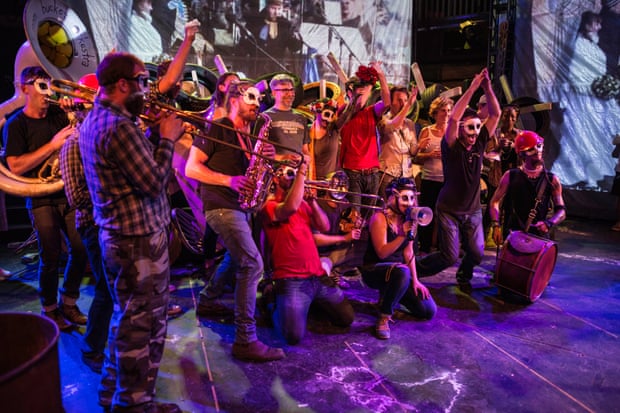
When the two returned from the Ukraine, they teamed up with Marczyk’s Lemon Bucket Orkestra to create Counting Sheep, an immersive “guerrilla folk opera”. A celebration of solidarity and the power of a collective voice, it also mourns those who died in the protests. Told from the perspective of the protesters, little is shared from the other side – but this rallying performance is fitting homage to not just the Ukrainian protesters, but those fighting government tyranny around the world.

Some audience sit around a huge table, whilst others sit on the sides of the space and still others up in a balcony. Klezmer or folk music is playing as the audience enters; there is a convivial atmosphere as the show formally starts. This is a party, or a wedding, or some other huge gathering, until the three screens display news reports of riots and police enter. The tone abruptly shifts, and the world that has been established is dismantled. It’s a wonderful, unsettling surprise.

The space is consistently reformed and redrawn using movement, and the audience is physically moved in the wake of the protesters’ gains and losses. They are willing and unquestioning, the sheep of the title. Though the numbers here obviously pale to those at the actual protest, incorporating the audience in acts such a building barricades and lobbing bricks at police fosters unity from disparate dozens. There is a hint of the solidarity and aggression found in protests, and joy and celebration from the audience who are keen to play. Being served food is also an important enabler that solidifies the unity the show aims to create.

Counting Sheep is hugely effective in its emotional manipulation, and also it’s storytelling through music, movement and projections. Choosing sheep as a metaphor is a curious choice, though. The benign but rather dumb livestock aren’t known for thinking for themselves and are susceptible to herding – otherwise, they wander around unproductively, getting lost and eaten by predators. Whilst the performers are the herders here, they are also in sheep masks, unempowered. Who then are the herders? The government? Unseen forces of political and social unrest? Whatever it is, us human beings are hugely susceptible to it when motivated enough, even if the metaphor isn’t totally clear.

Though sung completely in Ukrainian, there is a clear storyline conveyed through projections and movement. There is little nuance in this piece, but it a playground for the sweeping emotions of popular theatre. It provides at least a hint of the experience that the Ukrainian protesters endured, and powerfully unites the audience through the humanity of collective experience for a common goal. An excellent piece of theatre.

Counting Sheep runs through 29th August.

The Play’s the Thing UK is committed to covering fringe and progressive theatre in London and beyond. It is run entirely voluntarily and needs regular support to ensure its survival. For more information and to help The Play’s the Thing UK provide coverage of the theatre that needs reviews the most, visit its patreon.
Remember to Breathe, Equations for a Moving Body, Edinburgh Festival Fringe

https://s3.amazonaws.com/wos-photos-production/107110.jpg

Two women, in two different shows set on opposite sides of the world, swim as if their lives depend on it. One is training for an ironman-length triathlon, the other never learnt to swim and is doing so to overcome a fear of water. Equations for a Moving Body is Hannah Nicklin’s solo performance telling the story of her decision to complete an ironman and the research she did to discover what would happen to her body as she trains. Remember to Breathe follows fictional Maeve away from the safety of family and a secure job in Ireland, to world travels that eventually find her in New Zealand. Though Hannah and Maeve approach swimming completely differently, the sport shapes who they are and how they deal with obstacles that come their way.

Maeve and her kiwi husband Grant are back in Ireland when the Christchurch earthquake hits. The Celtic Tiger has been and gone, and their business is struggling so they decide to head to the southern hemisphere to help rebuild. It’s here that Maeve discovers a pool in the wreckage, staffed by the relentlessly perky Doreen. In that pool, Maeve gently catalogues her life through her relationship to her father. He and Doreen fade in and out again like memories in this quiet, reflective piece on family and finding your place in the world.

Liz Fitzgibbon as Maeve has a calm strength and enigmatic presence. This everywoman of a character with relatable struggles trying to find peace is a reassuring story to witness, though the lack of outright conflict between characters makes for a sleepy pace.

Julie Sharkey as Doreen and David Heap has Maeve’s earthy, grounded father are great foils constructed by writer Orla Murphy. As well as Maeve’s personal journey that she comes to terms with through swimming, there’s a pointed throughline of the effects of the economy on the common man – a clever inclusion making the script universally relevant.

Maeve swims and came to it in her adult life, but Hannah is a swimmer and has been doing so since she was four. Hannah explains the difference between “I swim” and “I’m a swimmer” and the role goals and life events have in shaping one’s identity. Her decision to complete an ironman in the year she turned 30 becomes a part of who she is and how she lives her life, and Equations for a Moving Body is the moving story of the ups and downs of pushing your body to its limits.

The most engaging focus of Hannah’s story is the people she meets along her training journey. She has a gift for making John, Tom and the various scientists she meets along the way come alive, even if they only feature for brief moments. These encounters provide landmarks that make her story stand out from anyone else’s and excellent focal points of her narrative structure.

The story’s climax is the triathlon, with peaks and troughs that are magnified versions of those in her training. It’s a hugely satisfying and emotional end to a story of struggle, grief and triumph. Those who aren’t much for sport or fitness who find her initial goal baffling are on side at by the finish line.

Nicklin uses live internet use to support her story and add a visual element to the production. Though simple, it’s a great choice. These are almost all accompanied by her narrative, though one section is poignant in its silence and elucidates the source of the show’s name.

Hannah cements her sense of self through her training and its end goal, and Maeve finally finds the peace she is searching for. Both productions are lovely, if very different stories of personal discovery at Summerhall.

The Play’s the Thing UK is committed to covering fringe and progressive theatre in London and beyond. It is run entirely voluntarily and needs regular support to ensure its survival. For more information and to help The Play’s the Thing UK provide coverage of the theatre that needs reviews the most, visit its patreon.

Macbeth: without words, Edinburgh Festival Fringe

https://i0.wp.com/edinburghfestivalguide.co.uk/wp-content/uploads/2015/11/Macbeth-Without-Words-Ludens-Ensemble-Photo-by-Chrysa-Karagianni.jpg

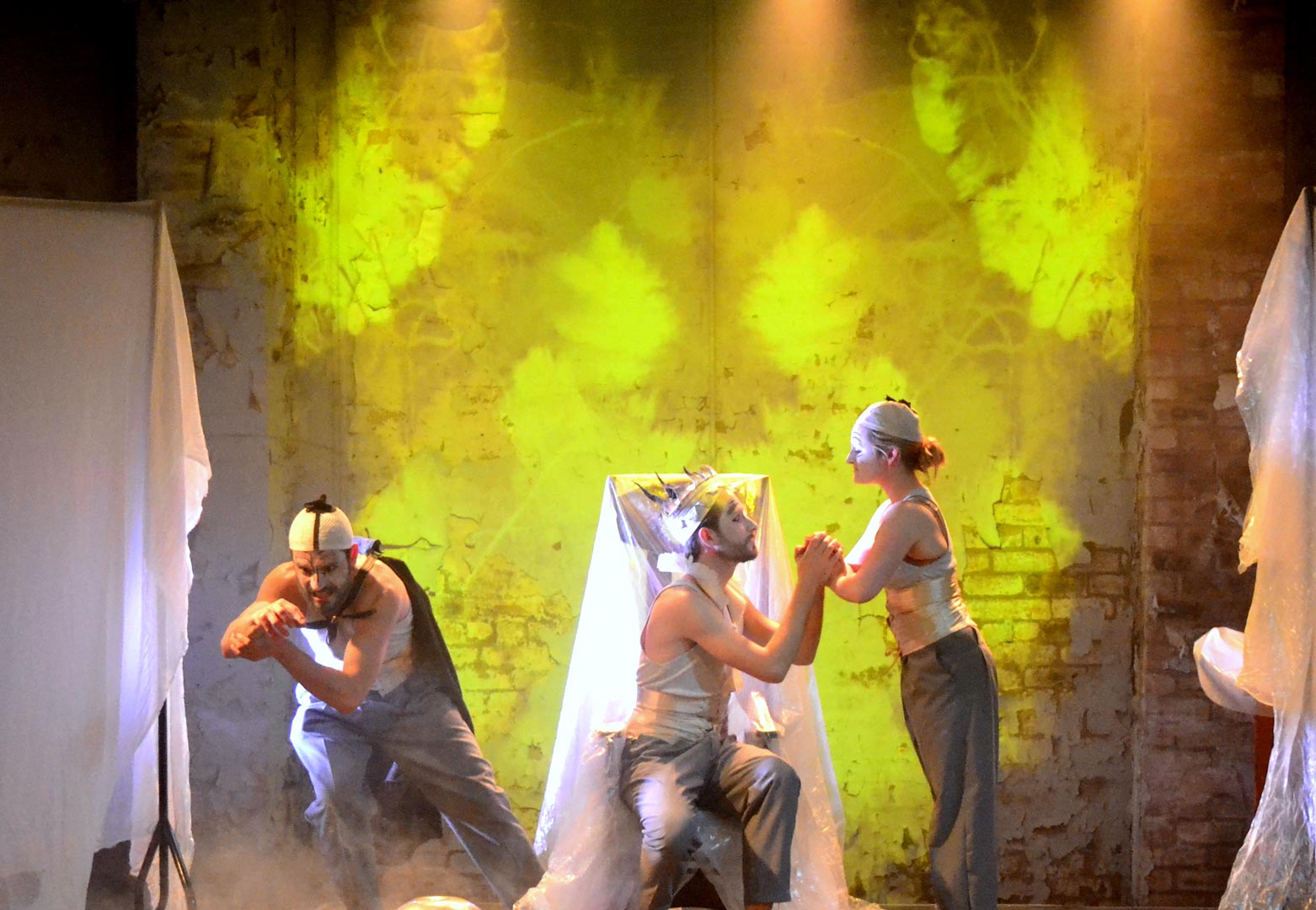
Shakespeare without words. What’s left? In Ludens Ensemble’s Macbeth: without words, plenty. Drawing on the aesthetic of silent films and Victorian gothic with the near-constant use of live sound mixing, a trio of performers playing all roles conveys the story effectively through movement and subtitles. This spooky adaption taps into the heavy darkness and supernatural elements of the story in an easy to follow and visually compelling production.

The design is the most striking element of the show. Greyscale, sexless costumes are the base for elements of victoriana – waspies, a skeletal skirt, capes and papery crowns. Large screens and dust sheets host an array of productions, from silent movie captions to abstract splodges of colour. Haze is used liberally, but it actually feels appropriate to this production to create fog over the heath. The dust sheets are also cleverly used to create ghostly apparitions and shadows, though these could be used more often as a design motif. Two microphones and prerecorded sounds are mixed live to create rich soundscape of suspense and violence, though silence is used to highlight powerful moments of suspense.

The two men and one women are strong physical performers evidently influenced by theatrical clowning and animal work. Their focus and intensity are unwavering, especially as Macbeth’s torment grows. Expressed outwardly, this becomes the centre of the story.

Though there are a few extracts of text, stage directions and summaries projected, Macbeth: without words would be hard to follow without knowing the story already. A freesheet with a plot summary would go a long way to ensure all audience members are catered for. Some of the scenes could use lengthening to reflect their importance to the story, particularly the banquet scene.

This is a visually stunning adaptation of Shakespeare’s play that in no way underserves the original by stripping away the text. Ludens Ensemble create a vocabulary of movement, images and sound that feels just as rich as Shakespeare’s.

Macbeth: without words runs through 29th August.

The Play’s the Thing UK is committed to covering fringe and progressive theatre in London and beyond. It is run entirely voluntarily and needs regular support to ensure its survival. For more information and to help The Play’s the Thing UK provide coverage of the theatre that needs reviews the most, visit its patreon.

Exactly Like You, Edinburgh Festival Fringe

https://i0.wp.com/www.underbellyedinburgh.co.uk/images/made/images/uploads/1000w-x-640h-px_750_500_60_c1.jpg

Things have never been easy for Abby. She doesn’t get on with her mum, she’s didn’t do well in school, she drifts from one shitty job to another without any purpose or goals. She misses her Nana, with whom she would spend long hours writing fantastical stories and listening to music. Nina Simone was their favourite. In Exactly Like You, Lotte Rice tells Abby’s story through a moving, passionate spoken word monologue on losing her way and finding it again.

Rice’s way with words makes Abby funny and relatable, the sort of woman you could sit down with over a pint or a cup of tea and natter about all and sundry going on in the world. She would always have a story or an anecdote to share that would make you laugh or think, or both. Her decision to make Abby a working class, down-at-heel character so expressive and articulate through spoken word is a fantastic choice rather than catering to the stereotype of working class young people as grunting cokeheads who only live for nights out on the piss. The piece is punctuated with soulful renditions of Nina Simone’s songs, effectively breaking up the dense text. Though Abby’s story isn’t remarkable in itself, the mode of telling it is hugely refreshing.

Designer Elouise Farley and lighting designer Zanna Woodgate work together to create a landscape of glowing bookcases, the sort that fit vinyl records. Though simple and subtle, they capture the inner warmth of Abby’s Nana who lived for music of all sorts. They are her memories of her time with Nana, always present and always driving her forward, and a lovely addition that makes the piece feel more polished than a bare stage.

When Abby hits rock bottom after yet another night out drowning her painful memories with too much whiskey, an unexpected helping hand appears. Fortunately, this is not some benevolent, condescending force sent to save her. Abby’s journey is one of reflective self-discovery told in an engaging, lively format with fantastic music to boot.

Exactly Like You runs through 28th August.

The Play’s the Thing UK is committed to covering fringe and progressive theatre in London and beyond. It is run entirely voluntarily and needs regular support to ensure its survival. For more information and to help The Play’s the Thing UK provide coverage of the theatre that needs reviews the most, visit its patreon.
Please Excuse My Dear Aunt Sally, Edinburgh Festival Fringe

https://www.thestage.co.uk/wp-content/uploads/2016/08/please-700x455.jpg

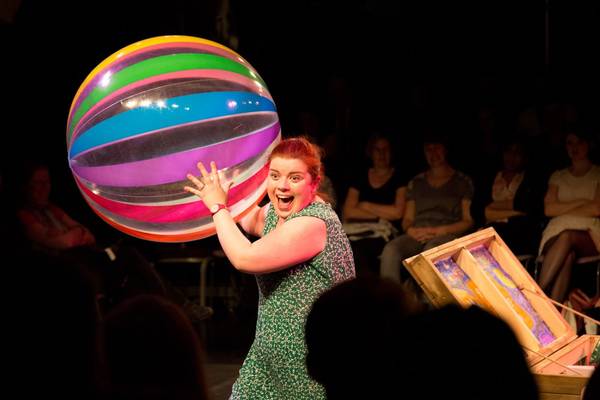
When fourteen-year-old boy Red starts at a new school after his parents’ divorce, his mum anxiously worries about him making friends. Soon, his mobile is constantly buzzing with texts and he’s out most evenings. Mum’s happy but she only sees the life Red constructs especially for her. Someone, or rather something, else has the privilege of an uncensored view – Red’s mobile. As the vulnerable boy is sexually exploited by his unsatisfied maths teacher, his phone sees everything and narrates the story around the characters’ interactions. This slick ensemble piece by NY theatre company One Year Lease seamlessly merges writing styles, design and physical theatre to tell a dream-like story of abuse veiled as love.

When Red’s maths teacher confiscates his mobile and accidentally takes it home with her instead of her own phone, she begins a downward spiral of communication that quickly becomes personal. Red’s parents separation is far from pleasant, and his teacher’s boyfriend is an unemployed layabout, with vague dreams of designing apps. This combination fosters a relationship where the teacher and the student inappropriately confide in each other, and she does nothing to stop it.

Suspicion helps propel the action upwards towards a climactic end, but a lack of consequence in Kevin Armento’s resolution is as disturbing as the story itself. The phone as narrator is a great device – it’s present enough to add context and framing, but is not overused to the point of becoming a gimmick. Abstract movement incorporating versatile set pieces adds a striking, dynamic visual and a disconnect from reality appropriate to a forbidden relationship. A live musical score by Estelle Bajou enhances the surrealism of the staging.

Mathematical equations coldly explain how their illicit affair develops, and minimalist design in black and white juxtaposes the intricacies of the complex lives that collide so inappropriately. Though the script avoids blatant condemnation of the relationship, Please Excuse My Dear Aunt Sally is a striking blend of visual and verbal storytelling.

Please Excuse My Dear Aunt Sally runs through 28th August.

The Play’s the Thing UK is committed to covering fringe and progressive theatre in London and beyond. It is run entirely voluntarily and needs regular support to ensure its survival. For more information and to help The Play’s the Thing UK provide coverage of the theatre that needs reviews the most, visit its patreon.

Declaration, Edinburgh Festival Fringe

rsz_cpgj-xixyaaoghq

Sarah wants to know everything. She’s inquisitive, gregarious and energetic, the life and soul of any party. But now that she’s in her thirties and wants to start a family, she needs to sort out some of her issues. So, she goes to a doctor to talk through all the behaviour quirks she’s had since childhood – the trouble sleeping, the irrational impulses, the disorganisation, the obsessions.

Diagnosis: ADHD.

Now that she knows what the problem is, does it really solve anything? Will a label help, or hinder? Will medication change the person that she’s always been and actually quite likes? Declaration is an honest, heartwarming solo performance that resonates with those of us who have always felt a bit different or care about people who are a bit weird or quirky. Written and performed by Sarah Emmott, with energy and charisma that’s undeniable, Declaration needs a few minor adjustments to make it an even slicker show.

Emmott’s script has the consistent theme of wanting to please but pesky impulses to do all sorts of irrational things get in the way. As an adult, she has developed coping mechanisms (which she marvelously demonstrates with audience help), but as a child, she was a loose cannon. The story of her childhood picks up once she introduces the superhero personal she invented for herself and a doll, Samantha, who is everything that she never could be. The opening exposition, though having important information, lacks the punch and the belly laughs that these sections have. Additionally, some of her transitions need clarity; consistent use of sound, lighting or changing props would help indicate a scene change.

Emmott develops a marvellous rapport with the audience from the moment they enter the theatre. She has the sort of natural magnetism that cannot be taught in any drama school, an innate quality that actors either have or don’t. Laughing and chatting, her stated need to know everything and everyone is evident. The audience rallies to her wide-eyed wonder, and snarky comments about school, doctors and other frustrations get plenty of laughs.

As Sarah works out how to get through life and a diagnosis has the potential to either change everything or nothing, the audience is with her the entire way. She uses props and audience interaction effectively, though she could use tech to further enhance the theatrical experience. Her lovable on-stage persona is a charming reminder that anyone we know may be struggling with mental health, learning or behaviour issues, and even though a few tweaks could be made to improve the show, she dares us to accept her, flaws and all.

Declaration was a one-off performance.

The Play’s the Thing UK is committed to covering fringe and progressive theatre in London and beyond. It is run entirely voluntarily and needs regular support to ensure its survival. For more information and to help The Play’s the Thing UK provide coverage of the theatre that needs reviews the most, visit its patreon.