
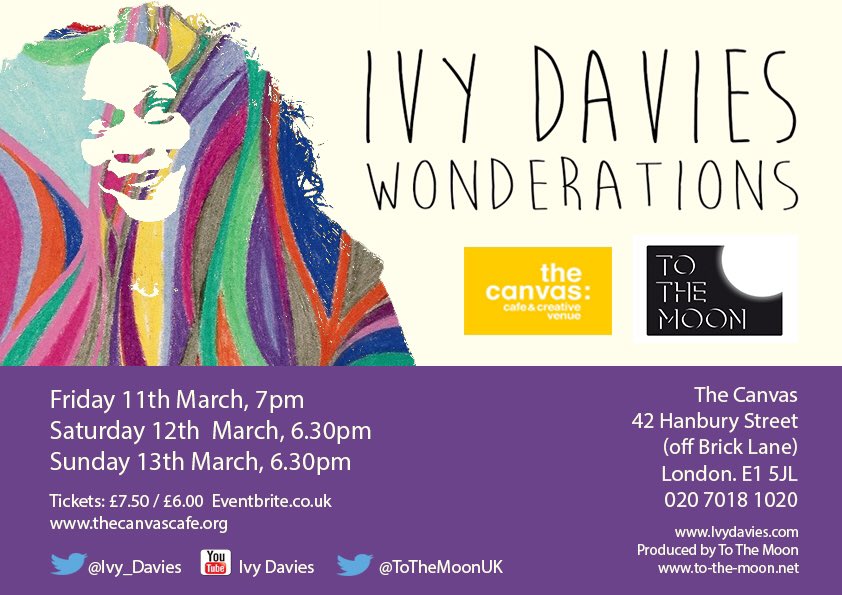
Sunday evening was a night of new discoveries. The Canvas Café, just off Brick Lane, serves homemade cakes and prosecco by the glass. It also has walls you can write on and a cosy downstairs performance space. In that space was Ivy Davies and her show Wonderations, a gentle, joyful blend of spoken word, songs from her EP and questioning whether or not Mickey Mouse is actually God. Though lacking in narrative, Davies’ performance shares issues that are particularly personal: aging and her search for identity and faith. With a touch of live art about it, Wonderations is a lovely celebration of self-acceptance akin to reading Davies’ journal.
This isn’t a visual show, but a totally aural one. It could easily be listened to through headphones or with eyes closed, though her soothing melodies and rhythms could lull you to sleep – it’s that relaxing. There are some powerful sentiments in her lyrics and poetry that deserve full attention, however. As Davies struggles to find her pre-marriage and babies self in theatrical songs and rhymes, one can’t help but to relate to her frustration with finding her true identity buried under all the nonsense life throws at us. We all find ourselves wasting hours on social media focused on constructing an image, or immersing ourselves in work and forgetting to just be present in the world for lengthy periods, but Davies exhorts us to let all of it go. She’s like a life coach, but a gentle one who uses cuddles rather than shouting.
This cabaret-esque structure feels conversational, but is precisely and satisfyingly scripted. There’s no plot to speak of, but with Davies wearing the form like her own skin, it works. Her spoken word isn’t the pounding, angry sort I’m accustomed to; it’s full of flowers, sunshine, rain and claiming her own ground. Davies has an immovable strength and presence, but one that overflows with positivity. Less connected from her celebratory songs and spoken word is what feels like an internal monologue where in looking for faith, she wonders if God is actually Mickey Mouse. He’s been seen around the world at the same time, and has plenty of purchasing power. It’s a wonderfully funny, and pointed, argument, though less clear on it’s place in the show’s structure.
Ivy Davies’ Wonderations is a hard show to pin down, but it doesn’t apologise for that. I’m pretty certain that she’s confident enough to not care what anyone thinks of her work, but the themes it contains are universally human presented in an easily digestible format. An excellent event for a quiet Sunday evening, particularly with a slice of cake and a glass of prosecco.
The Play’s the Thing UK is committed to covering fringe and progressive theatre in London and beyond. It is run entirely voluntarily and needs regular support to ensure its survival. For more information and to help The Play’s the Thing UK provide coverage of the theatre that needs reviews the most, visit its patreon.

![rsz_img_6902[1]](https://theplaysthethinguk.com/wp-content/uploads/2016/02/rsz_img_69021.jpg?w=646)

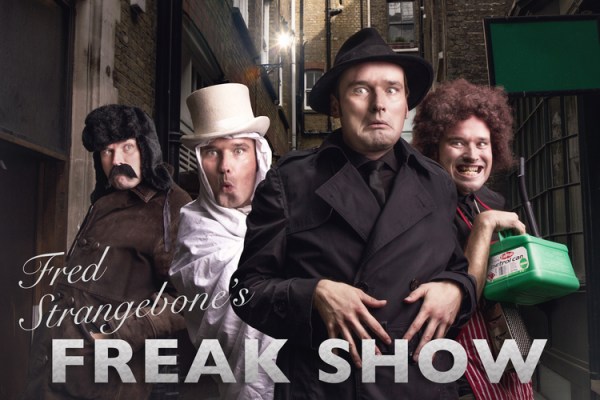 I’m watching Ben Whitehead play a socially inept Victorian playing a half-walrus/half-man creature, indicated by the wearing of a hooded grey sleeping bag, blue swimming flippers on his hands, and paper tusks precariously attached to his face with a false moustache. I’m pondering the life choices I’ve made that led me to this moment as well as whether or not the character-based stand up/absurd solo performance/live art/Victorian freakshow satire/old-fashioned variety show that unfolds before me is one of the greatest pieces of theatre I’ve ever encountered, or the worst. It may possibly be both. I still haven’t decided, and may not ever do so, let alone by the time I finish this review. Fred Strangebone’s Freakshow violently mashes up genres in a bizarre yet often-hilarious piece that manages to be both straightforward and bafflingly random.
 A male photographer is photographing a female celebrity who is tired of being so superficial. She wants this photo shoot to show her “true self”. She wants to be “real”, and we’re all hanging out in the studio with them in Action Hero’s Wrecking Ball. Audience expectations are immediately challenged on entry when invited to grab a beer from a cooler onstage, and this boundary remains blurred for the duration. Communication is attempted between the two characters, but neither is really listening and what they say doesn’t really have any meaning, pointedly ironic in characters striving for stripped back honestly. The performance is both funny and uncomfortable as the audience watches their professional relationship cross into the manipulative personal. This is a text-based performance with imagery rich language highlighting the absurdity of their encounter, but it triggers a good amount of reflection on our own behaviour. We all carefully construct our images, particularly in social media, yet at the same time we want to be genuine (whatever that means). This is an excellent, polished piece that is provocative in subject and the actor-audience relationship.
 Search Party’s My Son & Heir is without question the funniest thing I’ve seen this year in Edinburgh. Real-life couple Pete Phillips and Jodie Hawkes playfully examine the prospects of their young son, born in the same year as ‘baby Cambridge.’ The two little boys have little in common, though. Pete and Jodie share their hopes for their son in a cheerful, pink chaos that soon disintegrates into relentless judgments on their parenting methods and a stream of ‘what ifs’ capturing the anxiety and pressure to raise a perfect child. The message evokes sympathy and reflection, even from those without children. It’s an outstanding blend of comedy and social commentary on the perils of being an ordinary parent without heaps of cash to throw at your child. Their gleeful, child-like anarchy quickly turns vicious, creating pointed contrast between the haves and have-nots, but ends in a message of love. Perhaps the ending tends towards sentimental, but in a world where money is a large factor in success and a good life, it is also an ending of hope.
 Last up is Christopher Brett Bailey’s This Is How We Die, a spoken word and music performance that is deceptively simple but leaves you with overloaded senses and a feeling of having traveled around the world at a million miles a second. When I first saw This Is How We Die at Battersea Arts Centre several months ago, I was so moved that I wrote two responses:
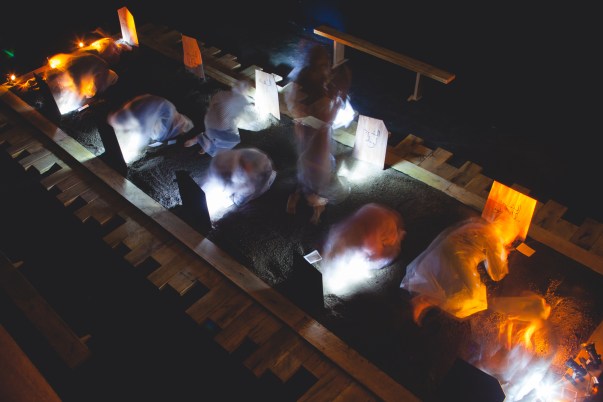
  A walk to a “secret location” ends in a dimly lit warehouse for Volcano’s show about the effects of coal mining. It is a promenade production that literally destabilises the audience, who have to walk over a floor covered with large chunks of the black stuff. Four actors taking on roles both historical and fictitious physically capture miners’ suffering in horrific working conditions. Disappointingly, in a piece with such a focus on introducing the characters at the beginning, their individual stories are neglected in favour of the visual and aural. Some of the metaphors make sense, like the animalistic dining scene showing the reduction of the miners to baser creatures, others are less clear. I still don’t understand the incorporation of Anna Karenina and playing cricket in their pants. Black Stuff is surreal and abstract, but so much so that any message or idea trying to be communicated is almost completely lost.
 Late Night Love is a sweetly nostalgic, and very funny, piece revolving around a phone-in radio show the three members of Eggs Collective listened to as teenagers. Having not grown up in the UK, I missed a lot of the cultural references, but the teenaged idealism about love and relationships is universal. Power ballads and dating conventions are gently mocked, but lovingly remembered. The two-way radios on each table are underused, but an interesting device that places the audience inside the radio show listened to in the dark. Though quite structurally loose at this point, it’s a show that speaks fondly of a specific era and development stage of teenage girls.
 Made in China’s Tonight I’m Gonna Be the New Me blurs the line between truth and fiction through founders Tim Cowbury’s and Jessica Latowicki’s real-life relationship laid bare onstage. The premise is that Tim has written the show that Jess performs as Tim runs the lights and takes notes at the back. Jess dances inside a metal box wearing sequined hotpants and a halter top, an object for our delectation, and presumably Tim’s. She soon hijacks the script that descends into the two picking at each other’s faults, empowering herself as the audience are voyeurs of their argument. What is truth and what is fiction? This blurring is far more interesting to consider than the argument typical of a long-term relationship that unfolds. The made-up story of Tim’s death returns the piece solidly to fiction, again made more interesting in the idea of fantasizing about a partner’s death (we all do it!) than the story itself. I expected the content of Tonight I’m Gonna Be the New Me to be far edgier than it was, though the ideas within the performance are certainly fascinating on several levels.
 The Play's The Thing UK