Killed: July 17th, 1916 for everything theatre

“…On first impressions, the superior set evoked the patriotic idealism of small town England at the start of WWI. It was so well-designed and well made by the talented Dave Benson, that it would easily have been at home on West End stage…

“The play uses a non-linear structure to tell the story of Billy Dean, a volunteer solider from Bradford, sentenced for cowardice in the face of the enemy…The best element of this production is the script and story…Even though the ending is rather abrupt, to alter it would take away from the harsh circumstances.

“The performances are good, but not outstanding. This is mostly because the characters were written without a great deal of depth but they still suit the story as they are…

“The costumes were of a high calibre for fringe theatre…costume designer Lorena Sanchez’ creative talent certainly shined through. Sound designer Max Thompson’s relentless bomb blasts during scene transitions became predictable…We certainly never forgot the world of the play was amidst the front lines of WWI.

“This is a story that definitely needs to be performed again. Director Elizabeth Elstub handled it clearly and simply, without any complex directing trickery…”

Read the entire review on everything theatre here.

Romeo & Juliet, everything theatre

“Lauderdale House is the Elizabethan-era home of a former Lord Mayor of London… Behind the house, Shooting Stars Theatre Company perform their modern take on Shakespeare’s Romeo & Juliet

“Romeo (Joe Sargent) is a sensitive, intellectual hipster who hangs out with Roisin Keogh’s tomboyish Benvolio and Graham Dron’s oversexed, brash Mercutio. They drink, smoke, probably do drugs and generally make a nuisance of themselves…Sargent’s relationship with Emily Loomes’ Juliet is flawless, turning my insides to mush by the interval…

“Rory Fairbairn (Peter/Balthasar) gives us some excellent multi-rolling and physical comedy. Maxwell Tyler has a forbidding presence as the Prince and a sleazy, Cockney Paris. Ruth E. Mortimer, playing Capulet as a cold, corporate businesswoman, is all the more disturbing whilst arranging her daughter’s marriage…The whole cast is fantastic…

“The fight choreography (using flick knives and unarmed combat)…occasionally felt a bit mechanical…

“The second half struggled to find momentum initially…As it got dark, the dimming light reflected the darkening of the action even though it made it harder to see…

This is a truly excellent production with clear, creative directorial vision in a gorgeous setting. Hie thee to Highgate and catch it before it goes.”

Read the entire review on everything theatre here.

Rhesus, everything theatre

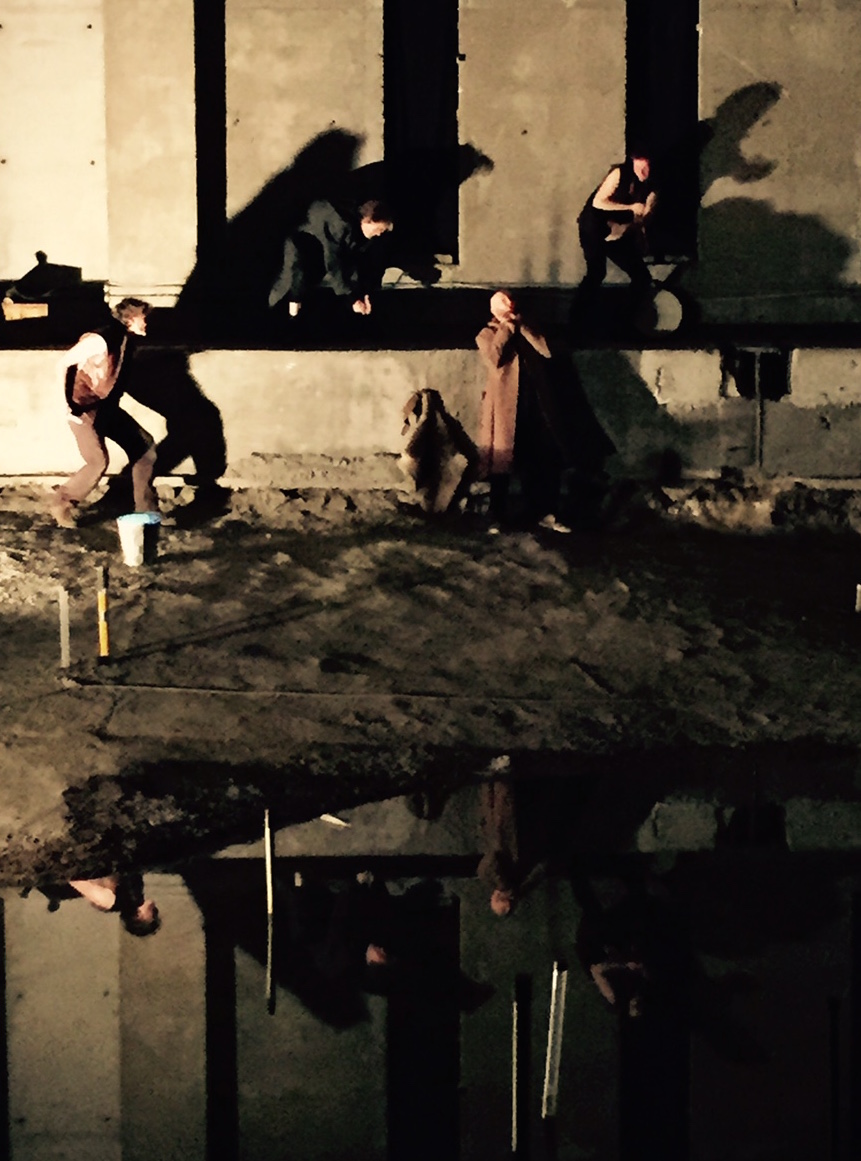
“Trinity Buoy Wharf was new to me as a venue, but certainly worth the trip. It is far from a conventional performance space…There is no obvious stage or audience space…Excellent lighting design by Pablo Fernandez-Baz gives this stark, damp basement with challenging sight lines a polished, professional feel. The set by Zahra Mansouri is minimal, but suits the space well and the audience sit amongst it, included in the world of the play…

“…There is absolutely no actor-audience boundary initially, but this changes when the play properly starts. From then on, there is no contact from the performers…

“The text is spoken well and all of the actors seem comfortable with heightened language. The cast is predominately female…Whether or not it was intentional, due to the cast being very young (late teens to early twenties, I’d guess) it carried a disturbing reminder that many who fought in our past wars were young and child soldiers are a very real tragedy in many places around the world today…

“The most notable features in this production are the regular movement sequences between the scenes. Some are abstract, some capture the brutality of battle and killing. All of them are impeccably choreographed and directed by Ailin Conant of Theatre-Temoin

“The performances in this ensemble piece were good, but as is often the case with very young performers, few stood out. No one was particularly weak but neither was anyone outstanding…

“The venue is certainly worth experiencing in this well-designed production of a rarely performed play. Though a showcase, it is certainly not a difficult one to sit through.”

Read the entire review on everything theatre here.

Super Premium Soft Double Vanilla Rich (LIFT Festival), everything theatre

“One of the first things that struck me about Arts Depot’s main theatre is how comfortable the seats are…It may seem trivial, but after seeing numerous productions in hot pub theatres on benches with straight backs…comfort does become important. The set was austere: two screen printed flats placed at a right angle showing the shelves of a modern convenience store and a small screen above for the projected surtitles…

“We quickly meet the two main characters. These young men work at the convenience store…Whilst there is no traditional narrative structure, we see snapshots of shop life…The absurdity of this corporate environment is obvious and makes me shudder to think how easy it is to be sucked in as a young person seeking purpose…

“This same absurdity comes through in the customers, we see one young woman who, upon discovering her favourite ice cream has been discontinued, has a meltdown…It is an existence of small tragedies, self-importance and the need to cling onto any kind of meaning in a cold, corporate world.

“Whilst the dialogue in the play tends to realism, the movement is abstract, expressionist and constant. It is mostly light and flowing; resembling tai chi…it loses meaning quickly and can be distracting…

“…It is a good piece of physical theatre and an excellent ambassador for the LIFT Festival.”

Read the entire review on everything theatre here.

Mugs Arrows, everything theatre

“…Visually striking yet incredibly simple, it immediately creates tension that carries on through the entire play and keeps the audience watching. The lights then come up on two men tensely playing a game of darts without speaking…As dialogue slowly starts, we gather that the two have just been to the funeral of a dear friend…Both Rhys King (Pat) and Eddie Elks (Ed) are clearly excellent performers who can skilfully use naturalism to create highly developed characters.

“What you perceive to be true is turned upside down when Sarah (Chiara Wilde) enters in a wedding dress and joins in darts game. Rather than a funeral, Pat and Ed have lost their best mate another way…With an inevitable violent end and convincing stage combat by Lyndall Grant, I thought the play had ended.

“But, no! Writer Eddie Elks surprises us. A final, joyfully weird scene takes everything you perceive to be real within the action and turns it upside down. You will leave with a head full of questions, but truly innovative theatre will have that effect...Whilst an incredible show for theatre folk, those who like their theatre conventional and commercial would struggle to watch this play…

“Go see this show before it closes if cutting edge independent theatre is your thing.”

Read the entire review here on everything theatre.

Shooting With Light, Greenwich Theatre

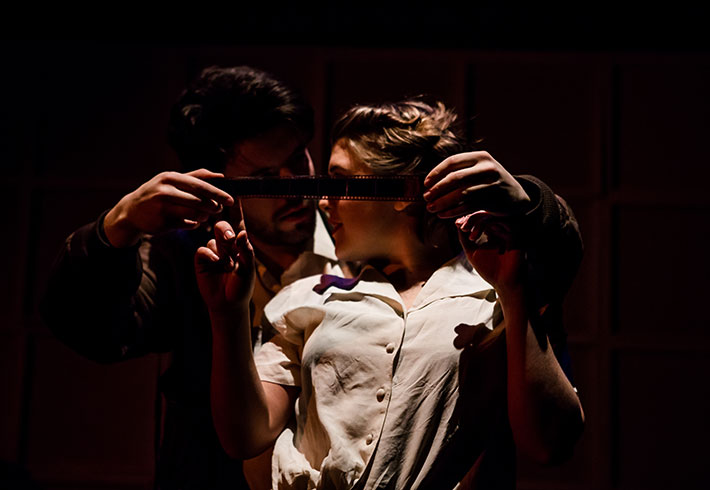
1930s Paris. Jewish Europeans are moving west to escape the rise of Nazism. Two of them meet: one of them is a Hungarian photographer, the other is a German activist. Both are full of youthful confidence and fearless in pursuit of their goals. Emerging company Idle Motion uses physical theatre, light, sound to tell the story of these young lovers, their legacy and the importance of photography.

Firstly, Shooting With Light is a loveShooting-With-Light_018 story. Two young people meet, fall in love and take the world by storm before ending in tragedy. These young people are Gerda Taro and partner Robert Capa (after they changed their names), pioneering photojournalists of the Spanish Civil War. Gerda and Robert start working together; Gerda is initially his assistant who supports him in reinventing his persona in order to make the professional contacts he needs to succeed. Her talent overcomes this role however, and she eventually develops an independent reputation for honest, brave documentation. Partly fictionalized but based on Gerta’s brief life, we see Robert teach her to use a camera followed by her passionate rise to renowned photojournalist needing to show the world the reality of life on the front lines. Alternating with this storyline is the time-jumping subplot of Robert’s brother Cornell and his assistant June, seeking to amalgamate Robert’s work after his death. They are frantically searching for a mysterious red suitcase Robert once spoke of in order to complete the archive of Robert’s work.

Interspersing the scenes of historical naturalism are transitions using visual and physical theatre, similar in style to Frantic Assembly. This is an on-trend performance aesthetic, but one that is visually appealing and provides another level of insight into the characters and their struggles. The most effective of these sequences show Taro and Capa falling in love over rolls of negatives towards the beginning, and Taro’s fight to access the front lines with her camera towards the end. The set is simple in appearance as several blocks and a white screen, but they transform using projections, light and a series of doors. Like their narrative, the structure is simple but highly effective and tells an excellent story. Projections of Taro’s work add further historical context and support the world of the play – the audience sees what she sees and experiences.

The company of five twenty-somethings work wonderfully together, and so they should as they met in secondary school. Shooting With Light captures the infectious enthusiasm and ambition of youth, no doubt mirroring their own attitudes that the world is theirs to have and success is a given if they work hard enough. It will be interesting to see how their work develops as they age and experience the challenges and hardships of working in the arts. As visually appealing as their work in now, it needs more depth of human experience. June and Cornell’s quest to locate Capa’s missing work is arguably the more interesting side of the story, but neglected in favour of Taro’s and Capa’s exciting lives and career progression. The ensemble also lacks diversity of age and ethnicity, something that I hope they increase in the future. Idle Motion have an obvious gift for storytelling and integrating various performance styles at this young age, so the world really could be their oyster as they continue to grow.

Intention: ☆ ☆ ☆ ☆

Outcome: ☆ ☆ ☆

Star Rating: ☆ ☆ ☆ 1/2


The Play’s The Thing UK is an independent theatre criticism website maintained voluntarily. Whilst donations are never expected, they are hugely appreciated and will enable more time to be spent reviewing theatre productions of all sizes. Click here to make a donation with PalPal.

Macbeth, Rose Playhouse

FullSizeRender-3 copyWith inventive staging, text deconstruction and some great performances, East London’s Malachites continue their takeover of South London following last month’s excellent King Lear with Macbeth at The Rose Playhouse. Director Benjamin Blyth approaches this unique venue head on, staging scenes in all parts of the concrete expanse that stretches beyond the pool of water protecting the remains of the Elizabethan Rose. Some moments were effective due to the grandiose scale, some did not work due to sight line issues and distance from the audience. Textual edits were similarly brave, rearranging sections to emphasize Lady Macbeth’s and the witches’ control over the fate of the play. Those dogmatic about the text would probably not appreciate such actions, but they are very much in the spirit of Shakespeare: celebrate language and the improvisational nature of theatre, do not slavishly bind yourself to the text. Overall, this is a confident, experimental production to be commended for its efforts and irreverent approach to the text. Some of the choices made did not work, but Blyth is still to be commended for his effort and conviction.

To open, Lady Macbeth reads the letter conveying Macbeth’s news from battle by candlelight. The action she reads about plays out at the back of the theatre, by the edge of the pool preserving the Rose’s foundations, like a memory or mental picture. Cinematic-style transitions break up her speech, hold a modern audience’s attention, but effectively tell the story. Choosing to begin with Lady Macbeth’s speeches and interspersing the opening scenes with them empower the character, emphasizing the control she has over her husband. This is blatant reconfiguring of the text, but it has a strong message, suits the storyline and creates a completely different tone from more typical productions. Orla Jackson gives a calmly fierce Lady Macbeth, who later on deteriorates from grief and remorse.

Following the initial rearranging of the text, the play carried on with some cuts, until the end, which was also untraditional but showed the cyclical nature of evil and the omnipresence of the witches. In this production, the witches were tall, spidery and male, almost entirely kept at the back of the site. This pulled focus from the action on stage at times and made it impossible to see detail such as facial expression, but they were well lit and cast intimidating shadows on the industrial back wall. They would have been a more powerful presence if brought onto the stage more than the once that they were.

The performances in this production were largely good, though not as consistent as last month’s King Lear. Benjamin Blyth is the highlight in the title role, playing Macbeth with outstanding nuance and emotion I have never seen in the part before. Beginning weak, he becomes more reckless but still dominated by a rich inner life of guilt, pain and fear. I daresay this is the best portrayal of Macbeth I have ever seen. Playing a role with such conviction as he did whilst directing the production indicates immense talent on Blyth’s part. Also notable is the versatile Robert Madeley as Banquo and the Porter (though his Banquo was the better performance) and David Vaughan Knight as a militaristic Macduff. Though he struggled to connect with grief upon hearing of the murder of his family, his stern, grounded performance provided lovely contrast to emotional Macbeth.

Blyth showed determination to use all available playing space at The Rose, placing a large proportion of the action on the far side of the archeological site. Whilst he does the space a service by not ignoring it, there are some obstructive railings and the distance caused visual detail to be lost. More of the action, particularly key moments in the plot, could have been moved to the stage closer to the audience. Clever lighting ensured everyone was lit well, but the presence of actors at the back of the site can distract for foreground action.

The Malachites are certainly a brave company, unafraid to adapt Shakespeare’s text to modern audiences and storytelling techniques. Blyth is a rising star worth watching. This company would benefit from more financial resources in order to add polish to their productions, but they are quickly becoming a key player in staging productions in unusual spaces.

Intention: ☆☆☆☆

Outcome: ☆☆

Star Rating: ☆☆☆


The Play’s The Thing UK is an independent theatre criticism website maintained voluntarily. Whilst donations are never expected, they are hugely appreciated and will enable more time to be spent reviewing theatre productions of all sizes. Click here to make a donation with PalPal.

Richard III, everything theatre

“Upon entering the theatre, a castle wall that looked like painted cardboard greeted me, and my heart sank. The set had the look of a budget Shakespeare production interpreted by enthusiastic amateurs, or something at home in a school hall…Fortunately, the set was an insignificant backdrop to some marvelous performances…

“The theatre company Custom/Practice claimed this production was a response to the upcoming re-internment of Richard’s remains. Expecting something current, I was confused by the mostly medieval costumes and traditional staging. The costumes, like the set, were redolent of a school or college production because of their inconsistencies…

“Director Rae Mcken made some excellent casting choices…Ousellam’s performance suggests that Richard charmingly murdered his way to the throne. His stage presence is magnetic and his verse handling flawless…Imogen Slaughter, as Elizabeth, is fantastic in her fight against Richard and eventual consent of his marriage to her daughter…Some of the characters could have used more development, such as Rebecca Loudon’s Lady Anne and Mott’s doubling as Richmond.

“Although nearly three hours with an interval, and despite the uncomfortable bleacher-style seating at The Cockpit, the production’s pace and energy ensured it did not feel that long…Mcken certainly has good ideas, but some could use refining…

“If a solid, well-acted Shakespeare is something you enjoy, this certainly hits the spot, as long as you overlook the design.”

Intention: ☆☆☆☆

Outcome: ☆☆

Star Rating: ☆☆☆

Read the entire review here on everything theatre.

The Verb, To Love and Portia Coughlan, Old Red Lion

Love, loss and obsession: Aria Entertainment’s double bill explores these themes with dramatically different outcomes. New British musical The Verb, To Love follows college lecturer Simon’s attempts to find a lasting relationship after breaking up with his boyfriend of 23 years. Mid-90’s Irish play Portia Coughlan shows the title role’s failure to function in day-to-day life whilst clinging to memories of her twin brother who drowned 15 years previously. Both productions, which can be seen singly or one after the other, depict emotion in its most raw, desperate state with committed performances and unique design elements.

The Verb, To LThe Verb, 'To Love', Old Red Lion Theatre, 29 April - 23 May 2015. Copyright Claire Bilyard -16ove by Andy Collyer is a two-hander but focuses almost exclusively on Simon (Martin Neely). He falls in love with fellow teacher, the wide-eyed, much younger Ben (Gareth Bretherton) after a breakup. Simon sings us the story of their friendship progressing to a reluctant confession of love, but there is no happily ever after. Several years later after building a successful career, Ben decides its time to move on even though doting Simon would do anything for his “baby boy”. Simon’s songs then journey through the stages of grief and forays in online dating until he finds peace with his houseplants.

Though billed as a musical there is little spoken dialogue. The contemporary musical theatre songs continuously flow into each other with few breaks and Ben doesn’t enter until he breaks up with Simon halfway through the show. Until their breakup, we hear their story exclusively from Simon’s perspective. Ben doesn’t interject often after he arrives, making this almost a one-man show. Even though it was only an hour, it’s a long time for Neely to sing almost continuously, which he does splendidly.

This is clearly a musical under development, but it has plenty of potential. Simon’s character is detailed and well developed; Neely adds plenty of nuance. The songs have enough variation to not sound too similar, but with a strong motif. It would not take much to make this a full-length show: more scenes, more Ben, and possibly some other characters – though The Last 5 Years proves a two-hander works beautifully, particularly when telling the rise and fall of a relationship. More substance will also help dilute the sentimentality, though it was never cloying. Focusing the bulk of the story on Ben and Simon’s relationship gave the show a sturdy narrative arc rather than showing a snapshot from Simon’s life. There was no dancing, lighting changes corresponded with emotional intensity and the flowery parkland set reminded the audience that there is light at the end of every tough time. I look forward to seeing The Verb, To Love develop and hope Aria Entertainment stages it again in a more fully formed state.

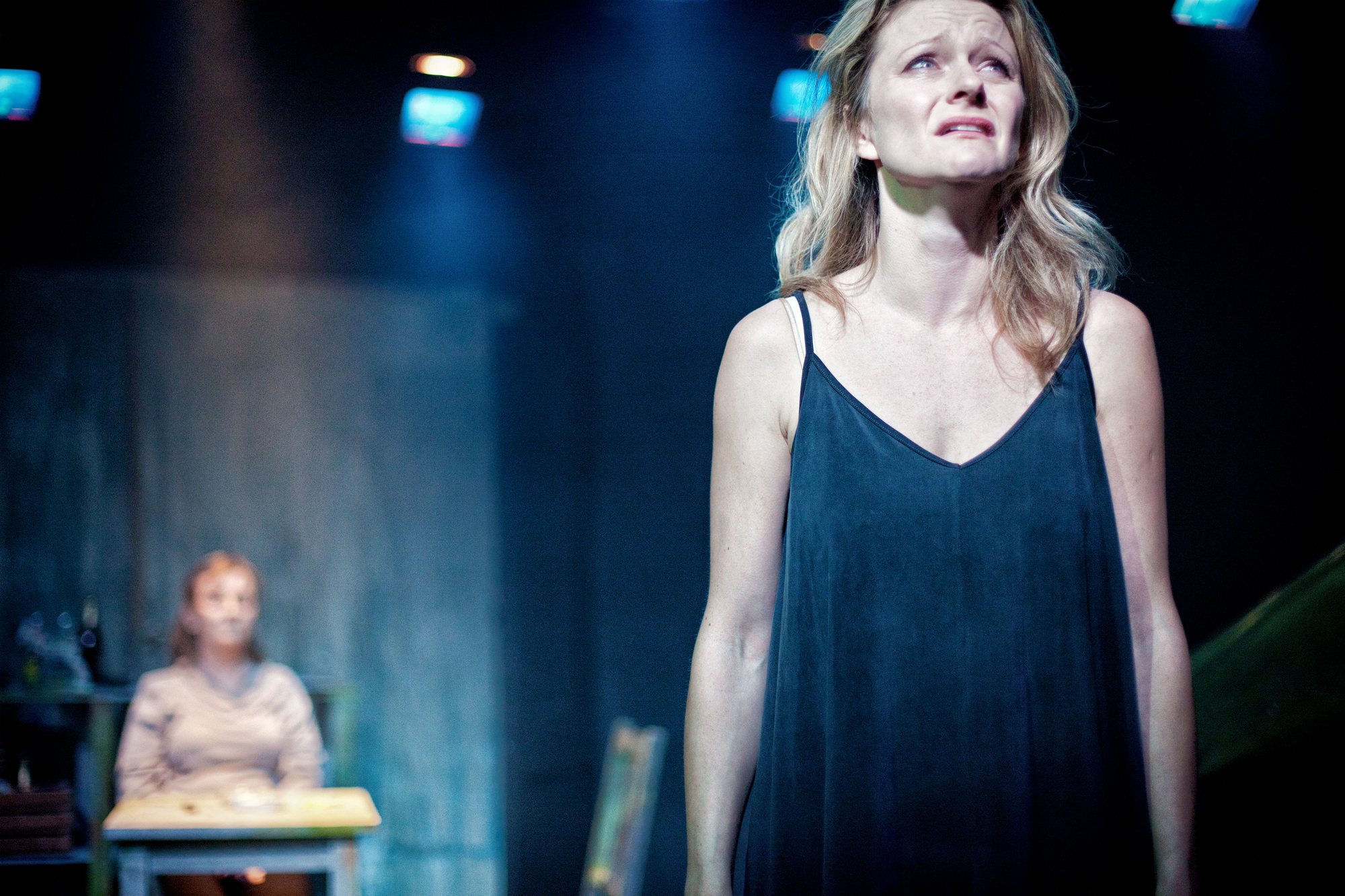
Marina Carr’s Portia Coughlan is mPortia Coughlan, Old Red Lion Theatre, 28 April - 23 May 2015. Copyright Claire Bilyard -42uch darker and more complete fare. Set in rural Ireland, Portia celebrates her thirtieth birthday. Fifteen years ago tomorrow, her twin brother drowned in the Belmont River that runs behind her father’s farm. She never recovered from his death, despite having a life that reads perfectly on paper: a wealthy husband, close family and three sons. Susan Stanley plays tortured Portia with a coiled spring intensity that never relents, even when drinking and flirting in the local pub. The verdant, grassy floor from The Verb, to Love remains, but a pool of water is Belmont River and a rustic kitchen set is her country home. The lighting is darker and ethereal music draws attention to the appearances of Portia’s ghostly brother, Gabriel.
Similarly broken people with hidden family secrets inhabit Portia’s world. Her parents pop in uninvited and berate her for not fulfilling her wifely duties. Her paternal grandmother abuses her and her mother relentlessly. Her best friend Stacia helps Portia with the kids, but only has one eye and needs of her own. Her patient husband Raphael (Ben Mulhern) does his best to look after their children when Portia says she wants nothing to do with them, as she’s afraid she’ll harm them. She never wanted to be a mother. She never wanted to marry Raphael. She doesn’t really want anything to do with this world at all, instead dwells on her brother’s death. She tries to distract herself with love affairs, to no avail. The day after her birthday has a predicable outcome halfway through the play, but then the action jumps back in time for more horrific familial revelations.

A cast of eleven creates Portia’s intimate, oppressive world of family, lovers and friends. Most have good intention in their hearts, but none of their efforts can save Portia from her deteriorating mental stability and Grabriel’s increasingly frequent, haunting presence. The dialogue is frank, but taps into an innate Irish poetry and spirit world of Celtic mythology. Though these characters simultaneously evoke pity and disdain, there is a grounded earthiness about them and their connections to each other. The ensemble work is excellent, particularly from those playing Portia’s family, though the other roles are certainly to be commended. Veronica Quilligan and James Holmes as older family friends, the Doorley’s, provide some comic relief and comfort amongst the abuse. Portia’s lovers Damus Halion (Alan Devally) and Fintan Goolan (Conan Sweeny) both barely conceal pent up rage and disdain for Portia. Even though she does not help herself, Portia is framed as a tragic hero, the victim of circumstances beyond her control. Carr’s writing is outstanding captures the often stark isolation of village life. Director Bronagh Lagan successfully captures the tone and mood of the play as it barrels towards its inevitable end. This is a production that would benefit from a larger venue and more space to create an even more atmospherically complex set.

Though radically different in tone, these two productions show desperate characters on the brink of collapse. Simon has a much more supportive, comfortable life and manages to pull himself back from edge after some facebook stalking and late night phone calls to Ben. Portia’s brother eventually catches up with her, but no one in her village is functional enough to save her. We could all to easily find ourselves in similar circumstances, but I hope we tend more towards Simon than Portia. The pairing of these two pieces shows great insight and intuition in producer Katy Lipson of Aria Entertainment. An accomplished young producer who focuses on British musicals, she made a wise choice to pair The Verb, To Love with Portia Coughlan.


The Play’s The Thing UK is an independent theatre criticism website maintained voluntarily. Whilst donations are never expected, they are hugely appreciated and will enable more time to be spent reviewing theatre productions of all sizes. Click here to make a donation with PalPal.

 

Titus Andronicus, Greenwich Theatre

*sAll-male Shakespeare companies justify their existence in the name of historical accuracy and providing audiences with insight into this important aspect of original Shakespearean practice. Whilst I do not negate the educational importance of such companies, the number of female theatre roles compared to male roles hardly makes this practice fair. Smooth Faced Gentlemen is an emerging all-female Shakespeare company that helps redress this imbalance and allow women the opportunity to take on great roles normally only open to male actors. Whilst they are extremely successful in creating masculine performances, capturing the energy of the text, and director Yaz Al-Shaatar has a superb instinct for striking visual theatre, the reasons behind some of their production choices in Titus Andronicus are unclear and casting tends towards younger performers.

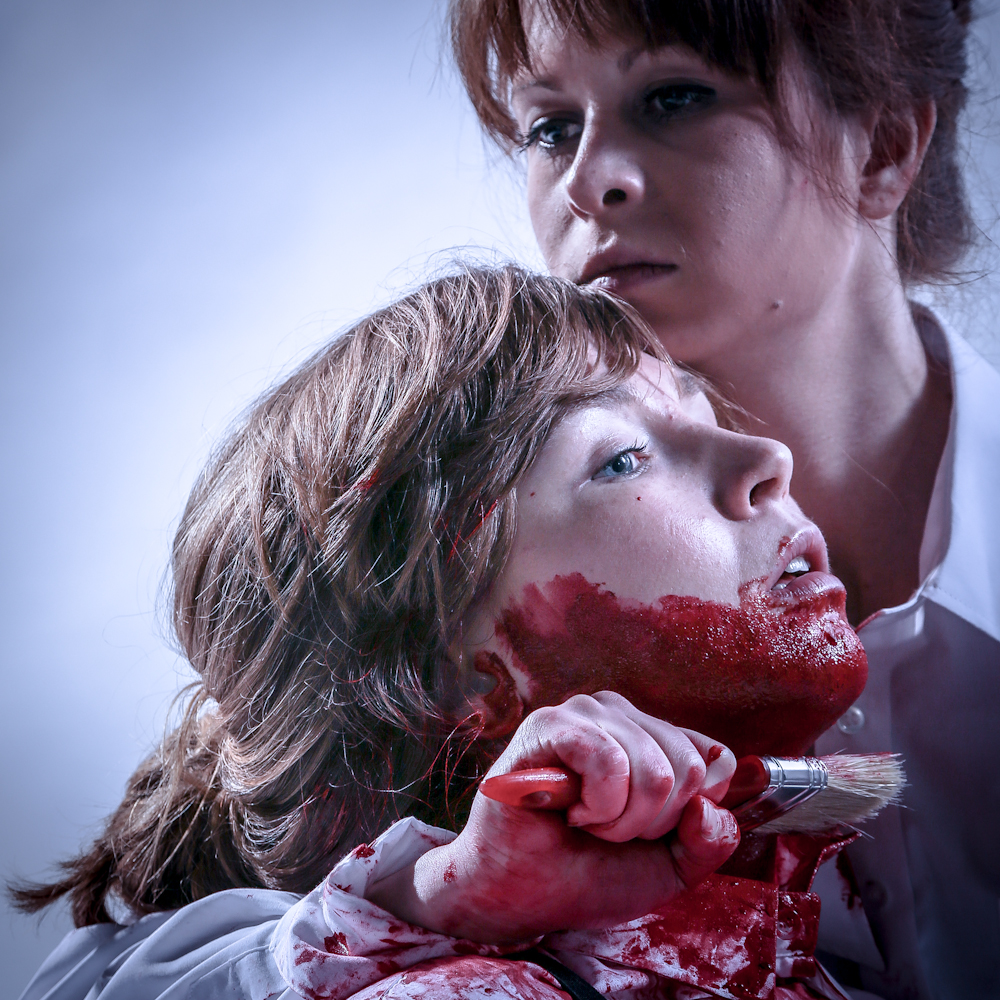
The eight-member cast wears a monochrome uniform of black skinny jeans, ankle boots, white shirts and black braces. Coats, scarves and a wheelchair identify character changes, as do physical and vocal alterations. The set is completely white, but not for long. As Shakespeare’s most gruesome play energetically unfolds and characters are mutilated and killed, the red paint in the tins on the stage edges soon covers the floor, walls and the actors. I’m rather surprised the audience managed to escape any paint splatter. Rather than swords, they have paintbrushes tucked into their waistbands that are dipped in paint before an attack. The paintbrushes were used with the same movements as swords, slicing and stabbing. With such a striking use of weaponry that normally creates rather than kills, it would have been a more unique choice to explore stylized movement rather than emulating real life. As it was, there was a level of absurdity to stabbing someone in the back or slitting a throat with a paintbrush. Perhaps this was a comment on the absurd amount of death and destruction in the play? Perhaps the murders are being compared to art, or even DIY where the old and excess is cleared to make room for new? Or perhaps I am reading too much into it and Al-Shaahtar made this choice simply because it was unique and looked great. White, black and red will always be a powerful colour scheme. The liberal use of red paint highlighted just how brutal this play is.

The performances were on the whole very good. Ashlea Kaye’s Marcus and Demetrius were a highlight of contrast between an ill, old man and scrappy, oversexed young manhood. Kaye is clearly a versatile performer with outstanding stage presence. Ariane Barnes was a formidable Titus, fully believable as the successful general that ruthlessly seeks revenge for his downfall. The ensemble work is excellent with smooth transitions at a fast pace. The ensemble aspect didn’t quite work as the actors remained on stage most of the time, but lounged casually on the periphery, half in the wings, watching the action when not performing. The goal is to enhance the ensemble aspect of the production, but the halfway approach came across as non-committal. Either be present on stage and dynamically contribute to the stage picture, or be out of sight. Otherwise, it lends itself to distractions. I would guess that the oldest cast member is in her early 30s; having a wider range of ages would make their diversity even more commendable.

With a running time of about an hour and 15 minutes, this was a good length to convey the main focal points of the story, but cutting this play can be tough. As one of Shakespeare’s earliest plays and his first attempt at writing a tragedy, it can feel quite clunky. Cutting it cannot overcome this quality and can occasionally exacerbate it. In this case, the tragic downfall of the central characters occasionally felt rushed, but not overly so. An interval wasn’t particularly necessary and felt like it occurred very late in the story. Generally in this version, the editing did a good job at preserving the story and capturing Titus’ life rapidly collapsing around him.

As previously mentioned, the energy was extremely high and well-maintained throughout. Moments of humour lightened the tragedy, particularly good was Tamora and her sons’ portrayal of Revenge, Rape and Murder. Another lovely moment is Aaron (Anita-Joy Uwajeh) meeting his newborn son for the first time and refusing to allow the child to be killed. There were numerous others. Smooth Faced Gentlemen have a clear gift for making Shakespeare accessible and telling a cracking story. They are certainly a company to follow as they grow and develop their performances.


The Play’s The Thing UK is an independent theatre criticism website maintained voluntarily. Whilst donations are never expected, they are hugely appreciated and will enable more time to be spent reviewing theatre productions of all sizes. Click here to make a donation with PalPal.