Wonderations, The Canvas Cafe

https://pbs.twimg.com/media/CcvF_vOWEAA7JKp.jpg

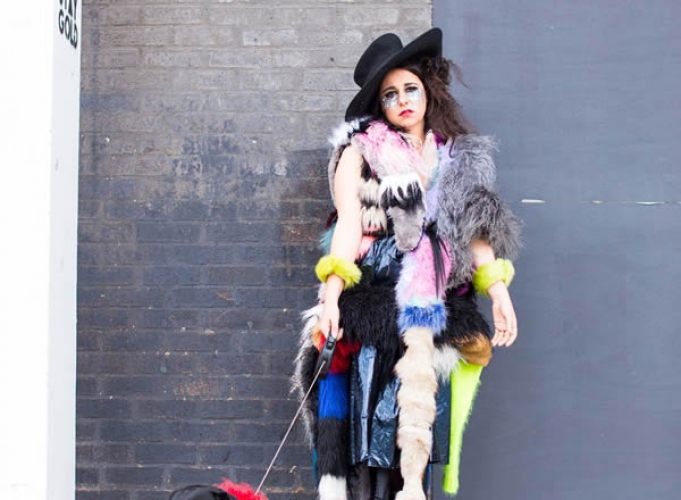
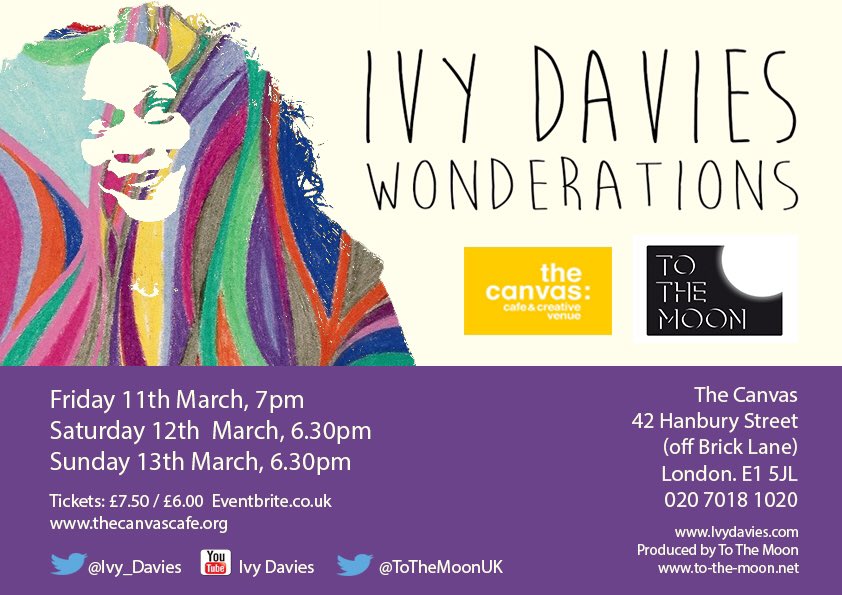
Sunday evening was a night of new discoveries. The Canvas Café, just off Brick Lane, serves homemade cakes and prosecco by the glass. It also has walls you can write on and a cosy downstairs performance space. In that space was Ivy Davies and her show Wonderations, a gentle, joyful blend of spoken word, songs from her EP and questioning whether or not Mickey Mouse is actually God. Though lacking in narrative, Davies’ performance shares issues that are particularly personal: aging and her search for identity and faith. With a touch of live art about it, Wonderations is a lovely celebration of self-acceptance akin to reading Davies’ journal.

This isn’t a visual show, but a totally aural one. It could easily be listened to through headphones or with eyes closed, though her soothing melodies and rhythms could lull you to sleep – it’s that relaxing. There are some powerful sentiments in her lyrics and poetry that deserve full attention, however. As Davies struggles to find her pre-marriage and babies self in theatrical songs and rhymes, one can’t help but to relate to her frustration with finding her true identity buried under all the nonsense life throws at us. We all find ourselves wasting hours on social media focused on constructing an image, or immersing ourselves in work and forgetting to just be present in the world for lengthy periods, but Davies exhorts us to let all of it go. She’s like a life coach, but a gentle one who uses cuddles rather than shouting.

This cabaret-esque structure feels conversational, but is precisely and satisfyingly scripted. There’s no plot to speak of, but with Davies wearing the form like her own skin, it works. Her spoken word isn’t the pounding, angry sort I’m accustomed to; it’s full of flowers, sunshine, rain and claiming her own ground. Davies has an immovable strength and presence, but one that overflows with positivity. Less connected from her celebratory songs and spoken word is what feels like an internal monologue where in looking for faith, she wonders if God is actually Mickey Mouse. He’s been seen around the world at the same time, and has plenty of purchasing power. It’s a wonderfully funny, and pointed, argument, though less clear on it’s place in the show’s structure.

Ivy Davies’ Wonderations is a hard show to pin down, but it doesn’t apologise for that. I’m pretty certain that she’s confident enough to not care what anyone thinks of her work, but the themes it contains are universally human presented in an easily digestible format. An excellent event for a quiet Sunday evening, particularly with a slice of cake and a glass of prosecco.

The Play’s the Thing UK is committed to covering fringe and progressive theatre in London and beyond. It is run entirely voluntarily and needs regular support to ensure its survival. For more information and to help The Play’s the Thing UK provide coverage of the theatre that needs reviews the most, visit its patreon.
What I Learned From Johnny Bevan, Soho Theatre; The Caucasian Chalk Circle, Jack Studio Theatre

Is revolution in the air? Or, are we all so broken and defeated by rising costs and a falling quality of life that all we can do is complain bitterly? Perhaps a bit of both? In any case, this is not the first time that I wonder if theatre is responding to the liberal sense of disaffection recently. Shortly before Christmas I questioned Dominic Cavendish’s assertion that theatre isn’t political enough, and my sentiment still stands, particularly after the coincidence of seeing two highly charged political pieces two nights in a row. Fringe theatre, like grassroots politics, is a place of community, a catalyst for change, and the foundations of revolt, as seen in Lazarus Theatre Company’s The Caucasian Chalk Circle and Luke Wright’s What I Learned From Johnny Bevan.

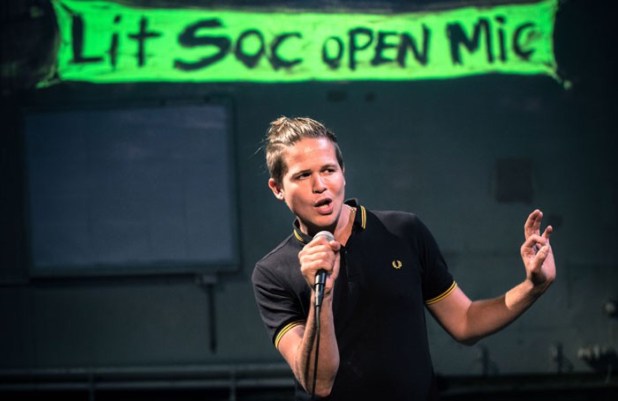
1997. The eve of the general election. Nick, who’s studying English Literature at a nameless uni stays up all night with his best mate, poet Johnny Bevan, to watch Tony Blair win. It’s the dawn of a new era and change is coming for the working class long oppressed by Thatcherite rule.  Fast forward fifteen years and Nick’s a journalist in London, but Johnny’s student aspirations didn’t come to fruition, and neither have Tony Blair’s. The story of these two lads’ friendship, written and performed by Luke Wright in a blaze of fiery spoken word, is an hour long tale of youthful vigour soured by the realities of adult life. Wright’s delivery and writing is fervent, topical and no moment is out of place in the trendy and on-point What I Learned From Johnny Bevan.

South of the river, an older revolution is taking place. In Soviet Russia, a group of peasants stages a play about a servant girl in Georgia raising the governor’s newborn baby that was abandoned during the family’s escape from a war zone. After a perilous journey, sacrifice for the sake of the infant, and a regime change, everything is put right again by a citizen judge. Lazarus Theatre Company, with its trademarks of a large cast and striking visuals, draws parallels between Brecht’s The Caucasian Chalk Circle and the despair of modern life – but “change is hope”. Energetic and in the round, the characters rally the audience to their side like they do in Wright’s monologue.

There’s optimism in both productions as well as despair, and an underlying current of discontent with the state of the UK’s current socio-political trajectory. Both display humanity’s capability for selflessness and selfishness, and the feeling that nothing has changed from Soviet ruled Eastern Europe, to Labour’s late-90’s victory, to present unviable economic conditions and Tory tyranny. We are undeniably flawed with a fickleness vulnerable to power and money, but as a society we are also deeply unhappy and feel that we lack the power to affect change. This sentiment now seems to be emerging in fringe theatre.

Though completely different in form and structure, both What I Learned From Johnny Bevan and The Caucasian Chalk Circle have plenty to say about the contemporary world from similar angles. What I Learned From Johnny Bevan is the better of the two productions, and  the more progressive. A solo performance delivered in spoken word accompanied by charcoal and watercolour landscape projections, most of the imagery in Wright’s language is precise and evocative. Brecht’s well-known play is linguistically stilted and stuffy in contrast, but it’s characters are just as colourful.

Performance poet Luke Wright is a singular tour de force and What I Learned From Johnny Bevan is politically charged and practically flawless. Lazarus Theatre’s performances vary, but of the ten-strong ensemble, no one was particularly strong or weak. Their choreography is well-rehearsed but director Ricky Dukes normally powerful movement sequences  lack impact in the round. The set components take up a lot of space and are used well occasionally, but otherwise clutter the stage with bright, industrial chaos. Neil McKeown’s sound design hints at atmosphere and mood, but is much too quiet to add the impact it could. It’s certainly not a bad production, but neither is it one of Lazarus’ stronger ones.

If theatre is a mirror held up to the world, then evidence is increasing that change is imminent. But what form will it take? Will the people rally as in The Caucasian Chalk Circle or will we either sell out or run away from it all like Nick or Johnny? Only time will tell.

The Play’s the Thing UK is committed to covering fringe and progressive theatre in London and beyond. It is run entirely voluntarily and needs regular support to ensure its survival. For more information and to help The Play’s the Thing UK provide coverage of the theatre that needs reviews the most, visit its patreon.

in/out (a feeling), Hope Theatre

rsz_in_-_out_-_a_feeling-5

Sometimes, simplicity in narrative structure is more effective than twists, heaps of characters and subplots. Storytelling has been a powerful medium for time immemorial. in/out (a feeling) starkly depicts young, Eastern European woman Blue working in a London brothel after promised a cleaning job. Her client Ollie is a coked-up, suburban lad out for his mate’s stag do, but their encounter changes both their lives, at least for a little while. This two-hander is a brutal depiction of sex trafficking and its uncomfortable nearness to us all, but unblinkingly focuses on the delicate humanity of these two characters through interweaving, storytelling monologues. Excellent performances and Andrew Maddock’s sophisticated wordplay and use of rhythm both captivates and horrifies in this outstanding production with few, if any, faults.

Nicholas Clarke and Alex Reynolds are Ollie and Blue. Though rarely addressing each other directly, their chemistry is still tangible. Clarke’s character has a more interesting journey, from lad’s lad to articulate romantic to devoted boyfriend; Reynolds’ is subtler but more devastating. Both have fearless, vulnerable presences and expressive eyes that pierce the audience to the core during extended sequences of direct address. This is a small, intimate play in a similarly sized venue, but these performers fill the room with intensity and then some. The audience feels like they really know them by the end: a remarkable feat.

Director Niall Phillips and lighting designer Çağla Temizsoy put the stage/bed in the round with harsh blue and red lighting. The set design, presumably by Phillips, is similarly harsh and animalistic: white paint slashes the black walls, strips of red fabric hang from the ceiling like intestines. It’s a nightmare to us, but it’s Blue’s reality. Small buckets, like the kind children play with at the beach, dangle at head height. They aren’t filled with sand, though. It’s Ollie’s perpetual supply of cocaine that he lovingly shares with Blue and frantically sniffs during descriptions of his all-night binges. By the end of this 70-minute play, there’s white powder everywhere.

Along with the performances, Maddock’s language is the star of the play. Evocative rhyme hints at spoken word at times, at others his prose dances with colours, imagery and Blue’s memories of a happier life. We meet several other characters through their storytelling: Blue’s pimp, Ollie’s friend Connell, and others. The double meaning and repetition of “in, out” innocuously describes breathing, then the other bodily function that dictates the rhythms of Blue’s existence. Maddock’s ability to wow the audience with his facility of word choice, sentence structure, rhyme and repetition easily tips into the terror that these characters experiences; this is proof of an extraordinary gift with words and evocative storytelling.

Though building awareness of the closeness of human trafficking is clearly the primary purpose of this piece (Do you actually know your neighbours’ isn’t a brothel? I don’t.), in/out (a feeling) could be about anything at all and the language would still have it’s power. This is a production that needs to be seen, but it feels it would lose its intensity in a larger venue. A good portion of the actors’ power hinges on eye contact, which is easily lost in a bigger space. But in/out (a feeling) needs to be seen by more people – by everyone. And it’s a stunning piece of theatre as well as a vital one.

The Play’s the Thing UK is committed to covering fringe and progressive theatre in London and beyond. It is run entirely voluntarily and needs regular support to ensure its survival. For more information and to help The Play’s the Thing UK provide coverage of the theatre that needs reviews the most, visit its patreon.

Edinburgh Festival Fringe, 13 August: Part One

It’s fair to say that I’m not generally drawn to comedy or light subject matter. My favourite theatre is intense, serious and powerful, often with a heavy dose of suffering and/or death. I might need a break from all the despair after today, though. From mental health to forced prostitution to the government breaking up families, I’ve been put through the emotional wringer. These four productions are radically different in style and execution, catering to diverse audiences, but all are excellent offerings at this year’s fringe.

my-beautiful-black-dog_681x500My Beautiful Black Dog at Udderbelly Cowgate is a rock musical/gig/spoken word/live art show created and performed by southeast Londoner Brigitte Aphrodite. It celebrates her depression, or as she calls it in attempt to accept it as part of who she is, Creshendorious. There is glitter and sequins everywhere, emphasizing her party girl highs and contrasting her lows. Aphrodite is honest, frank and a highly skilled wordsmith in her songs and spoken text. Her songs manage to be both dry and celebratory; they create a party-like atmosphere that has the audience dancing and laughing along. It is rough and ready, and intimate, like a secret basement gig by your favourite band. The projected images and song titles added an element of set, but weren’t particularly needed and sometimes hard to see on the theatre’s brick back wall. On stage with her is Quiet Boy, who provides backing vocals, guitar accompaniment and a character who tries to coax her out of the road case she sometimes hides in, but it is very much Aphrodite’s show.

The party vibe abruptly drops when Aphrodite reads a (glittery) letter that explains exactly how she feels when she is fighting her black dog. Her honesty is brutal, but necessary. My Beautiful Black Dog takes a (sequined) tyre iron to the stigma and silence surrounding mental health issues. In these moments, the shine is a shallow sticking plaster, trite and useless. Rather than ending on a somber note, she ends on a song – not a happy ending, but a hopeful one. Aphrodite knows her depression will return, but next time may it be with understanding and acceptance from those around her. This production is difficult to experience, particularly if mental health issues affect you. It forces open a dialogue about mental health issues and even though it a (sparkly) genre mash-up, it is a vital show that could be scaled up to a big show, complete with lights, confetti and the sparkle it deserves.

Blind_Mans_Song,_Edinburgh_Fringe_2015,_courtesy_Francois_Verbeek_1_751x500Blind Man’s Song in Pleasance Dome is Theatre Re’s non-verbal dance theatre offering this year. As blind man Alex Judd plays keyboard and electric violin, a masked Guillaume Pigé and Selma Roth personify the images and emotions in his head. There is love, violence, travel, and a host of other encounters between the characters. There are moments of narrative, but this piece is very much open to individual interpretation. A simple, black set paired with smoke, side lighting and timeless costumes evokes the silent film era or a painting coming to life. The soaring emotion in the blind man’s music could imply that these are his memories or dreams. The mood and music varied enough throughout to maintain audience attention, and the performers’ skills in dance and mime were evident. It’s a captivating watch, if a little long. Sadly, some of the audience members were less appreciative. An older couple noisily left part way through and an American voice a few rows back at one point proclaimed, “This is stupid.” Abhorrent behaviour.

The music is richly augmented by a recorded track, but deliberately repetitive and grating at times. I found my mind wandering occasionally, but this was due to a moment triggering my own imagination. The young boy sitting in front of me had some lovely responses to the piece that drew my eye away from the stage: at times he conducted the music, at others he swayed mirroring the performers on stage, or wiggling abstractly in a dance of his own. Blind Man’s Song certainly triggers strong reactions from its audience though strangely, not all positive. It is a meditative, evocative performance if an individual permits it to be, but perhaps a challenging offering to our short attention spans.


The Play’s The Thing UK is an independent theatre criticism website maintained voluntarily. Whilst donations are never expected, they are hugely appreciated and will enable more time to be spent reviewing theatre productions of all sizes. Click here to make a donation with PalPal.

This Is How We Die, Battersea Arts Centre

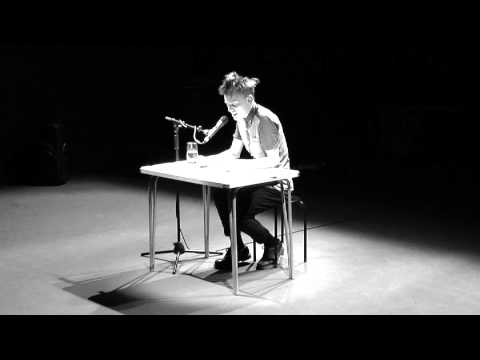
Chris Brett Bailey is a bard of thhqdefaulte modern age. Like Elizabethan theatre the audience went to hear rather than to see, This Is How We Die is a bombardment of the ears rather than the eyes. Using spoken word and beat poetry to tear open the world as we know it, Bailey forces us to confront the horrors and beauty of everyday existence. This piece of theatre moves away from the trend of visual theatre, taking the audience on a self-reflective ride of their lives.

At just over an hour, we are hurtled on a journey through Bailey’s rage against “-isms” and “-ists,” a brutal first meeting with his overly-literal girlfriend’s parents and a Hunter S. Thompson-like roadtrip through the American desert. His delivery is relentless, pausing only for comic effect or to take small sips of water from the glass that sits on his desk. Yes, a desk. He sits at a desk, with his script in front of him. This form rails against the increasingly visual culture we live in but it forces the audience to really and truly listen. He has a lot to say that he feels strongly about and you need to hear it.

Trying to describe what This Is How We Die is about is futile. Anything descriptive about plot or narrative arc will make this piece sound simplistic and trite. The feature that really makes this a must-see is Bailey’s visceral use of language. He savours it, relishes it and throws it away. A sea of sound washes over us, then pummels us, unarmed, in a back alley behind some dingy American bar. His imagery alternates between abstract and concrete, the highlight being his girlfriend’s neo-Nazi father left shaped like a swastika after a car accident.

The last ten minutes or so abandons speech, instead favouring live ambient music and harsh lighting. This is his Elizabethan jig, the audience’s catharsis after the emotional Sturm und Drang of the last hour. There was no point in fighting the journey of This Is How We Die so you may as well join him. Share in his rage, his joy and his passion. Relish the world you live in and the sounds of the words that pour so easily from his mouth. This isn’t about how we die, but how we should live.


The Play’s The Thing UK is an independent theatre criticism website maintained voluntarily. Whilst donations are never expected, they are hugely appreciated and will enable more time to be spent reviewing theatre productions of all sizes. Click here to make a donation with PalPal.