The State vs John Hayes, King’s Head Theatre

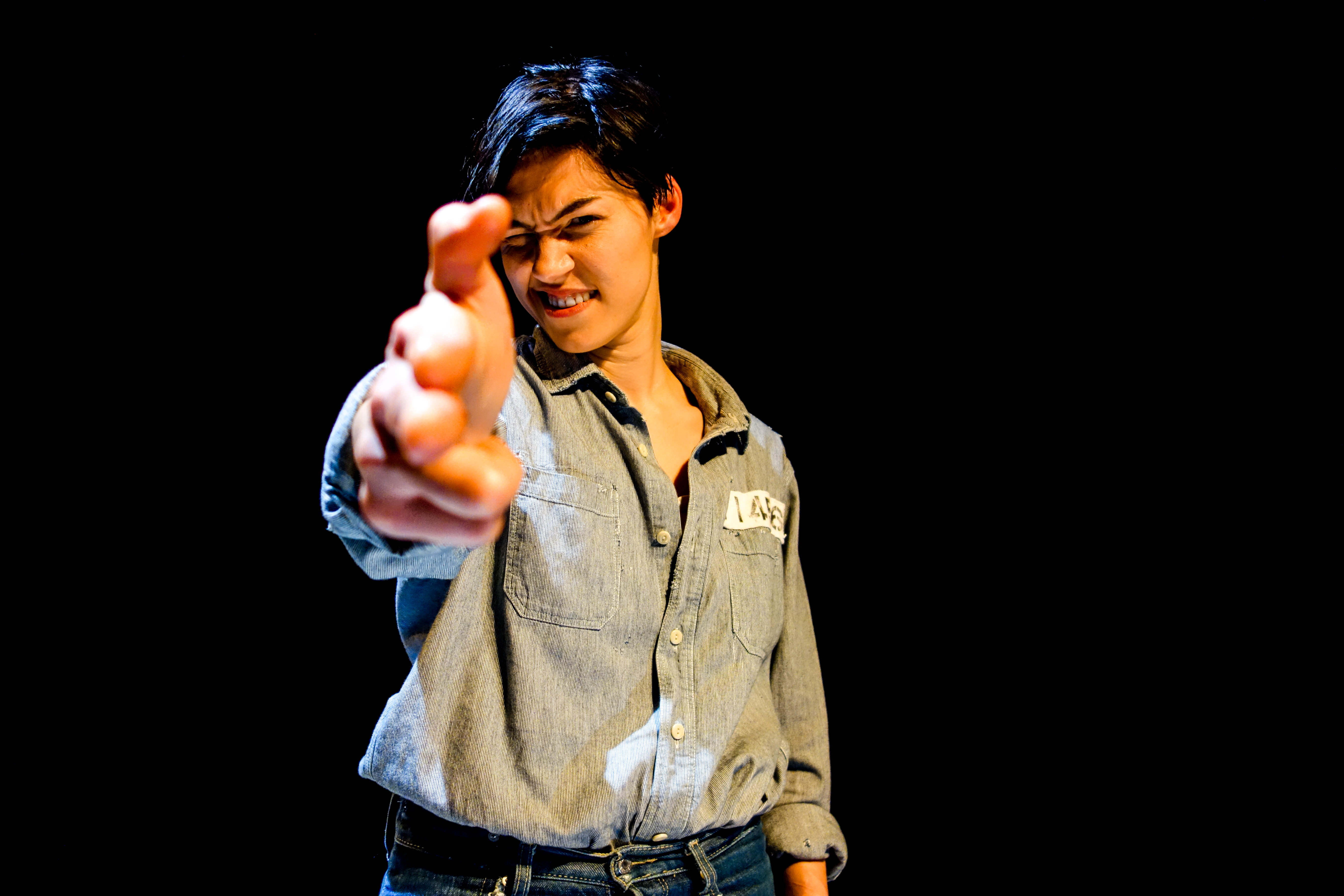
Lucy Roslyn, The State vs John Hayes (c) Jemma Gross (7)Elyese Dukie is going to die tomorrow. Though she needs to get through tonight first, at least she’s not alone. We’re in there with her, in her cell on Texas’ Death Row in 1959, as is John Hayes. But we’re not really there, and neither is John. We’re all in Elyese’s head, a figment of her very ill mind, but she’s still going to get the chair in the morning because “they would never send John…but they would send me.” For one of fictional Elyese/John’s last hours, we join her on an exquisitely performed journey akin to riding a rollercoaster handcuffed and blindfolded as Elyese reviews the dark corners and glowing intimacies of her past that led her to this moment.

Epsilon Productions continues to mature with this topical, one-woman show that’s part of The King’s Head Theatre’s new, new writing festival, #Festival45. Lucy Roslyn’s script unfolds Elyese’s troubled past spiraling towards the moment she murders her husband Dale, lover Lorraine and births John Hayes, her killer alter-ego spawned from Schizophrenia, Multiple Personality Disorder or severe childhood trauma. Elyese certainly isn’t alone in her struggle against those that live inside her head but take over her body, what with 73% of female inmates in America currently diagnosed with mental health issues; the percentage of mentally ill prisoners in the less-aware 1950s is unimaginable.

Roslyn, who also performs, begins the piece as John. We only meet Elyese later. She embodies him with perfectly sculpted hand movements and a southern redneck accent, deep as John, light and fragile as Elyese. His/her charm and charisma is unquestionable but can turn to violence and grief on a hair trigger, showing Elyese as a victim of the system unable or unwilling to provide her with the care she needs. As such, it’s a powerful critique of the US justice system.

Lighting designer Sherry Coenen reminds us of John’s threatening presence with greenish pulses when Elyese is struck with a crippling back spasm, a symbol of the control he has over her. The subtle heartbeat in dangling filament lights is Elyese’s, which will cease all too soon as electricity surges through her slender, fragile-looking body. The current seating arrangement, irregular and with a thrust so deep it’s nearly in the round, didn’t quite work with the lighting – those sat along the back wall of the stage had lights in their eyes.

The script begins as a straightforward monologue to the audience, with John flirting and joking. The structure becomes fragmented as her mental state breaks down; though she evokes sympathy she also evokes fear. If John will kill those Elyese loves the most, anyone is at risk, though it’s understandable how people immediately fall for his charms. There are times where the text rambles, but these moments are few and lead up to important story points; Roslyn’s performance adds light and shade that keeps the momentum going. Her performance consistently captivates with its commitment and intensity as well as using high levels of detail to differentiate the two characters from each other. A political firecracker with a stellar performance and numerous layers, this Argus Angel winner packs one hell of a punch.


The Play’s The Thing UK is an independent theatre criticism website maintained voluntarily. Whilst donations are never expected, they are hugely appreciated and will enable more time to be spent reviewing theatre productions of all sizes. Click here to make a donation with PayPal.
Next Lesson, Pleasance Theatre

image1In 1998, Thatcher introduced controversial Section 28 that banned promotion of homosexuality, publishing materials that supported it and teaching its acceptability in schools. Playwright Chris Woodley, fascinated by the change in schools’ attitudes towards homosexuality in pupils and staff between his student years in the 1980s and his teaching career in the 2000s, documents the effects of Section 28 on those affiliated with schools: pupils, teachers, and staff and parents alike. The play loosely centres on the character Michael, a GCSE student at Beckenham High School in 1988, who returns to teach there in 1996. Though Section 28 was not repealed in England until 2003, difference becomes more acceptable as time passes but Woodley still shows the impact on individual lives through such bigoted legislation.

A diverse cast of characters populates Beckenham High over nearly 20 years with their day-to-day battles and victories of being gay during and after Section 28. Superbly acted and well-written, Woodley’s script contains excellent scenes but the story as a whole could use more focus on Michael, as his journey is partially eclipsed by episodes from the lives of other gay people working and studying at Beckenham High. Though their stories are equally valid, if this play were to be lengthened Michael’s character arc should move to the forefront to give the whole piece a stronger focus. The early part of the play shows Michael coming out to his mother, but the audience doesn’t see him again until years later as an English teacher. In the meantime, teachers battle against curriculum restrictions and the stigma of being out at work. Not that these are issues that ever disappear completely, but these early scenes capture the stress of being gay in a Section 28 world. During his teaching career, we meet other gay teachers and students who become increasingly comfortable with expressing their sexuality.

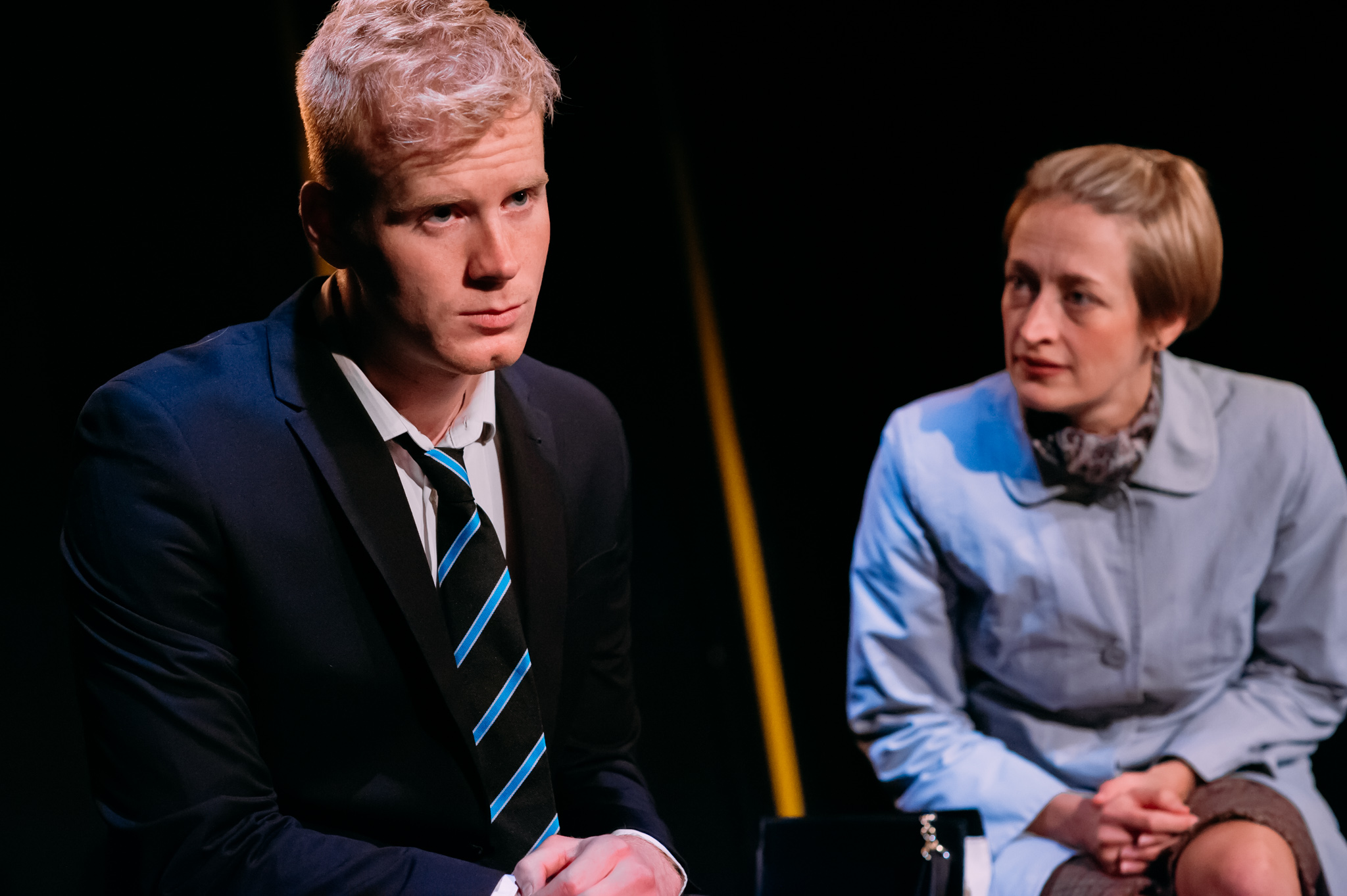
An ensemble of six adeptly play several roles each, except Stanley Eldridge as Michael. Director Andrew Beckett uses costume, small set changes, the year written on a chalkboard and music to indicate scene and character changes. Within the scenes, the direction is otherwise wonderfully unnoticeable. The cast is balanced, with no one standing out as stronger or weaker than the others and I’m hard-pressed to choose a personal favourite.

Some particularly good moments include Michael’s estranged mother surprising him at work on his birthday; the brightly coloured helium balloon and gift bag juxtapose his rage and her half-hearted apologies. The scenes discussing the impact of the Admiral Duncan bombing in 1999 on Michael’s life are powerfully moving and a reminder that the individuals cannot always speak for the entire gay community. Student Chloe (Anne Odeke) hilariously defends punching a male student after bullying her for being a lesbian to her form tutor. The script is filled with other great moments, but there was no singular moment of climax.

This is without a doubt an important play and introduces Woodley’s gift for creating excellent character-driven scripts. There is easily scope for this play to develop and it also deserves to be seen for its documentation of a moment in history that we have mercifully moved past, but its scars are still present in homophobia in and out of the classroom.


The Play’s The Thing UK is an independent theatre criticism website maintained voluntarily. Whilst donations are never expected, they are hugely appreciated and will enable more time to be spent reviewing theatre productions of all sizes. Click here to make a donation with PayPal.
Boat, Theatre N16

BOAT, Theatre N16 (c) Shawn Soh (1)A lot of firsts are happening in Balham theatre at the moment. Theatre N16 has moved from N16 to a new home in SW12, The Bedford Pub. There is little theatre in the immediate area – Tooting Arts Club is further down the Northern line, Clapham and Stockwell both have venues closer to town, BAC is a bit of a trek and there’s a new theatre tentatively in the works in Streatham, but that’s it. Their inaugural production in their new home is first play Boat by poet Kiran Millwood Hargrave; it’s also producer PIGDOG’s debut production. Hargrave’s text uses thickly layered metaphor to tell 14-year-old Girl’s experience of human trafficking. What starts off as an interactive, childlike show soon reveals the sickening underbelly of cities and towns around the world.

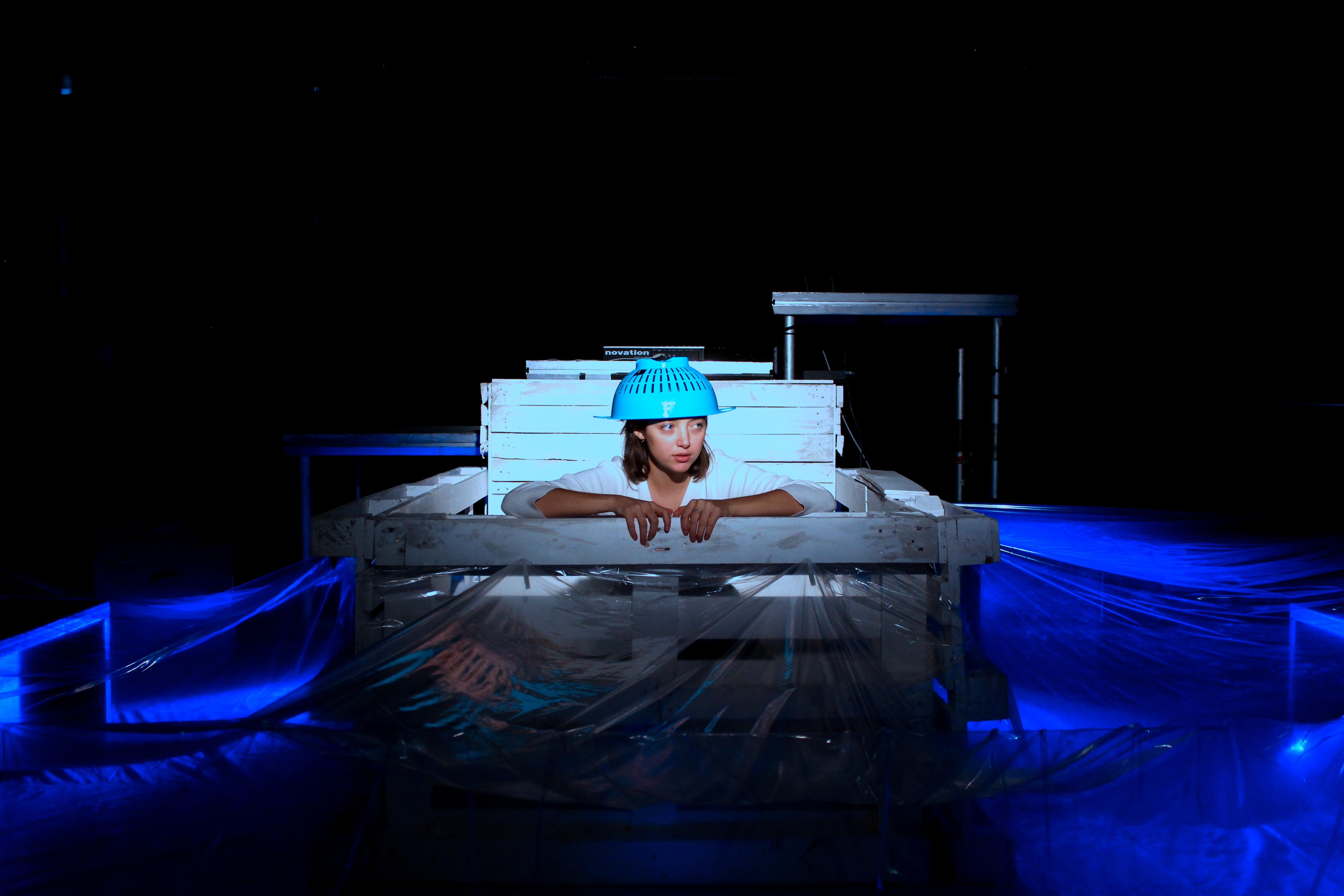
“Jellyfish of Sound” Jethro Cooke opens by asking the audience to create some effects that he proceeds to use with others through live mixing. This beginning should indicate that sound is a dominant feature throughout, but it only appears sporadically, and quietly, for the rest of the performance. Instead, the focus is on the story of Girl (Pia Laborde Noguez), on a Beckettian journey with no apparent beginning or end. She is 14, on a small drifting boat. Her Twin (Cristina Catalina) is with her and she keeps herself entertained with visits from the increasingly possessive Turtle (Matthew Coulton) and challenging Gull (Grabriele Lombardo). As Twin’s appearances become more rare, and Girl measures times in the phases of the moon and plans adventures with Gull to find the moon on the seabed, her boat of white pallets and surrounding sea of plastic sheeting abruptly collapses, transforming into a bedroom. Twin, unspeaking and inert, lays draped across the headboard with clay covering her face. Only the clay represents something else, as do Turtle and Gull, and oh god, the realization of her actual reality is horrifying. Girl reminds us that we can pretend none of this happens in the world, as “you believe what you want to believe” and traumatized people will construct an alternative reality in their heads as an escape, but that doesn’t make sex trafficking, child prostitution and refugees cease to exist.

Hargrave’s language is naturally that of a poet’s, but the transitions are abrupt and obvious, announced by the Jellyfish of Sound. The upstairs space in the Bedford is versatile and a good size, but the low ceilings challenge conventional lighting. As potent as the play’s message is, the script imbeds the real story so deeply that it’s easy to take it at face value, or transpose it onto the refugee boats that fill our oceans and our news. But to do so leaves large, logical holes in their world and dilutes its potency. Though a worthy first production, it feels a bit rough around the edges with some moments of vague writing despite good performances. PIGDOG and N16 clearly have great ideas, and this is a wonderful space to explore and develop them in.


The Play’s The Thing UK is an independent theatre criticism website maintained voluntarily. Whilst donations are never expected, they are hugely appreciated and will enable more time to be spent reviewing theatre productions of all sizes. Click here to make a donation with PayPal.
Joanne, Soho Theatre

Joanne2We never meet Joanne. We do however, meet four women who encounter her at different points over a crucial 24-hour period of her life, and one that remembers her as a child. We learn that she cuts a tall, striking figure, makes immediate impact on those she meets and she doesn’t seem to fit in anywhere the world. Joanne is homeless and has just been released from prison. Production company Clean Break, founded by 2 female prisoners in 1979 and still producing, recognizes the importance of sharing stories from vulnerable women prone to falling through society’s cracks. Joanne, written by five female playwrights, has some wonderful writing and is skillfully performed in an intimate space but the brevity of the monologues and talking around Joanne distances rather than fully engages.

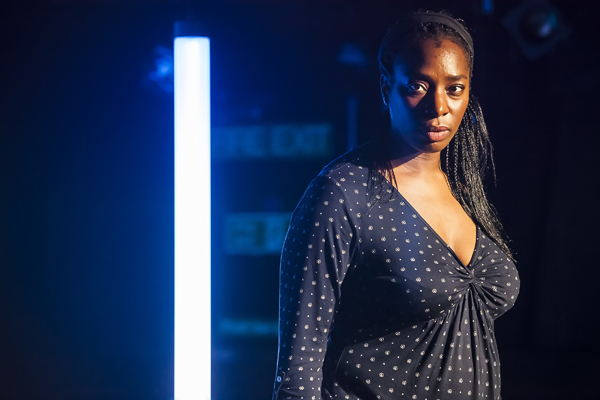
Tanya Moodie first plays a key worker, then easily slips into a police officer, an NHS receptionist, a hostel cleaner and a teacher. All were moved by Joanne’s plight and wanted to help her, innately sensing her need for support. These women related to something within Joanne, humanizing her and the thousands of other female prisoners like her. Moodie captures the genuine care these women feel, as well as their conflict – police officer Grace isn’t supposed to get attached to her cases, but alludes to her own struggle with finding a place in the world for her and her daughter. I am particularly touched by Kathleen, on the front line of an NHS hospital for 28 years. She makes some pointed critiques of government legislation’s effects on her workplace and its effects on those most needing care. These stories are much more engrossing than Joanne’s because they’re in front of us, as Joanne herself is a shadowy puzzle that we slowly and satisfyingly piece together.

Through written by five different writers, the monologues seamlessly connect but remain stylistically distinct. Told in the past tense through the sharing of memories, they are fine examples of storytelling that Moodie makes active and varied rather than nostalgic. She owns the distinct characterization of these women, skillfully masking Róisín McBrinn’s direction. Colour changing light-up columns and panels add visual variation, but don’t contribute towards meaning or location. Their presence is unimposing, but unnecessary. The otherwise minimal, black set draws all attention onto Moodie, as it should in this production. Audience focus is on Joanne’s attempted helpers and their capacity to empathise; they are more solid and demanding of immediate attention than the silhouetted subject of their stories who leaves nothing but a memory.


The Play’s The Thing UK is an independent theatre criticism website maintained voluntarily. Whilst donations are never expected, they are hugely appreciated and will enable more time to be spent reviewing theatre productions of all sizes. Click here to make a donation with PayPal.

Barbarians, Tooting Arts Club

Punks Paul, Jan and Louis are working class lads living in south London. School didn’t do much for them and unemployment is high, so they hang around and smoke, nick cars and try to pull girls. They’re bored, angry and frustrated at the lack of opportunities available to poor kids like them. They want to improve their quality of life and feel like they belong in society, but society’s too busy fighting terrorism and racism to pay them any attention so they do their best to get by, or not. It sounds like the present, right? Nope. Barrie Keeffe’s Barbarians premiered in 1977. As London battles the National Front, striking unions and IRA bombs to a soundtrack of The Clash and The Sex Pistols, audiences can’t help but draw parallels between life then and now. It’s unsurprising this Tooting Arts Club/Soho Theatre production will soon be followed by the Young Vic’s, a completely different production of the same play, what with its contemporary social relevance and three fantastic roles for young actors to get stuck into. Though close to three hours long and composed of three self-contained plays at different points in the boys’ lives, the excellent performances, atmospheric venue and socio-political comment make the time well spent.

The long-vacant uni building on Tottenham Court Road used as the performance space for this production is the defining feature of this production, fostering intimacy, interaction and that overused catch-all word, “immersion”. The decaying interior surrounding the audience reinforces the poverty in the the lads’ and how grim it is for them day in and day out. We are in this world too, rather than just observing. Political slogans and graffiti cover the walls. The ceiling’s falling in above the youth club tables and chairs. Barriers herd spectators like cattle at a football match. Discarded furniture lines Notting Hill’s streets during carnival. The audience doesn’t sit on comfortable theatre seats, but on the items that make up the set. We aren’t comfortable, but nor should we be as neither are these guys. The three rooms that are used for the three separate plays contained in Barbarians are small and crowded with people; the actors’ energy rushes around the room, occasionally making contact with those of us watching but we never feel threatened despite the regularly erupting violence. There’s a feeling of claustrophobia created by this space, but also the possibility for the walls to be blown away by all rage. It’s a wonderful, angry whirlwind that encourages our inner “fuck the establishment” punk anarchists and empathy with the characters even though their actions are often abhorrent.

The cast is outstanding. Josh Williams is the aspirational black Louis; his skin colour is often unseen by his mates, and also makes him the victim of their racist “banter” and violence. Williams captures his inner strength and good intentions that eventually grow large enough to stand up for his beliefs. Whilst all of the characters want their lives to have a purpose, Louis doesn’t let leader Paul (Thomas Coombes) turn him into one of his violent minions as they grow up. Coombes’ terrifying Paul still manages to evoke sympathy when he is younger. His need to fit in always tends towards mob violence; the character reminds me of troubled young people from dysfunctional homes with little love around and no other knowledge of how to express frustration. Jake Davies is Jan, the shy mousy one who also tries to make something of himself but doesn’t have the inner strength that Louis does. Unsurprisingly, all three lads come to a horrible end when they meet again after going their separate ways, in the summer heat at Notting Hill Carnival.

Keeffe’s script is excellent and each of the playlets can stand alone and still make their point, but to present all three really drives the message home as the audience can see the effect of a poor quality of life on young people over a longer period of time. I would love to see a female equivalent of this play, as much of what’s contained in Barbarians is stereotypically male, and working class young women’s lives would have been no easier during the late 70s. Regardless, Tooting Arts Club’s production is worth seeing for its use of space and the effects it has on characterization and the energy of the piece. Director Bill Buckhurst’s work here is certainly to be commended in one of my theatrical highlights of this year.


The Play’s The Thing UK is an independent theatre criticism website maintained voluntarily. Whilst donations are never expected, they are hugely appreciated and will enable more time to be spent reviewing theatre productions of all sizes. Click here to make a donation with PayPal.

Tamburlaine the Great, Tristan Bates Theatre

That which goes up must eventually fall. Christopher Marlowe’s Tamburlaine the Great tells of the title role’s rise from common thug to emperor of Persia and Africa. A precursor to, and probable influence of, Shakespeare’s ruthless Richard III, the man is needlessly brutal: he orders rivals’ remains displayed on city walls, women and children killed, manipulates others to join his cause and then betrays them. Fate eventually catches up with Tamburlaine after he sets fire to books, including the Qu’ran, and proclaims himself more powerful than God.

Lazarus Theatre Company returns to form after a disappointing Henry V with a modern, concise presentation of Marlowe’s play depicting Tamburlaine as a violent, string vest wearing hood rat transformed into a suited and booted world ruler. Social mobility is the dominant theme, emphasized through Rachel Dingle’s costume design in this rags to riches tale. With visually arresting movement sequences, skillful use of light, and pointed similarities with Middle Eastern politics, immigration and Western meddling in the region, this is a relevant, well-crafted adaptation of the Elizabethan original.

The defining feature of this Lazarus’ adaptation is the extended movement sequences, with a powerfully striking one opening the show. A large cast use militaristic stylization and East Asian performance techniques to slowly travel across the stage, setting the tone for Tamburlaine’s merciless and unfeeling crusade. The choreography is precisely angular and even though the actors are well-rehearsed and the effect is visually stunning, there are hints of restrained self-consciousness from some of the company. Accompanied by deep, tonal sound design by Neil McKeown with the actors smartly dressed in modern suits, it reflects the contemporary Western political machine that coldly invades other countries. These sequences are used throughout, enough to be effective but not so much that they lose their power. No choreographer is credited, so they are assumed to be a product of co-directors Ricky Dukes and Gavin Marrington-Odedra.

Performances from the company of 15 are good, with delivery occasionally broken and overindulgent. These moments are rare and don’t affect the pace or energy of the cast as a whole. Particular highlights are Kate Austen as the aggressive, trackie-bottomed Techelles who is Tamburlaine’s number two. She never loses her fierceness, even when Tamburlaine’s success means she has to wear a fitted dress. Robert Gosling is the simpering, camp Mycetes, Emperor of Persia. He’s a great contrast to Prince Plockey’s earthy Tamburlaine. Alex Reynolds is the captured prisoner Zenocrates that Tamburlaine woos and makes his bride. Her transition from victim to doting wife is a disturbingly good example of Stockholm Syndrome, reinforcing Tamburlaine’s power and manipulation. Lorna Reed plays three smaller roles, with a calm strength and subtly powerful voice. She would make an excellent Hermione or Lady Anne. The bombastic Bajozeth, Emperor of the Turks, is played by Alex Maude and is a joy to watch, particularly when imprisoned and force fed by Tamburlaine.

There are few weaknesses in this Lazarus production, but those that are present are minor. Tamburlaine’s final speech has too many pauses and the use of five identical crowns can cause confusion as to which character is the most important at any given moment. There was also an unsatisfying lack of blood considering the play’s violence. However, fringe productions tend to not have a dry cleaning budget; having the Mads Mikkelsen-as-Hannibal Lector suits cleaned daily would cost a small fortune. Artistic director Dukes’ flair for updating classical theatre with contemporary relevance and visual staging is at its finest in Tamburlaine the Great and is certainly worth a watch, particularly as it’s a play rarely staged.


The Play’s The Thing UK is an independent theatre criticism website maintained voluntarily. Whilst donations are never expected, they are hugely appreciated and will enable more time to be spent reviewing theatre productions of all sizes. Click here to make a donation with PalPal.