Piaf, Charing Cross Theatre

rsz_eventgallery-7928

Icon Edith Piaf inspired numerous films and plays, including 1978 play with music, Piaf. The four foot, 8 inches tall chanteuse from a broken home died at just 47, but left a songbook often heard in popular culture. These songs, which feature heavily, epitomize the defiant spirit of a France under attack, painfully relevant today. Addicted to drink and painkillers, the little sparrow must have struggled immensely with her inner demons but Pam Gems’ script avoids such nuance, for her or any of the other characters. Cameron Leigh’s belter of a voice reveals Piaf’s passion and turmoil through her songs, and the rest of the cast provide good vocal support, but Gems’ diabolically awful book manages to be rushed, tedious and two-dimensional all at once.

Portrayed as a selfish, junkie nymphomaniac who treats people as commodities, there is little room for audience sympathy in the first half. The scenes are short and delivered with an even, speedy pace; it’s as if director Jari Laakso feels uncomfortable with Piaf’s poor characterization and the gaping jumps in time that leave even the most important of events glossed over, and he wants to get to the interval ASAP. The second half marginally improves as Piaf’s health declines and she is seen as frail, vulnerable and poor. A few of the lines get laughs, as the humour is less distasteful than earlier in the play.

Cameron Leigh is an explosive barrage of rudeness as Edith Piaf and clearly struggles to find any decency in the script’s portrayal. Instead, she wisely focuses on revealing the character’s emotional life in her songs, the best feature of this play. Backed up by her best friend Toine (Samantha Spurgin), Marlene Dietrich (the imposingly glam Valerie Cutko) and an array of multi-rolling men and actor-musos, their vocal prowess makes this production bearable. It’s a small cast for the number of characters, but there is some good physical multi-rolling and costume indications help make up for scarcity in the dialogue.

Laakso and the cast energetically do their best, but the overwhelming issue in Piaf is Gems’ atrocious script. Otherwise, the songs are well sung, the production suits the theatre well and the set (Phillipa Batt) and lighting (Chris Randall) are well considered and often striking. It’s just a shame Gems isn’t alive to re-write it.


The Play’s The Thing UK is an independent theatre criticism website maintained voluntarily. Whilst donations are never expected, they are hugely appreciated and will enable more time to be spent reviewing theatre productions of all sizes. Click here to make a donation with PayPal.

Measure for Measure, Young Vic

https://i0.wp.com/www.officiallondontheatre.co.uk/servlet/file/store5/item336663/version1/fileservice770/336663_770_preview.jpgThere’s a mountain of inflatable sex dolls on the stage. Shiny, blank faces with gaping, toothless mouths, spherical tits and gargantuan cocks everywhere. The pile is so big that the actors have to wade through the dolls, a metaphor for the seedy Viennese streets where Shakespeare sets his Measure for Measure. Director Joe Hill-Gibbins wrenches this world into the present with a symbolism-laden, visually orgasmic production designed by Miriam Buether, and a great performance by Romola Garai as Isabella. Live video feeds, projection and pulsing beats marry a space that has ghosts of Elizabethan theatre structures, but some choices don’t sit well. Though the visuals are relevant and bold, there’s a disappointing tendency towards shouting, and a dubious (to the point of discomfort) characterization choice for infamous pimp Pompey. As the characters physically and emotionally wrestle through the heavily edited, relentless two hours of sex and religion, there is still a strong feeling that this production values style over substance.

Most modernized Shakespeare I see tacks on a more contemporary setting through costuming whilst changing little else. These sorts of adaptations tend to not generate any new insight on the play, its story or characters. This production manages to escape that trap through fully integrated design that cleverly functions on both a practical and representational level. The sex dolls, the most jarring of the updates, are in turn Angelo’s repressed sexuality, the sinners that Isabella (a novice nun) rejects, prisoners, and the duke’s citizens. The live feed is the media and public perception (as it was in the Old Vic’s 2005 Richard II), the duke’s altered perspective of events, and creates clear boundaries between locations. It’s also very Big Brother, and the audience is the all-seeing, both on and off camera. These design elements are grotesquely amplified, with every pore visible as faces are broadcast and projected at a massive size, and the dolls, well, they’re everywhere and thrown around like a cheap commodity to be used and discarded.

The dolls eventually move to a back room, akin to an Elizabethan inner stage, that’s often sealed off by sterile sliding panels, but we are regularly reminded of their presence both on and off camera. The live feed doesn’t let the audience forget about the bad behaviour happening in the concealed prison where Angelo’s offenders await execution. Some of the characters linger on stage even when not in a scene, giving time and space a fluidity but one that is understood to be separate from the action in any given moment. This rejection of set also harks back to Elizabethan performance convention. Projections of medieval art gorgeously juxtapose whirling, close-up photographs of the dolls and projections from the live feed, two worlds colliding in Hill-Gibbins and Buether’s updated Vienna. This contrast pointedly comments on the hypocrisy of modern religious fundamentalism; pro-lifers who are so pro-life that they kill abortion providers immediately spring to mind, though there is a plethora of other examples.

Though Garai’s performance has the power and confidence that Isabella often lacks in more demure interpretations, others in the cast let it down. Zubin Varlo as Duke Vincentio is quick to shout; this soon becomes excessive and a loss of power. Though a great performance from Tom Edden as Pompey the pimp, it’s disturbing that he has been characterized as a stereotypical Jewish New Yorker obsessed with money. However, Ivanno Jeremiah is an excellent Claudio with a quietness that is great contrast to the fiery Isabella. The colour-blind casting proudly shows off the UK’s diverse talent, with a female Sarah Malin as Escalus, PA to the duke and his deputy. Paul Ready as Angelo, the floundering, conservative who covers Vincentio during has absence and tries to bed Isabella in exchange for her brother’s life is definitely despicable but also incredibly conflicted. It’s easy to almost feel pity for him at times.

There is no doubt that this production looks fantastic, particularly in the opening and closing sequences. It updates well and has contemporary relevance on several levels, but there’s little unity across the design elements. This reminds me of Baz Luhrmann’s 1990’s Romeo & Juliet – all angry and dystopian and fast. It’s non-specific to a time and place, just broadly Western contemporary. It’s diverse in race, gender and accent and could easily be London, Paris, New York, or any other sleazy, urban environment. This gives it universality, but also shows laziness. I wonder if the design was initially chosen because it looks lush rather than makes a specific comment. Despite my interpretation of the underlying meaning of the design, I can’t help but to consider that my mind is constructing meaning that isn’t actually there. This was a relentless unease that lingered for the duration of the performance, though it didn’t spoil the experience.


The Play’s The Thing UK is an independent theatre criticism website maintained voluntarily. Whilst donations are never expected, they are hugely appreciated and will enable more time to be spent reviewing theatre productions of all sizes. Click here to make a donation with PayPal.

La Soirée, Southbank Centre

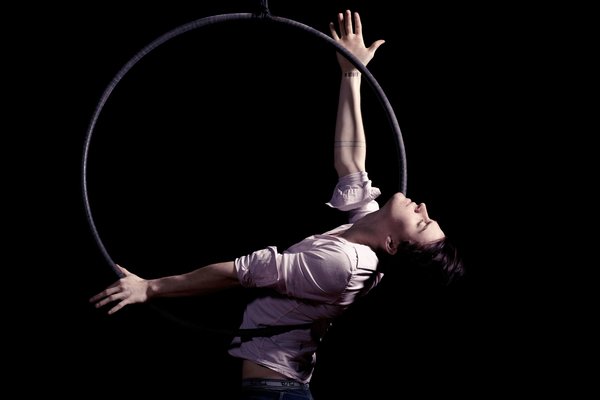
rsz_1bret_pfister_image_by_bertil_nilssonSouthbank Centre has a spiegeltent in residence under the Hungerford Bridge; it’s a sexy, glam, velvet and mirrored thing miles away from shabby travelling circuses with tired acts. It’s a fitting home for La Soirée, a heady mix of circus, cabaret and variety performance from around the world. Each act has a distinct character combined with extraordinary skill sets, often leaning towards adult and edgier content. Though the characters created as a vehicle for the skills on display generally rely on stereotypes, this doesn’t diminish the impressiveness of the techniques. The sumptuous environment and range of talent on show makes for a frivolous, fun night of light entertainment with heaping dose of sex appeal.

Though not solely circus, La Soirée seems to focus on circus arts and use other performance styles to add variation. They also change the lineup on a regular basis, so any given night is unique. These artists are multi-skilled, too: The English Gents are a pair of balancing acrobats, who separately are a bubble artist and a pole dancer. Captain Frodo contorts himself through tennis racquets as well as doing a bit of comedy magic. My favourite is Asher Treleaven, who has a sexual Diablo routine as well as a side-splittingly funny stand up act around a Mills & Boon novel. Then there’s a hoop artist, an aerialist using a single strap and a hand balancer on a motorbike. A singer, and modern clown/comedian Mooky with a double act composed of herself and a willing audience member complete the lineup. All of these performances take place on a tiny round stage, no more than 2 metres across.

There’s plenty of subversion in the event, as there always has been in circus – the exotic on display for the everyday Joe to get a glimpse at those who are unwilling or unable to conform to the status quo. From large tattoos and a lesbian kiss, to deliberately dislocated joints and extreme flexibility, that “otherness” is still very much present, even though its more mild forms no longer shock us. That subversion is sexy, titillating and occasionally grotesque, making the groups of business people on corporate outings squirm as well as gasp. It’s so easy to be impressed by the physical abilities, but the additional layers of characterization make these acts stand out from others I’ve seen previously. I don’t see much circus, cabaret or variety, but La Soirée has such a high quality range of acts that it’s hard not to be impressed.


The Play’s The Thing UK is an independent theatre criticism website maintained voluntarily. Whilst donations are never expected, they are hugely appreciated and will enable more time to be spent reviewing theatre productions of all sizes. Click here to make a donation with PayPal.

The White Feather, Union Theatre

During WWI, men considered too afraid to enlist were given white feathers by those disapproving of their cowardice. Also common were boys too young to join up lying about their ages so they could experience the excitement of battle. Then there were the hundreds who were killed for desertion and cowardice in the face of the enemy. These young men suffered from PTSD, an ailment not understood or acknowledged until well after the war was over.

A cast of nine tells the story of 16-year-old Harry Briggs, who cheerfully joins up to escape humdrum village life, and his sister Georgina’s search for the truth of what really happened to her kid brother out on the front. Whilst trying to clear his name, she discovers hidden secrets of her fellow Suffolk villagers, learning more than she bargained for. Spanning several decades and touching on a wide range of issues including homosexuality, shellshock, the class system and the reality of life in the trenches, The White Feather is an intimate, provincial musical with a sturdy first act and excellent music, that reflects the close-knit and often overbearing aspect of life in a small place during wartime. The second act, shorter but covering a much longer period of time, is rather choppy and introduces an interesting subplot but too late to for much development.

Abigail Matthews flawlessly leads as the kind but tenacious Georgina Briggs, supported by wonderfully mouthy best friend, Edith (Katie Brennan). It’s not all about the girls though; David Flynn as the conflicted lord of the manor Adam Davey is the most complex character of the lot and deserves more focus than the script gives him. Edward Brown, played by Zac Hamilton, has a couple of great scenes showcasing his emotional range. This is a great cast size for a musical: enough voices to give the larger numbers a punch, but not so large that some characters are relegated to the ensemble.

A piano, violin and cello trio give the music richness but an acoustic, rural tone that beautifully suits the world of the musical. The book and music are well integrated and transitions from one to the other are mostly smooth. The act finales could stand to be a bit longer, but otherwise the music feels developed, albeit quite gentle. The book follows an evenly paced narrative arc for the first half, but several jumps feel choppy and disruptive after the interval. The programme helps with indicating the time leaps, but more could be added to the script and design to clarify them so the audience doesn’t have to regularly refer to the programme. The Adam Davey subplot could do with more than a single, brief reference in the first half in order to have greater plot integration later, but this could potentially detract from the main thread of Georgina’s quest for justice. Though the title can represent Harry’s perceived cowardice, there is little mention of the feather as a convention of the time. All of the focus points are worthy of presentation and add to the overall story, but perhaps the show is trying to do too much. Without lengthening it quite a lot, some aspects of the plot will remain under-developed.

With an engrossing first act, detailed and complimentary characters, The White Feather writers clearly Ross Clark and Andrew Keates have a gift for telling great stories. New musicals often disappear after their initial run, but this one is a mostly polished affair that deserves more development and larger houses. In the Union Theatre, it’s an emotionally charged, intimate experience not to be missed, even with its shortcomings.


The Play’s The Thing UK is an independent theatre criticism website maintained voluntarily. Whilst donations are never expected, they are hugely appreciated and will enable more time to be spent reviewing theatre productions of all sizes. Click here to make a donation with PalPal.

Edinburgh Festival Fringe, 21 August

Two radically different solo performances make up my day: a joyful, music-based reimagining of A Midsummer Night’s Dream at Summerhall entitled Titania, and Total Theatre Award shortlisted physical/visual theatre piece, Oog at dancebase. Oog is the more polished and complete of the two, a non-verbal expressionist work depicting a broken soldier at the end of some unknown war, alone in a cellar. Titania is a sexy, celebratory, aural experience with audience participation that focuses on the fairies’ story.

Anna-Helena McLean uses live mixing, voice and cello performance in an impressive display of vocal dexterity to evoke the fairy kingdom. She often uses Shakespeare’s text, with spoken-word style delivery, and simultaneously creates atmosphere through sound. The effect is a rich, aural bath that can easily be absorbed with eyes closed. Rather than ethereal, this forest is earthy and sensual. McLean takes on a range of characters through fluid transitions and vocal differentiation, disregarding a narrative. More physical distinction between characters would have been welcome and in a piece entitled Titania, there isn’t as strong a focus on the fairy queen as expected.

At points McLean has the audience singing, snapping their fingers and joining her on stage. The scene where Titania seduces Bottom involves four audience members, one as Bottom and the others as fairy attendants; this scene is so sexually charged as she undoes Bottom’s shirt and strokes his chest that my rapidly-repeating inner monologue consists of, “OMG THEY’RE ALL GONNA START FUCKING”. As well as the sexual overtones, there is celebration and laughter. This piece could easily develop into a larger, club-style performance with additional actors, that seeks to create the forest through participation rather than the audience passively watching for much of the show.

Though using Shakespeare’s work as a launch pad for new styles of work is brilliant, to make a fully effective reimagining of the original, the artist must provide a clear, specific comment or interpretation on an aspect of the text. I’m not sure what McLean seeks to say about Shakespeare’s A Midsummer Night’s Dream; there is no evident overriding message in this piece. The grounded, sexual aspect of the fairies is a starting point, but it isn’t enough. That said, Titania is a piece I wholly enjoyed, even though it needs additional development.

Oog is an entirely different beast, using fast, twitchy movements to exhibit the trauma of war experienced by soldiers. There is no speech, but the character replays happy moments from civilian life mouthing conversation, memories of battle, and intermittently gazes up the ladder leading to his freedom that he cannot bear to climb.

Like a video sped up, performer Al Seed is relentless and tense. Oog is captivating to watch with a range of movements and styles; the expressionism lends itself to a range of interpretations. His Beckettian struggle feels like he has endured it forever, and will continue to do so for time eternal. There is little that signposts him as a soldier, though. Without the programme notes, I don’t know that I would have determined the production concept.

The design is stunning. Side lighting and smoke create strong visual angles and the electronic soundtrack enhances the tension in Seed’s body and mind. His coat is huge and sculptural, a presence in and of itself. Even though the performance is only 40 minutes, it could have been shorter and still conveyed the same intensity, particularly with the cyclical nature of the piece.

These radically different one-person shows experiment with form and style, showing the possibility of character-driven, non-narrative live performance. Both have their merits and both have their flaws, and both are worth seeing for their interpretations of timeless stories.


The Play’s The Thing UK is an independent theatre criticism website maintained voluntarily. Whilst donations are never expected, they are hugely appreciated and will enable more time to be spent reviewing theatre productions of all sizes. Click here to make a donation with PalPal.

Edinburgh Festival Fringe, 13 August: Part One

It’s fair to say that I’m not generally drawn to comedy or light subject matter. My favourite theatre is intense, serious and powerful, often with a heavy dose of suffering and/or death. I might need a break from all the despair after today, though. From mental health to forced prostitution to the government breaking up families, I’ve been put through the emotional wringer. These four productions are radically different in style and execution, catering to diverse audiences, but all are excellent offerings at this year’s fringe.

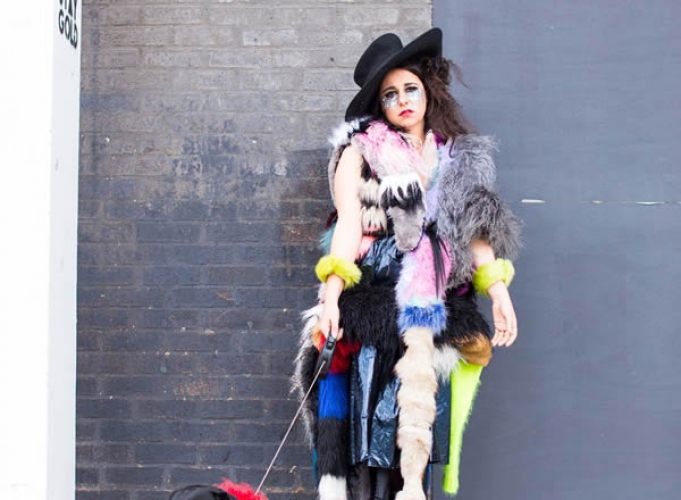
my-beautiful-black-dog_681x500My Beautiful Black Dog at Udderbelly Cowgate is a rock musical/gig/spoken word/live art show created and performed by southeast Londoner Brigitte Aphrodite. It celebrates her depression, or as she calls it in attempt to accept it as part of who she is, Creshendorious. There is glitter and sequins everywhere, emphasizing her party girl highs and contrasting her lows. Aphrodite is honest, frank and a highly skilled wordsmith in her songs and spoken text. Her songs manage to be both dry and celebratory; they create a party-like atmosphere that has the audience dancing and laughing along. It is rough and ready, and intimate, like a secret basement gig by your favourite band. The projected images and song titles added an element of set, but weren’t particularly needed and sometimes hard to see on the theatre’s brick back wall. On stage with her is Quiet Boy, who provides backing vocals, guitar accompaniment and a character who tries to coax her out of the road case she sometimes hides in, but it is very much Aphrodite’s show.

The party vibe abruptly drops when Aphrodite reads a (glittery) letter that explains exactly how she feels when she is fighting her black dog. Her honesty is brutal, but necessary. My Beautiful Black Dog takes a (sequined) tyre iron to the stigma and silence surrounding mental health issues. In these moments, the shine is a shallow sticking plaster, trite and useless. Rather than ending on a somber note, she ends on a song – not a happy ending, but a hopeful one. Aphrodite knows her depression will return, but next time may it be with understanding and acceptance from those around her. This production is difficult to experience, particularly if mental health issues affect you. It forces open a dialogue about mental health issues and even though it a (sparkly) genre mash-up, it is a vital show that could be scaled up to a big show, complete with lights, confetti and the sparkle it deserves.

Blind_Mans_Song,_Edinburgh_Fringe_2015,_courtesy_Francois_Verbeek_1_751x500Blind Man’s Song in Pleasance Dome is Theatre Re’s non-verbal dance theatre offering this year. As blind man Alex Judd plays keyboard and electric violin, a masked Guillaume Pigé and Selma Roth personify the images and emotions in his head. There is love, violence, travel, and a host of other encounters between the characters. There are moments of narrative, but this piece is very much open to individual interpretation. A simple, black set paired with smoke, side lighting and timeless costumes evokes the silent film era or a painting coming to life. The soaring emotion in the blind man’s music could imply that these are his memories or dreams. The mood and music varied enough throughout to maintain audience attention, and the performers’ skills in dance and mime were evident. It’s a captivating watch, if a little long. Sadly, some of the audience members were less appreciative. An older couple noisily left part way through and an American voice a few rows back at one point proclaimed, “This is stupid.” Abhorrent behaviour.

The music is richly augmented by a recorded track, but deliberately repetitive and grating at times. I found my mind wandering occasionally, but this was due to a moment triggering my own imagination. The young boy sitting in front of me had some lovely responses to the piece that drew my eye away from the stage: at times he conducted the music, at others he swayed mirroring the performers on stage, or wiggling abstractly in a dance of his own. Blind Man’s Song certainly triggers strong reactions from its audience though strangely, not all positive. It is a meditative, evocative performance if an individual permits it to be, but perhaps a challenging offering to our short attention spans.


The Play’s The Thing UK is an independent theatre criticism website maintained voluntarily. Whilst donations are never expected, they are hugely appreciated and will enable more time to be spent reviewing theatre productions of all sizes. Click here to make a donation with PalPal.

Divas and Islands, Edinburgh Festival Fringe

Divas Press ImageAdam and Damien, with a trio of backing singers, narrate their doomed-to-fail relationship from beginning to end. Magnus and Sophie, a high flying city couple and the epitome of pop culture, also use narration to tell the audience about their perfect relationship and their perfect lives that really aren’t so perfect. Fine Mess Theatre present these couples with two comedic short plays, Divas and Islands to remind us that we are all flawed creatures searching through the mess that is modern life to find that one person whose flaws fit ours. Also, city workers do their reputations no favours.

Divas follows a format similar to Jason Robert Brown’s The Last 5 Years. Adam (Joel Samuels) tells their story backwards, starting with their breakup. Damien (Daniel Ward) starts at the beginning. They address the audience, but rarely directly to each other. Three women in sequined black dresses sing stereotypical diva anthems a cappella, but also step in to take on the role of the other partner and friends as a mini-chorus. Things aren’t right, though. Adam is middle class and works in the corporate world. He desperately seeks out culture: book groups, art galleries, opera, fine food and wine. Damien is a working class barista who believes Adam is completely above him. Feeling the need to impress on one of their first few dates, he creates a new biography: he works in the music industry, he lives with hipster housemates, his parents are dead, the works. Lies are never infinitely sustainable, and in this case, all does not end well. As the story unravels, what is true and what is fabrication becomes increasingly unclear, but it works well by showing the two sides to every relationship.

Though the two men are desperately in love with each other, Samuels and Ward haven’t fully captured that chemistry. The staging is that of a cabaret, with a shiny red backdrop and the men using handheld microphones. The singers are not amplified, so the sporadically used microphones seem unnecessary and an obstacle to the characters’ relationship. There is little physical contact, though it is often discussed. Not that they need to be all over each other, but it may have helped create a stronger sense of their relationship. The cabaret format is a lovely idea to frame a couple that loves the genre, but it further distances the characters from each other. More direct interaction would certainly support their relationship, though it would have to be carefully placed and in order not to muddy the contrasting chronologies.

Islands_Press_ImageIslands is the stronger, more polished play, but with less likeable characters and a more conventional format. Magnus (Kyle Ross) and Sophie (Eva Tausig) are performed well, and hilariously embody aspects of corporate and pop culture that everyone loves to hate. From workplace affairs to text speak, they lead fabulously comfortable lives that look perfect from the outside. A quick pace generates some great comedic moments, but they are still two people desperately seeking the perfect compliment to themselves. There is also a heavy dose of narration, but the two regularly interact so their relationship seems genuine. Though this is a two-hander, the performances and the script are good enough to keep attention throughout, but there is perhaps one subplot too many. The puzzling element is the costume design – both characters are just in underwear. The stripped back costume contrasts their carefully constructed lives, but it doesn’t really add anything to their relationship and feels gratuitous.

Fine Mess Theatre are a new company of actor-writers that focus on new writing and clearly have the courage to experiment with form and structure. Their strengths are their characters and story ideas, but the structure doesn’t always support their characters’ relationships with each other. Narration and direct address is often ignored in character-driven work, but exploring it as a storytelling device is a worthy experiment. They are certainly a company to watch as they develop and refine their style.


The Play’s The Thing UK is an independent theatre criticism website maintained voluntarily. Whilst donations are never expected, they are hugely appreciated and will enable more time to be spent reviewing theatre productions of all sizes. Click here to make a donation with PalPal.

The Quentin Dentin Show, ACT Theatre at Kingston College

IYAF 1Disclaimer: due to TfL journey planner buggery I arrived at the theatre, the ACT at Kingston College in deepest, darkest zone 6, about ten minutes into the show. Fortunately, I only missed exposition that was covered as the story continued.

Keith (Jack Welch) and Nat (Shauna Riley) have been together for a while now. Their relationship has stagnated, as has Keith’s writing career. Nat’s had enough. They’re both chronically unhappy. The final straw as Keith’s radio breaking, but out of the static arrives weird and wonderful singing therapist Quentin Dentin (Henry Carpenter), and his two Friends (Caldy Walton and Ella Donaldson). Cloaked in white with matching hair, Quentin is a Christ-like figure there to save Nat and Keith’s relationship and to make them happy again.

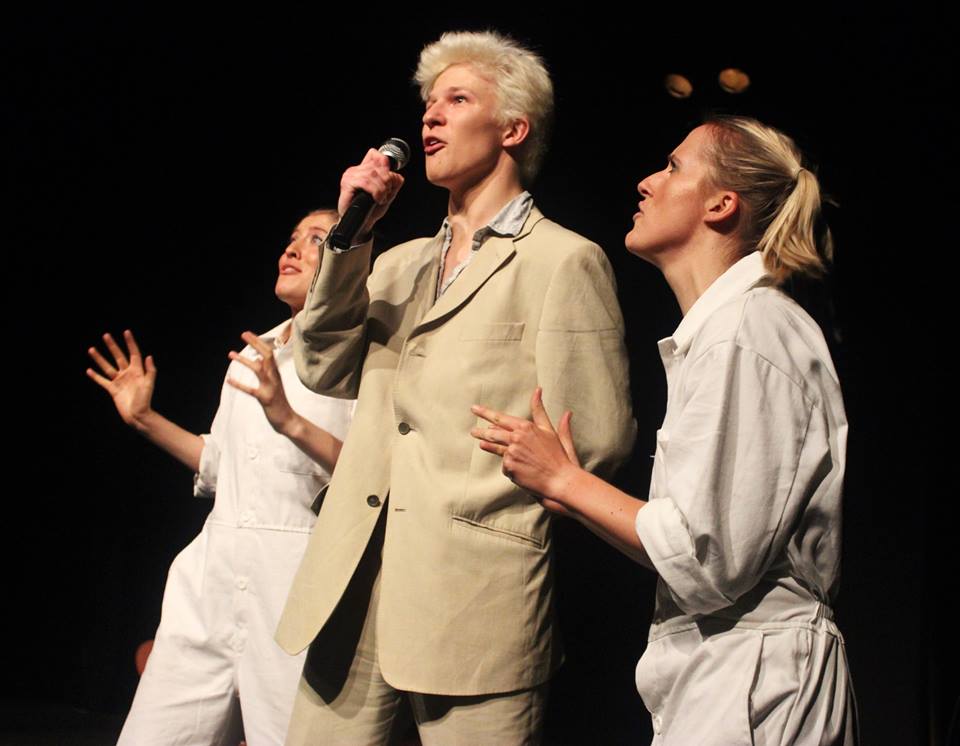
Of course, this is all rather creepy and surreal. The story takes a turn to a darker side as the couple’s treatments prove ineffective. Production company Slick Rat state that one of the primary influences on the show is The Rocky Horror Picture Show; Quentin has similar qualities to Frank N. Furter, and the couple are a rather more street-wise, contemporary Brad and Janet who go along with the strange man that appeared out of their radio with little question. Musically, the songs have a 1970’s glam rock vibe and Quentin also looks a bit like David Bowie. In summary, the title role is a Frank N. Furter/Jesus/David Bowie hybrid in a new rock musical. What’s not to like?

Not much, actually. Though this is a new musical by a young company, a long development period and support from places such as Rich Mix and The National Theatre Studio have helped Slick Rat shape their idea into a quirky little show with potential.

There are still some issues that should be looked at, such as clichéd lyrics (“Swim with the fishes/all that glitters is gold”) and an abrupt ending. Not that it necessarily needs to be positive, but it’s quite vague in its current form. The transitions into the songs are similarly abrupt, but all that is needed to correct this would be more lead-in music and/or dialogue that echoes the coming lyrics. Even though I missed to beginning exposition, is ten minutes of a one-hour show too much of an introduction?

The performances are good, particularly from Donaldson, Walton and Riley (Friends and Nat). Quentin could use an injection of charisma to avoid him becoming too creepy, but this could also be addressed in the writing. Similarly, Keith could do with more external artistic angst, frustration and clear isolation from the rest of the world. The music is fun and the premise both entertaining and thought-provoking: are we allowing society to dictate that we must be happy all the time? Are we too enamoured of miracle cures? What role does religion play in this?

This one-act could nicely develop into a more complex story with the addition of more characters and songs without losing its message. It has a distinctive musical style that manages to not muddy from all its influences. It would certainly benefit from the addition of a bigger budget, good design and a whole band rather than the sole onstage guitarist. In its current state, it captures the innovation and spirit of fringe theatre and admirably contributes to new British musicals, an area sorely underdeveloped in favour of revivals and American imports. It’s worth catching at Edinburgh Fringe, particularly for those interested in new musical theatre.


The Play’s The Thing UK is an independent theatre criticism website maintained voluntarily. Whilst donations are never expected, they are hugely appreciated and will enable more time to be spent reviewing theatre productions of all sizes. Click here to make a donation with PalPal.

Carmen Disruption, Almeida Theatre

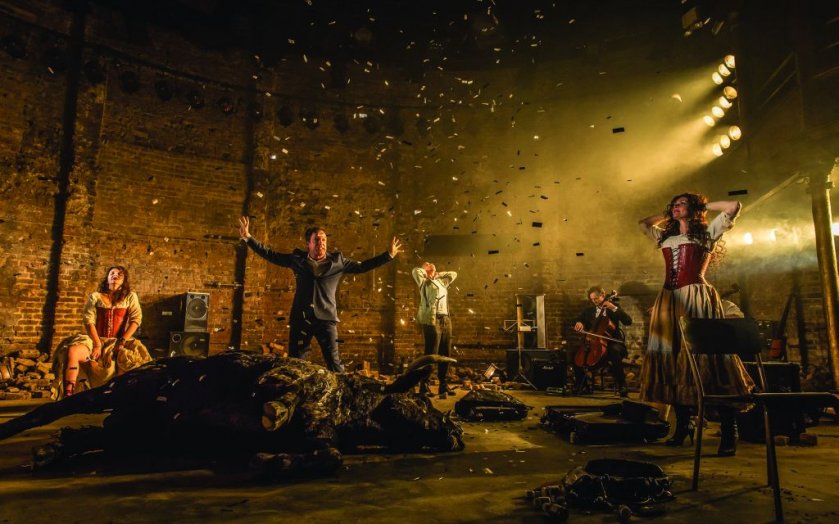
Bricks from disintegrating walls cover the stage.

A hulking, black bull breathes it last.

An aging opera singer arrives in a nameless European city.

A narcissistic rent boy readies for a “date.”

An awkward student is newly single.

A taxi driver prepares to meet the son she walked out on years ago.

A stockbroker travels to an appointment to “take care of” some poor transactions.

The one-woman chorus reaches out to each of them.

Two cellists watch and accompany from the edge.
carmen-disruption-1024x640Smash a mirror on the floor. Go on, do it. Now look at what remains. There are large chunks, long slivers and other bits that are so small they’re practically dust. Each one is uniquely sized and shaped. There is space in between them. Each one those sharp-edged, broken reflective pieces, no matter how large or small, is a person. Alone. Reflecting the world around them. With potential to fit into the pieces around us but. Just. Not. Doing it.

Simon Stephens slingshots Bizet’s Carmen into a wall at a billion mph, creating an explosion of bricks, sparkly confetti, agony, death, black blood, desperation and loneliness. His magnum opus to date, Carmen Disruption is a mess, but one that gloriously mirrors modern life with painful accuracy. Amongst the rubble are characters who are also these broken bits of mirror, pointing at us, mirroring us and paralleling Bizet’s original cast. We are them. They are us. They/we are also the creation of the deteriorating mind of the Singer (Sharon Small), who endlessly travels the world performing the same role over and over, no longer seeing truth in real life but only when she is Her. Carmen. Everyone she sees reflects an archetype from the opera, and not just the characters. Us, too. We are the Stephens’ characters, they are us, two mirrors facing each other. Reflecting infinity.

The five characters all lead radically different lives, intersecting only by chance because of opera and a motorbike accident. They never speak to each other, only to us. Even when they meet their narration is to the audience, about the others. They have no direct contact with anyone other than the observational Chorus (Viktoria Vizin). Fractured monologues weave in and out of each other, building their world that could be any major city, anywhere in the world. Fireflies blinking in the night sky. Their contact with the world filters through mobile phones, a comment on our dependence on our gadgets and urge to document rather than experience. If we take on the role of recorder, we don’t have to engage. Did technology cause the detachment from each other? This question is posed, but never answered, but not a major plot element anyway. By being posed, it makes a statement, calling on us to examine ourselves and our society in which we exist as lonely fragments of a shattered mirror.

Confrontational and omnipresent throughout the stories arising from our characters’ episodic speeches is the dark, hulking carcass of a bull. Its eventual movement surprises, showing a dying struggle rather than death. The actors pick their way around it as the audience did when they entered from the foyer, surprised and disorientated. A creeping pool of black blood eventually consumes. It is a striking visual, the elephant in the room, highlighting the destruction towards which we all hurtle.

The cellists are also fragments, as is their music. An LED surtitle screen adds an operatic element with sporadic, sarcastic content. None of the characters are particularly likeable, instead they evoke pity or disdain. The only thing that brings them together is a terrible accident they witness, but even then they only manage to bounce off of each other and continue spinning into the darkness. Alone. All roles are impeccably performed and the actors engage with each other in the space even without direct interaction.

It doesn’t matter if you know the story of Carmen or not before seeing this production. I don’t know it well at all and may have taken unintended meaning from Stephens’ script, but its ability to communicate Important Messages without having Bizet’s frame of reference attests to Stephens’ skill and the script’s excellence. Every individual will find different aspects of the production incredible and abhorrent, depending on their own frame of reference. John Light’s stockbroker, Escamillo, disgusts me. I am horrified by rent boy Carmen’s (Jack Farthing) details of his rape. I feel sorry for the naïve student (Katie West) who sexts her 63-year-old married lecturer boyfriend and believes their relationship has any love. Or meaning.

I could watch these characters forever. Not having an interval was certainly the right choice for this play. The compact snippets from their lives allude to distinct pasts and futures. Even though the world they inhabit is nameless and featureless, they were flawed, beautiful, unique humans. Smash another mirror. Go on, do it. Each individual fragment is totally unique, unlike those from our previous mirror. Future broken mirrors will be unique as well. Despite the presence of archetypes, the microscopic details of their stories are unrepeatable. On what trajectory would they all continue? I need to know. If Simon Stephens were to make a Synechdoche, New York version of Carmen Disruption, I would happily live in it. Forever.

Though director Michael Longhurst’s creative choices challenge perceptions of contemporary British drama, he could have emphasized the interaction and audience engagement even further. Even though the Almeida is known for its cutting edge work, this is a piece that could have been more fully explored in a large studio setting, without the constraints of a balcony and distinct actor/audience boundaries. I wanted to dance with these characters. I wanted them to move around me. I wanted them to look me directly in the eyes as they relayed their journeying tales and not have any regard for personal space. Carmen Disruption is aggressive, bold and visceral, the sort that is supported by more audience immersion rather than less. At the very least, the audience could have been lit so the actors could see their/our eyes, allowing a connection I craved and they characters clearly yearned for.

Despite this, the effect created was a Brechtian one of alienation and motivation to action. It’s no coincidence that Stephens’ work is popular in Germany. As I picked my way along Friday night’s Upper Street towards the tube station, the stories of those passing by and enjoying their warm, social evenings exploded around me like fireworks. I felt the need to connect. Never has the loneliness of modern life been so starkly emphasized on stage, and afterwards carried through the dark night.


The Play’s The Thing UK is an independent theatre criticism website maintained voluntarily. Whilst donations are never expected, they are hugely appreciated and will enable more time to be spent reviewing theatre productions of all sizes. Click here to make a donation with PalPal.