Freak, VAULT Festival

https://hepcatrestorations.files.wordpress.com/2012/01/sb72.jpg

A thing wot I learnt from theatre: there are people in the world that have a genetic disorder which gives them super stretchy skin. Whilst this is a great/horrifying party trick, historically it meant that people with this condition could join a travelling sideshow.

Nathan Penlington could be called a freak by those inclined to use such dated, derogatory language. He has a rare genetic disorder that, in him, manifests as hypermobility and chronic pain. But in other people it can make their skin stretch excessively. Penlington’s long-running fascination with sideshows combined with his own health issues, led him on a journey to a town in Florida with a unique history. His findings in the States, his research into sideshow culture and history, and a dash of disability rights combine to make solo performance/TED Talk work-in-progress Freak.

Continue reading

Droll, VAULT Festival

img_0177By guest critic Jo Trainor

“Let’s all dance ‘round the shitty faced baby.”

Drolls (director Brice Stratford explains) were short, raucous, illegal plays from the 17th Century. Oliver Cromwell and the Puritan interregnum banned theatre from 1642, but drolls were performed in pubs and alley ways to keep theatrical traditions going. Stratford says no one has put on a droll for 400 years, and boy, have companies been missing a trick because these sketches provide a hilarious evening of entertainment. There’s sex, there’s adultery, and you’re given a shot of whisky when you come in the door.

Continue reading

Wayward, VAULT Festival

https://i0.wp.com/www.vaultfestival.com/wp-content/uploads/2016/11/Catriona-MacLeod-WAYWARD-Supporting-Image01.jpg

by guest critic Martin Pettitt

After enduring the disorganisation of the first night of Vault Festival, entering the performance space is an instant antidote. Through hallways of cluttered objects and draped fabrics, we are guided by the music into a cavernous, atmospheric space arranged with a hotchpotch of tables and chairs and twinkling decorations. This physical preamble is wonderfully relevant to the down-the-rabbit-hole story we are treated to.

Continue reading

The Wild Party, Hope Theatre

rsz_wildparty_afphotography-529-1000x600

By guest reviewer Martin Pettitt

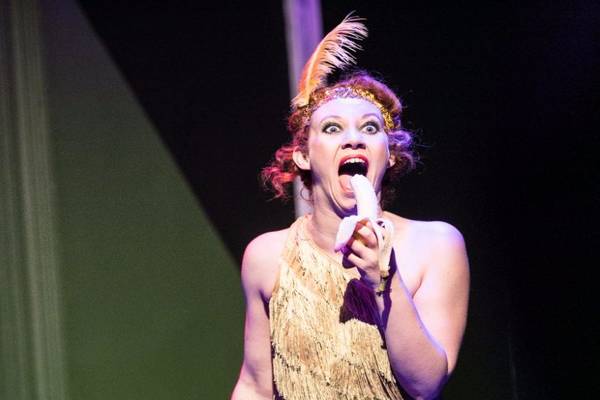
The Wild Party, a simple and to-the-point title, perfectly describes the show as well as the evening I experienced. There was so much to like about this performance. Adapted into a performance piece here by Mingled Yarn Theatre Company, The Wild Party was originally a book-length narrative poem by Joseph Moncure March in the roaring twenties. Initially deemed too racy to publish, it has since become a seminal work finding ever more relevance as we venture further into the 2000s.

Continue reading

Gardens Speak, Battersea Arts Centre

5 Tania El Khoury _Gardens Speak_please credit James Allan for Fierce & Artsadmin

In Syria, Asad’s regime attacks the funeral services for rebel fighters. Rather than holding public burials, families bury dead martyrs in their gardens, usually with no tombstone. In tribute to these people, live artist Tania El Khoury has created an interactive sound installation with the stories of ten martyrs buried in gardens. An intimate audience of ten each hear the recorded monologue of an individual martyr who died fighting against Asad’s forces, but they have to experience some discomfort in the process. Gardens Speak lasts a mere 30 minutes but irrevocably alters the detached western view of Middle Eastern conflict, fostering empathy and despair for fellow man.

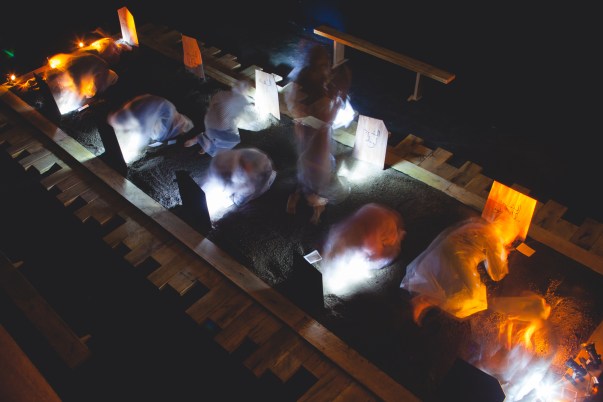
In a small room, we are asked to remove our shoes and socks, put our belongings to one side and don an over-sized raincoat. Once everyone is ready, the door is opened to a darkened room with ten tombstones lining the edge of a large wooden frame filled with soil. Each person is handed a postcard and a small torch. Following the instructions on the card, we each find the tombstone pictured. To hear the story of the person buried in that grave, we dig into the rich, peaty earth that scents the room. What with the competing sounds of other recordings, to hear properly we kneel or lie in the dirt.

The narration is a simple, unembellished tale of one man’s fight and fall at the hand of the tyrannical government. It’s neither overly graphic but neither does it hold back. The environment created by the set strongly influences the mood – there is a pronounced gravitas in the space. The whole effect doesn’t overwhelm, but imbeds itself internally, somewhere in the depths of the gut, along with the spirit of the young man who’s life spoke from the dirt I lie in.

We are lucky: the room is warm, and our clothes are protected from the soil. After the narrative of a man’s life, death and burial in his mother’s garden and a sound bath in Arabic singing, we can wash our feet (a reassuring ritual element that also adds to the aesthetic of the piece), collect our things and go home to our comfortable, little lives. Gardens Speak is both a little installation and one that encompasses the whole of humanity.

The Play’s the Thing UK is committed to covering fringe and progressive theatre in London and beyond. It is run entirely voluntarily and needs regular support to ensure its survival. For more information and to help The Play’s the Thing UK provide coverage of the theatre that needs reviews the most, visit its patreon.

Invisible Treasure, Ovalhouse Theatre

https://files.list.co.uk/images/i/invisible-treasure-lst184367.jpg

Invisible Treasure has no script and no actors. It’s not a play, but a playspace. For this hour long part-video game, part-puzzle, the audience/participants must work together to interpret the cryptic tasks that pop up on a small screen in the sterile room where they are deposited by theatre staff. The sensors, cameras and microphones that monitor the group at all times determine whether or not you progress to the next level or not, and the chance of failure is very real indeed. A giant white rabbit sinisterly lurks in the corner, its unblinking eyes the Big Brother that is unseen but all seeing. As the levels get harder, group dynamics become more pronounced. Emotions build and there’s potential for rebellion, made more exciting by each group’s unique composition. fanSHEN’s installation/event/environment’s use of interactive technology gives audiences a high degree of agency, but is still a powerful reminder that we are never truly free.

Hellicar & Lewis’ technical design is hugely impressive, or at least it is to a tech Luddite like myself. Others may find it less so but the unification and application are still incredibly inventive. The levels’ tasks require both problem solving and play that the group, on the whole, enjoyed even though some went on a bit too long. Those that aren’t keen on audience interaction or are introverted may find it challenging to engage, but as everyone is in the same position, it also might not feel so threatening. With clear leaders and followers quickly emerging, it’s possible to not contribute ideas but not joining in doesn’t feel like an option. It’s fascinating to watch others, and easy to let go and remember the childlike joy of playing without knowing where the game will lead.

When describing the experience with a friend afterwards, he boldly stated that it doesn’t sound like theatre. To be honest, I still haven’t decided if it is. But it is incredibly theatrical. With practitioners constantly trying to push the limits of immersive and interactive theatre, Invisible Treasure is certainly at the forefront and will create a personal experience and reaction for each person that attends. It’s tempting to go again and see what differs.

On completion of the levels, bonus rounds and free play sections the group is released into an analogue liminal space to process their thoughts and feedback on their experience. This relaxed environment provides an opportunity to decompress and discuss, but could, for some, lessen the impact of the experience by discovering how it works. Though this project is still in the early stages of its development, its certainly furthering the merging of theatre and gaming to empower audiences, and a wonderfully fun experience.


The Play’s The Thing UK is an independent theatre criticism website maintained voluntarily. Whilst donations are never expected, they are hugely appreciated and will enable more time to be spent reviewing theatre productions of all sizes. Click here to make a donation with PayPal.

The Tempest, Bloomsbury Festival

circle

By a guest reviewer who wishes to remain anonymous:

This adaptation of The Tempest by Kelly Hunter was a one-off performance as part of the Bloomsbury Festival at the Bloomsbury Studio Theatre. Hunter specifically designed this piece to enable children on the autism spectrum to participate in the show with the actors. These children’s parents/carers are invited to sit and watch.

I think this was the most unique Shakespeare productions I’ve seen. Hunter and her excellent cast of six set themselves the challenge of using The Tempest as a means of interacting and helping several young people on the autism spectrum to improve their self expression and communication with each other. Initially, I was uncertain how this would work as, personally, I’ve always found the Tempest a tricky play to follow. As the story progressed I saw that The Tempest actually lends itself perfectly to this kind of devised, interactive theatre. The play of course deals in magic; there’s also a clear physicality to many of the characters and a certain playfulness which allows the actors to introduce the young participants to the world of the play. This was not a full production of the Tempest and nor did it need to be. Considering its aims, the production was undoubtedly a huge success. All of the participants seemed to benefit hugely from playing simplified versions of various scenes from the play with these very experienced stage actors. More importantly they, along with the parents and carers watching, seemed to really enjoy themselves. When the play ended there was a lovely, warm feeling in the room. Everyone seemed enlivened by the experience, adults and children alike.

I sincerely hope that Flute Theatre will continue its success producing this kind of work in the future. It is extremely important and valuable to non-traditional theatregoers.


The Play’s The Thing UK is an independent theatre criticism website maintained voluntarily. Whilst donations are never expected, they are hugely appreciated and will enable more time to be spent reviewing theatre productions of all sizes. Click here to make a donation with PayPal.