Odd Man Out, Hope Theatre

https://i0.wp.com/mytheatremates.com/wp-content/uploads/2017/07/OddManOut_2guys_jul17.jpg?fit=648%2C404

A middle-aged, gay Welshman contemplates the English class he teaches in Hong Kong. Amongst the students is Windy, the Chinese woman with whom he shares his bed. Utterly smitten with her, he refers to her as his Pocahontas. He then kisses a barbie doll with long black hair and tanned skin.

Pocahontas was a Native American woman kidnapped by the colonising English in the 1600s, forced to marry, then taken to Britain. The same woman bore her husband a child then died, aged 21, after contracting a European illness.

Continue reading

I Know You of Old, Hope Theatre

https://cdn.thestage.co.uk/wp-content/uploads/2017/06/16131531/I-Know-You-of-Old-1-Sarah-Lambie-David-Fairs-Photo-Simon-Gethin-Thomas1-700x455.jpg

Hero’s coffin lies in a candlelit chapel of rest, draped in lace, overlooked by a portrait of the virgin Mary. Her cousin Beatrice and her lover Claudio quietly mourn the young woman, but their friend Benedick disrupts their grief. The characters are from Much Ado About Nothing of course, but this is not Much Ado About Nothing. David Fairs rips apart Shakespeare’s script to create a totally new story with Shakespeare’s verse and characters, I Know You of Old.

Continue reading

Mouths In a Glass, Hope Theatre

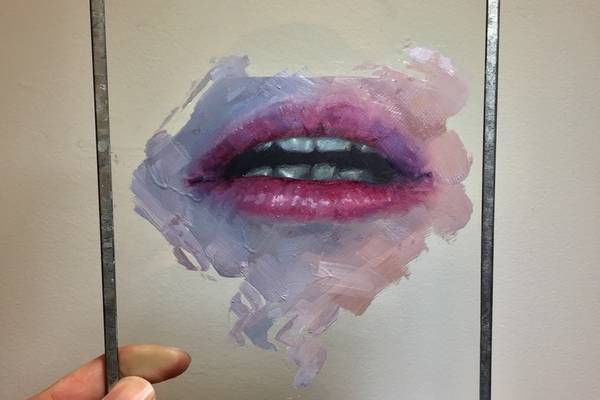
rsz_glass-4

by guest critic Alistair Wilkinson

Having never been to The Hope Theatre before, I am impressed by the intimacy of being in a space that only seated fifty audience members at a time. It’s a shame that Mouths In A Glass has a small crowd, resulting in a shortage of energy.

Perhaps it is this that leads to a lacklustre performance on stage, resulting in a rather basic delivery. The narrative doesn’t flow and the majority of the comedy falls flat. There are occasional laughs in the audience, however they seemed to come from family and friends.

Continue reading

The Wild Party, Hope Theatre

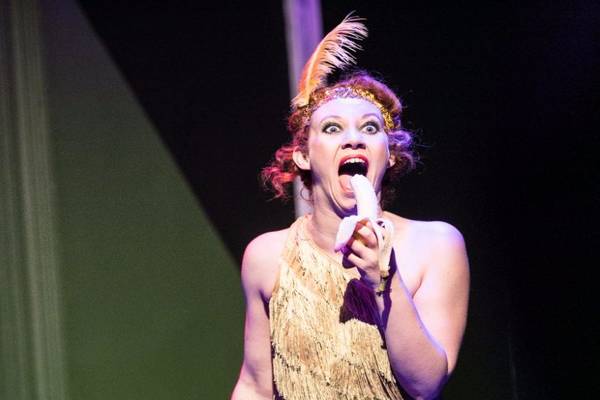
rsz_wildparty_afphotography-529-1000x600

By guest reviewer Martin Pettitt

The Wild Party, a simple and to-the-point title, perfectly describes the show as well as the evening I experienced. There was so much to like about this performance. Adapted into a performance piece here by Mingled Yarn Theatre Company, The Wild Party was originally a book-length narrative poem by Joseph Moncure March in the roaring twenties. Initially deemed too racy to publish, it has since become a seminal work finding ever more relevance as we venture further into the 2000s.

Continue reading

Nude, Hope Theatre

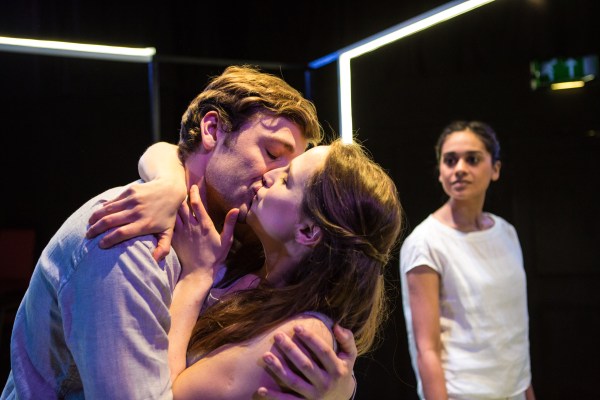
Nude- a play by Paul Hewitt - ©HelenMurray-156

A young couple meet, the relationship blooms, then goes through a rough patch and eventually ends when they are much older. Was it meant to be? Are the events in our lives accidental or controlled by outside forces? Within a standard love story, Nude boldly states that fate has the final word over life, death and love. Playwright Paul Hewitt relies on poetry and narration to tell this tiny, intimate tragedy that feels sadly familiar, like flicking through a dusty photo album of mostly forgotten family members whose memories thrive through stories. Poignant and competently executed, with gaps in the narrative that raise plenty of questions, Hewitt’s script skilfully uses language to depict this couple’s journey and the heavy hand that the personified Fate employs to convince us that we have free will.

Hewitt doesn’t rely on metaphors or overly flowery vocabulary in his rhyming poetry. His language is simple, almost pedestrian, but prettily structured and flows easily from the actors’ mouths. There are a lot of words though, and it’s delivered so quickly that there isn’t much time for in-depth processing. The narrative is a bit chunky with large sections missing and the length of time passing is consequently unclear. His characters are lovely and easy to relate to, though the heteronormative, white, middle class casting of the nameless everyman and woman, that are the focal point of this story, uncomfortably captures the lack of diversity theatre still struggles with. This is countered by a diverse production team and Fate, but romantic leads still lack diversity all to often.

Michelle Fahrenheim and Edward Nash are the charismatic couple controlled by Roshni Rathore as Fate. The three have a relaxed, watchable confidence and natural chemistry, though Fate clearly has the upper hand at all times, even when watching from the peripheral shadows. It creates a great dynamic that’s reminiscent of Prospero or a serious Puck.

Minglu Wang’s minimalist cube that contains the couple in the middle of the space is used well by director Ian Nicholson. Nicholson also incorporates some symbolic black thread, creating a sinister web that further traps the Woman and Man inside their box. This device could have been used more heavily to create a stronger sculptural effect, but was still a nice touch. Creating a space in the round emphasises the idea that the couple are constantly watched and controlled by outside forces – a canny choice.

Though Hewitt’s intention is to focus on a wider philosophical idea, his couple’s story steals the spotlight. Their timeless romance is achingly tragic and well executed textually and through Nicholson’s staging. Nude manages to move the heart even with its small faults, and taps into timeless truths about love, fear and loss.

The Play’s the Thing UK is committed to covering fringe and progressive theatre in London and beyond. It is run entirely voluntarily and needs regular support to ensure its survival. For more information and to help The Play’s the Thing UK provide coverage of the theatre that needs reviews the most, visit its patreon.


Twelfth Night, Hope Theatre

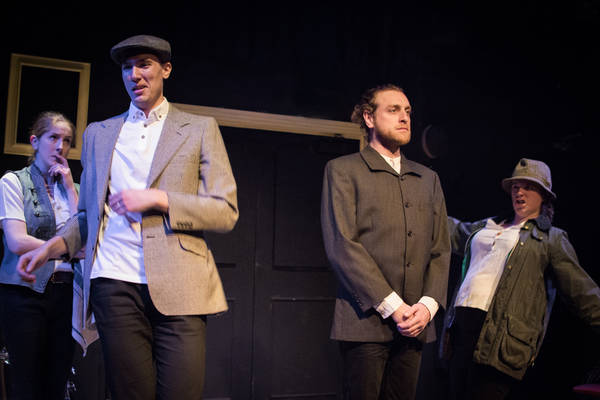
rsz_web_size-93

Fringe Shakespeare can be terrible, brilliant and everything in between those two ends of the spectrum. The better productions are vivacious and effortlessly handle Shakespeare’s language whether or not they are updated to a more modern setting, edited heavily or otherwise adapted with a concept. Thick as Thieves’ Twelfth Night is one of these good ones. Four versatile actors play all the parts in this bouncy interpretation that incorporates onstage character changes, plenty of music and audience interaction, and some clever character interpretations. At two hours long with an interval, the text doesn’t feel butchered though the interval isn’t particularly needed. With few faults, this is one of the best Twelfth Nights of recent fringe Shakespeare productions.

Company co-founder Nicky Diss, in an act of insightful  casting, plays Viola and Toby Belch. Her Viola is intense and boyish; her Belch is a gruff, posh older man. Diss’ presence and versatility are things of wonder, but she doesn’t outshine the rest of the cast. Her fellow co-founder Thomas Judd gives a Sir Andrew Aguecheek that is hapless and posh, a delightful interpretation that works very well; he doubles as a townie Orsino. Completing the quad are Oliver Lavery, particularly excelling as a hippy Feste and slimy Malvolio, and Madeliene MacMahon as a wonderfully frivolous Olivia. The four are all exceedingly good at creating clear, contrasting characters and have an energy that goes well beyond the walls of the tiny Hope Theatre.

There no set to speak of, which is fine for this play that changes location every scene. Costume pieces and musical instruments pepper the walls instead, giving easy access for changes. Hats, jackets and waistcoats over a uniform of black trousers and white shirts assist with character differentiation. It’s a simple but effective device to give visual variation and the lack of set reflects original practice. Occasional fiddly changes distract from the action on stage, but these moments are rare.

Some interesting alterations occur to facilitate the four actors, particularly the Sir Topas/Malvolio scene. Rather than Feste duping the prisoner, the lines are split between Sir Andrew, Toby and Maria. It’s believable enough despite vocal differences and makes no difference to the story.

Of the fringe Shakespeare that’s playing at the moment, the performances make this shoestring Twelfth Night a great one. Thick As Thieves are a talented, instinctual bunch certainly worth watching.

Twelfth Night runs through 30th April.

The Play’s the Thing UK is committed to covering fringe and progressive theatre in London and beyond. It is run entirely voluntarily and needs regular support to ensure its survival. For more information and to help The Play’s the Thing UK provide coverage of the theatre that needs reviews the most, visit its patreon.

in/out (a feeling), Hope Theatre

rsz_in_-_out_-_a_feeling-5

Sometimes, simplicity in narrative structure is more effective than twists, heaps of characters and subplots. Storytelling has been a powerful medium for time immemorial. in/out (a feeling) starkly depicts young, Eastern European woman Blue working in a London brothel after promised a cleaning job. Her client Ollie is a coked-up, suburban lad out for his mate’s stag do, but their encounter changes both their lives, at least for a little while. This two-hander is a brutal depiction of sex trafficking and its uncomfortable nearness to us all, but unblinkingly focuses on the delicate humanity of these two characters through interweaving, storytelling monologues. Excellent performances and Andrew Maddock’s sophisticated wordplay and use of rhythm both captivates and horrifies in this outstanding production with few, if any, faults.

Nicholas Clarke and Alex Reynolds are Ollie and Blue. Though rarely addressing each other directly, their chemistry is still tangible. Clarke’s character has a more interesting journey, from lad’s lad to articulate romantic to devoted boyfriend; Reynolds’ is subtler but more devastating. Both have fearless, vulnerable presences and expressive eyes that pierce the audience to the core during extended sequences of direct address. This is a small, intimate play in a similarly sized venue, but these performers fill the room with intensity and then some. The audience feels like they really know them by the end: a remarkable feat.

Director Niall Phillips and lighting designer Çağla Temizsoy put the stage/bed in the round with harsh blue and red lighting. The set design, presumably by Phillips, is similarly harsh and animalistic: white paint slashes the black walls, strips of red fabric hang from the ceiling like intestines. It’s a nightmare to us, but it’s Blue’s reality. Small buckets, like the kind children play with at the beach, dangle at head height. They aren’t filled with sand, though. It’s Ollie’s perpetual supply of cocaine that he lovingly shares with Blue and frantically sniffs during descriptions of his all-night binges. By the end of this 70-minute play, there’s white powder everywhere.

Along with the performances, Maddock’s language is the star of the play. Evocative rhyme hints at spoken word at times, at others his prose dances with colours, imagery and Blue’s memories of a happier life. We meet several other characters through their storytelling: Blue’s pimp, Ollie’s friend Connell, and others. The double meaning and repetition of “in, out” innocuously describes breathing, then the other bodily function that dictates the rhythms of Blue’s existence. Maddock’s ability to wow the audience with his facility of word choice, sentence structure, rhyme and repetition easily tips into the terror that these characters experiences; this is proof of an extraordinary gift with words and evocative storytelling.

Though building awareness of the closeness of human trafficking is clearly the primary purpose of this piece (Do you actually know your neighbours’ isn’t a brothel? I don’t.), in/out (a feeling) could be about anything at all and the language would still have it’s power. This is a production that needs to be seen, but it feels it would lose its intensity in a larger venue. A good portion of the actors’ power hinges on eye contact, which is easily lost in a bigger space. But in/out (a feeling) needs to be seen by more people – by everyone. And it’s a stunning piece of theatre as well as a vital one.

The Play’s the Thing UK is committed to covering fringe and progressive theatre in London and beyond. It is run entirely voluntarily and needs regular support to ensure its survival. For more information and to help The Play’s the Thing UK provide coverage of the theatre that needs reviews the most, visit its patreon.

Hello Again, Hope Theatre

https://i0.wp.com/grumpygaycritic.co.uk/wp-content/uploads/2015/10/Hello-Again-1402b.jpg

Knickers, bras and other vintage undergarments (oh my!) dangle from the Hope Theatre ceiling in dim light, the discarded ghosts of sexual encounters long past. Arthur Schnitzler’s 1897 Reigen, or La Ronde as it is more commonly known from the French translation, is reinvented in musical form in Michael John LaChiusa’s early 1990s Hello Again. Not content with the original story, LaChiusa spreads Schnitzler’s shags, blowjobs and wanks over the 21st century, updates some of the characters, includes gay relationships and adds a nearly continuous score mostly of duets, with musical influences from a host of eras. The sex is seen rather than just talked about, but otherwise Schnitzler’s format is replicated. Five actors each takes two characters and accompanied by a solitary keyboard, create an intimately filthy but strangely moving chamber musical in one of London’s newest pub theatres.

Hello Again, though titillating, also looks at the desire for sexual satisfaction through entirely unromantic, desperate scenarios. In ten short scenes, we see an array of social classes, professions and sexualities get their jollies before they run out of time; there’s the married housewife in her affair with a student, the soldier and the nurse before he ships out and the gentleman and cabin boy on the sinking Titanic amongst others. One-off and long-running relationships are accompanied by a range of musical styles on a bare bones set, but the minimalism means nothing is held back and it’s practically in your lap if you’re in the front row. Though there’s plenty of bonking, little is seen – a bum here, cleavage there; the acts themselves are staged realistically rather than stylized or hinted at by director Tania Azevedo. In our porno-fied modern culture where hardcore images and video are a couple of clicks away, to show the grunting and thrusting act without the bits strikes an interesting balance between honesty and discretion. With the audience split over three sides, more diagonals could have been used in the staging to improve sightlines for everyone, but otherwise the small space with no backstage is used well.

LaChiusa keeps the scenes short, but this enhances the immediacy and primal nature of sex. There are some good numbers, but the hodge podge of styles prevents much in the way of recurring motifs. The settings and characters are clear and believable, though their brevity needs the characters to get to the point quickly. As we don’t really get to know these people before us, they become an everyman of their character type: they are us, and we could easily be them. The ensemble cast is consistently good, with newcomer Isabella Messarra and veteran Miles Western giving the most striking vocal performances. Messarra’s Nurse is a wonderful force that literally dominates the posh student she cares for, Western is the smug senator exploiting a beautiful but lonely film star.

This is an excellent and largely faithful adaption of Schnitzler’s play that doesn’t shy away from explicitly prurient moments all sexual human beings can relate to. LaChiusa’s characters speak to all of us, even if his music is less satisfying. Azevedo’s direction and multi-roll casting suits the piece, as the intimate venue fits this infrequently staged and rarely seen musical.


The Play’s The Thing UK is an independent theatre criticism website maintained voluntarily. Whilst donations are never expected, they are hugely appreciated and will enable more time to be spent reviewing theatre productions of all sizes. Click here to make a donation with PayPal.