Iphigenia at Tauris, Rose Theatre

by Lidia Crisafulli

by Lidia Crisafulli

At the far edge of the Rose’s pool that preserves the remains of the original theatre, perches the temple of Diana. Blue and purple lighting reflects in the pool; waves are heard lapping at the shore. This is Iphigenia’s world where she serves as a priestess to the goddess on the island of Tauris, ruled by King Thoas. He loves Iphigenia and respects her wishes, but wants to kill the foreigners who turned up on the coast. She wants to not only save them, but escape with them.

Using rich, imagery-laden language, Goethe has adapted Euripides original tragedy, translated into English by Roy Pascal. The austere, Mediterranean set and rich sound design made this production a soothing but rich sensorial feast that compliments Goethe’s text. Unfortunately, unconnected performances and unvarying delivery from some of the cast who seem to focus more on the sound of their own voices rather than communicating their intentions makes a sleep-inducing affair.

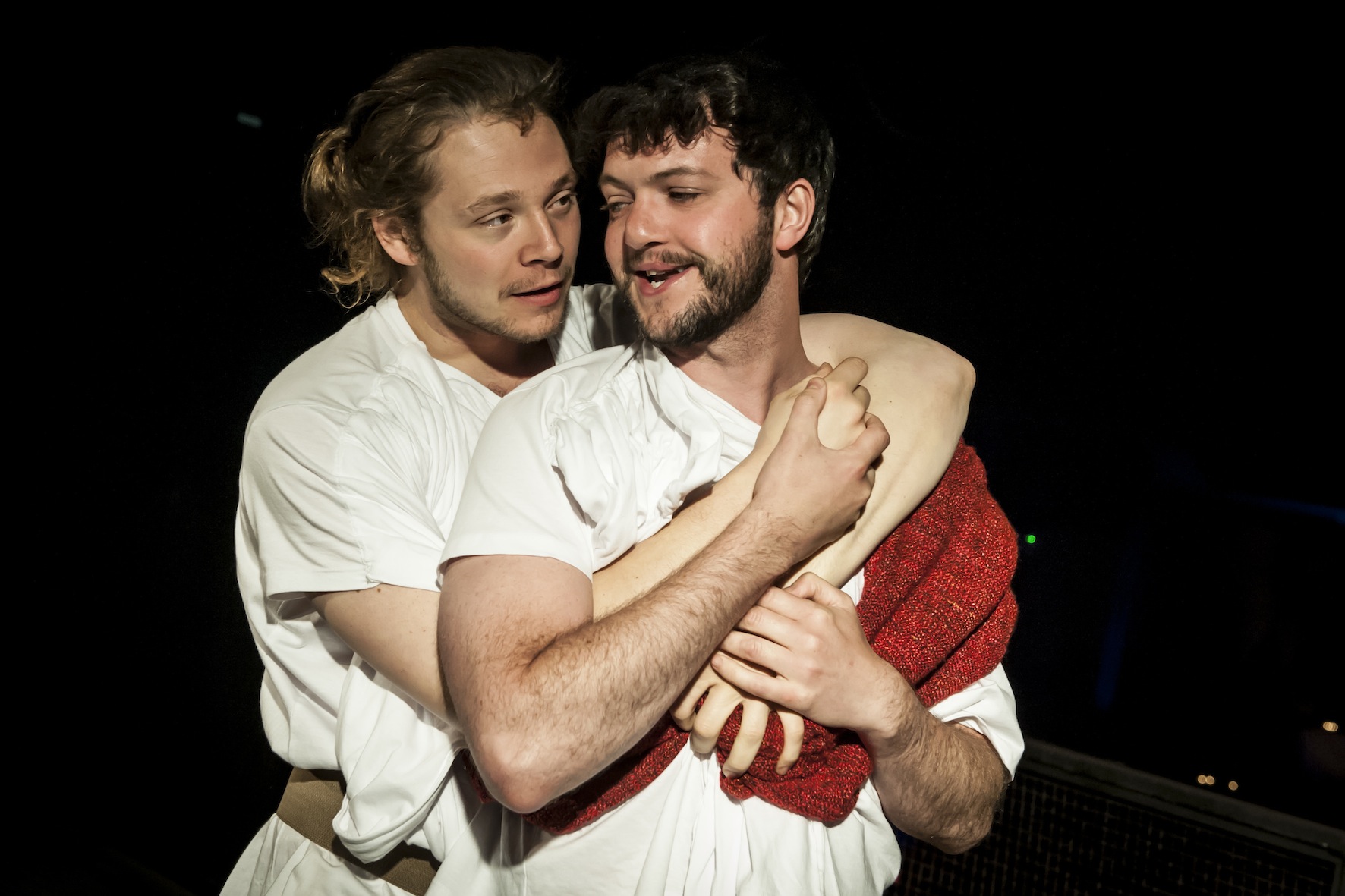
The best work comes from Ben Hale as Iphigenia’s brother Orestes and his lifelong “friend” Pylades (Andrew Strafford-Baker). They contribute vibrant performances and excellent chemistry, a welcome respite from the indulgence presented to the audience prior to their entrance. Pylades’ comforting of Orestes as he is tortured by the furies for murdering his mother is the stuff fanfic is made of, it’s that homoerotic and genuinely lovely. Even though their behaviour is rather laddish (they came to Tauris to steal Diana’s statue from her temple), they are charming, passionate and a joy to watch. Their eventual clash with James Barnes’ Thoas is inevitable, but well contrast against Thoas’ steely reserve.

Title role Iphigenia (Suzanne Marie) is a complex character and could even be considered feminist despite the play premiering in 1779. Her reunion with her brother is underplayed, but her longing for her homeland is clear. She eventually uses her manipulation and womanly charms to talk down Thoas from attacking her brother and Pylades, but none of the character’s power comes across in the delivery that hasn’t altered from her opening speech. Marie shows obvious pleasure at speaking Goethe’s words but gives equal weight to most of them, causing much of meaning to be lost. Her pace could have done with being kicked up a few notches in more urgent situations, but her grief for her family was touching.

The staging was an excellent balance of the foreground and the rear of the archaeological site. It was used enough to not be ignored, but not so much that action was lost. The set and lighting from Diana’s temple along the back wall created plenty of atmosphere, even as a backdrop when the action was on the stage. Director Pamela Schermann worked well with designers Gillian Steventon and Petr Vocka to create such an evocative atmosphere. Sound design by Philip Matejtschuk really ties the rest of the design elements together. The constant waves remind on we are by the sea and perfectly suits the large pool that dominates the Rose. A cinematic soundtrack emphasises moments of conflict or suspense, ending in the start of a storm as Thoas relents. The only design letdown is the costumes. They attempt to replicate Greek tunics and robes, but they are obviously altered t-shirts held in with women’s belts and the footwear is painfully modern. Iphigenia’s flowing gown is beautiful though, and suitable to a temple priestess.

It is a play not staged often and one particularly suited for the unique space of the Rose, so it is disappointing that the lead performance let it down. Fortunately two of the supporting actors add life and energy to a beautifully crafted script. This is one of the most effectively staged productions I’ve encountered at the Rose with thoughtful design elements that can easily become the star of the show.


The Play’s The Thing UK is an independent theatre criticism website maintained voluntarily. Whilst donations are never expected, they are hugely appreciated and will enable more time to be spent reviewing theatre productions of all sizes. Click here to make a donation with PalPal.
Bash, Etcetera Theatre

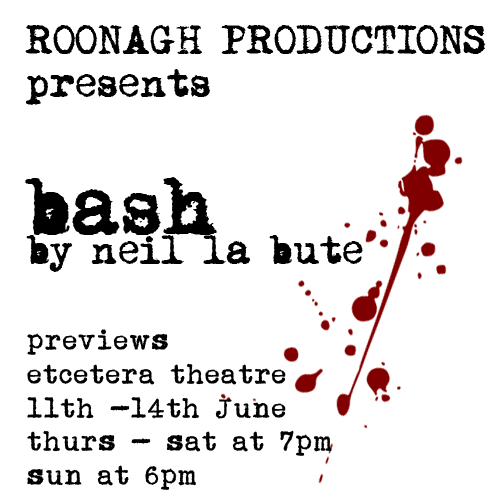
BashPoster_DetailsNeil Labute’s Bash is a distinctively 1990’s play containing three unrelated parts that are one-act plays in themselves. The component pieces have enough detail to stand alone and have unrelated characters, but a common theme: all of the characters are Mormon and commit horrific acts of violence. True to LaBute’s style, Bash exhibits the depravity that people sink to, despite these characters living on the supposed religious, moral high ground. This two-hander is the debut of Roonagh Productions, founded by Irish actors Stephen Gibbons And Sarah Purcell who perform all roles.

Act one. An unnamed man sits in his hotel room, sipping a glass of water. He has somehow convinced another guest to join him because he needs someone to talk to. What unfolds is the lengthy filicidal monologue from this fellow who seems to have it all: God, a wife, children, a good job. Gibbons initially plays the part nervously, not fully connecting with his character’s guilt. He finally relaxes when he moves onto talking about work and the fear of losing his job, but the first third of the scene had a constant, restrained delivery. When Gibbons connects his family to this prospect, all the pieces fall into place along with his performance. Though he could have more urgency and energy in the beginning of his speech, he eventually captures this calculatingly despicable man and unapologetically lays him at the audience’s feet for their self-righteous consumption.

Act two. A couple from Boston reminisces about a party in New York City they attended when they were students. Sue is sweet and wholesome; John is an all-American frat boy jock. Both characters are stereotypical and two-dimensional. Though there are two characters together on stage, they never talk to each other. Instead, they relay alternating lines to the audience in past tense, which has potential for tedium but Gibbons’ and Purcell’s work is dynamic and keeps the audience interested. John has a murderous, deliberate story similar to the man in first act, but Sue was asleep in the hotel room after the party and only has fond memories of the evening. The religion is more blatant in this story and a driving factor for John and his friend’s actions in a Central Park toilet at an early hour of the morning. The only particular issue in this part of the play is the choice of costume for Sue. If she’s a practicing Mormon, she certainly would not have worn a strapless dress.

Act three. Called “Medea Redux”, this is another monologue featuring Purcell in a police interview. Her story is by far the most complicated and sympathy-inducing but her crime is just as heinous as the previous two. When the woman was thirteen, she and one of her teachers had an ongoing affair; he then abandoned her when she fell pregnant with his child. She was fourteen. Driven to desperation by her lover’s abandonment of her, she repeats Medea’s final act of vengeance. Yes, her crimes are shocking but what is most frustrating is that she was the only character of the three criminals we’ve met who were caught. This is a much meatier role for Purcell, and she performs it with more nuance than she did Sue. This is the most interesting of the three stories, so fitting LaBute saves it for last.

The performances from the two actors are mostly good. There are a few accent slips and Irish intonations here and there, but perhaps not noticeable to British ears. Bash does feel rather dated now, but the writing and the characters are great. It’s an easy production to mount with little set needed, so a wise choice for a debut production. Purcell and Gibbons are older than your average early twenty-somethings thinking it’s cool to start a theatre company so even though there was nothing risky or inventive in this production, it was well done and chosen to suit their types and strengths. Besides, not all theatre has to be revolutionary. As long as its good theatre performed well, it is still to be commended.


The Play’s The Thing UK is an independent theatre criticism website maintained voluntarily. Whilst donations are never expected, they are hugely appreciated and will enable more time to be spent reviewing theatre productions of all sizes. Click here to make a donation with PalPal.
So It Goes, Greenwich Theatre

SOITGOES_CMYK_1

Hannah used to love running with her dad. When she was 17, her dad died and Hannah kept on running, silently and alone. She refused to speak about his death with anyone, including her family. So she decided rather than to navigate the burden of speech, she would create a silent play that tells her dad’s story and her process of dealing with his death. So It Goes is a sweet two-hander that manages to avoid over-sentimentality by focusing on the honest, deeply individual story of navigating life after the death of a parent.

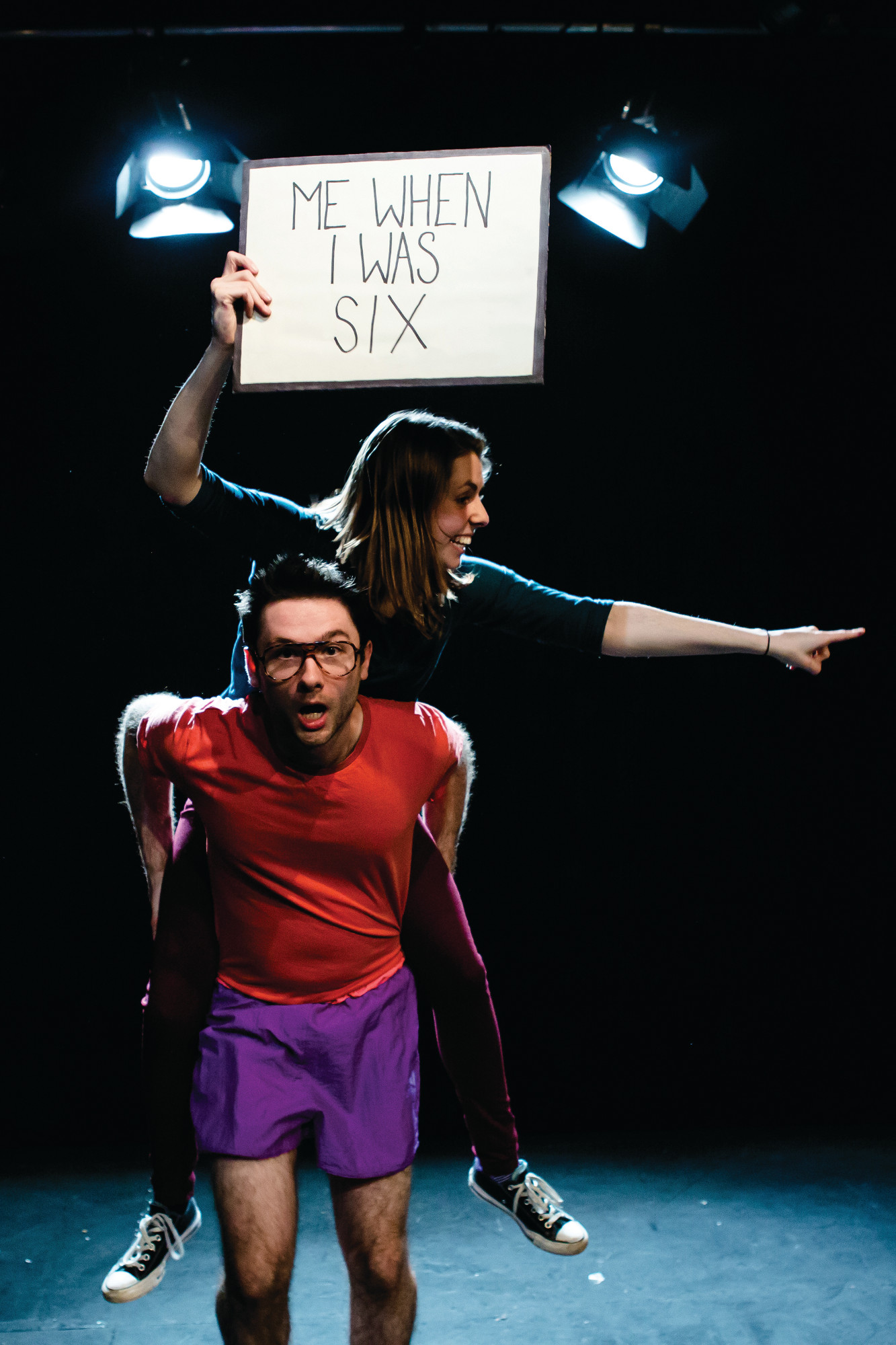
Other than the last line, there is absolutely no speech in this play. All text is written on small whiteboards worn around the actors’ necks or on pre-made signs. This keeps written communication basic; it is rather like watching a comic book or graphic novel being written. This could occasionally feel slow and it was often easy to predict what was coming next on the whiteboard within a scene, but not overly so and not often. The set and props are also simple, with signage and symbolic items representing other characters and jumps in time and place. Most props are drawn outlines of objects, adding humour and a sense of youthful play to the story. The physical performance style matches- it is exaggerated but simplified, physical theatre but not ornate, embellished or for the sole purpose of showing the actors’ physical prowess. So It Goes wants to tell Hannah’s story as clearly and simply as possible, focusing on truthfulness and emotional honesty. The look of the play would certainly appeal to children, but accessing adults’ inner child makes the experience of losing a parent a journey that ends with positive reflection rather than the bitterness of loss.

The performances are equally lovely. Hannah Moss plays herself, and has “help” telling the story from David Ralfe, who plays her Dad and Mum. Ralfe in drag has an initial hit of comedy, but he taps into Mum’s outward expression of hopelessness that soon makes the audience forget that it’s a bloke in a dress. The two actors embody an exaggeration familiar to children’s theatre that is also in keeping with the cartoon aesthetic of the production, but is not crude. If they did not employ the exaggeration or humour in their physical comedy, it would make audiences want to slit their wrists. Instead, there was a lot of sniffling and nose blowing mixed in with laughter.

This is the third play I have seen about death in recent weeks. Each production used a dramatically different approach to convey the same message. Hannah spelled it out for us by writing that her dad “didn’t just die, he lived.” There’s an overabundance of factors in the world that can easily depress us and forget to look for the little moments of daily joy in our own lives, but So It Goes provides a celebratory reminder to do so through a pared down, visual-textual hybrid of physical theatre. Though the tour has now finished of their debut production, On the Run Theatre is certainly a company to watch.

Intention: ☆ ☆ ☆ ☆ ☆

Outcome: ☆ ☆ ☆

Star Rating: ☆ ☆ ☆ ☆


The Play’s The Thing UK is an independent theatre criticism website maintained voluntarily. Whilst donations are never expected, they are hugely appreciated and will enable more time to be spent reviewing theatre productions of all sizes. Click here to make a donation with PalPal.

This Is How We Die, Battersea Arts Centre

Chris Brett Bailey is a bard of thhqdefaulte modern age. Like Elizabethan theatre the audience went to hear rather than to see, This Is How We Die is a bombardment of the ears rather than the eyes. Using spoken word and beat poetry to tear open the world as we know it, Bailey forces us to confront the horrors and beauty of everyday existence. This piece of theatre moves away from the trend of visual theatre, taking the audience on a self-reflective ride of their lives.

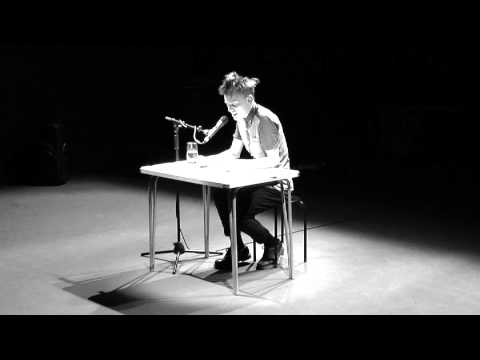
At just over an hour, we are hurtled on a journey through Bailey’s rage against “-isms” and “-ists,” a brutal first meeting with his overly-literal girlfriend’s parents and a Hunter S. Thompson-like roadtrip through the American desert. His delivery is relentless, pausing only for comic effect or to take small sips of water from the glass that sits on his desk. Yes, a desk. He sits at a desk, with his script in front of him. This form rails against the increasingly visual culture we live in but it forces the audience to really and truly listen. He has a lot to say that he feels strongly about and you need to hear it.

Trying to describe what This Is How We Die is about is futile. Anything descriptive about plot or narrative arc will make this piece sound simplistic and trite. The feature that really makes this a must-see is Bailey’s visceral use of language. He savours it, relishes it and throws it away. A sea of sound washes over us, then pummels us, unarmed, in a back alley behind some dingy American bar. His imagery alternates between abstract and concrete, the highlight being his girlfriend’s neo-Nazi father left shaped like a swastika after a car accident.

The last ten minutes or so abandons speech, instead favouring live ambient music and harsh lighting. This is his Elizabethan jig, the audience’s catharsis after the emotional Sturm und Drang of the last hour. There was no point in fighting the journey of This Is How We Die so you may as well join him. Share in his rage, his joy and his passion. Relish the world you live in and the sounds of the words that pour so easily from his mouth. This isn’t about how we die, but how we should live.


The Play’s The Thing UK is an independent theatre criticism website maintained voluntarily. Whilst donations are never expected, they are hugely appreciated and will enable more time to be spent reviewing theatre productions of all sizes. Click here to make a donation with PalPal.

No Take Backs, everything theatre

“What do you do when you’ve lost your dad, your girlfriend dumps you and a stranger breaks into your new flat, handcuffing you to the radiator? Engage in a battle of wits for your freedom of course!

“…Emily (Lucy Litchfield) is handcuffed to a radiator whilst the Lara Croft-esque Megan (Rachel Eireann) lords over her…The pace is almost akin to Beckett, and there are a few moments when I wonder if the action is going to progress…

“During their conversation it emerges that both of these young women carry lots of issues and baggage. The dialogue is mostly rapid fire and both characters are highly intelligent, if emotionally damaged. Power shifts again when Emily’s brother (Daniel Farley) enters the scene and recognises Megan after she beats him up. Things spiral out of control, and after the boss (Sylvie England) has cleaned up the mess the truth behind the whole hostage situation is made amusingly clear…

“The writing is tight, though playwright Michael Eckett could have easily shaved fifteen minutes from the beginning to make it even more pacy. He has a great sense of comic timing and a great understanding of sound dramatic structure, even if the twist at the end felt slightly formulaic…No Take Backs is a strong one-act offering for this years’ Camden Fringe Festival, and shows that not all good theatre relocates to Edinburgh for the summer!”

Read the entire review on everything theatre here.

Respawn, Hackney Attic

logosrespawnI really want to like Stars or Mars latest sci-fi offering, Respawn. Not because I like science fiction – quite the opposite. I really don’t enjoy the genre in any form, be it films, books or television. There isn’t much sci-fi theatre out there, though. The only sci-fi production I can ever recall seeing is Theatre Ad Infinitum’s Light. Light has the distinction of being my first five-star review, and it had nothing to do with the genre. I want to continue bucking my own trend by liking science fiction theatre (if you can call loving one show “bucking a trend”), but it can’t happen with Respawn.

The primary issue with this play is the script, a combination of Pinteresque vagueness and Beckettian lack of action set in a technology-ridden future. I’m sure playwright Susan Gray has an idea in her head of what she wants to communicate to the audience, but it struggles to transfer from page to stage. Her script is set in a world where people become artificial intelligences (AIs) when they die, but no clear message came through the muddled story. Characters were not named, instead referred to with pronouns. This added to the confusion. The programme states that two actors played multiple characters, but not all of the characters were clearly distinguished. Gray herself is credited with playing three roles, but two were so similar they seemed to be the same person. Melanie Crossey had a much clearer performance, playing an AI as a voiceover that lives in a hotel and interacts with living people, and the AI “in person”. Another structural issue lies in this occurrence: if the AIs don’t have bodies, why are we seeing them wearing Phantom of the Opera masks and performed as otherwise completely naturalistic characters? Even if the storyline were to be a clear-cut narrative, there is no overriding theme other than the idea that the AIs want to be human again, but can’t be. It is an interesting idea, but one that can serve as a starting point rather than the crux of an entire play.

Crossey’s performance is a saving grace of this production. With a confident but relaxed stage presence, she holds this convoluted one-act together. She is obviously a skilled performer that deserves the challenge of meaty, contemporary characters. A sound designer is credited, but no director, lighting director or script advisor. These creative roles would be a wise addition to the company’s upcoming Camden Fringe productions.

The Hackney Attic is an unconventional venue, more of a cabaret or comedy venue that a theatre. At the top of a cinema, it is a long, white room with tables rather than rows of seats and a staffed bar in the room. The stage lights are either on or off, the dressing rooms can be seen through a curtain, and a paint job is needed in order to achieve blackout. The space needs some alterations to become suitable for a wider range of performance styles, but the location is great. There was also no signage warning audiences of the strobe light effect that occurred several times in the play.

Furthering the sci-fi theatre genre is certainly a noble pursuit, as it is a genre sorely neglected. LA has Sci-Fest, but London is only this year bringing a celebration of the genre to the fringe at Chelsea Theatre in October. There is huge potential to reach a brand new audience base who spend their weekends at comicons and cosplay events rather than at the theatre. I admire Gray’s aim of developing science fiction theatre, but first she needs to continue refining her own craft.


The Play’s The Thing UK is an independent theatre criticism website maintained voluntarily. Whilst donations are never expected, they are hugely appreciated and will enable more time to be spent reviewing theatre productions of all sizes. Click here to make a donation with PalPal.

Romeo & Juliet, everything theatre

“Lauderdale House is the Elizabethan-era home of a former Lord Mayor of London… Behind the house, Shooting Stars Theatre Company perform their modern take on Shakespeare’s Romeo & Juliet

“Romeo (Joe Sargent) is a sensitive, intellectual hipster who hangs out with Roisin Keogh’s tomboyish Benvolio and Graham Dron’s oversexed, brash Mercutio. They drink, smoke, probably do drugs and generally make a nuisance of themselves…Sargent’s relationship with Emily Loomes’ Juliet is flawless, turning my insides to mush by the interval…

“Rory Fairbairn (Peter/Balthasar) gives us some excellent multi-rolling and physical comedy. Maxwell Tyler has a forbidding presence as the Prince and a sleazy, Cockney Paris. Ruth E. Mortimer, playing Capulet as a cold, corporate businesswoman, is all the more disturbing whilst arranging her daughter’s marriage…The whole cast is fantastic…

“The fight choreography (using flick knives and unarmed combat)…occasionally felt a bit mechanical…

“The second half struggled to find momentum initially…As it got dark, the dimming light reflected the darkening of the action even though it made it harder to see…

This is a truly excellent production with clear, creative directorial vision in a gorgeous setting. Hie thee to Highgate and catch it before it goes.”

Read the entire review on everything theatre here.

Rhesus, everything theatre

“Trinity Buoy Wharf was new to me as a venue, but certainly worth the trip. It is far from a conventional performance space…There is no obvious stage or audience space…Excellent lighting design by Pablo Fernandez-Baz gives this stark, damp basement with challenging sight lines a polished, professional feel. The set by Zahra Mansouri is minimal, but suits the space well and the audience sit amongst it, included in the world of the play…

“…There is absolutely no actor-audience boundary initially, but this changes when the play properly starts. From then on, there is no contact from the performers…

“The text is spoken well and all of the actors seem comfortable with heightened language. The cast is predominately female…Whether or not it was intentional, due to the cast being very young (late teens to early twenties, I’d guess) it carried a disturbing reminder that many who fought in our past wars were young and child soldiers are a very real tragedy in many places around the world today…

“The most notable features in this production are the regular movement sequences between the scenes. Some are abstract, some capture the brutality of battle and killing. All of them are impeccably choreographed and directed by Ailin Conant of Theatre-Temoin

“The performances in this ensemble piece were good, but as is often the case with very young performers, few stood out. No one was particularly weak but neither was anyone outstanding…

“The venue is certainly worth experiencing in this well-designed production of a rarely performed play. Though a showcase, it is certainly not a difficult one to sit through.”

Read the entire review on everything theatre here.

Super Premium Soft Double Vanilla Rich (LIFT Festival), everything theatre

“One of the first things that struck me about Arts Depot’s main theatre is how comfortable the seats are…It may seem trivial, but after seeing numerous productions in hot pub theatres on benches with straight backs…comfort does become important. The set was austere: two screen printed flats placed at a right angle showing the shelves of a modern convenience store and a small screen above for the projected surtitles…

“We quickly meet the two main characters. These young men work at the convenience store…Whilst there is no traditional narrative structure, we see snapshots of shop life…The absurdity of this corporate environment is obvious and makes me shudder to think how easy it is to be sucked in as a young person seeking purpose…

“This same absurdity comes through in the customers, we see one young woman who, upon discovering her favourite ice cream has been discontinued, has a meltdown…It is an existence of small tragedies, self-importance and the need to cling onto any kind of meaning in a cold, corporate world.

“Whilst the dialogue in the play tends to realism, the movement is abstract, expressionist and constant. It is mostly light and flowing; resembling tai chi…it loses meaning quickly and can be distracting…

“…It is a good piece of physical theatre and an excellent ambassador for the LIFT Festival.”

Read the entire review on everything theatre here.

Mugs Arrows, everything theatre

“…Visually striking yet incredibly simple, it immediately creates tension that carries on through the entire play and keeps the audience watching. The lights then come up on two men tensely playing a game of darts without speaking…As dialogue slowly starts, we gather that the two have just been to the funeral of a dear friend…Both Rhys King (Pat) and Eddie Elks (Ed) are clearly excellent performers who can skilfully use naturalism to create highly developed characters.

“What you perceive to be true is turned upside down when Sarah (Chiara Wilde) enters in a wedding dress and joins in darts game. Rather than a funeral, Pat and Ed have lost their best mate another way…With an inevitable violent end and convincing stage combat by Lyndall Grant, I thought the play had ended.

“But, no! Writer Eddie Elks surprises us. A final, joyfully weird scene takes everything you perceive to be real within the action and turns it upside down. You will leave with a head full of questions, but truly innovative theatre will have that effect...Whilst an incredible show for theatre folk, those who like their theatre conventional and commercial would struggle to watch this play…

“Go see this show before it closes if cutting edge independent theatre is your thing.”

Read the entire review here on everything theatre.