Romeo and Juliet, Greenwich Theatre

https://theatreweekly.com/wp-content/uploads/2017/04/JSS_8484.jpg

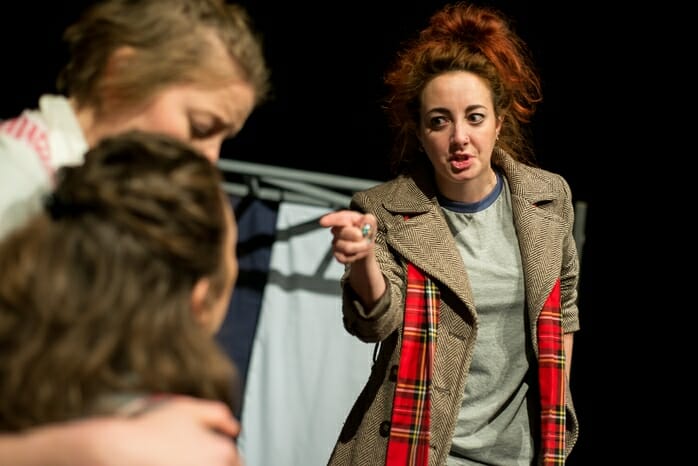
A self-described modern rep company, Merely Theatre is addressing Shakespeare’s  gender problem with 50/50 casting. Five male/female pairs each learn a set of characters in two plays, then on the night it’s decided who will perform. The result is a focus on clear storytelling rather than unimportant details such as the appearance or gender if individual characters. It’s a great device, and partnered with simple staging and a pace that doesn’t hang about, artistic director Scott Ellis has created a distinctive style of performance honouring the historical aesthetics of travelling players, though there’s a lack of nuance dissatisfying to modern audiences.

Continue reading

Sublime, Tristan Bates Theatre

rsz_adele

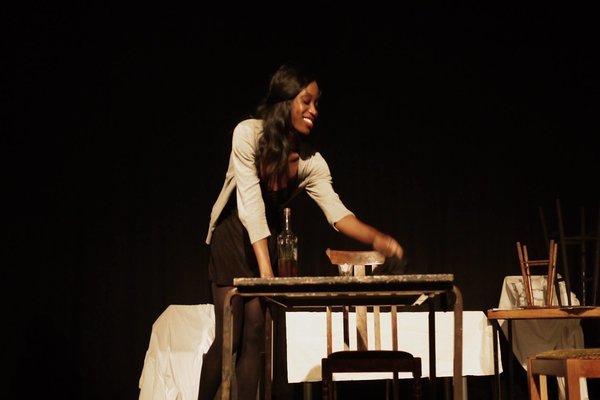
Sam and Clara live the ordinary, domestic life of a young professional couple, until Sam’s sister Sophie turns up unannounced. The playful, carefree young woman eventually chameleons into someone much more sinister. Caught up in the criminal underworld, she’s back in town with an agenda. As Sophie lures Sam back to the adrenaline-junkie lifestyle of high-end burglary and fraud he’s desperate to leave behind, the siblings’ facade deteriorates further. No one is what they seem in Sublime, though the plodding script that should be thrilling never reaches its potential.

Continue reading

The Poetry of Exile, White Bear

https://cdn.thestage.co.uk/wp-content/uploads/2017/03/31135947/The-Poetry-of-Exile-c-Adam-Bennett-1-700x455.jpg

You can be who you want to be, right? Rob, a driving instructor in modern day Romford, believes himself to be an 8th century Chinese poet from the Tang Dynasty. When he finally chooses to live the sequestered life of a poet out on the marshes in a wooden hut, it has huge repercussions on his family and friends. The whole thing’s silly – sure, you can choose a career, or where you live, but contrary to what Rachel Dolezal and desperate sci-fi fans may think, we cannot chose our race or the century we live in.

Continue reading

The Toll, Half Moon

https://cdn.onthewight.com/wp-content/2017/03/luke-wright.jpg

Luke Wright’s jovial demeanour and impressive word hoard sit at odds with his smudged eyeliner and black leather jacket. The unassuming performance poet skulks to the mic, breathes, then unleashes a torrent of verbal acrobatics snapshotting British everymen and women. From a Georgian dine and dasher, to a bloke from Essex who swears he saw a lion roaming a campground, Wright’s depictions bring these characters to life. His dexterity and character-driven performance has a theatricality missing from most performance poetry, but the polished story present in What I Learned From Johnny Bevan is notably absent in The Toll.

Continue reading

Custody, Ovalhouse

https://cdn.thestage.co.uk/wp-content/uploads/2017/03/30165602/Custody-7-Kike-Brimah-Urbain-Hayo-Sacharissa-Claxton-Photo-Lidia-Crisafulli1-700x455.jpg

By guest critic Alistair Wilkinson

HOPE: A feeling of expectation and desire for something to happen.

How do we cope when we don’t get what we want? How do we beat a system that is set up to make you fail? Custody asks just these questions, as we are taken on a two-year journey of a family’s struggle for justice for their loved one, twenty-nine year old Brian, who died whilst in police custody. Through this eighty-minute narrative, we see four different individuals cope/hope, whilst their questions are left unanswered.

Continue reading

a profoundly affectionate, passionate devotion to someone (-noun), Royal Court

https://i0.wp.com/www.theartsdesk.com/sites/default/files/images/stories/THEATRE/aleks_sierz/profound2.jpg

There are loads of jokes and stereotypes about life within a heterosexual relationship – women talk too much, men don’t understand the difficulties of pregnancy, LTRs feel like a burden, and so forth. Of course each relationship has its unique aspects, but there are common elements that often make generalisations about love ring true. Writer/director debbie tucker green discards many of the trappings of character specificity to expose universal truths about love and relationships in a powerful, moving script with elemental staging that taps into common experience.

Continue reading

The Principle of Uncertainty, Draper Hall

https://i0.wp.com/www.redorbit.com/media/uploads/2012/09/shutterstock_838492.jpg

According to one of the theories of quantum mechanics we’re taught in The Principle of Uncertainty, we can be in multiple places at once. If only that were true. I could review way more shows than I can currently, go on holiday, live in multiple countries and hold down several jobs, all at once. It would be wonderfully productive. Dr Laura Bailey (Abi McLoughlin), the lecturer who explains the theory to us, has a simpler wish – to be able to see her daughter again.

We are Dr Bailey’s freshman class in Draper Hall, a housing estate community space in Elephant & Castle newly doubling as a performance venue run by veteran Italian polymath Stefania Bochicchio. The non-traditional space doesn’t have a lighting rig or backstage, so shows like this that defy theatrical conventions are a natural fit.

Closely resembling a lecture, this production takes time to get to its point but when it does, it breaks hearts. McLoughlin excels as the warm, enthusiastic Laura and utterly convinces as a scientist. Her gentle breakdown is a moving climax to a script as it begins to lose focus, with the attention shifting from equations and concepts to her own, personal story.

Dr Andrea Brunello’s script is science heavy, though it doesn’t matter if it’s understood or not. It takes awhile for the story to emerge from the lesson; though it doesn’t work if it’s earlier, this happens well after the question of what the performance’s point is arises. McLoughlin is fully engaging throughout even if it’s difficult to care about the content of the lecture.

The piece suits the space well, and takes a relaxed and accessible tone – a great choice for a south London council estate venue seeking to bring new audiences to theatre. An excellent performance in this a show that doesn’t feel like a show charms, educates, and provokes reflection on the important things in life.

The Principle of Uncertainty runs through 1 April 2017.

The Play’s the Thing UK is committed to covering fringe and progressive theatre in London and beyond. It is run entirely voluntarily and needs regular support to ensure its survival. For more information and to help The Play’s the Thing UK provide coverage of the theatre that needs reviews the most, visit its patreon.

The Bad Seed, Brockley Jack Studio Theatre

L-R Rebecca Rayne as Rhoda, Jessica Hawksley as Monica and Beth Eyre as Christine © David Monteith-Hodge

Rhoda is the picture-perfect 1950s American child. Obedient, clever and helpful, she is a dream for any parent. But after the death of a classmate who won the penmanship medal Rhoda coveted, mum Christine’s investigations into past “accident” uncover a dark secret from her own childhood that means Rhoda isn’t all that seems. The revelation ends in tragedy with serious implications for Rhoda’s future.

Continue reading

One Last Thing (For Now), Old Red Lion

https://theblogoftheatrethings.files.wordpress.com/2017/02/one-last-thing-for-now-credit-of-laurie-field-14.jpg

Families separated by war and conflict have kept in touch one way or another for time immemorial. Recently giving way to skype, texts and emails, letter writing is now largely neglected – but surviving relics betray heartache, fear and longing. International theatre company Althea Theatre draw on choral physical theatre and the intimate communications between family members from a range of global conflicts to create a moving tribute to love and patriotism.

Continue reading

Spillikin, Pleasance Theatre

http://www.huntspost.co.uk/polopoly_fs/1.4892837.1487231182!/image/image.jpg_gen/derivatives/landscape_630/image.jpg

by guest critic Alistair Wilkinson

You could easily classify this production as “the one with the robot” but there is more to Spillikin, currently on tour throughout the UK. Despite the high level of artificial intelligence on show, this is a human story depicting the world of a woman going through Alzheimer’s, the struggles she faces and how we as a society care for those who need support. Plays on these themes need to be put on more frequently, however Spillikin could tell this story better.

Continue reading