A Nation’s Theatre: Wail and The Beanfield, Battersea Arts Centre

For two months, theatre makers from across the country are coming to London to celebrate the state of British theatre. One of the A Nation’s Theatre venues is Battersea Arts Centre, currently hosting the double bill of Little Bulb’s Wail and Breach Theatre’s The Beanfield. Wail is an exuberant cabaret about whales and human expression; The Beanfield uses multimedia to examine the impact of police violence on peaceful people and the need to fit in. Though different from each other in content and tone, both Little Bulb and Breach play with performance conventions to create innovative new structures that are at the forefront of theatre performance.

WAIL_Little Bulb Theatre

There’s a lot of science in Wail, and a lot of musical instruments. Actor-musicians Clare Beresford and Dominic Conway, performing as themselves, also have boundless enthusiasm and impressive music repertoires. With material ranging from folk to metal, they share their enthusiasm for whales through songs alternating with monologues of scientific facts. Their charisma and cheer keeps these sections engaging, particularly with the addition of audience interaction. Though the overall energy is light and positive, Beresford’s melancholy for never actually seeing a whale in the flesh provides a bit of contrast to the Male Whale Choir, a hilarious whole-audience exploration of whale songs that males use when on the pull in the coastal waters of Madagascar.

There isn’t as much material on the promised exploration of why humans wail, but a song about why they sing songs is a tender, poignant homage to feeling fragile. This fun, frivolous show is light on the gravitas that a bit more time on this topic could bring, but Wail is still a wonderful, joyful piece as is. The symphonic final number is a fantastic climax wrapping up an excellent contribution to A Nation’s Theatre.
The Beanfield_014_please credit Richard Davenport

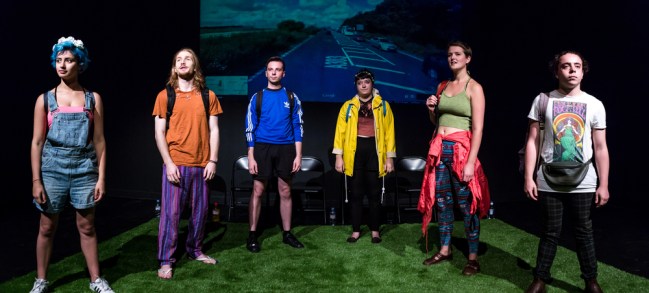
The Beanfield by Warwick University’s Breach Theatre wowed audiences at Edinburgh last summer, and understandably so. Drawing on the historic clash between new age travelers heading to Stonehenge and police fresh from the miners’ strikes, they add the framing device of a uni reenactment group researching the event in order to recreate it, and a counter narrative of a group of students going to Solstice. It’s a sophisticated script with plenty of absurdity to lighten the bleak depiction of police violence against unarmed civilians, but still serves as a potent reminder that this happens today in the UK and abroad. Part documentary, interview footage with witnesses on both sides is broadcast liberally; even though the inclusion of police is sympathetic, The Beanfield firmly supports the travelers. Rightly so – pregnant women and children were among the 600 or so attacked with truncheons and projectiles by 1000-odd police.

There is no explicit link between the Beanfield story and that of the contemporary, skeptical students at Solstice, but the inclusion of the latter provides some necessary humour. It’s not a needed subplot though, and detracts from the power behind the political statement of the Beanfield standoff. The script is a great collage of experiences past and present, the sweet naivety of students juxtaposing the atrocities that happened at thirty years previously. The Beanfield, a bit less polished than Wail, is still an excellent piece of theatre with some important thoughts on police brutality.

With multimedia at its forefront, The Beanfield captures the rapid-fire sensory bombardment of present day youth and the desire to instigate change as well as fit in with our peers. Wail, mostly analogue and much less angry, implies the importance of conservation and sympathy for all creatures, human and not. Both shows excellently address concerns of people in this country and experiment with performance, fitting contributions to A Nation’s Theatre.

Wail runs until 23 April, The Beanfield until 21 April then touring.

The Play’s the Thing UK is committed to covering fringe and progressive theatre in London and beyond. It is run entirely voluntarily and needs regular support to ensure its survival. For more information and to help The Play’s the Thing UK provide coverage of the theatre that needs reviews the most, visit its patreon.
Leaper: A Fish Tale, Greenwich Theatre

unspecified

Our oceans are dying. Just yesterday, the news reported that 95% of the Great Barrier Reef has been bleached due to temperature rises. There are huge swathes of sea with high concentrations of microplastics that leach toxins into the water and the food chain. We are overfishing our oceans, causing a myriad of problems to human and sea life.

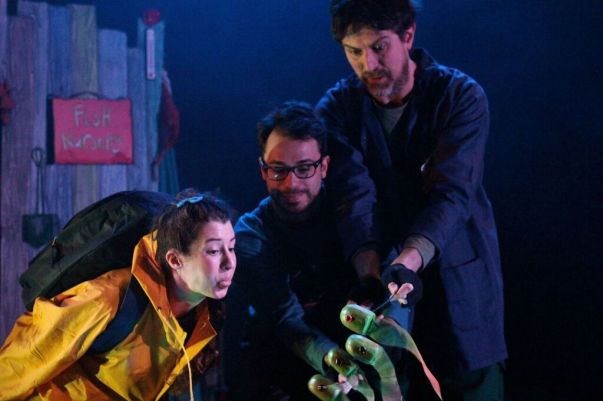
Tucked In is trying to change that through Leaper: A Fish Tale, an adventure story for families about a young girl’s discoveries in the world’s waterways. The unnamed daughter isn’t particularly interested in her dad’s fish farm and wreaks more havoc than anything else. But after falling into the stream in pursuit of a dropped crisp packet, she makes friends with Leaper the salmon on her journey from stream, to river, to ocean and back again. Good puppetry and movement keep younger ones engaged in this surprisingly complex story, though at times it feels a bit too convoluted and the lack of dialogue is unnaturally forced.

With an impressive array of animal puppets by Claire Harvey and Annie Brooks’ transformative set, there’s plenty to look at in the show’s recycled aesthetic. The larger puppets have an excellent range of movements, particularly the duck, seal and big fish. The rubbish monster is the most wonderfully inventive surprise, and the large jellyfish are poetry in motion. The smaller puppets are understandably simpler, but less dynamic with fewer moving parts. The baby fish, though sweet in the way the human characters treat them, are harder to see and not particularly interesting in and of themselves. The design really comes into its own in the middle of the ocean, with atmospheric lighting and sound to match.

Though the show wants to address both overfishing and ocean pollution, the littering is the primary focus. It makes sense as children may struggle with the concept of overfishing, but the plot points on the topic are consequently less engaging. There aren’t many of them though, and the focus is almost solely on the girl’s (Lizzie Franks) journey.

The performances by Franks, Philip Bosworth and Robert Welling are engaging and precise, though the reason for minimising speech is unclear. There are plenty of vocal effects, but character communication and actor impulses feel unnaturally limited. It doesn’t interfere with the story and the children in the audience aren’t bothered, but it doesn’t contribute to the production style.

Leaper: A Fish Tale is visually compelling with some great puppetry and an engaging story for children and adults alike. The performances are good and the story has all the necessary components of a satisfying adventure tale with a clear moral. Though there are some small issues, they don’t interfere with the overall enjoyment of the piece, and this show could play a powerful role in raising engaged, environmentally conscious young people.

Leaper: A Fish Tale is touring schools and theatres in April.

The Play’s the Thing UK is committed to covering fringe and progressive theatre in London and beyond. It is run entirely voluntarily and needs regular support to ensure its survival. For more information and to help The Play’s the Thing UK provide coverage of the theatre that needs reviews the most, visit its patreon.

These Books Are Made For Walking, Jackson’s Lane

https://farm8.staticflickr.com/7398/15871797584_e5b143b72f_b.jpg

Fabrice Dominici is a solitary librarian who takes great pleasure from the books he tenderly looks after. Gently stroking them, he flips to his favourite passages before giving them a sniff and balancing them on shelves made out of ladders. When a pile of books at the top comes to life, revealing a woman who has no intention of leaving and has a musician friend join her, the librarian tries everything to drive off these nonchalant interlopers. As his attempts continue to fail, this simple storyline of These Books Are Made for Walking starts to wander until it completely loses its way at an anti-climactic ending. Though visually dynamic and a nice premise for its aged 6+ target audience, the lack of distinct characterisation and a simple narrative arc is a disappointment to all ages.

Dominici’s nameless librarian draws on clowning to create a somewhat hapless but caring character who endears himself to the audience with his Wile E. Coyote determination. There are regular laughs, and his performance finds a lovely midpoint between over-exaggerated and underplayed. The other two performers lack personality, and it is never made clear what they want other than to hang out and make music on top of the rickety shelves. A love song gives away that they are a couple, but their relationship has no real bearing on the story.

Whilst the librarian’s attempts to get rid of his uninvited guests are entertaining and draw to a close before they become stale and repetitive, his sudden change of heart is inexplicable. He dashes around the stage with ropes and an audience volunteer to set up for the woman’s slack rope routine; after poking her musician friend in the bum with gardening sheers it simply doesn’t make sense. It’s a strange transition, but not as abrupt and unsatisfying as the show’s conclusion.

The set design, presumably by the three devising artists that also perform, is the highlight These Books Are Made for Walking. It’s instability naturally creates tension, though I would not want to be the person that had to risk assess the freestanding structure with performers clambering along the top. Books create a wonderful aesthetic, though watching them tumble to floor and then be trodden on cause several tiny heartbreaks. Christopher McGhee’s lighting works with the set well to create gentle shadows and focus points, though a moment of bright orange rays made the subjects hard to see as they were too close to the source to be lit evenly.

This second production from Bikes & Rabbits shows a promising use of narration in physical and visual theatre with additional elements of circus, but the spectacle’s temptation proves too much and is not properly integrated into the piece’s structure. It’s a lovely idea that doesn’t manage to follow through to a satisfying, clear conclusion.

These Books Are Made For Walking tours until 2 April at various venues.

The Play’s the Thing UK is committed to covering fringe and progressive theatre in London and beyond. It is run entirely voluntarily and needs regular support to ensure its survival. For more information and to help The Play’s the Thing UK provide coverage of the theatre that needs reviews the most, visit its patreon.
Institute, The Place

rsz_gecko-pcte2pct80pct93-institute-e1423864432429

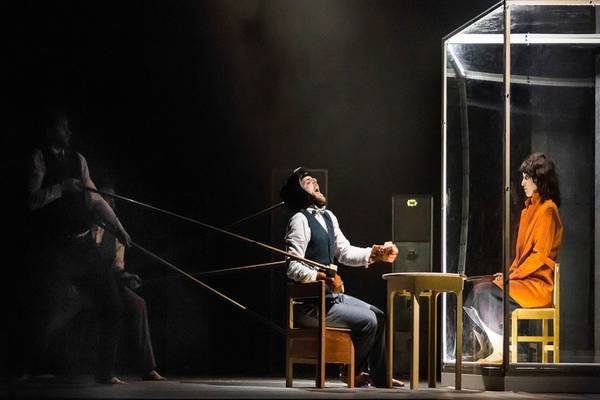
Say your only close friends are people you work with. Can you trust them to help you out if you’re struggling with your health? Martin’s mental health is deteriorating, so Daniel, Louis and Karl try their best to care for him despite their own inner demons and needing to be looked after as well. With a distinctive physical vocabulary and a masculine camaraderie, Gecko’s Institute is an absorbing look at a society made of lonely, needy people without the safety net that family can provide.

Rhys Jarman and Amit Lahav’s deceptively simple set of Victorian wooden filing cabinets is loaded with the possibility of discovery and serves as a convenient place for the characters to store their memories, good and bad. The moments that new items are revealed are a wonderfully surprising juxtaposition to the hulking, boxy structures. Lahav and Chris Swain’s lighting design dark and atmospheric, sharpened by the addition of otherwise unnecessary smoke. Both serve the choreography well, without drawing too much attention onto the design.

Lahav also directs this devised piece, and performs as Martin. Considering he is also the artistic director of the company, it is a true marvel, and a testament to his talent, that none of his production roles suffer. He seemlessly incorporates multiple languages and regular movement sequences that are tightly choreographed and emotive expressions of his characters. The characters puppeteering of each other is a powerfully visualised (and sometimes sinister) metaphor of helplessness at the hands of external forces and the support that peers can offer – or not offer. It’s a visually arresting comment on the support and limitations of others on our individual lives.

The strong sense of brotherhood imbedded in the choreography is a lovely thing to witness. There’s a physical comfort the performers have with each other that blends with the characterisation, making the moments where they treat each other badly all the more shocking. The single female character, Martin’s imaginary girlfriend Margaret, is inventively shown, through costume and movement, but her appearance in a plastic cube is anticlimactic. The whole piece starts to feel too long towards the end, though none of the scenes are gratuitous.

Institute is typical Gecko fare, but the character’s relationships and externalised emotions are the finest features in this physical theatre performance. It’s some of best, most reliable physical theatre work out there at the moment, and Gecko retain the ability to surprise as well as showcase their unique theatrical language.

The Play’s the Thing UK is committed to covering fringe and progressive theatre in London and beyond. It is run entirely voluntarily and needs regular support to ensure its survival. For more information and to help The Play’s the Thing UK provide coverage of the theatre that needs reviews the most, visit its patreon.

Never Ending Night, The Vaults

“Immersive” is a trendy term that’s rather overused in theatre at the moment. But what is it, exactly? The same can be said for “site-specific” and “interactive” theatre. Audiences are seeking out alternative theatre experiences that aren’t just sitting in a dark room and watching actors tell a story, and theatre producers are obliging, using the aforementioned vocabulary often too liberally and consequently diminishing the words’ meaning. Established practitioners of immersive performance include Punchdrunk, probably the most well-known, Secret Cinema’s events that are part cinema and part theatre, and Coney’s use of game design to empower audiences. Many other companies and individual shows also describe their work as immersive; some definitely is whereas others is less concretely categorised. CCSD lecturer Dr. Gareth White says the accepted definition of immersive theatre is a production that contains “installations and expansive environments, which have mobile audiences, and which invite audience participation.” But is that entirely accurate?

Never Ending Night at the Waterloo Vaults is immersive in that the audience is freely mobile in a space fully kitted out as a bunker for the survivors of a global pandemic. The audience is first taken through decontamination, where personal effects are checked and white boiler suits and masks are provided. There is a distinct air of authority that the audience dares not violate. The first part of the performance is set outdoors in one of the two large rooms that contain the show. It’s a desolate street, with bodies of the living, barely living and dead. Lighting guides the audience to individual moments, promenade style. This provides clear, concise exposition to the world created. Narratives overlap, creating snapshot moments of grief and desperation, but it’s not frantic. Soldiers in boiler suits take the last survivors and the audience into the next room, where the rest of the play happens.

The audience can spend as much or as little time with any given character as they chose. There are several options: following a character, staying in one space to see what characters come and go, or move to scenes as they occur; each will create a totally different experience. The survivors have all been in this bunker for quite some time, and a reference to nearby Waterloo Station adds an element of site-specific performance, but doesn’t seem important to any particular narrative. The structure gives the audience autonomy, but with a large cast, individual characters have few scenes so it’s hard to connect to their experiences and learn about the little details of their lives.

There is no interaction between the audience and the actors, which raises the question of whether or not Never Ending Night is fully immersive. Can immersive theatre not be interactive? My initial instinct is to say no, but I don’t know if that’s necessarily correct, showing the issue with the lack of a standard definition. The audience here, even in provided costume, are merely observers with an unclear role. They are not residents of the facility, nor are they government officials. Even if they are there to observe, the reason why is never made clear.

Created by a company of actors trained in the Meisner Technique of character development, this quietly ending piece feels more like an extended acting exercise. It would certainly be possible for the audience and actors to speak to each other without disrupting the main scenes at any given moment, but create a new level of intimacy and depth. There characters are interesting enough to want to engage with them, but the audience was invisible. There are numerous encounters between characters and emotions are often running high, which make for excellent bursts of dramatic tension. These are too brief, within a form that goes on for too long, however. The ensemble cast remains excellent, with immense focus and emotional truth Meisner would commend. The gentle ending is a powerful anti-climax, after which the audience is set free into the night.

It is a well-managed, polished piece of ensemble theatre, but the opportunity to develop a relationship with the characters is not provided. They would continue to function and interact in their world with our without the audience present. Consequently, this is a great production for those looking for an unconventional theatre experience without the pressure of audience participation. The setting is clear, but what isn’t, is what the audience is meant to take from the experience. Still the performances are good, as is the design and it’s a worthy attempt at a form that is still developing, whether or not it really counts as immersive.


The Play’s The Thing UK is an independent theatre criticism website maintained voluntarily. Whilst donations are never expected, they are hugely appreciated and will enable more time to be spent reviewing theatre productions of all sizes. Click here to make a donation with PalPal.