Give Me Your Love, Battersea Arts Centre

I’ve grown up always having pet cats and it’s absolutely true that cats love being in cardboard boxes. I stumbled on a Buzzfeed or similar article recently that says cats seek out boxes or other encloses spaces when they’re stressed or in need of comfort. Humans have similar instincts, really. Think about the last time you were upset or stressed: did you want to hide under a duvet, make a pillow fort or crawl into a small, dark space? Or at least curl up into as small of a ball as you could? Observations and life experience indicate we’re pretty similar to our felines in that way. So it would make sense that someone suffering from grief or trauma might hide in a box and never come out.

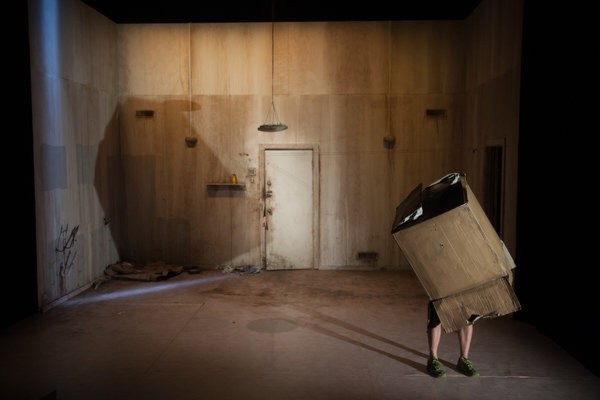
Zach (David Woods) does just that with feline stubbornness and rejection of direct human contact. An Iraq veteran suffering from Post-Traumatic Stress Disorder (PTSD) living with an unsympathetic wife (convincingly voiced offstage by Jon Haynes), we never see Zach’s face, or anyone else’s, in Give Me Your Love. This quiet, tiny show looks empty but brims with feeling in a sophisticated script, discusses cutting edge medical research without boring the audience and shares the horrors of PTSD that many of our vets are left to contend with, unsupported. A talking cardboard box and a patient drug dealer behind a chained door captivate for about an hour with flawless, sensitive performances and detailed dialogue that delicately balances humour and pathos.

Though it’s easy to focus on Woods as the central character, Haynes wonderfully supports and opposes him as wife Carol and friend/drug dealer Ieuan. Carol opposes Zach’s desire to explore MDMA’s potential to cure his PTSD, Ieuan, not unfamiliar with trauma himself, encourages Zach whilst displaying genuine, moving care for him. There’s a brotherly intimacy here that’s lovely to watch, and is perfectly captured by the pair of actors.

Jacob Williams’ set is super-realistic: there are no metaphors here, just the sparse filth that Zach lives in. The detail is in the tiniest things: the way masking tape curls at the edges, the holes in the box for Zach’s arms, the stains on the walls. The lack of people on stage calls for other means of  visual stimulation, and Williams’ work exceeds this tall order very well. Give Me Your Love is never boring, visually or otherwise.  Sound and light by March Cher-Gibard and Richard Vabre match the set’s naturalism, then toy with the audience’s perception of reality through abstract and expressionistic approaches. It’s a jarring transition, but manages to compliment Zach’s turmoil and experimental recovery instead of feeling stuck on and questions what is objective reality and what is in Zach’s head. 

The inclusion of using Ecstasy in PTSD therapy is fascinating research that doesn’t go too much in depth, but can feel extraneous to Zach’s struggle. It’s not about the recovery, but the day-to-day existence and paralysis that can result from action solders experience on the front line. The dialogue still flows, but the research informs the play rather than being the centre of it. This certainly isn’t a bad thing at all because the script could easily end up a lecture; the focus is very much on Zach’s mental and emotional health. The clever use of humour prevents it from becoming a drag, and exquisitely balances the brutality and debilitation of mental health conditions. This is a vital theatrical contribution to the mental health dialogue and de-stigmatisation, and one executed with delicate, detailed skill and a moving emotional journey. A fantastic watch.

The Play’s the Thing UK is committed to covering fringe and progressive theatre in London and beyond. It is run entirely voluntarily and needs regular support to ensure its survival. For more information and to help The Play’s the Thing UK provide coverage of the theatre that needs reviews the most, visit its patreon.

Town Hall Cherubs, Battersea Arts Centre

rsz_c_alex_brenner_strictly_no_usage_without_credit_town_hall_cherubs__battersea_arts_centre__dsc5380

Dear Town Hall Cherubs,

I know we only met yesterday afternoon but I haven’t been able to stop thinking about you since then. Concentrating at work today has been really hard – I couldn’t wait to leave so I could pen this missive, and I’ve been fighting the tiredness that comes with broken sleep filled with golden apples, inflatable little friends, snow and glitter. I’m off somewhere else tonight, but I’m still smiling at the memories of your gentle journey of discovery around Battersea Arts Centre. I’d love to keep you all to myself, but your warm, generous nature shouldn’t be caged, nor is it fair of me to prevent others, young and old, from experiencing the wonderful joy you evoke. So here’s a review for you to share with families far and wide:

❄ ❄ ❄ ❄ ❄ ❄ ❄ ❄ ❄ ❄ ❄ ❄ ❄ ❄ ❄ ❄ ❄ ❄ ❄ ❄ ❄ ❄

The first generation of immersive theatre fans are growing up. The twenty-somethings who discovered Punchdrunk in their early days are 30-somethings. Now immersed in nappies and temper tantrums as well as non-traditional theatre, these new parents will have high expectations of children’s theatre. Pros arch, run-of-the-mill theatre isn’t enough for them, or their progeny. Fortunately, that first wave of immersive theatre makers is also starting families of their own. Merging interactive, immersive and promenade theatre to create a site-specific adventure for 2-5 year olds, Theatre Ad Infinitum and Sarah Golding from Battersea Arts Centre team up to create children’s show Town Hall Cherubs, a winter adventure that brings the building’s distinctive architecture to life among a landscape of sensory-focused design elements.

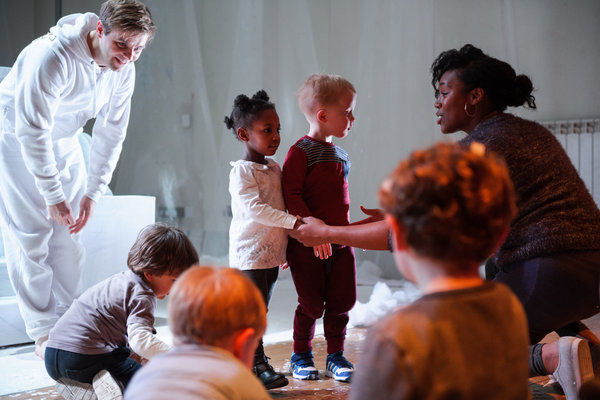
Dani (Danielle Marshall) gently rallies a group of children, parents and early years teachers in a cozy corner next to the BAC’s grand staircase. Soothing music and colouring in a drawing of a cherub warms the children to her before they head up the stairs to a discovery on the landing. They find a cherub (joyful and wide eyed Barra Collins) and a fabric garland that continues their music-accompanied journey through several rooms; each contains interactive, sturdy set and design. My favourite is a room full of “little friends”, inflatable blobs by Amy Pennington that the children can dance and climb cardboard mounts with, roll, cuddle and any other imaginative play they can create. The children also discover a giant kaleidoscope by Ted Barnes and Amy Pitt, and a replica of the BAC staircase that Deborah Pugh brings to life as Sarah, a dragon-seahorse creature that’s scared of falling down.

Though the kids won’t notice or care, the moral tacked onto the end feels unnecessarily teacher-y, and Cherub’s plan to go on an adventure and then return home could have been clearer at the beginning. These tiny potential improvements certainly don’t detract from the quiet, calming joy of the event.

This isn’t a high energy, raucous performance. It’s intimate, gentle and encouraging with the pace dictated by the group. As an adult without a child there, it was a joy to observe the children’s reactions to their discoveries and freedom to engage with their new surroundings without fear. It’s a powerful reminder to notice the tiny details around us and enjoy the pleasure of experiencing something new beyond our regular routines.

❄ ❄ ❄ ❄ ❄ ❄ ❄ ❄ ❄ ❄ ❄ ❄ ❄ ❄ ❄ ❄ ❄ ❄ ❄ ❄ ❄ ❄

Thank you again, Town Hall Cherubs, for having me along on your gorgeous little adventure.


The Play’s The Thing UK is an independent theatre criticism website maintained voluntarily. Whilst donations are never expected, they are hugely appreciated and will enable more time to be spent reviewing theatre productions of all sizes. Click here to make a donation with PayPal.

Jackson’s Way: The Christmas Top-Up Power Seminar!, Battersea Arts Centre

rsz_jacksons_way_battersea_arts_centre

Will Adamsdale’s standup/solo performance creation Chris Jackson is a motivational speaker and life coach, and the audience is at his seminar to learn his life changing methods. Jackson’s Way: The Christmas Top-Up Power Seminar! teaches you the importance of attempting meaningless or impossible actions, or “jactions”, in our lives that are otherwise filled with purpose. Adamsdale’s script has a clear narrative but somewhat lacking in follow through – we never really learn precisely WHY we should be filling our time with jactions, but the character’s detailed biography and emotional journey through the Christmas story is satisfyingly seasonal.

Just so you know, jactions have levels, can be compounded and done in groups or individually. You know you’ve succeeded when you have a mild feeling of nausea but manage to Push Through It (PTI). Some of Jackson’s most famous jactions include trying to move the floor, preventing a thrown towel from hitting the ground, and making your hand be in two places at once. The absurdity and existentialism are wonderfully funny, as is the conviction with which Adamsdale gets the audience to attempt jactions.

The autobiographical storyline and the use of projections add to the theatricality of the piece, as does Adamsdale’s immersion in the character he created and his sudden change of mood. Though the structure seems pre-formatted some of the content is improvised and there’s loads of audience interaction.

The ending is rushed but generates plenty of laughs with the character’s narcissism and has a degree of resolution. A bit more time on end and clearer goals for the seminar premise would give this already polished piece of performance more finesse, but it definitely isn’t lacking in humour that functions on multiple levels.

Adamsdale is clearly a skilled, charismatic (and sweaty!) performer with an innate sense of comedy and stage presence, as it should be for such a seasoned performer. Though English, his American accent is flawless. Running for over ten years now, it’s no wonder that Jackson’s Way has staying power in the performance and comedy circuits, and Jackson’s Way: The Christmas Top-Up Power Seminar! is a great variation on usual holiday theatre offerings and a reminder to enjoy the frivolity of Christmas rather than stressing out over its logistics.


The Play’s The Thing UK is an independent theatre criticism website maintained voluntarily. Whilst donations are never expected, they are hugely appreciated and will enable more time to be spent reviewing theatre productions of all sizes. Click here to make a donation with PayPal.

Live from Television Centre

On Sunday night, theatre people ( and hopefully others) up and down the country tuned in to BBC Four to watch Battersea Arts Centre and Arts Council England take over the former Television Centre, now a building site for luxury flats. Over two hours, four theatre companies streamed their work for live audiences in the comfort of their homes, to push the boundaries of theatre’s adaptability to the popular small screen and to challenge typical TV programming. I watched in bed and with twitter open so I could keep half an eye on #livefromTVC; it was a gloriously anarchic experiment that I hope ushers in a new era for telly and theatre even though not every element worked as well as it could have – but that’s the point of experimentation.

Gecko’s The Time of Your Life celebrates life cycles in a circular swirling movement with a “Truman Show”-style storyline of meta-television. The close-up nature of telly supports the characters’ intimacy and expressiveness well, but the narrow framing reduced their normally expansive work to a much smaller scale. I didn’t mind the spinning camera work, but twitter buzzed with complaints of dizziness. It was rough and ready, with limbs often out of the frame and movements ahead of the action, but that supports the “liveness”. Their piece wasn’t the most accessible and most suitable to open the evening either; Richard DeDomenici’s Redux Project would have been a more appealing start to non-theatre goers.

The long running Redux Project is adapted for the evening with joyfully irreverent recreations of classic moments from BBC television history. DeDomenici has a friendly, laid-back persona thinly veiling biting political commentary just as sharp as “The Revolution Will Be Televised”, but less blatant and without personal attacks. The live artist aims, “to disrupt the cinema industry by making counterfeit sections of popular films”; he satisfies with powerful alternative perspectives that are funny on the surface, but pose bigger challenges to cinematic convention underneath.

Common Wealth’s No Guts, No Heart, No Glory is a verbatim piece sharing the experiences of young women from Bradford who are Muslim boxers. It’s a powerful piece challenging stereotypes and giving voice to a demographic often ignored at best or stigmatized at worst. This worked brilliantly on telly, capturing the intensity and passion of the characters despite some strange camera angles.

Backstage in Biscuit Land by Touretteshero (Jess Thom) becomes Broadcast from Biscuit Land, the wonderful show that’s inclusive, informative, and contains plenty of biscuits and cats. Thom has a noticeable form of Tourettes that manifests in physical and verbal tics used for comedic effect in her show, and a reminder that understanding for people with disabilities is still lacking. In a more surreal moment, Thom reminisces about a particularly funny tic about Keith Chegwin in a quiet theatre; cameras then reveal Cheggers there in the live studio audience.

The variety of the evening reminds audiences of the power of live performance and its relevance to everyone. I’m certain that anyone who watched would be able to find something appealing in the evening, and hopefully discovered a company or artist previously unknown to them. Even if it was mainly theatre makers and goers that watched, TV can still reach audiences that are otherwise unable to travel to an individual performance. At best, those who don’t consider themselves theatre people will have found pleasure in the event, and there’s hope that the powers that be discover there is room for dancing biscuits, physical theatre and political performance on our small screens as well as our big stages.


The Play’s The Thing UK is an independent theatre criticism website maintained voluntarily. Whilst donations are never expected, they are hugely appreciated and will enable more time to be spent reviewing theatre productions of all sizes. Click here to make a donation with PayPal.

The Notebook, Battersea Arts Centre

https://i0.wp.com/www.forcedentertainment.com/wp-content/uploads/2014/10/The-Notebook-Forced-Entertainment-Rehearsal-Image-April-2014-photo-Tim-Etchells-DSC04935.jpgNearly everyday we see news of refugees fleeing war torn lands in search of safety abroad. No matter how the press spins objective facts to suit their own agenda and their readers’ opinions, the perspective of these events unfailingly separates “them” from “us”. These people running for their lives are The Other that we must either keep out or allow in. It’s all very black and white, heavily doused with an air of superiority; we either look down on them as vermin that need controlling or as victims that need handling with kid gloves. We never really hear from these refugees, though. It’s all, “me, me, me” and a flamboyant display of either virtue or condemnation.
The Notebook, with a stark simplicity that forces the audience to sit and listen for two unrelenting hours, slowly unpacks the horrors of war that drives people to flee from a first person perspective. It makes us take the focus off ourselves for once and genuinely listen to the stories of those in need. Told by nameless twin boys moved to their grandmother’s home in the Hungarian countryside, they come of age during World War II, the subsequent Russian occupation and descent of the Iron Curtain. Adapted from Agota Kristóf’s novel of the same name, Forced Entertainment strips the story down to a text that’s read from thick notebooks by two identically dressed actors (Robin Arthur and Richard Lowdon) who represent the boys. This is storytelling in its most raw, boiled down form, with language being almost the sole vehicle of communication.

The set is two wooden chairs and the lighting rarely changes. There isn’t much to look at, which makes this show a tough one for those used to constant visual stimulation in both real and theatrical worlds. There were times I internally railed against the form, like a kid with ADD in a lesson that lasts more than three seconds. One woman walked out part way through. Others fidgeted and checked their watches. We just aren’t used to sitting down and just listening for a couple of hours anymore. The story is unquestionably riveting, though. Through use of precisely timed delivery, often in unison, childhood innocence breaks down and is eventually destroyed, despite their mother’s attempts to protect it. Their grandmother’s house is hardly a haven, and they must resort to deplorable behaviour to eek out a sub-par existence even though the bombs are a distant threat. It’s understandable though, considering the abuse they endure from their grandmother, the general public and those in positions of trust. The people in this story are rarely kind; even though it’s unsaid it’s given that it’s not their fault. The human spirit can endure only so much.

The language doesn’t hold anything back. It is often explicitly graphic with appalling acts emphasised by unemotional delivery. The audience inevitably uses their imagination to make up for the lack of visuals; these images are far worse than anything that could be presented on stage. Though the performance could use shortening, it’s soaked with detail and condenses years into hours. Shaving off half an hour would still maintain impact, but it’s not Forced Entertainment’s job to make us comfortable. Director Tim Etchells wants us to think, empathise and listen, really listen, even if the process isn’t easy. The Notebook is a hard production to watch, but the message of acceptance and universal humanity is a vital one.


The Play’s The Thing UK is an independent theatre criticism website maintained voluntarily. Whilst donations are never expected, they are hugely appreciated and will enable more time to be spent reviewing theatre productions of all sizes. Click here to make a donation with PayPal.

This Is How We Die, Battersea Arts Centre

Chris Brett Bailey is a bard of thhqdefaulte modern age. Like Elizabethan theatre the audience went to hear rather than to see, This Is How We Die is a bombardment of the ears rather than the eyes. Using spoken word and beat poetry to tear open the world as we know it, Bailey forces us to confront the horrors and beauty of everyday existence. This piece of theatre moves away from the trend of visual theatre, taking the audience on a self-reflective ride of their lives.

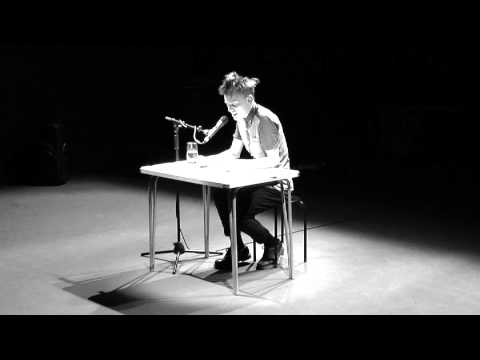
At just over an hour, we are hurtled on a journey through Bailey’s rage against “-isms” and “-ists,” a brutal first meeting with his overly-literal girlfriend’s parents and a Hunter S. Thompson-like roadtrip through the American desert. His delivery is relentless, pausing only for comic effect or to take small sips of water from the glass that sits on his desk. Yes, a desk. He sits at a desk, with his script in front of him. This form rails against the increasingly visual culture we live in but it forces the audience to really and truly listen. He has a lot to say that he feels strongly about and you need to hear it.

Trying to describe what This Is How We Die is about is futile. Anything descriptive about plot or narrative arc will make this piece sound simplistic and trite. The feature that really makes this a must-see is Bailey’s visceral use of language. He savours it, relishes it and throws it away. A sea of sound washes over us, then pummels us, unarmed, in a back alley behind some dingy American bar. His imagery alternates between abstract and concrete, the highlight being his girlfriend’s neo-Nazi father left shaped like a swastika after a car accident.

The last ten minutes or so abandons speech, instead favouring live ambient music and harsh lighting. This is his Elizabethan jig, the audience’s catharsis after the emotional Sturm und Drang of the last hour. There was no point in fighting the journey of This Is How We Die so you may as well join him. Share in his rage, his joy and his passion. Relish the world you live in and the sounds of the words that pour so easily from his mouth. This isn’t about how we die, but how we should live.


The Play’s The Thing UK is an independent theatre criticism website maintained voluntarily. Whilst donations are never expected, they are hugely appreciated and will enable more time to be spent reviewing theatre productions of all sizes. Click here to make a donation with PalPal.

Missing, Battersea Arts Centre

Lily is an ordinary newlywed with a good job, but something isn’t right. She’s reserved, doesn’t join it at parties or nights out and goes through life disconnected, as if it were a treadmill. With the aid of a mysterious doctor-type figure, Lily relives past memories and important life events. A collage of dance, movement, light and sound, Missing bombards audiences with one character’s family history and rediscovery of her repressed self.

The predominant element of this production is movement. Some sequences have a strong dance influence, others are more abstract, capturing relationship dynamics between two people. Still others are violently fitful as Lily wrestles with parts of herself she would rather forget. Coloured backlighting creates faceless, silhouetted dancers who form the world around Lily. Her movements, in contrast, are usually restrained or awkward, including the duet with her new husband in their marital home as they navigate space with the newfound addition of the other. Memories of her mother, a sensual nightclub dancer, further emphasize how uncomfortable Lily is in her own skin. A particularly striking scene shows Lily at work with her glowing laptop, coffee cup and other daily items that just won’t sit still as she tries to work. They tentatively settle, then fly around the room, always just out of reach. In Lily’s life, everything moves confidently around her and she struggles to keep up. The audience empathizes because like Lily, we all experience moments in life where we feel disconnected from everything around us, as if we live in a grotesque dream world.

Lily decides to see some sort of doctor, a psychologist, perhaps. In a more literal interpretation of the counseling process, he removes a glowing light from her, placing it in a cardboard box. On a further visit, the doctor creates a storyboard of images from Lily’s past and presents them to her without judgement. These events provoke extended memory sequences from Lily’s childhood, with toddler Lily as a bunraku-style puppet. All of her memories take place in glowing frames, with performers behind. The effect created is one is one of large-scale Polaroid photographs that move across the stage. The lighting skillfully conceals the performers holding the frames and the space around them so the frames and their contents appear to float in the darkness. It is a powerful nostalgic effect, akin to watching fragments of one’s own retro ghosts on 1980s VHS home movies.

Two treadmills add a flowing quality to the set and choreography; the performers quickly slide them about to rearrange the stage space and direction of movement through space. Lily is at times caught up in this flow and cannot get off, other times she observes the pace of those around her whilst she herself is not travelling. This is one of the most unique features of the production and one that thoroughly enhances the visual and metaphorical production elements.

Sound is constant or near enough so, either cheerful and musical or a high, droning tone. Dialogue is not an important feature; often the sound drowns out the speakers so that the audience can hear speech but not discern what is being said. Several languages are used: German, Spanish, English and others. None of them is predominant, but the language is not the focus of this piece and it is easy to discern what is happening from the movement. The speech often adds another layer to the soundscape, enhancing the universality of Lily’s inner turmoil.

Missing is a feast of the senses and I struggle to find fault with any visual aspect of the production, though I would have liked to get to know the characters in more detail. The episodic, dreamlike structure leaves the story open to interpretation and to personally connect with several themes and issues presented.

I went with the year 10 GCSE Drama students at the school where I teach part time. Most of the students go to the theatre regularly but none of them had seen anything like Gecko’s Missing before. Each of them had their own interpretation of the production, further proof that Gecko’s work speaks to each of us on a deeply personal level.


The Play’s The Thing UK is an independent theatre criticism website maintained voluntarily. Whilst donations are never expected, they are hugely appreciated and will enable more time to be spent reviewing theatre productions of all sizes. Click here to make a donation with PalPal.

Rove, Battersea Arts Centre, for everything theatre

“As the audience enters, a young man with a magnificent beard is asking the violinist on stage with him if she knows “the one about…” several times. She always says yes, and then plays a brief tune. I realized after I settled that all the requests feature a man called Rover Joe involved in numerous exploits or unlikely situations…

“The structure of the performance is relaxed and loose. The subject of the story is a man called Rover Joe, Evans’ grandfather who emigrated from Ireland to Chicago. His tale is told in four sections, in between music, and talking to the audience about the importance of stories, their families, and so on…

“Armstrong’s music is excellent, as is Evans’ storytelling; though opening his eyes whilst giving us the tales would create more of a connection with the audience…

“This is certainly a unique performance: sentimental, quaint and emotionally honest. It raises some thought-provoking points on the nature of families and the tales they harbour. This is certainly a production to see for those interested in storytelling, folk music and folk tales, and quirky performances that don’t easily fit into a genre.”

Intention: ☆☆☆☆☆

Outcome: ☆☆

Star Rating: ☆☆☆ 1/2

Read the entire review on everything theatre here.