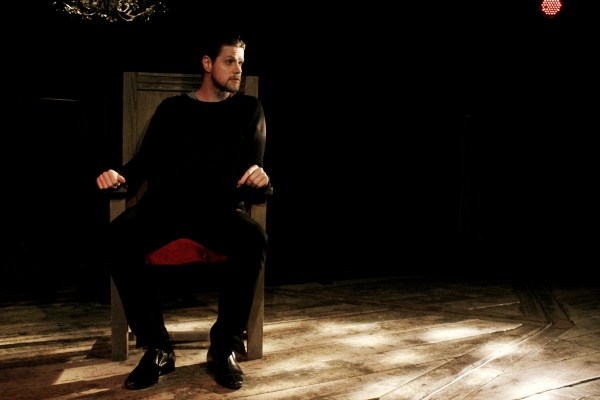
Fury, Soho Theatre

https://i.guim.co.uk/img/media/c255500e31a395db7d5e99d0e22866efcadc2904/0_0_3907_2727/3907.jpg?w=700&q=55&auto=format&usm=12&fit=max&s=24616b52e71621aa153ffabc5805fe48

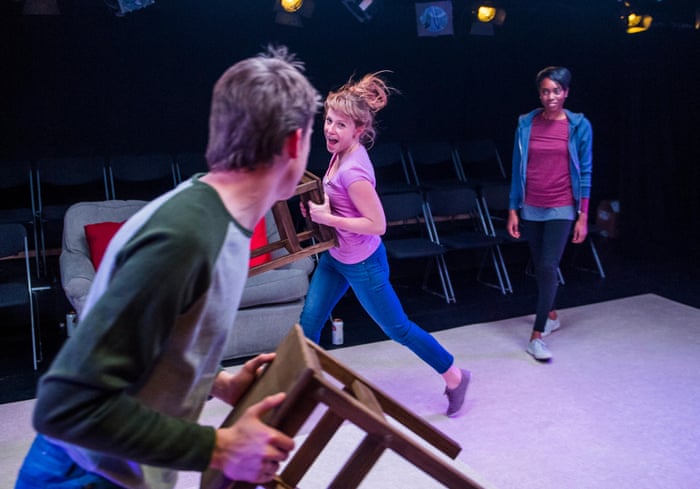
Sam is a young, single mum living in a council flat in Peckham. Having gone through the care system and her boyfriend leaving her after her second son was born, she has no one. When she meets socially inept Tom, an MA student in the flatshare above her, after losing her job as a cleaner, he creates an opportunity for friendship, sex and an escape from her kids. But Sam was born a victim, and a victim she remains. In this discourse on social class, parenting and gaslighting, playwright Phoebe Eclair-Powell incorporates Greek tragedy and a commentating chorus to expose the perils of growing up with no support network.

This is one of the young writer’s first full-length plays, and she’s still finding her feet. Fury has a great concept and characters, and the use of the chorus is a fantastic touch that adds depth and structural variation, but the execution if the ideas isn’t quite there yet. Some sections of the script don’t quite fit the main thread, like her beach outing with an old friend, and others rush the narrative progression. The chorus fills in information left out of the scenes, but this sticking plaster over the gaps is still unsatisfying and overly simplistic. The relationship between Sam (Sarah Ridgeway) and Tom (Alex Austin) escalates a bit too quickly to be plausible, though some slight extending would go far to rectify this.

Ridgeway is excellent as Sam, with a nervous energy and a risk of exploding into violence at any point, making Tom’s manipulation all the more believable to social services. Austin is slimy, awkward and initially seems harmless, but quickly reveals a dark interior. Though he plays the role well, it’s a challenging one because he transforms so quickly. His unlikely behaviour after his initial awkwardness is a powerful reminder that anyone is capable of committing horrendous acts, particularly against vulnerable people. The chorus of three (Naana Agyei-Ampadu, Daniel Kendrick and Anita-Joy Uwajeh) also play additional characters, flipping between them and non-characters with ease and agility.

Director Hannah Hauer-King uses a simple set by Anna Reid to focus on the text. Her in the round staging is a great choice that adds to Sam’s rising paranoia – everyone is indeed watching her every move. The chorus uses seats set into the audience, which although it keeps them ever present, it is unclear why the audience/actor boundary is blurred. She occasionally struggles to clarify space what with the mostly bare stage, but the dialogue usually explains well enough. Hauer-King taps into Eclair-Powell’s poetry with instinctual finesse, making some moments particularly moving.

Though the ended is rather different from the Medea that the show’s marketing compares it to, there is still senseless tragedy brought on by a man’s deliberate actions against a vulnerable woman. Fury shows much potential from the emerging writer and director, and contains some vital messages about growing up poor and female that, with some small adjustments, will be heard loud and clear.

Fury runs through 30 July.

The Play’s the Thing UK is committed to covering fringe and progressive theatre in London and beyond. It is run entirely voluntarily and needs regular support to ensure its survival. For more information and to help The Play’s the Thing UK provide coverage of the theatre that needs reviews the most, visit its patreon.
The Doctor in Spite of Himself, Drayton Arms Theatre

The Doctor in Spite of Himself (c) Ulysse Beauvois (3)

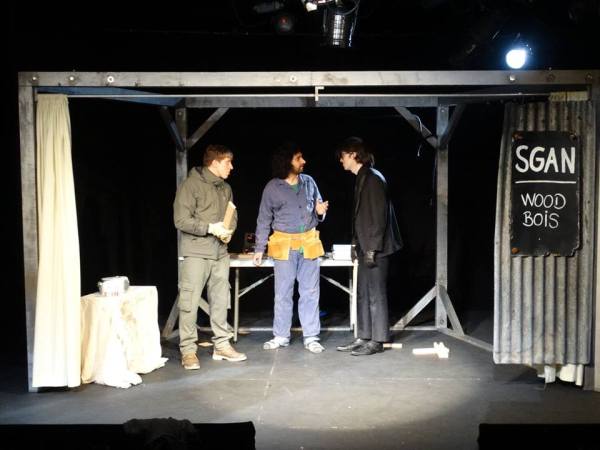
When the abusive, drunken woodcutter Sganarelle beats his wife one time too many, she takes advantage of passing strangers looking for a doctor to cure a young woman’s mysterious illness. Telling them she knows just the man, an eccentric but renowned man of medicine, sets the ball rolling on an absurd adventure of lust, remorse, and blagging it. Exchange Theatre, a French company based in London, have adapted Moliere’s The Doctor In Spite of Himself into a 75-minute contemporary version loaded with metatheatre, energy and good leading performances from a French cast. Plenty of slapstick, detailed design and Shakespearian influence make this a fun, easy to watch adaptation of the French classic.

Actor-director David Furlong plays Sganarelle with a goofy, watchable charm. His undeniable charisma is at odds with the unlikeable character, though his comeuppance and subsequent reform are a somewhat satisfying narrative despite the anti-feminist premise from the 1660s. Furlong is by far the strongest in the cast, but the others are generally good. Anita Adam Gabay as the mostly mute Lucinda exudes a sweet innocence, particularly in the opening montage where she discovers her betrothal to a man she doesn’t love. Matt Mella is the hilariously dumb Lucas, able to evoke laughter with a well-timed pause and a blank look. Some of the actors find it hard to connect to the language in English at times, but these jarring moments are fairly infrequent.

The edited plot occasionally feels rushed and overly compact, though it’s easy to follow and the translation uses relatively modern English. The excused wife beating is uncomfortably old fashioned, but at least it’s ridiculed – along with medicine and the gullibility of the upper classes. These themes translate fairly well to the modern day and English culture, especially considering the Shakespeare-esque comedy sequences that are likely to have drawn on the same commedia del’arte heritage that Shakespeare did. Furlong updates even further by adding in discreetly funny elements of self-reference, even if they don’t always work. The bust of Moliere as a weapon is cute, but characters dictating text to others from an anthology of Moliere plays isn’t as effective and causes energy to drop.

The design, presumably also by Furlong, incorporates an Elizabethan stage-within-a-stage to emphasise the metatheatre and clarify location. It’s clever and looks great, though it causes some difficulties with sightlines and narrows the playing area. Furlong’s overarching concept of using the metatheatre to create distance is a strong one what with its acknowledgment the absurdity of the story and the plot points that don’t work in a present day context.

This production of The Doctor in Spite of Himself is a funny, palatable adaptation of Moliere for London audiences. It’s a good laugh, a good length and has good performances. The company’s talent and vision is highly commendable and deserving of larger production values; their commitment to bringing audiences high quality French theatre in intimate venues makes them one to watch.

The Doctor in Spite of Himself runs through 17 July with performances in both French and English.

The Play’s the Thing UK is committed to covering fringe and progressive theatre in London and beyond. It is run entirely voluntarily and needs regular support to ensure its survival. For more information and to help The Play’s the Thing UK provide coverage of the theatre that needs reviews the most, visit its patreon.

The Alchemist, Rose Playhouse

rsz_flyer-front

When butler Jeremy’s master goes out of town, he transforms himself into Captain Face and recruits his comrade in deceit, Subtle the Alchemist, to help him make a quick buck from gullible townsfolk. Aided by the local prozzie Doll Common, the three create bespoke schemes for each potential customer. Their plans spiral out of control and the risk of discovery becomes all too real in typical Jacobean comedy format, but also typical of the style, it all ends well – or as much as it can for the victims of their scams. With jokes that come quick and fast in this surprisingly straightforward story, it’s a fun, light-hearted play that needs clear direction to succeed.

Though The Alchemist can be considered Ben Jonson’s best play, it doesn’t get staged often. The slapstick comedy satirising a cross section of Jacobean society is swift, easy to follow and jolly so it deserves much more stage time than it receives. In Mercurius’ strongest of their last three productions, an energetic cast fully commit to the stock characters’ hijinks and trickery with clear staging and character doubling. Jenny Eastop’s direction is tight and precise, though altering the time period from the original is gratuitous and occasionally inconsistent with the text. This light production of a rarely staged play is a midsummer treat with few shortcomings.

The cast of eight are a generally tight ensemble with good chemistry. Peter Wicks as Jeremy/Captain Face has a commanding presence and wonderful speaking voice that is easily watchable. Benjamin Garrison as Subtle is a delightfully flamboyant foil but with the character having less to lose, he has less depth. Alec Bennie as Surly is the star of the supporting roles, playing the posh sceptic with a dry, steely wit. Charlie Ryall is strong as the feisty nun Ananias, but her disinterested Widow Pliant is harder to engage with.

Eastop’s choosing to set the play in the 1800s is justified in the programme notes, but with a play that is so undeniably Jacobean in its style, the costumes (that are in a poorly made/maintained state and betray a lack of time and/or budget) look out of place, particularly next to some set pieces that look much older. Nothing other than the characters’ dress indicate a change in time period, and as such, the adaptation contributes nothing to the understanding of the play. She also, nonsensically, reinvents two protestant characters as nuns who have derogatory dialogue about the Catholic Church. Despite the change in setting, this choice is painfully jarring. Otherwise, Eastop’s direction and choreography is well paced and takes advantage of the script’s inherent comedy.

This production suits the Rose Playhouse’s unique structure well, with the rear of the site being used occasionally for comic effect. Placing most of the action on the small stage in close proximity to the audience makes these larger than life characters all the more exaggerated, further emphasising the stereotypes that the play relies on for laughs. With a good cast and intuition for light comedy, The Alchemist makes for some excellent entertainment.

The Alchemist runs through 30 June.

The Play’s the Thing UK is committed to covering fringe and progressive theatre in London and beyond. It is run entirely voluntarily and needs regular support to ensure its survival. For more information and to help The Play’s the Thing UK provide coverage of the theatre that needs reviews the most, visit its patreon.

Interview: Chris Hislop on Barker’s Gertrude

https://i0.wp.com/mytheatremates.com/wp-content/uploads/2016/05/600x425Izabella-Urbanowicz-as-Gertrude-Gertrude-The-Cry-at-Theatre-N16-c-Roy-Tan.jpg

“It is impossible – now, at this point in the long journey of human culture – to avoid the sense that pain is necessity…that it is integral to the human character both in its inflicting and in its suffering…” – Howard Barker

Howard Barker is no stranger to sex and violence. His 2002 reimagining of Shakespeare’s Hamlet places the prince’s mother and her sexuality centre stage in a divisive interpretation of the character who receives little attention in the original story. Rarely staged (most likely due to its relentless, sexually explicit subject matter), theatre PR Chris Hislop returns to directing with this upcoming production of Gertrude: The Cry at Theatre N16 in Balham. The play has fostered a huge range of opinions regarding its depiction of women, feminism and female sexuality and its director has a lot to say on the matter.

Why does this play need to be staged?

It’s a vital, powerful and fascinating piece that tackles feminism and sexuality from a very different angle. It’s also a wonderful dissection of Hamlet – considering the Shakespeare 400 celebrations, now is a great time to be giving the Prince of Denmark an overhaul. It’s also a largely forgotten and underperformed piece by a difficult and complex writer. We need more plays like this and writers like Barker, and if this production inspires anybody to think differently, I’ve done my job well.

Opposing views say Barker presents women in an empowering or negative light. What approach are you taking, and why?

Both – my favourite thing about this play is how it was written to empower an underwritten female character, and yet does such a piss-poor job of doing so. Or maybe it doesn’t – maybe Barker’s aggressive sexualising of Gertrude and blatant female nudity throughout is his attempt at female empowerment. Either way, he’s not a misogynist. Barker’s obsession with women has translated into some wonderful parts in his shows, and he’s always trying to write pieces that celebrate and empower them, just through a rather perverse lens. I don’t want to circumnavigate that entirely, just sand down some of the sharper corners.

What’s so appealing about the character of Gertrude in Shakespeare and Barker’s scripts?

She’s an utter mess. She doesn’t know what she wants, she doesn’t know how she’ll achieve it, and she’s governed by her wants and desires. She’s an incredibly human, rounded character. She’s a mother and a lover, neither of which are mutually exclusive.

Would you say this is a feminist play? Why/why not?

I struggle with the word “feminism”. Our world is defined by our language, and by defining an issue by a specific gender we’re generating responses that hinder as well as help. We talk about “racism” – defining someone by their race – so why don’t we call it “genderism”?

Anyway, I digress: I think this is a play about women, the role of women, and women’s sexuality – not exclusively, I think it has a lot to say about sex in general, but the fact that it does so from a female perspective is important. You could say that it’s not even really from a female perspective; it’s a script by a man, and it’s being directed by a man, but I find such comments painfully genderist. I wouldn’t expect only women to like Carol Churchill, or only men to like books by Ross Kemp.

So – is it a feminist play? Yes. Do I think that’s important? Not really. Do I think it tackles important issues around sex and gender? Yes. Is that important? 100%.

Gertrude: The Cry opens 12 June.

The Play’s the Thing UK is committed to covering fringe and progressive theatre in London and beyond. It is run entirely voluntarily and needs regular support to ensure its survival. For more information and to help The Play’s the Thing UK provide coverage of the theatre that needs reviews the most, visit its patreon.
Twelfth Night, Hope Theatre

rsz_web_size-93

Fringe Shakespeare can be terrible, brilliant and everything in between those two ends of the spectrum. The better productions are vivacious and effortlessly handle Shakespeare’s language whether or not they are updated to a more modern setting, edited heavily or otherwise adapted with a concept. Thick as Thieves’ Twelfth Night is one of these good ones. Four versatile actors play all the parts in this bouncy interpretation that incorporates onstage character changes, plenty of music and audience interaction, and some clever character interpretations. At two hours long with an interval, the text doesn’t feel butchered though the interval isn’t particularly needed. With few faults, this is one of the best Twelfth Nights of recent fringe Shakespeare productions.

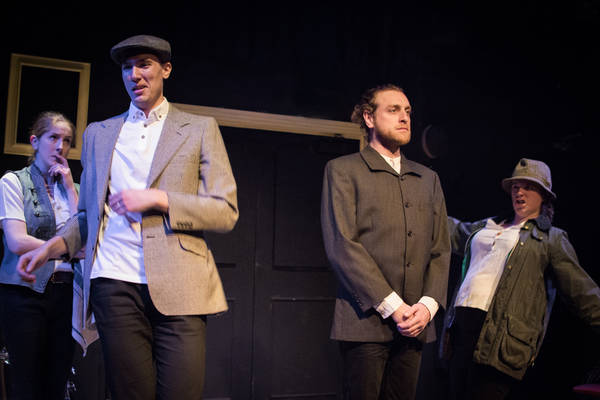
Company co-founder Nicky Diss, in an act of insightful  casting, plays Viola and Toby Belch. Her Viola is intense and boyish; her Belch is a gruff, posh older man. Diss’ presence and versatility are things of wonder, but she doesn’t outshine the rest of the cast. Her fellow co-founder Thomas Judd gives a Sir Andrew Aguecheek that is hapless and posh, a delightful interpretation that works very well; he doubles as a townie Orsino. Completing the quad are Oliver Lavery, particularly excelling as a hippy Feste and slimy Malvolio, and Madeliene MacMahon as a wonderfully frivolous Olivia. The four are all exceedingly good at creating clear, contrasting characters and have an energy that goes well beyond the walls of the tiny Hope Theatre.

There no set to speak of, which is fine for this play that changes location every scene. Costume pieces and musical instruments pepper the walls instead, giving easy access for changes. Hats, jackets and waistcoats over a uniform of black trousers and white shirts assist with character differentiation. It’s a simple but effective device to give visual variation and the lack of set reflects original practice. Occasional fiddly changes distract from the action on stage, but these moments are rare.

Some interesting alterations occur to facilitate the four actors, particularly the Sir Topas/Malvolio scene. Rather than Feste duping the prisoner, the lines are split between Sir Andrew, Toby and Maria. It’s believable enough despite vocal differences and makes no difference to the story.

Of the fringe Shakespeare that’s playing at the moment, the performances make this shoestring Twelfth Night a great one. Thick As Thieves are a talented, instinctual bunch certainly worth watching.

Twelfth Night runs through 30th April.

The Play’s the Thing UK is committed to covering fringe and progressive theatre in London and beyond. It is run entirely voluntarily and needs regular support to ensure its survival. For more information and to help The Play’s the Thing UK provide coverage of the theatre that needs reviews the most, visit its patreon.
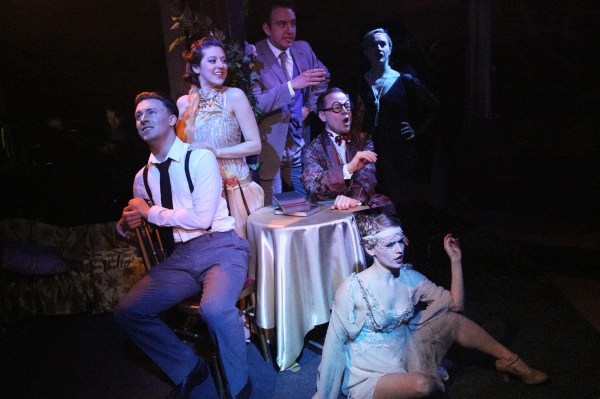
Gatsby, Union Theatre

Gatsby (c) Roy Tan (4)

Jay Gatsby’s distinctive yellow car is an iconic image in The Great Gatsby. Power, wealth and charisma emanate from its shimmering, custom paint job as it rolls between Long Island and Manhattan in the decadent 1920s. It’s eye catching and demands attention, like the enigmatic man who owns it. Adaptations of The Great Gatsby are plentiful, but good ones need the same characteristics as Gatsby’s car, along with a generous, heady mix of self-indulgence and extravaganza. Linnie Reedman and Joe Evans’ musical incarnation of F. Scott Fitzgerald’s iconic novel manages to avoid incorporating any these. Bland music, lazy performances and design and a book with numerous shortcomings makes Gatsby a stuttering, third-hand Ford Fiesta rather than a customized, purring Rolls Royce.

Reality TV celeb Ferne McCann makes her theatre debut in this production, bringing a lot of negative publicity with her as consequence. She’s also incredibly surprising – alone in a theatre-trained cast, she is the only one consistently able to be heard over the live actor-musos with her Amy Winehouse-influenced performance. Of the 13-strong cast, most are weak, some terribly so. They are either grotesquely overacted cartoons, or underplayed so much that their performances are flat. There’s no sense of danger or excitement, or EVERYTHING IS EXCITING ALL THE TIME FOR OVER TWO HOURS. It’s exhausting to take in. In either case, the characters are no more than stereotypes; this is more of an issue with Reedman’s book as it certainly doesn’t give the actors much depth to work with. Accents drift around the 50 states and then some, with the only consistent one coming from an actual American.

Reedman also directs, with little comprehension of the narrative arc she constructed from the novel. Other than the Plaza hotel scene late in the play when Daisy and Jay confess all to Tom, there is a pronounced lack of tension. Myrtle’s tragic end is anticlimactic and rushed, as is her husband George’s retaliation. She neglects characterization and seems to focus solely on staging. If that.

There are 21 musical numbers (including a couple of reprises), but none of Joe Evans’ tunes stands out from the rest. Even with a mix of smaller and larger numbers, there is little  musical variation. Transitions from book to song are often abrupt and forced for the sake of fitting in another tune rather than naturally reaching a point in the story where music is necessary to accentuate a plot point or emotion. Nick Pack’s choreography, without much to work with, is similarly unvaried with a bit of a Charleston every now and then.

There are few positives to pull from this production. Reedman and Evans’ interpretation is a choppy hatchet job of Fitzgerald’s work and few, if any, features deem it a worthy adaptation. If Gatsby’s goal is for the audience to “feel…the heat, sweat and life” of the euphoric, post-war American decade, it barely comes close. Tepid, cool and laconic is what actually comes across, in a wheezy motorcar threatening to cut out at any moment.

Gatsby runs through 30th April.

The Play’s the Thing UK is committed to covering fringe and progressive theatre in London and beyond. It is run entirely voluntarily and needs regular support to ensure its survival. For more information and to help The Play’s the Thing UK provide coverage of the theatre that needs reviews the most, visit its patreon.
What I Learned From Johnny Bevan, Soho Theatre; The Caucasian Chalk Circle, Jack Studio Theatre

Is revolution in the air? Or, are we all so broken and defeated by rising costs and a falling quality of life that all we can do is complain bitterly? Perhaps a bit of both? In any case, this is not the first time that I wonder if theatre is responding to the liberal sense of disaffection recently. Shortly before Christmas I questioned Dominic Cavendish’s assertion that theatre isn’t political enough, and my sentiment still stands, particularly after the coincidence of seeing two highly charged political pieces two nights in a row. Fringe theatre, like grassroots politics, is a place of community, a catalyst for change, and the foundations of revolt, as seen in Lazarus Theatre Company’s The Caucasian Chalk Circle and Luke Wright’s What I Learned From Johnny Bevan.

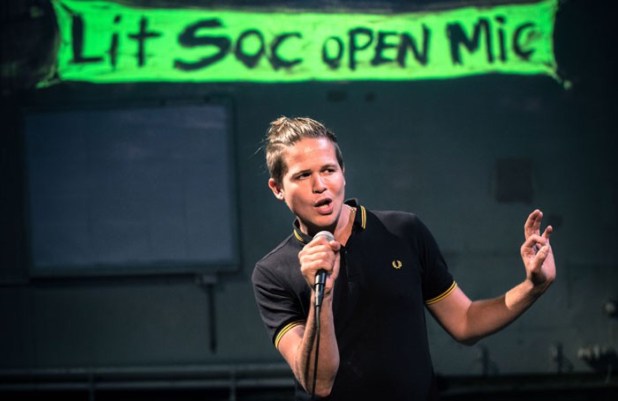
1997. The eve of the general election. Nick, who’s studying English Literature at a nameless uni stays up all night with his best mate, poet Johnny Bevan, to watch Tony Blair win. It’s the dawn of a new era and change is coming for the working class long oppressed by Thatcherite rule.  Fast forward fifteen years and Nick’s a journalist in London, but Johnny’s student aspirations didn’t come to fruition, and neither have Tony Blair’s. The story of these two lads’ friendship, written and performed by Luke Wright in a blaze of fiery spoken word, is an hour long tale of youthful vigour soured by the realities of adult life. Wright’s delivery and writing is fervent, topical and no moment is out of place in the trendy and on-point What I Learned From Johnny Bevan.

South of the river, an older revolution is taking place. In Soviet Russia, a group of peasants stages a play about a servant girl in Georgia raising the governor’s newborn baby that was abandoned during the family’s escape from a war zone. After a perilous journey, sacrifice for the sake of the infant, and a regime change, everything is put right again by a citizen judge. Lazarus Theatre Company, with its trademarks of a large cast and striking visuals, draws parallels between Brecht’s The Caucasian Chalk Circle and the despair of modern life – but “change is hope”. Energetic and in the round, the characters rally the audience to their side like they do in Wright’s monologue.

There’s optimism in both productions as well as despair, and an underlying current of discontent with the state of the UK’s current socio-political trajectory. Both display humanity’s capability for selflessness and selfishness, and the feeling that nothing has changed from Soviet ruled Eastern Europe, to Labour’s late-90’s victory, to present unviable economic conditions and Tory tyranny. We are undeniably flawed with a fickleness vulnerable to power and money, but as a society we are also deeply unhappy and feel that we lack the power to affect change. This sentiment now seems to be emerging in fringe theatre.

Though completely different in form and structure, both What I Learned From Johnny Bevan and The Caucasian Chalk Circle have plenty to say about the contemporary world from similar angles. What I Learned From Johnny Bevan is the better of the two productions, and  the more progressive. A solo performance delivered in spoken word accompanied by charcoal and watercolour landscape projections, most of the imagery in Wright’s language is precise and evocative. Brecht’s well-known play is linguistically stilted and stuffy in contrast, but it’s characters are just as colourful.

Performance poet Luke Wright is a singular tour de force and What I Learned From Johnny Bevan is politically charged and practically flawless. Lazarus Theatre’s performances vary, but of the ten-strong ensemble, no one was particularly strong or weak. Their choreography is well-rehearsed but director Ricky Dukes normally powerful movement sequences  lack impact in the round. The set components take up a lot of space and are used well occasionally, but otherwise clutter the stage with bright, industrial chaos. Neil McKeown’s sound design hints at atmosphere and mood, but is much too quiet to add the impact it could. It’s certainly not a bad production, but neither is it one of Lazarus’ stronger ones.

If theatre is a mirror held up to the world, then evidence is increasing that change is imminent. But what form will it take? Will the people rally as in The Caucasian Chalk Circle or will we either sell out or run away from it all like Nick or Johnny? Only time will tell.

The Play’s the Thing UK is committed to covering fringe and progressive theatre in London and beyond. It is run entirely voluntarily and needs regular support to ensure its survival. For more information and to help The Play’s the Thing UK provide coverage of the theatre that needs reviews the most, visit its patreon.

Mirrors, Rosemary Branch Theatre

rsz_tim_smyth-mirrors-siobhan_mcmillan_54

Photography © Tim Smyth

Maybe the witch in Snow White isn’t that bad. Or, maybe her badness is justified, like she had a traumatic childhood or suffers from a mental illness. Siobhan McMillan proposes just that: Shivvers realizes she’s past her prime and, with insecurity taking over rational thought, she decides to hunt down the young woman who dethroned her from her position as the fairest in the land. This quest takes shape as a solo performance told in the third person, like a fairytale. McMillan regularly interjects with contemporary references and using sarcastic humour to great advantage, makes a strong comment on women’s insecurity about aging.

The use of third person narration is one of the more interesting features of Mirrors; it distances McMillan from the audience and herself. Her physicality and energy cannot be denied as she embodies the characters she simultaneously describes. The audience is told her story but has plenty to watch, and a liberal use of sound and vocal effects create a dynamic aural landscape, even if a touch too loud at times.

The use of an occasional live feed adds another visual layer by which the audience scrutinises Shivvers, but a backlight interferes. The intention shows good instinct by director Jesse Raiment. The set isn’t particularly dyanmic with its black flats and mirrors, save for the ornate frame mounted on a table centre stage – a symbol of modern obsession with female appearance and its dominance in Shivver’s life.

This feminist solo show is an excellent display of performance storytelling and a witty comment on modern life as a woman. Not just about aging, it also looks at female competition, the need to be desired and the perils of dating. With the opportunity of a longer run, Mirrors could upgrade its tech and design to create a more polished production matching its content, creating a piece great for touring small to mid-scale venues.

The Play’s the Thing UK is committed to covering fringe and progressive theatre in London and beyond. It is run entirely voluntarily and needs regular support to ensure its survival. For more information and to help The Play’s the Thing UK provide coverage of the theatre that needs reviews the most, visit its patreon.

Hamlet Peckham, Bussey Building

What happens when a director completely disregards age, gender and nationality in a Shakespeare production, then stages it in a former cricket bat factory with a stripped-back aesthetic and fantastic performers? Shakespeare Peckham. Founded by actor/director/producer Anthony Green, Hamlet Peckham bears more resemblance to the vibrancy and gender bending of Shakespeare’s original productions than most modern conceptual interpretations. Green incorporates several aspects of original practice, which prove that embracing the conventions of Shakespeare’s theatre with a fearless cast is a winning combination.

There are a few concepts that Green adds, such as casting three actors as Hamlet to highlight “the problem, the plan and the solution” of Hamlet’s narrative. He also empowers Polonius, making the father of Laertes and Ophelia the strongest character in the play. There’s loads of direct address and audience interaction, as there was in Elizabethan and Jacobean theatre and as there should always be. The ghost is just a man rather than ethereal or otherworldly, and when Hamlet is played by a woman, he changes all gender pronouns to “she” and “her.” These choices, proving Green’s instinct for excellent theatre and Shakespeare performance, either work well or, at the very least, don’t not work. The only one of these approaches that jars is the textual changes according to gender, but it will have little impact on a viewer who doesn’t know the play well.

The Bussey Building, here configured with the audience on three sides, also has three slender poles along the front of the stage. Though their position prohibits the curving movement that the Globe’s pillars creates, the actors use them – as supports, to hide behind and to propel them. Sight lines are occasionally blocked, but never for long. There is no backstage, so the actors hang out in the dark behind the audience. No feature of this space goes unused, though there are no specific adaptations that warrant the addition of “Peckham” to the show title. This isn’t a site-specific production, but it is certainly wonderfully site-responsive as well as being sensitive to the audience’s energy. Set designer Michael Leopold and lighting designer Adam King create a subtle, harmonising impact on the space with wooden crates, white curtains and colour. The actors’ black and white contemporary costumes looks like their own clothing, but rather than appearing cheap, it comes across as relaxed and accessible.

The cast is phenomenal. Nine of them take on all roles, with only a few not doubling, tripling or more. It’s impossible to chose a few standout performances, but the three Hamlets (Sharon Singh, Max Calandrew and Izabella Urbanowicz) seamlessly blend their interpretations whilst making each moment their own. Gil Sutherland as Polonius is the driving force behind manipulative Claudius (Pete Collis), Daniel Rusteau is a warm, grounded Horatio. Eva Savage is half a dozen characters, particularly excelling as the joyful singing gravedigger. As a whole, they are a well-oiled, energetic and charismatic bunch who have the talent for the world’s biggest stages. Working with Green, each moment is crafted with care and detail, but the effort only shows in the performers’ ease.

Both progressive and ancient, Hamlet Peckham is what contemporary Shakespeare should be – striving for equality in cast and crew, respecting core performance techniques from original Shakespearian theatre practice, and a relaxed, flexible concept that focuses on telling the story with passion and muscularity. This production creates opportunities, showcases great talent and tells Shakespeare’s story with all the energy and life of new play. Don’t miss it.

The Play’s the Thing UK is committed to covering fringe and progressive theatre in London and beyond. It is run entirely voluntarily and needs regular support to ensure its survival. For more information and to help The Play’s the Thing UK provide coverage of the theatre that needs reviews the most, visit its patreon.

Hamlet, The Rose Bankside

The Rose, the tiny fringe theatre built on the remains of its Elizabethan original, is one of the most unique theatres in London. It has its issues, though. Rather than the hierarchy with an artistic director at the top, it is managed by a team of artistic associates, all volunteers. Due to the lack of  an individual’s clear programming vision, the productions here are hit and miss. Their current production of Hamlet, though it has a few moments of invention and effectiveness, largely misses the mark due to poor performances and a huge reduction in length, which hacks the dramatic arc and character journeys to bits.

Of the cast of seven, Luke Jasztal as Horatio is the only one with completely consistent characterisation and stage presence. As the confident, loyal friend and member of the court’s inner circle, he holds the plot together and picks up the energy in lagging scenes with warmth and charisma. Chris Clynes in the title role is more believable once Hamlet decides to feign madness. His ‘to be, or not to be’ is simple and honest, and he is full of energy whilst deeming Polonius a fishmonger. Clynes’ initial sullen sulk casts him as an overgrown, spoils teenager rather than a grieving young adult, but fortunately he gets over that quickly. The remaining cast tended towards either completely flat, monotone delivery or overwrought melodrama, with little light and shade between the two performance styles. The verse handling is also hugely inconsistent amongst this cast.

At nearly three hours if left intact, to reduce Shakespeare’s script to 90 minutes removes a lot of action. Though director Diana Vucane’s edit is linguistically seamless, major plot points are inevitably lost. The focus on Hamlet is maintained, but with so much of his dialogue cut, his character choices come across as unjustified. With The Rose’s 90-minute limit on productions, perhaps Hamlet isn’t the most suitable for this venue.

Some of Vucane’s choices were strong, whilst others questionable. Hamlet’s use of puppets in the players’ scene was inventive, but the impact of the scene was diminished with the murder reveal coming from Hamlet rather than strangers. Contemporary dress also worked in this casual, reduced version of the original but the number of costume changes was excessive and pointless. I stopped counting after Ophelia’s dresses numbered four, in as many different scenes. The rich sound design that stood in for the ghost and scene transitions was rich and spooky, but inexplicably gave way to vintage show tunes. (I’ll never know why “The Lonely Goatherd” made an appearance, or Judi Dench’s rendition of “Send in the Clowns” after the evocative introduction.) She utilises the rear of the The Rose rarely, but it is striking and powerful when she does. If she cast the play, she ought to look at her audition process in order to secure more consistent talent. No lighting designer or fight choreographer is credited, but both of these elements are well done and can count towards Vucane’s strengths as a director.

Though the abbreviated length works against the original play, with the performances given it largely goes in this production’s favour. Diana Vucane shows some promise as an emerging director, but her choices need more clarity in their justification. Luke Jasztal is a pleasure to watch, and Chris Clynes gets closer to his level eventually, but this Hamlet, like the Midsummer mechanicals, is tedious brief.

The Play’s the Thing UK is committed to covering fringe and progressive theatre in London and beyond. It is run entirely voluntarily and needs regular support to ensure its survival. For more information and to help The Play’s the Thing UK provide coverage of the theatre that needs reviews the most, visit its patreon.