Lucy McCormick: Triple Threat, Edinburgh Festival Fringe

https://files.list.co.uk/images/2016/08/05/lucy-mccormick-triple-threat-750-500-lst214192.jpg

A cultural relic of its time, the bible is hardly pro-women. Lucy McCormick, here incarnated as one of those vapid pop stars who evangelically (and often inappropriately) rallies for the cause they’re currently backing, wants to turn the spotlight on the new testament’s women. She focuses on their underwritten stories, their emotional involvement in Jesus’ life, and all the fingering and angel snogging that was left out of the text we know so well in Western culture.

Trashy, tasteless, obscene, and absolutely excellent, McCormick’s newest show pushes theatre to to limits of acceptability and beyond – any further and it would be pornographic (arguably it already is), though Lucy McCormick: Triple Threat is still not one for those easily offended. Accompanied by two muscly dancers in Calvins, her three-act play that she dutifully explains scene by scene is the story of Jesus Christ. She plays Mary Magdalene, Jesus’ mother Mary, and Jesus himself, with her backing dancers in the supporting roles. It’s also very funny, though laughter swells from amusement as much as it does from discomfort.

This gig-theatre piece is interspersed with appropriate pop songs at key moments of the story, accompanied by excellent dancing and raw emotional outbursts. Her personal life bleeds into the act as she slowly falls apart in the wake of the pressures of celebrity life. Take all of those public celeb breakdowns and multiply them by hundreds with a lot more nudity and mess, and you get something resembling the whirlwind of in-yer-face chaos that is Lucy’s stage persona in this piece.

Her commitment to her cause is unquestionable, but the fact that her character finds the actions that unfold acceptable is disturbing, yet all too familiar. That we can watch someone fall to bits with no dignity and laugh at their plight, righteously judging them, is a powerful comment on the levels of voyeurism and exhibitionism that are now bombard us through all of media’s incarnations.

Lucy McCormick: Triple Threat, for all its deliberate mess and audience discomfort, is a fantastically considered social commentary executed with precision and high levels of consideration and skill. It’s the epitome of fringe shows, and a great one at that.

Lucy McCormick: Triple Threat runs through 28th August.

The Play’s the Thing UK is committed to covering fringe and progressive theatre in London and beyond. It is run entirely voluntarily and needs regular support to ensure its survival. For more information and to help The Play’s the Thing UK provide coverage of the theatre that needs reviews the most, visit its patreon.

Adler & Gibb, Edinburgh Festival Fringe

https://www.thestage.co.uk/wp-content/uploads/2016/08/Adler-and-Gibb-GIna-Moxley-credit-Richard-Lakos-700x455.jpg

I was gutted when I found out Janet Adler and Margaret Gibb aren’t real. The portrait Tim Crouch paints of this fictional couple and their anti-capitalist approach to their art, in striking contrast to a deranged Method actor and her coach making a film about Adler’s life, is so well-formed that they feel that that they can’t not be real. Even though the reality of these characters is so detailed through their dialogue, Crouch’s staging and choreography is wholly unrealistic and often absurd, a work of art in itself. This rigid stylisation, though eventually giving way, rebels against convention just as the characters do. These two sets of characters and the staging battle for dominance in a wonderfully compelling and disturbing commentary on the ownership, commodification and nature of art and its creators.

A nameless student begins with a lecture, and intersperses scenes with a discourse on Janet Adler’s life and work, shaping and contextualising the woman that actor Louise discusses with zealous devotion. Despite these strong feelings, Louise is unmoving, staring straight ahead. Her teacher Sam is the same; though their voices have some emotion, their bodies are rigid as they stare through they audience. Adler’s widow, Margaret, assumes the same style when she first appears. A boy moves any necessary props, wearing wireless headphones with instructions whispered to him by a woman sitting upstage with a microphone. Some of the props are appropriate to the action, some totally absurd. The boy’s innocence and movement is powerfully accentuated amongst the stillness; though he is a child, he has control of all physical action rather than the adults. The sculptural staging with juxtaposed power becomes a thoughtful commentary on art’s relationship with its audience, something Adler may have approved of.

Though the performances aren’t wooden in the least, the distance they maintain through roughly half of the play is frustrating, albeit canny. It works as a concept within a play about art and the detailed characters are built through dialogue, but the initial lack of connection between them leaves a gaping void.

Cath Whitefield endows Louise with a fanatical “I will stop at nothing” attitude that’s both satisfying to look down on and be disturbed by. Her and Sam’s visit to the house where Adler and Gibb last lived and their subsequent choices are a potent critique of the Method acting technique, as well as any other justification of awful behaviour for the sake of making art. Her character’s abrasiveness effectively generates empathy for Adler’s widow Margaret, ferociously played by Gina Moxley, who also shows moving tenderness when faced with the memories of her partner.

The richness of the characters and the feeling that they live beyond this play is the strength of Crouch’s writing, but the messages contained therein are important to consider. Who does art belong to once it’s in front of an audience? Where are the boundaries of an homage to the dead? Who do any resulting accolades belong to? It’s certainly thought-provoking stuff to consider the lineage of the cultural products we consume. Despite all the good intentions in the world, what damage may have been caused in the research and making of that book/film/play/artwork/song that we consume so casually?

Adler & Gibb runs through 27th August.

The Play’s the Thing UK is committed to covering fringe and progressive theatre in London and beyond. It is run entirely voluntarily and needs regular support to ensure its survival. For more information and to help The Play’s the Thing UK provide coverage of the theatre that needs reviews the most, visit its patreon.

Missing the Mark: Three Shakespeare Appropriations, Edinburgh Festival Fringe

https://i0.wp.com/cdn.spectator.co.uk/content/uploads/2015/12/iStock_000023304291_Small1.jpg

As great as it is to see Shakespeare inspiring contemporary theatre makers to create derivative work, like any new writing it has the chance of missing the mark by a long shot. Annika Nyman’s Romeo and Juliet Post Scriptum poses the question, “What happens and Romeo and Juliet don’t die?” and the answer isn’t pretty, nor well thought out or well-written. Z Theatre Company’s The Female Question gives us Shakespeare and his female alter-ego bickering over whether or not they shortchanged his female characters, from whom we hear a lot of moaning. MacBain, part of Summerhall’s Big In Belgium season, retells Macbeth through a hybrid of drug-addled Kurt Cobain and Courtney Love and Shakespeare’s text, giving us MacBain.

Romeo and Juliet Post Scriptum is such a lovely premise, but the route Nyman takes is inexplicably far from the characters Shakespeare created. Romeo is the main issue here. Nyman presents him as an indecisive coward who now regrets the whole “feigning death and running away” idea. Deciding that family is more important than love, he wants to go home and make up with his dad. Juliet, unimpressed by this, tries to convince him to stick to the plan and when he is unconvinced, they argue for pretty much the rest of the play. They speak in stilted English that isn’t Elizabethan, but it’s certainly not modern either, preventing the actors from connecting their text. The characters partly make up, then they argue again. Wash. Rinse. Repeat. The rushed ending is disconnected from the all the fighting leading up to the moment, making the overarching effect one of pettiness that doesn’t relate to Shakespeare’s characters and no clear message about their actions.

It’s 400 years since Shakespeare died, and he and his female alter ego meet for their annual discussion in his office. She’s trying to convince him of their legacy, but he doesn’t believe her. Hamlet has been bugging him lately, and he’s feeling like he didn’t do his female characters any justice, hence The Female Question. He talk to the skull on his desk, texts on his phone and has a desk covered in books about himself and papers. Quite what is occupying his time since his death is never revealed, neither is how he got a mobile phone, why there are two of him and why Hamlet keeps giving him grief. Some of his characters come in for a chat, but the through-line (that was never really made clear to begin with) only tenuously connects these characters to Shakespeare’s inner dilemma. This could likely be due the fact that there are two of the same dead person and the rest of the characters aren’t real. Whilst the idea to give Shakespeare’s women another crack at the spotlight is admirable, the execution is muddy, badly performed and has no solid resolution or narrative structure.

MacBain has the most promise due to it’s Summerhall location, but this one-trick pony also disappointed. Despite excellently imposing lighting and sound design, the performances of Kurt and Courtney off their heads playing at talk show interviews that randomly morph into a two-person Macbeth with children’s toys is almost completely pointless. There is no commentary on the Macbeths’ power dynamic, sexuality or guilt. The only thing of any interest is the introduction of “the babe that milks me,” a son that eventually committed suicide. Otherwise, the banter between Kurt and Courtney, a powerful, mythic couple in their own right, comes across as self-indulgent stoners. Watching MacBain is like being the only sober person at a party where everyone else is off their nut, having a great time making in-jokes and reminiscing, only truly coherent to each other. When they are finally pinned and silenced beneath a descending sheet of plexiglass covered in vibrating cutlery, it is sweet relief.

In three unrelated productions that have premises with potential to offer fresh insight into Shakespeare and his work, the lack of dramaturgy and clear concept is painfully apparent. None of them managed to have any meaningful follow-through and most ended with an unspoken question hanging in the air – “what was the point of that?”

The Play’s the Thing UK is committed to covering fringe and progressive theatre in London and beyond. It is run entirely voluntarily and needs regular support to ensure its survival. For more information and to help The Play’s the Thing UK provide coverage of the theatre that needs reviews the most, visit its patreon.

A Dream of Dying, Edinburgh Festival Fringe

https://files.list.co.uk/images/2016/08/07/dsc3677-lst214126.jpg

On 16th June 2009, the body of a man was found dead on a beach near Sligo, Ireland. He had given his name as Peter Bergmann at his hotel, but postmortem investigations determined that was an alias. In the days running up to his death, CCTV recorded the man methodically moving around Sligo but taking advantage of cameras’ blind spots, he disposed of all items that could possibly be used to identify him. Monologue A Dream of Dying creates a young man who plans such a death in his future in an attempt to justify why Bergmann might have died the way he did. This quiet, reflective piece may not be the most exciting theatre at the fringe, but its subject matter is a sensitive look at life’s inevitability and the desire to control these final moments.

Lawrence Boothman embodies the fictionalised Bergmann, his friends and family from childhood through to recent graduate on the cusp of the rest of his life. As he contemplates what life will bring him – career, wife, children, grandchildren – he expresses the lingering fear that it could all go wrong. In either case, because life is so unpredictable despite the best laid plans, he is able to plan his death with mechanical precision. The calm rationale is both understandable and unsettling.

Boothman attacks the role with vigour, perhaps too much so in transitions that become rushed. Treasa Nealon’s text follows a natural narrative progression and Boothman tells it with instinct for its rises and falls, lingering over moments of tenderness and celebrating milestones. There’s an anti-theatricality to the piece, but it’s a good story well told.

Peter Bergmann’s true identity was never discovered. His remains evidenced late stage prostate and bone cancer so it is easy to draw conclusions as to why Bergmann chose to end his life. The saddest thing to consider is that whilst he worked hard to make himself unidentifiable, there may have been no one to look for him when he disappeared. A Dream of Dying, though not particularly theatrical, feels like a fitting homage to those that have died unknown and unclaimed the world over.

A Dream of Dying runs through 27th August.

The Play’s the Thing UK is committed to covering fringe and progressive theatre in London and beyond. It is run entirely voluntarily and needs regular support to ensure its survival. For more information and to help The Play’s the Thing UK provide coverage of the theatre that needs reviews the most, visit its patreon.
A Tale of Two Cities: Blood for Blood, Edinburgh Festival Fringe

rsz_two_cities

A Tale of Two Cities: Blood for Blood is a rather different beast from Charles Dickens’ A Tale of Two Cities. This choppy, convoluted adaptation lacks the detail and finesse of the novel, though adds a lingering threat and gloom that hangs over this story of revenge and espionage that spans two countries. Though not specifically modernised, the set alludes to greater powers and constant obstacles, but dominates the production and interferes with the action. The script is initially confusing and takes time to settle, but the lost opportunity to capture attention from the start causes the production to never really find its feet.

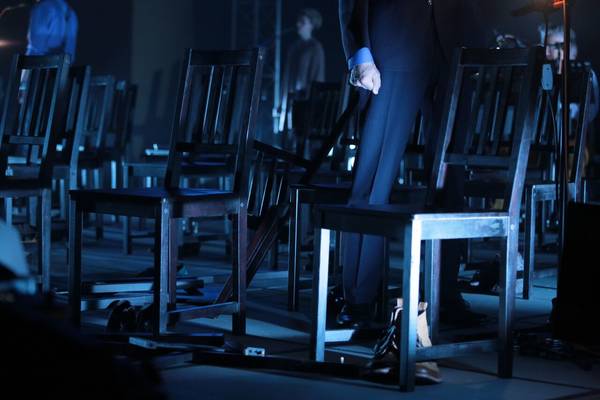
The set is a baffling assemblage of chairs, with a sound desk commanding attention centre stage. There are a lot of chairs; the stage is literally filled with rows of them reminiscent of a large school room, with enough space in between for one person to cautiously pass. This slows movement to a sleepy pace that clashes with the story’s tension, and after the initial visual impact, they are largely unchanging.

Performances are of a good standard across the board with some excellent multi-rolling. The actors do well to keep a high level of vocal energy despite physical limitations caused by the chairs. The selective use of microphones adds distance and authority, though their inconsistent use is more of a muddled hindrance to the performers and themes in the story.

The story naturally has conflict that helps keep it going, but initial exposition doesn’t lay enough groundwork to create solidly increasing tension. With the reliance on text needed to compensate for the staging, its patchiness makes clashes between characters feel sudden and forced.

A Tale of Two Cities: Blood for Blood certainly has some interesting seeds of ideas, but the script needs smoothing and design needs to be re-thought so it helps the action rather than hinders it.

A Tale of Two Cities: Blood for Blood runs through 28th August.

The Play’s the Thing UK is committed to covering fringe and progressive theatre in London and beyond. It is run entirely voluntarily and needs regular support to ensure its survival. For more information and to help The Play’s the Thing UK provide coverage of the theatre that needs reviews the most, visit its patreon.
Life According to Saki, Edinburgh Festival Fringe

CpVFTsMXYAA1jSg

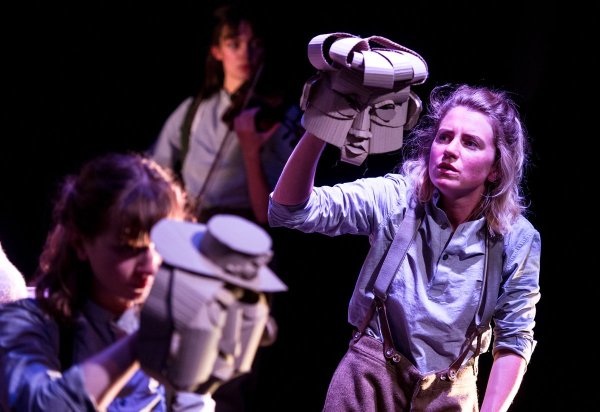
Author Hector Hugh Munro, otherwise known as Saki, is in WWI’s trenches. He and his men been out there for nearly a year, and they are long fed up with life on the front. To entertain his fellow troops, he tells the stories that have already made him a well-known writer. Life According to Saki mixes biography and fiction as Saki tells the audience about his life, interspersed with silly and bizarre anecdotes. The cast of six play both soldiers and the character’s in Saki’s stories with fantastic energy and physical commitment, but the structure of the play and Saki’s pontificating soon grows repetitive. An excessively long ending and too many stories ushers in eventual tedium despite a polished show with high production values.

Anna Lewis’ design is excellent; it clearly indicates the trenches and is flexible for the imagined worlds elsewhere. Costumes are WWI uniforms that fit the cast of women and men smartly – they are not frumpy, unaltered hire costumes. The puppets by Claire Roi Harvey and Suzi Battersby are also very good, with the cock being particularly charming with a great range of realistic movement.

The script is where it begins to fall flat a few stories in. Each one is very short, some only a few minutes long. There are about eight or ten altogether, and the constant shift from tale to tale is exhausting. The are performed with great physical comedy, accents and verge on the fantastical; each one is lovely but there are way too many. Episodes from Saki’s life are bland and dry filler, and the two styles feel forced to miserably cohabit in the same structure. The tacked-on conclusion preaches about how to live one’s life, then drags on even longer into a song and a poem. Though it blatantly states its message of living life to its fullest, the connection to the hour of stories preceding it is tenuous.

Three or four longer stories with depth and detail, and less of Saki’s biography (if any at all) would make this a much more engaging play. The premise of a soldier entertaining his troops is a fine one, but The Life of Saki comes across as self-centred and lecture-y with some silly, disconnected interludes.

Life According to Saki runs through 29th August.

The Play’s the Thing UK is committed to covering fringe and progressive theatre in London and beyond. It is run entirely voluntarily and needs regular support to ensure its survival. For more information and to help The Play’s the Thing UK provide coverage of the theatre that needs reviews the most, visit its patreon.

“Just let the wind untie my perfumed hair…” or, Who Is Tahirih?, Edinburgh Festival Fringe

https://i0.wp.com/www.ridikulmagazin.hu/cuccok/storages/thumbnails/2014-06-06/153cc8eec7af4dc9e7fe3737d2192f41/680x0.jpg

A woman sings behind a gauzy white curtain. We cannot see her face, but in her soaring cries we hear her passion. This is Tahirih, born in what is now Iran in the early 1800’s (we don’t know her exact date of birth because authorities burned these documents after her execution). She is a poet, theologist and women’s rights activist, and she has enough followers that the country views her as a national threat to the patriarchal Islam that requires women to be veiled in public.

In the days leading up to her execution, Delia Olam plays people from Tahirih’s life, unfolding her biography, teachings and radical actions. These we see plainly, but Tahirih is always behind the curtain, playing and singing. As the revered and reviled woman is sculpted through the accounts of others whilst her face remains hidden, she becomes mythical and hugely powerful, a revolutionary who’s life is tragically cut short.

Olam’s script and performance meld into a fluid solo performance that is a fitting tribute to such a remarkable woman. Her physical and vocal distinction between the handful of characters she plays is detailed and precise. A servant, Tahirih’s father, an executioner, and a female follower are crafted in detail, and all visited by the audience who go to these people to discover more about this woman who is revolutionary, dangerous, or both. This is excellent clarification of the audience/character relationship in solo performance format – it makes sense with the play’s circumstances and embeds the audience in the action. There is none of the talking out into undefined space or invisible characters that alienates the audience and removes the character from reality, something that often occurs in solo performance. Across these characters in different places and with different relationships to Tahirih, there is still a clear, well-proportioned narrative arc building to an awful end.

The scenes themselves are well-crafted and provide a snapshot of the landscape of attitudes towards women in Iran at the time. They are simply staged and prettily enhanced with candlelight, their simple, calming beauty juxtaposes the inevitable prospect of her death. Transitions are a touch slow; some are smoothed with recorded music whereas others have silent gaps as Olam transforms in and out of Tahirih, who sings and plays between characters. The silences make for a choppy disruption, but this is a minor issue easily forgiven in view of the story’s excellent construction and execution.

To learn about such a remarkable woman through a strong show and performance feels as much of a privilege as it is an education. Olam has fantastic instinct for storytelling and character development, and this detailed show needs hardly any improvement. Do not miss it.

“Just let the wind untie my perfumed hair…” or, Who Is Tahirih? runs through 29th August.

The Play’s the Thing UK is committed to covering fringe and progressive theatre in London and beyond. It is run entirely voluntarily and needs regular support to ensure its survival. For more information and to help The Play’s the Thing UK provide coverage of the theatre that needs reviews the most, visit its patreon.

Agent of Influence: The Secret Life of Pamela More, Edinburgh Festival Fringe

https://i0.wp.com/www.underbellyedinburgh.co.uk/images/made/images/uploads/pamela_more_750_500_60_c1.jpg

Lady Pamela More covers fashion and socialites for The Times and she has no interest in any other topic. As Britain’s involvement in the war becomes certain, her disinterest in politics and international affairs wanes, and her social circles are split into those who support Germany and those who believe the whispered stories coming across the channel. With newfound purpose and contacts, the use of her journalistic skills changes direction to a more practical use – she is recruited to spy on Britain’s elite.

Sarah Sigal reinvents Pamela from her 2014 Park Theatre play World Enough and Time, now making the character the primary subject of a solo performance. Reprised by Rebecca Dunn, Pamela recounts her wartime adventures through past-tense narration and dialogue between herself and impersonated peers. She meets and watches real people from British history, moulding a clear perspective of their wartime activities – this is the most interesting aspect of the narrative. Who the audience is, or why she is telling us her story is never made clear, though. Her tale is interesting enough, but what is it’s point?

The scenes Dunn enacts are more dynamic than the stretches of narration that span the years surrounding the war. She employs accents and an impressive vocal range to differentiate between herself and those she converses with, often with charm and humour. Her storytelling is good enough to maintain attention, but as no moral or message emerges from the text, the ambiguity of the script dwarfs Dunn’s ability.

Agent of Influence: The Secret Life of Pamela More suits a written format much more so than a staged one – it would make a lovely novella what with its detailed description of the setting and characters involved. Though its well performed and a good story in and of itself, theatricality gets in the way, making this solo performance piece fall flat.

Agent of Influence: The Secret Life of Pamela More runs through 28th August.

The Play’s the Thing UK is committed to covering fringe and progressive theatre in London and beyond. It is run entirely voluntarily and needs regular support to ensure its survival. For more information and to help The Play’s the Thing UK provide coverage of the theatre that needs reviews the most, visit its patreon.
Foiled, Edinburgh Festival Fringe

https://theplaysthethinguk.com/wp-content/uploads/2016/08/7cbcd-duckspeak2b-2bfoiled2b2528editorial_promo25292b2528c25292balex2bbrenner252c2bno2busage2bwithout2bcredit2b2528_dsc71542529.jpg

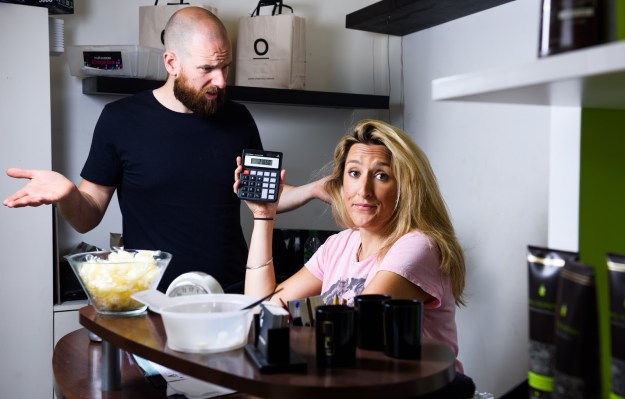
It’s a big day at Bleach for the Stars. The Welsh salon has been nominated salon of the year by Clip Advisor, and dim-but-enthusiastic manageress Sabrina has a lot to do to prepare, like fill out the form to nominate the salon for the award and find money to pay the administration fee. Fed up junior stylist Tanisha does her best to pander to Sabrina’s whims and half-truths, but as the end-of-day deadline for the application looms and a last minute “celebrity” client arrives, Sabrina struggles to keep the business running to the standard that her dad, the owner, expects.

Foiled takes place after hours in a working hair salon, adding a genuine site-specific element to a script that draws on several styles of text-based comedy to entertain its audience. Puns, slapstick, one-liners and Sabrina’s regular misspeaking keep the laughs coming, and two scenarios that raise the stakes drive the action forward. There’s a token sprinkling of musical theatre numbers that feel a bit out of place, but help break up the action nicely.

The intertwining sitcom-esque scenarios hover on the verge of messiness, but writers Beth Granville (who also plays Sabrina) and David Charles keep just enough order in the story for it to not get lost. Staging is a challenge here with the actors racing up and down the narrow salon and sightlines oaccasionally blocked, but the salon is small enough that it’s always easy to hear the dialogue.

Though insubstantial and silly on the surface, Foiled makes pretty powerful comments on social mobility, class and privilege. Tanisha and Sabrina come from very different backgrounds and financial situations which, combined with the two primary plot threads manage to to not feel crowbarred. Foiled is a good laugh, well performed and has a lot to say.

Foiled runs through 29th August.

The Play’s the Thing UK is committed to covering fringe and progressive theatre in London and beyond. It is run entirely voluntarily and needs regular support to ensure its survival. For more information and to help The Play’s the Thing UK provide coverage of the theatre that needs reviews the most, visit its patreon.

Lines, Edinburgh Festival Fringe

http://www.emmanently.com/wp-content/uploads/2015/03/tubemap-2012-12.png

Every Londoner has strong feelings about the tube. They love it, hate it, love to hate it, depend on it, avoid it, sometimes all at once. In Lines, Rose Bruford students pay homage to the underground by extracting individuals from the millions of faces that blur through stations each day. A collage of movement, narration and dialogue captures the diversity of the city with a lovely affection, but the tangled, underdeveloped plot threads that emerge aren’t followed through.

Writer Ian Horgan has numerous lovely ideas but none of them, even the fictional disaster that has the power to unite passengers, is chosen as the narrative spine. Whilst this adds to the montage effect of individual moments, it’s a format that only works for short periods of time. There are certainly some great stories of individual characters and any of them could be short plays in and of themselves, but here they are unsatisfying. The sections of spoken word vary in the quality of delivery, but this is a style that Horgan uses inconsistently. The use of live music is much more regular, and a great contribution to the piece.

There are some great performances, as should be expected from drama school students. No one stands out as a weak link and their time training together has formed a seamless ensemble. Lines also has the distinction of one of the more ethnically diverse productions of the fringe, which in and of itself is hugely commendable.

Though this affectionate tribute to London transport has plenty of potential, it falls short of true excitement or innovation in its current form.

Lines runs through 15th August.

The Play’s the Thing UK is committed to covering fringe and progressive theatre in London and beyond. It is run entirely voluntarily and needs regular support to ensure its survival. For more information and to help The Play’s the Thing UK provide coverage of the theatre that needs reviews the most, visit its patreon.