

T wo estranged sisters dig through a rubbish tip after their mother’s funeral. Recovering heroin addict Becky, in a moment of anger, had thrown away an unopened letter from their mother containing important information. Older, responsible Diane insisted they recover it, so here they are in their funereal finery, ankle deep in trash, full of hatred, resentment and grief. New company Indigo Iris, founded by actor-producers Emma Shenkman and Georgina Philipps, debut with Arthur M. Jolly’s Trash, a two-hander with potential for absurd situation comedy that instead plays it straight, focusing on the complexity of sisterhood and familial responsibility.
Trash is a well-constructed play driven by long-standing conflict between Diane (Emma Shenkman) and Becky (Georgina Philipps). Their mother’s illness tested daughterly obligation: Diane fulfilled it, but Becky refused to and ran away. They haven’t seen each other since. Diane’s resentment spews forth in relentless verbal attacks that Becky coldly thwarts. Occasionally, the violence turns physical, with great fight direction by Gordon Kemp.
This is a tense, wordy production but the energy is full on, particularly from Shenkman. Her vicious, relentless performance counters Philipps’ low-key character and keeps the audience’s attention. Both have a hard veneer that rarely cracks and is truthful to their situation, though more emotional range would have been welcome to break up the near constant anger. As such, sympathy for either woman is difficult to summon, even though Becky doesn’t seem to by lying about being clean and Diane clearly had more than her share of trouble caring for their dying mother over the last three years. The script steers clear of a formulaic narrative arc but still satisfies through a gradual information reveal and an ending open to several possible outcomes. It’s not a happy ending, but not a stalemate either and avoids sentimentality. These women are damaged, and it will take much more than an hour in a dump together to repair their relationship.
The set design is simple but effective. Filled bin bags and a load of other stuff cover the stage, with a backdrop of an ominous gray envelope. Its ever-present dominance is a powerful signifier of the control their mother still has over them in her last attempt at communicating with Becky before her death.
This would make a good touring studio production due to its universal conflict and small scale. Indigo Iris have good instinct for choosing a well written, showcase production. Hopefully they’ll continue their producing journey with more plays less familiar to the London fringe that focused on character relationships through solid, well-crafted scripts.
The Play’s The Thing UK is an independent theatre criticism website maintained voluntarily. Whilst donations are never expected, they are hugely appreciated and will enable more time to be spent reviewing theatre productions of all sizes. Click here to make a donation with PalPal.
 Though touring regularly, The Rocky Horror Show hasn’t appeared in the West End since 1990-1991. For a limited time, this camp, B-side parody musical returns to the Playhouse Theatre before embarking on a new UK tour. Devoted fans attend in costume and call out responses during the show, carrying on long-held traditions developed after the release of the film, The Rocky Horror Picture Show. Audience behaviour is unlike anything I’ve ever seen in the West End and the regular punters don’t quite know what to make of the anarchy, but it’s a fun night out and a cultural awakening to this cult phenomenon. This is a polished revival with some inventive touches and great performances, but does the award winning musical from the 1970s withstand the test of time? Not so much.
 Willem is 34. He moved from Amsterdam to New York City 12 years ago. After an inconveniently timed phone call from his mother on a cold New York morning, he goes home for his younger brother Pauli’s funeral. He is greeted by his father’s disappointment, his sister’s lectures and the disorientation of not knowing where “home” is anymore. Much has changed, yet so much has remained the same.
 The pool preserving the remains of The Rose Playhouse is the sea surrounding a nameless, remote island. Fascinating, dangerous, wild or wonderful, all of the island dwellers have lengthy, close relationships with the sea, for better or worse. These intertwining, turbulent histories meet and join each other at the Old Man and his Boy, a story of a new, young love and a past love, long lost. Heady Conduct’s Reckless unfolds a timeless tale of love, truth and community dictated by the sea using narration, site-specific influences and direct address interspersed with conventional performance. The story is both sweet and saddening, but the play’s structure is disjointed and thin, occasionally unclear in time and place, causing the story to lose support and clarity. Fortunately, the scenes between characters are endowed with honesty and intimacy, and the unique performance venue is fantastically utilized by director/actor Rebecca Rogers.
 That which goes up must eventually fall. Christopher Marlowe’s Tamburlaine the Great tells of the title role’s rise from common thug to emperor of Persia and Africa. A precursor to, and probable influence of, Shakespeare’s ruthless Richard III, the man is needlessly brutal: he orders rivals’ remains displayed on city walls, women and children killed, manipulates others to join his cause and then betrays them. Fate eventually catches up with Tamburlaine after he sets fire to books, including the Qu’ran, and proclaims himself more powerful than God.
 Carol (Holly Joyce) moved to a village in Carcassonne to rebuild her life after a devastating divorce and her son had grown up. She is convinced that in a past life, she was a medieval troubadour called Guy in the time of the Cathars. Raymond (Danny Solomon) is an actor working in the second-rate tourist attraction that Carol stalks, and longs for a life in the more exciting London. With a poetic, reflective script by Nick Wood and direction by Natasha Wood, Consolation has riveting moments between these two damaged, conflicting characters as they travel on parallel journeys of self-discovery, but at two and a half hours with a lengthy, slow-burning beginning, the production could use a trim. The slow development and several sub-plots lend a real-life complexity to the story, though the last to be introduced has insufficient expositional time considering its importance to the play’s conclusion. Despite the script’s need for additional development, this is a moving character piece unsentimentally following two individuals as they come to terms with the insubstantiality of their dreams.
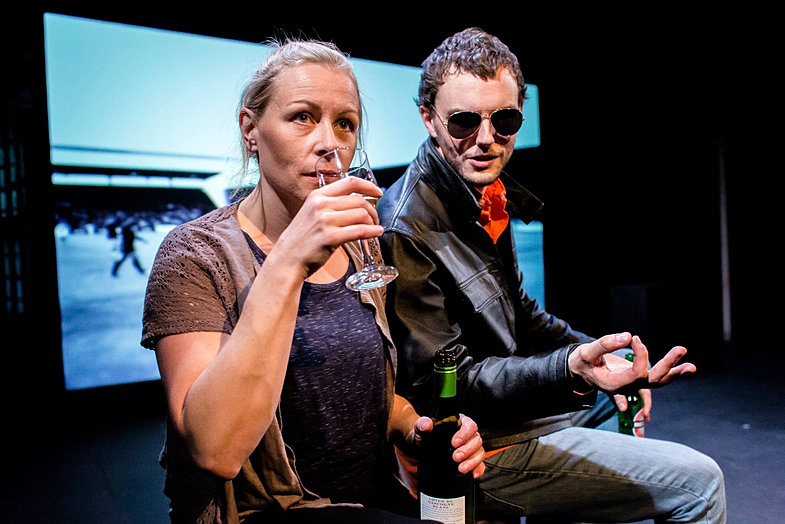
 A male photographer is photographing a female celebrity who is tired of being so superficial. She wants this photo shoot to show her “true self”. She wants to be “real”, and we’re all hanging out in the studio with them in Action Hero’s Wrecking Ball. Audience expectations are immediately challenged on entry when invited to grab a beer from a cooler onstage, and this boundary remains blurred for the duration. Communication is attempted between the two characters, but neither is really listening and what they say doesn’t really have any meaning, pointedly ironic in characters striving for stripped back honestly. The performance is both funny and uncomfortable as the audience watches their professional relationship cross into the manipulative personal. This is a text-based performance with imagery rich language highlighting the absurdity of their encounter, but it triggers a good amount of reflection on our own behaviour. We all carefully construct our images, particularly in social media, yet at the same time we want to be genuine (whatever that means). This is an excellent, polished piece that is provocative in subject and the actor-audience relationship.
 Search Party’s My Son & Heir is without question the funniest thing I’ve seen this year in Edinburgh. Real-life couple Pete Phillips and Jodie Hawkes playfully examine the prospects of their young son, born in the same year as ‘baby Cambridge.’ The two little boys have little in common, though. Pete and Jodie share their hopes for their son in a cheerful, pink chaos that soon disintegrates into relentless judgments on their parenting methods and a stream of ‘what ifs’ capturing the anxiety and pressure to raise a perfect child. The message evokes sympathy and reflection, even from those without children. It’s an outstanding blend of comedy and social commentary on the perils of being an ordinary parent without heaps of cash to throw at your child. Their gleeful, child-like anarchy quickly turns vicious, creating pointed contrast between the haves and have-nots, but ends in a message of love. Perhaps the ending tends towards sentimental, but in a world where money is a large factor in success and a good life, it is also an ending of hope.
 Last up is Christopher Brett Bailey’s This Is How We Die, a spoken word and music performance that is deceptively simple but leaves you with overloaded senses and a feeling of having traveled around the world at a million miles a second. When I first saw This Is How We Die at Battersea Arts Centre several months ago, I was so moved that I wrote two responses:
  A walk to a “secret location” ends in a dimly lit warehouse for Volcano’s show about the effects of coal mining. It is a promenade production that literally destabilises the audience, who have to walk over a floor covered with large chunks of the black stuff. Four actors taking on roles both historical and fictitious physically capture miners’ suffering in horrific working conditions. Disappointingly, in a piece with such a focus on introducing the characters at the beginning, their individual stories are neglected in favour of the visual and aural. Some of the metaphors make sense, like the animalistic dining scene showing the reduction of the miners to baser creatures, others are less clear. I still don’t understand the incorporation of Anna Karenina and playing cricket in their pants. Black Stuff is surreal and abstract, but so much so that any message or idea trying to be communicated is almost completely lost.
 Late Night Love is a sweetly nostalgic, and very funny, piece revolving around a phone-in radio show the three members of Eggs Collective listened to as teenagers. Having not grown up in the UK, I missed a lot of the cultural references, but the teenaged idealism about love and relationships is universal. Power ballads and dating conventions are gently mocked, but lovingly remembered. The two-way radios on each table are underused, but an interesting device that places the audience inside the radio show listened to in the dark. Though quite structurally loose at this point, it’s a show that speaks fondly of a specific era and development stage of teenage girls.
 Made in China’s Tonight I’m Gonna Be the New Me blurs the line between truth and fiction through founders Tim Cowbury’s and Jessica Latowicki’s real-life relationship laid bare onstage. The premise is that Tim has written the show that Jess performs as Tim runs the lights and takes notes at the back. Jess dances inside a metal box wearing sequined hotpants and a halter top, an object for our delectation, and presumably Tim’s. She soon hijacks the script that descends into the two picking at each other’s faults, empowering herself as the audience are voyeurs of their argument. What is truth and what is fiction? This blurring is far more interesting to consider than the argument typical of a long-term relationship that unfolds. The made-up story of Tim’s death returns the piece solidly to fiction, again made more interesting in the idea of fantasizing about a partner’s death (we all do it!) than the story itself. I expected the content of Tonight I’m Gonna Be the New Me to be far edgier than it was, though the ideas within the performance are certainly fascinating on several levels.
 The Play's The Thing UK