Hardy Animal, Battersea Arts Centre

https://sites.google.com/a/georgetown.edu/mdarts/_/rsrc/1439559537290/units/unit-3/section-2/performance-laura-dannequin-s-hardy-animal/Dannequin.png

What happens when a dancer and performance maker loses the ability to dance due to chronic pain? She makes a solo dance piece with hardly any dance in it. A mix of emotive description, encounters with medical and health practitioners, and her own research tell the story of an injury and the subsequent pain that wouldn’t leave her body. Pointedly still and so quiet that she needs a mic, Laura Dannequin’s resilience makes a compelling piece of solo storytelling that mourns the dances her body wouldn’t allow her to make.

An impassioned monologue about all of the dances she wants to create is followed by a voiceover describing her dancing, whilst Dannequin stands perfectly still. Though her expression gives away nothing, she exudes a sense of loss; the simplicity and contrast between aural and visual imagery are captivating and heavy with grief. A sequence of small flexing movements of her bare back against a litany of treatments and diagnoses she sought from all over the world creates a similar effect, this one with added existentialism and frustration with a medical community that still knows precious little about the human body and its mechanisms. It’s captivating viewing in its simplicity.

Much of the piece examines Dannequin’s relationship with her body and her pain. It becomes a separate entity that she confronts with a range of emotions and dogged research to understand why hers is so persistent. There’s a scientific lecture on types of pain and her own educated theories, but like the rest of her piece’s components, there’s an emotional undercurrent that carries her words. A cathartic climax celebrates her mysterious recovery and the overarching effect is one of beauty and wonder.

Dannequin miraculously withholds the anger she is more than entitled to feel, instead she shares a grounded story of bodily rebellion imbued with emotion and strength. Hardy Animal is a piece of simple, quiet beauty that doesn’t let itself be bogged down with science or negativity.

Hardy Animal ran from 28-29 April and tours regularly.

The Play’s the Thing UK is committed to covering fringe and progressive theatre in London and beyond. It is run entirely voluntarily and needs regular support to ensure its survival. For more information and to help The Play’s the Thing UK provide coverage of the theatre that needs reviews the most, visit its patreon.

The Destroyed Room, Battersea Arts Centre

Question: do you think people are happier now or in the past?

It’s a big one with no right or wrong answer, but three actors debate it on stage for over an hour in The Destroyed Room with a deliberate diversion to terrorism and the refugee crisis. The extended, semi-improvised conversation is filmed by two live-feed cameras broadcasting to a large screen above the middle class, sanitised lounge and kitchenette that makes up the set. The audience, more like that of a televised political debate, can choose to watch the close up footage or the live wide angle. After the subject matter turns to violence, voyeurism and relationships between the onstage personas break down due to clashing viewpoints, the inescapable reality of the refugee crisis floods the stage in this subtly provocative, highly metaphorical piece of experimental performance that makes the audience reflect on how it perceives these events.

Driven by the idea that we view the world through the lens of the culture we live in, the conversation quickly heads into to the violence bedded into modern life. There’s a pretty clear, scripted signpost to steer the topic in this direction, which although necessary to ensure the conversation hits the points the production wants to make, is disappointing after the promise of improvisation.

Another question: have you ever watched one of those videos by terrorists of them killing someone?

There’s an awful, revealing confession from Barnaby Power that the three discuss for some time; it’s this subject that really starts to press the audience’s emotional buttons. Personalities are revealed, and gloves come off. It’s interesting to consider how much of what we see are characters and how much are the actors’ own selves. Power’s inner conservative conflicts with his liberal exterior, Pauline Goldsmith is flamboyant and brash, Elicia Day is the middle ground between the two and has a secret sensitive to the others’ sweeping generalisations.

An anti-theatricality to this production makes the form both experimental as live performance and occasionally a bit dull. The conversation certainly has a dramatic arc that reads like a script, but even with the live feed projection, there’s little visual variation until the end. The content has merit, but the mind can wonder until the conflict starts to emerge and things fall apart, both literally and metaphorically.

The Destroyed Room is a hard one to pin down, delightfully evading categorisation by being both small and worldly at the same time. Though the amount of time spent in sit down debate feels to long, it accomplishes its goal of reflecting on how we view world events through the lens of Western privilege.

The Destroyed Room runs through 14 May.

The Play’s the Thing UK is committed to covering fringe and progressive theatre in London and beyond. It is run entirely voluntarily and needs regular support to ensure its survival. For more information and to help The Play’s the Thing UK provide coverage of the theatre that needs reviews the most, visit its patreon.

Stowaway, Shoreditch Town Hall

A body falls from the sky, landing in a B&Q car park near Heathrow. Frozen, it explodes on impact. The event makes the news, and is quickly forgotten by everyone other than those directly involved. Andy was getting out of his car when the body landed in front of him. Lisa, a writer, was on that plane. Debbie is Andy’s wife, who has minimal patience for Andy’s trauma. And then there’s Adi, the poetic, aspirational man who fell. The threads of these people’s stories weave through news broadcasts about India’s new space programme that will place the struggling country amongst the world’s elite. Stowaway places Adi’s life in a global context whilst simultaneously giving detail and vibrancy to one of thousands of people who died in their attempts to make a better life. Moving and powerful, the script says a lot in its one act but tries to say too much in the time it has. 
 
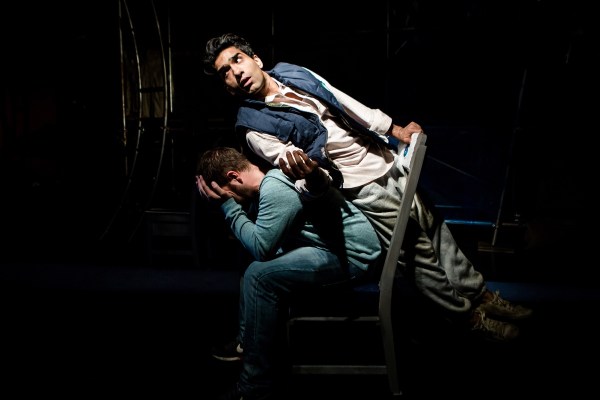
A scaffold plane, like a cross section of a whale’s rib cage, holds the plane’s passengers (legitimate and otherwise). This skeleton is also a coastal Indian village, Andy and Debbie’s middle class house, a cafe and B&Q’s car park. Hannah Barker and Lewis Hetherington’s writing and transitions quickly clear up any ambiguity, as does their clever use of angular metal chairs to create a range of sculptural forms acting as furniture and buildings and, well, chairs. The strong metallic lines have the shimmering permanence of skyscrapers the character’s lack – a canny metaphor that fits well with the script’s style and intent.
 
Barker and Hetherington thoroughly examine various sides of the refugee debate through their characters. Adi (Devesh Kishore) wants to see the world and send money home to his family. Andy (Steven Rae) and Debbie (Balvinder Sopal) have a comfortable Western life together, more concerned with their daughter’s progress at school and DIY than the rest of the world. Lisa (Hannah Donaldson) is a successful author who has all the good, liberal intentions of giving voice to the oppressed, but as a privileged white woman, she is limited in experience and access to the research and stories she seeks. The four are excellent microcosmic representations of a good portion of the world that’s more or less likeable, though the extremely conservative, ant-immigration sort are noticeably absent. Their exclusion makes the story more palatable, though a voice from this side could potentially serve to rally greater support to the inclusive left. With or without, the characters and their responses to Adi’s death are powerful political messages.
 
There are a few brief movement sequences that, though lovely in their Frantic Assembly-like fluidity, are so infrequent that they don’t contribute much other than breaking up the emotionally intense writing that is the best feature of this show. More would be welcome. Moments of detailed description devastate; only the hardest of hearts could resist Adi’s charm and poetry that grows from a daydreaming child to a motivated young man. Disconnected telly interview fragments on India’s upcoming Mars mission and the country’s aspirations to be taken seriously cleverly mirror Adi’s hopes for himself and his family, and also obviously question why a nation is launching a rocket when so many of it’s people are destitute – though this doesn’t just apply to India. 
 
Blatantly political, Stowaway uses its well-developed characters to loudly declare support for economic migrants. It’s an emotionally draining but important production, though it could use lengthening in order to make the storyline less dense and convoluted. The performances are good vehicles for the characters’ messages and the scripts’ positive emotional manipulation has potential to be a powerful catalyst for change if the play could be compulsory viewing for the Western populace.
 
Stowaway runs through 30 April.
 
The Play’s the Thing UK is committed to covering fringe and progressive theatre in London and beyond. It is run entirely voluntarily and needs regular support to ensure its survival. For more information and to help The Play’s the Thing UK provide coverage of the theatre that needs reviews the most, visit its patreon.
This Room, Battersea Arts Centre

https://i0.wp.com/40.media.tumblr.com/0de2b8a4c234adfa06d227487f497f1a/tumblr_nkr4q4aw501r8bp0ao8_1280.jpg

Laura Dean has Obsessive Compulsive Disorder. She’s afraid she’s going to kill herself in her sleep so spends at least two hours before bed checking her house for anything she could use to self-harm. Scarves and tights are hidden away, as are knives and other sharp objects. She can’t sleep without her checking routine and after months of exhaustion, she’s had enough. An NHS diagnosis comes with a round of Cognitive Behaviour Therapy sessions that help her recover, but introduce several ideas that make Dean question the nature of her self. This Room is a gently communal experience where Dean provides insight into the recovery process. There are plenty of clinical reports, forms and questionnaires but Dean’s individuality is never drowned out by these or by the condition she fights.

The audience is in Dean’s bedroom with her as she works through the most commonly held thoughts by people suffering from OCD. She confesses that she wants to know what’s going on inside her head so she can understand what’s really wrong with her, something she still hasn’t quantified after the pages of documented appointments she reads at lightening speed. The clinical nature of her recitations is a lovely juxtaposition to the soft, confession-like anecdotes from her treatment, most notably the session where her therapist (with the perfect bottom) visits her at home to confront her fears, represented by a serpentine tangle of tights, head on. The whole piece is intimate, quiet and deeply personal.

Dean has a soft strength that’s immensely watchable, whether she’s sitting silently on the edge of the stage clutching her water bottle, or reading her medical notes into a stand mic. The audience immediately sides with her, and dutifully responds to her questions. The empathy is tangible, and a group hug would not be out of place after the curtain call.

This Room avoids sentimentality or an overabundance of awareness-raising. Instead, it’s a personal account of a treatment process and an individual response to it. Will Dean ever really be well? If so, does that mean she’s not really herself anymore? These are big questions that don’t have an immediate answer, but are examined in a wonderful format that is a privilege to witness.

This Room runs through 27 April.

The Play’s the Thing UK is committed to covering fringe and progressive theatre in London and beyond. It is run entirely voluntarily and needs regular support to ensure its survival. For more information and to help The Play’s the Thing UK provide coverage of the theatre that needs reviews the most, visit its patreon.

Hamlet, Who’s There?, Park Theatre

Some people are so precious about Shakespeare. There’s historical merit in periodic restrained, original practice productions, and modern productions with superficial concepts add a degree of variation, but neither approach progresses contemporary Shakespeare performance practice. The first folio texts, those regarded closest to Shakespeare’s intentions, still may be quite distant from what may have come from the actors in the moment. Scholars can only speculate on performance style, staging and most other production elements due to a dearth of primary sources. Considering all of that, theatre makers should mess about with Shakespeare more. 

Kelly Hunter does that with her Hamlet, Who’s There? by reconfiguring the original timescale and characters to place her adaptation firmly in the present. As two frivolous, tacky families with more money than sense drunkenly celebrate a wedding, a disregarded son suffers a psychotic episode that triggers their collective downfall. Six actors focus the tragedy on the familial element, making this more of a kitchen sink drama than a grandiose spectacle. This is a Hamlet that’s easy to relate to but still be horrified by. The intimacy is well performed and powerful, and Hunter’s script, whilst dramatically different from the original, still contains its visceral, conflicted essence.

Mark Quartley is Hamlet, an angsty, tormented young man disgusted by his elders. He excellently embodies the grief that tips him into Schizophrenia, making him believe he is his dead father. This device carries him forward on a mad quest for revenge. Quartley’s Hamlet is a victim, not just of his surroundings but also his own mind. Kelley Hunter is his drunk mother Gertrude, sloppy and self-absorbed. She’s a great contrast to Quartley, and also to her manipulative new husband Claudius (Tom Mannion), who keeps her well-lubricated throughout the story. The second family is a hapless Polonius (Steven Beard) and two children. Laertes (Finlay Cormack) has been wonderfully reimagined as Hamlet’s best friend, using lines from Rosencrantz and Guildenstern. Their brief encounters are intimate and warming, alleviating Hamlet’s otherwise relentless agony. The language comes easily to the cast, managing to not jar with the modern story. 

Though the performances are excellent, the highlight of this production is Hunter’s script. Pared down, it’s more Eastenders than Stratford, and the use of identifiable mental health issues and familial conflict help move it away from Shakespeare’s fantastical ghosts and dated duels. Ophelia’s madness is logically clarified through wonderfully disturbing staging, with Hunter also directing. The gravedigger scene is still present, but somehow fits in with the concept. Though the end is rushed and heavily changed from the original, it cuts a striking image. 

Hamlet, Who’s There? As a title also suits Hamlet’s mental health struggles as he searches for himself and the father that takes over his mind. Hunter’s set is sparse, but symbolic items and copious amount of blood are visually dynamic. The venue’s lighting balcony and ladder up to it are also cleverly employed.

Flute Theatre and Kelly Hunter’s script bring Hamlet firmly into the present with Hamlet, Who’s There?. It’s firm proof that Shakespeare can be made even more relevant through radical reinterpretations and confident textual adaptations. There’s no need to slavishly follow Shakespeare’s original scripts all the time, but still respect the integrity of the language and story. This is a fantastic production at the forefront of contemporary Shakespeare practice.

Hamlet, Who’s There? Is touring the UK and Europe through the summer.

The Play’s the Thing UK is committed to covering fringe and progressive theatre in London and beyond. It is run entirely voluntarily and needs regular support to ensure its survival. For more information and to help The Play’s the Thing UK provide coverage of the theatre that needs reviews the most, visit its patreon.

Sket, Park Theatre

What sort of trouble would you have got into as a teenager if you were equipped with today’s technology? It’s a frightening thought. What with the teenage brain’s late-developing understanding of consequences and a world outside their own immediate gratification, it’s no wonder sexting is a thing. Insecure teenagers wanting to impress their crushes, an over-inflated sense of self and peer pressure brews a potentially deadly, life ruining combination in the presence of a smart phone. Maya Sondhi’s Sket is a snapshot of the perils of urban, working class teenaged life and the consequences of poverty, boredom and hormones constantly plugged into the Internet. A cast of seven depict a pretty spot-on representation of young people’s emotional lives, but Sondhi’s play seems to take a dim view of troubled teens and the adults that work with them. Painting her young people as a bunch of sex-crazed, badly behaved tearaways and their teacher as useless and boundary crossing is not only hugely generalised but a potentially harmful stereotype.

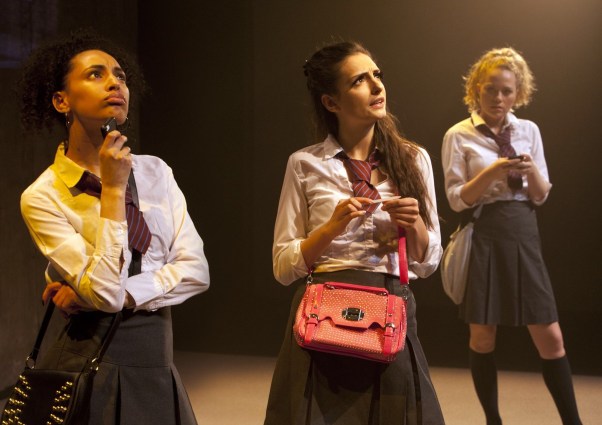
JC (Tom Ratcliffe) has a cousin who runs a porn site, and JC helps him out by manipulating his female school mates into sending him explicit photos and videos. Emily (Laura Gardiner), Daisy (Olivia Elsden) and Tamika (Tessie Orange-Turner) are friends who are just as bad as each other, but quick to judge and pair up against the odd one out of the three. JC’s backed up by the charmingly insecure Adam (Dave Parry) and Leo (Romario Simpson), who know what JC is doing is wrong, but aren’t confident enough to stand up for themselves. The six young actors are believable London estate kids most of the time, and have some nice moments of conflict and comraderie. There are a few accent slips into middle class Home Counties, but these are rare. It’s typical teenaged tribal warfare, but when the girls discover their photos and videos are online, they aren’t strong enough to maintain a tough facade. Their teacher Miss (Anna O’Grady) tries to get information out of them, but manages to be completely inappropriate most of the time and makes no mention of referring the girls to a higher power what with the information she does glean from them – a huge misrepresentation of teachers and support workers, who proactively combat the consequences of sexting.

A horrific end reinforces how brutal children can be towards each other, but it is needlessly bleak. A lack of resolution indicates that these kids will never escape the boys vs. girls revenge cycle and grow up into functional adults. Considering most kids are decent human beings trying to get through life regardless of their backgrounds, Sket paints them at their worst. A few moments of kinship and tears aren’t enough amongst the horror. Whilst sexting and revenge porn is certainly a problem, Sondhi doesn’t show any of the work that is done to fight it by schools, police and social services. The distrustful relationship between teenagers and their teachers is also hugely inaccurate. Individual scenes are well-written and the characters are otherwise believable, but the overall message the script communicates is frankly wrong.

That said, it’s a good production otherwise. Director Prav MJ keeps her staging simple in order to focus on the characters and their conflicts. Simple projections indicate location, and school uniforms reinforce the characters’ youth. There’s no set, but it isn’t particularly needed in a small venue. The script could certainly do with a wider range of material in order to diffuse the negativity and to add is some degree of resolution, but it wouldn’t take much to turn around the play’s attitude and make a really great story.

Sket runs until 14 May.

The Play’s the Thing UK is committed to covering fringe and progressive theatre in London and beyond. It is run entirely voluntarily and needs regular support to ensure its survival. For more information and to help The Play’s the Thing UK provide coverage of the theatre that needs reviews the most, visit its patreon.
Blue on Blue, Tristan Bates Theatre

There’s been a lot of attention on the lack of diversity in theatre lately. White, middle class, able-bodied males dominate theatre and the industry is finally beginning to see that it’s a problem. More diverse work is now creeping into the spotlight, as it should, but it’s usually labelled as “BAME theatre”, “working class theatre”, disabled theatre” or whatever the appropriate qualifier happens to be. That’s all fine in the short term, but if theatre wants to make true progress in diversity, it needs to move away from these labels and have a diverse cast in plays of all genres, time periods and topics. Theatre needs to aspire to be just “theatre” that is blindly inclusive of race, gender, dis/ability.

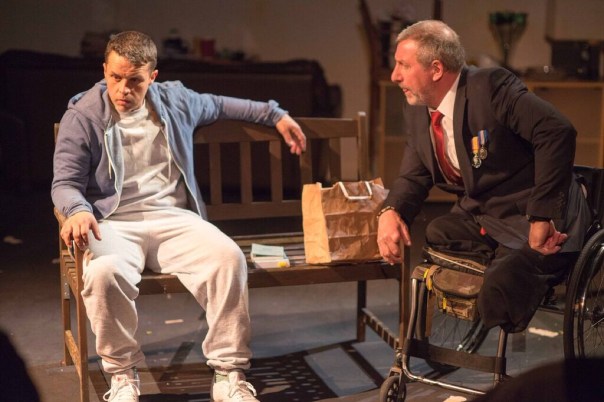
Chips Hardy’s Blue on Blue does just that. The play is fundamentally about mental health in a domestic drama setting, but happens to have a character who’s a double amputee and wheelchair user. It’s not about Moss’ disability, but his relationship with his nephew Carver, who is struggling to build a normal life as a self harmer with OCD. This little, well-made play with great performances is the sort of theatre that truly works towards championing diversity.

Daniel Gentely as Carver is a tormented 30-something trying to put his life back together after falling on hard times. He’s got a job at a garden centre and some carer responsibilities for his uncle whom he lives with, Ronnie Moss (Darren Swift), and things are on the up. But he can’t cope when the world flits beyond his control, even though he desperately tries to engage in “normal” activities, like going out with his mates or fucking Moss’ carer Marta (Ida Bonnast) in Moss’ wheelchair in the middle of the night. His defensive banter and tough guy exterior with Moss eventually give way to a rewardingly vulnerable core. This transition is lovely and shows both Gentely’s range as a performer and validates male emotional need. Swift’s similarly hardened outside, which categorises people into one of the “five kinds of cunts in the world” and wants to be left alone by his overbearing nephew, abruptly gives way to genuine care and warmth. Bonnast also has the opportunity to show some great emotional contrast as the Hungarian care worker studying accountancy who genuinely wants the best for everyone, and the three display a wonderfully consistent chemistry in the hardest and easiest of moments. 

Hardy’s script follows a conventional, linear structure which works well for following his characters’ journeys. It’s a character-driven story that, though just over an hour, has three scenes that are essentially miniature acts. Though the narrative arc is fairly smooth, it’s steep and could adapt well to lengthening. It harks back to Miller, Williams, and the like but doesn’t feel old-fashioned in the least. It’s a current play, with modern issues, families and their messed up baggage. The two scene changes are needlessly long, but other than this, faults are few.

Blue on Blue, though conventional in style still feels progressive with its inclusivity. Hardy’s intuitive dialogue and similar ability from the cast make this a strong play deserving of a solid future.

Blue on Blue runs through 14 May.

The Play’s the Thing UK is committed to covering fringe and progressive theatre in London and beyond. It is run entirely voluntarily and needs regular support to ensure its survival. For more information and to help The Play’s the Thing UK provide coverage of the theatre that needs reviews the most, visit its patreon.
Your Ever Loving, TheatreN16

In 1975, Paul Hill was convicted for bombing two English pubs, along with three other people. Coerced into confessing by the police, the twenty-one year old from Belfast later retracted his confession but was found guilty and imprisoned with the others as IRA supporters. It wasn’t until 1989, long after his attempt to appeal had been denied, that investigators discovered police officers linked to the original case had altered evidence. The “Guildford Four” were released immediately, after 14 years inside. 

Your Ever Loving chronicles Hill’s conviction, imprisonment and eventual release through the letters he wrote to his family over the years. One actor plays Hill, another plays numerous figures Hill encounters along the way. Martin McNamara’s frantic script cuts across years and locations, often leaving the audience in its dust and struggling to keep up. The cast of two display huge emotional investment in the characters, but the script’s pace, though stylistically distinct, is wanting in depth and focus.

Stevan McCusker is Paul Hill, who cuts a gentle young father and doting son as well as a prison-hardened thug who takes nothing from no one. McCusker’s quiet strength and fierce determination are charming immensely watchable. James Elmes is the often violent rest of the world, from fellow prisoners, to judges, to police and guards. Elmes provokes McCusker in dozens of short-lived fights, a clever manifestation of Hill’s lengthy battle to clear his name.

McNamara tries to fit a decade and then some into one act, but in doing so, he glosses over episodes that deserve more attention. Hill’s release is anti-climactic and rushed; the initial montage of moments (too short to be called scenes) is so fast that it confuses. Highlights of the fifteen years merge into one after awhile, creating a continuously evolving pilot point rather than separate ones. The structure constantly destabilises, along with the often maniacal caricatures painted by Elmes, but prevents any deeper exploration of Hill’s day-to-day life inside and after he’s realised. 

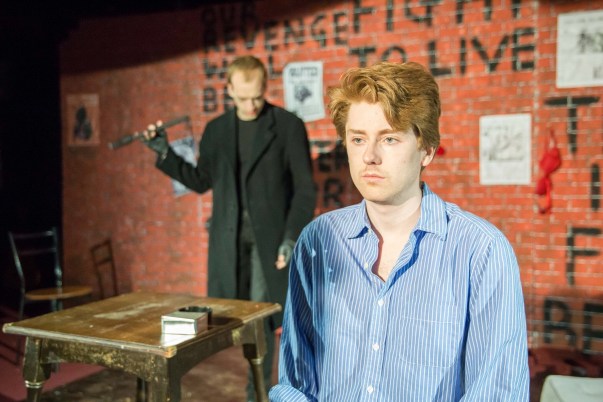
Despite the script’s shortcomings, directors Jamie Alexander Eastlake and Sarah Chapleo do a commendable job at keeping energy high and recreating the sensory barrage of life at the hands of abusive wardens. A simple red brick wall set with political graffiti and notices is an ever-present reminder of the social and political upheaval during the height of IRA activity, and the inflexibility with which suspects were treated by the UK government – a wise design choice on the part of the two directors.

Your Ever Loving isn’t a great script, but it manages to hit some important historical socio-political points. Eastlake and Chapleo do their best, along with the two performers, but McNamara’s play is an ultimately unsatisfying gloss over a vital period of recent history and the government’s treatment of people wrongly accused in times of trouble.

Your Ever Loving runs through 5 May.

The Play’s the Thing UK is committed to covering fringe and progressive theatre in London and beyond. It is run entirely voluntarily and needs regular support to ensure its survival. For more information and to help The Play’s the Thing UK provide coverage of the theatre that needs reviews the most, visit its patreon.
The Tempest, Steiner House Theatre

Shakespeare 400 has understandably inspired a glut of Shakespeare productions this month. Whilst it’s brilliant to see people celebrating the Bard at all performance levels and abilities, the quality of productions out there hugely varies. The Steiner House’s Shakespeare Festival production of The Tempest, with it’s Asian-inspired music and costume, cuts a lovely aesthetic but the majority of performances are painfully sub-par. At nearly three hours long with the interval, it’s also entirely too long, made so by some of the cast’s laconic pace, slow transitions and no noticeable cutting. Though commendably diverse in race and nationality and lovely to look at, the performances make this production more like a dull, drizzly day than an otherworldly storm. 

Hedi Pinkerfield’s music is subtle and atmospheric, with more personality than most of the characters portrayed on stage. It never overpowers, and provides a dynamic, nearly-constant soundtrack for the story. Indian and Japanese influences don’t try to be edgy or interesting, but appropriately populate this island that’s full of more noises than people. It’s lovely and soothing, and helps alleviate the tedium of the poor delivery on stage.

Emma Caller’s costumes are similarly rich, drawing on Indian influences of rich coloured tunics and flowing dresses. The set incorporates the same “slightly brighter than pastel but not garish” colour scheme. It’s as soothing as the music, with a giant full moon watching the action on a gauzy backdrop. Initially seeming solid, Prospero hides behind it, illuminated, at one moment. It’s a great choice, but one sadly avoided in the numerous other instances where he invisibly observes other characters.

Of the sixteen-strong cast, a few are quite good. Alexander Yousri and Machael Claff are energetic double-act Trinculo and Stephano, as are Robert Land (Sebastian) and Eshy Moyo (Antonio). Samuel Mattioli is a sweetly wistful Ferdinand, but let down by a Miranda who doesn’t articulate her consonants, making her difficult to understand. Director Geoff Norris casts three Ariels for indecipherable reasons; Bowy Goudkamp is the strongest, resisting the instinct to constantly writhe around or pull constipated faces at the audience.

The rest struggle with maintaining Shakespeare’s rhythm and variation of tone at the same time, some chew the words rather than easily speak them. Still others mumble or don’t articulate consonants, creating a white noise rather than a comprehensive story. There’s a general lack or pace and genuine characters, making this a highly frustrating experience. Director Geoff Norris seems to lack experience directing inexperienced performers and handling Shakespeare’s text, particularly this more linguistically complex final play.

Norris’ misguided casting and lack of structural instinct are the primary shortcomings in Perform International’s The Tempest. Fortunately his choice of composer and designer provides some relief, but not enough to alleviate this particular island’s drudgery.

The Tempest runs through 30th April.

The Play’s the Thing UK is committed to covering fringe and progressive theatre in London and beyond. It is run entirely voluntarily and needs regular support to ensure its survival. For more information and to help The Play’s the Thing UK provide coverage of the theatre that needs reviews the most, visit its patreon.

My Mother Said I Never Should, St. James Theatre

Doris, Margaret, Jackie and Rosie are four generations of the same family. They often fight, but they’re always there for each other. Though they each grew up in a distinct era and often misunderstand the others’ world views, there’s a lot of love in the baggage they carry. These women that playwright Charlotte Keatley created are passionate, feisty and reflect society’s views of women from the 1930s through the 1980s. Though there’s been inevitable progress in women’s rights, Keatley’s script shows how agonisingly slow it’s been. Excellent performances by the ensemble cast of four and a decade-spanning politically commentary make My Mother Said I Never Should a relevant, fun and poignant production that, even though written in the 1980s, still holds important messages about womanhood.

Doris (Maureen Lipman) is the formidable matriarch of the family who always says exactly what she thinks and has little patience for frivolity. Lipman’s dry comedy is impeccably timed with delightful results. Her uptight daughter Margaret (Caroline Faber) is a great foil, ferociously protective of her punky, energetic granddaughter Rosie (Serena Manteghi), who she’s raising as her own so her scatty daughter Jackie (Katie Brayben) doesn’t have to give up her gallery-owning dreams. As time passes and each woman navigates love and heartbreak, we see a wonderful array of strength, vulnerability and commitment from the cast to these women. This tight knit family are wholly believable as they power through the trials and tribulations of growing up as the second sex.

Keatley’s script, though structurally groundbreaking at the time it was written, has less shock value now but the non-linear, disconnected scenes of female children playing have as much of an impact as the realistic family’s story. Girls playing at casting “spells” to kill their mummies and regarding motherhood as an inevitable part of life is still powerful social commentary today. Though these scenes decrease in frequency as the family’s story takes shape, they are more directly powerful and disturbing. That’s not to say the majority of the script isn’t good – it’s great, with well-defined characters and clear linguistic distinction between the four.

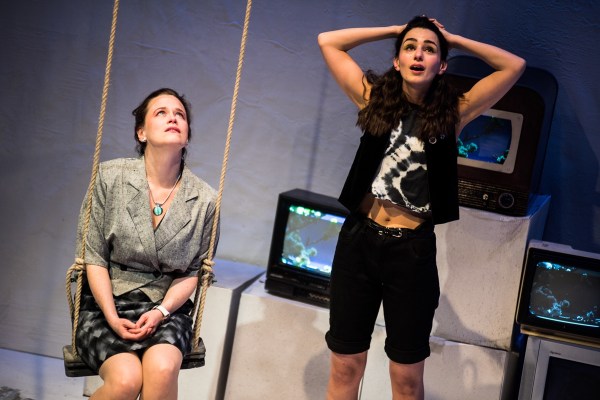
Signe Beckmann’s wintry set of white, blues and greys is a cold but striking backdrop to the story. Old fashioned TV sets display dates and locations as well as historical footage to create a greater context around the play’s microcosm. It’s rather clinical, but doesn’t distract from the action. It gives director Paul Robinson plenty of freedom to use the space as he sees fit and effortlessly transition between Keatley’s eras.

This powerfully moving play showcases stellar performances and writing that’s surprising relevant today. It’s a potent reminder that whilst there has been progress in women’s rights over the past 80 years, there is still so much to do about how society views women, and how women view themselves and their relationships.

My Mother Said I Never Should runs through 21 May.

The Play’s the Thing UK is committed to covering fringe and progressive theatre in London and beyond. It is run entirely voluntarily and needs regular support to ensure its survival. For more information and to help The Play’s the Thing UK provide coverage of the theatre that needs reviews the most, visit its patreon.