
Testament, VAULT Festival

testement-22february17-0573

by guest critic Michael Davis

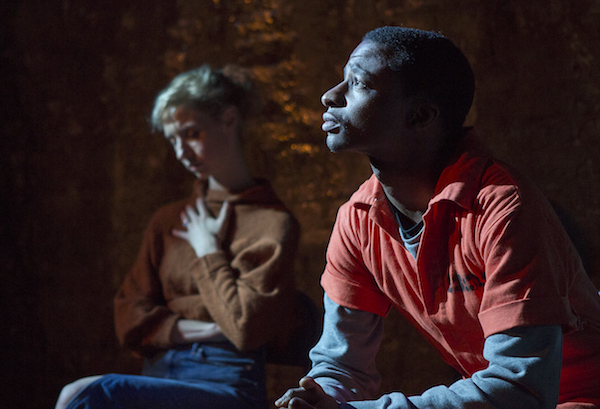
The idea of retelling biblical stories is nothing new. During the infancy of European theatre, the Mystery plays were popular for showing highlights of the Bible. Much later, during the 17th century, John Milton’s epic poem Paradise Lost would – contrary to author’s intentions – spur an interest in the anti-hero and biblical stories from a revisionist perspective. People over the centuries have questioned aspects of the Bible that they’ve found problematic for various reasons. Directed by Lucy Jane Atkinson, Tristan Bernays’ Testament not only addresses some of the problematic passages, but also give a voice to minor characters in the Bible.

Continue reading

On the Crest of a Wave, VAULT Festival

https://c1.staticflickr.com/7/6151/6256944614_f60d68027b_b.jpg

Camilla Whitehill’s grandmother died when her dad was 10 years old. He never talked much about her, but Camilla is fascinated by this woman she never met. Inspired by familial memory and grief, Whitehill and five other theatre makers draw on their own histories to create a playful homage to the endurance of family stories. It’s a joyful experience with a retro seaside aesthetic and a big heart, though lacking in polish and a consistent throughline.

Continue reading

Save + Quit, VAULT Festival

http://res.cloudinary.com/jpress/image/fetch/w_620,f_auto,ar_3:2,c_fill/http://www.scotsman.com/webimage/1.4213540.1472207418!/image/image.jpg

Joe and Steph are two lonely Londoners, and Cara and Dylan are dealing with grief in Dublin. The four young people, in two pairs of intertwined stories, disclose their anxieties and struggles in narrative monologues that are strong examples of moving storytelling. But they are only loosely linked thematically, and there is little that conveys a wider reason for placing these characters within the same work. The stories command attention as do the performances, but the question of why they are presented together never disappears.

Continue reading

The HIV Monologues, Ace Hotel

https://cdn.thestage.co.uk/wp-content/uploads/2017/02/07125605/The-HIV-Monologues-c-Eliza-Goroya-1-700x455.jpg

By guest critic Jo Trainor

Diagnosis, dread, death, devotion, Patrick Cash has written five interlocking, thoughtful monologues that explore HIV from the most human perspective.

Alex isn’t wearing his power bottom singlet, but his James Dean swagger and Nick’s beautiful eyes are the making of a dream Tinder date. Until Nick reveals he’s HIV positive. Alex legs it, but his audition for Barney the next day forces him to re-evaluate his behaviour.

Continue reading

A Year From Now, VAULT Festival

https://newimages.bwwstatic.com/upload11/1522200/tn-500_redbellyblack'sayearfromnow-courtesyofvickibaron_3.jpg

by guest critic Jo Trainor

“Two or three people with guitars call themselves a band, they’re a group!”

Red Belly Black Theatre Company asked fourteen people where they think they’ll be a year from now, and have used their voices to create an hour of witty, beautiful and moving theatre.

Lip-synced verbatim is a new experience for this reviewer, and if you’re not used to it there is a brief moment where you need to get on board with the style. Luckily Red Belly Black are so precise with their movements and mannerisms that it’s impossible not to love A Year From Now.

Continue reading

Familie Flӧz, Peacock Theatre

https://i0.wp.com/www.festivalcomic.cat/2015/style/images/hotel_paradiso.jpg
by guest reviewer Rebecca Nice

German physical theatre company Teatro Delusio perform a silent comedy accompanied by an array of canonical scores from ballet to opera to a bit of pop. The international show that crosses language barriers through visual tableaus and expressive physicality of character is formed by a series of vignettes starring stock characters. Three performers play stage technicians and alternate to appear as stereotypical theatricals who they encounter backstage. There’s the one who always wants to sit and eat, the one who doesn’t want to be there and the one who’s always flexing his muscles can always be found in a technical team and this trio run the show, set entirely backstage, with haphazard efficiency and human agenda.

Continue reading

Father Comes Home From the Wars (Parts 1, 2 & 3), Royal Court

https://i0.wp.com/www.officiallondontheatre.co.uk/servlet/file/store5/item374788/version1/fileservice770/374788_770_preview.jpg

American, Pulitzer Prize-winning playwright Suzan-Lori Parks doesn’t shy away from epic projects. Six years ago, she wrote a play a day to create 365 Days/365 Plays, then went on to write the nine-part Father Comes Home From the Wars. Parts one, two and three centre around Hero, a strapping young slave on a remote Texan farm. Spanning the Civil War, this epic story with influence from Greek myths and contemporary socio-political issues in Parks’ distinctive, poetic language takes its time to develop and has some discordant stylistic choices, but its narrative and historical interpretation is both compelling and important.

Each of the three parts has moments of profound brilliance and devastation, but Parks is in no rush to tell her story. The dialogue-driven script takes its time, meandering around a complex landscape of slavery, loyalty and race within this particular slave family. Though set in war time, there is little action – broader issues drive the conversation more so than current events. This is more of a kitchen sink drama than a wartime adventure story.

Part one solely takes place on the farm as Hero debates whether or not join his master in battle. The rest of the slaves take bets and try to persuade him one way or the other, but in the back of Hero’s mind is a promise from the Boss-Master – but is he likely to keep his end of the deal? Hero’s loyalty is split between his owner and his wife Penny, but the lure of the cast-off but smart uniform proves too much. Though little happens, the domesticity of part one has some of the tension that precedes a huge decision. Seeing a tall, strapping black man in the prime of his life wearing Confederate greys is most unsettling; this paired with the ingrained, accepted attitude that he is the property of his owner is a potent reminder that there has been insufficient progress in America’s attempts at racial equality.

Part two, though set at a particular moment in the midst of the war, has the calm of an eye of a storm and is by far the best of the three parts. Hero and Boss-Master have captured a Yankee prisoner whilst separated from their regiment during a battle. Hero’s loyalty is tested again, this time by his prisoner upon discovery of a secret that’s hidden in plain sight and only skin deep. Racial identity, individuality and freedom intertwine in an intoxicating allure of potential for Hero, who is still doggedly loyal to his owner. The powerful ending devastates in its frank depiction of ingrained attitudes of racial inferiority and liberal frustration with this mentality.

Part three is the more mature sibling to part one. The characters are older, wiser and more world weary in the face of Southern defeat. The pre-war certainty has given way to a chance at the great unknown of freedom, and for the first time they can choose where they live – anywhere in the great, wide world, or on the farm they have known forever. Penny and Hero’s devotion is destabilised in this irrevocably changed world that is now free, but cold and dangerous – and still is for black Americans today. The morality of freedom isn’t black or white here, but the ominous, thought-provoking grey of Hero’s, (now called Ulysses) uniform.

Neil Patel’s unforgiving desert of a set doesn’t have bells and whistles, but it’s sparsity highlights the richness of Park’s language and characterisation. Steve Toussaint is the remarkable Hero, painted with delicate light and shade. The rest of the cast are excellent in their own right, though lack the development of the initially appropriately-named lead.

Parks’ script is almost completely bedded in realism (that’s occasionally heightened), though a talking pet and some contemporary costumes slightly skew reality. Both are used sparingly and without any evident justification across the three parts so their inclusion feels jarring and unnecessary. The onstage musician, though very much a separate commentator, doesn’t clash the way these choices do.

For a play set during a war and a pivotal moment of America’s history, it is oddly detached from violence and conflict. Instead, Parks’ text goes after deeper themes within this transition from slavery to freedom. Though a greater sense of danger and looming dread would add needed further tension in parts one and two, the nuance that flows through the story is undeniably exquisite.

Father Comes Home From the Wars (Parts 1, 2 & 3) run through 22 October.

The Play’s the Thing UK is committed to covering fringe and progressive theatre in London and beyond. It is run entirely voluntarily and needs regular support to ensure its survival. For more information and to help The Play’s the Thing UK provide coverage of the theatre that needs reviews the most, visit its patreon.

Interview: Isley Lynn on Skin a Cat

rsz_skin-a-cat-main-image-digital

The upcoming opening of new venue The Bunker has certainly generated plenty of buzz, but what has excited me most about their debut season is that Rive Productions is bringing back Isley Lynn’s Skin a Cat for a three-week run. Hugely deserving winner of Vault Festival’s Pick of the Year, Skin a Cat is the coming-of-age story of Alana, a young woman who, like most young people, just wants to lose her virginity – but there’s something in the way. I spoke with writer Isley Lynn about the importance of Alana’s story, why stories like hers need to be told and how Lynn is working for more diversity in British theatre.

TPTTUK: Why does Alana’s story need telling?

IL: I’ve always been most interested in telling stories I haven’t heard before. I get so bored and frustrated when I see a show that’s beautifully produced/designed/directed/written/performed but tells me nothing I didn’t already know, or shows me nothing I haven’t seen so many times over. The bar really is so low for new stories – stories about differently abled people, women-centred stories, unconventional stories of anyone non-white, I could go on. Stories that give us new perspective are so important and exciting that I want to spend my time telling them. And the stories about sex – especially first sex – never matched up with my own experiences, so I figured I should tell mine. It really was as simple as that, but that’s also why it’s important.

TPTTUK: You use several dramatic forms and styles in Skin a Cat. Tell me a bit about these choices and the reasons behind them.

IL: To be honest, the play was so easy to write that it came out without too much thought. The stylistic qualities were organic to the material – and I had plenty of lived material to work with! I felt the direct address was important because it allows Alana to be honest and open with the audience in a way she isn’t able to be with the characters onstage with her. In a play about the pressures of how others see you and what effort it is to please, it felt crucial to keep this [play focused on] her story, her testimony, her voice.

So much of the action happens mid-coitus, and I had no idea how to put sex on stage. All credit to our wickedly brilliant director Blythe Stewart for its staging (this was definitely the most fun I’ve ever had in rehearsals, and I’m still impressed with how she managed to create a representational, physical language without resorting to silly hip thrusts).

TPTTUK: What would you like audiences to take away from Skin a Cat?

IL: We only had six performances at the Vault Festival, but after every one I had someone approach me and share their own embarrassing story, or their own experience of sexual shame or difference. That’s exactly the reaction I hope for at the Bunker – I want people to be able to see themselves in Alana’s story, and feel emboldened to talk about their experiences with strangers and friends and loved ones, because that’s the only way we can start to realise how we all “fall short” of the expectations placed on us – and not just with sex, but in so many other areas of our lives – and how unimportant and unhealthy those expectations can be.

TPTTUK: What are the biggest issues in the theatre industry today? Is your work combating them?

IL: I hope I am – I’m trying to. So many of the issues in our industry have their roots in the lack of representation. I’ve already talked about how important it is to have a diversity of stories and that’s a big part of it, but the responsibility for that is at the feet of everyone, not just writers – It’s important to create opportunities for underrepresented people on the stage, but it’s worthless if those individuals are not in a position to take opportunities available to them because they can’t afford to work for low or no pay, for example, or if they couldn’t afford the outrageous drama school audition [fee] in the first place. I have no idea how to fix that with unpaid work being the foundation for any career (certainly mine) and so much the norm.

Often, only people with strong financial support behind them can take full advantage of what’s out there. There are great one-off schemes, and great venues doing their part (like the Hope Theatre with their Equity house agreement on pay), but until the entire industry is a viable career option [for anyone], we won’t have a community that reflects the world we live in, and that’s the primary job of the arts.

TPTTUK: Isley Lynn fans are dying to know: what’s coming up next?

IL: I’ve been working with one of my absolute favourite actors on a one woman show that, if all goes well, should have a life at the 2017 Edinburgh Fringe and hopefully beyond. It’s about a English-Egyptian woman who takes up pole dancing when her husband leaves her for the revolution in Cairo. It’s going to be a unique perspective on the battle over women’s bodies and what that means when you have to navigate two very different worlds, when you’re not fully on one side or the other.

Skin a Cat runs 12 October – 5 November.

The Play’s the Thing UK is committed to covering fringe and progressive theatre in London and beyond. It is run entirely voluntarily and needs regular support to ensure its survival. For more information and to help The Play’s the Thing UK provide coverage of the theatre that needs reviews the most, visit its patreon.

Team Viking, Edinburgh Festival Fringe

https://i0.wp.com/www.pxleyes.com/images/contests/old-camera/fullsize/Viking-Funeral-4ca7e68bcb25e_hires.jpg

How far would you go for your best mate? Are there any limits, any lines, you wouldn’t cross?

What if your best friend was dying?

What if he asked you to ensure he had a viking funeral?

James Rowland does exactly that for his best friend Tom. He grew up as part of a neighbourhood trio that stayed close well into adulthood. As children, their favourite game was to play Vikings (as in the Kirk Douglas film). When Tom is diagnosed with terminal cancer at age 25 and given only a short time to live, he calls in one final favour from James and Sarah, the other third of their childhood gang. Tom doesn’t care about logistics and legalities, and his magnetic charisma convinces Sarah and James to do this for him, and James is here to tell us the story of their friendship through life and death.

Rowland’s engaging, laddish charm makes you laugh loads, then the tiniest change in pace and inflection turns on the tears. His script approaches death and friendship with respectful levity that does not gloss over the reality of grief, but neither is it too weighty. It’s a perfectly balanced emotional journey, and Rowland’s relaxed delivery draws the audience to him and to each other.

Director Daniel Goldman chooses simple staging – Rowland is on a small, bare stage with few props and tech, and the venue’s lighting is barely existent. The piece would work well in the round to foster it’s warmth and inclusivity. It’s simple, storytelling structure would also suit the intimacy of a circle.

Team Viking is an exemplary solo storytelling piece excelling in its honesty and simplicity. It’s a powerful tribute to his friends, but it’s not insular – it’s the complete opposite, and a truly delightful, heartwarming adventure story for those who have loved and lost.

The Play’s the Thing UK is committed to covering fringe and progressive theatre in London and beyond. It is run entirely voluntarily and needs regular support to ensure its survival. For more information and to help The Play’s the Thing UK provide coverage of the theatre that needs reviews the most, visit its patreon.

Skin of the Teeth, Edinburgh Festival Fringe

https://www.thestage.co.uk/wp-content/uploads/2016/08/Skin-of-the-teeth-700x455.jpg

Nick is fearless. Literally, he can’t feel fear. The young man’s father finds this most unsettling and whilst Nick thinks it’s kinda cool, he desperately wants to find his shudder so he can fit in with everyone else in his small coastal town. When a mysterious stranger appears on the beach and offers to help, Nick jumps at the chance. This modern myth by Anna Beecher is a vibrant, young hero’s journey through a dark underworld of a solo performance with good potential.

Daniel Holme tells Nick’s story with sweet, wide-eyed naiveté, making the people he encounters in the big city after his father sends him away all the more threatening. The gang of men with green gloves who claim they will help him find his shudder through increasingly extreme tasks builds suspense and danger to a climax in Beecher’s script that Nick only vaguely understands. An open ending and some unanswered questions are a bit of a letdown, but otherwise her script is a good piece of storytelling.

Holme’s performance does a good job at keeping the audience’s attention, though more dramatic lighting design, projections and/or props would add visual variation and further increase the ebb and flow of his adventure. Beecher’s language contains some gorgeous moments of imagery and dystopia that certainly deserve to be supported further through a strong design concept and a larger space that grants more freedom of movement to Holme.

Skin of the Teeth is a strong character monologue that can work well on its own, but also has scope to develop further into an action-driven, multiple character script. The story is a good concept though in its current incarnation in a small venue, it is limited in its power. Beecher is a promising writer with dynamic ideas who, with more resources, has the power to make even greater impact.

The Play’s the Thing UK is committed to covering fringe and progressive theatre in London and beyond. It is run entirely voluntarily and needs regular support to ensure its survival. For more information and to help The Play’s the Thing UK provide coverage of the theatre that needs reviews the most, visit its patreon.