Macbeth: without words, Edinburgh Festival Fringe

https://i0.wp.com/edinburghfestivalguide.co.uk/wp-content/uploads/2015/11/Macbeth-Without-Words-Ludens-Ensemble-Photo-by-Chrysa-Karagianni.jpg

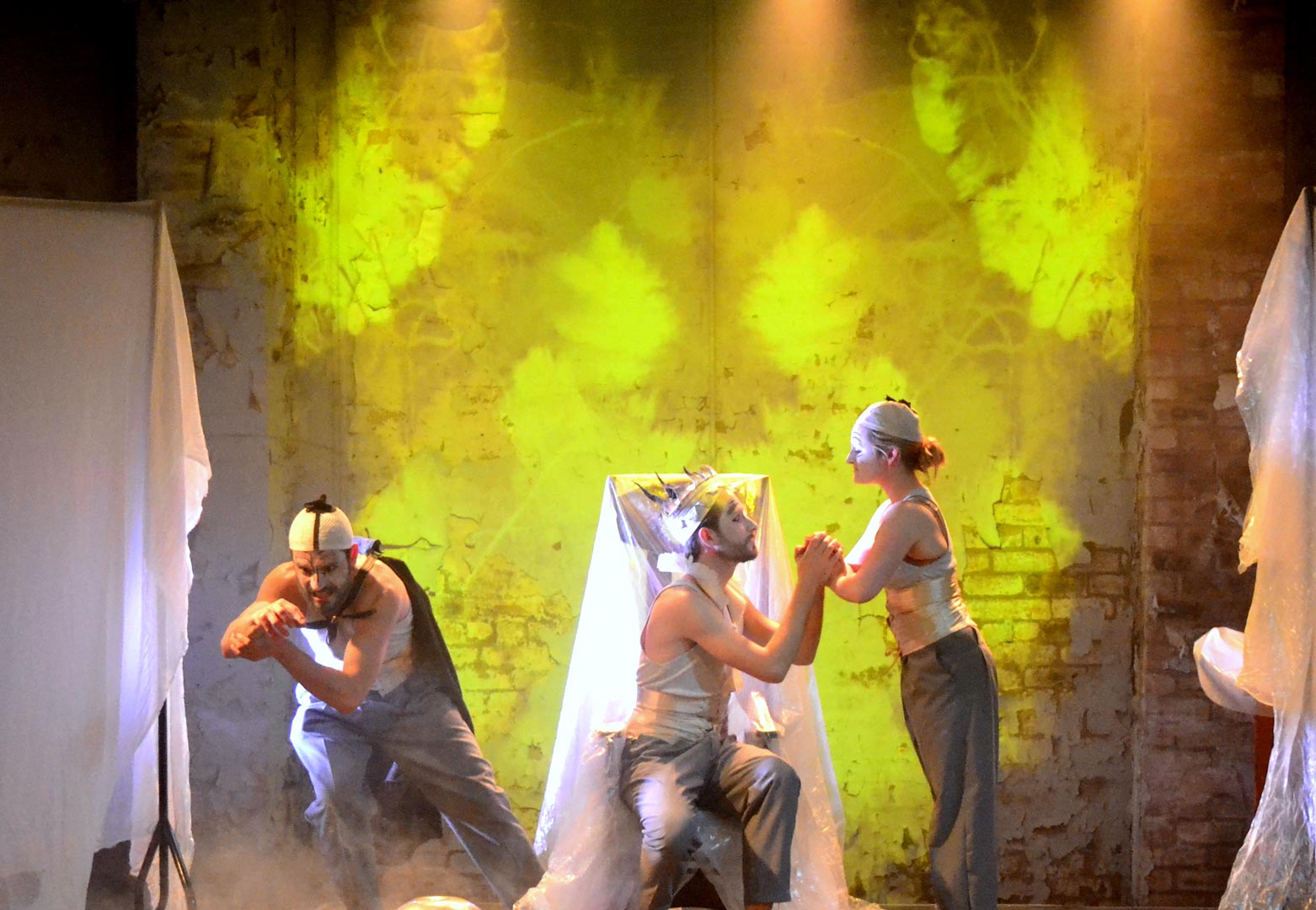
Shakespeare without words. What’s left? In Ludens Ensemble’s Macbeth: without words, plenty. Drawing on the aesthetic of silent films and Victorian gothic with the near-constant use of live sound mixing, a trio of performers playing all roles conveys the story effectively through movement and subtitles. This spooky adaption taps into the heavy darkness and supernatural elements of the story in an easy to follow and visually compelling production.

The design is the most striking element of the show. Greyscale, sexless costumes are the base for elements of victoriana – waspies, a skeletal skirt, capes and papery crowns. Large screens and dust sheets host an array of productions, from silent movie captions to abstract splodges of colour. Haze is used liberally, but it actually feels appropriate to this production to create fog over the heath. The dust sheets are also cleverly used to create ghostly apparitions and shadows, though these could be used more often as a design motif. Two microphones and prerecorded sounds are mixed live to create rich soundscape of suspense and violence, though silence is used to highlight powerful moments of suspense.

The two men and one women are strong physical performers evidently influenced by theatrical clowning and animal work. Their focus and intensity are unwavering, especially as Macbeth’s torment grows. Expressed outwardly, this becomes the centre of the story.

Though there are a few extracts of text, stage directions and summaries projected, Macbeth: without words would be hard to follow without knowing the story already. A freesheet with a plot summary would go a long way to ensure all audience members are catered for. Some of the scenes could use lengthening to reflect their importance to the story, particularly the banquet scene.

This is a visually stunning adaptation of Shakespeare’s play that in no way underserves the original by stripping away the text. Ludens Ensemble create a vocabulary of movement, images and sound that feels just as rich as Shakespeare’s.

Macbeth: without words runs through 29th August.

The Play’s the Thing UK is committed to covering fringe and progressive theatre in London and beyond. It is run entirely voluntarily and needs regular support to ensure its survival. For more information and to help The Play’s the Thing UK provide coverage of the theatre that needs reviews the most, visit its patreon.

Fire Burn: The Tragedy of Macbeth, Edinburgh Festival Fringe

https://i0.wp.com/cdn3.historyextra.com/sites/default/files/imagecache/623px_wide/Macbeth%202.jpg

It must be rather dull hanging out on a Scottish Heath with your sisters, waiting for some poor soul to come along to manipulate to the point of ruin. Fire Burn: The Tragedy of Macbeth tries to show the three witches re-enacting the tragedy they catalysed, or perhaps they act it out for the first time and the story Shakespeare depicts is all in their imagination. In either case, the concept of their playacting isn’t clear through their intentions or performance styles.

The three women who play all of the parts are good enough performers, differentiating characters well and endowing the text with energy and purpose. The Macbeth is occasionally a touch flat, but the young trio otherwise make good sense of the story. The witches’ spidery, angular movement and distorted voices contrasts the naturalism of the rest of the characters, and the application and removal of face paint also indicates character changes. This good choice plays up the ritual of the ancient story and adds a dressing-up element to the witches acting out the story.

If the witches are indeed portraying the characters, it is doubtful they would have the interest or ability to employ a contemporary conventional performance style. There is no hint of the witches’ personality or character when taking on the others, and there are no off-text moments to remind the audience that this is the concept. There should be a ruthless brutality and also a sense of play coming through to some extent, either in outbursts or as an undertone to the other roles.

Though not a bad production per se, the intended concept doesn’t read at all. As the show gets underway, there is little to indicate that this is anything more than a three-person version of the play. A three-person Macbeth, whilst a fine incarnation, is less inventive and insightful than the witches’ views on the people’s lives that they toy with.

Fire Burn: The Tragedy of Macbeth runs through 27th August.

The Play’s the Thing UK is committed to covering fringe and progressive theatre in London and beyond. It is run entirely voluntarily and needs regular support to ensure its survival. For more information and to help The Play’s the Thing UK provide coverage of the theatre that needs reviews the most, visit its patreon.
Hamlet in Bed, Edinburgh Festival Fringe

https://i0.wp.com/www.rattlestick.org/wp-content/uploads/2015/09/hib-2.jpg

Michael, a typical New York City lost soul, is obsessed with Hamlet. He knows the play inside out and pours over every bit of scholarship he can find on it. His neighbourhood secondhand bookseller puts anything aside that he might be interested in and this time, he’s struck gold. A diary from forgotten ex-actor Anna May Miller details her rehearsals for Hamlet, a failed relationship and a child she put up for adoption on the day Michael was born. The orphaned man, desperate for a mother and to enact his perfect version of Hamlet, creates an elaborate scheme to cover both bases in Hamlet in Bed.

What is more of a treatise on Shakespeare’s play than a journey of personal discovery is also a creepy, misogynistic story of stalking and entitlement. The two interweaving storylines are given equal measure by writer Michael Laurence, resulting in neither reaching full potential, though Annette O’Toole gives an electric performance as Anna May.

The imagery-laden beginning of the script is a feast for the ears. Though the start makes for a great aural experience, the best scene is an extended rehearsal for Michael’s Hamlet where a debate on the characters’ intentions becomes a thinly veiled filter for their own issues and insecurities. Also, the scholarship on display in this scene is in-depth and spot-on. An anti-climactic end is a lost opportunity for Anna May to condemn his self-centred exploitation of her weaknesses, which creates an uneasy feeling that his actions are deemed acceptable. There are also entirely too many coincidences to make the story believable, and a few occasions where choices aren’t fully explained or justified.

Though the story revolves around Michael, played by Laurence, O’Toole’s performance completely dominates his. It’s not at all to do with any shortcomings on his part, but a total mastery of craft on hers. The privilege of seeing a stage and screen legend in an intimate venue at least partially alleviates the problems in the script.

With questionable themes and a script that can’t decide what it wants to be about, Hamlet in Bed has several glaring flaws that a re-write would be able to solve. Despite these, O’Toole’s performance is fantastic, and great to watch.

Hamlet in Bed runs through 29th August.

The Play’s the Thing UK is committed to covering fringe and progressive theatre in London and beyond. It is run entirely voluntarily and needs regular support to ensure its survival. For more information and to help The Play’s the Thing UK provide coverage of the theatre that needs reviews the most, visit its patreon.

Hamlet, Ophelia – Part One, Edinburgh Festival Fringe

rsz_121

What would Hamlet have been like as a child? Ophelia? Were they close? Did they squabble or were they the best of friends? Shakespearian Lovers, a new female-led company from Italy, attempt to answer these questions in Hamlet, Ophelia – Part One. In this version Hamlet is played by a woman, bringing a quiet, feminine sensitivity to the role considered one of Shakespeare’s greatest. Despite performing in their second language, the two women have a sound connection with the contemporary English text that shows the two grow from playful children to adults at Gertrude’s wedding to her second husband. There are some major issues with staging and the ending needs work, but this gentle, little play stays true to Hamlet’s personality as reflected in Shakespeare’s text and has the strong foundations of a good script.

Of the two performers, the perky Ophelia is the stronger. She has a natural curiosity and handles the English script comfortably. Hamlet is much more reserved and often too quiet to easily hear, but she has an intellectual intensity that suits the character. Though Hamlet’s femininity is not disguised, masculine pronouns are used throughout – the relationship in this piece wouldn’t differ from one gender to the other, Ophelia is clearly female but Hamlet’s ambiguity interferes with any potential statement about his gender.

The script has a sensible progression through childhood and into adulthood. They play as equals but as they grow, the difference between the son of a king and the daughter of a minister informs their interactions. The affection they have for each other is genuine and heartwarming, though the circumstances life deals them requires formal restraint, even through teenage hormones. The ending needs development and resolution in order to emphasise why the it is where it is, and the reason why this story is being told needs clarification, but the characterisation is sound.

The staging is the primary issue with this production. The venue is too small to allow space to be clearly differentiated through either distance or lighting and there is no backstage. Private moments lose their intimacy and physical expression is restricted, particularly when they are playing, and Hamlet tries to express his grief for his father’s death.

This is some promising work from a new international company. Even though a native English speaker’s advice would be useful to sort out a few minor mispronunciations, the confidence and ability both actors display in performing in a foreign language is impressive. With additional work on the script and fully realised staging, this has potential to be a great two-hander.

Hamlet, Ophelia – Part One runs through 28th August.

The Play’s the Thing UK is committed to covering fringe and progressive theatre in London and beyond. It is run entirely voluntarily and needs regular support to ensure its survival. For more information and to help The Play’s the Thing UK provide coverage of the theatre that needs reviews the most, visit its patreon.

The Ruff Guide to Shakespeare, Edinburgh Festival Fringe

https://files.list.co.uk/images/2016/07/26/ruffguide_large.jpg

There’s a good amount of Shakespeare-based work for children and young people at the fringe, which is a great way to introduce children to his work as well as give theatre makers a chance to experiment with different styles when approaching the bard’s text. The Ruff Guide to Shakespeare is a mashup of his most popular plays and characters with a biography of his life. There’s a lot packed into an hour, perhaps too much for the primary school middle years that are the target audience age. The show is otherwise well written, well performed and the story line constructed out of Shakespeare’s life gives it a solid grounding on which to sample extracts of his work.

Six Bristol Old Vic students perform Toby Hulse’s script. Though there isn’t a weak link amongst the cast, the strongest by far is Georgia Frost. She has a charisma and stage presence that the others lack, though they all show promise. The company handles their verse well, maintains high energy and warmly encourage the audience of children to join in.

The script is quick and punchy, most valuable for giving the young audience context about Shakespeare as a person in a easily digestible format framed by his “seven ages of man” monologue – a fantastic idea that parallels a short piece of text to a story. There are gags, games and songs that are interactive and playful, though more time could be taken within each activity in order to allow the audience to engage fully. The characters and scenes that are included are some of the most well known, kept short and explained well. There are a lot of them though, and the sheer amount is potentially overwhelming for the younger children in the audience.

Comparable to the Reduced Shakespeare Company’s The Complete Works of William Shakespeare (Abridged), this is a jolly, friendly romp through Shakespeare’s life and works that’s great for a young audience. Some tweaking to either cut some of the characters or pitch it to slightly older children would make this an even stronger piece, but it’s polished, slick and jolly good fun compared to similar shows on offer.

The Ruff Guide to Shakespeare runs through 19th August.

The Play’s the Thing UK is committed to covering fringe and progressive theatre in London and beyond. It is run entirely voluntarily and needs regular support to ensure its survival. For more information and to help The Play’s the Thing UK provide coverage of the theatre that needs reviews the most, visit its patreon.

Missing the Mark: Three Shakespeare Appropriations, Edinburgh Festival Fringe

https://i0.wp.com/cdn.spectator.co.uk/content/uploads/2015/12/iStock_000023304291_Small1.jpg

As great as it is to see Shakespeare inspiring contemporary theatre makers to create derivative work, like any new writing it has the chance of missing the mark by a long shot. Annika Nyman’s Romeo and Juliet Post Scriptum poses the question, “What happens and Romeo and Juliet don’t die?” and the answer isn’t pretty, nor well thought out or well-written. Z Theatre Company’s The Female Question gives us Shakespeare and his female alter-ego bickering over whether or not they shortchanged his female characters, from whom we hear a lot of moaning. MacBain, part of Summerhall’s Big In Belgium season, retells Macbeth through a hybrid of drug-addled Kurt Cobain and Courtney Love and Shakespeare’s text, giving us MacBain.

Romeo and Juliet Post Scriptum is such a lovely premise, but the route Nyman takes is inexplicably far from the characters Shakespeare created. Romeo is the main issue here. Nyman presents him as an indecisive coward who now regrets the whole “feigning death and running away” idea. Deciding that family is more important than love, he wants to go home and make up with his dad. Juliet, unimpressed by this, tries to convince him to stick to the plan and when he is unconvinced, they argue for pretty much the rest of the play. They speak in stilted English that isn’t Elizabethan, but it’s certainly not modern either, preventing the actors from connecting their text. The characters partly make up, then they argue again. Wash. Rinse. Repeat. The rushed ending is disconnected from the all the fighting leading up to the moment, making the overarching effect one of pettiness that doesn’t relate to Shakespeare’s characters and no clear message about their actions.

It’s 400 years since Shakespeare died, and he and his female alter ego meet for their annual discussion in his office. She’s trying to convince him of their legacy, but he doesn’t believe her. Hamlet has been bugging him lately, and he’s feeling like he didn’t do his female characters any justice, hence The Female Question. He talk to the skull on his desk, texts on his phone and has a desk covered in books about himself and papers. Quite what is occupying his time since his death is never revealed, neither is how he got a mobile phone, why there are two of him and why Hamlet keeps giving him grief. Some of his characters come in for a chat, but the through-line (that was never really made clear to begin with) only tenuously connects these characters to Shakespeare’s inner dilemma. This could likely be due the fact that there are two of the same dead person and the rest of the characters aren’t real. Whilst the idea to give Shakespeare’s women another crack at the spotlight is admirable, the execution is muddy, badly performed and has no solid resolution or narrative structure.

MacBain has the most promise due to it’s Summerhall location, but this one-trick pony also disappointed. Despite excellently imposing lighting and sound design, the performances of Kurt and Courtney off their heads playing at talk show interviews that randomly morph into a two-person Macbeth with children’s toys is almost completely pointless. There is no commentary on the Macbeths’ power dynamic, sexuality or guilt. The only thing of any interest is the introduction of “the babe that milks me,” a son that eventually committed suicide. Otherwise, the banter between Kurt and Courtney, a powerful, mythic couple in their own right, comes across as self-indulgent stoners. Watching MacBain is like being the only sober person at a party where everyone else is off their nut, having a great time making in-jokes and reminiscing, only truly coherent to each other. When they are finally pinned and silenced beneath a descending sheet of plexiglass covered in vibrating cutlery, it is sweet relief.

In three unrelated productions that have premises with potential to offer fresh insight into Shakespeare and his work, the lack of dramaturgy and clear concept is painfully apparent. None of them managed to have any meaningful follow-through and most ended with an unspoken question hanging in the air – “what was the point of that?”

The Play’s the Thing UK is committed to covering fringe and progressive theatre in London and beyond. It is run entirely voluntarily and needs regular support to ensure its survival. For more information and to help The Play’s the Thing UK provide coverage of the theatre that needs reviews the most, visit its patreon.

Impromptu Shakespeare, Edinburgh Festival Fringe

https://fruglblog.files.wordpress.com/2015/11/impromptu-shakespeare.jpg

Though there was likely to have been a level of improvisation in Shakespeare, Impromptu Shakespeare creates a whole new, short play every performance inspired by Shakespeare’s style and language. Though quality will vary from show to show, it remains an impressive display of skill in long form improvisation. This is obviously not a polished performance of a play or a script worthy of development, but the source material is evident and consistent comedy ensure plenty of laughs.

To compile a suitable stimulus on which to ground their piece, each audience member is given ping pong balls with thematic words on them. From the barrage of balls that are soon tossed around the room, several are chosen and written down. An audience member provides his/her name and a location, and off they go.

Today, the English are preparing for war against the Welsh and Cornish. King Matthew of England’s beautiful daughter (played by a man) wants to fight the forces of the Welsh bishop, but the Celtic nations are strong and brutal. Who will win? Will the single bishop find a companion? Will the princess be allowed to fight? The play becomes a rough draft of an unpublished Shakespeare history play that is more talk that action, but still delightfully funny.

The main issue with this format is sustaining any sort pace as the performers think on their feet and deliver lines they make up on the spot. There may be a format that the company follows to ensure some sort of story develops, but there are inevitable loose ends and undeveloped subplots.

Even with a slow pace and a story that doesn’t quite live up to the quality of Shakespeare’s writing, laughs are plentiful in this entertaining display of skill.

Impromptu Shakespeare runs through 28th August.

The Play’s the Thing UK is committed to covering fringe and progressive theatre in London and beyond. It is run entirely voluntarily and needs regular support to ensure its survival. For more information and to help The Play’s the Thing UK provide coverage of the theatre that needs reviews the most, visit its patreon.

A Fool’s Paradise, Edinburgh Festival Fringe

rsz_shakespeare-in-ecn

“Americans can’t do Shakespeare,” joke the five women from A Fool’s Paradise.

The self-deprecating, all-female company of players from Baltimore boot that myth out of the theatre with relish. Having learnt 45 scenes, speeches and moments from Shakespeare’s cannon, they promise to perform 30 of them in 60 minutes or else one of the actors gets a pie in the face.

In this delightfully raucous hour, the audience chooses what the actors perform from a bingo card that adds play to their autonomy, and they’re encouraged to take photos as well. The performances are a mix of styles, from emotionally committed and realistic through to outrageous slapstick. Some stick to Shakespeare’s text, some eschew it all together. Some use audience volunteers, some use props. The range is reminiscent of variety, vaudeville and US-style improvisation shows, creating a wonderful mix of theatrical traditions. It’s part-game show and part-celebration of Shakespeare teetering on the edge of total chaos. The atmosphere becomes wonderfully Elizabethan, with the actor/audience and actor/character boundaries heavily blurred.

Kids get involved in order to fill their bingo cards and win sweets, adults are swept away by playful joy. The performers’ response rate is lightening fast and each of them plays about a dozen or so roles. It’s a fantastic display of improvisation, multi-rolling, ensemble and physical skill, and the company are warm and charismatic, sharing enthusiasm rather than alienating through an acrobatic display of Shakespeare knowledge. The material isn’t all from his most popular plays, either – they include histories and the late romances though not all of the scenes include context, which makes it a challenge for even the most Shakespeare-familiar to keep up.

It’s a shame they aren’t here for the whole festival as it promises to be different each night and the exuberance of the company is a delightful celebration of Shakespeare’s greatest moments.

A Fool’s Paradise runs through 12th August.

The Play’s the Thing UK is committed to covering fringe and progressive theatre in London and beyond. It is run entirely voluntarily and needs regular support to ensure its survival. For more information and to help The Play’s the Thing UK provide coverage of the theatre that needs reviews the most, visit its patreon.

A Midsummer Night’s Dreaming, Edinburgh Festival Fringe

https://i0.wp.com/www.pci.leeds.ac.uk/files/2016/08/MJ42723_news.jpg

Tang Xianu and Shakespeare were writing about similar themes at the same time, on opposite sides of the world but never met. Teaming up to create a cross cultural performance, Leeds University and International Business and Economics University (UIBE) in China each took a play from each other’s culture and created a new play inspired by the foreign text. Inspired by the Chinese legend of Sophora, a spirit of the woods associated with visions and dreams, UIBE chose A Midsummer Night’s Dream. Adding multiple levels of reinterpretation, they swap the lovers’ genders and who fancies who in order to comment on gender roles in China and the pressures young people face. Performed in English, the students struggle to connect to the emotion behind the words but their adaptation is a complex and clever commentary on relationships and social expectations.

The Sophora Nest Hotel, run by three nameless staff members with otherworldly powers, is an escape from university studies for glamorous young couple Lysander and Hermia. They are followed by their friend Helena, who’s in love with Lysander, and Helena brings along Demetrius, the geeky, shy boy who will do anything for her. Helena is blind to his love, and instead uses him more as servant than a friend. Mostly in contemporary language, the lovers’ plot thread from the original unfolds but rather than the boys being drugged, its the girls, who then both fall in love with Demetrius. Lysander, who orders Hermia around to no end, needs to learn to not take advantage of her. Helena needs to do the same with her devoted sidekick.

All the chopping and changing from the original is wonderfully refreshing, and effectively communicates our need to open our eyes to those right in front of us rather than focusing on our own wants. Other themes emerge as well, particularly the pressure on women that results from being under their father’s thumb, then their husband’s. All four characters also have the drive to be the sexiest, cleverest and have the fanciest gadgets. Though China is so far away, it’s both comforting and disconcerting that young people feel this the world over.

The three hotel staff add a lovely dynamic. One is purely logical and analyses the hotel guests’ behaviour. A second wants to play tricks, and the third tries to maintain harmony between the first two. The emphasis on balance between this trio and the lovers feels distinctly eastern, and one worth worth considering in the west.

Though still maintaining an amount of student-level execution, the insight these Chinese young people provide through their script is provocative, relevant and culturally eye-opening.

A Midsummer Night’s Dreaming runs through 13th August.

The Play’s the Thing UK is committed to covering fringe and progressive theatre in London and beyond. It is run entirely voluntarily and needs regular support to ensure its survival. For more information and to help The Play’s the Thing UK provide coverage of the theatre that needs reviews the most, visit its patreon.

Feature/Review: Children & Shakespeare, Edinburgh Festival Fringe

https://i0.wp.com/unknownmagazine.co.uk/wp-content/uploads/2015/07/York-3-credit-Rob-Freeman-1-1024x683.jpg

Whilst there’s plenty of Shakespeare at the fringe, it doesn’t get much coverage. It’s understandable – the Bard doesn’t count as a potential Next Big Thing, and he’s favoured by student and international groups that usually have short runs and are deemed less worthy of critical attention. It’s obviously necessary to recalibrate expectations and vocabulary when evaluating children and young people’s performances, but directors and teachers can and should be held accountable for the quality of their own creative work and bringing out the best in their students or young cast. They do have the additional pressure of incorporating an educational element and ensuring that their work is suitable for the children and young people they are working with, but that specialism is no more or less different than any other in the performing arts.

To completely ignore young people’s work at the Fringe when sampling the Shakespeare on offer cuts out a large segment of the Shakespeare productions on offer, and considering that these are often international schools as well, the cultural differences can be considered when critiquing. Over one day at the fringe, I watched three distinctly different Shakespeare adaptations – a Scottish stage school including children approximately aged eight through sixteen that looks at Twelfth Night, an American university’s analysis of Shakespeare’s baddies and a Notts young people’s dance-theatre company’s deconstruction of Macbeth.

Admirable Fooling or What You Will by Little Shakespeare School’s Michelle van Rensburg had the most challenging remit in that it is a show suitable for performers over a big age range, but the show she invents is a nonsensical mess. When she sticks to her simplified script with sections of original text more the more able students, it is standard children’s fare – able to be followed, giving the kids a chance to show their skills and including everyone. The random sections from Titanic, though? Inexplicable. None of the children on that stage or in the audience would have even been alive when the film came out, so crowbarring in pop culture references that they wouldn’t understand is gratuitous and self-absorbed. There are also numerous off-text clowning sequences that are unconnected to the story, and a lengthy exposition setting up a storytelling premise that isn’t consistently followed through. The one, shining moment of kitschy, creative inspiration that epitomises fringe Shakespeare is the tiny blond girl who plays the letter Malvolio finds in the garden. She wears a bright yellow sack with felted letters on either side and enthusiastically delivers the text that Malvolio reads from the letter in Shakespeare’s original. She looks about eight years old, maybe nine, certainly no more than ten, and it is an adorable thing of wonder. There are some good actors who are confident and speak well, particularly the eldest girl who plays Olivia, but the show itself is a baffling construction with little through-line or sense.

Bad Shakespeare, by Oklahoma State University drama students, isn’t bad, but it’s just as much of a lecture as it is a performance. Showcasing their intensive summer Shakespeare studies, they work their way though Shakespeare’s development of his villains. The exposition that sets up their five act structure is too long, but the acts’ increasing complexity is a nice touch. Most of the ethnically diverse ensemble are good performers, and all bar one are women – great work towards increasing diversity from the programme director. They handle the language and verse with muscularity and confidence, though there is no evidence of work towards convincingly playing men. Their emotions tend to read more as upset rather than angry or vindictive, and their physicalities are distinctly feminine. The show’s director has chosen faux-period costume; some are in dresses and some in doublet and hose. Neutral, modern dress would suit much better, especially considering the large amount of instructing the audience with contemporary language and pop culture references. Bad Shakespeare is great for learning more about Shakespeare’s characters and some of the scholarship behind them in a relaxed, easy to follow format, but it’s more of a learning experience than a show. However, they wear their confidence and passion for Shakespeare on their sleeves, which is a wonderful thing to see.

Fortitude Dance Theatre’s Macbeth has potential to be the most promising of these three adaptations, and whilst it certainly has some great moments, there are also some misguided creative choices and interpretations, and an inconsistent application of style. The young company demonstrates competence in their dance and verse delivery, though as a whole, they struggle with achieving moments of emotional intensity and staging on a  thrust. The pace was great, but tone consistently conversational. Their opening sequence was a great capture of the 90’s club scene with text and contemporary dance obviously inspired by Frantic Assembly, but the dance element is absent until the discovery of Duncan’s body, about half way through this abrupt edit. There are missed opportunities to incorporate movement into Macbeth and Lady Macbeth’s scenes showing their fluctuating power struggle. This dynamic between characters later between Macbeth and the witches inspires some good tribal, threatening choreography. Macduff’s monologue on hearing of his wife and children’s deaths is a stunning blend of movement and text that the company could to stylistically inspire their future work. They could also do with a stronger director, or dramaturg familiar with Shakespeare pronunciation, to confirm any line interpretations – “Out, damn spot” is not referring to blemishes on her face.

It’s brilliant to see young artists finding their way through making work and discovering styles and forms that work for what they want to communicate in their Shakespeare interpretations. Even though they won’t be up to professional performance standard unless they are extraordinarily gifted, their teachers and directors should be strive for clarity. Though none of these three productions quite reached that point, they each had their merits and watching children and young people discover and explore the joy of performing is a marvelous thing.

The Play’s the Thing UK is committed to covering fringe and progressive theatre in London and beyond. It is run entirely voluntarily and needs regular support to ensure its survival. For more information and to help The Play’s the Thing UK provide coverage of the theatre that needs reviews the most, visit its patreon.