Assisted Suicide: The Musical, Royal Festival Hall

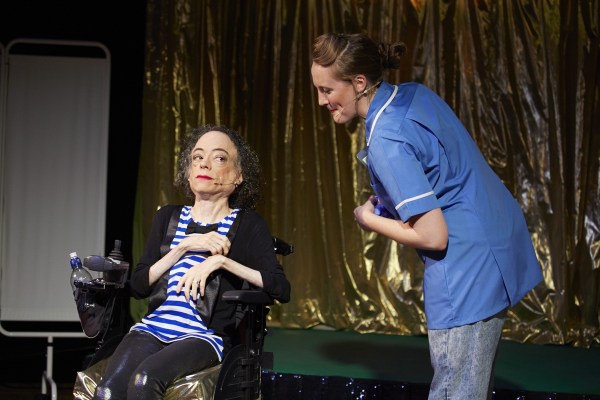
It’s uncomfortable to watch a play that conflicts with your politics or world view, and Liz Carr’s Assisted Suicide: The Musical does just that. The gay actor and comedian aligns with cuddly liberal ideology other than her avowed opposition to legalising assisted suicide in the UK. As a disabled woman, she worries that disabled people will consequently feel pressured to end their lives so they are no longer burdens on their loved ones, especially as many non-disabled people flippantly comment how hard their lives must be. After all, if you’re told the same thing over and over again, it’s too easy to start believing it.

Continue reading

Feature | Barker’s Play Doesn’t Erase Minorities – The Print Room Does

http://www.trbimg.com/img-5296a467/turbine/la-ol-katy-perry-american-music-awards-yellowf-001/600/600x399

by Daniel York

I actually sat down and read In The Depths of Dead Love last night.

If anything, I’m even more angry now. The argument put forth by the Print Room is that, although the play is set in ancient China and the characters have Chinese names, the characters are not “Chinese” and it’s a very “English story”.

Is this true? Well, there are a lot of “deep bows” and talk of emperors but reading the work leaves me wondering just exactly how ethno-specific a play would have to be before the people who programmed and presented this one would consider that, yes, we might just have to cast some actors who aren’t actually Caucasian and middle-class.

The thing that really does disgust me, though, is the Print Room’s argument that they should have the right to cast “the best actors for the roles, independent of ethnic origin”. Leaving aside that being “independent of ethnic origin” appears to be a privilege that only applies to white people, we have the Print Room citing Christopher Hurrell’s defence that, “the characteristics [Barker’s play] seeks in actors are not social, cultural or ethnic—they’re technical, aesthetic and artistic.”

Let’s just pause there. Would it have to be written in pidgin English before the demands were relegated to “social, cultural or ethnic”?

And this is what is utterly despicable about the whole argument I’ve had so many times in the past and, I hope, not too many more in the future: the sheer racial and social snobbery embodied by organisations like the Print Room and the Wrestling School when they assert that they cast “the best actors for the role”. What they’re actually saying is “you little ethnics just aren’t up to the job”.

This would be bad enough but we’re now all pretty much certain that they never met or considered any actors of any other ethnic background other than white Caucasian for this production. This play which was produced on the radio in 2013, which Christopher Hurrell maintains was given a reading at the Print Room in 2013. They’ve had FOUR YEARS to develop this. FOUR YEARS in which it looks as if they never once even considered casting actors who weren’t white. I presume, they never once considered that actors who weren’t white Caucasian were up to the “technical, aesthetic and artistic” demands of the play.

The racial and social snobbery is compounded by the Print Room alleging that the protests have come from “some members of the public” when in fact it’s mainly members of the theatre community. When they argue that the references to China are merely “oblique”. When they give trite lectures about The Great Man being a “fabulist” whose work “is poetic and often difficult to pin down in time or place”.

Yes, we do understand all those things. Because we’ve actually read a few books too. We understand the arguments perfectly because, believe it or not, we’re “artists” as well.
And, as artists, we politely but firmly reject this cultural ethnic elitist high-handedness.

Please join us in in our protest this Thursday Jan 19th. If you can’t physically make it (or even if you can) please partake in the “thunderclap” social media protest.

The Play’s the Thing UK is committed to covering fringe and progressive theatre in London and beyond. It is run entirely voluntarily and needs regular support to ensure its survival. For more information and to help The Play’s the Thing UK provide coverage of the theatre that needs reviews the most, visit its patreon.

He(art), Theatre N16

jack-gogarty-alex-reynolds-by-jesse-night

Chalk and cheese Alice and Rhys debate whether to purchase a painting in an art gallery. Simultaneously, siblings Kev and Sam hatch a plan to fund a life-saving procedure for their ill mum that the NHS won’t cover. Running at just over an hour, writer Andrew Maddock fits in the nature of art and its criticism, public health, social class, poverty and loyalty across two very different sets of characters in the same neighbourhood. It’s a lot for 65 minutes and whilst it’s not enough time to fully explore these themes, the play doesn’t feel crowded. Though the direction and performances are intuitive and finely tuned, Maddock’s outstanding verse poetry and use of non-naturalism is sorely missed in this surprising diversion from his trademark style.

Continue reading

Three Sisters, Union Theatre

https://i0.wp.com/www.jetsetreport.com/admin2/photos/Moscow_Ritz.jpg

“Nothing turns out the way we planned.”

Though 2016 has been riddled with despair, 2017 looks worse. With the fascist post-truth movement on the rise and Trump taking office in a matter of days, there is little to look forward to. Far-off lands look like alluring utopias, and it’s easy to fall prey to the lingering question of what the point is of carrying on in the face of all this societal disintegration. With existentialism one of the cruxes of the story, this Three Sisters is a bleak echo of present day narcissism and hopelessness. Phil Willmott’s staging of a new, pared back translation doesn’t stagnate, though. Combined with a strong cast, this is production uncannily suits our times.

Continue reading

Glockenspiel, Tristan Bates Theatre

https://i0.wp.com/www.stevendykesplaywright.com/wp-content/uploads/2015/09/glockenspiel-columbia-1-770x513.jpg

In the programme notes for Steven Dykes’ Glockenspiel, we are told that 40% of current personnel have been deployed more than once, and 27% of those veterans deployed to Iraq and Afghanistan suffer from anxiety disorders and/depression. A fifth of ex-service people are unemployed, and a fifth report cases of domestic violence. Male ex-service members are twice as likely to commit suicide than their non-serving peers. So it’s no secret that the US doesn’t look after its veterans very well. The play tries to look at the effects of service on those now finding their way in the civilian world, but Old Sole Theatre Company’s execution doesn’t deliver the power needed for this slowly-developing script.

Continue reading

Editorial | An Open Letter to the Print Room

https://s3.amazonaws.com/wos-photos-production/89185.jpg

I never make New Year’s resolutions. They work for other people and that’s great, but they aren’t my thing. But Daisy Bowie-Sell’s tweet from a few days ago asking what theatre’s resolutions should be for 2017 resonated with me. An industry making resolutions? Now that’s something I can get behind – people working together for a common goal is what theatre is about on a microcosmic level anyway, and more unity is surely a good thing in a world becoming increasingly polarised.

Continue reading

Monorogue: Elf Off, Old Red Lion Theatre

https://i0.wp.com/northpoleexperience.com/wp-content/uploads/2014/09/slide-1.jpg

The Salon:Collective’s Monorogue is back again, this time with a Christmas edition. The monologue showcase is now in Santa’s workshop, where perky elf Gingersparkles is interviewing human candidates for a vacancy in the Lapland workshop. Seven lacklustre individuals who can’t otherwise find seasonal employment are created and performed by Salon:Collective actors in this spunky, lighthearted show where the audience gets to vote for the best performer/character. Distinctive characters and good performances are the trademark of this regular event, and the framework around the monologues makes for more palatable viewing.

The set is a simple construction of heaps of brightly wrapped presents, Christmas decorations and toys. It’s easy, cheap and hugely effective in the intimate blackbox theatre. Though perhaps unintended, it is also a lovely juxtaposition to some of the more down-at-heel characters.

The performances are generally good, though some of the characters tend towards stereotypical and miss opportunities for nuance. The standouts are Lucy Gallagher and Louise Devlin’s intense Scottish tomboy Mae, and Angela Harvey’s struggling mum of five Hayley. Rachel Stoneley’s confused but sweet stripper, Jade, is a great way to wrap up the candidates. Laurie Stevens is the adorable Gingersparkles, but she surprises with a ferocious climax that wraps up the evening well.

The scripts have a strong lean towards comedy, which suits the time of year, but some of them lack depth and choose to mock personality traits rather than empathise. Whilst there is nothing overtly offensive and the stereotypes created are identifiable and relatable, there is room for more variation.

Monorogue proves again that they offer an entertaining event that allows actors and playwrights to showcase their talents without taking the more common, in your face approach to self-marketing usually found in showcases. The theme sets the actor/writers a challenge and gives the audiences a needed framing device, and the performances are usually good.

Monorogue: Elf Off is now closed.

The Play’s the Thing UK is committed to covering fringe and progressive theatre in London and beyond. It is run entirely voluntarily and needs regular support to ensure its survival. For more information and to help The Play’s the Thing UK provide coverage of the theatre that needs reviews the most, visit its patreon.
The People Show 124: Fallout, Toynbee Studios

https://i0.wp.com/cdn.paper4pc.com/images/desert-landscape-pictures-wallpaper-2.jpg
Making devised work for the past 50 years, People Show are nothing less than prolific. Their multidisciplinary works are numbered as part of the title; the company’s works now number 132. To celebrate their anniversary, the company’s taken over Toynbee Studios for three days, filling the venue with performances, films and an exhibition celebrating their half a century of work.

People Show 124: Fallout, first performed in 2013, is resurrected here. The piece deconstructs speeches by public figures and adds light, sound and film; the overall effect is one of provocative absurdity – isolated soundbites lose all meaning, even in a world that’s said to be falling apart. This short piece drives its point home quickly and efficiently and stimulates the senses, but with its message emphasising meaninglessness, it soon becomes repetitive.

Everything in the room is white, even the padded floor is powdered with talc to add an additional layer of frost. Pillows attached to the walls evoke a soothing dreamscape. But soon, pulsing colours disturb the peace as the cast of four fiercely deliver snippets of text. The lights are often so bright they are uncomfortable, even though the colours are childlike and fun. The juxtaposition is clever and sharp, and the switch from austere to saturated is an effective one.

The actors’ tone ranges from gentle to antagonistic, with a decidedly post-apocalyptic bent to the text. Projections of sweeping desert landscapes back up the promises of nuclear fallout, though the dreamy atmosphere from the beginning still lingers – what is real, and what is the product of our subconscious? The disconnect from reality diminishes any potential meaning, making the outcome decidedly absurd, even though the intention seems to want to carry more weight.

This colourful world enhanced with gorgeous projections, bright lights and music is integrated  with the text, though there is a lack of development in the core idea of the piece. If real life is has no purpose and we’re better off in a dream because the world is hellbent on destroying us, that’s fine – but a performance telling us that is not an easy thing to execute and in this case, not done fully effectively.

People Show 124: Fallout is now closed.

The Play’s the Thing UK is committed to covering fringe and progressive theatre in London and beyond. It is run entirely voluntarily and needs regular support to ensure its survival. For more information and to help The Play’s the Thing UK provide coverage of the theatre that needs reviews the most, visit its patreon.
Songs For the End of the World, Battersea Arts Centre


https://i0.wp.com/www.domcoyote.com/wp-content/uploads/2015/12/millygraphic-2-e1469019899426.jpg

Jim Walters is the first person sent to colonise Mars. But when a global apocalypse occurs, trapping him in the Earth’s orbit and running out of oxygen, he and his guitar are left to broadcast music to the devastation below. Can anyone hear him? Are there any survivors? Will he ever know? Dom Coyote and his band the Bloodmoneys present a post-Brexit apocalypse in the gig-theatre Songs For the End of the World, a piece overly heavy on the ‘gig’ and reliant on a plot constructed of dystopian tropes. Though the story is thin, Dom Coyote’s songs are fantastically varied and plentiful, helping to gloss over any shortcomings in the script.

There’s rockabilly, 90s rock anthems, glam rock, and blues numbers with a touch of connecting story sprinkled in between. Set in Ashley Coombe, the village serves as a window into the attitudes of small, English towns of this dictatorial era – the elderly preacher woman who runs the place condemns foreigners, terrorists and space exploration whilst the rebels put on club nights in an underground bunker. The country is now called New Albion and rather than run by an individual, a corporation dictates all rules and procedures. These plot devices are predictable within a story of a dystopian future, but are simplistic enough to work within the gig-theatre format without needing much explanation. As these two tribes clash, Jim Walters is in space – a symbol of both human progress and arrogant dominion. It’s no surprise which side survives down on Earth, and that the future beyond the end of the show looks particularly bleak.

Though the story is overly familiar, the music is wonderfully varied. David Bowie’s promised influence is clear, but not limiting in style. All of the characters in this Little England kitsch/cold international corporation hybrid are suitably blown out of proportion, but feel eerily familiar in a fundamentalist-driven, isolationist Britain and a world where Donald Trump may become the next leader of its most powerful country. Staging is fairly static as per the usual gig-theatre approach, but there is some variation in movement and costume. The lighting design adds power and hope to the bleak, clinical setting.

A more substantial script and dynamic staging would lend more theatricality to the excellent set of tunes in of Songs For the End of the World; as is, it is overly driven by music and the narrative potential is neglected. That said, it would make a fantastic concept album, and the design is strong – an extra half hour of script would add polish to this fun, vibrant performance piece.

Songs For the End of the World is now closed.

The Play’s the Thing UK is committed to covering fringe and progressive theatre in London and beyond. It is run entirely voluntarily and needs regular support to ensure its survival. For more information and to help The Play’s the Thing UK provide coverage of the theatre that needs reviews the most, visit its patreon.

Party Trap, Shoreditch Town Hall

https://www.thestage.co.uk/wp-content/uploads/2016/09/Party-Trap-Alex-Brenner-no-use-without-credit-Show-and-Tell-Party-Trap-by-Ross-SutherlandShoreditch-Town-Hall-_DSC5659.jpg

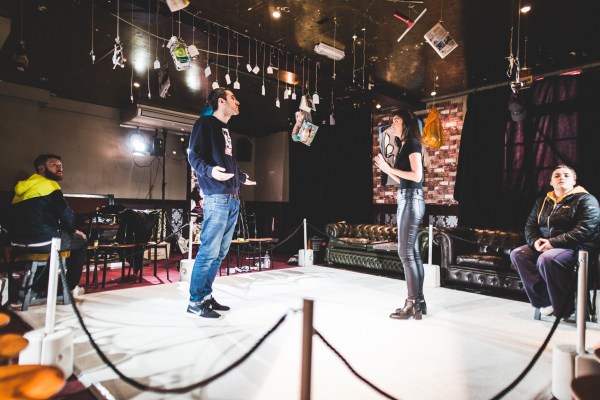
Politicians and members of the press are hardly the best of bedfellows. Unrestrained and violent, Ross Sutherland’s Party Trap explodes this relationship in a dystopian TV interview between journalist Sir David Bradley and MP Amanda Barkham after a landmark decision classifying political criticism as hate speech. Sutherland sets himself the challenge of telling his story through a script that’s an extended palindrome – an impressive feat, were it executed with more of a focus on storytelling rather than showing off a clever concept.

The palindromic writing isn’t particularly pronounced; instead it creates a haunting sense of deja vu once the script passes the halfway point. The shift in power and control from David to Amanda, and the action’s dark turn prevents it from turning stale, but the script structure is still more of a hindrance than a help. The language takes precedence over story clarity, so the plot soon muddies. The slightly futuristic premise becomes less and less tenable, to the point that the entire reality of the piece is called into question. There is little solid ground on which to build a sturdy plot line; language isn’t enough even though this experiment is certainly an interesting one.

The performances are one of the biggest disappointments. Cold and detached, they are couched in venomous sarcasm and violence. Simon Hepworth as Sir David Bradley has some nice moments of vulnerability and depth, but these are too little and too late. Otherwise, he and Zara Plessard are ruthless, calculating and distant. Video performances of other characters are relied on to fill in for news broadcasts and line managers with disturbing agendas; these characters are as self-absorbed as the two on stage.

The design elements are unobtrusive and tie the production together well, with Sutherland’s projections and video being particularly slick.There is no question that Party Trap is well-planned and thought out, but the concept is so prominent that it prevents a story from shining through. It’s a worthy experiment, but one that doesn’t work.

Party Trap runs through 1 October.

The Play’s the Thing UK is committed to covering fringe and progressive theatre in London and beyond. It is run entirely voluntarily and needs regular support to ensure its survival. For more information and to help The Play’s the Thing UK provide coverage of the theatre that needs reviews the most, visit its patreon.