
Jackson’s Way: The Christmas Top-Up Power Seminar!, Battersea Arts Centre

rsz_jacksons_way_battersea_arts_centre

Will Adamsdale’s standup/solo performance creation Chris Jackson is a motivational speaker and life coach, and the audience is at his seminar to learn his life changing methods. Jackson’s Way: The Christmas Top-Up Power Seminar! teaches you the importance of attempting meaningless or impossible actions, or “jactions”, in our lives that are otherwise filled with purpose. Adamsdale’s script has a clear narrative but somewhat lacking in follow through – we never really learn precisely WHY we should be filling our time with jactions, but the character’s detailed biography and emotional journey through the Christmas story is satisfyingly seasonal.

Just so you know, jactions have levels, can be compounded and done in groups or individually. You know you’ve succeeded when you have a mild feeling of nausea but manage to Push Through It (PTI). Some of Jackson’s most famous jactions include trying to move the floor, preventing a thrown towel from hitting the ground, and making your hand be in two places at once. The absurdity and existentialism are wonderfully funny, as is the conviction with which Adamsdale gets the audience to attempt jactions.

The autobiographical storyline and the use of projections add to the theatricality of the piece, as does Adamsdale’s immersion in the character he created and his sudden change of mood. Though the structure seems pre-formatted some of the content is improvised and there’s loads of audience interaction.

The ending is rushed but generates plenty of laughs with the character’s narcissism and has a degree of resolution. A bit more time on end and clearer goals for the seminar premise would give this already polished piece of performance more finesse, but it definitely isn’t lacking in humour that functions on multiple levels.

Adamsdale is clearly a skilled, charismatic (and sweaty!) performer with an innate sense of comedy and stage presence, as it should be for such a seasoned performer. Though English, his American accent is flawless. Running for over ten years now, it’s no wonder that Jackson’s Way has staying power in the performance and comedy circuits, and Jackson’s Way: The Christmas Top-Up Power Seminar! is a great variation on usual holiday theatre offerings and a reminder to enjoy the frivolity of Christmas rather than stressing out over its logistics.


The Play’s The Thing UK is an independent theatre criticism website maintained voluntarily. Whilst donations are never expected, they are hugely appreciated and will enable more time to be spent reviewing theatre productions of all sizes. Click here to make a donation with PayPal.
The State vs John Hayes, King’s Head Theatre

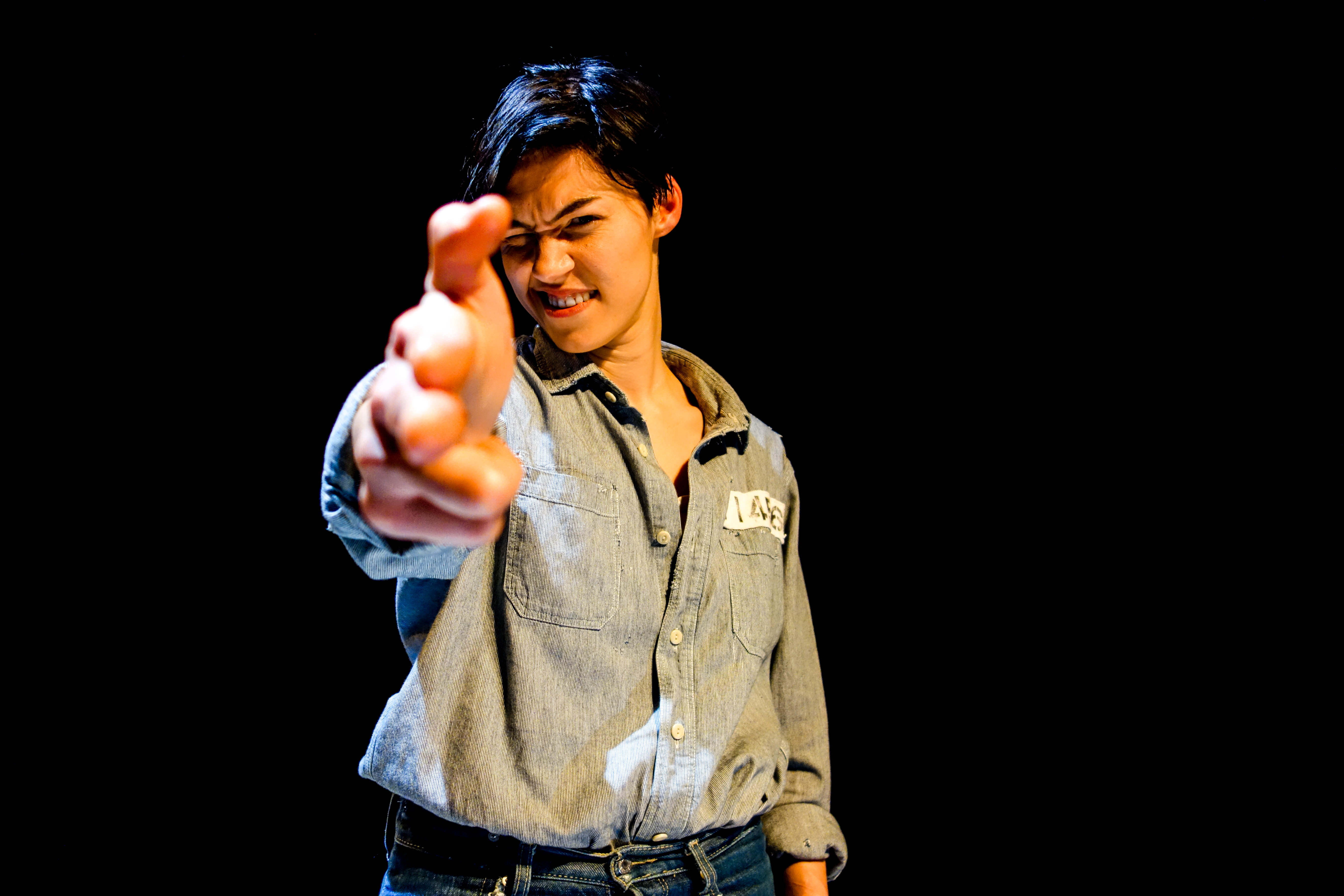
Lucy Roslyn, The State vs John Hayes (c) Jemma Gross (7)Elyese Dukie is going to die tomorrow. Though she needs to get through tonight first, at least she’s not alone. We’re in there with her, in her cell on Texas’ Death Row in 1959, as is John Hayes. But we’re not really there, and neither is John. We’re all in Elyese’s head, a figment of her very ill mind, but she’s still going to get the chair in the morning because “they would never send John…but they would send me.” For one of fictional Elyese/John’s last hours, we join her on an exquisitely performed journey akin to riding a rollercoaster handcuffed and blindfolded as Elyese reviews the dark corners and glowing intimacies of her past that led her to this moment.

Epsilon Productions continues to mature with this topical, one-woman show that’s part of The King’s Head Theatre’s new, new writing festival, #Festival45. Lucy Roslyn’s script unfolds Elyese’s troubled past spiraling towards the moment she murders her husband Dale, lover Lorraine and births John Hayes, her killer alter-ego spawned from Schizophrenia, Multiple Personality Disorder or severe childhood trauma. Elyese certainly isn’t alone in her struggle against those that live inside her head but take over her body, what with 73% of female inmates in America currently diagnosed with mental health issues; the percentage of mentally ill prisoners in the less-aware 1950s is unimaginable.

Roslyn, who also performs, begins the piece as John. We only meet Elyese later. She embodies him with perfectly sculpted hand movements and a southern redneck accent, deep as John, light and fragile as Elyese. His/her charm and charisma is unquestionable but can turn to violence and grief on a hair trigger, showing Elyese as a victim of the system unable or unwilling to provide her with the care she needs. As such, it’s a powerful critique of the US justice system.

Lighting designer Sherry Coenen reminds us of John’s threatening presence with greenish pulses when Elyese is struck with a crippling back spasm, a symbol of the control he has over her. The subtle heartbeat in dangling filament lights is Elyese’s, which will cease all too soon as electricity surges through her slender, fragile-looking body. The current seating arrangement, irregular and with a thrust so deep it’s nearly in the round, didn’t quite work with the lighting – those sat along the back wall of the stage had lights in their eyes.

The script begins as a straightforward monologue to the audience, with John flirting and joking. The structure becomes fragmented as her mental state breaks down; though she evokes sympathy she also evokes fear. If John will kill those Elyese loves the most, anyone is at risk, though it’s understandable how people immediately fall for his charms. There are times where the text rambles, but these moments are few and lead up to important story points; Roslyn’s performance adds light and shade that keeps the momentum going. Her performance consistently captivates with its commitment and intensity as well as using high levels of detail to differentiate the two characters from each other. A political firecracker with a stellar performance and numerous layers, this Argus Angel winner packs one hell of a punch.


The Play’s The Thing UK is an independent theatre criticism website maintained voluntarily. Whilst donations are never expected, they are hugely appreciated and will enable more time to be spent reviewing theatre productions of all sizes. Click here to make a donation with PayPal.
Fred Strangebone’s Freakshow, London Horror Festival

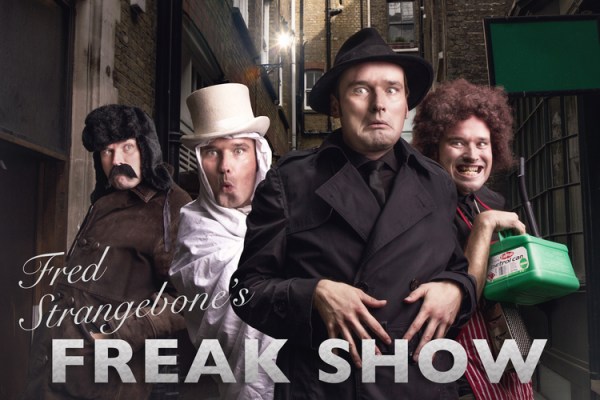
Freak Show by Chris BrockI’m watching Ben Whitehead play a socially inept Victorian playing a half-walrus/half-man creature, indicated by the wearing of a hooded grey sleeping bag, blue swimming flippers on his hands, and paper tusks precariously attached to his face with a false moustache. I’m pondering the life choices I’ve made that led me to this moment as well as whether or not the character-based stand up/absurd solo performance/live art/Victorian freakshow satire/old-fashioned variety show that unfolds before me is one of the greatest pieces of theatre I’ve ever encountered, or the worst. It may possibly be both. I still haven’t decided, and may not ever do so, let alone by the time I finish this review. Fred Strangebone’s Freakshow violently mashes up genres in a bizarre yet often-hilarious piece that manages to be both straightforward and bafflingly random.
Whitehead’s narrator Fred Strangebone cuts an imposing figure in a dinner suit, black shirt, and velvet bowtie. His rigidity and demeanor remind me of Lurch in the original The Addams Family series from the 1960s, but more well spoken and deadpan. Fred tells us exactly what’s going to happen: he will perform some comedy, then tell us a tale of unspeakable horror, and then, time permitting, he’s going to kill himself. His tale of unspeakable horror is more of a speakable mystery (so he says), where Strangebone goes to the freakshow and meets the walrus man and other oddities affiliated with the travelling show. These characters are a fantastic platform for accomplished voice actor Whitehead to get stuck into, and an enjoyably grotesque one at that. After a failed attempt to impress the freakshow to the point that they invite him to join them, he fulfills his initial promise…or does he? The meta-theatre from the stand-up clouds the levels of reality within Fred’s world.

Each of Whitehead’s creations could be a piece in itself, but he connects them through an overarching storyline. This structure could do with some work, as the narration between characters is often thin, with a tenuous link from one character to the next. The dwarfish property developer with pink wellies chewing on a cigar made of chorizo, whilst hilarious, only loosely fits into the established story. A scriptwriter or script consultant could have a positive influence on the story. His comedy is achingly funny, using absurdity and grotesque imagery to generate laughter mixed with disgust. Like when the demon bin-babies vomit all over mute clown cleaner, Sid, after he breast-feeds them to a monstrous soundtrack. (That was another one of those existential moments for me I mentioned earlier.)

Despite the rough structure and the script with predetermined characters crowbarred in, Whitehead has a fantastic sense for the absurdly funny and Fred Strangebone’s Freakshow manages to pay homage to several earlier popular performance forms – including the freakshow (obviously), variety, cabaret and travelling circus. There’s some audience participation, but the piece is more presentational than interactive. The event is a baffling, bizarre and uniquely wonderful one that refuses to be classified into one particular performance genre and certainly a one-of-a-kind contribution to the London Horror Festival this year.


The Play’s The Thing UK is an independent theatre criticism website maintained voluntarily. Whilst donations are never expected, they are hugely appreciated and will enable more time to be spent reviewing theatre productions of all sizes. Click here to make a donation with PayPal.

Joanne, Soho Theatre

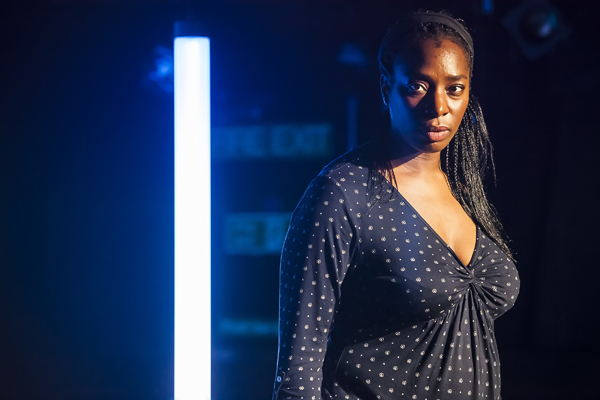
Joanne2We never meet Joanne. We do however, meet four women who encounter her at different points over a crucial 24-hour period of her life, and one that remembers her as a child. We learn that she cuts a tall, striking figure, makes immediate impact on those she meets and she doesn’t seem to fit in anywhere the world. Joanne is homeless and has just been released from prison. Production company Clean Break, founded by 2 female prisoners in 1979 and still producing, recognizes the importance of sharing stories from vulnerable women prone to falling through society’s cracks. Joanne, written by five female playwrights, has some wonderful writing and is skillfully performed in an intimate space but the brevity of the monologues and talking around Joanne distances rather than fully engages.

Tanya Moodie first plays a key worker, then easily slips into a police officer, an NHS receptionist, a hostel cleaner and a teacher. All were moved by Joanne’s plight and wanted to help her, innately sensing her need for support. These women related to something within Joanne, humanizing her and the thousands of other female prisoners like her. Moodie captures the genuine care these women feel, as well as their conflict – police officer Grace isn’t supposed to get attached to her cases, but alludes to her own struggle with finding a place in the world for her and her daughter. I am particularly touched by Kathleen, on the front line of an NHS hospital for 28 years. She makes some pointed critiques of government legislation’s effects on her workplace and its effects on those most needing care. These stories are much more engrossing than Joanne’s because they’re in front of us, as Joanne herself is a shadowy puzzle that we slowly and satisfyingly piece together.

Through written by five different writers, the monologues seamlessly connect but remain stylistically distinct. Told in the past tense through the sharing of memories, they are fine examples of storytelling that Moodie makes active and varied rather than nostalgic. She owns the distinct characterization of these women, skillfully masking Róisín McBrinn’s direction. Colour changing light-up columns and panels add visual variation, but don’t contribute towards meaning or location. Their presence is unimposing, but unnecessary. The otherwise minimal, black set draws all attention onto Moodie, as it should in this production. Audience focus is on Joanne’s attempted helpers and their capacity to empathise; they are more solid and demanding of immediate attention than the silhouetted subject of their stories who leaves nothing but a memory.


The Play’s The Thing UK is an independent theatre criticism website maintained voluntarily. Whilst donations are never expected, they are hugely appreciated and will enable more time to be spent reviewing theatre productions of all sizes. Click here to make a donation with PayPal.

The Devil Without, London Horror Festival

rsz_1devilHiding in a room above a pub in Camden, John is on the run from an archdemon that he initially believed was the angel Madimi, with whom he did a dodgy deal for his soul. This archdemon is so powerful that being in his presence is enough to kill a mortal. But don’t worry, everyone is safe as long as we follow John’s instructions and don’t go through the door. Arcane symbols and a circle of salt help protect us from harm, as does his wisdom and hundreds of years of life experience. We are there for a workshop of sorts, to learn how to augment our realities through the power of the liminal space that exists between realities and just happen to be caught up in the demon chase, so the audience must sign a waiver before entering the theatre. Part séance, part hypnotism show, part magic and part theatre, The Devil Without seamlessly merges genres and the occult in a frighteningly unpredictable show loaded with audience interaction.

It’s difficult to say much about this show’s details without giving away the elements that generate the near-constant surprise and suspense, but there is a storyline and a structure that definitely makes this a piece of highly effective theatre. Ian Harvey-Stone plays the character of the 500-year-old immortal, performing feats of mind control and magic that rely on audience participation, including four people taken on an out-of-body journey to see if it’s safe to emerge from the room. There are also guided meditations that are meant to reduce phobias and demonstrate the power of our own minds, which are uncomfortably successful. It’s certainly impressive as Harvey-Stone manages to fully convinces and disarms the audience. Logically I believe what he does must be trickery involving audience plants, but he’s so convincing that the seeds of doubts are there, especially with Harvey-Stone’s assurance that they aren’t and the show changes nightly – could it be real? After all, “magic features the power of words…speak something and it exists,” says John. This uncertainty contributes to the scare factor of the show; we are unsettled when logic cannot explain an occurrence.

Smoothly directed by John-David Henshaw, the use of light and sound emphasizes the paranormal with resonant tones and pulsing lights. Henshaw’s direction combined with Harvey-Stone’s performance makes them an impressive pair of suspense masters. As a former scare attraction performer and an aficionado of horror, it takes a lot to rattle me but The Devil Without is hugely unsettling. The fluid genre mash-up and Harvey-Stone’s committed performance combine to create a show that extends the genre of horror theatre in a wonderfully frightening direction.


The Play’s The Thing UK is an independent theatre criticism website maintained voluntarily. Whilst donations are never expected, they are hugely appreciated and will enable more time to be spent reviewing theatre productions of all sizes. Click here to make a donation with PayPal.

The Sandman, London Horror Festival

rsz_sandmanThe sandman doesn’t throw sand in your eyes to help you sleep, oh no. That’s just what parents want children to believe so they aren’t scared of the real sandman. The real sandman is horrible. If you’re still awake, he steals your eyes and puts them into his little bag and takes them up to his little, bald bird-children who live on the moon. Then they eat them.

T. A. Hoffmann, celebrated German gothic horror author, wrote short story “The Sandman” in 1816. Featuring automatons, folklore, love, childhood trauma and obsession, it tells the tragic downfall of Nathaniel, who couldn’t let go of his boyhood fear of the sandman, personified in his father’s malformed colleague, Coppelius. Adie Mueller and Mike Carter adapt and modernise this short story into a one-woman show of the same name that eschews linear narrative in favour of a disturbing, extremely fragmented chaos. Mueller skillfully performs the eight characters that appear in the story, but the show requires a lot of thinking and patience to decipher the truth behind the numerous perspectives.

In the programme, Mueller and Carter state, “The woman knows that this story is too much for her and she needs you, the audience. The story bursts out of her and comes at you in fragments, randomly and out of chronological sequence. You will have to play your part in piecing them together, finding the overarching narrative, and search beyond reason to make meaning from them.” This is a nice idea to draw the audience into a one-person show and make them feel needed, but for the tired and those that want to sit back and be entertained/scared, it’s hard work. It also serves as a distraction from the lack of clarity of the audience’s function and relationship to the performer, a vital element of one-person performance. Requiring us to sift through the pieces of story strewn before us has no benefit to the performance or the piece; it would be delivered identically whether the audience understands or not. Director Carter chooses to keep the house lights on so Meuller can make eye contact, but there is no direct dialogue. What does she want from us? Why are we hearing this story? It is never revealed.

Mueller’s performance draws attention away from these shortcomings, and it’s an excellent one. Her use of physical storytelling and character differentiation comes easily, and shows a high level of skill and training. Clad in white, she cuts a powerful image in the Etcetera’s small black box, adding to the chaos with her violent use of creepy props.

The story modernizes well, with a focus on sexual dysfunction, technology and its grim intersection. The characters evoke empathy, particularly Nathaniel, who we see as a scared child and an adult obsessed with his lecturer’s “daughter” Olympia. Though his behaviour is appalling, he is a victim of his past rather than a calculating psychopath. His attempts to maintain a normal relationship with human being Clara are thwarted by reoccurring psychotic episodes…or are they real? The prospect of an alternative, tormenting reality that haunts Nathaniel is deliciously spooky. The Sandman is creepily unsettling and despite the effort needed to work out what is happening, the performances and characters make up for the jagged structure.


The Play’s The Thing UK is an independent theatre criticism website maintained voluntarily. Whilst donations are never expected, they are hugely appreciated and will enable more time to be spent reviewing theatre productions of all sizes. Click here to make a donation with PayPal.

Song from Far Away, Young Vic Theatre

Willem is 34. He moved from Amsterdam to New York City 12 years ago. After an inconveniently timed phone call from his mother on a cold New York morning, he goes home for his younger brother Pauli’s funeral. He is greeted by his father’s disappointment, his sister’s lectures and the disorientation of not knowing where “home” is anymore. Much has changed, yet so much has remained the same.

I’m 33 years old. Eleven years ago, I moved to the UK from New York City. I use the term “home” fluidly because I don’t know where that place is anymore. So far I haven’t had to suddenly return for a family funeral, but that time will come. I know too well that disarming, unnamed feeling of simultaneous comfort and sadness from remembered places and people, those that have stayed the same and those have changed or disappeared altogether. There are many things that I miss, but much that reinforces my choice not just to leave, but to stay away.

I should have been in tears by the end of Song from Far Away, especially as I saw the 11 September performance, a day indelibly impressed on my memory with an anniversary no easier to bear with each passing year. Willem unexpectedly lost his little brother to an undiagnosed heart condition; I fortunately lost no one in 9/11. I was moved at times, by Simon Stephens’ delicate language, Mark Eizel’s folksy travelling tunes, and Eelco Smits’ honest portrayal of Willem’s understated struggles. Frustratingly, I never received the cathartic cry I sought from this production though, and I should have, considering how keenly I relate to Willem.

The performance and design elements are subtly beautiful, but the production is skeletal. The changing light and shadows of time passing have more connection to the present than the character does, who is more at home in transit than in the arrival at a place. The production seems to want to be minimalist in the extreme in order to draw attention to Willem’s displacement in the world, but in doing so creates an ethereal anti-theatre that doesn’t manage to come close to the audience’s heartstrings. Willem’s extended monologue in the form of letters to Pauli opens his heart to us as he (literally) bares all, but his world is so insular that we are excluded. We can witness, but not engage.

Stephens’ script sounds like it would read better on the page than performed as a theatre piece, at least with Ivo van Hove’s chosen directorial concept. The language is undeniably beautiful and human, and creates a wonderful character, but the production concept distances and isolates him from us, reinforced in the final moments of the play. A Song from Far Away is just that – too distant to hear the details of a faintly mourning cry on cold winter’s day in New York City. We want to comfort the singer, but he is moving further out of our grasp the longer we listen.


The Play’s The Thing UK is an independent theatre criticism website maintained voluntarily. Whilst donations are never expected, they are hugely appreciated and will enable more time to be spent reviewing theatre productions of all sizes. Click here to make a donation with PalPal.

Forest Fringe Digest: Part Two

A male photographer is photographing a female celebrity who is tired of being so superficial. She wants this photo shoot to show her “true self”. She wants to be “real”, and we’re all hanging out in the studio with them in Action Hero’s Wrecking Ball. Audience expectations are immediately challenged on entry when invited to grab a beer from a cooler onstage, and this boundary remains blurred for the duration. Communication is attempted between the two characters, but neither is really listening and what they say doesn’t really have any meaning, pointedly ironic in characters striving for stripped back honestly. The performance is both funny and uncomfortable as the audience watches their professional relationship cross into the manipulative personal. This is a text-based performance with imagery rich language highlighting the absurdity of their encounter, but it triggers a good amount of reflection on our own behaviour. We all carefully construct our images, particularly in social media, yet at the same time we want to be genuine (whatever that means). This is an excellent, polished piece that is provocative in subject and the actor-audience relationship.

Search Party’s My Son & Heir is without question the funniest thing I’ve seen this year in Edinburgh. Real-life couple Pete Phillips and Jodie Hawkes playfully examine the prospects of their young son, born in the same year as ‘baby Cambridge.’ The two little boys have little in common, though. Pete and Jodie share their hopes for their son in a cheerful, pink chaos that soon disintegrates into relentless judgments on their parenting methods and a stream of ‘what ifs’ capturing the anxiety and pressure to raise a perfect child. The message evokes sympathy and reflection, even from those without children. It’s an outstanding blend of comedy and social commentary on the perils of being an ordinary parent without heaps of cash to throw at your child. Their gleeful, child-like anarchy quickly turns vicious, creating pointed contrast between the haves and have-nots, but ends in a message of love. Perhaps the ending tends towards sentimental, but in a world where money is a large factor in success and a good life, it is also an ending of hope.

Last up is Christopher Brett Bailey’s This Is How We Die, a spoken word and music performance that is deceptively simple but leaves you with overloaded senses and a feeling of having traveled around the world at a million miles a second. When I first saw This Is How We Die at Battersea Arts Centre several months ago, I was so moved that I wrote two responses: an immediate visceral reaction that probably isn’t particularly well written followed by a reasoned review. I wanted to experience this piece in a smaller space, and Forest Fringe did not disappoint. Bailey’s delivery was more intimate and personal, and sitting in the front row was a full-blast experience. This piece isn’t for everyone, though. A couple of people walked out, and responses have been polarized; you either love this piece or you hate it.


The Play’s The Thing UK is an independent theatre criticism website maintained voluntarily. Whilst donations are never expected, they are hugely appreciated and will enable more time to be spent reviewing theatre productions of all sizes. Click here to make a donation with PalPal.

Ross & Rachel, Edinburgh Festival Fringe

Confession: I don’t like Friends. I find the acting two-dimensional, the jokes not funny and it bears no reflection on real life in New York City, where I spent four happy years at drama school. So I was reluctant to see MOTOR’s Ross & Rachel, because I thought it’s about the couple from Friends.

PRO TIP: Ross & Rachel doesn’t have anything to do with Friends, not really.

To boil down what this solo show featuring two characters is about feels reductive, because there’s a lot in there. Playwright James Fritz fits an entire relationship and its issues spanning many years into an hour, but it doesn’t feel crowded or rushed. This piece focusing on a middle-aged couple’s ups and downs from beginning to lonely end will speak to anyone who has ever been in a relationship. For me, the theme of a partner’s premature mortality is particularly resonant.

Molly Vevers plays both characters in this relentless, rapid-fire dialogue, deservedly earning The Stage Award for Acting Excellence in week one of the fringe. She is a captivating watch and a consummate professional, endeavoring to complete the performance after a woman in the audience fainted, right in the middle of the highly emotional end. She directly engages with the audience, personalizing this “every-couple’s” story and their need to connect with others outside themselves, particularly as one of them becomes more and more ill.

The meaning of the shallow pool Vevers first tentatively steps in is made clear towards the end, but its initial incorporation feels artificial. Director Thomas Martin otherwise does an excellent job through differentiating the two characters voiced by a single performer and maintaining audience focus with pace and energy. His casting choice is an interesting one, though. Vevers’ talent is unquestionable, but the characters she plays are middle aged. Vevers looks no older than 25. I wonder how the tone of this piece would have changed if she matched the ages of the characters.

Regardless, this is a lovely piece that plays on the audience’s emotions, without becoming overly sentimental, and gently explores their relationship with the performer in an intimate venue.


The Play’s The Thing UK is an independent theatre criticism website maintained voluntarily. Whilst donations are never expected, they are hugely appreciated and will enable more time to be spent reviewing theatre productions of all sizes. Click here to make a donation with PalPal.

Edinburgh Festival Fringe, 21 August

Two radically different solo performances make up my day: a joyful, music-based reimagining of A Midsummer Night’s Dream at Summerhall entitled Titania, and Total Theatre Award shortlisted physical/visual theatre piece, Oog at dancebase. Oog is the more polished and complete of the two, a non-verbal expressionist work depicting a broken soldier at the end of some unknown war, alone in a cellar. Titania is a sexy, celebratory, aural experience with audience participation that focuses on the fairies’ story.

Anna-Helena McLean uses live mixing, voice and cello performance in an impressive display of vocal dexterity to evoke the fairy kingdom. She often uses Shakespeare’s text, with spoken-word style delivery, and simultaneously creates atmosphere through sound. The effect is a rich, aural bath that can easily be absorbed with eyes closed. Rather than ethereal, this forest is earthy and sensual. McLean takes on a range of characters through fluid transitions and vocal differentiation, disregarding a narrative. More physical distinction between characters would have been welcome and in a piece entitled Titania, there isn’t as strong a focus on the fairy queen as expected.

At points McLean has the audience singing, snapping their fingers and joining her on stage. The scene where Titania seduces Bottom involves four audience members, one as Bottom and the others as fairy attendants; this scene is so sexually charged as she undoes Bottom’s shirt and strokes his chest that my rapidly-repeating inner monologue consists of, “OMG THEY’RE ALL GONNA START FUCKING”. As well as the sexual overtones, there is celebration and laughter. This piece could easily develop into a larger, club-style performance with additional actors, that seeks to create the forest through participation rather than the audience passively watching for much of the show.

Though using Shakespeare’s work as a launch pad for new styles of work is brilliant, to make a fully effective reimagining of the original, the artist must provide a clear, specific comment or interpretation on an aspect of the text. I’m not sure what McLean seeks to say about Shakespeare’s A Midsummer Night’s Dream; there is no evident overriding message in this piece. The grounded, sexual aspect of the fairies is a starting point, but it isn’t enough. That said, Titania is a piece I wholly enjoyed, even though it needs additional development.

Oog is an entirely different beast, using fast, twitchy movements to exhibit the trauma of war experienced by soldiers. There is no speech, but the character replays happy moments from civilian life mouthing conversation, memories of battle, and intermittently gazes up the ladder leading to his freedom that he cannot bear to climb.

Like a video sped up, performer Al Seed is relentless and tense. Oog is captivating to watch with a range of movements and styles; the expressionism lends itself to a range of interpretations. His Beckettian struggle feels like he has endured it forever, and will continue to do so for time eternal. There is little that signposts him as a soldier, though. Without the programme notes, I don’t know that I would have determined the production concept.

The design is stunning. Side lighting and smoke create strong visual angles and the electronic soundtrack enhances the tension in Seed’s body and mind. His coat is huge and sculptural, a presence in and of itself. Even though the performance is only 40 minutes, it could have been shorter and still conveyed the same intensity, particularly with the cyclical nature of the piece.

These radically different one-person shows experiment with form and style, showing the possibility of character-driven, non-narrative live performance. Both have their merits and both have their flaws, and both are worth seeing for their interpretations of timeless stories.


The Play’s The Thing UK is an independent theatre criticism website maintained voluntarily. Whilst donations are never expected, they are hugely appreciated and will enable more time to be spent reviewing theatre productions of all sizes. Click here to make a donation with PalPal.