Trash, Rosemary Branch Theatre

Two estranged sisters dig through a rubbish tip after their mother’s funeral. Recovering heroin addict Becky, in a moment of anger, had thrown away an unopened letter from their mother containing important information. Older, responsible Diane insisted they recover it, so here they are in their funereal finery, ankle deep in trash, full of hatred, resentment and grief. New company Indigo Iris, founded by actor-producers Emma Shenkman and Georgina Philipps, debut with Arthur M. Jolly’s Trash, a two-hander with potential for absurd situation comedy that instead plays it straight, focusing on the complexity of sisterhood and familial responsibility.

Trash is a well-constructed play driven by long-standing conflict between Diane (Emma Shenkman) and Becky (Georgina Philipps). Their mother’s illness tested daughterly obligation: Diane fulfilled it, but Becky refused to and ran away. They haven’t seen each other since. Diane’s resentment spews forth in relentless verbal attacks that Becky coldly thwarts. Occasionally, the violence turns physical, with great fight direction by Gordon Kemp.

This is a tense, wordy production but the energy is full on, particularly from Shenkman. Her vicious, relentless performance counters Philipps’ low-key character and keeps the audience’s attention. Both have a hard veneer that rarely cracks and is truthful to their situation, though more emotional range would have been welcome to break up the near constant anger. As such, sympathy for either woman is difficult to summon, even though Becky doesn’t seem to by lying about being clean and Diane clearly had more than her share of trouble caring for their dying mother over the last three years. The script steers clear of a formulaic narrative arc but still satisfies through a gradual information reveal and an ending open to several possible outcomes. It’s not a happy ending, but not a stalemate either and avoids sentimentality. These women are damaged, and it will take much more than an hour in a dump together to repair their relationship.

The set design is simple but effective. Filled bin bags and a load of other stuff cover the stage, with a backdrop of an ominous gray envelope. Its ever-present dominance is a powerful signifier of the control their mother still has over them in her last attempt at communicating with Becky before her death.

This would make a good touring studio production due to its universal conflict and small scale. Indigo Iris have good instinct for choosing a well written, showcase production. Hopefully they’ll continue their producing journey with more plays less familiar to the London fringe that focused on character relationships through solid, well-crafted scripts.


The Play’s The Thing UK is an independent theatre criticism website maintained voluntarily. Whilst donations are never expected, they are hugely appreciated and will enable more time to be spent reviewing theatre productions of all sizes. Click here to make a donation with PalPal.

Song from Far Away, Young Vic Theatre

Willem is 34. He moved from Amsterdam to New York City 12 years ago. After an inconveniently timed phone call from his mother on a cold New York morning, he goes home for his younger brother Pauli’s funeral. He is greeted by his father’s disappointment, his sister’s lectures and the disorientation of not knowing where “home” is anymore. Much has changed, yet so much has remained the same.

I’m 33 years old. Eleven years ago, I moved to the UK from New York City. I use the term “home” fluidly because I don’t know where that place is anymore. So far I haven’t had to suddenly return for a family funeral, but that time will come. I know too well that disarming, unnamed feeling of simultaneous comfort and sadness from remembered places and people, those that have stayed the same and those have changed or disappeared altogether. There are many things that I miss, but much that reinforces my choice not just to leave, but to stay away.

I should have been in tears by the end of Song from Far Away, especially as I saw the 11 September performance, a day indelibly impressed on my memory with an anniversary no easier to bear with each passing year. Willem unexpectedly lost his little brother to an undiagnosed heart condition; I fortunately lost no one in 9/11. I was moved at times, by Simon Stephens’ delicate language, Mark Eizel’s folksy travelling tunes, and Eelco Smits’ honest portrayal of Willem’s understated struggles. Frustratingly, I never received the cathartic cry I sought from this production though, and I should have, considering how keenly I relate to Willem.

The performance and design elements are subtly beautiful, but the production is skeletal. The changing light and shadows of time passing have more connection to the present than the character does, who is more at home in transit than in the arrival at a place. The production seems to want to be minimalist in the extreme in order to draw attention to Willem’s displacement in the world, but in doing so creates an ethereal anti-theatre that doesn’t manage to come close to the audience’s heartstrings. Willem’s extended monologue in the form of letters to Pauli opens his heart to us as he (literally) bares all, but his world is so insular that we are excluded. We can witness, but not engage.

Stephens’ script sounds like it would read better on the page than performed as a theatre piece, at least with Ivo van Hove’s chosen directorial concept. The language is undeniably beautiful and human, and creates a wonderful character, but the production concept distances and isolates him from us, reinforced in the final moments of the play. A Song from Far Away is just that – too distant to hear the details of a faintly mourning cry on cold winter’s day in New York City. We want to comfort the singer, but he is moving further out of our grasp the longer we listen.


The Play’s The Thing UK is an independent theatre criticism website maintained voluntarily. Whilst donations are never expected, they are hugely appreciated and will enable more time to be spent reviewing theatre productions of all sizes. Click here to make a donation with PalPal.

Reckless, Rose Playhouse

The pool preserving the remains of The Rose Playhouse is the sea surrounding a nameless, remote island. Fascinating, dangerous, wild or wonderful, all of the island dwellers have lengthy, close relationships with the sea, for better or worse. These intertwining, turbulent histories meet and join each other at the Old Man and his Boy, a story of a new, young love and a past love, long lost. Heady Conduct’s Reckless unfolds a timeless tale of love, truth and community dictated by the sea using narration, site-specific influences and direct address interspersed with conventional performance. The story is both sweet and saddening, but the play’s structure is disjointed and thin, occasionally unclear in time and place, causing the story to lose support and clarity. Fortunately, the scenes between characters are endowed with honesty and intimacy, and the unique performance venue is fantastically utilized by director/actor Rebecca Rogers.
Rogers is the central narrator figure, the Harbour Master. She is the all-seeing and all-knowing, performing with a reserved omniscience. Rogers also plays the Old Man’s dead wife, a quiet enigmatic character often referenced but rarely seen. She’s a wonderful, etherial presence when she does eventually appear. The other living characters have more energy, particularly Alison Tennant as feisty, confident Girl that shy Boy falls in love with, and Blake Kubena as the Old Man, father of Boy. Kubena’s Old Man is a ball of pent up mourning that’s become a threatening obsessive, controlling his son’s every move. Though there is no issue with their performance, Kubena and Simon Rodda’s Boy look like they could be brothers in their late 20s or early 30s, not an elderly man and his teenaged son. The lighthouse keeper, played by Edward Bijl, is a watchful outsider trying to engage with the native islanders though never succeeds, resorting to desperate measures to fit in. Though the character provides some comic relief, he contributes little to the story and provides minimal plot progression.

The general atmosphere is good; atmosphere is vital to make a successful show in such a vast and unusual performance space. It gives productions here specificity of location and time period, otherwise the dark emptiness beyond the stage dwarfs the play. Nautical elements deck the back wall of the site, a hut perches precariously on the water’s edge, seagull puppets and some good sound design add specificity. The lighting isn’t fully utilized to create mood, nor does it do much to counter the sweeping grey ceiling and walls, but this island could be in a location that’s perpetually cloudy.

The use of ritual and tradition gives the story gravitas; the Harbour Master’s Festival of the Lost is a moving tribute to those drowned at sea. It connects the characters to each other and to the island, helping to counteract the loosely fitting scene structure. It also emphasizes the seriousness of the small twist at the end where the audience learns the details of the Wife’s death, and the gradual muddying of the truth with the passage of time. The most moving plot point is Boy giving a ring of his mother’s to Girl, inscribed with a medieval French saying, “pences pour moye du” or “think of me, God willing”. Historically, this ring was found during the Rose’s excavations and now lives in the Museum of London (The Rose sells replicas in its giftshop). This is a delightful nugget of Rose history bonding the theatre to this particular production.

Though Reckless is in the early stages of its expansion into a full production from a one-person show, it still needs more flesh on its skeletal frame. There are great characters and the love story at its core is wonderful, but its dreamlike atmosphere needs more detail to make the world of the play truly believable. It’s most certainly achievable, and this play will develop its sea legs as it continues its development.


The Play’s The Thing UK is an independent theatre criticism website maintained voluntarily. Whilst donations are never expected, they are hugely appreciated and will enable more time to be spent reviewing theatre productions of all sizes. Click here to make a donation with PalPal.

We Just Keep Going, Hen & Chickens Theatre

Everyone’s family is messed up, with mother/daughter relationships an infamous source of tension. At the start of We Just Keep Going, Ruby (Elle van Knoll) and her mum Susan (Hilary Tones) recently relocated from San Francisco to England after Susan split from Ruby’s dad for hinted-at sinister reasons. As time passes, Ruby grows up and both ladies are in the dating scene, leading to even more conflict between the two. Though the subject matter is rather serious, the delivery most certainly isn’t. Elle van Knoll’s script is full of hilarious one-liners and situation comedy; director Helen Oakleigh intuitively adds pace and timing. The scenes are excellent stand-alone pieces and the company has good chemistry, though the performances are occasionally too heightened and the transitions are lengthy, particularly considering the scenes are numerous and short. Despite these issues, this is a great effort from new company VK Unlimited.

This is van Knoll’s debut as a playwright; as well as playing the lead role and producing. For a debut play, the script is very good. Van Knoll has a great sense for character comedy and narrative arc; her choice of episodic structure is an effective storytelling device. Ruby and Susan’s conflicting history and personal issues show some depth, though there is more of a focus on Ruby rather than Susan. Ruby’s character has a clearly defined journey that van Knoll skillfully captures, but similar character development in Susan wouldn’t go amiss as she recovers from her divorce and finds her independence as her daughter grows up. The male characters, Michael (Scott Westwood) and David (Sam Parks), get less attention though their story of estrangement is just as interesting as the women’s troubled family history. The interval wasn’t particularly needed at the current length, but with further development and character exploration, We Just Keep Going could become a full-length play.

The performances from the company of four are wonderfully funny, but don’t always feel genuine in moments of high conflict and revelation. Westwood’s and Parks’ performances feel uncommitted at times, understandingly so as they are less developed and have less stage time than the women. When Michael (Ruby’s boyfriend) and Sam (Susan’s boyfriend) eventually clash, their fight, choreographed by Andrei Zayats, feels restrained and staged rather than convincingly violent. Tones has a lovely, warm quality that is a great contrast to van Knoll’s spikiness. Westwood and Parks have a similar dynamic that is an effective mirror.

Though the comedy is the main feature of this play, it has potential for a darker focus as well, what with the themes of abuse and abandonment that feature. For a first production, We Just Keep Going is good, but a more balanced use of comedy and characterization would make this an excellent play with meaty roles that are a treat for any actor to play.


The Play’s The Thing UK is an independent theatre criticism website maintained voluntarily. Whilst donations are never expected, they are hugely appreciated and will enable more time to be spent reviewing theatre productions of all sizes. Click here to make a donation with PalPal.

Consolation, Bridewell Theatre

Carol (Holly Joyce) moved to a village in Carcassonne to rebuild her life after a devastating divorce and her son had grown up. She is convinced that in a past life, she was a medieval troubadour called Guy in the time of the Cathars. Raymond (Danny Solomon) is an actor working in the second-rate tourist attraction that Carol stalks, and longs for a life in the more exciting London. With a poetic, reflective script by Nick Wood and direction by Natasha Wood, Consolation has riveting moments between these two damaged, conflicting characters as they travel on parallel journeys of self-discovery, but at two and a half hours with a lengthy, slow-burning beginning, the production could use a trim. The slow development and several sub-plots lend a real-life complexity to the story, though the last to be introduced has insufficient expositional time considering its importance to the play’s conclusion. Despite the script’s need for additional development, this is a moving character piece unsentimentally following two individuals as they come to terms with the insubstantiality of their dreams.

By far, the best scenes are between Carol and Raymond. She’s middle-aged and needy; he’s young and cynical. Both struggle to live in the present, instead finding solace in imaginary worlds. Their conflict is charged and spiky; their softening and opening up to each other is rewarding. These scenes are a welcome break from lengthy conversations Carol has with the meditative voice in her head and the languid, but beautiful, projections from Raymond’s workplace and the fantasies in Carol’s head. Also good are the awkward skype conversations between Carol and her theatre technician son Jamie (Tom Grace) and his girlfriend, Laura (Nathalie Barclay). Jamie and Laura are projected onto the ever-present, multi-purposed large screen, further enhancing the discrepancy between Carol and Raymond’s real life in conflict with their fantasies.

There are numerous themes at play here, dreams and ambitions versus reality, and the dreams never fulfilling expectation dominate any others. There is also a nod to mental health issues, living as an immigrant, running away from real life, family loyalty and the politics of domestic terrorism. The latter isn’t exposed until the end after subtle foreshadowing and provides a convenient dénouement, but feels underdeveloped and unneeded. The central focus of the story is Carol and Raymond’s personal journeys, which are captured with nuance and truth by Joyce and Solomon. Their electric confrontations are the bright focal points of Consolation with chemistry that makes this production worth watching, but half an hour of the script could easily go and not be missed.

This is a good offer from Strasbourg’s Theatre Voliere, bridging the gap between UK and continental theatre in an increasingly small world, with human stories that are capable of transcending international boundaries.


The Play’s The Thing UK is an independent theatre criticism website maintained voluntarily. Whilst donations are never expected, they are hugely appreciated and will enable more time to be spent reviewing theatre productions of all sizes. Click here to make a donation with PalPal.

Ross & Rachel, Edinburgh Festival Fringe

Confession: I don’t like Friends. I find the acting two-dimensional, the jokes not funny and it bears no reflection on real life in New York City, where I spent four happy years at drama school. So I was reluctant to see MOTOR’s Ross & Rachel, because I thought it’s about the couple from Friends.

PRO TIP: Ross & Rachel doesn’t have anything to do with Friends, not really.

To boil down what this solo show featuring two characters is about feels reductive, because there’s a lot in there. Playwright James Fritz fits an entire relationship and its issues spanning many years into an hour, but it doesn’t feel crowded or rushed. This piece focusing on a middle-aged couple’s ups and downs from beginning to lonely end will speak to anyone who has ever been in a relationship. For me, the theme of a partner’s premature mortality is particularly resonant.

Molly Vevers plays both characters in this relentless, rapid-fire dialogue, deservedly earning The Stage Award for Acting Excellence in week one of the fringe. She is a captivating watch and a consummate professional, endeavoring to complete the performance after a woman in the audience fainted, right in the middle of the highly emotional end. She directly engages with the audience, personalizing this “every-couple’s” story and their need to connect with others outside themselves, particularly as one of them becomes more and more ill.

The meaning of the shallow pool Vevers first tentatively steps in is made clear towards the end, but its initial incorporation feels artificial. Director Thomas Martin otherwise does an excellent job through differentiating the two characters voiced by a single performer and maintaining audience focus with pace and energy. His casting choice is an interesting one, though. Vevers’ talent is unquestionable, but the characters she plays are middle aged. Vevers looks no older than 25. I wonder how the tone of this piece would have changed if she matched the ages of the characters.

Regardless, this is a lovely piece that plays on the audience’s emotions, without becoming overly sentimental, and gently explores their relationship with the performer in an intimate venue.


The Play’s The Thing UK is an independent theatre criticism website maintained voluntarily. Whilst donations are never expected, they are hugely appreciated and will enable more time to be spent reviewing theatre productions of all sizes. Click here to make a donation with PalPal.

Down & Out In Paris and London, Edinburgh Festival Fringe

George Orwell’s first full-length book, Down and Out in Paris and London, documents the Eton graduate’s foray into a life of artistic poverty in the 1920’s. About 80 years later, Polly Toynbee spent a period of time living on the minimum wage in London to write her book, Hard Work: Life in Low-Pay Britain. Writer and director David Byrne (not that one), deconstructing and interweaving these two books, creates a hard-hitting new play that confronts contemporary notions of social progress by demonstrating that experiences of a life in poverty have not improved, and “the system” created to support some of society’s most vulnerable people is inherently flawed.

A finely tuned, energetic ensemble of six multi-role a huge range of characters across London and Paris; only Richard Delaney as narrator George Orwell plays one part. His character consistency is the linchpin that holds the Paris story together, countered by Carole Street’s impressively performed Polly Toynbee. Mike Aherne, Andrew Strafford-Baker and Stella Taylor play a diverse array of smaller characters spread across both time periods using accents and costume to distinguish them. There is potential for confusion what with the constantly alternating worlds, but these three actors support clarity and understanding. They are also clearly talented performers; the only downside is that they didn’t have larger roles to really sink their teeth into.

Structurally, Byrne’s script is sound with clear transitions and sufficient exposition. He skillfully avoids audience confusion despite the constant switching between the two different settings. Polly and George embark on similar character journeys, albeit with slightly differing initial aims, but end with the same deeper understanding of society’s invisible working poor. The play is narration-heavy, restricting meaningful character interactions to unsatisfying short scenes. It also can feel more like a lecture than a performance. The fragmentary nature successfully drives the message home, particularly as adjacent scenes in the different settings focus on identical topics, including the bureaucracies of job hunting, flat hunting, and work environments. The play is robust and important enough that it deserves to be lengthened, which would allow for more development of the characters and scenes that are already present. Further emphasis on the individual human lives affected by crushing poverty will also generate further gravitas and audience empathy.

Down & Out In Paris and London returns to London’s New Diorama this spring (where Byrne is artistic director). Hopefully its message will have a wide reach and move people to rally in support of the working poor, particularly in the face of the government’s promised brutal welfare cuts. Its message is a vital one backed by a good script and great performances that deserves more attention.


The Play’s The Thing UK is an independent theatre criticism website maintained voluntarily. Whilst donations are never expected, they are hugely appreciated and will enable more time to be spent reviewing theatre productions of all sizes. Click here to make a donation with PalPal.

Edinburgh Festival Fringe, 17 August: Part Two

Hailing from LA, Waitless is a semi-autobiographical play about newlyweds Shelly and Trent, from the American south but living in New York. Trent works in finance and Shelly in TV production, but when Trent’s job transfers him to London, Shelly gives up her career to go with him. Told through heightened, contemporary farce with moments of sincerity, Waitless shows that the cultural gap between the UK and US is bigger than you think.

Actors Jessica Moreno and Andrew Boyle play all of the stereotyped characters, with the primary focus on Shelly’s emotional struggle and adjustment from career woman to housewife. Moreno seems to be the stronger performer here, but she has more to work with. Because they are using such a heightened performance style, moments of truthfulness are rare. A more naturalistic performance style would better serve the story’s message and give the actors meatier roles to explore, however both performers are extremely energetic and they have some lovely stand-alone scenes together.

These scenes make nice set pieces, but as a cohesive whole, the play could use a bit more substance. Shelly needs more intimate, honest moments alone with the audience when Trent is away for work to give the script a bit more weight. The ending is also abrupt and open, which doesn’t show a completed character arc. There is certainly scope for the play to be lengthened. There are heaps of jokes and references that I appreciate as an American who also relocated to the UK, but this narrows the play’s target audience down to a small demographic. It’s telling that I was the only person in the audience who chuckled at some of Shelly’s digs at British culture: British people won’t relate to her frustration, and neither will Americans who have never lived abroad. Any immigrant will be able to empathise with her situation though, at least in part.

Overall, it’s a great issue to look at onstage. Immigration is a hot topic in many countries, and the immigrant experiences in the news focuses on an entirely different demographic. Those who quietly relocate to work or study largely go unnoticed, often battling the cultural adjustment alone and unsupported. The script needs some adjustment in order to truly capture the emotional upheaval and rediscovery that comes from this momentous life change, but it is heading in the right direction.


The Play’s The Thing UK is an independent theatre criticism website maintained voluntarily. Whilst donations are never expected, they are hugely appreciated and will enable more time to be spent reviewing theatre productions of all sizes. Click here to make a donation with PalPal.

Edinburgh Festival Fringe, 17 August: Part One

Today should have been a great day. A morning show in Summerhall, a venue that consistently stages innovative work, followed by an afternoon play affectionately looking at a topic I very much relate to. Both Current Location by FellSwoop Theatre and Waitless by Cailin Harrison have some good ideas and individual moments, but individual production elements don’t quite fit together to form a cohesive whole.

Current Location is an adaptation of the Japanese play by Toshiki Okada, set in a coastal village, presumably in England, with a minimalist script and design. It feels quite Scandinavian (which suits the simile I will use shortly). Four women anxiously rehearse for a performance, then another arrives who disrupts the natural chemistry of the group. She is soaked from a sudden downpour from the blue, “bad luck cloud” that recently appeared over the village. Its appearance effects the entire population: animals are behaving strangely and people are no longer talking to each other. Rumours abound of a coming disaster; the women we see are split – some believe them, others don’t. As the play progresses, climate change intensifies as does character conflict. Some believe nature will soon cause the village to disappear, others refuse that it’s a possibility.

The premise and climate change message are certainly interesting, but the execution doesn’t make sufficient impact. There is no set and no stage lights, and the room is too big for this intimate piece. The traverse staging and naturalistic performance style chosen by director Bertrand Lesca causes lines to be completely lost if the performers’ backs are to the audience. Some vital moments were missed completely because they couldn’t be heard. It is a frustrating experience that would work better on film. The classical score that accompanies, whilst beautiful, also doesn’t improve the volume issue. Despite the naturalistic performance, the actors sit in the audience when they are off stage (sometimes), creating an inconsistent style.

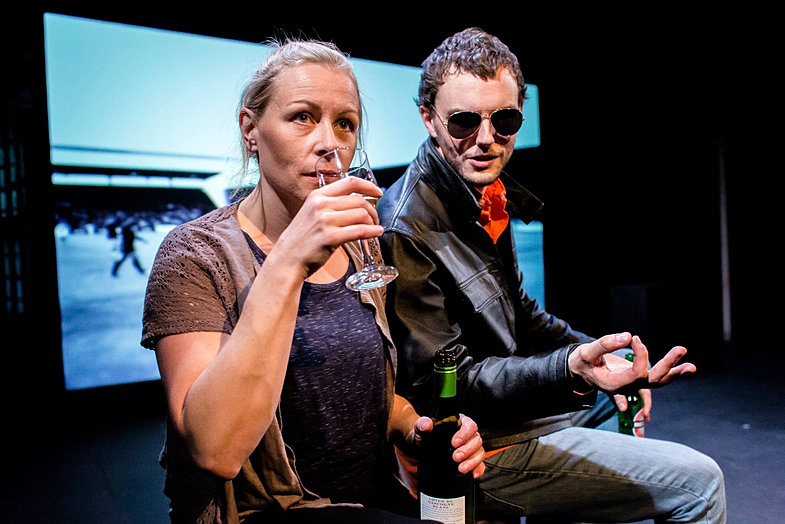
The production rather reminded me of Ikea. Minimalist Scandinavian design, looks great on paper, but once constructed it doesn’t hold up very well. Other than the volume, the performances are good and character arguments are satisfying explosions of pent up frustration. Florence (Caitlin Ince) is the leader of the bunch who violently insists on maintaining the staus quo and that the village will be fine, of course. Hannah (Pia Laborde Noguez) is the late arriving disruptor who is quickly dealt with. The other three, Eva (Charlotte Allan), Jayne (Emma Keaveney Roys) and Elisabeth (Roisin Kelly), capture the uncertainly of a world on the brink of disaster. A script of five female roles is certainly commendable but their microcosmic conflicts don’t carry the gravitas of a major world issue. Like a piece of Ikea furniture that’s full of promise in the catalogue, it is disappointingly insubstantial and the component parts don’t quite fit together properly once out of the package and assembled.


The Play’s The Thing UK is an independent theatre criticism website maintained voluntarily. Whilst donations are never expected, they are hugely appreciated and will enable more time to be spent reviewing theatre productions of all sizes. Click here to make a donation with PalPal.

Tether, Edinburgh Festival Fringe

Mark is an aspiring Olympian who just isn’t good enough to make Team GB’s marathon team. Becky is a completely blind marathon runner who needs a guide when she runs. Tether isn’t about running, though. Two deeply flawed individuals find themselves in an unusual relationship where they must navigate clashing aspirations, inherent selfishness and potholes.

Playwright Isley Lynn’s script is some of the best new writing I’ve seen in a long time. The characters are intricately detailed and exquisitely sculpted with enough contrasting goals to create natural dramatic conflict without excess. Using Mark’s girlfriend and Becky’s running club mate as a point of reference in their conversation prevents the play from becoming just about Mark and Becky, placing it in the real world even though we only ever see the two of them. The story’s dramatic arc is textbook, but hugely effective with a satisfying resolution. My only issue is the length – this play simply must be lengthened so the story can be continued. I was so engrossed that the abrupt ending was frustrating.

Lee Drage’s and Maisie Greenwood’s performances are similarly excellent; the characters are a gift for any performer. Considering they are actually running for a large part of the play, their endurance is admirable. Both embark on a journey of softening and discovery: Mark realises how selfish he is; Becky gradually drops her prickly guard and is able to trust Mark. The massive argument they barrel towards is a necessary and inevitable wake up call for both of them. Also commendable is casting visually impaired Greenwood as Becky. Director Bethany Pitts uses simple but effective staging and the clever use of harnesses allows for a realistic run and an obvious metaphor.

This is an unmissable new play from a Royal Court graduate that offers insight into a world rarely considered before the London Paralympics 2012. It is a great step towards increasing the visibility of disabled performers and deserves further attention beyond Edinburgh Fringe.


The Play’s The Thing UK is an independent theatre criticism website maintained voluntarily. Whilst donations are never expected, they are hugely appreciated and will enable more time to be spent reviewing theatre productions of all sizes. Click here to make a donation with PalPal.