Torch, Edinburgh Festival Fringe

https://i0.wp.com/www.underbellyedinburgh.co.uk/images/uploads/Torch_updated_for_web.jpg

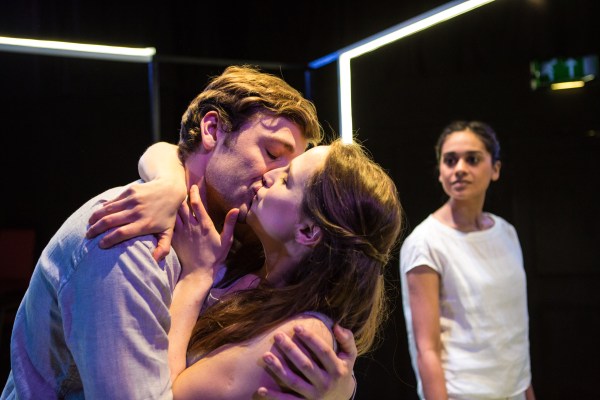
We’re in a club toilet. Not a nice one, either  – there’s no loo roll, lipstick and graffiti pepper the cubicle walls and door. Jess Mabel Jones is an unnamed woman out with a friend, but after a lot of vodka and some coke, she feels self-conscious, past it and wants to hide. Reflecting on the life choices that brought her to this newly-single moment of remorse, she chronicles past lovers, committed relationships, eating disorders, panic attacks, and youthful exploits. Whilst longing for her youthful, perkier self with thinner legs and a tighter arse, she manages to celebrate the woman she has grown up to be in all of her flawed glory. Jones is an absolute firecracker of a performer who slams herself around a robust script baring lived female experience in all its rawness.

Phoebe-Éclair Powell’s text is an extended monologue of fragmented experiences and memories punctuated with pop songs. It doesn’t shy away from visceral topics, though the transitions from text to music are abrupt with little lead-in. The character she paints alternates between vulnerable and endearing, and ferociously bold. She is an everywoman with experiences that most women can relate to on some level and reminds us that despite going through moments of absolute despair and self-loathing, women are incredible.

It’s not just about girl power, though. The character’s anecdotes are funny, moving and compelling stories that are accessible to any human that has grown up, had sex, been in a relationship or felt they don’t meet society’s expectations. She is haunted by the woman she hasn’t become and simultaneously unapologetic about her.

Director Jessica Edwards incorporates plenty of movement, though some seems gratuitous it prevents the performance from becoming static. Amelia Jane Hankin’s set is both industrial, messy and glittery, an outward expression of the character’s spirit.

Jones’ performance is what makes this production worth seeing. She has a stunning voice, emotional vulnerability, and electric charisma. The songs she covers become the millennial generation’s torch songs as she delivers them with a power and depth. She rallies the audience to her side despite behaviour that could be viewed disapprovingly by more conservative audience members because her commitment and connection to the script is as truthful as it possibly can be. Torch is not one to miss.

Torch runs through 28th August.

The Play’s the Thing UK is committed to covering fringe and progressive theatre in London and beyond. It is run entirely voluntarily and needs regular support to ensure its survival. For more information and to help The Play’s the Thing UK provide coverage of the theatre that needs reviews the most, visit its patreon.

Generation Zero, Edinburgh Festival Fringe

https://i0.wp.com/static.progressivemediagroup.com/uploads/imagelibrary/nri/power/projects/Princess.jpg

A nameless couple meet online, fall in love and build a life together. Their lives are comfortably boring, with day jobs, road trips to the beach, holidays in a Yorkshire cottage and lazy weekends snuggling in bed, listening to records. They are almost identical to any contemporary middle class, suburban couple, but something’s not quite right.

Their world is just a bit off. They run out of gas, but they can’t go to the shop to top up their gas meter – they aren’t allowed to exceed their monthly allocation. There’s talk of restrictions on travel in order to cut pollution levels. He’s ambivalent about the environment, but she’s a political activist who devotes more and more of her time to a local group campaigning for change. He wants to spend more time with her, but she’s always out in the evenings, planning actions with the group, so he takes action of his own.

Becky Owen-Fisher’s debut play Generation Zero looks at the battle over the environment through the lens of a young couple in a poetic, episodic script that unsettles through it’s familiarity and the complacency with which (most? some?) people approach political issues. The story doesn’t viciously attack climate change, but takes a gentle, sinister approach that gets into your bones. Owen-Fisher has a good instinct for dialogue and imagery-laden narration that easily flows in and out of naturalism, adding just enough variation in style to keep the audience lightly unsettled.

Director Tom Fox attacks the script with lightening fast transitions; these could be slowed a bit for the sake of keeping up with the actions and the to-ing and fro-ing through time. Without sound and lighting signifiers, they would be totally unclear. Some important moments are also rushed, particularly towards the end, causing the gravitas they should have to be glossed over.More stylised physicality would also be welcome to coordinate with the stylistic changes in text.

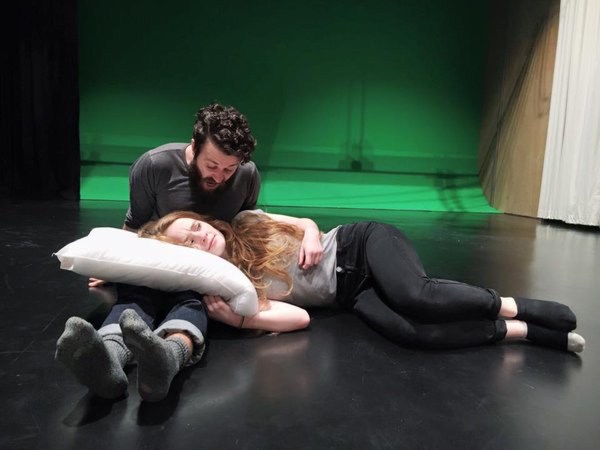
The two actors are excellent; Jordan Turk and Francesca Dolan have a gorgeous chemistry that’s lovely to watch, made more romantic by dream-like lighting. The sheets and pillows covering strip lighting on the stage’s edge creates a lovely ethereal effect, destroyed by their reveal at a pivotal moment that also reveals the truth of their relationship’s dynamic – a great choice.

Perhaps some adjustments could be made to the script to transform it into more of a propaganda piece and place a stronger emphasis on the environmental collapse that is merely hinted at, but to do so would cause the piece to lose its delicacy. This is a promising play from an emerging writer with an important message that deserves to be heard.

Generation Zero runs through 29th August.

The Play’s the Thing UK is committed to covering fringe and progressive theatre in London and beyond. It is run entirely voluntarily and needs regular support to ensure its survival. For more information and to help The Play’s the Thing UK provide coverage of the theatre that needs reviews the most, visit its patreon.

Savage, Arts Theatre

rsz_gary_fannin_and_bradley_clarkson_in_savage_at_the_arts_theatre_c_roy_tan

Denmark in the mid-1930s was a great place to be if you were gay. Homosexuality was legalized in 1933 and a thriving club scene allowed gay men to meet and socialize publicly. But as the dark cloud of National Socialism swept Europe, safety became more precarious. Dr Carl Vaernet was one of their threats. A practicing GP with an interest in hormone therapy, the Danish Nazi Party member soon captured the attention of party higher ups with his therapies that he claimed cured homosexuality. Hired to cure gay prisoners at Buchenwald late in the war, he experimented on seventeen inmates before the war ended and he escaped to Argentina.

Claudio Macor’s latest play Savage focuses more on the story of Nikolai and his American boyfriend Zack than Dr Vaernet, but the lovers are soon separated and Nik becomes one of the doctor’s victims. The emerging subplot of an SS officer and his secret, gay love slave quickly becomes just as important as Nik and Zack, making Savage more of a play about homosexuality in WWII than specifically about Dr Vaernet and his horrific medical experiments. Spanning several years and multiple narratives, the script, sadly, doesn’t give in-depth attention to any particular character; individual stories are disrupted and incomplete. This would be a much more compelling text if Macor focused attention on one primary character rather than taking a scattergun approach. All of these characters have potential to steer a rich, interesting play that focuses on them, but none of them get the full, individual attention they deserve. There are some great set piece scenes, but the overall structure lacks focus.

Some of the performances are inconsistent and the cast present a range of styles, which distracts from the seriousness of the plot. There are a few good performances, though. Gary Fannin cuts a cold, scientific Dr Vaernet with a clear disgust for gay people; this professional face of homophobia and calm hatred is a most chilling one indeed. Emily Lynne as the doctor’s nurse viciously opposes the Nazis and blatantly defies their rules in a display of ferocious persistence. She’s a great contrast to the doctor’s calm hatred. The two pairs of lovers have moments of genuine care for each other, whereas other times feel forced.

Jamie Attle’s costumes are sharp and detailed, whilst David Shields’ set of rotating panels clarify location but are a bit clumsy. Macor also directs, ensuring his political messages get across but an additional pair of eyes could have developed more intimacy between the couples.

Though the topic is most serious indeed, there’s a distinct lack of joy in the beginning cabaret scene and between Nik and Zack. Macor clearly wants to raise awareness of the horrors of Vaernet’s work, but some lighter moments of exposition would emphasise this further. A dramaturg would not go amiss in order to streamline the script and performance styles in future productions, but this premier still has potential and exposes a historical figure too easily forgotten amidst more prominent Nazi war criminals.

Savage runs through 23 July.

The Play’s the Thing UK is committed to covering fringe and progressive theatre in London and beyond. It is run entirely voluntarily and needs regular support to ensure its survival. For more information and to help The Play’s the Thing UK provide coverage of the theatre that needs reviews the most, visit its patreon.

Maggie and Pierre, Finborough Theatre

https://i0.wp.com/www.theartsdesk.com/sites/default/files/imagecache/mast_image_landscape/mastimages/KellyBurke5_PhotoByAshley%20Carter_REDUCED.jpg

It’s easy to see why Justin Trudeau is one of the darlings of world politics these days. This charming former teacher, actor and advocate, turning to politics after his father’s death, identifies as a feminist, wants to legalise marijuana, is pro-choice, gay friendly and committed to the rights of the First Nations and other minorities. Canada’s liberal prime minister attracts groups of screaming fans wherever he goes both nationally and internationally, like any pop star. But where did these attributes come from?

His parents. Maggie and Pierre Trudeau, who met whilst holidaying in Tahiti in the ‘60s when she was a mere 18 years old, were THE Canadian celebrity couple of the 1970s. Pierre was, like his son after him, the prime minister of Canada. Their relationship was flawed, though. Maggie, young, free-spirited and bipolar, soon felt trapped by family life as her intellectual husband busied himself with work. The press’s constant presence also took its toll on their relationship, which the public then poured over in microscopic detail. In 1979, Linda Griffiths’ and Paul Thompson’s Maggie and Pierre premiers, a solo performance tribute to this enigmatic couple. It runs off and on for many subsequent years, a testament to the pair’s appeal.

The script feels quite contemporary, but other than for the purpose of historical documentary, its purpose isn’t clear all these years later. Though the two meet, fall in love and navigate their relationship, life in the spotlight, and the press, there’s no overriding message. It’s unclear why this story needs to be told. It’s a solid narrative over many years with moving insight into these historical figures, but the social and political commentary are limited to brief reflection on their relationship with the press. Perhaps this play would be more satisfying to Canadians or those that already know of the Trudeaus, but for audiences that have never before heard of this couple, there is little impact. It reads like an autobiography. Outstandingly performed by Kelly Burke and worth seeing for her intricate work alone, there’s the feeling that without her, the play would be disappointing.

Burke plays Pierre, Maggie and journalist Henry whose career has hinged on his reporting of their every move. Even though director Eduard Lewis incorporates numerous costume changes to signify a character change, Burke’s physical and vocal mannerisms completely transform into each respective character. It’s a wholly compelling process, a masterclass in performance. Her energy and commitment never falters and her presence is magnetic.

Designer Sarah Booth’s set is simple, but a confusing mix of abstract and functional elements. A huge, bright red quilt with Pierre’s slogan takes up half the stage and is only referred to once, near the end. Its visual dominance is impossible to ignore but it has hardly any bearing on the story. However, Booth’s creation of a bed that’s revealed from a nondescript cupboard is a great device. Philip Matejtschuk’s composition and sound design adds further depth, emotion and context that the set avoids, giving the show a more rounded, polished feel.

As a documentary artefact, Maggie and Pierre is no doubt a learning experience. The couple’s history is an interesting one and the love story is universally relatable. Kelly Burke’s performance is a wondrous thing to experience though, and more than redeems any of the production’s inadequacies.

Maggie and Pierre runs through 5 July.

The Play’s the Thing UK is committed to covering fringe and progressive theatre in London and beyond. It is run entirely voluntarily and needs regular support to ensure its survival. For more information and to help The Play’s the Thing UK provide coverage of the theatre that needs reviews the most, visit its patreon.

Schism, Finborough Theatre

https://i0.wp.com/www.finboroughtheatre.co.uk/assets/images/press-images/schism/pre/Schism-3.jpg

Chicago, 1998. Harrison and Katherine are both struggling. Harrison’s wife recently left him and he gave up a challenging career choice for a safer one as a Math teacher. Fourteen-year-old Katherine’s school cannot see past her cerebral palsy, so she’s not allowed to take “normal” classes. Schism begins when both characters reach breaking point: Harrison is mid-suicide attempt when Katherine breaks into his home to appeal for his help to move into his Math class. This initial meeting spawns a twenty-year long relationship between the two, but not a healthy one. Harrison constantly tries to manipulate and control Katherine, who fights for her independence with progressively underhanded methods. Athena Stevens’ script choppily covers the huge time period in sections, addressing several important issues: autonomy within relationships, abuse, life/work balance, failure and aspiration. A play featuring disability that pushes other topics to the forefront, Schism needs more fleshing out but its messages are loud and clear.

Twenty years is a lot of material to fit into a play and at just over an hour, a lot of the plot is left out. There are about four years between each scene, nicely signposted by a current affairs talk radio show, but pivotal transitions are missing. How does their romantic relationship eventually come about? What are the immediate consequences of his awful behaviour? How does her career develop? How did he manage to keep his job after Katherine, in her final year of high school, hang out at his home regularly? These are unanswered, but easily could be by the addition of more scenes. This wouldn’t effect the episodic nature of the script, but would make the story more satisfying. Despite the clunky narrative arc, Stevens’ dialogue still manages to crackle and easily creates tension. There are some great one-liners that spark belly laughs, and moments that are equally horrifying. As set pieces, the scenes are excellent pieces of writing.

Stevens also plays Katherine and displays a clear sense of ownership over the role. Whether or not there are elements of Katherine in her own life, Stevens performance is emotionally genuine and wholly committed. Tim Beckmann gives a nuanced Harrison who transitions from teacher to lover easily, and maintains an undercurrent of desperation. Alex Marker’s domestic design with the ever-present huge, architectural drawings peeking through the windows is a good reflection of the passion that drives both characters, and director Alex Sims displays a good instinct for portraying the journey of a relationship.

Disability issues are ever present and dictate many of Katherine’s choices, but Schism isn’t about her overcoming adversity. It’s part of who she is, but she has other, more pressing problems – university admissions, bidding for work, whether or not to start a family, and civilian objection to her building projects. Harrison does as well, but they are more psychological and harder to resolve. His inability to cope with Katherine’s success in the field where he failed, his inability to have children with his ex-wife and his inability to let Katherine be an independent woman slowly devour him. It’s compelling to witness. In fact, Schism makes more of a statement about feminism within heterosexual relationships than it does about disability awareness, which is hugely refreshing and shows great progress in theatre equality – Katherine’s disability is a part of her, but only a small one compared to her aspirations.

Schism is a provocative relationship drama that certainly resonates despite the holes in the story. This dysfunctional couple can be both delightful and painful to watch, much like anyone in a modern relationship dealing with the other’s baggage. With some further development, Stevens’ play could pack an even heavier punch.

Schism ran through 14 May.

The Play’s the Thing UK is committed to covering fringe and progressive theatre in London and beyond. It is run entirely voluntarily and needs regular support to ensure its survival. For more information and to help The Play’s the Thing UK provide coverage of the theatre that needs reviews the most, visit its patreon.

Nude, Hope Theatre

Nude- a play by Paul Hewitt - ©HelenMurray-156

A young couple meet, the relationship blooms, then goes through a rough patch and eventually ends when they are much older. Was it meant to be? Are the events in our lives accidental or controlled by outside forces? Within a standard love story, Nude boldly states that fate has the final word over life, death and love. Playwright Paul Hewitt relies on poetry and narration to tell this tiny, intimate tragedy that feels sadly familiar, like flicking through a dusty photo album of mostly forgotten family members whose memories thrive through stories. Poignant and competently executed, with gaps in the narrative that raise plenty of questions, Hewitt’s script skilfully uses language to depict this couple’s journey and the heavy hand that the personified Fate employs to convince us that we have free will.

Hewitt doesn’t rely on metaphors or overly flowery vocabulary in his rhyming poetry. His language is simple, almost pedestrian, but prettily structured and flows easily from the actors’ mouths. There are a lot of words though, and it’s delivered so quickly that there isn’t much time for in-depth processing. The narrative is a bit chunky with large sections missing and the length of time passing is consequently unclear. His characters are lovely and easy to relate to, though the heteronormative, white, middle class casting of the nameless everyman and woman, that are the focal point of this story, uncomfortably captures the lack of diversity theatre still struggles with. This is countered by a diverse production team and Fate, but romantic leads still lack diversity all to often.

Michelle Fahrenheim and Edward Nash are the charismatic couple controlled by Roshni Rathore as Fate. The three have a relaxed, watchable confidence and natural chemistry, though Fate clearly has the upper hand at all times, even when watching from the peripheral shadows. It creates a great dynamic that’s reminiscent of Prospero or a serious Puck.

Minglu Wang’s minimalist cube that contains the couple in the middle of the space is used well by director Ian Nicholson. Nicholson also incorporates some symbolic black thread, creating a sinister web that further traps the Woman and Man inside their box. This device could have been used more heavily to create a stronger sculptural effect, but was still a nice touch. Creating a space in the round emphasises the idea that the couple are constantly watched and controlled by outside forces – a canny choice.

Though Hewitt’s intention is to focus on a wider philosophical idea, his couple’s story steals the spotlight. Their timeless romance is achingly tragic and well executed textually and through Nicholson’s staging. Nude manages to move the heart even with its small faults, and taps into timeless truths about love, fear and loss.

The Play’s the Thing UK is committed to covering fringe and progressive theatre in London and beyond. It is run entirely voluntarily and needs regular support to ensure its survival. For more information and to help The Play’s the Thing UK provide coverage of the theatre that needs reviews the most, visit its patreon.


How To Survive a Swarm of Bees, Bread & Roses Theatre

The heaps of white pillows that cover most of the stage make How To Survive a Swarm of Bees look like a slumber party or a kids’ fort, something with a lot of fun and giggles. But Anna Crace’s short play is far from the happy cuddliness implied by the set. With a Scandi aesthetic in both design and dialogue, this austere piece of new writing gives little away except for the looming apocalypse Of a massive storm and a swarm of bees that threatens the existence of two young couples barricaded into their homes. The minimalist text bears more than a passing resemblance to Beckett, but it’s so sparse that there isn’t much depth or substance despite the interesting premise.

The unnamed hetero couples in their early 20s live separately, but their lives and conflicts parallel each other in the moment. Rather than the somewhat disappointing story, the most interesting feature is the intertwining scenes where the characters occasionally swap partners (not that way, pervert) without acknowledging the change. The device is gently disorientating, aiding the distance from reality that creates a state of reflection in the audience. These four are Every Men in the face of a crisis, with fear, anxiety and need that manifest in four different ways. We can relate to them all, but know they are not of our world.

The lack of action and a threadbare story is frustrating, through. The only thing the four do is talk around the problem and argue, and shift pillows around in their confinement. What exactly is going on in the world? Disappearing news broadcasters and friends choosing to live underground are never fully explained. Why is the world reacting so strongly to a storm? Why are these couples fighting about staying in their homes with the buzzing growing ever louder? They allude to consequences of nature creeping into the house and “the nets” failing, but what are these consequences? It’s never revealed, but easily could be by lengthening this script by another twenty minutes or so.

There is some distinction between the different characters, but other than Laurie Ogden’s agoraphobic young woman, the rest are very similar. Should we stay or go? How long can we realistically eat the soup we’ve stockpiled? How will our relationship hold up with our choice? What do we do if one stays and the other leaves? These questions are debated, but never really answered. The end of the play is abrupt and feels like an interval; some audience hang around for a while and then, confused, head into the night.

The four performances are fine, but tend towards minimalist reflection as well. Though inherently theatrical in structure, elements of this script would be great for telly. The intimacy works well in small fringe theatres, but would most likely come across as flat anywhere larger.

Anna Crace is certainly onto some interesting ideas and design concepts in How To Survive a Swarm of Bees, but the need further development and clearer means of communication.

How To Survive a Swarm of Bees runs until 20th March.

The Play’s the Thing UK is committed to covering fringe and progressive theatre in London and beyond. It is run entirely voluntarily and needs regular support to ensure its survival. For more information and to help The Play’s the Thing UK provide coverage of the theatre that needs reviews the most, visit its patreon.

Auld Acquaintance, Bread & Roses Theatre

Imogen and Jake are a trendy, young couple with a new born daughter. It’s nearly Christmas and they are at their mother’s house with Jake’s brother Rob and his wife, Natasha. Everything should be perfect, but it’s far from it: Jake and Rob’s mum is dying in a hospice, Imogen has fallen out of love with Jake whilst struggling with post-natal depression, Rob and Imogen hate each other but Imogen and Natasha are old school friends with an intimate secret.

This one act play by Natalie Audley, newly re-worked for London after a 2014 run at Brighton Fringe, still needs some refining. There are some killer one-liners and painfully spot-on insight on fertility and relationships, but an abrupt ending and wordy lines that uncomfortably stumble from the actors’ mouths give the script a weight that goes against it comedic instincts. The pace varies, but feels slower than it ought to. Audley clearly leans towards poetry and language-driven plays, but some trimming here and there would go a long way.

Performances are mixed and take some time to find their rhythm. Charlie Lees-Massey is by far the best of the cast of four as Natasha. Her moment of surrender to Imogen (Emily Ambler) is sexy as hell, and she maintains a consistent energy and believability throughout. Ambler’s best moments are with Lees-Massey, as are Tom Everatt’s at Rob. Matthew Corbett as Jake seems awkward throughout, though this could be a character choice. Director Courtney Larkin deftly moves her actors around the tiny stage without it feeling crowded or blocking sight lines.

There’s still a clunkiness to the script but further expansion and chiselling will refine the dialogue and turn this into a polished piece of contemporary naturalism. The issues presented are crucial ones to examine on stage, especially as they are told from a female perspective and with a 50/50 gender split cast, but more development is crucial to give them the power they deserve.

The Play’s the Thing UK is committed to covering fringe and progressive theatre in London and beyond. It is run entirely voluntarily and needs regular support to ensure its survival. For more information and to help The Play’s the Thing UK provide coverage of the theatre that needs reviews the most, visit its patreon.

Fucking Men, King’s Head Theatre

rsz_richard_de_lisle_&_haydn_whiteside_2__f-cking_men_c_andreas_griegerSchnitzler’s La Ronde has been remade dozens of times and might be coming back into fashion again, what with the recent Hope Theatre production of Hello Again. Joe DiPietro’s Fucking Men follows Schnitzler’s format but sets the 2008 story in gay New York. The show also has the distinction of being the longest running show on the London fringe beginning with it’s 2008 Finborough run and followed by several transfers and extensions. After a brief break, it’s back at The King’s Head. At an hour long, three actors play all ten characters in ten brief scenes, too brief for much character development (with a few exceptions), but an effective snapshot of the ability sex has to cut across social groups.

Performances vary with the character, but the actors’ energy and commitment is consistent. Richard De Lisle excels as the other married guy and the journalist, the latter particularly moving. Harper James entertains as the enthusiastic “straight” soldier who likes to fuck guys and has a satisfying character journey that we see though the adorably sweet Hayden Whiteside as the escort. The short scenes lend themselves to stereotypical performances that are tough to fight against; this is a play that could definitely do with lengthening.

The small stage and Jamie Simmons’ universal set pieces are used well but some of the transitions take too long. His costumes give good character identification, important in scenes that aren’t long enough to have much exposition. Mark Barford’s direction is conservatively sexy: there’s a changing room scene with full frontal, but that’s it. Otherwise, all bits are covered at least with pants, with a bit of bum here and there. A bit more nudity wouldn’t be gratuitous, but neither is it necessary, either.

Despite the sex, this play is about the immediacy of relationships formed in passing encounters and the loneliness they can embody. The LGBT vehicle brings up issues more common in the gay scene (like monogamy and HIV), the overriding desperation for human contact transcends gender and sexuality.

This is a tender, fun production that deserves development and a good counterpoint to the camp Mirror Mirror: A Snow White Pantomime on earlier in the evening. Though not explicitly seasonal, Fucking Men is an important reminder that even during the holidays, some people are still lonely and desperate for even the most fleeting of human contact regardless of how comfortable their lives may be otherwise.


The Play’s the Thing UK is committed to covering fringe and progressive theatre in London and beyond. It is run entirely voluntarily and needs regular support to ensure its survival. For more information and to help The Play’s the Thing UK provide coverage of the theatre that needs reviews the most, visit its patreon.

Torn Apart (Dissolution), Theatre N16

rsz_1broken_heart_by_chain_saw

Love is one of the best things in the world, or the worst. It feels like floating, butterflies, warmth and fuzziness, or being trapped in a cage with no way out. Everyone wants to love and be loved, but when it backfires, the effects are devastating. For life, sometimes. Torn Apart (Dissolution) presents three interconnected relationships across generations and international borders. These people are broken at worst or dysfunctional at best, which makes for some good dramatic tension but the playwright BJ McNeill’s structure, style and storyline deteriorates towards the end. Some lovely set-piece scenes, a few good performances and a powerful set design help offset these issues, but new company No Offence Theatre need to continue developing their ideas in order to better showcase them.

The international company founded by two actors, Australian Hannah Kerin and Polish Natazja Somers is admirably diverse, and the play suits their strengths well. Complimented by Simon Donohue and Elliott Rogers, they form two couples that are related but never met. Rogers, at only twenty years old, possesses a presence and rich emotional range rare in a performer so young. He is excellent contrast to his carefree girlfriend Casey (Kerin) and the two fill the intimate Theatre N16 wonderfully. Somers and Donohue as Alina and an unnamed soldier have a more mature, world-weary energy that add another layer of contrast. Less developed are scenes with lesbian couple Holly (Katherine Eskenazi) and Erica (Monty Leigh), but they create a rare and commendable female-strong cast. The action flips between these three couples’ stories, revealing their connection at a good pace.

Szymon Ruszczewski’s set is simple but evocative. A bed with white linens sits in the middle of the stage, inside a white cube with threads creating walls the audience can see through – or thin bars, trapping the unhappy couples inside a generic, characterless bedroom. Ruszczewski has also designed the lighting, which is the most successful plot I’ve seen in this low-ceilinged theatre with several nooks and crannies that tend to cast stark shadows.

McNeill also directs. There’s a good use of diagonal lines so all sides can see, but some odd choices as well. Gratuitous female toplessness doesn’t add anything to the story. If the point is that the audience is witnessing private, intimate moments, why isn’t everyone naked when they’re having sex? He also doesn’t include a curtain call; this is incongruent with the naturalistic style of the piece that has a literal fourth wall. Several of the characters toy with the strings that make up the set walls, which makes their meaning jarringly ambiguous – are they walls, or are they bars, or are they just strings? Structurally, the last couple of scenes change style, and neither develops the plot. Ending with the last soldier/Alina scene would be abrupt, but a reinforcement of the horror that lurks in some relationships.

There is definite potential in this new company and their creatives, as well as scope to continue developing and refining their work. Their goal to create truly international work not limited by where their artists are from is a wonderful one that will garner them more attention with the overall increase in quality of their work.


The Play’s The Thing UK is an independent theatre criticism website maintained voluntarily. Whilst donations are never expected, they are hugely appreciated and will enable more time to be spent reviewing theatre productions of all sizes. Click here to make a donation with PayPal.