Feature/Review: Children & Shakespeare, Edinburgh Festival Fringe

https://i0.wp.com/unknownmagazine.co.uk/wp-content/uploads/2015/07/York-3-credit-Rob-Freeman-1-1024x683.jpg

Whilst there’s plenty of Shakespeare at the fringe, it doesn’t get much coverage. It’s understandable – the Bard doesn’t count as a potential Next Big Thing, and he’s favoured by student and international groups that usually have short runs and are deemed less worthy of critical attention. It’s obviously necessary to recalibrate expectations and vocabulary when evaluating children and young people’s performances, but directors and teachers can and should be held accountable for the quality of their own creative work and bringing out the best in their students or young cast. They do have the additional pressure of incorporating an educational element and ensuring that their work is suitable for the children and young people they are working with, but that specialism is no more or less different than any other in the performing arts.

To completely ignore young people’s work at the Fringe when sampling the Shakespeare on offer cuts out a large segment of the Shakespeare productions on offer, and considering that these are often international schools as well, the cultural differences can be considered when critiquing. Over one day at the fringe, I watched three distinctly different Shakespeare adaptations – a Scottish stage school including children approximately aged eight through sixteen that looks at Twelfth Night, an American university’s analysis of Shakespeare’s baddies and a Notts young people’s dance-theatre company’s deconstruction of Macbeth.

Admirable Fooling or What You Will by Little Shakespeare School’s Michelle van Rensburg had the most challenging remit in that it is a show suitable for performers over a big age range, but the show she invents is a nonsensical mess. When she sticks to her simplified script with sections of original text more the more able students, it is standard children’s fare – able to be followed, giving the kids a chance to show their skills and including everyone. The random sections from Titanic, though? Inexplicable. None of the children on that stage or in the audience would have even been alive when the film came out, so crowbarring in pop culture references that they wouldn’t understand is gratuitous and self-absorbed. There are also numerous off-text clowning sequences that are unconnected to the story, and a lengthy exposition setting up a storytelling premise that isn’t consistently followed through. The one, shining moment of kitschy, creative inspiration that epitomises fringe Shakespeare is the tiny blond girl who plays the letter Malvolio finds in the garden. She wears a bright yellow sack with felted letters on either side and enthusiastically delivers the text that Malvolio reads from the letter in Shakespeare’s original. She looks about eight years old, maybe nine, certainly no more than ten, and it is an adorable thing of wonder. There are some good actors who are confident and speak well, particularly the eldest girl who plays Olivia, but the show itself is a baffling construction with little through-line or sense.

Bad Shakespeare, by Oklahoma State University drama students, isn’t bad, but it’s just as much of a lecture as it is a performance. Showcasing their intensive summer Shakespeare studies, they work their way though Shakespeare’s development of his villains. The exposition that sets up their five act structure is too long, but the acts’ increasing complexity is a nice touch. Most of the ethnically diverse ensemble are good performers, and all bar one are women – great work towards increasing diversity from the programme director. They handle the language and verse with muscularity and confidence, though there is no evidence of work towards convincingly playing men. Their emotions tend to read more as upset rather than angry or vindictive, and their physicalities are distinctly feminine. The show’s director has chosen faux-period costume; some are in dresses and some in doublet and hose. Neutral, modern dress would suit much better, especially considering the large amount of instructing the audience with contemporary language and pop culture references. Bad Shakespeare is great for learning more about Shakespeare’s characters and some of the scholarship behind them in a relaxed, easy to follow format, but it’s more of a learning experience than a show. However, they wear their confidence and passion for Shakespeare on their sleeves, which is a wonderful thing to see.

Fortitude Dance Theatre’s Macbeth has potential to be the most promising of these three adaptations, and whilst it certainly has some great moments, there are also some misguided creative choices and interpretations, and an inconsistent application of style. The young company demonstrates competence in their dance and verse delivery, though as a whole, they struggle with achieving moments of emotional intensity and staging on a  thrust. The pace was great, but tone consistently conversational. Their opening sequence was a great capture of the 90’s club scene with text and contemporary dance obviously inspired by Frantic Assembly, but the dance element is absent until the discovery of Duncan’s body, about half way through this abrupt edit. There are missed opportunities to incorporate movement into Macbeth and Lady Macbeth’s scenes showing their fluctuating power struggle. This dynamic between characters later between Macbeth and the witches inspires some good tribal, threatening choreography. Macduff’s monologue on hearing of his wife and children’s deaths is a stunning blend of movement and text that the company could to stylistically inspire their future work. They could also do with a stronger director, or dramaturg familiar with Shakespeare pronunciation, to confirm any line interpretations – “Out, damn spot” is not referring to blemishes on her face.

It’s brilliant to see young artists finding their way through making work and discovering styles and forms that work for what they want to communicate in their Shakespeare interpretations. Even though they won’t be up to professional performance standard unless they are extraordinarily gifted, their teachers and directors should be strive for clarity. Though none of these three productions quite reached that point, they each had their merits and watching children and young people discover and explore the joy of performing is a marvelous thing.

The Play’s the Thing UK is committed to covering fringe and progressive theatre in London and beyond. It is run entirely voluntarily and needs regular support to ensure its survival. For more information and to help The Play’s the Thing UK provide coverage of the theatre that needs reviews the most, visit its patreon.


Hardy Animal, Battersea Arts Centre

https://sites.google.com/a/georgetown.edu/mdarts/_/rsrc/1439559537290/units/unit-3/section-2/performance-laura-dannequin-s-hardy-animal/Dannequin.png

What happens when a dancer and performance maker loses the ability to dance due to chronic pain? She makes a solo dance piece with hardly any dance in it. A mix of emotive description, encounters with medical and health practitioners, and her own research tell the story of an injury and the subsequent pain that wouldn’t leave her body. Pointedly still and so quiet that she needs a mic, Laura Dannequin’s resilience makes a compelling piece of solo storytelling that mourns the dances her body wouldn’t allow her to make.

An impassioned monologue about all of the dances she wants to create is followed by a voiceover describing her dancing, whilst Dannequin stands perfectly still. Though her expression gives away nothing, she exudes a sense of loss; the simplicity and contrast between aural and visual imagery are captivating and heavy with grief. A sequence of small flexing movements of her bare back against a litany of treatments and diagnoses she sought from all over the world creates a similar effect, this one with added existentialism and frustration with a medical community that still knows precious little about the human body and its mechanisms. It’s captivating viewing in its simplicity.

Much of the piece examines Dannequin’s relationship with her body and her pain. It becomes a separate entity that she confronts with a range of emotions and dogged research to understand why hers is so persistent. There’s a scientific lecture on types of pain and her own educated theories, but like the rest of her piece’s components, there’s an emotional undercurrent that carries her words. A cathartic climax celebrates her mysterious recovery and the overarching effect is one of beauty and wonder.

Dannequin miraculously withholds the anger she is more than entitled to feel, instead she shares a grounded story of bodily rebellion imbued with emotion and strength. Hardy Animal is a piece of simple, quiet beauty that doesn’t let itself be bogged down with science or negativity.

Hardy Animal ran from 28-29 April and tours regularly.

The Play’s the Thing UK is committed to covering fringe and progressive theatre in London and beyond. It is run entirely voluntarily and needs regular support to ensure its survival. For more information and to help The Play’s the Thing UK provide coverage of the theatre that needs reviews the most, visit its patreon.

Closer, Udderbelly at Southbank Centre

https://i0.wp.com/www.udderbelly.co.uk/images/made/images/uploads/closer_for_web_750_500_60_c1.jpg

Five performers gleefully throw themselves around the stage inside Southbank’s upside down purple cow. Displays of tumbling, trapeze and acrobatics abound, but what makes Australian company Circa’s show different from other circus isn’t their physical skill. Closer is full of unadulterated joy and celebration of human intimacy. Personality is on show as much as circus skills are, and Closer is a powerful reminder to share our emotions with those around us because it feels great to connect with others.

The ensemble of five begin with a sequence more akin to contemporary dance than circus. It suits the show’s pared back aesthetic of black costumes on a black stage that draws all focus onto their movement. Without the spectacle now common in modern circus, there are only bodies in space and their relationships with each other. It’s a refreshing change from the often vapid glitz and glam that draws attention away from the performers. Even the sections with equipment and props keep it simple: a white rope, plain wooden chairs, single coloured hoops. Every other sequence is acrobatic and balancing on each other, showcasing feats of strength and agility and how bodies can interact with each other. These numbers are by far more interesting than the solo displays of trapeze, hula hooping, hand balancing and rope work, though they are not without skill.

There is no narrative framework, and the simplicity is reminiscent of children at play. Emotions are clearly expressed facially, be they resentment, longing, or happiness. They’re a joy to watch, even if the plot they act out is a secret looked in their own minds as they hug, cuddle and throw themselves into each other’s arms. Obviously circus performers are often in contact with each other’s bodies, but the usual lack of expression doesn’t facilitate character relationships. Here, though there are no explicit characters, the ever-changing relationships between the performers are always clear.

The promised intimacy was plentiful between the performers, but less so with the audience. Udderbelly isn’t a small venue by any means, so even though the front row might feel a thrill from the performers being so close, the back row’s experience is more diluted. There is some audience participation but in this large, nearly full venue it still doesn’t stretch to the “intimacy” label.

Closer is not typical contemporary circus, and it’s all the better for it. Apart from the corporate sponsor’s logo emblazoned across the backdrop before the start, Circa’s work avoids the pitfalls of the form; instead it looks at the basics of human interaction through movement and circus. The performers’ bodies moving through space and stretching themselves to physical limits demonstrates what we do for the people we love without any sequins or glitter.

Closer runs through 12 June.

The Play’s the Thing UK is committed to covering fringe and progressive theatre in London and beyond. It is run entirely voluntarily and needs regular support to ensure its survival. For more information and to help The Play’s the Thing UK provide coverage of the theatre that needs reviews the most, visit its patreon.
Institute, The Place

rsz_gecko-pcte2pct80pct93-institute-e1423864432429

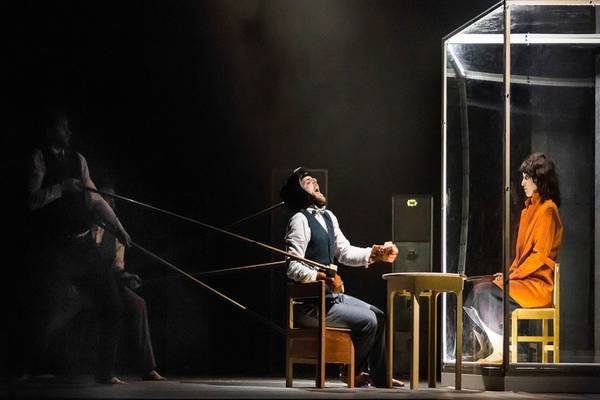
Say your only close friends are people you work with. Can you trust them to help you out if you’re struggling with your health? Martin’s mental health is deteriorating, so Daniel, Louis and Karl try their best to care for him despite their own inner demons and needing to be looked after as well. With a distinctive physical vocabulary and a masculine camaraderie, Gecko’s Institute is an absorbing look at a society made of lonely, needy people without the safety net that family can provide.

Rhys Jarman and Amit Lahav’s deceptively simple set of Victorian wooden filing cabinets is loaded with the possibility of discovery and serves as a convenient place for the characters to store their memories, good and bad. The moments that new items are revealed are a wonderfully surprising juxtaposition to the hulking, boxy structures. Lahav and Chris Swain’s lighting design dark and atmospheric, sharpened by the addition of otherwise unnecessary smoke. Both serve the choreography well, without drawing too much attention onto the design.

Lahav also directs this devised piece, and performs as Martin. Considering he is also the artistic director of the company, it is a true marvel, and a testament to his talent, that none of his production roles suffer. He seemlessly incorporates multiple languages and regular movement sequences that are tightly choreographed and emotive expressions of his characters. The characters puppeteering of each other is a powerfully visualised (and sometimes sinister) metaphor of helplessness at the hands of external forces and the support that peers can offer – or not offer. It’s a visually arresting comment on the support and limitations of others on our individual lives.

The strong sense of brotherhood imbedded in the choreography is a lovely thing to witness. There’s a physical comfort the performers have with each other that blends with the characterisation, making the moments where they treat each other badly all the more shocking. The single female character, Martin’s imaginary girlfriend Margaret, is inventively shown, through costume and movement, but her appearance in a plastic cube is anticlimactic. The whole piece starts to feel too long towards the end, though none of the scenes are gratuitous.

Institute is typical Gecko fare, but the character’s relationships and externalised emotions are the finest features in this physical theatre performance. It’s some of best, most reliable physical theatre work out there at the moment, and Gecko retain the ability to surprise as well as showcase their unique theatrical language.

The Play’s the Thing UK is committed to covering fringe and progressive theatre in London and beyond. It is run entirely voluntarily and needs regular support to ensure its survival. For more information and to help The Play’s the Thing UK provide coverage of the theatre that needs reviews the most, visit its patreon.
Macbeth, Young Vic Theatre

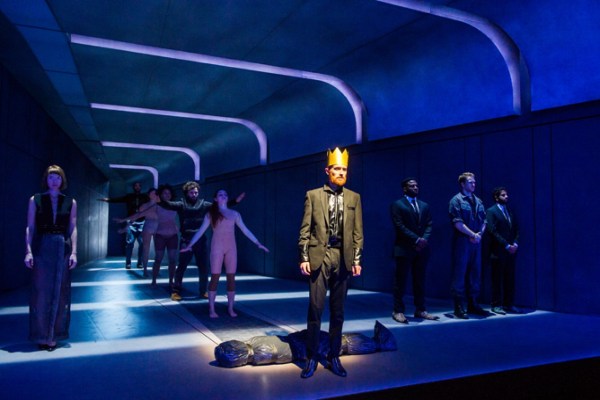
Though drastic re-imaginings of Shakespeare’s plays can show the contemporary relevance of his workgroups the use of a clear, justifiable concept, randomly slapping on cool ideas has the opposite effect. Alienating and confusing, the audience can go away with no more understanding of the story than they came in with, and the director’s decisions look masturbatory and self-indulgent. If a new perspective or insight isn’t provided on a play that the audience is likely to already know or have seen, then there is absolutely no point to adding a concept at all. Such is the case with Carrie Cracknell and Lucy Guerin’s Macbeth. With a text cut to ribbons, lengthy contemporary dance sequences inserted, generically quirky witches and inexplicable doubling, this production is a fine example of how contemporary Shakespeare concepts for the sake of edginess fails to communicate anything to the audience.

An optical illusion of a set by Lizzie Clachan and Neil Austin’s lighting ensures every moment could make a stunning photograph with stark shadows and forced perspective. This isn’t an art exhibition, though. The cold, industrial feel supports the mood of the play but lacks the sumptuousness that the Macbeths kill for. The rarely changing set doesn’t delineate space or place well, merging this world with the next. In some scenes this works, but it’s hard to follow where the characters are, particularly with the liberal cuts to the text. A home or a Heath? Scotland or England? Bedroom or banquet? It’s easy to lose track, even knowing the play well.

The witches, wearing beige dance wear, twitch and spasm around the space, sometimes with other characters joining in to create a repetitive, robotic movement machine. Why? I genuinely don’t know. There’s a hint of a lack of self-control but the repetition counters that effect. They also double for the child characters, which causes them to lose their power and inhuman-ness. Their movement sequences are entirely too long and lack any support for the narrative, though they are distinct from the other characters.

Fortunately, some of the performances are quite good. John Heffernan as Macbeth is a flawed man we see unravel, though this process is forced due to the cuts in the first half of the play. Anna Maxwell Martin on the other hand is rushed and deadpan, completely disregarding the verse and therefore flattening it. Prasanna Puwanarajah is a good Banquo, though the choice to have his ghost narrate the “out, damn spot” monologue was completely ineffective and nonsensical. Despite a disempowerment of the smaller roles due to the textual edits, the rest of the cast perform with energy and commitment.

There is a litany of further poor choices that show a value of style over substance in this production, and despite the directors’ need for weirdness, the whole thing comes across as generic and pointless. The stylised, lengthy movement sequences make no comment on the world of the play or its inhabitants, and with so much of the text removed, this Macbeth is very much “a tale…full of sound a fury, signifying nothing”.

The Play’s the Thing UK is committed to covering fringe and progressive theatre in London and beyond. It is run entirely voluntarily and needs regular support to ensure its survival. For more information and to help The Play’s the Thing UK provide coverage of the theatre that needs reviews the most, visit its patreon.

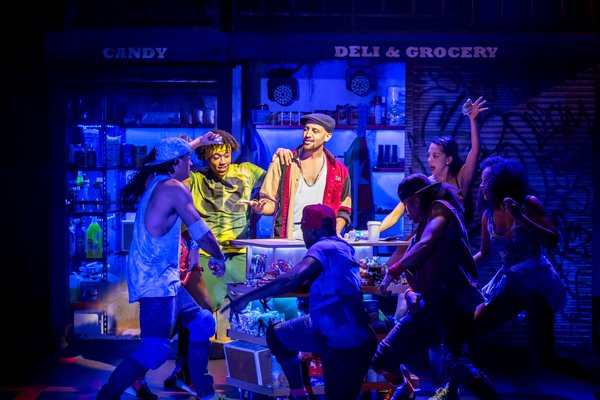
In the Heights, Kings Cross Theatre

rsz_sam_mackay_as_usnavi_and_the_cast_of_in_the_heights_photo_credit_johan_persson

Way up in Manhattan, so far north that it’s nearly the Bronx, is Washington Heights. You take the A or the 1 train to 181 Street to find this primarily Hispanic neighbourhood that’s not on any tourist radar. In the Heights shows the day-to-day struggles and celebrations of a group of residents on one block far removed from downtown prosperity with a soundtrack of salsa, hip-hop and poppy musical theatre.

The songs are the most innovative aspect of this mostly-sung musical with a stellar cast, but the book is rather sparse and the large cast of characters means it’s a cracking ensemble performance with frustratingly little development for any one character. The book and lyrics rely on stereotypes of Latino immigrants in New York City, though it both fulfills and destroys them within the diverse array of characters. The story feels rather tenuously squeezed around the songs with the dialogue serving as a plot point connector; most, of the scenes aren’t substantial enough to stand on their own. But, going back to the music, the songs make up the bulk of this musical and create a fabulous atmosphere complimented by excellent design. The Latin and hip-hop tunes are the best and most original, resulting in a fun evening and a memorable soundtrack.

This production is the same one that received numerous accolades and award nominations last year at Southwark Playhouse, and deservedly so. The Kings Cross Theatre suits this show well, with a wide traverse stage and audiences on either side, creating intimacy and suiting Drew McOnie’s circular, street party choreography. There are still design relics from The Railway Children, but Takis’ urban set and Gabriella Slade’s bright, revealing costumes pull the focus onto this completely contrasting world. With the performances practically in the laps of the front rows, it’s hard not to get up and dance. Some people do during the curtain call.

It’s not all a party, though. Nina (Lily Frazer), the first of the neighbourhood to go to university, has dropped out after her first year. Her father Kevin (David Bedella) hates her boyfriend Benny (Joe Aaron Reid) and is furious about Nina’s deceitful behaviour. Corner shop (or “bodega” in NYC lingo) owner Usnavi (Sam Mackay) and salon owner Daniela (Victoria Hamilton-Barritt) are getting priced out due to rising rents. Others came here for a better life only to find themselves cleaning houses and pigeonholed by poverty. The joy in this show comes in the characters’ ability to party and find solace in each other in the face of adversity – a powerful message for modern times.

I wanted to know more about these characters, though. This is a “slice of life” show that tries to fit in a lot of big personalities and backstories in a short amount of time, so the main characters and their tales have little space to grow. The storyline feels rushed and the ending, though a happy resolution, is a bit too “musical theatre twee” for a world that’s poor and gritty, albeit one soaked with colour and excellent music. It’s still possible to be pulled into this little stretch of Washington Heights in the height of summer and to want to dance the night away to this extraordinary blend of Latino, rap and musical theatre.


The Play’s The Thing UK is an independent theatre criticism website maintained voluntarily. Whilst donations are never expected, they are hugely appreciated and will enable more time to be spent reviewing theatre productions of all sizes. Click here to make a donation with PayPal.

The Emperor Jones, Lost Theatre

Whilst visiting a Caribbean island about 100 years ago, Brutus Jones, an African American train driver, some how ends up emperor of the island’s native tribe. His reign is brutal, so Jones knows it will eventually end. Eugene O’Neill’s 1920 The Emperor Jones begins with Jones’ initially relaxed attempt at escape from the uprising citizens, and inevitable guilty descent into the madness of a Shakespearian villain. The script is entirely spoken by Jones, barring the first and last scenes, with his madness peppered with ghosts that won’t let him rest in the darkness of the island’s woods.
The ensemble cast add variation with movement, dance and music, breaking up the lengthy monologue that comprises most of the play. The Afro-Caribbean style dancing and ritual bowing designed by movement director Diane Alison-Mitchell compliment the set of heavy, distressed drapes that become a throne room, forest and road. The dance and movement plays a vital role in determining the setting, as the script largely neglects this. The time period is also ignored in the text, but also smartly indicated with generic peasant costumes by Sorcha Corcoran. Director Ursula Campbell effectively unites the design elements, rounding it off with Fasier Milroy’s dark sound and lighting.

It’s an interesting play choice for Black History Month considering how unlikeable the title role is, but shows episodes from African-American history in Jones’ hallucinations, and can provide some insight into Caribbean island life. What is also worth considering is that The Emperor Jones was written by a white man prior to US integration and features a black leading man who speaks in the vernacular of the slave generations, but O’Neill was the son of Irish immigrants, a nationality on the receiving end of much discrimination. Though initial pathos towards Jones is impossible, there is room for it to develop over the course of his collapse. O’Neill’s script is similarly wordy and slow to develop tension, not gathering momentum until roughly half way through. It employs several different performance styles including early realism that although experimental at the time of writing, feels dated now.

RSC, National and Globe veteran Mark Springer is egotist Brutus Jones. His arrogance, written into the script, takes a long time to break down; this limits Springer’s range until he starts to lose his mind after which he splendidly falls apart. His second in command, Smithers (Matthew McFetridge), is the bearded manipulator that keeps his cards close to his chest when advising Jones of the people’s revolt. The rest of the cast who form an ensemble are good, but underused.

The issue with The Emperor Jones isn’t the production in this case, but the script itself. Despite considered design and production elements, it becomes clear why this play is rarely produced in the UK. It has little relevant to modern British society and Jones’ narcissism, whilst no doubt fun to play, is much less fun to watch and drags on for too long.


The Play’s The Thing UK is an independent theatre criticism website maintained voluntarily. Whilst donations are never expected, they are hugely appreciated and will enable more time to be spent reviewing theatre productions of all sizes. Click here to make a donation with PayPal.

Edinburgh Festival Fringe, 13 August: Part One

It’s fair to say that I’m not generally drawn to comedy or light subject matter. My favourite theatre is intense, serious and powerful, often with a heavy dose of suffering and/or death. I might need a break from all the despair after today, though. From mental health to forced prostitution to the government breaking up families, I’ve been put through the emotional wringer. These four productions are radically different in style and execution, catering to diverse audiences, but all are excellent offerings at this year’s fringe.

my-beautiful-black-dog_681x500My Beautiful Black Dog at Udderbelly Cowgate is a rock musical/gig/spoken word/live art show created and performed by southeast Londoner Brigitte Aphrodite. It celebrates her depression, or as she calls it in attempt to accept it as part of who she is, Creshendorious. There is glitter and sequins everywhere, emphasizing her party girl highs and contrasting her lows. Aphrodite is honest, frank and a highly skilled wordsmith in her songs and spoken text. Her songs manage to be both dry and celebratory; they create a party-like atmosphere that has the audience dancing and laughing along. It is rough and ready, and intimate, like a secret basement gig by your favourite band. The projected images and song titles added an element of set, but weren’t particularly needed and sometimes hard to see on the theatre’s brick back wall. On stage with her is Quiet Boy, who provides backing vocals, guitar accompaniment and a character who tries to coax her out of the road case she sometimes hides in, but it is very much Aphrodite’s show.

The party vibe abruptly drops when Aphrodite reads a (glittery) letter that explains exactly how she feels when she is fighting her black dog. Her honesty is brutal, but necessary. My Beautiful Black Dog takes a (sequined) tyre iron to the stigma and silence surrounding mental health issues. In these moments, the shine is a shallow sticking plaster, trite and useless. Rather than ending on a somber note, she ends on a song – not a happy ending, but a hopeful one. Aphrodite knows her depression will return, but next time may it be with understanding and acceptance from those around her. This production is difficult to experience, particularly if mental health issues affect you. It forces open a dialogue about mental health issues and even though it a (sparkly) genre mash-up, it is a vital show that could be scaled up to a big show, complete with lights, confetti and the sparkle it deserves.

Blind_Mans_Song,_Edinburgh_Fringe_2015,_courtesy_Francois_Verbeek_1_751x500Blind Man’s Song in Pleasance Dome is Theatre Re’s non-verbal dance theatre offering this year. As blind man Alex Judd plays keyboard and electric violin, a masked Guillaume Pigé and Selma Roth personify the images and emotions in his head. There is love, violence, travel, and a host of other encounters between the characters. There are moments of narrative, but this piece is very much open to individual interpretation. A simple, black set paired with smoke, side lighting and timeless costumes evokes the silent film era or a painting coming to life. The soaring emotion in the blind man’s music could imply that these are his memories or dreams. The mood and music varied enough throughout to maintain audience attention, and the performers’ skills in dance and mime were evident. It’s a captivating watch, if a little long. Sadly, some of the audience members were less appreciative. An older couple noisily left part way through and an American voice a few rows back at one point proclaimed, “This is stupid.” Abhorrent behaviour.

The music is richly augmented by a recorded track, but deliberately repetitive and grating at times. I found my mind wandering occasionally, but this was due to a moment triggering my own imagination. The young boy sitting in front of me had some lovely responses to the piece that drew my eye away from the stage: at times he conducted the music, at others he swayed mirroring the performers on stage, or wiggling abstractly in a dance of his own. Blind Man’s Song certainly triggers strong reactions from its audience though strangely, not all positive. It is a meditative, evocative performance if an individual permits it to be, but perhaps a challenging offering to our short attention spans.


The Play’s The Thing UK is an independent theatre criticism website maintained voluntarily. Whilst donations are never expected, they are hugely appreciated and will enable more time to be spent reviewing theatre productions of all sizes. Click here to make a donation with PalPal.

Butoh Beethoven, Edinburgh Festival Fringe

web.phpCulture vulture audiences will know Beethoven, but may not be familiar with Butoh, the Japanese modern dance developed out of the devastation of WWII that translates to “darkness dance”. It wholly rejects the conventions of classical dance by tapping into the inner life of the dance’s subject. In this case, the eponymous composer and Butoh founder Hijikata Tatsumi inspire french creator and performer Vangeline.

A row of pig masks on the back wall of the tiny theatre watches this non-speaking show that embraces the grotesque. Vangeline is dressed in a glowing white, glamorous gown made of shirt sleeves. Her makeup starkly matches, and evokes the spirit of these dead men. A red glowing heart in her hands followed by a light up conductor’s wand are a focal point, but not as intriguing as the expression that soon dominates Vangeline’s face. Her vigorous movements fill the small stage, but expression begins small, then grows into an gaping mouth and searching tongue. Her eyes are closed most of the performance but her mouth exhibits passion, struggle and ecstasy brought on by the symphony she conducts. As the music climaxes, so does she but this is not sexual…or perhaps it is?

The character the audience sees is also a non-character, more of a personification of the pleasure we feel when listening to our favourite piece of music. This creates a simple narrative, but lacks enough substance for a 45-minute performance. I want to know more about this creature but she never satisfies this curiosity. Her movements are intriguing and full of feeling, but the promised parallels between the performance and film noir never materialize. Knowing only basic information about Butoh, the tribute to the dance’s founder is not clear other than the chosen dance form itself.

Butoh Beethoven, whilst using a form unique to most audiences in this country, is certainly a cultural experience but one that is not entirely accessible to those unfamiliar with Butoh due to the lack of speech. It falls into the genres of performance art and live art and though the production contains captivating physical images and outstanding sound design, it is only fully accessible to audiences with a specific knowledge of the dance form.


The Play’s The Thing UK is an independent theatre criticism website maintained voluntarily. Whilst donations are never expected, they are hugely appreciated and will enable more time to be spent reviewing theatre productions of all sizes. Click here to make a donation with PalPal.

The Four Fridas, Woolwich Barracks

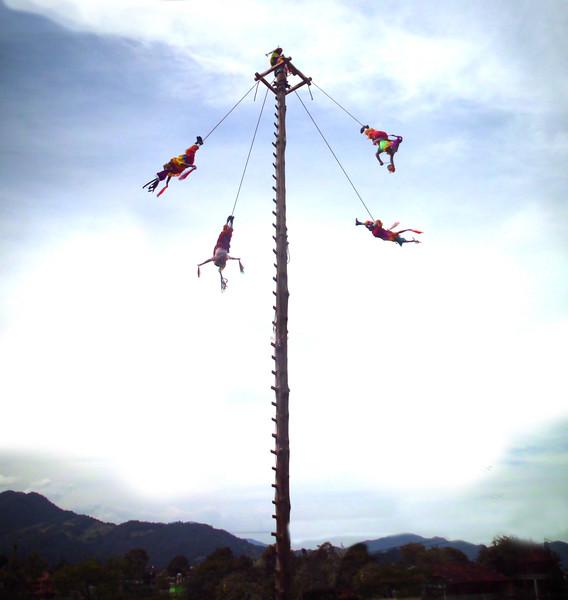
Voladoras_1396b-LWhen she was little, Frida Kahlo yearned to be able to fly. Her parents’ gift of a dress with wings proved disappointing though her dreams of flight remained, particularly following a crippling bus accident that left her with chronic pain and unable to have children. Bedridden for months during her recovery, she channeled her despair and rage into painting. These paintings, along with the ones she made over the rest of her short life, are the inspiration for Bradley Hemmings’ stunning outdoor multimedia event at Greenwich & Docklands International Festival this year. Using pyrotechnics, dance, projections, aerialists, music and the Mexican fertility ritual of the Voladores, The Four Fridas is a visually arresting spectacle but the show that is meant to be a tribute to Kahlo does not provide any particularly unique insight into her life and work.

Divided into for sections that reflect the elements earth, air, water and fire, The Four Fridas chronicles Kahlo’s life. Whilst there were clear acts to the script that took place in different areas of the site, the association with the elements was loose at best. The most sculptural set piece, a bus and tram crash built from metal and crates, was only used briefly towards the beginning. The script itself was fantastical and poetic, but densely written and delivered at a quick, even pace. The language was second rate to the visuals, though what with how impressive they were it would be nigh on impossible to surpass them with any other production element. It was easy to ignore the language in favour of visual performance surrounding the audience allowed to freely wander the performance site.

There were two highlights of the 45-minute long production. The first was an extended projection and aerialist hybrid against a giant screen held up by a crane. The projections were animations based on Kahlo’s work, with the performers against the screen adding texture and further detail. The most exquisite sequence was a flying butterfly, with a performer as the body of the insect. Each aerialist was controlled by a less obvious human counterbalance who scrambled up and down the vertical rigging on the side of the screen. This added an element of puppetry to the performance mediums used. These sections reflected freedom Kahlo felt when painting and her anguish of being trapped in a body that had previously been healthy and unscarred, but made no specific comments on her life.

The second most notable feature was the ancient ritual of the Voladores. Using nothing but rope to ensure their safety, four people climbed a wooden pole without harness, only to fall backwards suspended by their feet. The top section of the pole gently spirals, lowering them to the ground. Whilst this is a Mexican fertility ritual, the vague connections to Kahlo are her inability to bear children and that it also hails from Mexico. Surely it is an affront to an infertile woman to end a performance about her life with hope for children? Nevertheless, it is a remarkable cultural phenomenon to witness.

The free access to an event with such high technical requirements is highly commendable, though the tech is at the mercy of the outdoors. On the last night, part of a scaffolding tower collapsed and had to be removed (fortunately no one was hurt). On a previous night, winds meant that the screen was unable to be used. Whilst this adds to the immediacy of live performance, it also means the performance is shortened. Whilst it was free to stand in the site and watch, bleacher seats came at a price. Those that paid may have felt short changed by the abbreviated length.

Hemmings had set the bar high for this kind of accessible public performance though his work on the Paralympic Games Opening Ceremony and stylistically, work like this should be produced often, up and down the country. It is a shame that the spectacle did not particularly support the woman it is meant to honour. Even with basic knowledge of Kahlo and her work; the opportunity was there to communicate a deeper understanding but that was never reached. Though this kind of theatre is still new and infrequently produced, it should aim to develop more nuance and meaning. I look forward to more artists creating large-scale public performances incorporating a rich combination of performance practice and technology. This is the sort of art that has the potential to capture public affection and encourage them to more fully marry art with day-to-day life.


The Play’s The Thing UK is an independent theatre criticism website maintained voluntarily. Whilst donations are never expected, they are hugely appreciated and will enable more time to be spent reviewing theatre productions of all sizes. Click here to make a donation with PalPal.