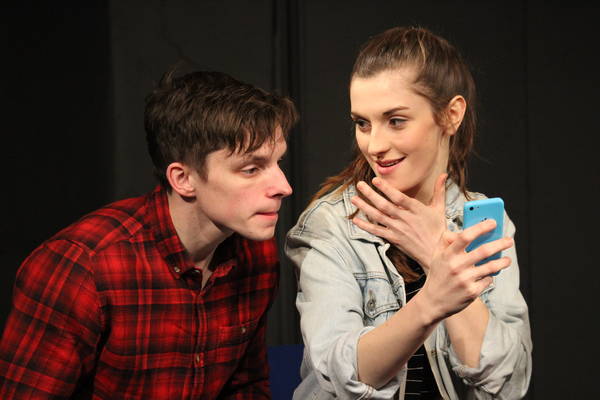
Savage, Arts Theatre

rsz_gary_fannin_and_bradley_clarkson_in_savage_at_the_arts_theatre_c_roy_tan

Denmark in the mid-1930s was a great place to be if you were gay. Homosexuality was legalized in 1933 and a thriving club scene allowed gay men to meet and socialize publicly. But as the dark cloud of National Socialism swept Europe, safety became more precarious. Dr Carl Vaernet was one of their threats. A practicing GP with an interest in hormone therapy, the Danish Nazi Party member soon captured the attention of party higher ups with his therapies that he claimed cured homosexuality. Hired to cure gay prisoners at Buchenwald late in the war, he experimented on seventeen inmates before the war ended and he escaped to Argentina.

Claudio Macor’s latest play Savage focuses more on the story of Nikolai and his American boyfriend Zack than Dr Vaernet, but the lovers are soon separated and Nik becomes one of the doctor’s victims. The emerging subplot of an SS officer and his secret, gay love slave quickly becomes just as important as Nik and Zack, making Savage more of a play about homosexuality in WWII than specifically about Dr Vaernet and his horrific medical experiments. Spanning several years and multiple narratives, the script, sadly, doesn’t give in-depth attention to any particular character; individual stories are disrupted and incomplete. This would be a much more compelling text if Macor focused attention on one primary character rather than taking a scattergun approach. All of these characters have potential to steer a rich, interesting play that focuses on them, but none of them get the full, individual attention they deserve. There are some great set piece scenes, but the overall structure lacks focus.

Some of the performances are inconsistent and the cast present a range of styles, which distracts from the seriousness of the plot. There are a few good performances, though. Gary Fannin cuts a cold, scientific Dr Vaernet with a clear disgust for gay people; this professional face of homophobia and calm hatred is a most chilling one indeed. Emily Lynne as the doctor’s nurse viciously opposes the Nazis and blatantly defies their rules in a display of ferocious persistence. She’s a great contrast to the doctor’s calm hatred. The two pairs of lovers have moments of genuine care for each other, whereas other times feel forced.

Jamie Attle’s costumes are sharp and detailed, whilst David Shields’ set of rotating panels clarify location but are a bit clumsy. Macor also directs, ensuring his political messages get across but an additional pair of eyes could have developed more intimacy between the couples.

Though the topic is most serious indeed, there’s a distinct lack of joy in the beginning cabaret scene and between Nik and Zack. Macor clearly wants to raise awareness of the horrors of Vaernet’s work, but some lighter moments of exposition would emphasise this further. A dramaturg would not go amiss in order to streamline the script and performance styles in future productions, but this premier still has potential and exposes a historical figure too easily forgotten amidst more prominent Nazi war criminals.

Savage runs through 23 July.

The Play’s the Thing UK is committed to covering fringe and progressive theatre in London and beyond. It is run entirely voluntarily and needs regular support to ensure its survival. For more information and to help The Play’s the Thing UK provide coverage of the theatre that needs reviews the most, visit its patreon.

Maggie and Pierre, Finborough Theatre

https://i0.wp.com/www.theartsdesk.com/sites/default/files/imagecache/mast_image_landscape/mastimages/KellyBurke5_PhotoByAshley%20Carter_REDUCED.jpg

It’s easy to see why Justin Trudeau is one of the darlings of world politics these days. This charming former teacher, actor and advocate, turning to politics after his father’s death, identifies as a feminist, wants to legalise marijuana, is pro-choice, gay friendly and committed to the rights of the First Nations and other minorities. Canada’s liberal prime minister attracts groups of screaming fans wherever he goes both nationally and internationally, like any pop star. But where did these attributes come from?

His parents. Maggie and Pierre Trudeau, who met whilst holidaying in Tahiti in the ‘60s when she was a mere 18 years old, were THE Canadian celebrity couple of the 1970s. Pierre was, like his son after him, the prime minister of Canada. Their relationship was flawed, though. Maggie, young, free-spirited and bipolar, soon felt trapped by family life as her intellectual husband busied himself with work. The press’s constant presence also took its toll on their relationship, which the public then poured over in microscopic detail. In 1979, Linda Griffiths’ and Paul Thompson’s Maggie and Pierre premiers, a solo performance tribute to this enigmatic couple. It runs off and on for many subsequent years, a testament to the pair’s appeal.

The script feels quite contemporary, but other than for the purpose of historical documentary, its purpose isn’t clear all these years later. Though the two meet, fall in love and navigate their relationship, life in the spotlight, and the press, there’s no overriding message. It’s unclear why this story needs to be told. It’s a solid narrative over many years with moving insight into these historical figures, but the social and political commentary are limited to brief reflection on their relationship with the press. Perhaps this play would be more satisfying to Canadians or those that already know of the Trudeaus, but for audiences that have never before heard of this couple, there is little impact. It reads like an autobiography. Outstandingly performed by Kelly Burke and worth seeing for her intricate work alone, there’s the feeling that without her, the play would be disappointing.

Burke plays Pierre, Maggie and journalist Henry whose career has hinged on his reporting of their every move. Even though director Eduard Lewis incorporates numerous costume changes to signify a character change, Burke’s physical and vocal mannerisms completely transform into each respective character. It’s a wholly compelling process, a masterclass in performance. Her energy and commitment never falters and her presence is magnetic.

Designer Sarah Booth’s set is simple, but a confusing mix of abstract and functional elements. A huge, bright red quilt with Pierre’s slogan takes up half the stage and is only referred to once, near the end. Its visual dominance is impossible to ignore but it has hardly any bearing on the story. However, Booth’s creation of a bed that’s revealed from a nondescript cupboard is a great device. Philip Matejtschuk’s composition and sound design adds further depth, emotion and context that the set avoids, giving the show a more rounded, polished feel.

As a documentary artefact, Maggie and Pierre is no doubt a learning experience. The couple’s history is an interesting one and the love story is universally relatable. Kelly Burke’s performance is a wondrous thing to experience though, and more than redeems any of the production’s inadequacies.

Maggie and Pierre runs through 5 July.

The Play’s the Thing UK is committed to covering fringe and progressive theatre in London and beyond. It is run entirely voluntarily and needs regular support to ensure its survival. For more information and to help The Play’s the Thing UK provide coverage of the theatre that needs reviews the most, visit its patreon.

Hardy Animal, Battersea Arts Centre

https://sites.google.com/a/georgetown.edu/mdarts/_/rsrc/1439559537290/units/unit-3/section-2/performance-laura-dannequin-s-hardy-animal/Dannequin.png

What happens when a dancer and performance maker loses the ability to dance due to chronic pain? She makes a solo dance piece with hardly any dance in it. A mix of emotive description, encounters with medical and health practitioners, and her own research tell the story of an injury and the subsequent pain that wouldn’t leave her body. Pointedly still and so quiet that she needs a mic, Laura Dannequin’s resilience makes a compelling piece of solo storytelling that mourns the dances her body wouldn’t allow her to make.

An impassioned monologue about all of the dances she wants to create is followed by a voiceover describing her dancing, whilst Dannequin stands perfectly still. Though her expression gives away nothing, she exudes a sense of loss; the simplicity and contrast between aural and visual imagery are captivating and heavy with grief. A sequence of small flexing movements of her bare back against a litany of treatments and diagnoses she sought from all over the world creates a similar effect, this one with added existentialism and frustration with a medical community that still knows precious little about the human body and its mechanisms. It’s captivating viewing in its simplicity.

Much of the piece examines Dannequin’s relationship with her body and her pain. It becomes a separate entity that she confronts with a range of emotions and dogged research to understand why hers is so persistent. There’s a scientific lecture on types of pain and her own educated theories, but like the rest of her piece’s components, there’s an emotional undercurrent that carries her words. A cathartic climax celebrates her mysterious recovery and the overarching effect is one of beauty and wonder.

Dannequin miraculously withholds the anger she is more than entitled to feel, instead she shares a grounded story of bodily rebellion imbued with emotion and strength. Hardy Animal is a piece of simple, quiet beauty that doesn’t let itself be bogged down with science or negativity.

Hardy Animal ran from 28-29 April and tours regularly.

The Play’s the Thing UK is committed to covering fringe and progressive theatre in London and beyond. It is run entirely voluntarily and needs regular support to ensure its survival. For more information and to help The Play’s the Thing UK provide coverage of the theatre that needs reviews the most, visit its patreon.

This Room, Battersea Arts Centre

https://i0.wp.com/40.media.tumblr.com/0de2b8a4c234adfa06d227487f497f1a/tumblr_nkr4q4aw501r8bp0ao8_1280.jpg

Laura Dean has Obsessive Compulsive Disorder. She’s afraid she’s going to kill herself in her sleep so spends at least two hours before bed checking her house for anything she could use to self-harm. Scarves and tights are hidden away, as are knives and other sharp objects. She can’t sleep without her checking routine and after months of exhaustion, she’s had enough. An NHS diagnosis comes with a round of Cognitive Behaviour Therapy sessions that help her recover, but introduce several ideas that make Dean question the nature of her self. This Room is a gently communal experience where Dean provides insight into the recovery process. There are plenty of clinical reports, forms and questionnaires but Dean’s individuality is never drowned out by these or by the condition she fights.

The audience is in Dean’s bedroom with her as she works through the most commonly held thoughts by people suffering from OCD. She confesses that she wants to know what’s going on inside her head so she can understand what’s really wrong with her, something she still hasn’t quantified after the pages of documented appointments she reads at lightening speed. The clinical nature of her recitations is a lovely juxtaposition to the soft, confession-like anecdotes from her treatment, most notably the session where her therapist (with the perfect bottom) visits her at home to confront her fears, represented by a serpentine tangle of tights, head on. The whole piece is intimate, quiet and deeply personal.

Dean has a soft strength that’s immensely watchable, whether she’s sitting silently on the edge of the stage clutching her water bottle, or reading her medical notes into a stand mic. The audience immediately sides with her, and dutifully responds to her questions. The empathy is tangible, and a group hug would not be out of place after the curtain call.

This Room avoids sentimentality or an overabundance of awareness-raising. Instead, it’s a personal account of a treatment process and an individual response to it. Will Dean ever really be well? If so, does that mean she’s not really herself anymore? These are big questions that don’t have an immediate answer, but are examined in a wonderful format that is a privilege to witness.

This Room runs through 27 April.

The Play’s the Thing UK is committed to covering fringe and progressive theatre in London and beyond. It is run entirely voluntarily and needs regular support to ensure its survival. For more information and to help The Play’s the Thing UK provide coverage of the theatre that needs reviews the most, visit its patreon.
To Kill a Machine, King’s Head Theatre

To Kill a Machine: Scriptography Productions

How well can you condense Alan Turing’s life and work into one hour? Considering his technologically groundbreaking career, WWII code breaking and conviction for crimes of gross indecency, that’s a lot of source material for precious little time. Catrin Fflur Huws chooses to focus on the man behind the achievements at various pivotal points in his life for To Kill a Machine. From boarding school days to chemical castration shortly before his death, Huws shows the relationships rather than the events that shaped his life. Scenes of naturalism are interspersed with a surreal, presentational game show indicating the factors outside of Turing’s control that dictate his unfortunate fate at the hands of discrimination. Though stylistically dynamic, they are less compelling than the latter. Together, they make a good whole but with so much missing from Turing’s life, the highlights contained in To Kill a Machine shortchange the story of such an important man.

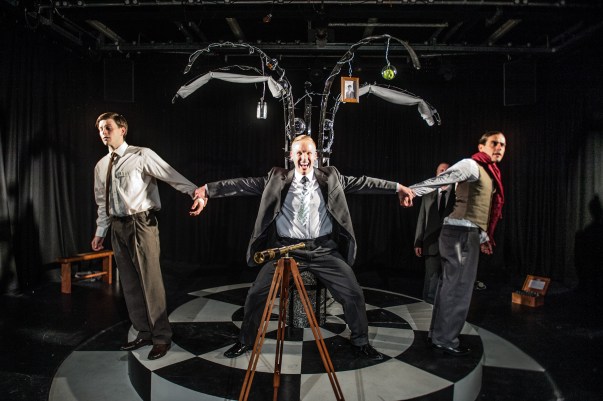
In the centre of a round platform, a wiry, mechanical tree by designer Cordielia Ashwell sprouts important mementos from Turing’s life: a photograph of Christopher, his first love at school, pages of indecipherable code, and the apple that he may or may not have used to kill himself. Its trunk is also a convenient place to store props and costume, but the visual aspect is the most dominant, and strikingly so. The symbol of life manifested in an everlasting, sculptural form against the items that were his downfall is powerful image.

The tree also dictates circular movements from the cast of four, most prominent in the game show scenes and Turing’s sex with his younger lover, Arnold Murray, who eventually betrays him – the moments where his life spirals irrevocably out of control. Alan’s eventual tethering to the tree via medical equipment during his “treatment” is a horrible,  effective reminder of history’s handing of people discovered to be gay and sapping their life force with discriminatory legislation.

Gwydion Rhys as Alan Turing is the anchor in the cast, with a nuanced and sensitive performance that leaves Benedict Cumberbatch’s generic interpretation in the dust. He is complimented well by intimate scenes with François Pandolfo as his school friend Christopher, and older brother John giving him advice in the run up the trial. This latter scene is by far the best in the play.

Though the script is good, it’s short length is unsatisfying and otherwise dwarfed by the performances and design. The structure works as does the lens with which it views Turing’s life, but surely there is more than an hour’s worth of material on the man behind the life-changing mathematician and inventor.

To Kill A Machine runs through 23 April.

The Play’s the Thing UK is committed to covering fringe and progressive theatre in London and beyond. It is run entirely voluntarily and needs regular support to ensure its survival. For more information and to help The Play’s the Thing UK provide coverage of the theatre that needs reviews the most, visit its patreon.
Wonderations, The Canvas Cafe

https://pbs.twimg.com/media/CcvF_vOWEAA7JKp.jpg

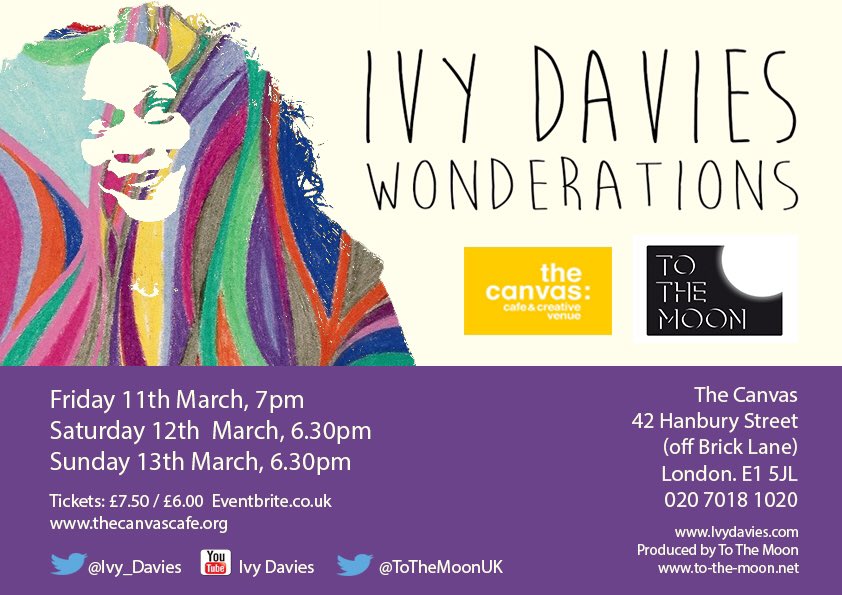
Sunday evening was a night of new discoveries. The Canvas Café, just off Brick Lane, serves homemade cakes and prosecco by the glass. It also has walls you can write on and a cosy downstairs performance space. In that space was Ivy Davies and her show Wonderations, a gentle, joyful blend of spoken word, songs from her EP and questioning whether or not Mickey Mouse is actually God. Though lacking in narrative, Davies’ performance shares issues that are particularly personal: aging and her search for identity and faith. With a touch of live art about it, Wonderations is a lovely celebration of self-acceptance akin to reading Davies’ journal.

This isn’t a visual show, but a totally aural one. It could easily be listened to through headphones or with eyes closed, though her soothing melodies and rhythms could lull you to sleep – it’s that relaxing. There are some powerful sentiments in her lyrics and poetry that deserve full attention, however. As Davies struggles to find her pre-marriage and babies self in theatrical songs and rhymes, one can’t help but to relate to her frustration with finding her true identity buried under all the nonsense life throws at us. We all find ourselves wasting hours on social media focused on constructing an image, or immersing ourselves in work and forgetting to just be present in the world for lengthy periods, but Davies exhorts us to let all of it go. She’s like a life coach, but a gentle one who uses cuddles rather than shouting.

This cabaret-esque structure feels conversational, but is precisely and satisfyingly scripted. There’s no plot to speak of, but with Davies wearing the form like her own skin, it works. Her spoken word isn’t the pounding, angry sort I’m accustomed to; it’s full of flowers, sunshine, rain and claiming her own ground. Davies has an immovable strength and presence, but one that overflows with positivity. Less connected from her celebratory songs and spoken word is what feels like an internal monologue where in looking for faith, she wonders if God is actually Mickey Mouse. He’s been seen around the world at the same time, and has plenty of purchasing power. It’s a wonderfully funny, and pointed, argument, though less clear on it’s place in the show’s structure.

Ivy Davies’ Wonderations is a hard show to pin down, but it doesn’t apologise for that. I’m pretty certain that she’s confident enough to not care what anyone thinks of her work, but the themes it contains are universally human presented in an easily digestible format. An excellent event for a quiet Sunday evening, particularly with a slice of cake and a glass of prosecco.

The Play’s the Thing UK is committed to covering fringe and progressive theatre in London and beyond. It is run entirely voluntarily and needs regular support to ensure its survival. For more information and to help The Play’s the Thing UK provide coverage of the theatre that needs reviews the most, visit its patreon.

The Marvellous Adventures of Mary Seacole, Rosemary Branch Theatre

I had never heard of Mary Seacole until I began working in UK schools, several years after my arrival to the UK. What a woman!  No wonder her entrepreneurial, caring Victorian spirit is on the National Curriculum and she has been the subject of several plays, including Rosemary Branch co-artistic director Cleo Sylvestre’s one-woman show, The Marvellous Adventures of Mary Seacole. With a simple narrative structure, Sylvestre’s piece focuses on characterisation and biography. It is well performed, though some adjustments to the script and tech could make this an even better solo show.

We are never told who we are, but Seacole treats us like a society or club she has come to lecture about her life.  She speaks in the past tense shortly after her return from the Crimea; we hear her life story starting with her childhood in Jamaica, helping her mother run their Hotel, Blundell Hall and learnt about her “remedies” from foraging. Continuing onto her London, Central America and finally The Crimean War, Sylvestre endows her with a confident, charismatic warmth – no wonder she was so popular with soldiers and civilians alike. Her performance peaks when recalling her mother first teachings her about plants, and later memories of battlefields heaving with wounded soldiers – her “boys.” These are lovely moments to witness, but some of the more mundane content is delivered on autopilot.

Structurally, the script is a simple, linear narrative. This would be an excellent piece to tour to primary schools, as it’s easy to follow and has plenty of captivating anecdotes. The content is interesting enough to hold an adult audience’s attention for nearly an hour, but it would be a refreshing experiment to see this piece as episodic, with more lighting and sound than is presently used to highlight pivotal moments. This is not a new show, and solo performance has evolved since its inception. Sylvestre’s imagery-laden work would suit regularly used bigger projections, detailed soundscapes stronger lighting changes. Even though this is an important story, it is not an innovative production, but it certainly has the potential to be.

Cleo Sylvestre’s performance is the highlight of The Marvellous Adventures of Mary Seacole, but this long-running solo performance needs some revisiting to give it an extra burst of life worthy of such a vibrant character.

Running at The Rosemary Branch, 9-11 April.

The Play’s the Thing UK is committed to covering fringe and progressive theatre in London and beyond. It is run entirely voluntarily and needs regular support to ensure its survival. For more information and to help The Play’s the Thing UK provide coverage of the theatre that needs reviews the most, visit its patreon.

One Under, Vault Festival

rsz_img_6902[1]

Amy Fleming’s dad committed suicide when she was four years old. Fleming struggles with mood swings and wonders if she’s “mental,” like her dad. Luckily, she studied Molecular Medicine before becoming an actor so she understands how genetics dictates our characteristics. She also knows that talking about our problems and developing positive habits helps us overcome them. Combining her science and performance backgrounds, Fleming’s One Under is part conversational lecture, part interactive game. She relies on narration, humour and audience involvement to share her message, but the piece as a whole feels unfinished. It’s a nice idea, but it lacks theatricality and detail.

There’s no character, just Fleming and her generally cheerful honesty. She relaxes the audience straight away and easily facilitates discussion. After a frank introduction about her childhood and how genes are passed from parents to child; there’s some framing by her biography and a multi-round game/quiz with easily answerable mental health questions. These two elements aren’t solidly connected to each other, and the piece’s message isn’t spelled out until the very end. Structurally, it’s weak. By that point though, the message is less interesting that the journey we took to get there and the camaraderie that emerges en route.

This solo show isn’t very theatrical, but it’s lovely for its warm cuddliness and playful approach to form. Fleming is clearly passionate about helping people improve their quality of life and their mental health, which is a commendable mission. Her openness and her anti-performance make me feel uncomfortable writing any sort of negative judgement – it’s such a personal piece. But at an hour long, glossing over parts of her past with some audience debate over quiz questions about how to approach mental health issues at work, there’s a noticeable lack of depth.

The Play’s the Thing UK is committed to covering fringe and progressive theatre in London and beyond. It is run entirely voluntarily and needs regular support to ensure its survival. For more information and to help The Play’s the Thing UK provide coverage of the theatre that needs reviews the most, visit its patreon.

Beetles From the West, Lion & Unicorn Theatre

rsz_img_5808

Half of the UK population born after 1960 will be diagnosed with cancer during their lifetime. Considering this figure, cancer rarely features as the primary subject matter in theatre, though last year there were several productions that put it at the forefront. I caught two of them in Edinburgh: The Eulogy of Toby Peach and Goodstock. James Hartnell’s debut play, Beetles From the West, is also driven by a diagnosis. Set in a hospital waiting room, immature Boyd waits with his girlfriend for news of his father’s health after a sudden collapse that’s left him unconscious. A young doctor’s attempts to explain what’s going on are aggressively questioned as Boyd comes to terms with what it all means. Hartnell’s script, obviously early career from its unwieldy text and underdeveloped characters, spotlights the importance of cancer screenings but it needs more development to have greater impact.

A combination of flowery, metaphor-filled monologues directed to the audience and simplistic scenes between the characters attempts to show range, but they are so dramatically different that they seem spoken by different characters. Dialogue paints Boyd (Ryan Penny) and his girlfriend Jenny (Amy Doyle) as immature and ignorant young teenagers. Their monologues have a more mature gravitas, but these contrasting tones don’t reconcile. The transitions in the writing are abrupt and jarring, creating an unconvincing baseline reality. Hartnell has a sense of dramatic arc and a satisfying ending that suits an awareness piece, but individual scenes and monologues sit clumsily within it. The script does manage not to preach, though.

There’s little subtlety or depth in the characters despite their dialogue, but Penny, Doyle and Matthew Marrs as the doctor attack them with gusto. Penny also directs, and favours heightened performances – though this might suit the language, it clashes with the thematic content. It’s an interesting choice, but not one that consistently works. There are some moments of good chemistry, particularly when the doctor reveals details of his own past – though highly unprofessional and unlikely to happen in the real world.

Beetles From the West shows cancer isn’t a battle, it’s a disease we are just as likely to get as not. It reminds us to monitor our mental and physical health and have symptoms investigated, something men are more likely to neglect than women. This is definitely a men’s health play, though it doesn’t alienate women. It’s just a shame that the script doesn’t do the themes justice or give the performers properly developed, meaty roles.

The Play’s the Thing UK is committed to covering fringe and progressive theatre in London and beyond. It is run entirely voluntarily and needs regular support to ensure its survival. For more information and to help The Play’s the Thing UK provide coverage of the theatre that needs reviews the most, visit its patreon.

Botallack O’Clock, Old Red Lion Theatre

Roger Hilton was an abstract artist working in Cornwall until his death in 1975. As alcoholism and ill health took hold, he confined himself to a basement bedroom and studio, prolifically churning out work in the middle of the night. Modelling Hilton’s experimental work, playwright Eddie Elks (of Mugs Arrows acclaim) has crafted an unconventional dialogue between an ageing, ill man finding late-night solace in his art, and his radio. Elks begins in naturalism, then surreal expressionism sets in like a lucid dream. The mind of an artist is an unusual, hard to pin down thing inventively captured and well performed in Botallack O’Clock, accompanied by the sadness of approaching death and the need to leave a legacy.

Ken McClymont’s set recreates Hilton’s studio/bedroom with excellent accuracy and detail, and a bit of theatre trickery further enhances the surrealism and absurdity. Photographic projections reinforce the authenticity of the set, complete with drying paintings strung around the periphery and paintbrushes everywhere. A 1960’s radio benignly sits centre stage next to a desk with paper and paints. With Dan Frost as an angular Roger folded on the corner of a mattress and the radio next to him, they become equals. The wardrobe on the back wall is also more than it appears, as are the walls themselves. Particularly bizarre but wonderful moments include the old man struggling to be reborn through the wall and Roger’s energetic bogey with a surprise visitor.

The power in this script is the juxtaposition of the profundity and truth in Roger’s dialogue with his radio, and the veering away from reality that happens soon after insomnia slowly wakes him. It surprises and disarms; Roger’s negotiation of this alteration is charming and confessional, provoking reflection on one’s own mortality. But it’s also deliciously funny and sweet, though begins to feel too long about fifteen minutes before the end.

Dan Frost is not an old man, but endows his physicality with the creaky weight of age. This is simply cast off, like his glasses, when he gleefully reflects on his art school days in Paris. Frost’s vocal rhythm is quick and short, forcing the audience to really listen to and process Elks’ script. Frost is complimented by the dulcet tones of George Haynes as the Radio. 

Botallack O’Clock is, in essence, a simple conversation between a man and his subconscious but Elks’ creativity and skill makes it seem like more than that.  There are some delightful surprises along the way and a range of styles are used to examine our intimate relationships with our work, our possessions and our inevitable deaths – a thoughtful, reflective piece is thinly veiled under the humour and Frost’s abrupt delivery. Though we empathise with Roger throughout, all of us are alone in our twilight years, and we are the sole leading players in our own narratives.

The Play’s the Thing UK is committed to covering fringe and progressive theatre in London and beyond. It is run entirely voluntarily and needs regular support to ensure its survival. For more information and to help The Play’s the Thing UK provide coverage of the theatre that needs reviews the most, visit its patreon.