Remember to Breathe, Equations for a Moving Body, Edinburgh Festival Fringe

https://s3.amazonaws.com/wos-photos-production/107110.jpg

Two women, in two different shows set on opposite sides of the world, swim as if their lives depend on it. One is training for an ironman-length triathlon, the other never learnt to swim and is doing so to overcome a fear of water. Equations for a Moving Body is Hannah Nicklin’s solo performance telling the story of her decision to complete an ironman and the research she did to discover what would happen to her body as she trains. Remember to Breathe follows fictional Maeve away from the safety of family and a secure job in Ireland, to world travels that eventually find her in New Zealand. Though Hannah and Maeve approach swimming completely differently, the sport shapes who they are and how they deal with obstacles that come their way.

Maeve and her kiwi husband Grant are back in Ireland when the Christchurch earthquake hits. The Celtic Tiger has been and gone, and their business is struggling so they decide to head to the southern hemisphere to help rebuild. It’s here that Maeve discovers a pool in the wreckage, staffed by the relentlessly perky Doreen. In that pool, Maeve gently catalogues her life through her relationship to her father. He and Doreen fade in and out again like memories in this quiet, reflective piece on family and finding your place in the world.

Liz Fitzgibbon as Maeve has a calm strength and enigmatic presence. This everywoman of a character with relatable struggles trying to find peace is a reassuring story to witness, though the lack of outright conflict between characters makes for a sleepy pace.

Julie Sharkey as Doreen and David Heap has Maeve’s earthy, grounded father are great foils constructed by writer Orla Murphy. As well as Maeve’s personal journey that she comes to terms with through swimming, there’s a pointed throughline of the effects of the economy on the common man – a clever inclusion making the script universally relevant.

Maeve swims and came to it in her adult life, but Hannah is a swimmer and has been doing so since she was four. Hannah explains the difference between “I swim” and “I’m a swimmer” and the role goals and life events have in shaping one’s identity. Her decision to complete an ironman in the year she turned 30 becomes a part of who she is and how she lives her life, and Equations for a Moving Body is the moving story of the ups and downs of pushing your body to its limits.

The most engaging focus of Hannah’s story is the people she meets along her training journey. She has a gift for making John, Tom and the various scientists she meets along the way come alive, even if they only feature for brief moments. These encounters provide landmarks that make her story stand out from anyone else’s and excellent focal points of her narrative structure.

The story’s climax is the triathlon, with peaks and troughs that are magnified versions of those in her training. It’s a hugely satisfying and emotional end to a story of struggle, grief and triumph. Those who aren’t much for sport or fitness who find her initial goal baffling are on side at by the finish line.

Nicklin uses live internet use to support her story and add a visual element to the production. Though simple, it’s a great choice. These are almost all accompanied by her narrative, though one section is poignant in its silence and elucidates the source of the show’s name.

Hannah cements her sense of self through her training and its end goal, and Maeve finally finds the peace she is searching for. Both productions are lovely, if very different stories of personal discovery at Summerhall.

The Play’s the Thing UK is committed to covering fringe and progressive theatre in London and beyond. It is run entirely voluntarily and needs regular support to ensure its survival. For more information and to help The Play’s the Thing UK provide coverage of the theatre that needs reviews the most, visit its patreon.
Declaration, Edinburgh Festival Fringe

rsz_cpgj-xixyaaoghq

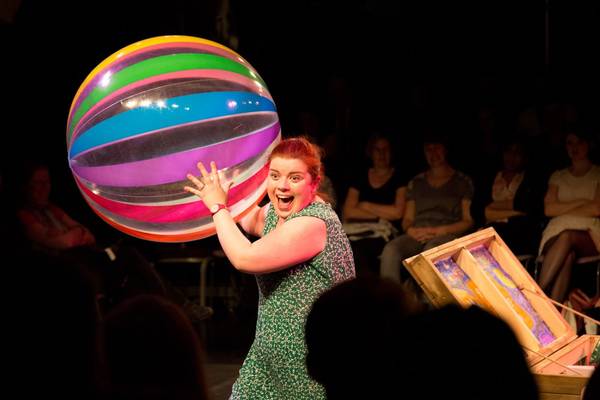
Sarah wants to know everything. She’s inquisitive, gregarious and energetic, the life and soul of any party. But now that she’s in her thirties and wants to start a family, she needs to sort out some of her issues. So, she goes to a doctor to talk through all the behaviour quirks she’s had since childhood – the trouble sleeping, the irrational impulses, the disorganisation, the obsessions.

Diagnosis: ADHD.

Now that she knows what the problem is, does it really solve anything? Will a label help, or hinder? Will medication change the person that she’s always been and actually quite likes? Declaration is an honest, heartwarming solo performance that resonates with those of us who have always felt a bit different or care about people who are a bit weird or quirky. Written and performed by Sarah Emmott, with energy and charisma that’s undeniable, Declaration needs a few minor adjustments to make it an even slicker show.

Emmott’s script has the consistent theme of wanting to please but pesky impulses to do all sorts of irrational things get in the way. As an adult, she has developed coping mechanisms (which she marvelously demonstrates with audience help), but as a child, she was a loose cannon. The story of her childhood picks up once she introduces the superhero personal she invented for herself and a doll, Samantha, who is everything that she never could be. The opening exposition, though having important information, lacks the punch and the belly laughs that these sections have. Additionally, some of her transitions need clarity; consistent use of sound, lighting or changing props would help indicate a scene change.

Emmott develops a marvellous rapport with the audience from the moment they enter the theatre. She has the sort of natural magnetism that cannot be taught in any drama school, an innate quality that actors either have or don’t. Laughing and chatting, her stated need to know everything and everyone is evident. The audience rallies to her wide-eyed wonder, and snarky comments about school, doctors and other frustrations get plenty of laughs.

As Sarah works out how to get through life and a diagnosis has the potential to either change everything or nothing, the audience is with her the entire way. She uses props and audience interaction effectively, though she could use tech to further enhance the theatrical experience. Her lovable on-stage persona is a charming reminder that anyone we know may be struggling with mental health, learning or behaviour issues, and even though a few tweaks could be made to improve the show, she dares us to accept her, flaws and all.

Declaration was a one-off performance.

The Play’s the Thing UK is committed to covering fringe and progressive theatre in London and beyond. It is run entirely voluntarily and needs regular support to ensure its survival. For more information and to help The Play’s the Thing UK provide coverage of the theatre that needs reviews the most, visit its patreon.
Scorched, Edinburgh Festival Fringe

rsz_cn0idouxgaazjdi

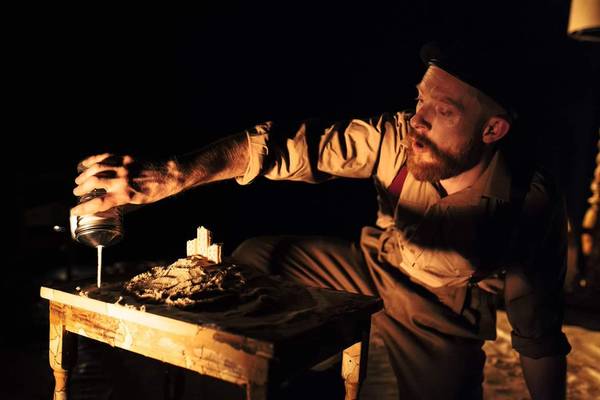
Jack, feeble in body and mind, wiles away the days watching news broadcasts from operation Desert Storm. The former WWII soldier, now safe and looked after in a care home, vividly recounts memories from his youth and on the front line. He may not be aware of the present, but his past is ever present and will not let me rest. Solo show Scorched is a moving and honest look at veterans’ experiences of combat and ageing, leaving the troubling feeling that society is not fulfilling its responsibility to this vulnerable demographic.

Lisle Turner’s script, inspired by her grandfather’s life, is an expressionistic snapshot of his thoughts at the twilight of his life. Stationed in Egypt during the war, we hear tales of heat, explosions, and beautiful women interspersed with memories from his childhood. The storyline is loosely constructed; it is episodic rather than wholly linear. This structure works well considering that these are Jack’s memories he plays out for himself rather than for an audience arbitrarily included in the action without being allocated any clear identity.

There are some beautiful design elements: Jack remembers tattooing himself and this is projected on his arm rather than shown with makeup. To see something normally considered permanent conveyed through an ephemeral form is a fitting reminder that nothing truly lasts forever and Jack is nearly at the end of his life. The loveliest of other whimsical projections is on a cascade of sand poured from a dinner tray. This sand is everywhere, like the memories that cling onto Jack’s deteriorating mind and are constantly discovered in unsuspecting places – a clever device either by Turner or director Claire Coache. A simple puppet is used well but not enough, as are mundane objects that transform into others more exciting – an umbrella becomes a fishing rod, a footstool is a motorbike. This object manipulation is a lovely surprise and suits Jack’s mental state well, so it could be utilised further to comment on the childhood of old age.

Robin Berry plays Jack with power and pathos, initially with a delicate frailty that gives way to a younger, more powerful man who enjoys boxing, horse riding, dancing and defending his country. Berry has a strong physical presence that is eminently watchable and a range that makes him believe both as the older and younger Jack.

Strengthening and streamlining the staging and theatrical devices will help make the script feel less like a random collection of memories, and reordering some of scenes would also have the same effect. Jack is a fantastic character and the play is a fitting tribute to elderly veterans, though also serves to pay homage to a generation that soon will no longer be with us.

Scorched runs through 29th August.

The Play’s the Thing UK is committed to covering fringe and progressive theatre in London and beyond. It is run entirely voluntarily and needs regular support to ensure its survival. For more information and to help The Play’s the Thing UK provide coverage of the theatre that needs reviews the most, visit its patreon.

A Dream of Dying, Edinburgh Festival Fringe

https://files.list.co.uk/images/2016/08/07/dsc3677-lst214126.jpg

On 16th June 2009, the body of a man was found dead on a beach near Sligo, Ireland. He had given his name as Peter Bergmann at his hotel, but postmortem investigations determined that was an alias. In the days running up to his death, CCTV recorded the man methodically moving around Sligo but taking advantage of cameras’ blind spots, he disposed of all items that could possibly be used to identify him. Monologue A Dream of Dying creates a young man who plans such a death in his future in an attempt to justify why Bergmann might have died the way he did. This quiet, reflective piece may not be the most exciting theatre at the fringe, but its subject matter is a sensitive look at life’s inevitability and the desire to control these final moments.

Lawrence Boothman embodies the fictionalised Bergmann, his friends and family from childhood through to recent graduate on the cusp of the rest of his life. As he contemplates what life will bring him – career, wife, children, grandchildren – he expresses the lingering fear that it could all go wrong. In either case, because life is so unpredictable despite the best laid plans, he is able to plan his death with mechanical precision. The calm rationale is both understandable and unsettling.

Boothman attacks the role with vigour, perhaps too much so in transitions that become rushed. Treasa Nealon’s text follows a natural narrative progression and Boothman tells it with instinct for its rises and falls, lingering over moments of tenderness and celebrating milestones. There’s an anti-theatricality to the piece, but it’s a good story well told.

Peter Bergmann’s true identity was never discovered. His remains evidenced late stage prostate and bone cancer so it is easy to draw conclusions as to why Bergmann chose to end his life. The saddest thing to consider is that whilst he worked hard to make himself unidentifiable, there may have been no one to look for him when he disappeared. A Dream of Dying, though not particularly theatrical, feels like a fitting homage to those that have died unknown and unclaimed the world over.

A Dream of Dying runs through 27th August.

The Play’s the Thing UK is committed to covering fringe and progressive theatre in London and beyond. It is run entirely voluntarily and needs regular support to ensure its survival. For more information and to help The Play’s the Thing UK provide coverage of the theatre that needs reviews the most, visit its patreon.
Life According to Saki, Edinburgh Festival Fringe

CpVFTsMXYAA1jSg

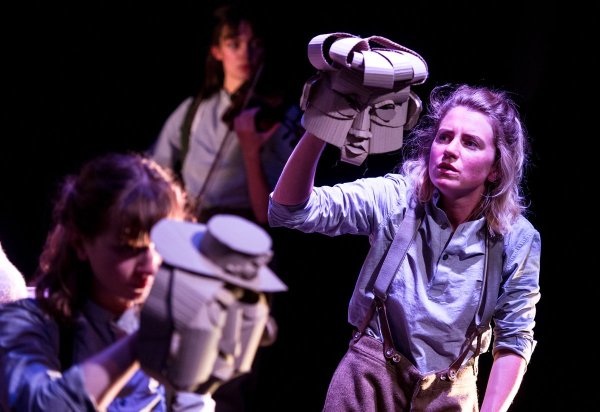
Author Hector Hugh Munro, otherwise known as Saki, is in WWI’s trenches. He and his men been out there for nearly a year, and they are long fed up with life on the front. To entertain his fellow troops, he tells the stories that have already made him a well-known writer. Life According to Saki mixes biography and fiction as Saki tells the audience about his life, interspersed with silly and bizarre anecdotes. The cast of six play both soldiers and the character’s in Saki’s stories with fantastic energy and physical commitment, but the structure of the play and Saki’s pontificating soon grows repetitive. An excessively long ending and too many stories ushers in eventual tedium despite a polished show with high production values.

Anna Lewis’ design is excellent; it clearly indicates the trenches and is flexible for the imagined worlds elsewhere. Costumes are WWI uniforms that fit the cast of women and men smartly – they are not frumpy, unaltered hire costumes. The puppets by Claire Roi Harvey and Suzi Battersby are also very good, with the cock being particularly charming with a great range of realistic movement.

The script is where it begins to fall flat a few stories in. Each one is very short, some only a few minutes long. There are about eight or ten altogether, and the constant shift from tale to tale is exhausting. The are performed with great physical comedy, accents and verge on the fantastical; each one is lovely but there are way too many. Episodes from Saki’s life are bland and dry filler, and the two styles feel forced to miserably cohabit in the same structure. The tacked-on conclusion preaches about how to live one’s life, then drags on even longer into a song and a poem. Though it blatantly states its message of living life to its fullest, the connection to the hour of stories preceding it is tenuous.

Three or four longer stories with depth and detail, and less of Saki’s biography (if any at all) would make this a much more engaging play. The premise of a soldier entertaining his troops is a fine one, but The Life of Saki comes across as self-centred and lecture-y with some silly, disconnected interludes.

Life According to Saki runs through 29th August.

The Play’s the Thing UK is committed to covering fringe and progressive theatre in London and beyond. It is run entirely voluntarily and needs regular support to ensure its survival. For more information and to help The Play’s the Thing UK provide coverage of the theatre that needs reviews the most, visit its patreon.

“Just let the wind untie my perfumed hair…” or, Who Is Tahirih?, Edinburgh Festival Fringe

https://i0.wp.com/www.ridikulmagazin.hu/cuccok/storages/thumbnails/2014-06-06/153cc8eec7af4dc9e7fe3737d2192f41/680x0.jpg

A woman sings behind a gauzy white curtain. We cannot see her face, but in her soaring cries we hear her passion. This is Tahirih, born in what is now Iran in the early 1800’s (we don’t know her exact date of birth because authorities burned these documents after her execution). She is a poet, theologist and women’s rights activist, and she has enough followers that the country views her as a national threat to the patriarchal Islam that requires women to be veiled in public.

In the days leading up to her execution, Delia Olam plays people from Tahirih’s life, unfolding her biography, teachings and radical actions. These we see plainly, but Tahirih is always behind the curtain, playing and singing. As the revered and reviled woman is sculpted through the accounts of others whilst her face remains hidden, she becomes mythical and hugely powerful, a revolutionary who’s life is tragically cut short.

Olam’s script and performance meld into a fluid solo performance that is a fitting tribute to such a remarkable woman. Her physical and vocal distinction between the handful of characters she plays is detailed and precise. A servant, Tahirih’s father, an executioner, and a female follower are crafted in detail, and all visited by the audience who go to these people to discover more about this woman who is revolutionary, dangerous, or both. This is excellent clarification of the audience/character relationship in solo performance format – it makes sense with the play’s circumstances and embeds the audience in the action. There is none of the talking out into undefined space or invisible characters that alienates the audience and removes the character from reality, something that often occurs in solo performance. Across these characters in different places and with different relationships to Tahirih, there is still a clear, well-proportioned narrative arc building to an awful end.

The scenes themselves are well-crafted and provide a snapshot of the landscape of attitudes towards women in Iran at the time. They are simply staged and prettily enhanced with candlelight, their simple, calming beauty juxtaposes the inevitable prospect of her death. Transitions are a touch slow; some are smoothed with recorded music whereas others have silent gaps as Olam transforms in and out of Tahirih, who sings and plays between characters. The silences make for a choppy disruption, but this is a minor issue easily forgiven in view of the story’s excellent construction and execution.

To learn about such a remarkable woman through a strong show and performance feels as much of a privilege as it is an education. Olam has fantastic instinct for storytelling and character development, and this detailed show needs hardly any improvement. Do not miss it.

“Just let the wind untie my perfumed hair…” or, Who Is Tahirih? runs through 29th August.

The Play’s the Thing UK is committed to covering fringe and progressive theatre in London and beyond. It is run entirely voluntarily and needs regular support to ensure its survival. For more information and to help The Play’s the Thing UK provide coverage of the theatre that needs reviews the most, visit its patreon.

The Verge of Strife, Edinbrugh Festival Fringe

https://s.yimg.com/ny/api/res/1.2/dYMZRbOfigpSinFsDrmM4w--/YXBwaWQ9aGlnaGxhbmRlcjtzbT0xO3c9ODAw/http://media.zenfs.com/en/homerun/feed_manager_auto_publish_494/e8b3b49c0f2b401a3fb7882c92866d28

The Wildean young poet Rupert Brooke revels in the self-absorbed, upper classes of Edwardian Oxford and London at the turn of the twentieth century. He finds virtue in beauty, love, poetry and little else. Vain, pretentious and excessive is his behaviour, he manipulates his friends and lovers, all in the name of art and pleasure. Though not a particularly likeable person, his poetry betrays emotional depth and inner conflict, and his social circle flocks to his talent and intensity. Verge of Strife largely focuses on his young life of frivolity, turbulent relationships and their reflection in his poems. Eventually known for his war poetry, this play celebrates his writing’s evolution through the lens of his life’s eras and the women he loved. The poetic but sedate script needs more action as it meanders through Edwardian summers, and nuanced performances are appropriately restrained, making this a somewhat sleepy aural bath.

Much of the story involves parties, encounters with friends and suitors, and a life of indulgent leisure and writing. The dialogue is pretty and light, with beauty but little substance. The narrative flutters rather than sharply rises and falls, presenting snapshots from his life rather than a continuous plot line. Though this mirrors real life, it does not make for particularly dramatic theatre. There is also a sharp change of direction in the final section of the play, presenting Rupert in a completely different role than that of his carefree youth. The contrast is sudden and not clearly explained; the lack of gradual change from wafting, emotional poet to no-nonsense commander jars and feels like there are scenes missing that explain how his life so dramatically altered. The minor characters and their potential to conflict with Rupert are also underused – Rupert is the sole focus throughout, with everyone else merely supporting.

Jonny Labey takes on the verbose Rupert, meticulously sculpting delicate and flirtatious mannerisms. The character is frustratingly shallow for much of the play, denying Labey much freedom to achieve any depth. He does effectively capture Rupert’s growing instability building up to his remarkable transition into a man of real responsibility, and his chemistry with the female characters is undeniable. Emma Barclay as the solemn intellectual Katherine Cox, and Sam Warren as his openly gay friend, are excellent and full of character.

With most of the cast delivering strong performances and pretty language enveloping the senses, The Verge of Strife certainly has its positives but the script needs further work to add clarity and substance in order to communicate its message about the impact of war on a young artist.

The Verge of Strife runs through 29th August.

The Play’s the Thing UK is committed to covering fringe and progressive theatre in London and beyond. It is run entirely voluntarily and needs regular support to ensure its survival. For more information and to help The Play’s the Thing UK provide coverage of the theatre that needs reviews the most, visit its patreon.


Poena 5×1 and No Horizon, Edinburgh Festival Fringe

https://i0.wp.com/www.underbellyedinburgh.co.uk/images/made/images/uploads/POENA-5X1_1_%C2%A9RichardDavenport_750_500_60_c1.jpg

Science and Mathematics. Vaccinations, space travel, electricity. Nuclear weapons, lethal injections, pollution. Poena 5×1 and No Horizon. One is a new play showing the dark potential of science, the other a new musical celebrating overcoming disadvantage through maths. Radically different in style and story, both productions find inspiration in the potential of science, maths and technology, and both need further development.

Scientist Bryony Adams works for the Department of Justice in Poena 5×1. She’s a typical Tory suit who fully believes her horrifying work benefits the greater good – she invented Poena, a drug that reduces prison populations through humane punishment (whatever that is). Named after the minor goddess of punishment, Poena induces a state of despair and hopelessness that can lead to catastrophic mental consequences for the prisoners that are her voluntary test subjects. Bryony becomes emboldened by praise as she further develops the drug, deciding to test it on an unknowing volunteer.

Bryony is a despicable character that Cathy Conneff plays admirably, particularly as she begins to emotionally deteriorate. Considering this is a solo performance with little visual element, her ability to maintain audience focus through compelling embodiment of the character is excellent. The character presents her work to the audience until a twist reveals all is not what it seems. It’s at this point that Abbie Spallen’s script starts to lose its way. As Bryony’s story becomes more personal and less about her work, the narrative becomes knotty and unclear, having a knock-on effect on the script as a whole that until this point, terrifies through the government’s potential to commit heinous acts. Any themes and messages established about the horror of governmental capital punishment are unfortunately diluted. Reworking the ending to maintain character and plot continuity and clarifying the play’s message would take little work but have great effect.

In contrast to Poena 5×1, No Horizon has a solid, consistent script, but this new musical’s shortcomings are its music and the casting of this particular production. The true story of a remarkable young man in the 1680s looks at the power of mathematics to unite people across social class and ability. Nicholas Saunderson, blinded by Smallpox as an infant, learns to read through his friends’ support and tracing letters on gravestones. His envy and frustration grow as his parents enforce limitations on him because of his disability and his best friend in their tiny Yorkshire village goes to Cambridge. Through sheer determination and an innate aptitude for maths and physics, he eventually proves that in a pre-Braille era, disability is still no barrier to success.

It’s a wonderful, uplifting story with a generally good narrative arc, though most of the cast are gifted singers who struggle to match their acting ability to their voices. There is frustratingly little connection between characters, though George Griffiths as Joshua Dunn is a notable exception. The music is rather samey and repetitive without distinction, though there are some standout numbers amongst the Cambridge students. The music is pre-recorded, which makes it even harder to capture any nuance in tone and volume. There is minimal choreography, making the ensemble numbers more choric than musical theatre.

Theatre can be a powerful vehicle for maths and science, but in the cases of No Horizon and Poena 5×1, the subjects are let down a bit. Some tinkering is definitely needed to whip these productions into shape, but there is much potential in these character-driven stories.

Poena 5×1 runs through 29th August, No Horizon runs through 27th August.

The Play’s the Thing UK is committed to covering fringe and progressive theatre in London and beyond. It is run entirely voluntarily and needs regular support to ensure its survival. For more information and to help The Play’s the Thing UK provide coverage of the theatre that needs reviews the most, visit its patreon.
How to Win Against History, Ovalhouse

rsz_copy_of_©rah_petherbridge_photography_-_how_to_win_against_history-_done_3

British history is peppered with truly remarkable people. Kings, queens, writers, actors, scientists, athletes and military generals pepper school history books and cultural subconscious. Then there are the people like Henry Paget, fifth Marquis of Anglesey, who are largely forgotten, tucked away in the centuries-old folds of this country’s past. During his brief Victorian life, he became rather infamous for cross-dressing, blowing his family fortune, and turning the chapel of his estate into a 150-seat theatre where he played the leads in his own productions with which he later toured Britain and Europe.

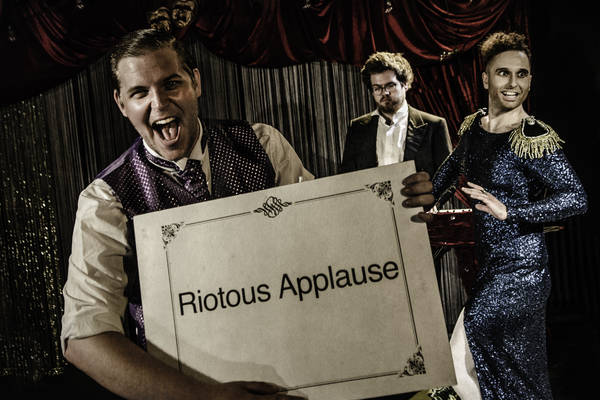
Seiriol Davies’ How to Win Against History chronicles (and fictionalises parts) of Henry’s radical life, focusing on his theatre work and cross dressing, as a fabulous, form-bending cabaret/musical. This little show has a huge heart and needs further script development to smooth out the lumpy narrative, but sequins and silliness, destroying the fourth wall, clowning and contemporary political commentary makes for a powerfully subversive and hilarious production.

The lengthy introduction provides necessary exposition, but as it gives way to a song that focuses on the Marquis’ time at Eton, it becomes too long. The interesting plot points come once the character is of age, and these deserve more attention than they are given. The beginning also sets up the style that’s maintained throughout, of musical theatre songs punctuating scenes that are heavy on the sort of narration and banter that is found in cabaret and drag acts. It’s a wonderful act of genre smashing. Musical theatre, cabaret, vaudeville and pantomime make an engaging, energizing combination that fosters audience participation and celebration. If this is where popular theatre is heading, then bring it on – Seiriol Davies’ script is at the forefront of musical theatre innovation.

Once young Henry finishes school, action starts to pick up. After a mutually beneficial marriage to his cousin (that was reportedly never consummated) and teaming up with a actor Alexander Keith (Matthew Blake), he casts himself in several plays. When no one comes, they take the shows on the road, making hilarious changes as the audience becomes less enamored of his work. More could be made out of his marriage and his increasingly weird theatre productions; they are rushed and little sense of a timescale is provided. Between his awakening as a student to a touring theatre maker, there’s a feeling that a lot of plot is missing. He is suddenly a broken man in Monte Carlo being interviewed by Daily Mail journalist Quentin (a brilliant in-joke!) and whilst this is deliciously funny, there is yet another leap in time and place. More scenes could easily be written to fill in these gaps without disrupting the established style. Even though the cabaret influence comes though in the short sketch-like scenes, as a musical it feels underwritten.

Writer Seiriol Davies plays Henry, the fabulously flamboyant lover of sequined dresses and the theatre. His journey from naïve boy to the ill and impoverished 20-something is lovely and genuine, with songs that in turn capture his enthusiasm and anguish. Energy abounds from the other two performers, making the show feel a lot bigger than it actually is.

Though this new musical needs further development to give it the scale and narrative punch that matches the style, it is fantastically good fun. The political content and deconstructing of style and structure are fly in the face of historical erasure of controversial figures and dramatic conventions. But it evoked engagement and contribution from a willing audience that was eating out of the performers’ hands within the first few minutes and this in and of itself is a huge indicator of excellent work. How to Win Against History could easily have the scale of a West End show, and it deserves the attention that would garner it.

How to Win Against History runs through 28 August in London and Edinburgh.

The Play’s the Thing UK is committed to covering fringe and progressive theatre in London and beyond. It is run entirely voluntarily and needs regular support to ensure its survival. For more information and to help The Play’s the Thing UK provide coverage of the theatre that needs reviews the most, visit its patreon.
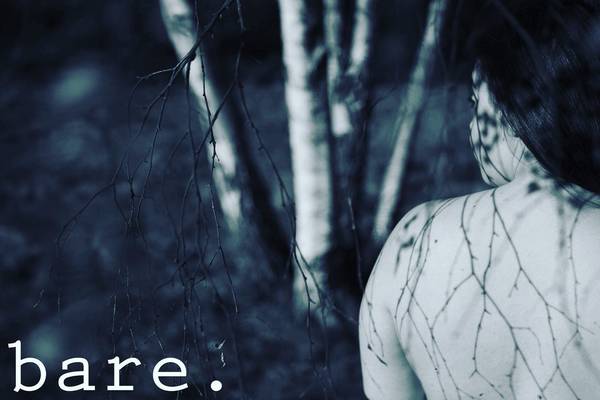
 

bare., Courtyard Theatre

rsz_clbw12owyaau3v8

Three young women, three short solo performance pieces, three stories of vulnerability make bare., a thematically linked evening of new writing. Each of the three mini-plays has a distinct style and is performed by the writer. They vary in the quality of writing and inventiveness, and feel very new – more like scratch performances rather than finished pieces. bare. is a lovely concept – short, female solo performances that reveal hopes, fears, aspirations and conflict. It could easily become a regular event, giving women the chance to try out one-person work in front of an audience. As is, these pieces certainly need development but the three writer/performers show much promise and commendable initiative that, with development and experience, will certainly improve their work.

Kat Ronson is first, performing ‘IBZ’. This fragmented work follows a young woman’s journey from singledom into a loving relationship. The wild, drug fueled club nights transform into something more gentle and intimate, but her story does not end happily ever after. The young woman’s transformation is lovely, but the choppy writing makes for an unclear narrative and timeline. Ronson uses comedy punch lines and moments of reflective sincerity effectively, but this doesn’t balance out the vague writing. This piece would benefit from dramaturgical support and a hefty re-write, but the concept and central character are certainly workable.

American Steffanie Freedoff shows that yanks can handle their poetry and spoken word with ‘in the beginning there was Word’, a biographical monologue in verse about hating poetry as a teenager and growing to love it as an adult. This is also a coming-of-age story, but a much more positive one on self-discovery and confidence. It’s a bit cheesy and motivational, but the two stand-alone poems she ends on are angry, provocative and polished. The focus is on these pieces, which feel disconnected from the first part of the performance but add variation in style and tone. This second mini-play also needs development and shaping to find its overarching message, but it feels like it could be lengthened without becoming dull.

Madeleine Dunne brings a strong character piece to the trio with ‘Mind the Gap’, a piece that looks at the struggle of overcoming mental health issues. Lucy is a little girl terrified of breaking the rules and a young adult still limited by these fears. Told in two parts, Dunne’s gift for transformation is revealed in these two naturalistic monologues. It’s not clear who she is talking to and why in either section, but the character is a suitably interesting one. Lucy could also work well as the protagonist in a full play with multiple characters, perhaps even better with others to respond to rather than limited in a solo performance.

A quiet, sung finale wraps up the evening, a nice touch that adds some unity to these unrelated plays. bare. still feels like a scratch or showcase with a range in quality, but as a themed performance event, it is poignant and well curated. All three pieces need refining and/or expansion, though each shows at least some element of promise.

bare. runs through 16 July.

The Play’s the Thing UK is committed to covering fringe and progressive theatre in London and beyond. It is run entirely voluntarily and needs regular support to ensure its survival. For more information and to help The Play’s the Thing UK provide coverage of the theatre that needs reviews the most, visit its patreon.