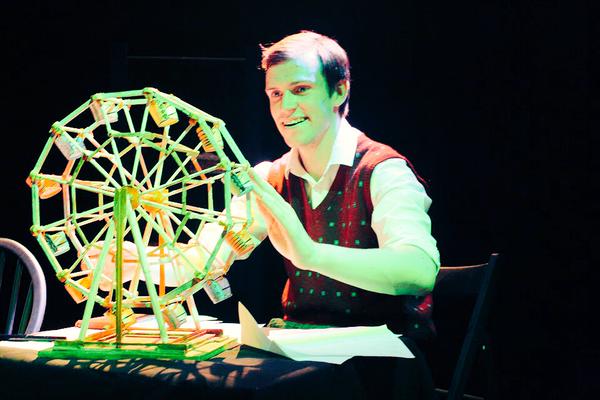
Please Excuse My Dear Aunt Sally, Edinburgh Festival Fringe

https://www.thestage.co.uk/wp-content/uploads/2016/08/please-700x455.jpg

When fourteen-year-old boy Red starts at a new school after his parents’ divorce, his mum anxiously worries about him making friends. Soon, his mobile is constantly buzzing with texts and he’s out most evenings. Mum’s happy but she only sees the life Red constructs especially for her. Someone, or rather something, else has the privilege of an uncensored view – Red’s mobile. As the vulnerable boy is sexually exploited by his unsatisfied maths teacher, his phone sees everything and narrates the story around the characters’ interactions. This slick ensemble piece by NY theatre company One Year Lease seamlessly merges writing styles, design and physical theatre to tell a dream-like story of abuse veiled as love.

When Red’s maths teacher confiscates his mobile and accidentally takes it home with her instead of her own phone, she begins a downward spiral of communication that quickly becomes personal. Red’s parents separation is far from pleasant, and his teacher’s boyfriend is an unemployed layabout, with vague dreams of designing apps. This combination fosters a relationship where the teacher and the student inappropriately confide in each other, and she does nothing to stop it.

Suspicion helps propel the action upwards towards a climactic end, but a lack of consequence in Kevin Armento’s resolution is as disturbing as the story itself. The phone as narrator is a great device – it’s present enough to add context and framing, but is not overused to the point of becoming a gimmick. Abstract movement incorporating versatile set pieces adds a striking, dynamic visual and a disconnect from reality appropriate to a forbidden relationship. A live musical score by Estelle Bajou enhances the surrealism of the staging.

Mathematical equations coldly explain how their illicit affair develops, and minimalist design in black and white juxtaposes the intricacies of the complex lives that collide so inappropriately. Though the script avoids blatant condemnation of the relationship, Please Excuse My Dear Aunt Sally is a striking blend of visual and verbal storytelling.

Please Excuse My Dear Aunt Sally runs through 28th August.

The Play’s the Thing UK is committed to covering fringe and progressive theatre in London and beyond. It is run entirely voluntarily and needs regular support to ensure its survival. For more information and to help The Play’s the Thing UK provide coverage of the theatre that needs reviews the most, visit its patreon.

Gatsby, Union Theatre

Gatsby (c) Roy Tan (4)

Jay Gatsby’s distinctive yellow car is an iconic image in The Great Gatsby. Power, wealth and charisma emanate from its shimmering, custom paint job as it rolls between Long Island and Manhattan in the decadent 1920s. It’s eye catching and demands attention, like the enigmatic man who owns it. Adaptations of The Great Gatsby are plentiful, but good ones need the same characteristics as Gatsby’s car, along with a generous, heady mix of self-indulgence and extravaganza. Linnie Reedman and Joe Evans’ musical incarnation of F. Scott Fitzgerald’s iconic novel manages to avoid incorporating any these. Bland music, lazy performances and design and a book with numerous shortcomings makes Gatsby a stuttering, third-hand Ford Fiesta rather than a customized, purring Rolls Royce.

Reality TV celeb Ferne McCann makes her theatre debut in this production, bringing a lot of negative publicity with her as consequence. She’s also incredibly surprising – alone in a theatre-trained cast, she is the only one consistently able to be heard over the live actor-musos with her Amy Winehouse-influenced performance. Of the 13-strong cast, most are weak, some terribly so. They are either grotesquely overacted cartoons, or underplayed so much that their performances are flat. There’s no sense of danger or excitement, or EVERYTHING IS EXCITING ALL THE TIME FOR OVER TWO HOURS. It’s exhausting to take in. In either case, the characters are no more than stereotypes; this is more of an issue with Reedman’s book as it certainly doesn’t give the actors much depth to work with. Accents drift around the 50 states and then some, with the only consistent one coming from an actual American.

Reedman also directs, with little comprehension of the narrative arc she constructed from the novel. Other than the Plaza hotel scene late in the play when Daisy and Jay confess all to Tom, there is a pronounced lack of tension. Myrtle’s tragic end is anticlimactic and rushed, as is her husband George’s retaliation. She neglects characterization and seems to focus solely on staging. If that.

There are 21 musical numbers (including a couple of reprises), but none of Joe Evans’ tunes stands out from the rest. Even with a mix of smaller and larger numbers, there is little  musical variation. Transitions from book to song are often abrupt and forced for the sake of fitting in another tune rather than naturally reaching a point in the story where music is necessary to accentuate a plot point or emotion. Nick Pack’s choreography, without much to work with, is similarly unvaried with a bit of a Charleston every now and then.

There are few positives to pull from this production. Reedman and Evans’ interpretation is a choppy hatchet job of Fitzgerald’s work and few, if any, features deem it a worthy adaptation. If Gatsby’s goal is for the audience to “feel…the heat, sweat and life” of the euphoric, post-war American decade, it barely comes close. Tepid, cool and laconic is what actually comes across, in a wheezy motorcar threatening to cut out at any moment.

Gatsby runs through 30th April.

The Play’s the Thing UK is committed to covering fringe and progressive theatre in London and beyond. It is run entirely voluntarily and needs regular support to ensure its survival. For more information and to help The Play’s the Thing UK provide coverage of the theatre that needs reviews the most, visit its patreon.

The Long Road South, King’s Head Theatre

The Civil Rights movement in America was time of turbulence and violence but both black and white activists retaliated with their passion for equality. The issue divided individual families across generations, recreating the conflict on a microcosmic level. Paul Minx’s The Long Road South recreates this excruciating tension through close examination of the dysfunctional Price family in suburban Indiana.

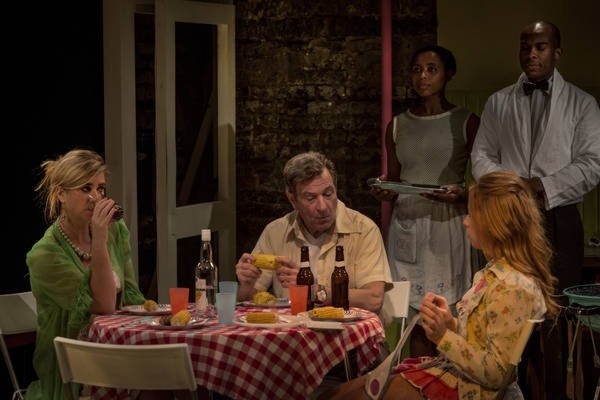
Stay at home Carol Ann (Imogen Stubbs)is mother  to teenager Ivy (Lydea Perkins) and married to supermarket manager Jake (Michael Brandon). They are the only family in their neighbourhood able to afford “help”, black couple Grace (Krissi Bohn) and Andre (Cornelius Macarthy). On the surface, these characters are aspirational and progressive. That American Dream veneer doesn’t hold up for long, though. The characters’ gangrenous innards seep out, creating a kitchen sink drama with excellent moments, dramatic themes  and characterisation akin to Miller and Williams, but lacks the linguistic sophistication of these revolutionary writers and a few too many twists and turns for a one-act play.

The cast is generally strong, with Brandon outshining the rest when he eventually appears in Willy Loman-esque glory. Perkins has a grating vocal quality that, though appropriate to the lying, manipulative character, was nails on a blackboard after a few scenes. Bohn and Macarthy are good foils to each other with a lovely chemistry and sharp edges that sporadically pop out, adding to the dissonance. Stubbs is the tragic heroine, trapped in her house by alcoholism and the memory of an institutionalised child. This lot are a close-knit ensemble, an extended family with all the complexity of a real life one. Unfortunately, the accents spanned the country rather than uniting this family in a common place.

Director Sarah Berger skilfully uses the irregular playing space and space to enhance tension. Rarely touching or even close to each other, this shows the power of religious belief in these characters constantly aware of Satan’s temptations. Adrian Linford’s sunny back garden with its perfectly mowed grass and pastel BBQ juxtaposes the family’s chaos. Minx has an instinct for conflict, but the production’s subtlety comes from the performances rather than the dialogue. There’s no overt moralising or thickly laid Americanisms, just the characters’ genuine need to do what they think is right.

The Long Road South is a quite the good script by a writer with plenty of promise and a great cast. It’s a good reminder of a crucial period of American history, and that monumental change can wreak havoc on the closest of family units. The cast and the characters’ individual stories are certainly the best features here, but the other production elements aren’t far behind.

The Play’s the Thing UK is committed to covering fringe and progressive theatre in London and beyond. It is run entirely voluntarily and needs regular support to ensure its survival. For more information and to help The Play’s the Thing UK provide coverage of the theatre that needs reviews the most, visit its patreon.

No Villain, Old Red Lion Theatre

rsz_no_villain_old_red_lion_theatre_adam_harley_courtesy_of_cameron_harle_5

There’s usually good reason why renowned writers have known but unpublished early works. They hone their craft by writing, usually badly at first, and then have a major breakthrough after they have been writing for some time. Expecting this to be the case with Arthur Miller’s world premiere of the unpublished No Villain, the play proved to be surprisingly good. Miller’s autobiographical one act was written for a playwriting competition when the 20-year-old undergraduate at the University of Michigan was on the verge of leaving due to his family’s losses during the Great Depression. It was in the university’s archives that director Sean Turner found the manuscript mentioned in Miller’s memoirs, dashed off with the desperate hope of saving his Journalism degree. A theatrical and historical relic, the script isn’t a particularly polished affair but brims with youthful enthusiasm, political activism, and familial conflict that hints at the greatness to come in later works like Death of a Salesman and The Crucible.

From beginning to end, tension dominates this story set in 1936 New York City during the strikes that paralysed the garment district and bankrupted businesses barely holding on to their survival. Father Abe Simon (David Bromley) has no sympathy or understanding for the strikers or his sons’ recent discovery and devotion to the new political system taking over the East, Communism. Arnold (Adam Harley) is a thinly veiled Miller who at the beginning of the play returns from Michigan for the holidays. Refusing to help his father (David Bromley) at the shop because it would compromise his principles, older brother Ben (George Turvey) is more practical. The action largely centres around these three men, but the strain of the Depression also shows in their interactions with their mother (Nesba Crenshaw), sister Maxine (Helen Coles) and grandfather (Kenneth Jay).

Focused, emotionally endowed performances in heightened realism and moments of good dialogue generate exquisite set piece scenes, but the overall plot structure and storyline is a bit loose, and the politics are so blatant that it’s agitprop. This is not a subtle play, but it’s certainly not poorly made. The story is a microcosmic representation of Big Issues but it’s clear that this is real life replicated on stage rather than pure fiction. There’s a lot of preaching and arguing and threats, but the actors truthfully capture this almost-constant tension within the family, and these moments are plentiful. Like a baby Death of a Salesman, we see the idealism and father-son relationships that help make Miller one of the greatest dramatists of the 20th century.

Max Dorey’s set and Natalie Pryce’s costumes contribute detail and further authenticity to the production. Stylistically, this is a great example of early 20th century American theatre (but with accents from different parts of the US in one family) made popular by Clurman, Adler, Meisner and the rest of the Group Theatre in the 1920s and 30s. Turner captures this performance style well and in combination with the factual/biographical nature of the script, it feels like the audience is watching a moment of history brought to life.


The Play’s the Thing UK is committed to covering fringe and progressive theatre in London and beyond. It is run entirely voluntarily and needs regular support to ensure its survival. For more information and to help The Play’s the Thing UK provide coverage of the theatre that needs reviews the most, visit its patreon.
Hello Again, Hope Theatre

https://i0.wp.com/grumpygaycritic.co.uk/wp-content/uploads/2015/10/Hello-Again-1402b.jpg

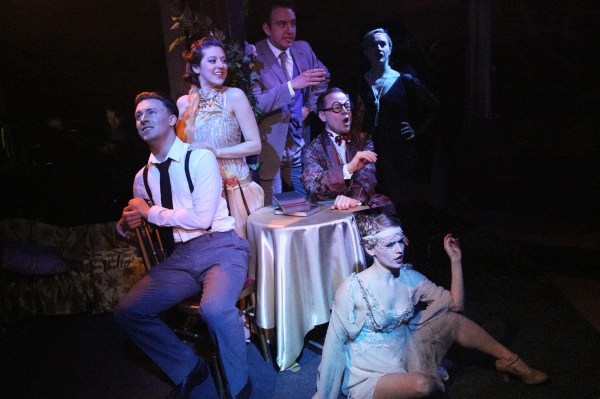
Knickers, bras and other vintage undergarments (oh my!) dangle from the Hope Theatre ceiling in dim light, the discarded ghosts of sexual encounters long past. Arthur Schnitzler’s 1897 Reigen, or La Ronde as it is more commonly known from the French translation, is reinvented in musical form in Michael John LaChiusa’s early 1990s Hello Again. Not content with the original story, LaChiusa spreads Schnitzler’s shags, blowjobs and wanks over the 21st century, updates some of the characters, includes gay relationships and adds a nearly continuous score mostly of duets, with musical influences from a host of eras. The sex is seen rather than just talked about, but otherwise Schnitzler’s format is replicated. Five actors each takes two characters and accompanied by a solitary keyboard, create an intimately filthy but strangely moving chamber musical in one of London’s newest pub theatres.

Hello Again, though titillating, also looks at the desire for sexual satisfaction through entirely unromantic, desperate scenarios. In ten short scenes, we see an array of social classes, professions and sexualities get their jollies before they run out of time; there’s the married housewife in her affair with a student, the soldier and the nurse before he ships out and the gentleman and cabin boy on the sinking Titanic amongst others. One-off and long-running relationships are accompanied by a range of musical styles on a bare bones set, but the minimalism means nothing is held back and it’s practically in your lap if you’re in the front row. Though there’s plenty of bonking, little is seen – a bum here, cleavage there; the acts themselves are staged realistically rather than stylized or hinted at by director Tania Azevedo. In our porno-fied modern culture where hardcore images and video are a couple of clicks away, to show the grunting and thrusting act without the bits strikes an interesting balance between honesty and discretion. With the audience split over three sides, more diagonals could have been used in the staging to improve sightlines for everyone, but otherwise the small space with no backstage is used well.

LaChiusa keeps the scenes short, but this enhances the immediacy and primal nature of sex. There are some good numbers, but the hodge podge of styles prevents much in the way of recurring motifs. The settings and characters are clear and believable, though their brevity needs the characters to get to the point quickly. As we don’t really get to know these people before us, they become an everyman of their character type: they are us, and we could easily be them. The ensemble cast is consistently good, with newcomer Isabella Messarra and veteran Miles Western giving the most striking vocal performances. Messarra’s Nurse is a wonderful force that literally dominates the posh student she cares for, Western is the smug senator exploiting a beautiful but lonely film star.

This is an excellent and largely faithful adaption of Schnitzler’s play that doesn’t shy away from explicitly prurient moments all sexual human beings can relate to. LaChiusa’s characters speak to all of us, even if his music is less satisfying. Azevedo’s direction and multi-roll casting suits the piece, as the intimate venue fits this infrequently staged and rarely seen musical.


The Play’s The Thing UK is an independent theatre criticism website maintained voluntarily. Whilst donations are never expected, they are hugely appreciated and will enable more time to be spent reviewing theatre productions of all sizes. Click here to make a donation with PayPal.

Home Free!, London Horror Festival

CRvG0L4WwAA3jO7Siblings Joanna and Lawrence live in 1950s New York City, a place brimming with promise and excitement for its younger residents. They don’t take advantage of it, though. Lawrence never leaves their little apartment; instead he lives vicariously through Joanna’s “adventures” to the market and her encounters in the corridor with their landlady “Pruneface” who has said they need to move out soon. Pruneface doesn’t like that Joanna’s pregnant, and with good reason. It’s Lawrence’s baby and the two refer to each other as husband and wife as often as they do brother and sister. Home Free!, whilst not a scary addition to the London Horror Festival, is a disturbing, excellently performed one-act showing the forgotten and invisible underbelly of an otherwise glamourous city. Untreated mental illness and agoraphobia has enormous consequences for these two innocent twenty-somethings, with Home Free! raising bigger questions about societies that let such a pair slide, unnoticed and unsupported, into catastrophe.

Lanford Wilson’s dialogue is deliberately circular and repetitive, serving to emphasise the cycle of fear that dominates Joanna and Lawrence’s lives. Though necessary, the repetition becomes predictable but this is fortunately a play in a single act. Wilson fully forms the imaginary friends the two have, Claypole and Edna, and Lawrence truly believes they are real – an unsettling device with a surprising impact on the play’s climax. Wilson was one of the pioneers of the New York City fringe theatre scene in the 1960s and it shows in this well-formed play, perfect for a tiny venue like the Etcetera.

This two-hander is adeptly handled by Lindsey Huebner and Rob Peacock, with direction by Courtney Larkin. Larkin focuses on Lawrence’s childlike mannerisms and instinct to see everything in his world as something to play with, occasionally emerging as aggressive attempts to get Joanna into bed despite her protestations. The two have some genuinely sweet moments, particularly when they give each other gifts from their “surprise box” that lives on the bookcase, made all the more unnerving by the awareness that they are brother and sister.

International company Theatrum Veritatus seeks to merge North American and British theatre traditions through their productions, a worthwhile effort in this American play performed in a pub theatre – a quintessential British venue. This production of Home Free! is a good one of a play rarely-staged here, but it’s inclusion in the London Horror Festival is an interesting choice. The horror this play contains is not the kind most familiar to Halloween. There are no ghosts, gouls, or things that go bump in the night. Instead, there’s incest, pathology and no support structure for vulnerable young people. Now that’s a truly frightening thing to imagine.


The Play’s The Thing UK is an independent theatre criticism website maintained voluntarily. Whilst donations are never expected, they are hugely appreciated and will enable more time to be spent reviewing theatre productions of all sizes. Click here to make a donation with PayPal.

In the Heights, Kings Cross Theatre

rsz_sam_mackay_as_usnavi_and_the_cast_of_in_the_heights_photo_credit_johan_persson

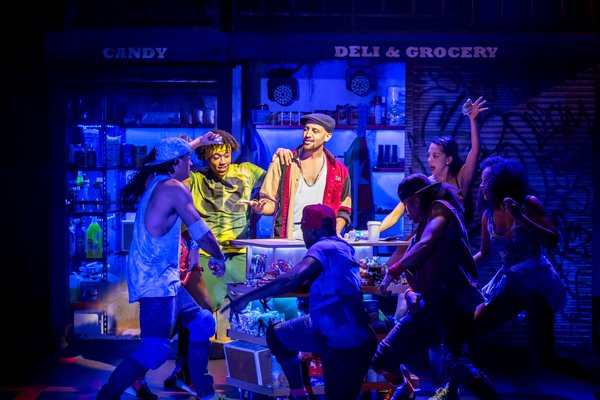
Way up in Manhattan, so far north that it’s nearly the Bronx, is Washington Heights. You take the A or the 1 train to 181 Street to find this primarily Hispanic neighbourhood that’s not on any tourist radar. In the Heights shows the day-to-day struggles and celebrations of a group of residents on one block far removed from downtown prosperity with a soundtrack of salsa, hip-hop and poppy musical theatre.

The songs are the most innovative aspect of this mostly-sung musical with a stellar cast, but the book is rather sparse and the large cast of characters means it’s a cracking ensemble performance with frustratingly little development for any one character. The book and lyrics rely on stereotypes of Latino immigrants in New York City, though it both fulfills and destroys them within the diverse array of characters. The story feels rather tenuously squeezed around the songs with the dialogue serving as a plot point connector; most, of the scenes aren’t substantial enough to stand on their own. But, going back to the music, the songs make up the bulk of this musical and create a fabulous atmosphere complimented by excellent design. The Latin and hip-hop tunes are the best and most original, resulting in a fun evening and a memorable soundtrack.

This production is the same one that received numerous accolades and award nominations last year at Southwark Playhouse, and deservedly so. The Kings Cross Theatre suits this show well, with a wide traverse stage and audiences on either side, creating intimacy and suiting Drew McOnie’s circular, street party choreography. There are still design relics from The Railway Children, but Takis’ urban set and Gabriella Slade’s bright, revealing costumes pull the focus onto this completely contrasting world. With the performances practically in the laps of the front rows, it’s hard not to get up and dance. Some people do during the curtain call.

It’s not all a party, though. Nina (Lily Frazer), the first of the neighbourhood to go to university, has dropped out after her first year. Her father Kevin (David Bedella) hates her boyfriend Benny (Joe Aaron Reid) and is furious about Nina’s deceitful behaviour. Corner shop (or “bodega” in NYC lingo) owner Usnavi (Sam Mackay) and salon owner Daniela (Victoria Hamilton-Barritt) are getting priced out due to rising rents. Others came here for a better life only to find themselves cleaning houses and pigeonholed by poverty. The joy in this show comes in the characters’ ability to party and find solace in each other in the face of adversity – a powerful message for modern times.

I wanted to know more about these characters, though. This is a “slice of life” show that tries to fit in a lot of big personalities and backstories in a short amount of time, so the main characters and their tales have little space to grow. The storyline feels rushed and the ending, though a happy resolution, is a bit too “musical theatre twee” for a world that’s poor and gritty, albeit one soaked with colour and excellent music. It’s still possible to be pulled into this little stretch of Washington Heights in the height of summer and to want to dance the night away to this extraordinary blend of Latino, rap and musical theatre.


The Play’s The Thing UK is an independent theatre criticism website maintained voluntarily. Whilst donations are never expected, they are hugely appreciated and will enable more time to be spent reviewing theatre productions of all sizes. Click here to make a donation with PayPal.

The Emperor Jones, Lost Theatre

Whilst visiting a Caribbean island about 100 years ago, Brutus Jones, an African American train driver, some how ends up emperor of the island’s native tribe. His reign is brutal, so Jones knows it will eventually end. Eugene O’Neill’s 1920 The Emperor Jones begins with Jones’ initially relaxed attempt at escape from the uprising citizens, and inevitable guilty descent into the madness of a Shakespearian villain. The script is entirely spoken by Jones, barring the first and last scenes, with his madness peppered with ghosts that won’t let him rest in the darkness of the island’s woods.

The ensemble cast add variation with movement, dance and music, breaking up the lengthy monologue that comprises most of the play. The Afro-Caribbean style dancing and ritual bowing designed by movement director Diane Alison-Mitchell compliment the set of heavy, distressed drapes that become a throne room, forest and road. The dance and movement plays a vital role in determining the setting, as the script largely neglects this. The time period is also ignored in the text, but also smartly indicated with generic peasant costumes by Sorcha Corcoran. Director Ursula Campbell effectively unites the design elements, rounding it off with Fasier Milroy’s dark sound and lighting.

It’s an interesting play choice for Black History Month considering how unlikeable the title role is, but shows episodes from African-American history in Jones’ hallucinations, and can provide some insight into Caribbean island life. What is also worth considering is that The Emperor Jones was written by a white man prior to US integration and features a black leading man who speaks in the vernacular of the slave generations, but O’Neill was the son of Irish immigrants, a nationality on the receiving end of much discrimination. Though initial pathos towards Jones is impossible, there is room for it to develop over the course of his collapse. O’Neill’s script is similarly wordy and slow to develop tension, not gathering momentum until roughly half way through. It employs several different performance styles including early realism that although experimental at the time of writing, feels dated now.

RSC, National and Globe veteran Mark Springer is egotist Brutus Jones. His arrogance, written into the script, takes a long time to break down; this limits Springer’s range until he starts to lose his mind after which he splendidly falls apart. His second in command, Smithers (Matthew McFetridge), is the bearded manipulator that keeps his cards close to his chest when advising Jones of the people’s revolt. The rest of the cast who form an ensemble are good, but underused.

The issue with The Emperor Jones isn’t the production in this case, but the script itself. Despite considered design and production elements, it becomes clear why this play is rarely produced in the UK. It has little relevant to modern British society and Jones’ narcissism, whilst no doubt fun to play, is much less fun to watch and drags on for too long.


The Play’s The Thing UK is an independent theatre criticism website maintained voluntarily. Whilst donations are never expected, they are hugely appreciated and will enable more time to be spent reviewing theatre productions of all sizes. Click here to make a donation with PayPal.

Proof, Tabard Theatre

UHiP6jXbA5DqIaNXkAytOBl1UuLDXy_b779FX7xl6BQ,a9rOk_j1JSFH2FR-jBMbqGBJsjT4iFWRGYLFIWCxaIA,C2UVon_VzrAAqP9YeBbzFYsaScoYT5zPqdFATRLMTa4David Auburn’s 2001 play Proof is an exquisitely crafted Tony award winner about Catherine, a young woman who gave up her early 20s to care for her father, a renowned mathematician suffering from mental illness. The night before her 25th birthday, she wrestles with her overbearing older sister Claire, awkward advances from her father’s former student Hal, and the question of  how much of her father’s genius and/or madness she inherited. Darting between mathematics, sibling relationships, mental health and trust, Front Foot Theatre’s production brings out the script’s humour and uses stark character contrast to easily generate external conflict. There is little subtlety in this interpretation though, and an unusual casting choice exacerbates this.

Of the cast of four, they are all undoubtedly excellent, and three of them are mostly consistent with their Chicago accents. But director Sebastien Blanc focuses on character clashes whilst neglecting lead character Catherine’s inner battle, here played by Julia Papp, an actor from Hungary. Papp performs in both a language and accent that aren’t native to her, huge challenges to overcome in order to achieve any sort of in-depth characterization. She does get there near the end of the play; up to this point, she relies on sarcasm and shouting to convey a generalized emotional state. Her accent is also frustratingly inconsistent. There is great chemistry between the cast as a whole though, particularly Papp with Kim Hardy as her father’s ex-student Hal, and in her final scene with her father (Tim Hardy). Their more intimate moments are lovely. Papp certainly has talent as a performer, but the obstacles in Proof create a constant struggle for her. Mary-Ann Cafferkey, as Catherine’s older sister Claire, a no-nonsense currency analyst living in Manhattan with her fiancé who has no patience for Catherine’s issues, balances Catherine’s emotional instability. Her stereotyped interpretation is fun to hate, but Blanc ignores her genuine love and worry for Catherine. The male characters are played with much more nuance than the women, despite them being smaller roles, so it appears that there are some deeper directorial issues present.

Michael Leopold’s dilapidated house is a wonderful set, more complex than most in fringe theatre. It looks well-crafted and sturdy, an excellent finishing touch to a play grounded in modern naturalism. The sound design is an original composition by Chris Roe, blending a range of emotions with the digital precision of the mathematics that feature so heavily in Auburn’s script.

Without a doubt, Proof is a beautiful play. It’s unsurprising that it won several awards during its Broadway run and the play itself is the highlight of this production, followed by the design. The direction neglects the inner emotional life, particularly of the female characters, but most performances help redeem this. It’s a play rarely mounted in the UK, and the opportunity to catch it should not be missed despite this production’s shortcomings.


The Play’s The Thing UK is an independent theatre criticism website maintained voluntarily. Whilst donations are never expected, they are hugely appreciated and will enable more time to be spent reviewing theatre productions of all sizes. Click here to make a donation with PalPal.