Edinburgh Festival Fringe, 17 August: Part One

Today should have been a great day. A morning show in Summerhall, a venue that consistently stages innovative work, followed by an afternoon play affectionately looking at a topic I very much relate to. Both Current Location by FellSwoop Theatre and Waitless by Cailin Harrison have some good ideas and individual moments, but individual production elements don’t quite fit together to form a cohesive whole.

Current Location is an adaptation of the Japanese play by Toshiki Okada, set in a coastal village, presumably in England, with a minimalist script and design. It feels quite Scandinavian (which suits the simile I will use shortly). Four women anxiously rehearse for a performance, then another arrives who disrupts the natural chemistry of the group. She is soaked from a sudden downpour from the blue, “bad luck cloud” that recently appeared over the village. Its appearance effects the entire population: animals are behaving strangely and people are no longer talking to each other. Rumours abound of a coming disaster; the women we see are split – some believe them, others don’t. As the play progresses, climate change intensifies as does character conflict. Some believe nature will soon cause the village to disappear, others refuse that it’s a possibility.

The premise and climate change message are certainly interesting, but the execution doesn’t make sufficient impact. There is no set and no stage lights, and the room is too big for this intimate piece. The traverse staging and naturalistic performance style chosen by director Bertrand Lesca causes lines to be completely lost if the performers’ backs are to the audience. Some vital moments were missed completely because they couldn’t be heard. It is a frustrating experience that would work better on film. The classical score that accompanies, whilst beautiful, also doesn’t improve the volume issue. Despite the naturalistic performance, the actors sit in the audience when they are off stage (sometimes), creating an inconsistent style.

The production rather reminded me of Ikea. Minimalist Scandinavian design, looks great on paper, but once constructed it doesn’t hold up very well. Other than the volume, the performances are good and character arguments are satisfying explosions of pent up frustration. Florence (Caitlin Ince) is the leader of the bunch who violently insists on maintaining the staus quo and that the village will be fine, of course. Hannah (Pia Laborde Noguez) is the late arriving disruptor who is quickly dealt with. The other three, Eva (Charlotte Allan), Jayne (Emma Keaveney Roys) and Elisabeth (Roisin Kelly), capture the uncertainly of a world on the brink of disaster. A script of five female roles is certainly commendable but their microcosmic conflicts don’t carry the gravitas of a major world issue. Like a piece of Ikea furniture that’s full of promise in the catalogue, it is disappointingly insubstantial and the component parts don’t quite fit together properly once out of the package and assembled.


The Play’s The Thing UK is an independent theatre criticism website maintained voluntarily. Whilst donations are never expected, they are hugely appreciated and will enable more time to be spent reviewing theatre productions of all sizes. Click here to make a donation with PalPal.

Catalpa, Edinburgh Festival Fringe

tumblr_inline_nrvc51lXq21ty6pcm_500In 1876, Captain George Anthony was hired to sail The Catalpa from Massachusetts to Freemantle, Australia to rescue six Irish prisoners. Numerous difficulties nearly scuppered the mission, creating fascinating narrative potential for songwriters and playwrights. Actor/writer Donal O’Kelly frames this nautical tale with a frustrated screenwriter who keeps being rejected by Hollywood producers. After the latest, “no”, he returns to his flat alone and enacts the entire story he sees in his head that no one appreciates. Youthful American company 35 Brookline brings this one-man show from Boston to Edinburgh with a great performance by Joseph Freeman, but some script issues and production choices prevent this play from reaching its full potential.

There are some wonderful moments. Freeman’s ability to embody honest tenderness as George saying goodbye to wife Greta and daughter Pearl, and later imagining them on his journey, are the best in the play. The model Catalapa at sea on the screenwriter’s bed with a small torch sun is simple but effective object manipulation. Freeman’s energy and commitment to the role are excellent and unwavering. In a play written 20 years ago, Freeman feels too young for the screenwriter character, though. The language doesn’t sit organically in a contemporary character of his age and a man reaching that level of bitterness is usually middle-aged rather than early-to-mid twenties, though his youth suits the characters in the Catalpa story.

The introduction of O’Kelly’s script is rushed, not giving the performer enough time to suitably build to the desperation required to carry him through the enactment of his script alone in his flat. It’s also an unconvincing scenario, and one that feels plausible with the addition of copious amounts of alcohol. The script also fails to return to the screenwriter at the end of the play, creating an abrupt ending and the feeling of incompletion.

Though the pace and energy are generally good with suitable attention paid to the more intimate moments, other climactic moments could have been slowed down more. The story depicted in lengthy and complicated, which can be hard to follow at pace. I’m unsure whether this is a script or directorial issue, but it’s easy to lose track of the story. There is much more potential for sound and lighting detail to add even more atmosphere, but this is underused. What is there is supportive of the story with the exception of a few blackouts.

This is certainly a quirky and endearing piece of theatre, but one that does not manage to fully satisfy. The story is wonderful as is Freeman’s performance, but other elements of the production don’t knit together as smoothly as they could.


The Play’s The Thing UK is an independent theatre criticism website maintained voluntarily. Whilst donations are never expected, they are hugely appreciated and will enable more time to be spent reviewing theatre productions of all sizes. Click here to make a donation with PalPal.
The Ghost Sonata, Rose Playhouse

A mysterious old man manipulates a poor student, then a wealthy colonel. A woman – or is she a parrot? – lives in a wardrobe. A beautiful, sick daughter always stays indoors. Servants control their masters. There is discussion of past love affairs, betrayal, and deceit. Strindberg’s The Ghost Sonata is inhabited by a cast of damaged, dysfunctional characters drawn to a house that rots them all from the inside. Director Charlotte Ive has adapted the original to suit a small cast and stage at The Rose on Bankside with good intuition for creating mystery without losing momentum. Though I am unfamiliar with Strindberg’s script, Ive seems to have made some edits but keeps the crux of the story, all which is made clear at the end. There are some issues, but this is a lovely intimate piece of theatre with strong directorial choices that mostly support the performance, and an able, predominantly female, cast.

They story is slow to develop, but does so with deliberating measure, managing to escape stagnation. The start is somewhat unclear: the initial location is vague, as is why two characters meeting for the first time are in what is an obviously engineered situation. These factors enhance the mysterious aspect of the story, but do not foster understanding. Foss Shepherd is Jacob Hummel, an 80-year-old, chatting to female Charley Willow who plays young male student Arkenholtz. Willow’s gender is not particularly well disguised, and a less convincing boy than she is as the old colonel. Hummel clearly wants something from Arkenholtz, but what and why is only revealed later. Shepherd and Willow’s performances have enough tension and energy to keep the story moving; lesser talent would cause the action to stall.

Making up the rest of the cast are Sophie Lakely and Olivia Meguer, who play the rest of the roles. Meguer as the revolting chef who stuffs the family full of food drained of nutrients is particularly fun to watch. Lakely as the supposedly ill daughter never quite connects with Willow’s student, though her conviction is genuine. They also play disembodied ghosts voiced from the audience or the edge of the stage. Shepherd bends and twists his way through his performance as Hummel, though I wonder why Ive did not cast an older man. Though with this run starting the same time as Edinburgh Fringe and Camden Fringe, perhaps the older male fringe actors were otherwise engaged.

The design is provincial and pretty with flower garlands canopied over the stage, drawing attention away from the heavy gray concrete that forms the theatre’s walls and ceiling. A small table, jug and basin and other items add period signposts without taking up too much space. The costumes are simple, but in keeping with the time period. Ive chose not to use the entire site, with the exception of an unlit dancing couple at the far side of the pool that preserves the old Rose’s foundations. For a production that is adapted to The Rose, neglecting this part of the venue raises a question: what then makes the Rose so vital to this production?

This is a production that requires patience and acceptance from its audience. The performances are worthy of attention as the plot gently and almost imperceptibly unfolds. The characters switch between expressionism and naturalism without fanfare; very little information is actually revealed until the end. The language is evocative of broken people in a time long ago who don’t quite manage to cope with life as they should and is a wonderful, odd production despite its shortcomings.

NOTE: The performance reviewed was a preview performance.


The Play’s The Thing UK is an independent theatre criticism website maintained voluntarily. Whilst donations are never expected, they are hugely appreciated and will enable more time to be spent reviewing theatre productions of all sizes. Click here to make a donation with PalPal.
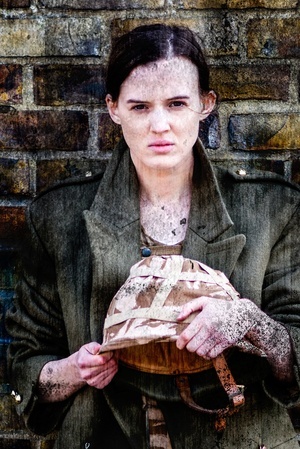
 

Elephant Man, everything theatre

“…In his original adaptation, writer and director Steve Green confronts audiences with the uncomfortable social history of ownership, entrapment and public appearance in the Victorian era.

“Actor Daniel Christostomou plays Merrick as a sensitive, articulate young man caged by his physical deformities and Victorian attitudes. Rather than prosthetics or make up, costume designer Anastasia Sarajeva has created an evocative, confrontational structure of wire, chain link and mesh for Chrisostomou…

“Steve McGarrick’s portrayal of Frederick Treves is warm but scientific…He genuinely cares for Merrick, but also has a sense of ownership for the man and wants to “keep him” in hospital for the sake of medical research. This is thinly veiled as concern for Merricks’ wellbeing.

“Adam Trussell’s Tom Norman keeps Merrick in a caged bed…as a freak show specimen in a Whitechapel shop front. Trussell also portrays Dr Reginald Tuckett, a deeply disturbed colleague of Treves. Trussell’s characters are very similar to each other, which unfortunately doesn’t allow him to show much range as an actor.

“Amy Sayers and Katie Turner also play a range of characters in Merrick’s life. Many of these characters are also caged, but by prejudices and attitudes that prohibit them from seeing Merrick as fully human.

“Despite Chrisostomou’s incredible performance and the unique approach to Merrick’s experience, the script falls short…

“Regardless of the confusing and unpolished script, the characters and the performances still make this a production worth catching…”

Read the entire review on everything theatre here.

Jekyll & Hyde, Platform Theatre

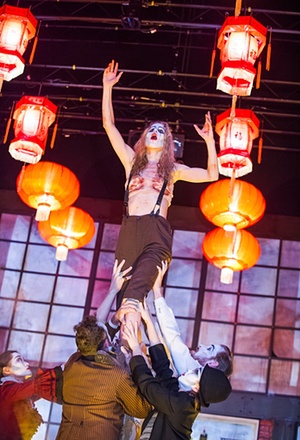
4404a479-e69a-4d92-9600-3d8eb075ff6c-1390x2040Giant red paper lanterns float over a smoky Victorian London alleyway. Six actors in western clothes and eastern whiteface also marry East and West in what initially promises to be a vibrant, transnational reimagining of R. L. Stevenson’s gothic novel Jekyll & Hyde. With the addition of a female Jekyll and a textual deconstruction that incorporates a range of performance styles, there is a lot to process in Jonathan Holloway’s script and staging. Whilst each individual choice has merit, none are fully explored due to the overwhelming array of influences Holloway employs. The sum total creates a muddy hodge-podge of ideas rather less substantial than a focus on the development of one or two of them.

The show begins away from Stevenson’s story, with an older man in Chinese dress (who is not Chinese) sharing the discovery of a wonderful but horrific tale he wants to sell to a young woman in1920s dress, presumably a publisher. To pique her interest, he begins to tell the story contained in the tome’s pages. This unnamed pair reappear regularly as the story is acted out to the audience, using narration to preempt the action and distance the audience by reminding them it is indeed a story. This is one of several Brechtian devices employed; even though it is a useful one in plays addressing social issues, it is unclear what element of the story the alienation is meant to highlight and any contemporary social relevance.

The story that plays out from the old man’s book is the more traditional Victorian story of Dr. Jekyll and Mr. Hyde, but Jekyll is a woman from Eastern Europe and the only woman doctor in the UK. It’s initially a great feminist touch, but the sex-crazed, manipulative Jekyll is hardly an empowering, feminist character. Having escaped war in her home country, she comes to London alone and uses her research to transform into a man. Though well-played by the physically expressive Olivia Winteringham, the character lacks depth and wears a costume that looks like it was put together in Camden Market rather than a costume workshop.

The set and lighting by Neil Irish are fantastic, though. Coordinated to create a horror film effect during particularly disturbing moments, they sumptuously support Holloway’s staging. Jon Nicholls’ sound design is atmospheric and sinister, well integrated with the other production elements. The costumes are somewhat inconsistent, with the men’s outfits appearing more historically accurate than the women’s. It is unsurprising that no costume designer credited.

The performances vary, with one of Chinese actors occasionally struggling to connect to the meaning in the language, creating unintended comedy. As this is a production incorporating two cultures, why shy away from using two languages? Other than a brief bit of either Cantonese or Mandarin at the start, the rest is in English. The story is well known enough to support a mix of languages, though with the melodrama, physical theatre, expressionism and naturalism already present, this would add further excess. As is, this adaptation feels predominantly English, with some East Asian design influence and a couple of Chinese performers. Though gorgeous to look at, the production never quite found the substance behind the façade.


The Play’s The Thing UK is an independent theatre criticism website maintained voluntarily. Whilst donations are never expected, they are hugely appreciated and will enable more time to be spent reviewing theatre productions of all sizes. Click here to make a donation with PalPal.
Gorilla, Polka Theatre

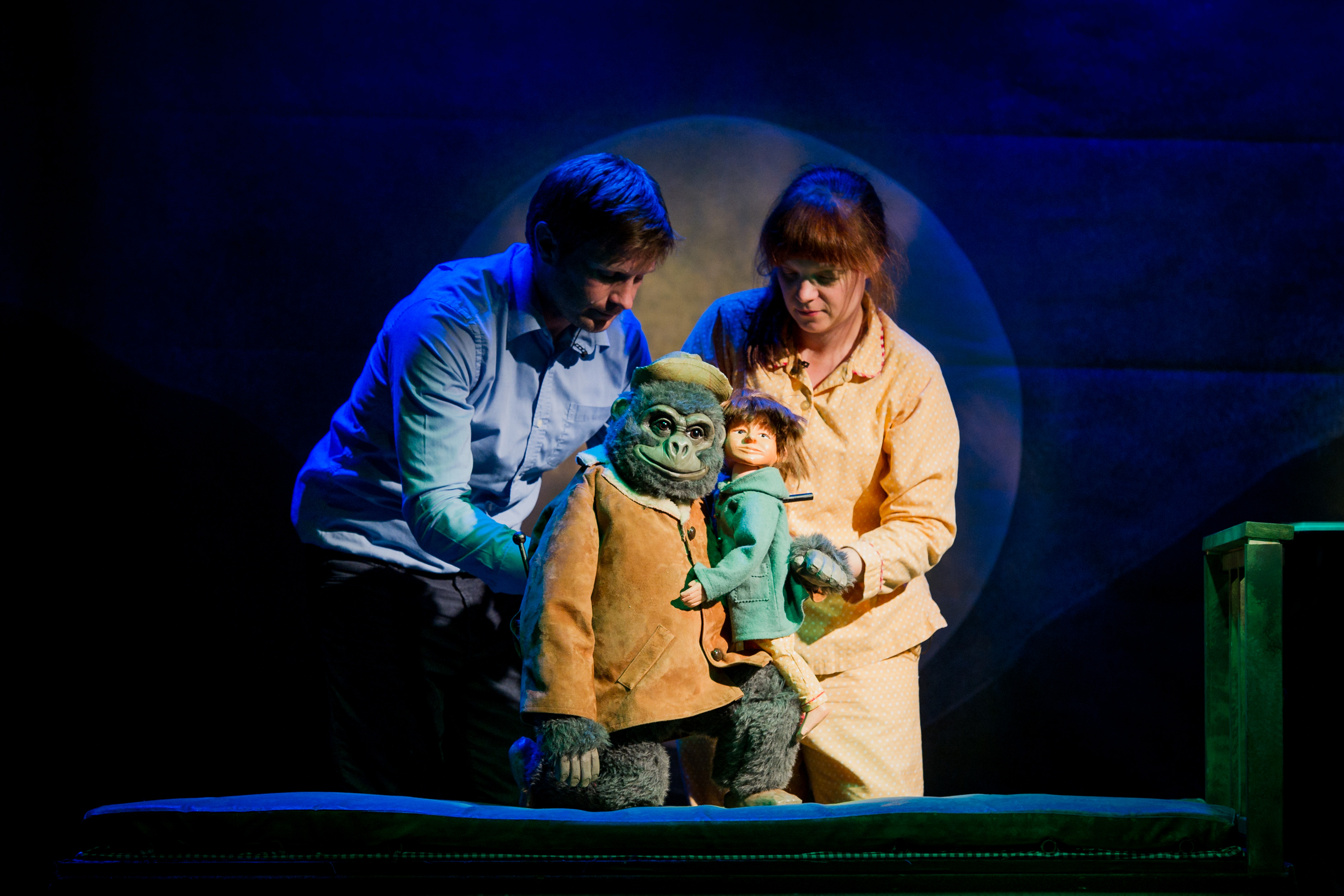
Gorilla Revival - Polka TheatreHannah is a little girl that loves gorillas. She spends all day drawing them, watching programmes about them, and talking about them. She tries to share her love for these wonderful animals with her dad, but he’s too busy. Then, on the night of her birthday she received a small toy gorilla that comes to life and takes her on an adventure, teaching her about kindness and gratitude, and her dad then gives her the best birthday ever. This classic children’s book, Gorilla, is charmingly brought to life with two actors, two puppets and a detailed but lo-tech set for children aged four to eight at Polka Theatre.

The story is a wonderful little adventure, executed quietly and calmly, without special effects and updating to reflect present day. Even the music sounds like it comes from a 1970s lounge bar. Initially I found it all terribly old fashioned, but considering the technology children are bombarded with today, it makes a refreshing change and reminds us that children don’t need an ipad and hi-tech toys to entertain them by the time they’re 3. After Hannah’s introduction, the sequence to establish her day-to-day routine and dad’s busyness is rather repetitive; the children in the audience became a bit fidgety and chatty. Once Hannah’s birthday arrives and the adventure begins through puppet versions of the characters, the audience of little ones becomes quiet and focused. Set changes tend towards the lengthy side, but the reveals that come from the set flips, rope tugs and lighting changes are choreographic in and of themselves.

The puppets suit the design of the set, old fashioned but still detailed and expressive. Actors Ceri Ashcroft and Phil Yarrow are good, with lovely chemistry, though at times it was hard to hear Ashcroft during the songs. The barometer for children’s theatre is the children in the audience though, and these maintained a steady focus once Hannah and her gorilla friend meet. They took some time to settle and weren’t grasped by the beginning exposition, but the rest of the play more than compensated.

There were some lovely staging choices by director Roman Stefanski. Particularly notable are the puppets coming into the audience as it transformed into a cinema and watching the audience as zoo animals from outside the bars of the cage. Transforming the human sized set into a puppet sized one also enchanted the audience, both adult and child. This is particularly praise-worthy as the transitions were quite lengthy and all changes (or most of them) looked operated solely by the performers.

This was my first visit to the Polka. What I found most disappointing was that the house was only half full. The theatre could certainly do with the revenue full houses generate, and this production makes a refreshing change from the fancy bells and whistles of West End family shows. The building emanates a warm sense of community that local families should enjoy more often, and it’s a break from fast and loud modern life. After all, people my age and older thrived in a childhood without the internet and handheld gadgets. Gorilla not only tells a sweet story with a strong female child as a lead, it proves that children today can enjoy live entertainment that quietly focuses on old fashioned adventure storytelling.


The Play’s The Thing UK is an independent theatre criticism website maintained voluntarily. Whilst donations are never expected, they are hugely appreciated and will enable more time to be spent reviewing theatre productions of all sizes. Click here to make a donation with PalPal.

Shakespeare & The Alchemy of Gender, Rose Playhouse

At 19 years old, Lisa Wolpe fell in love with Shakespeare. She’s now performed more of Shakespeare’s male roles than any woman in history after founding Los Angeles Women’s Shakespeare Company twenty years ago. She is currently touring the world with her solo show, Shakespeare & The Alchemy of Gender. Although it sounds like an academic lecture, it contains some of the best Shakespeare performances I have seen. The play pays homage to her father, telling the man’s story and how he affected her life. The man who killed himself when Wolpe was four is brought to life in a deceptively simple show that finds hope in a history of suicide, abuse and war.

Though to say the show is about her father’s life oversimplifies the content. Yes, a large portion is about him, but it also covers her life after he had gone, her relationship to specific Shakespeare characters, gender, performance, religion, Elizabethan society, family and alchemy – the transformation of a base material into something precious. These themes intertwine, with no moment unrelated or superfluous and the 55-minute show amazingly manages to not feel overloaded with messages. As she works through her life and her father’s, she relates Shakespeare’s characters to individual moments in time. As she reflects on her relationship with him now, she becomes Hamlet remembering his father’s ghost, in the best performance of the role I’ve encountered. Her father’s WWII escape and joining up with the Canadian forces as a double agent lead into Henry V. We also meet Richard III, Hermione, Shylock and others in relation to herself and her family’s history. Wolpe is not only adept as any man at embodying the male roles, she excels. She also effortlessly switches between men, women and herself, functioning in an androgynous state when addressing us out of character.

Wolpe is comfortable addressing us with an open honesty about difficult episodes in her life without coming across as confessional or masturbatory, as one-person shows run the risk of being when used to come to terms with the performer’s or writer’s issues, whatever they may be. The show is relaxed and conversational with the audience nodding, laughing, even verbally agreeing. The intimate venue helps, but she certainly has the energy to fill a huge theatre. She had a profound effect on the audience, particularly when sharing moments about her relationship with her family and dressing in boys’ clothes to defend herself against her predatory stepfather.

Her interpretation of the characters she performs seems rooted in physical and vocal distinctions, with her General American accent capturing the visceral-ness of the language that the more recently created RP/Standard English. These characters come from her gut, and she explains how she is able to relate to each one and perform them with truth. This is evidence of Shakespeare’s continuing relevance to modern life. Not only is Shakespeare: An Alchemy of Gender an excellent piece of solo theatre, it is also a lesson in performing the great Shakespearean roles of both genders and an encouragement for all to defy gender boundaries dictated by society.

Because this is a woman that must be experienced, here is an extract from her Iago. Enjoy.


The Play’s The Thing UK is an independent theatre criticism website maintained voluntarily. Whilst donations are never expected, they are hugely appreciated and will enable more time to be spent reviewing theatre productions of all sizes. Click here to make a donation with PalPal.

How Nigeria Became, everything theatre

“It’s 1914. The British government has merged the tribes and kingdoms to create modern Nigeria. King George V has sent Charles (Christian Roe) to visit Herbert Ogunde (Tunji Falana) to ask him and his theatre troupe to perform at the unity celebrations…

“The story the theatre troupe shares with Charles follows young girl Jenrola (Rita Balogun) on her quest to find the spear of Shango…Also looking for the spear are Aguzani (Stephanie Levi-John) and Obaze (Rebecca Omogbehin). The three women engage in a battle of wit and strength to see who can get to the spear first…

“The story of Charles, Herbert and his actors is framed by a Yoruba creation myth that starts and finishes the production…As lovely as this story was, it felt disconnected from the main plotline, even though it provided the background to the spear…

“All of the actors except Roe play multiple roles, and they do so incredibly skillfully. Falana…employs great physical skill to differentiate these characters and shows the inherent misogyny of 1914 Nigeria through comedy rather than nastiness…

“The set is simple but colourful and effective. The stage is a painting of a river delta and coast, forming the natural curve of the stage. There are mats and cushions on the front of the stage for young children, which gives them more of an opportunity to engage with the interactive elements of the production…

“This production is highly polished and engages the young members of the audience as well as the older ones. It was a great experience…seeing numerous young people engage with the action unfolding before them.”

Read the entire everything theatre review here.

Henry V, Union Theatre

I’ve known Lazarus THTP-037-4heatre Company and artistic director Ricky Dukes’ work for a long time. We first met back in 2010 sharing a venue at Camden Fringe when I was a fledgling producer. Since then, I’ve seen several of their shows and reviewed others, including The Spanish Tragedy (my first review for everything theatre) and last summer’s Troilus & Cressida. Dukes is visually inventive, with a solid grasp on the challenges of classical theatre. He boldly reconceptualises plays, honouring the language but ensuring productions are energetic and a feast for the eyes and ears. I expect Lazarus shows to provide a creative, unique perspective on the play, with high quality performances. Until this Henry V at The Union Theatre, they have always fulfilled these expectations.

The all-female, barefoot cast is rendered androgynous by identical navy blue boiler suits, emphasising Lazarus’ dedicated ensemble approach. Whilst this easily allows for multi-rolling, there is no visual distinction between characters. This hinders understanding of the story, particularly with the sweeping cuts to the text. The dark colour is a striking contrast to the dominating white table in the middle of the thrust stage, covered in religiously symbolic items, all white or light coloured: candles, an ornate bible, an alter cloth, a bowl of water for ritualistic washing, and Henry’s crown. These objects justify Henry’s contentious claim to France. A stack of self-referential Arden scripts is tucked under the table. There is no other set, save for black metal chairs ringing the playing space for actors to sit when not performing. The cast are on stage the entire time, a Brechtian technique used to emphasise the narrative aspect of theatre. Additional visuals include a creepily masked French herald, bright pink gift bags filled with the Dauphin’s luminous green tennis balls and a single pink helium balloon. These remain on stage for the duration, as well as the balls, which are thrown about the space upon delivery, causing the actors to tread warily. The overall look of the production harks back to the 1960’s.

The colour combinations and excellent lighting design looks fantastic. Dukes and the actors use the stage effectively, playing to all sides of the audience. Any individual moment could be photographed and it would make a striking image. The issue is that none of these visual choices supports the production concept. Dukes wants the audience to question whether Henry really has the right to invade France. Clutching at straws, I connected the boiler suits to mechanics, or builders – perhaps these characters are tearing down England and rebuilding it to be bigger, faster and stronger? This is tenuous, at best.

I really want this production to be as good as Lazarus’ past productions I’ve seen. Adaptations of Shakespeare should give the audience new insight into the play and provide a clear level of understanding, but this time Lazarus did not succeed in doing so. Other than it looking great, the reason behind the design choices remains unclear and they do not support the production concept.

The ensemble has some excellent performances. Colette O’Rourke is a feisty Northern Henry that holds attention throughout her lengthy trademark speeches. She is grounded, but with a volatile, pent up aggression. Her performance is reminiscent of Clare Dunn’s Hal in Phyllida Lloyd’s Henry IV at the Donmar last year. Just as watchable is RJ Seeley as Fluellen, who has some great scenes with Emily Owens’ Pistol. Nuala McGowan is vibrant and dynamic as the disturbing French herald and Captain MacMorris. The rest of the cast struggle to distinguish themselves from each other, delivering the text with nearly identical rhythm and pace.

Other devices that add distinctive features but no further clarification to the production concept include a loud hailer through which Henry rallies his troops, but it flattens delivery. Some speeches are delivered in prayer, emphasising the driving force of religion in Henry’s mission. Direct address is used copiously as it should be, but not excessively so. The St. Crispin’s speech is a wonderfully intimate interpretation. Pistol adds in some “fuck you’s”, which although gratuitous, suit the character. The diverse female cast, whilst laudable for diversity reasons, also provides no unique insight into the play, as their costume and performance style does not pander to any particular gender identity.

This Henry V is certainly not a bad production, but it is not up to Lazarus’ usual standard of excellence. A great performance from the title role and striking visuals help hold audience interest to some extent, but the lack of concept and design unity prevent total audience engagement.


The Play’s The Thing UK is an independent theatre criticism website maintained voluntarily. Whilst donations are never expected, they are hugely appreciated and will enable more time to be spent reviewing theatre productions of all sizes. Click here to make a donation with PalPal.

Iphigenia at Tauris, Rose Theatre

by Lidia Crisafulli

by Lidia Crisafulli

At the far edge of the Rose’s pool that preserves the remains of the original theatre, perches the temple of Diana. Blue and purple lighting reflects in the pool; waves are heard lapping at the shore. This is Iphigenia’s world where she serves as a priestess to the goddess on the island of Tauris, ruled by King Thoas. He loves Iphigenia and respects her wishes, but wants to kill the foreigners who turned up on the coast. She wants to not only save them, but escape with them.

Using rich, imagery-laden language, Goethe has adapted Euripides original tragedy, translated into English by Roy Pascal. The austere, Mediterranean set and rich sound design made this production a soothing but rich sensorial feast that compliments Goethe’s text. Unfortunately, unconnected performances and unvarying delivery from some of the cast who seem to focus more on the sound of their own voices rather than communicating their intentions makes a sleep-inducing affair.

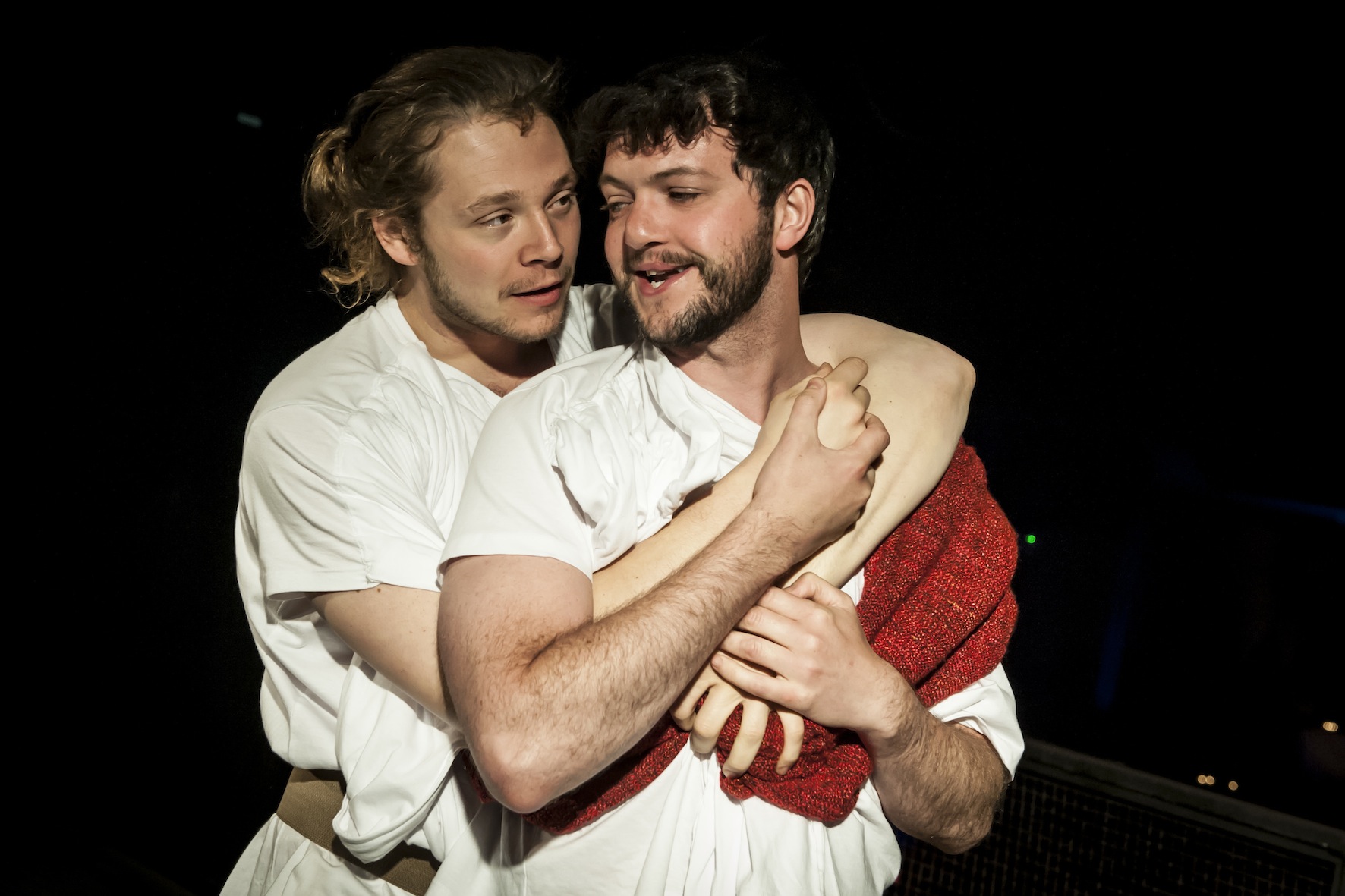
The best work comes from Ben Hale as Iphigenia’s brother Orestes and his lifelong “friend” Pylades (Andrew Strafford-Baker). They contribute vibrant performances and excellent chemistry, a welcome respite from the indulgence presented to the audience prior to their entrance. Pylades’ comforting of Orestes as he is tortured by the furies for murdering his mother is the stuff fanfic is made of, it’s that homoerotic and genuinely lovely. Even though their behaviour is rather laddish (they came to Tauris to steal Diana’s statue from her temple), they are charming, passionate and a joy to watch. Their eventual clash with James Barnes’ Thoas is inevitable, but well contrast against Thoas’ steely reserve.

Title role Iphigenia (Suzanne Marie) is a complex character and could even be considered feminist despite the play premiering in 1779. Her reunion with her brother is underplayed, but her longing for her homeland is clear. She eventually uses her manipulation and womanly charms to talk down Thoas from attacking her brother and Pylades, but none of the character’s power comes across in the delivery that hasn’t altered from her opening speech. Marie shows obvious pleasure at speaking Goethe’s words but gives equal weight to most of them, causing much of meaning to be lost. Her pace could have done with being kicked up a few notches in more urgent situations, but her grief for her family was touching.

The staging was an excellent balance of the foreground and the rear of the archaeological site. It was used enough to not be ignored, but not so much that action was lost. The set and lighting from Diana’s temple along the back wall created plenty of atmosphere, even as a backdrop when the action was on the stage. Director Pamela Schermann worked well with designers Gillian Steventon and Petr Vocka to create such an evocative atmosphere. Sound design by Philip Matejtschuk really ties the rest of the design elements together. The constant waves remind on we are by the sea and perfectly suits the large pool that dominates the Rose. A cinematic soundtrack emphasises moments of conflict or suspense, ending in the start of a storm as Thoas relents. The only design letdown is the costumes. They attempt to replicate Greek tunics and robes, but they are obviously altered t-shirts held in with women’s belts and the footwear is painfully modern. Iphigenia’s flowing gown is beautiful though, and suitable to a temple priestess.

It is a play not staged often and one particularly suited for the unique space of the Rose, so it is disappointing that the lead performance let it down. Fortunately two of the supporting actors add life and energy to a beautifully crafted script. This is one of the most effectively staged productions I’ve encountered at the Rose with thoughtful design elements that can easily become the star of the show.


The Play’s The Thing UK is an independent theatre criticism website maintained voluntarily. Whilst donations are never expected, they are hugely appreciated and will enable more time to be spent reviewing theatre productions of all sizes. Click here to make a donation with PalPal.