King Lear, The Rose Playhouse

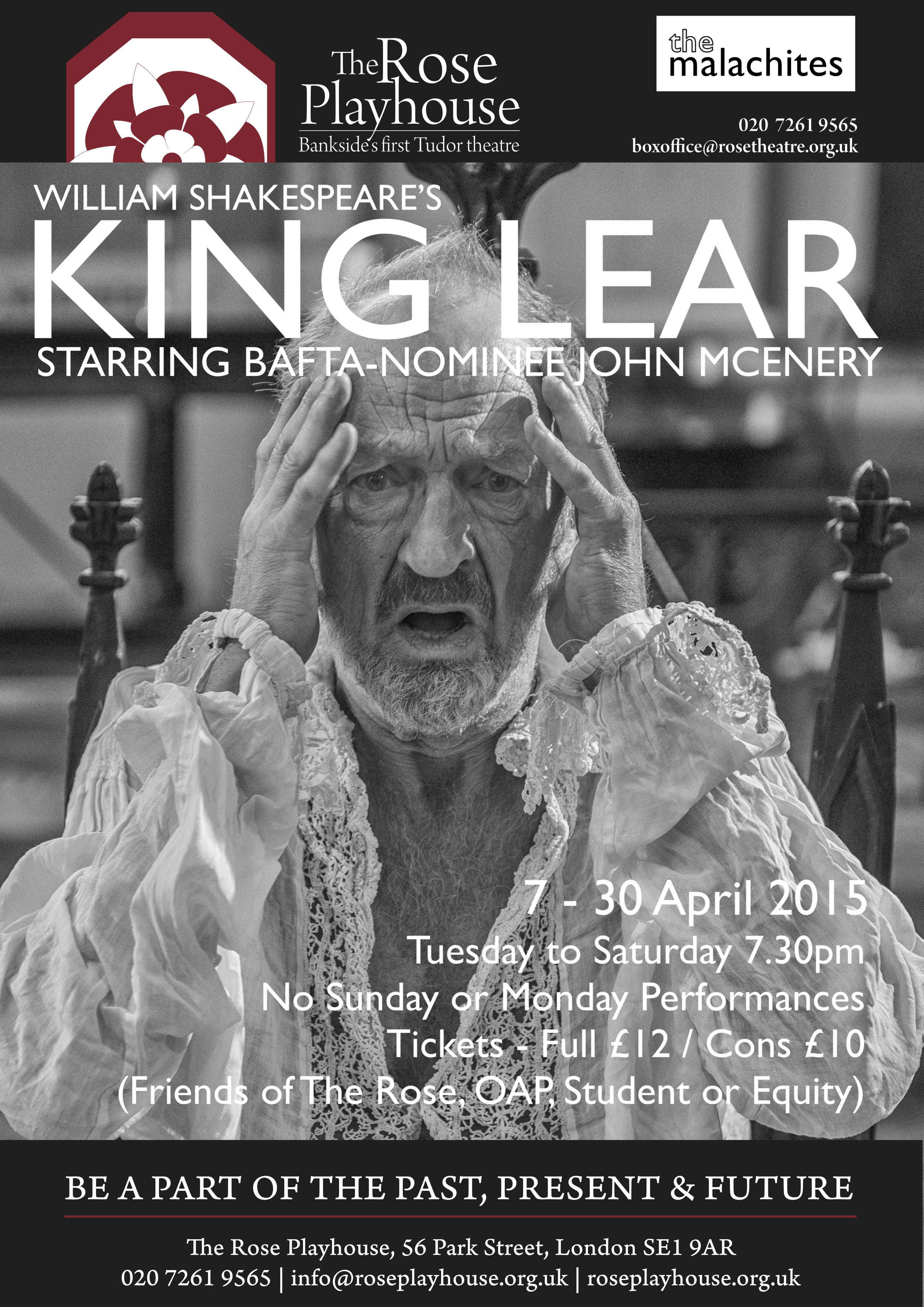
KING LEAR Poster JPEG April 2015Last summer, I left The Malachites’ Shoreditch rooftop A Midsummer Night’s Dream lukewarm. I hoped their current production of King Lear, currently running at The Rose Playhouse after a transfer from Peckham Asylum, would be a more unified, consistent production. Fortunately, these hopes were not just met, but exceeded. With an outstanding cast headlined by John McEnery, original Early Music accompaniment and a full utilization of the unique performance space at The Rose, it far surpassed my expectations and proved to be an exemplary showcase of the potential at The Rose and of fringe Shakespeare.

Due to the vastness of the theatre, its large pool of water and only a relatively small section of the space able to be used, design and staging are particularly crucial in order to make productions here feel polished and professional. Trying to ignore the size and feel of the space simply does not work and diminishes the historical importance of the venue. Director Benjamin Blyth embraces these characteristics. He clothes his performers in neutral blacks, whites, grays and browns. Even the Fool was blandly dressed. The costumes were generally contemporary winter dress with a Russian or Eastern European look. Furs, capes, leathers, scarves and multiple layers abound but the odd piece of costume was jarringly and frivolously classical, such as Oswald’s cloak. The drab colours and mostly angular lines match the concrete expanse that stretches out from the stage. Though the play is set in cold weather, the obvious winter wear also highlighted a man’s struggle through the winter of his life, and made Poor Tom’s near-nudity all the more ghastly. A simple throne and wooden chairs were the sole set pieces; stark white lighting emphasized the grim realities of Lear’s treatment by his family and decent into madness. Some direct address was used, but the audience felt sufficiently included due to the small playing area. The pool of water preserving the Rose’s foundations doubled as a lake or seaside and Poor Tom’s hovel was a fort of black drapes in a rear corner. The musicians were dark silhouettes to the side of the pool. Most of the action took place on the tiny wooden platform stage, but the rest of the site was not ignored. Blyth set Lear’s world at the edges of sanity, existence and human decency and suited the production’s look and feel to the venue with great skill and intuition.

There was not a poor performance in the company and due to this being a transfer, the ensemble and their chemistry came with ease and depth. There were some unique and refreshing character choices, such as Cordelia (Emma Kirrage) played as mature and practical in the beginning rather than innocent and naïve, as she is often portrayed. David Vaughan Knight gives us a stern, militaristic Kent and shows a wide performance range through his character’s disguise and devotion to Lear. William De Coverly shows similar ability in his portrayal of Edmund, skillfully manipulating Gloucester and Edgar through status, movement and voice. Samuel Clifford’s Fool is extremely intelligent with moments of deadpan and quiet sarcasm, drawing more attention to Lear’s mental collapse. I could listen to Anatole Gadsby (France and doctor) read a shopping list in his mesmerizing speaking voice; he will make a great Hamlet with his intensity and watchability if he hasn’t already played the role. Claire Dyson and Orla Jackson are deliciously evil as Goneril and Regan. Finally, John McEnery as Lear brings over half a century of Shakespearian expertise, fully committing to this sensitive, fragile old man who falls victim to the cruelty of the changing world around him.

Though this is an excellent production, it is not flawless. Dr Deborah Pritchard and Danielle Larose composed the original music for the production. Atmospheric and haunting, it was beautifully written and well-used in moments of high tension, but could have been used more often. It was unobtrusive enough that the entire play could have been underscored with carefully chosen moments of silence instead of the other way around. Stage combat sequences can be longer, with Edmund and Edgar’s fight lengthened to show the inherent conflict between the two characters. The scenes were quick and transitions energetic, though some of the energy dropped in the intimacy and quiet of the final scene between Lear and Cordelia. Though it was intimate and moving, the small scale of it did not quite carry through the venue.

These issues are minor, however. The high level of talent and creativity in such an intimate and unique venue is extraordinary, and certainly worth catching whilst tickets are still available.

Intention: ☆☆☆☆☆

Outcome: ☆☆☆

Star Rating: ☆☆☆☆


The Play’s The Thing UK is an independent theatre criticism website maintained voluntarily. Whilst donations are never expected, they are hugely appreciated and will enable more time to be spent reviewing theatre productions of all sizes. Click here to make a donation with PalPal.
The Beautiful Game, everything theatre

“As someone who is not a huge Andrew Lloyd Webber fan and has a dislike of football, I did not have high expectations for this production. I was, delightfully, proven wrong for the most part. Creative direction, fantastically tight ensemble work, endearing characters and some beautiful ballads were some of the highlights of the show…

“Lotte Wakeham uses the intimate Union Theatre space brilliantly. Traverse staging creates both a joyful football pitch and the dangerous streets of 1970s Belfast. During the football matches, the characters watching the game stand behind the audience so we are part of the experience…A few benches are versatile set pieces; they become church pews, locker room benches and a coffin.

“Niamh Perry leads the young but skilled ensemble as the charming, feisty Mary who falls in love with 18-year-old footballer John, played by a skillful Ben Kerr…Joanna O’Hare is the other shining star... Here, the audience sees the root of the conflict: both sides have unwavering belief that Ireland is theirs…

“…The second half starts with John and Mary’s wedding, but the plot deteriorates from this point. Suddenly, the characters have aged and are going their different ways. Whilst this is a sad fact of growing up, it is the undoing of a musical that relies too heavily on the misadventures and celebrations of youth…The story abruptly ends with a short, quiet number, with little resolution…

“Overall, this show is certainly worth seeing for the novelty factor of its rarity and the excellent performances by a cast with impressive credits…”

Intention: ☆☆☆☆

Outcome: ☆☆

Star Rating: ☆☆☆

Originally posted here on everything theatre.

The Great Charter, So & So Arts Club

This year is the 800th anniversary of the signing of the Magna Carta, the document that laid the foundation for modern British democracy. To commemorate the anniversary, Steve Hawes wrote The Great Charter and presented it as a rehearsed staged reading by So & So Arts Club, directed by Sarah Berger.

I was initially wary of the use of a hotel conference room instead of a theatre, but the space worked surprisingly well. A high quality sound system and projector helped contribute to the play’s historical atmosphere and a platform was an effective stage. A grey plinth created another level on the stage and was aptly reminiscent of Richard III’s newly-carved tomb in Leicester Cathedral. Even though stage lighting was used, the entire room’s ceiling lights stayed on, further creating a period-style performance. There was very little interaction between performers and the audience due to the use of scripts, but the potential was there and allowed for a more relaxed, communal theatre experience.

The performers were clearly rehearsed and familiar with the script, showing the beginnings of character development. Ensemble work was minimal, but to be expected considering it was a staged reading. There were some moments of lovely chemistry, such as Sarah Lawrie as outcast leper Alys and Faye Winter as King John’s frustrated queen, Isabella. Winter and Hugh John as William also shared a great scene hinting at their forbidden affair.

Though the reading was directed and performed skilfully, the script let down the evening. The first half was almost completely exposition, building up to King John’s re-crowning before the interval, which was anti-climactic. The characters certainly do a lot of talking, but engage in very little action. Rather than showing us the important events, they are discussed at length with most action happening in between scenes or offstage. Overall, very little actually happens in the two hours’ traffic on our stage, but events are debated and discussed, at length. Fortunately, the scenes are generally short with crisp transitions.

The characters themselves have very little evolution or reasoning behind their choices. King John is clearly a terrible person, but there is never much explanation for his selfish actions, whether it’s taking his friends’ wives for his own use or locking up his wife in a castle for her own “safety.” There is little character development, though potential for plenty: the two most engaging characters, Isabella and Spike, have relatively few scenes and their personal journeys are downplayed. This has the effect of two-demensional characters. Perhaps this play focuses on historical accuracy, but we all know that history is often quite boring. Good historical dramas take plenty of creative license, with necessity. This play needs much more of it. Adding more fights, showing the revolts, and more stage time to the subplots will make the existing story into a much more dramatic piece of theatre.

The reading was a suitable commemoration to the Magna Carta anniversary, but if the play aspires to become a fully staged production, the script will need to be heavily overhauled. A great performance team helped pass the time, but this would not be enough in a full production.


The Play’s The Thing UK is an independent theatre criticism website maintained voluntarily. Whilst donations are never expected, they are hugely appreciated and will enable more time to be spent reviewing theatre productions of all sizes. Click here to make a donation with PalPal.

Heresy, for everything theatre

An austere, dimly lit set of arches and benches captures the heat and lethargy of a time in Spain when smoke fills the air with the Spanish Inquisition at its peak…The whole of the first act provides the audience with character exposition, but nothing progresses until much later in the play. Although playwright Tilo Ulbrecht expresses himself beautifully through the language, this part of the play could be drastically trimmed in order to focus more on the latter acts, rather than the prologue-like first…

“From Act II, set five years later, the story begins to progress. The action is set in the house of Don Felipe (Nick Simons), a very old blind man. He is a Cathar, a branch of Catholicism deemed heretical by the medieval church. He hides in plain sight as the audience learns that his dear friend and former student Don Carlos is the new Inspector General of the Inquisition…

“The performances are largely good, with excellent work from Macavie and Simons. It is incredibly refreshing to see a cast of older actors in fringe theatre rather than 20-somethings playing at being old. Maya is also a force of calm strength that is lovely to watch. Saracen is good as the conflicted Inspector but his moments of anger are difficult to find convincing. Gaoler Bernard O’Sullivan provides some light relief and good contrast to the heavy content of his scenes…

“The characters are well developed and Ulbricht skillfully uses language to create atmosphere, but the plot is somewhat neglected. The play as a whole certainly has potential, but needs re-structuring. The story is a great idea and it gives a very personal humanity to a period of history associated with the devastating capabilities of the Spanish Inquisition…

Intention: ☆☆☆☆

Outcome: ☆☆

Star Rating: ☆☆☆

Read the entire everything theatre review here.

Significant Other; Object of Affection, Tristan Bates Theatre

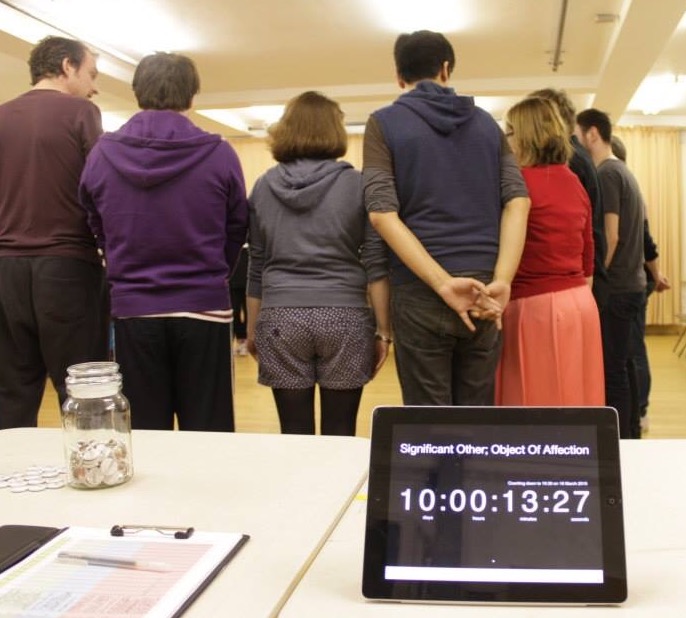
FullSizeRenderWhat do you get when you give ten playwrights, ten directors and twenty actors ten days to make some theatre? (This isn’t a Maths question.) You’ll have The Pensive Federation’s annual collection of ten, ten-minute plays, Significant Other. Inspired by modern relationships, The Pensive Federation celebrates the ups and downs of our human connections with this event. This year, each writer was given an object that had to be included in the scene and serves as the short plays’ titles. On the whole, they were funny, touching and well performed, especially considering the playwright had only five days to write the script and the director and actors had five days to rehearse them. One of the scenes was even a musical, with songs and choreography.

The relationships presented run the gamut from flatmates, sisters, straight couples, mates to co-workers. Whilst most of the plays dealt with romantic relationships, others confront familial complexities and troublesome colleagues. As it’s an issue commonly ignored in an industry that favours youth, Panties commands attention for being the sole play focusing on older characters. Here, a couple try to find the love and excitement in their relationship again now that their children are grown. All provided objects were completely random; some writers worked them into the plot more effectively than others did. My particular favourite was a life-sized cardboard cut-out of Harrison Ford, absurdly fought over by a couple who both fancied him.

As for the scripts, some are certainly stronger than others. None of them are poor and some had potential to be brilliant. Of note, Blu-Ray (by Anna Forsyth), Shirt (by Joseph Lidster and composed by Griffinn Candey), Ring (by Leah Cowan) and Life-size Cardboard Cut-out (by Breman Rajkumar) have the most potential and can certainly stand up to further development. Direction is simple but effective in all plays, with minimal set used and a focus on characters and their relationships. Of the performances, though all are consistent, Catherine Nix-Collins and Jeremy Donovan particularly shone as best friends and flatmates in Blu-Ray, with Jeremy’s character about to move in with his boyfriend and Catherine’s coming to terms with him leaving. Anthony Couzens in Cash evoked pity with his washed up underground ticket seller who fancies his much younger colleague.

Singling out one of the plays as a favourite, or “best,” is impossible. Stylistically, most are initially grounded in reality with subject matter that the audience can relate to, even if on a basic level. Rather than being complete plays, most were snapshots of a larger issue and well-rounded characters. This really is an event that appeals to everyone: gay, straight, young, old, people with children, people who work, people who have friends and people who have families. The default was comedy rather than drama, with some excellent execution of comic timing and sensibility. Performances could become quite heightened, but the emotions matched. Despite the comedic bent, there was plenty of poignancy across the board as well. Including a focus on an object draws attention to the attachment we have to material goods, particularly when we associate them with someone we love, or hate, or otherwise feel strongly about. The only play where this idea could be more fully realised is Oil Can (by Giles Fernando) but the tension created between two former schoolmates is commendable.

This is an enjoyable evening in The Actors’ Centre Tristan Bates Theatre. Plenty of comedy and writing that couldn’t be fresher help ease the predictability of the format in an evening that could do with being a couple of plays shorter. The Pensive Federation clearly have a great instinct for discovering and showcasing new talent and will should develop some these micro-plays further.

Intention: ☆☆

Outcome: ☆☆☆☆

Star Rating: ☆☆☆


The Play’s The Thing UK is an independent theatre criticism website maintained voluntarily. Whilst donations are never expected, they are hugely appreciated and will enable more time to be spent reviewing theatre productions of all sizes. Click here to make a donation with PalPal.

Fucking Outside the Box, for everything theatre

“Frankie is a 17-year-old college student and former champion competitive ballroom dancer…She wants to fuck outside the box…

“The play is set in the present, as Frankie (Jessica Burgess) is home alone and waiting to find out if Michael is going to come and take advantage of her parents’ absence…As she waits for a text, we hear all about her last encounter with him. She’s obsessed with rape fantasy role play…

“Her confidence soon starts to deteriorate and we can see that she is really only 17 without much experience, in life or sex. As she tells us stories from her past, we learn about her mother, her ballroom dancing and the consequences of social media. Her naivety is sweet and funny, but someone who doesn’t have much patience for young people’s poor choices would probably just find her annoying…

“The VAULT Festival, in the tunnels under Waterloo Station, is an experience in and of itself. The space for Fucking Outside the Box is in a small but professionally equipped studio…The venue is achingly cool, so much so that as a 30-something, I felt like a stodgy old fart completely out of place. Fortunately, the play was very good and I had a great interest in the topics addressed…

Intention: ☆☆☆☆

Outcome: ☆☆

Star Rating: ☆☆☆

Read the entire review here on everything theatre.

Missing, Battersea Arts Centre

Lily is an ordinary newlywed with a good job, but something isn’t right. She’s reserved, doesn’t join it at parties or nights out and goes through life disconnected, as if it were a treadmill. With the aid of a mysterious doctor-type figure, Lily relives past memories and important life events. A collage of dance, movement, light and sound, Missing bombards audiences with one character’s family history and rediscovery of her repressed self.

The predominant element of this production is movement. Some sequences have a strong dance influence, others are more abstract, capturing relationship dynamics between two people. Still others are violently fitful as Lily wrestles with parts of herself she would rather forget. Coloured backlighting creates faceless, silhouetted dancers who form the world around Lily. Her movements, in contrast, are usually restrained or awkward, including the duet with her new husband in their marital home as they navigate space with the newfound addition of the other. Memories of her mother, a sensual nightclub dancer, further emphasize how uncomfortable Lily is in her own skin. A particularly striking scene shows Lily at work with her glowing laptop, coffee cup and other daily items that just won’t sit still as she tries to work. They tentatively settle, then fly around the room, always just out of reach. In Lily’s life, everything moves confidently around her and she struggles to keep up. The audience empathizes because like Lily, we all experience moments in life where we feel disconnected from everything around us, as if we live in a grotesque dream world.

Lily decides to see some sort of doctor, a psychologist, perhaps. In a more literal interpretation of the counseling process, he removes a glowing light from her, placing it in a cardboard box. On a further visit, the doctor creates a storyboard of images from Lily’s past and presents them to her without judgement. These events provoke extended memory sequences from Lily’s childhood, with toddler Lily as a bunraku-style puppet. All of her memories take place in glowing frames, with performers behind. The effect created is one is one of large-scale Polaroid photographs that move across the stage. The lighting skillfully conceals the performers holding the frames and the space around them so the frames and their contents appear to float in the darkness. It is a powerful nostalgic effect, akin to watching fragments of one’s own retro ghosts on 1980s VHS home movies.

Two treadmills add a flowing quality to the set and choreography; the performers quickly slide them about to rearrange the stage space and direction of movement through space. Lily is at times caught up in this flow and cannot get off, other times she observes the pace of those around her whilst she herself is not travelling. This is one of the most unique features of the production and one that thoroughly enhances the visual and metaphorical production elements.

Sound is constant or near enough so, either cheerful and musical or a high, droning tone. Dialogue is not an important feature; often the sound drowns out the speakers so that the audience can hear speech but not discern what is being said. Several languages are used: German, Spanish, English and others. None of them is predominant, but the language is not the focus of this piece and it is easy to discern what is happening from the movement. The speech often adds another layer to the soundscape, enhancing the universality of Lily’s inner turmoil.

Missing is a feast of the senses and I struggle to find fault with any visual aspect of the production, though I would have liked to get to know the characters in more detail. The episodic, dreamlike structure leaves the story open to interpretation and to personally connect with several themes and issues presented.

I went with the year 10 GCSE Drama students at the school where I teach part time. Most of the students go to the theatre regularly but none of them had seen anything like Gecko’s Missing before. Each of them had their own interpretation of the production, further proof that Gecko’s work speaks to each of us on a deeply personal level.


The Play’s The Thing UK is an independent theatre criticism website maintained voluntarily. Whilst donations are never expected, they are hugely appreciated and will enable more time to be spent reviewing theatre productions of all sizes. Click here to make a donation with PalPal.

Lardo, Old Red Lion Theatre

Deep in working class Scotland where you’re a celebrity if Poundland invites you to open their newest store and Buckfast is the drink of choice, bullied Lardo desperately wants a regular spot on The Depot’s “Tartan Wrestling Madness” bill. He has aspired towards this since he was a kid, wanting to live up to his dad who died in the ring. Lardo is also a youtuber, a call centre worker and not coping well with his girlfriend Kelly’s revelation of her pregnancy. Event promoter and producer Gavin Stairs takes a shine to the supposedly fearless, pudgy Lardo and gives him a chance but Stairs is not the sort of person to give anything away for free.

Daniel Buckley plays Lardo as a wide-eyed, immature escapist with pathos and enthusiasm, like a well intentioned but hapless pantomime hero. Nick Karimi’s Stairs is a fitting villain, a failed wrestler refusing to let go of his past glories and grudges. Pushing the limits of health and safety regulations and the boundaries of inspector Cassie (Rebecca Pownall), Stairs wants to bring real violence into the ring. There is an undercurrent of danger in him, foreshadowing a violent end. Zoe Hunter plays Mary (who moonlights as hard as nails Whiplash), a single mother trying to get by and do the right thing. Wrestling director Henry Devas’ choreography captures the theatricality of pro wrestling, which all of the performers embraced eagerly and executed skilfully.

During the wrestling matches in the ring that takes up most of the pub theatre stage, the characters interact directly with the audience and encourage them to cheer, shout and root for their favourite. Part pantomime and part live sporting event, the fights blend these forms of theatre, pulling the audience into a meta-theatricality where actors play characters who play more exaggerated characters in the ring. Just as Lardo, Mary and Stairs transform into a heightened Lardo, Whiplash and Heartbreaker to escape the misery of daily life in their weekly wrestling nights, the audience are pulled out of their reality as people watching a play and become spectators of a wrestling match in Scotland. It is rather like living inside their heads, seeing the otherwise-guarded fantasies instead displayed under the bright lights of a dingy wrestling club. The audience also sees some of the wrestlers’ rehearsals. Like rehearsals for a play, these scenes come across as intimate moments that are a privilege to witness.

This is writer Mike Stone’s first full length play and it is an excellent start. Lardo uses an array of theatrical and cultural influences to expose the inner life of the characters, but more depth would not go amiss in the characters’ real lives and relationships. A couple of jumps forward in time created ambiguity and suspense but additional clarity would be welcome and would not have to reveal the missing action. The characters’ need to escape is one we all can relate to, so the audience willingly plays pretend with the characters.

This is a wonderfully fun play, with genuine belly laughs as well as moments of exposed, raw pain that have the ability to slide the audience along a spectrum of feelings. There is certainly scope to develop these characters more and the play would work well in a larger theatre, where the ring is a separate set element rather than the set itself. This production gives insight into an often-troubled world desperate for a distraction and temporary escape, even if it means risking life and limb to do so.

Intention: ☆☆☆☆☆

Outcome: ☆☆☆

Star Rating: ☆☆☆☆


The Play’s The Thing UK is an independent theatre criticism website maintained voluntarily. Whilst donations are never expected, they are hugely appreciated and will enable more time to be spent reviewing theatre productions of all sizes. Click here to make a donation with PalPal.

Margaret Thatcher Queen of Soho, for remotegoat

With a stage covered in tinsel and large neon pink script of ‘Maggie’, it is immediately clear that the audience is in for an evening of fabulously camp cabaret. The hour-long show tells us the fictitious story taking place on the eve of the Section 28 vote. Maggie has been contemplating the morality of this vote for some time, and goes for a walk to clear her head. She was not paying attention and got lost in deepest, darkest Soho where, being mistaken for a drag queen, she is invited into a club. After emerging the next morning as a new woman, she resigns and embarks on a new career in show business.

Matt Tedford, with immaculate vocals and gesture, drives the show as Margaret Thatcher. Robert Cawsey and Ed Yelland multi-role in a costume base of cut-off denim shorts and moustaches. There are some show tunes and gay standards, but the show is predominately spoken. All three performers possess a high level of physical performance and the difference between the various characters effectively uses stereotype for comedic effect. Tedford’s banter with the audience and comic timing is impeccable, creating numerous moments of raucous laughter.

The writing is tight, polished and riddled with political references and jokes. Despite the format and pretence of being a light-hearted cabaret show, it looks at Thatcher’s controversial policies, particularly the state of the country leading up to the Section 28 vote. This production ends happily for the main character, (even though the majority of audiences are the sort that despise her) and lends itself to empathising with someone that, despite her mistakes, is very much a human rather than a monster. If only this production depicted real life! Writers Jon Brittain and Matt Tedford are a great team who deliver a brilliant piece of writing that manages to be hilarious and highly political at the same time.

Whilst the show was excellent, there is little scope for development. If it were any longer, the concept would stale. As an intimate show, larger venues would also present a challenge. Despite this, it is a vital contribution to fringe theatre and caters to a wide range of audiences.

Intention: ☆☆☆☆☆

Outcome: ☆☆☆☆

Star Rating: ☆☆☆☆ 1/2

Click for original review on remotegoat.com.

A Chaste Maid in Cheapside, The Rose Playhouse

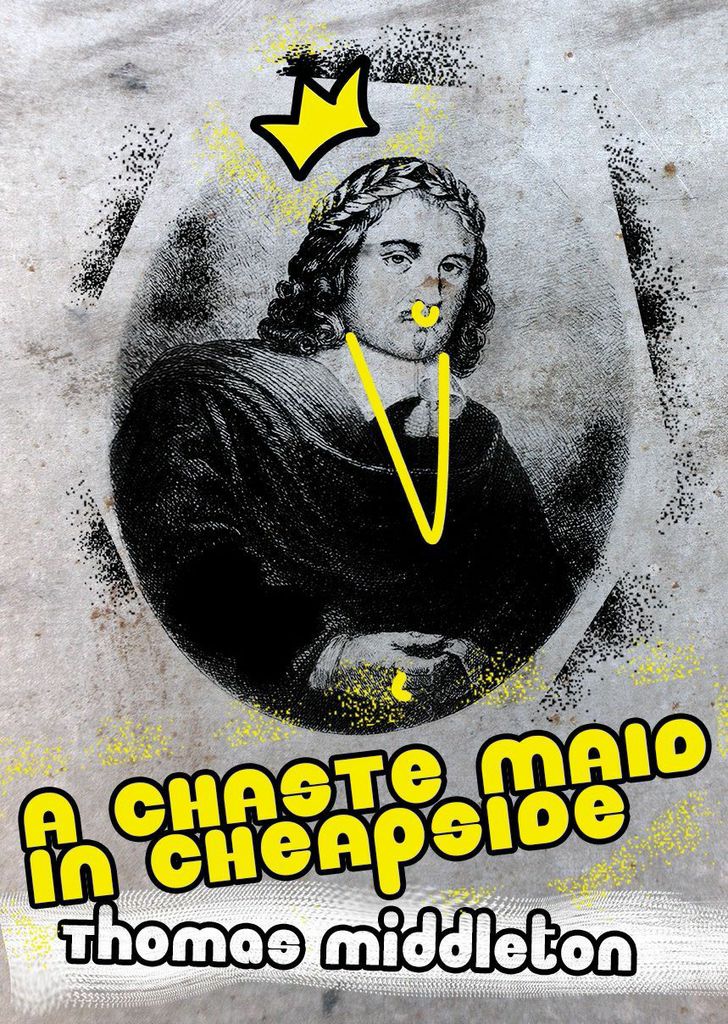
A CHASTE MAID OF CHEAPSIDE March 2015Compared to the number of Shakespeare productions that must be staged in London every year, his Jacobean and Elizabethan contemporaries are rarely produced. The opportunity to see Middleton’s A Chaste Maid in Cheapside in the ruins of The Rose Theatre, built in 1587, is a most rare one indeed.

The Rose is an archeological treasure with a small performance space overlooking to excavated remains. It is not the most comfortable of spaces – there is no heating or toilets, but the volunteer staff members provide the audience with blankets and Shakespeare’s Globe allows Rose audiences to use their facilities. Despite the potential for discomfort, it remains one of the most unique performance venues in London. It has the potential to dramatically emphasize a play and its production values, but directors do not always fully exploit the venue’s potential.

Set in the 1950’s, this version of A Chaste Maid in Cheapside aims to draw attention to post-war sexual frivolity and a rising middle class. Running at just over an hour, this edit focuses on the sex and relationship politics of the characters. The 1950’s aspect is conveyed solely through costume and music. Red is a dominant colour, matching the rope lights that outline the theatre’s excavated foundations, the set’s archways, and the themes of love, lust and anger. The goal of portraying a more powerful middle class does not particularly come across, but that is due to a middle class not existing at the time the play was written even though some of the characters are driven by money. The era’s post-war positivity and rebellious youth does suit this script very well, however.

Overall, the performances are very good. In particular, Alana Ross and Fergus Leathem are fantastically funny as Sir and Lady Kix. Richard Reed and Harry Russell, who play the brothers Touchwood, compliment each other well. Reed plays a cockney wide boy marketing his virility to barren couples and Russell is a wide-eyed young lover. Both play their parts with energy, enthusiasm and commitment. Commendably, casting was age-appropriate to the role. The pace of line delivery takes some time to pick up, but the second half of the play is delightfully quick.

This script has been heavily edited. Even though the story has been pared down to focus on the sexual dynamics, it did not leave much scope for character development. Quite a lot of exposition has been lost, which makes the action feel artificial and rushed. Even an extra half an hour would have given this production more substance.

The opportunities to see this play are rare and there are certainly some very good production elements in this adaptation, but the editing lets it down. The concept can feel tacked on at points, particularly with large chunks of text missing. Fortunately the second half and the performances help compensate, as does the novelty of the Rose itself.

Intention: ☆☆☆☆

Outcome: ☆☆

Star Rating: ☆☆☆


The Play’s The Thing UK is an independent theatre criticism website maintained voluntarily. Whilst donations are never expected, they are hugely appreciated and will enable more time to be spent reviewing theatre productions of all sizes. Click here to make a donation with PalPal.