Over the course of last year, several high profile political art events were cancelled due to protests and political action. The Tricycle Theatre pulled the UK Jewish Film Festival that was part-funded by the Israeli government (then changed its decision after it was too late), Barbican art installation “Exhibit B” that depicted black people (actual people, not mannequins) in cages closed the day after it opened, and Underbelly cancelled Israeli hip-hop musical The City at the Fringe last year after its first preview. More recently, the National Youth Theatre stopped a new play, Homegrown, about Islamic extremists from opening for reasons that are still unclear. These events polarized audiences, artists and others, re-sparking the censorship debate: should art be censored? If so, under what circumstances? Should racist/offensive/morally questionable art and/or art funded by racist/offensive/morally questionable sources be censored? Producers and venues also asked themselves: how far do the protests have to go before we have to give in?
 Eight, 5-minutes plays by established playwrights in response to these event cancellations, followed by a panel discussion with rotating guests, create Walking the Tightrope: The Tension Between Art and Politics. Today’s panel was Jonathan Mills (Former Director, Edinburgh International Festival), Fergus Linehan (Director, Edinburgh International Festival) and Tim Fountain (writer). A cast of four excellently performs the mini-plays; the scripts are powerful and constructively contribute to the debate, and the discussion itself can become a piece of one-off theatre once the audience is handed the microphones.
For uncomfortable shock value, Neil Labute’s two-hander Exhibit A gives us Syrus Lowe as an artist and Melissa Woodbridge as a drugged art student. As Lowe’s character performs his latest piece on a bound, moaning Woodbridge, he challenges the audience to intervene, or object that what he does is not art. Whilst what he does is awful to witness, it is equally disturbing that the audience does not respond to his challenges.
Tim Fountain’s Beyond the Fringe is a hilarious and thought-provoking family piece. The mum is a writer trying to stop the Israeli performance at Underbelly, her son is a fringe performer who is going to see the show. I find myself relating to, and laughing at, both of their perspectives, illustrating the multi-faceted complexity the issue poses.
What Are We Going To Do About Harry? is Mark Revenhill’s contribution that personalises the dilemma between maintaining funding streams from the white, middle-class and meeting diversity targets by disenfranchising these backers. This is another piece with no easy solution to the problem it poses.
Other highlights are Timberlake Wertenbaker’s satire of the BBC, Shampoo, and Re:Exhibit by Gbolahan Obisesan that stages an imaginary casting for the banned “Exhibit B.” The final play, Tickets Are Now on Sale by Caryl Churchill was an anti-climax, but still a witty look at funding sources. Another letdown was that in such a politically charged event, only two of the eight performed plays were by women.
The post-show discussion provided additional commentary and historical context to the cancellations. Jonathan Mills, former Edinburgh International Festival director, and current director Fergus Linehan explain that protests against the arts have been happening in Britain for a long time. Tim Fountain elucidates that Underbelly eventually came to the decision to cancel the Israeli show because the protests had grown to such an extent that protesters were affecting other performances and audiences in the venue.
Fountain and Mills go on to discuss the challenges faced by police and venue security, then address whether all art is inherently political: “If all art is political, it becomes agit-prop.” Art is political, but is also has other functions, such an engagement and humour. Linehan touches on funding and calls for cases to be looked at individually. Fountain discusses venues’ loyalties to their artists in the face of adversity, and then the audience has the chance to ask the panel questions.
Q1: Is there ever a place for boycott in the arts?
Q2: How can a space for discussion within the festival be created?
And, then “Q3”.
Now, what happens isn’t even a question, but a tirade that personalised last year’s protests at Underbelly. An older lady who protested The City explains that the Palestinians supported the production boycott and even though their protest was disruptive, the protesters were also treated horribly. The panel attempt to respond and placate: both sides behaved badly, we need to create a space where both artists and protesters can be heard, etc. Fountain simply states, “You won.” The woman was having none of it, tensions rise on both sides, and she walks out.
Whilst this becomes an improvised, topical performance in itself with passions and viewpoints laid bare in preparation for battle, the woman’s preface to her comment sticks with me:
She explains that she isn’t an artist, and is completely removed from the “mystical process” of making art. She is just an ordinary person.
It saddens me that the creative process is still considered some sort of abstraction by people who are somehow not considered normal citizens who do a job, trying to make a living. This singular comment proves that artists are not engaging enough with “ordinary people”. This isn’t about getting bums on seats. It’s about not engaging the wider population in the process of how art is made.
Perhaps if this lady, and the wider population of non-artists, did not feel so alienated from the creative process and artists themselves, both sides of this fight would have a greater understanding of the other. Imagine what society would be like if the general public and British government actually comprehended what was involved in making art and saw it as work rather than a “mystical process”.
Take a moment, picture that world, then decide what you’re going to do about it.
The Play’s The Thing UK is an independent theatre criticism website maintained voluntarily. Whilst donations are never expected, they are hugely appreciated and will enable more time to be spent reviewing theatre productions of all sizes. Click here to make a donation with PalPal.

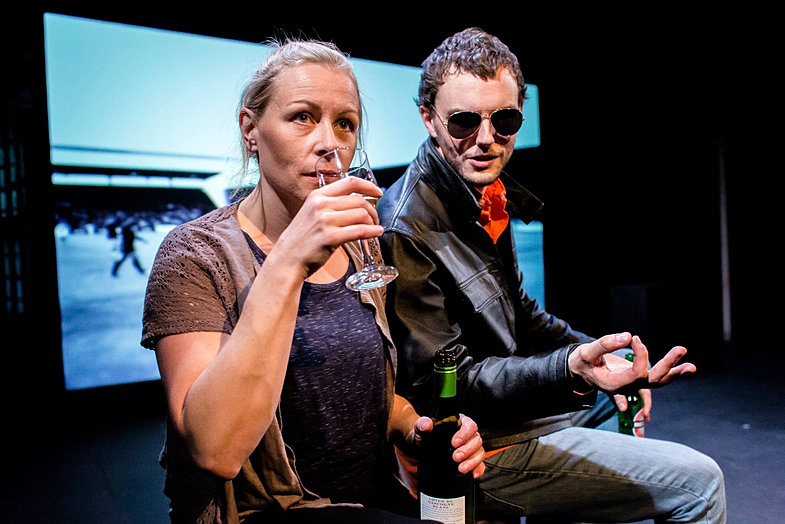
 A male photographer is photographing a female celebrity who is tired of being so superficial. She wants this photo shoot to show her “true self”. She wants to be “real”, and we’re all hanging out in the studio with them in Action Hero’s Wrecking Ball. Audience expectations are immediately challenged on entry when invited to grab a beer from a cooler onstage, and this boundary remains blurred for the duration. Communication is attempted between the two characters, but neither is really listening and what they say doesn’t really have any meaning, pointedly ironic in characters striving for stripped back honestly. The performance is both funny and uncomfortable as the audience watches their professional relationship cross into the manipulative personal. This is a text-based performance with imagery rich language highlighting the absurdity of their encounter, but it triggers a good amount of reflection on our own behaviour. We all carefully construct our images, particularly in social media, yet at the same time we want to be genuine (whatever that means). This is an excellent, polished piece that is provocative in subject and the actor-audience relationship.
 Search Party’s My Son & Heir is without question the funniest thing I’ve seen this year in Edinburgh. Real-life couple Pete Phillips and Jodie Hawkes playfully examine the prospects of their young son, born in the same year as ‘baby Cambridge.’ The two little boys have little in common, though. Pete and Jodie share their hopes for their son in a cheerful, pink chaos that soon disintegrates into relentless judgments on their parenting methods and a stream of ‘what ifs’ capturing the anxiety and pressure to raise a perfect child. The message evokes sympathy and reflection, even from those without children. It’s an outstanding blend of comedy and social commentary on the perils of being an ordinary parent without heaps of cash to throw at your child. Their gleeful, child-like anarchy quickly turns vicious, creating pointed contrast between the haves and have-nots, but ends in a message of love. Perhaps the ending tends towards sentimental, but in a world where money is a large factor in success and a good life, it is also an ending of hope.
 Last up is Christopher Brett Bailey’s This Is How We Die, a spoken word and music performance that is deceptively simple but leaves you with overloaded senses and a feeling of having traveled around the world at a million miles a second. When I first saw This Is How We Die at Battersea Arts Centre several months ago, I was so moved that I wrote two responses:
  A walk to a “secret location” ends in a dimly lit warehouse for Volcano’s show about the effects of coal mining. It is a promenade production that literally destabilises the audience, who have to walk over a floor covered with large chunks of the black stuff. Four actors taking on roles both historical and fictitious physically capture miners’ suffering in horrific working conditions. Disappointingly, in a piece with such a focus on introducing the characters at the beginning, their individual stories are neglected in favour of the visual and aural. Some of the metaphors make sense, like the animalistic dining scene showing the reduction of the miners to baser creatures, others are less clear. I still don’t understand the incorporation of Anna Karenina and playing cricket in their pants. Black Stuff is surreal and abstract, but so much so that any message or idea trying to be communicated is almost completely lost.
 Late Night Love is a sweetly nostalgic, and very funny, piece revolving around a phone-in radio show the three members of Eggs Collective listened to as teenagers. Having not grown up in the UK, I missed a lot of the cultural references, but the teenaged idealism about love and relationships is universal. Power ballads and dating conventions are gently mocked, but lovingly remembered. The two-way radios on each table are underused, but an interesting device that places the audience inside the radio show listened to in the dark. Though quite structurally loose at this point, it’s a show that speaks fondly of a specific era and development stage of teenage girls.
 Made in China’s Tonight I’m Gonna Be the New Me blurs the line between truth and fiction through founders Tim Cowbury’s and Jessica Latowicki’s real-life relationship laid bare onstage. The premise is that Tim has written the show that Jess performs as Tim runs the lights and takes notes at the back. Jess dances inside a metal box wearing sequined hotpants and a halter top, an object for our delectation, and presumably Tim’s. She soon hijacks the script that descends into the two picking at each other’s faults, empowering herself as the audience are voyeurs of their argument. What is truth and what is fiction? This blurring is far more interesting to consider than the argument typical of a long-term relationship that unfolds. The made-up story of Tim’s death returns the piece solidly to fiction, again made more interesting in the idea of fantasizing about a partner’s death (we all do it!) than the story itself. I expected the content of Tonight I’m Gonna Be the New Me to be far edgier than it was, though the ideas within the performance are certainly fascinating on several levels.
 Confession: I don’t like Friends. I find the acting two-dimensional, the jokes not funny and it bears no reflection on real life in New York City, where I spent four happy years at drama school. So I was reluctant to see MOTOR’s Ross & Rachel, because I thought it’s about the couple from Friends.
 George Orwell’s first full-length book, Down and Out in Paris and London, documents the Eton graduate’s foray into a life of artistic poverty in the 1920’s. About 80 years later, Polly Toynbee spent a period of time living on the minimum wage in London to write her book, Hard Work: Life in Low-Pay Britain. Writer and director David Byrne (not that one), deconstructing and interweaving these two books, creates a hard-hitting new play that confronts contemporary notions of social progress by demonstrating that experiences of a life in poverty have not improved, and “the system” created to support some of society’s most vulnerable people is inherently flawed.
 Hailing from LA, Waitless is a semi-autobiographical play about newlyweds Shelly and Trent, from the American south but living in New York. Trent works in finance and Shelly in TV production, but when Trent’s job transfers him to London, Shelly gives up her career to go with him. Told through heightened, contemporary farce with moments of sincerity, Waitless shows that the cultural gap between the UK and US is bigger than you think.
 Current Location is an adaptation of the Japanese play by Toshiki Okada, set in a coastal village, presumably in England, with a minimalist script and design. It feels quite Scandinavian (which suits the simile I will use shortly). Four women anxiously rehearse for a performance, then another arrives who disrupts the natural chemistry of the group. She is soaked from a sudden downpour from the blue, “bad luck cloud” that recently appeared over the village. Its appearance effects the entire population: animals are behaving strangely and people are no longer talking to each other. Rumours abound of a coming disaster; the women we see are split – some believe them, others don’t. As the play progresses, climate change intensifies as does character conflict. Some believe nature will soon cause the village to disappear, others refuse that it’s a possibility.
 CultureClash’s debut production, Hannah and Hanna by John Retellack, is a perfect fit for company co-founders and actors Cassandra Hercules and Serin Ibrahim. It’s as if Retellack wrote it for them. Written and set in 2001, Hannah and Hanna takes place in Margate as the British government temporarily re-homes thousands of Kosovan refugees in down-at-heel seaside towns, causing predictable social backlash. Hannah is black British, Hanna is from Kosovo. Both are 16, love pop music and navigating life as teenagers. This production is ably directed by Greenwich Theatre artistic director James Haddrell, and well performed, but the sentimental script with a predictable story arc lets down the talent in the production.
 The Play's The Thing UK