
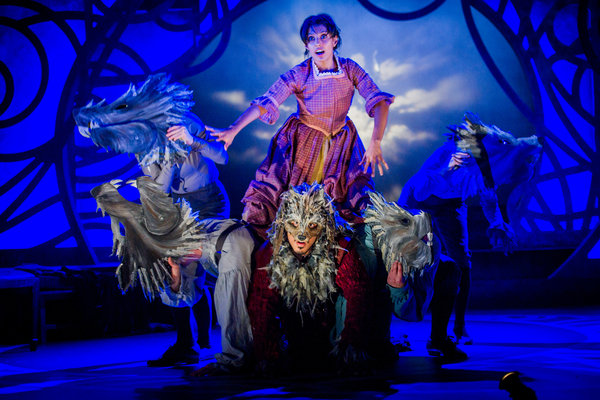
Cold, dark days make me want to see feel-good theatre, especially in the run up to the holidays. Bonus points if it’s colourful, has some depth and at least some non-formulaic elements, even in a classic story. Polka Theatre’s Beauty & the Beast for ages 6-12 meets these criteria with a surprisingly complex storyline that keeps adult attention as well as kids’. Despite the target age range, there is some great humour and a touch of innuendo adults will appreciate (kids definitely won’t get it), sumptuous set and lighting and an adapted, relevant script. Some of the performances are wooden from the dated language and there are some dodgy movement-based transitions, but the school group audience was quiet and focused for most of the nearly two hours with interval.
Charles Way’s adaptation of the traditional story gives a much wider context than the Disney film and is more relatable to a modern, young audience. Belle is still the main character, but we get to know her father, Mr Godwin (Simon Holmes) and sister Cassandra (Géhane Strehler) well. Belle and Cassandra are complete opposites: Belle’s bookish, a visionary and frightened by most things; Cassandra loves boys, pretty dresses and adventures. The two bicker regularly and their money-driven merchant father is tired of it, a family dynamic that many children will recognize. Beginning in London and moving to the remote countryside when Mr Godwin loses his fortune, the girls also have to cope with big life changes and overcome adversity.
The women’s performances are consistently stronger than the men’s. Ritu Arya’s Belle is convincingly performed with a wonderfully dry sense of humour and an excellent character arc that isn’t overly saccharine. She carries the story and its energy well without being a stereotypical children’s performer, dealing with the old fashioned language brilliantly. Géhane Strehler is great contrast, giving young girls two opposite ideals to potentially relate to. Both have flaws, virtues and detail. Emma Cater is a sinister housekeeper for Jason Eddy’s Beast, a gentle man with stylized physicality and an imposing presence. Eddy doesn’t quite manage to carry that through after his transformation, but it’s so close to the end that it doesn’t matter much.
The set is layers of swirling panels that change colour and glow according to location, with the Beast’s castle the richest of them all. Laura McEwen’s set and Ian Scott’s lighting work together in wonderful harmony, with the occasional addition of puppets. Stage combat from RC Annie also adds a visual component, but the fights are slower that fight speed and brief. Some of the transitions lag and have abstract movement to fill the time, but this doesn’t contribute to the story and usually look pretty naff. Costumes, also by McEwen indicate the characters’ circumstances and changes in social class, but the highlight is the headdress and mask for the Beast.
Though there are still age and gender stereotypes, the adapted script empowers the young female characters. The detail and length will occupy adults as well as children and Way’s story is excellently constructed. With wonderfully visual design and a stirring score by Julian Butler, this is a lovely production harking back to the classical story without the glitz of Disney-fication or the panto cheese, and a solid option for a family holiday show.
The Play’s The Thing UK is an independent theatre criticism website maintained voluntarily. Whilst donations are never expected, they are hugely appreciated and will enable more time to be spent reviewing theatre productions of all sizes. Click here to make a donation with PayPal.


 It’s panto season, and our stages are filled with villains, heroes and dames. Playwright David Bottomley’s new work-in-progress has some passing resemblance to the characters in Britain’s traditional seasonal offerings, but his new play on the London housing crisis is darker, angering fare. Capturing its victims’ lack of power and its perpetuators’ greed, Skyline doesn’t offer a solution but still states a clear opinion on the issue. With a cast of five playing seven characters, the audience sees a microcosmic cross section of social classes who, with poetic and pointed language, are a powerful reminder of the importance of secure housing. There is still some work to be done on the script, but the staged reading in conjunction with a pre-show talk and an exhibition by
 Baz Luhrmann’s 1996 film Romeo + Juliet transformed a young generation into Shakespeare fans. Dan Poole and Giles Terera were training at Mountview at the time of the film’s release. They previously weren’t keen on Shakespeare’s plays what with their difficult language and having to read them at school. But, Romeo + Juliet changed all that. These avid Shakespeare buffs joined forces to make a documentary that explores why people don’t like Shakespeare, and to make the Bard more accessible to those ruling him out as boring or irrelevant. Over four years, Terera and Poole travelled around the world and interviewed prominent actors, audience members, people on the street and passionate theatre makers about their attitudes towards Shakespeare. Funny and relaxed, Muse of Fire feels more like a goofy road trip with your mates rather than a dry, academic film as the passion and love for Shakespeare’s work always shines through.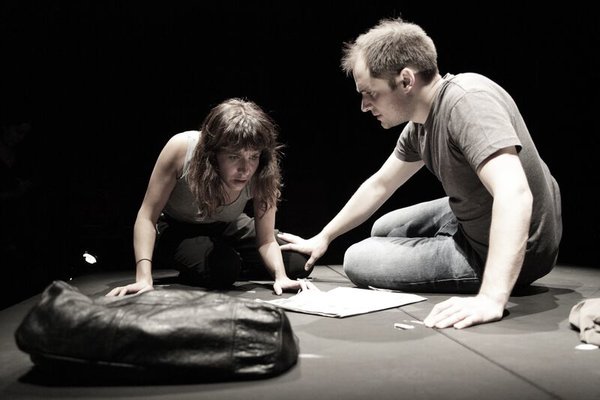
 We’ve seen “Mad Men,” or at least heard the clichés about cutthroat ad agency types. Competition for clients, drug and drink fueled late nights, ruthless bidding for commissions regardless of morals. Steve Thompson’s Spin Cycle uses all these ingredients, but the writing style doesn’t match director Stephen Oswald’s delivery. It’s either a farce that was delivered as naturalism, or a naturalistic piece (albeit with a liberal use of humour) that attempts a farcical production. All of the characters are pretty stereotypical with at least some degree of reinforcement from the script, causing the two hours of day-to-day office life to feel repetitive and lacking in depth. There are clear individual storylines, but everything that goes wrong is treated as a crisis that’s conveniently and speedily resolved. The performances are generally quite good in this strong ensemble, but the actors are unable to show much range or development due to a lack of character journey.
 There’s a mountain of inflatable sex dolls on the stage. Shiny, blank faces with gaping, toothless mouths, spherical tits and gargantuan cocks everywhere. The pile is so big that the actors have to wade through the dolls, a metaphor for the seedy Viennese streets where Shakespeare sets his Measure for Measure. Director Joe Hill-Gibbins wrenches this world into the present with a symbolism-laden, visually orgasmic production designed by Miriam Buether, and a great performance by Romola Garai as Isabella. Live video feeds, projection and pulsing beats marry a space that has ghosts of Elizabethan theatre structures, but some choices don’t sit well. Though the visuals are relevant and bold, there’s a disappointing tendency towards shouting, and a dubious (to the point of discomfort) characterization choice for infamous pimp Pompey. As the characters physically and emotionally wrestle through the heavily edited, relentless two hours of sex and religion, there is still a strong feeling that this production values style over substance.
 The Play's The Thing UK