Gardens Speak, Battersea Arts Centre

5 Tania El Khoury _Gardens Speak_please credit James Allan for Fierce & Artsadmin

In Syria, Asad’s regime attacks the funeral services for rebel fighters. Rather than holding public burials, families bury dead martyrs in their gardens, usually with no tombstone. In tribute to these people, live artist Tania El Khoury has created an interactive sound installation with the stories of ten martyrs buried in gardens. An intimate audience of ten each hear the recorded monologue of an individual martyr who died fighting against Asad’s forces, but they have to experience some discomfort in the process. Gardens Speak lasts a mere 30 minutes but irrevocably alters the detached western view of Middle Eastern conflict, fostering empathy and despair for fellow man.

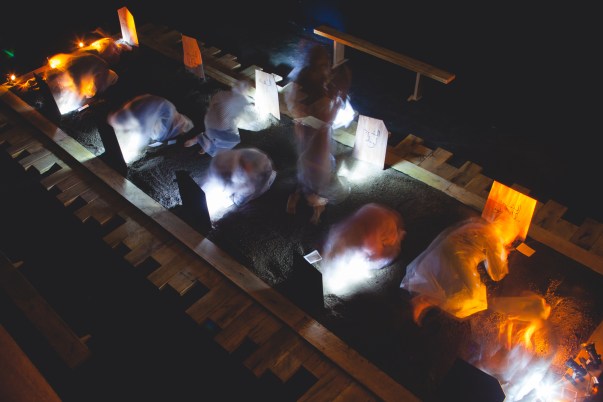
In a small room, we are asked to remove our shoes and socks, put our belongings to one side and don an over-sized raincoat. Once everyone is ready, the door is opened to a darkened room with ten tombstones lining the edge of a large wooden frame filled with soil. Each person is handed a postcard and a small torch. Following the instructions on the card, we each find the tombstone pictured. To hear the story of the person buried in that grave, we dig into the rich, peaty earth that scents the room. What with the competing sounds of other recordings, to hear properly we kneel or lie in the dirt.

The narration is a simple, unembellished tale of one man’s fight and fall at the hand of the tyrannical government. It’s neither overly graphic but neither does it hold back. The environment created by the set strongly influences the mood – there is a pronounced gravitas in the space. The whole effect doesn’t overwhelm, but imbeds itself internally, somewhere in the depths of the gut, along with the spirit of the young man who’s life spoke from the dirt I lie in.

We are lucky: the room is warm, and our clothes are protected from the soil. After the narrative of a man’s life, death and burial in his mother’s garden and a sound bath in Arabic singing, we can wash our feet (a reassuring ritual element that also adds to the aesthetic of the piece), collect our things and go home to our comfortable, little lives. Gardens Speak is both a little installation and one that encompasses the whole of humanity.

The Play’s the Thing UK is committed to covering fringe and progressive theatre in London and beyond. It is run entirely voluntarily and needs regular support to ensure its survival. For more information and to help The Play’s the Thing UK provide coverage of the theatre that needs reviews the most, visit its patreon.

Every One, Battersea Arts Centre

Mary Jane, Joe and their two teenagers, Maz and Kev, are happy. Even Mary Jane’s mum, confined to a wheelchair and trapped in her own mind by age and medication, is happily restful. Their lives aren’t perfect, but they love each other and relish their middle class, heteronormative, suburban existence. Joe’s a teacher, Mary Jane’s a tax inspector, Maz wants to study fashion and Kev is obsessed with video games. They are undeniably normal, until Mary Jane has a stroke whilst doing the ironing and the four of them are changed forever. Jo Clifford’s Every One, even with its nuclear family, takes a gently radical view of death through a metatheatrical structure that loosely parallels Everyman and thoroughly breaks hearts with the love this family has for each other.

Lengthy monologues by the five family members smash the fourth wall, creating an intimate space inclusive of the audience as well as each other. They immediately endear themselves to us with their personal anecdotes that set up the tiny, catastrophic fall that is the death of a daughter, wife and mother. Michael Fenton Stevens as Joe, Mary Jane’s husband, devastates us on witnessing the death of his wife and seemingly never ending grief. Mary Jane (Angela Clerkin) is so full of life both before and after her death. Her diminutive frame, alternatively longing for her family, whirling with joy and relishing a post-coital Saturday morning is so alive, making the impact of her passing all the more keenly felt. Nigel Barrett makes a wonderfully surprising appearance as Death, but he is a dapper, crush velvet-clad friendly chap who escorts Mary Jane to the underworld. Maybe death isn’t so bad, after all.

The set consists of a serious of wooden platforms at various heights that, with a smattering of potted plants, has a warm sense of life. Katherine Williams’ lighting design has a similar warmth, even in the underworld. The actors are constantly present on stage, further highlighting the bonds of this wonderful little family. Clifford wisely focus on the characters’ relationships rather than on Mary Jane’s death; she is very much alive to them one year after her passing.

Though Every One plucks at the heartstrings and leaves you wanting a cuddle from your nearest and dearest, it is just a shade too long. Two hours with no interval could easily be 90 minutes and still retain it’s impact. This is a script issue rather than one of pace. The pace and energy of the play is spot-on, to increase either would cause the production to lose its impact.

Every One takes a celebratory view of life and death, but doesn’t glamourise it. A recitation of causes of death around the world reiterates its normalcy but draws attention to the horror that is constantly occurring abuse, famine and terrorism. Death is all around us, and this fantastically performed family’s experience of it is both heartwarming and heartbreaking. This gentle interpretation of Jo Clifford’s 2010 play reminds us of our mortality but also calls on us to make the most of the time we have with those we love. Go see it, then tell your friends and family that you love them.

The Play’s the Thing UK is committed to covering fringe and progressive theatre in London and beyond. It is run entirely voluntarily and needs regular support to ensure its survival. For more information and to help The Play’s the Thing UK provide coverage of the theatre that needs reviews the most, visit its patreon.

All Your Wants + Needs Fulfilled Forever, Vaults Festival

I’ve never seen any theatre from New Zealand before All Your Wants + Needs Fulfilled Forever. Compared to British theatre, how similar or different would a show be from a company that has never worked in the UK? What themes and styles are classed as “innovative and imaginative” down there? Would the work have the same aesthetic that British fringe theatre has developed, and would it be to a British audience’s taste?

All Your Wants + Needs Fulfilled Forever bears some resemblance to British progressive theatre, but in other areas, there is clear difference. With a plot showing influence by “The Trueman Show”, “Inception” and other films that present a reality controlled by unseen, powerful individuals, it has a plot that I could easily imagine from a number of UK fringe theatre companies, but the major difference is that the production is slick. Like, REALLY slick. It doesn’t look or feel like fringe theatre. Eli Kent’s dystopian script is layered, has a perfectly formed dramatic arc and a balanced use of humour and pathos. Other than a slight excess of vague plot points, this is a provocative, progressive play that British fringe theatre could learn a lot from.

Simon (played by playwright Kent) recently lost his dad and is struggling to cope. A disembodied voice/robot/computer that we never see who has a trio of technicians at its disposal intervene to create a better narrative for Simon. The audience’s view is from backstage – rather than seeing Simon’s engineered world from his perspective, we see a blinding white box framed by microphones, computers, sound desks and random props that Joel Baxendale, Victoria Abbott and Hamish Parkinson (playing themselves) use to construct reality. It’s a unique perspective, and one that takes some time to adjust to. A toy gorilla is Simon’s stoner best mate, his mum is a pair of pink marigolds, and his girlfriend Alice is a mannequin that’s seen better days. All’s ticking along just fine, even with some glitches, until Simon’s free will trumps the science that attempted to control his life.

Live sound mixing is used more effectively in this play than in any others where I’ve seen it used. It fits this metatheatrical world to a T rather than trying to be invisible or be something it’s not. Marcus Mcshane’s lighting takes advantage of the smart lighting rig, adding mood and colour to the white cube that Simon functions in. The mid-1990’s costumes by Lizzie Morris juxtapose the contemporary tech and highlight the awkwardness of the characters and their inability to fit in. It all blends seamlessly with the storyline and no design elements dwarfs the others.

Clearly one of the factors of this show’s success is its funding. This isn’t a large scale show at all, but the tech and specially made set with its windows and flaps in just the right positions for the action won’t have come cheap. R&D wouldn’t have been short, either. Though fringe in spirit, All Your Wants + Needs Fulfilled Forever is definitely not fringe in appearance. If small scale theatre in the UK had more funding, this level of work would be much more common on the fringe: sophisticated, progressive scripts with a well-rehearsed cast and enough design to create a fully formed world rather than the predictable minimalism that restricts ideas to the familiar domesticity of a few tables and chairs.

This ninth production from The Playground Collective has been running off and on since 2014 so the cast have great chemistry and there are no apparent mistakes with any of the tech. No doubt the long run also plays a part in the polish of the show, but this is something that is also not possible without financial backing. Though thematically just as progressive as some of the small-scale British touring companies (Theatre Ad Infinitum’s Light is a strong parallel), it’s an excellent show that proves the potential of fringe theatre if it had access to decent levels of funding.

The Play’s the Thing UK is committed to covering fringe and progressive theatre in London and beyond. It is run entirely voluntarily and needs regular support to ensure its survival. For more information and to help The Play’s the Thing UK provide coverage of the theatre that needs reviews the most, visit its patreon.

Transports, Pleasance Theatre

1973, a village in rural England. Fifteen-year-old Dinah is placed in the care of 49-year-old, first time foster mother, Lotte (not ‘Lottie,’ that’s an English name!). As the two navigate the fallout that results from Dinah’s troubled past, Lotte’s life as a war refugee in England parallels Dinah’s experiences of the care system. With more similarities between the two than expected, Transports is a fantastically performed, personal view of the trauma of displaced with excellent design elements.

Juliet Welch (Lotte) and Hannah Stephens (Dinah) are also Lotte’s carer Mrs Weston and Young Lotte respectively, about 35 years ago. Both women showcase great range and emotional truth through scenes of tenderness sharply contrasting their clashes. Writer Jon Welch’s gentle unfolding and blossoming of these women in each other’s lives is more moving than most love stories, and beautifully developed. Lotte is feistier than expected, and Dinah has a fragile heart that eventually opens to Lotte despite her hard exterior. A bittersweet end doesn’t sugarcoat the harsh realities of life as a displaced person, but neither is it too bleak of a forecast – a great choice by Welch.

Welch also directs this two-hander. His careful partitioning of the space with Alan and Jude Munden’s design creates intimacy and a sense of homeliness. Clean, stylised transitions clearly indicate changes in character and time, but these are longer than need be and not consistently accompanied by occasionally projected dates. A video makes up a brief epilogue about Leisl Munden, a poet who was on one of the last Kindertransport trains to England and on whose life Transports is based. Though powerful to see that the story has some truth in it, it also has enough power to stand independently of this bookend.

Two railroad tracks dominate the set, serving as a reminder that none of these women are able to be static and take root in any one place. Projections are laid over the full-scale tracks, hinting at atmosphere rather than displaying it outright. At times this is frustrating, at others, the shadows are more evocative than a clear image. Little details show care and consideration of the characters, like Lotte’s cat figurines and chest of memories from the war. There’s a sweetness in the design, as well as strength and movement. The overarching picture is incredibly dynamic as a result.

Transports occasionally feels like it could be a play for young people, what with the central experiences revolving around teenagers. The message of acceptance and and understanding is a simple one, but the script’s structure adds depth and universality. The story is a lovely one and occasionally sentimental, but by not shying away from frank discussion it finds a good balance – a complete and well-rounded play with a powerful story.

The Play’s the Thing UK is committed to covering fringe and progressive theatre in London and beyond. It is run entirely voluntarily and needs regular support to ensure its survival. For more information and to help The Play’s the Thing UK provide coverage of the theatre that needs reviews the most, visit its patreon.

Mirando: The Gay Tempest, Lion & Unicorn Theatre

Shakespeare’s The Tempest is a love story, a swan song and a spectacle of supernatural life. It lends itself well to adaptation what with its complex, intertwining themes. In Mirando: The Gay Tempest, Martin Lewin turns the play into a solo performance told through a gay lens. Completely nude with a liberal coating of silver body spray, Lewin transforms Prospero’s daughter into a son and camps up some of the supporting roles. Though competently performed, there is too little focus on Mirando and Ferdinand’s blossoming love and in a solo performance, the relationships Lewin wants to focus on  are difficult to convey. It is certainly an interesting experiment, but one that does not completely follow through on its intentions.

Lewin is in the space and chatting with the audience as they enter; this immediately diminishes any awkwardness created by finding a naked man. Lewin’s use of text also draws attention away from his nudity and onto the story he tells us. With a triangle of colour-changing rope lights on the floor and a few wooden chairs, the audience focus is completely on him and his tale. Other than the play being set in on a wild island populated by all sorts of creatures, the justification behind Lewin’s nakedness isn’t clear. It didn’t create an issue, but neither did it add much to the production.

The edit Lewin created uses stage directions to add context and clarity; though initially surprising, they prove helpful.  His characters are often very similar, with little vocal variation. Some have distinct physical traits: Ariel has wings, Stephano is a constantly moving gym bunny and Caliban, in his bestial earthiness, cannot resist constantly fondling himself. There are both speeches and scenes, but the most powerful and moving moments are Prospero’s monologues and the two scenes between Ferdinand and Mirando. The comic characters are fine, but not the strongest.

Though there is no designer credited, the sound and lighting works towards supporting the atmosphere, but sound isn’t used nearly enough. Shakespeare’s rich description goes a long way in supporting the imagery, but the other senses are neglected, especially with this being a text-heavy piece.

Though not a bad piece by any means and Lewin’s characters are the best aspect, he tries to do too much in a minimalist one-person show. The concepts are certainly valid, but they need further clarity and justification to make this a great piece of theatre.

The Play’s the Thing UK is committed to covering fringe and progressive theatre in London and beyond. It is run entirely voluntarily and needs regular support to ensure its survival. For more information and to help The Play’s the Thing UK provide coverage of the theatre that needs reviews the most, visit its patreon.


Eggs, Vault Festival

rsz_eggs_florence_keith-roach_and_amarni_zardoe_courtesy_simon_annand_1

Women get the raw end of the deal no matter how young or old they are, how mainstream or alternative. Two late twenty-somethings, acquaintances through a mutual late friend but with completely opposite personalities, end up bonding over important issues but with dry humour and restrained emotion. Despite the content, Eggs avoids catering purely to women. The frank honesty is stereotypically blokey, covering topics such as masturbation, one-night stands and careers – issues that are obviously relevant to women, just not often spotlighted so directly – as well as fertility, marriage and the fear of aging. Structurally episodic and a bit clunky, Eggs is also bitingly funny and poignant, particularly for those of us in our 20s and 30s feeling like we don’t really fit into the world.

Playwright Florence Keith-Roach uses the versatile symbolism of eggs throughout, albeit obviously. Even the set and costume by Clementine Keith-Roach and Lily Ashley are all white and yellowy-orange. It’s an interesting catalyst for written material, and Keith-Roach riffs in numerous directions from that starting point. Fertility is an obvious path, but egg shaped vibrators less so. This makes the events in the story nicely unpredictable, but Keith-Roach does a great job tying up the issues into a satisfying end.

Keith-Roach and Amani Zardoe are girl 1 and girl 2. Girl 1 is a hippy artist fighting the status quo; Girl 2 loves her corporate job and can’t wait to marry and have children. Both performances are heighted and somewhat ‘Sex in the City’-esque, particularly at the beginning, where they feel like chick lit but on stage. Fortunately, both actors settle into more naturalistic performances after a couple of scenes. Unlike the terrible television series, these unnamed women develop depth and genuine conflict, even though they are not the most likeable of characters. Their insecurities and flaws are believably human, as are their prickly, awkward encounters that evolve into a genuine care for each other.

Eggs is heart-warming without being cheesy, and substantial but does not preach. It provides gentle solidarity to women who feel like their lives aren’t everything they’re supposed to be, and even though the earlier scenes feel disconnected from each other, the last third of the play really rings true. It’s a good piece of theatre for a second play and is a pointed reminder of the fact that no one really has their life together.

The Play’s the Thing UK is committed to covering fringe and progressive theatre in London and beyond. It is run entirely voluntarily and needs regular support to ensure its survival. For more information and to help The Play’s the Thing UK provide coverage of the theatre that needs reviews the most, visit its patreon.

What I Learned From Johnny Bevan, Soho Theatre; The Caucasian Chalk Circle, Jack Studio Theatre

Is revolution in the air? Or, are we all so broken and defeated by rising costs and a falling quality of life that all we can do is complain bitterly? Perhaps a bit of both? In any case, this is not the first time that I wonder if theatre is responding to the liberal sense of disaffection recently. Shortly before Christmas I questioned Dominic Cavendish’s assertion that theatre isn’t political enough, and my sentiment still stands, particularly after the coincidence of seeing two highly charged political pieces two nights in a row. Fringe theatre, like grassroots politics, is a place of community, a catalyst for change, and the foundations of revolt, as seen in Lazarus Theatre Company’s The Caucasian Chalk Circle and Luke Wright’s What I Learned From Johnny Bevan.

1997. The eve of the general election. Nick, who’s studying English Literature at a nameless uni stays up all night with his best mate, poet Johnny Bevan, to watch Tony Blair win. It’s the dawn of a new era and change is coming for the working class long oppressed by Thatcherite rule.  Fast forward fifteen years and Nick’s a journalist in London, but Johnny’s student aspirations didn’t come to fruition, and neither have Tony Blair’s. The story of these two lads’ friendship, written and performed by Luke Wright in a blaze of fiery spoken word, is an hour long tale of youthful vigour soured by the realities of adult life. Wright’s delivery and writing is fervent, topical and no moment is out of place in the trendy and on-point What I Learned From Johnny Bevan.

South of the river, an older revolution is taking place. In Soviet Russia, a group of peasants stages a play about a servant girl in Georgia raising the governor’s newborn baby that was abandoned during the family’s escape from a war zone. After a perilous journey, sacrifice for the sake of the infant, and a regime change, everything is put right again by a citizen judge. Lazarus Theatre Company, with its trademarks of a large cast and striking visuals, draws parallels between Brecht’s The Caucasian Chalk Circle and the despair of modern life – but “change is hope”. Energetic and in the round, the characters rally the audience to their side like they do in Wright’s monologue.

There’s optimism in both productions as well as despair, and an underlying current of discontent with the state of the UK’s current socio-political trajectory. Both display humanity’s capability for selflessness and selfishness, and the feeling that nothing has changed from Soviet ruled Eastern Europe, to Labour’s late-90’s victory, to present unviable economic conditions and Tory tyranny. We are undeniably flawed with a fickleness vulnerable to power and money, but as a society we are also deeply unhappy and feel that we lack the power to affect change. This sentiment now seems to be emerging in fringe theatre.

Though completely different in form and structure, both What I Learned From Johnny Bevan and The Caucasian Chalk Circle have plenty to say about the contemporary world from similar angles. What I Learned From Johnny Bevan is the better of the two productions, and  the more progressive. A solo performance delivered in spoken word accompanied by charcoal and watercolour landscape projections, most of the imagery in Wright’s language is precise and evocative. Brecht’s well-known play is linguistically stilted and stuffy in contrast, but it’s characters are just as colourful.

Performance poet Luke Wright is a singular tour de force and What I Learned From Johnny Bevan is politically charged and practically flawless. Lazarus Theatre’s performances vary, but of the ten-strong ensemble, no one was particularly strong or weak. Their choreography is well-rehearsed but director Ricky Dukes normally powerful movement sequences  lack impact in the round. The set components take up a lot of space and are used well occasionally, but otherwise clutter the stage with bright, industrial chaos. Neil McKeown’s sound design hints at atmosphere and mood, but is much too quiet to add the impact it could. It’s certainly not a bad production, but neither is it one of Lazarus’ stronger ones.

If theatre is a mirror held up to the world, then evidence is increasing that change is imminent. But what form will it take? Will the people rally as in The Caucasian Chalk Circle or will we either sell out or run away from it all like Nick or Johnny? Only time will tell.

The Play’s the Thing UK is committed to covering fringe and progressive theatre in London and beyond. It is run entirely voluntarily and needs regular support to ensure its survival. For more information and to help The Play’s the Thing UK provide coverage of the theatre that needs reviews the most, visit its patreon.

Poll Function, The Pleasance

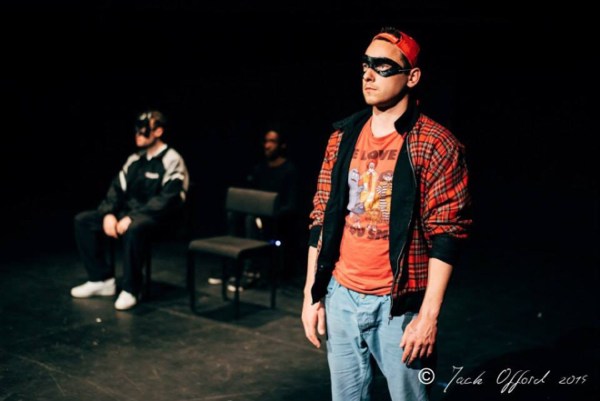
Two West Country lads speed through the night as both cheerful teenagers and disillusioned twenty-somethings. They wear cheap fancy dress masks; one is Batman and the other small and indistinct – Robin, maybe?. Movement, voice and lighting states dictate time and place, with most of the action taking place in and around a car as they tear through the small town where they’ve spent their whole lives in this frenetic and occasionally unclear performance piece with a nod to performance art. Seeking to be a commentary on austerity and social responsibility, Poll Function comes across more as a general coming of age story where, though the protagonists are academically unmotivated, they struggle to come to terms with the realities of adulthood not even closely resembling the aspirations of their youth – a problem many millennials face. Though the intended message doesn’t particularly come across, the physical performances in Poll Function are excellent and the strongest feature of this work.

Greg Shewring and Jon Pascoe play these two unnamed young people. Pascoe is the leader, always behind the wheel, controlling where they go and how fast. He’s not the brightest bulb though, laddish “banter” sets the tone from the start. As the character ages and there’s an unfortunate encounter between a badger and the bumper of his car, the profundity of his language abruptly moves beyond, ‘Mate. Shut up. Slaaaags!’ and even includes frequent use of metaphor. Whilst his sentiment is lovely and captures the character’s inner frustration, it’s a dubious linguistic leap in Shewring’s script. Shewring as the quieter sidekick is the more dynamic and interesting character, and just as ably performed as his louder, dumber counterpart. Both Shewring and Pascoe show well-developed sense of physical performance, which could do with being further used in this non-linear piece.

As the car is completely mimed complete with vocal effects, it takes some time to work out if the boys are in an actual car, playing a game, or, what with the short, sharp scenes jumping back and forth through time, if the whole thing is more abstract than that. The lack of clear exposition is effective, but disarmingly unexpected and takes some time to settle into its own rhythm. Not that it’s a bad thing to wonder what’s actually happening for the first quarter of a performance, but it has the potential to be off-putting. Poll Function (a title that only tenuously comes through in the message) wouldn’t be entirely out of place in an experimental theatre venue or festival; the work reminds me a bit of Action Hero in tone and theme.

Poll Function is certainly an interesting work from new Bristol-based collective The Project, particularly as it’s their first production. Though it has some flaws, thy company are certainly off to a flying start.

The Play’s the Thing UK is committed to covering fringe and progressive theatre in London and beyond. It is run entirely voluntarily and needs regular support to ensure its survival. For more information and to help The Play’s the Thing UK provide coverage of the theatre that needs reviews the most, visit its patreon.

Firebird, Trafalgar Studios

Tia is fourteen and lives with her foster mum in Rochdale. She’s had a rough life growing up the care system, and no one seems to care about her. When she meets “youth worker” AJ in a kebab shop, he gives her a cigarette, offers to buy her chips and take her to a “party” in his flash car. A bit of attention and some small gifts, and Tia’s sold. She gets more than she expects in Phil Davies’ first full-length play, though. Manipulation and lies lead to her rape rewarded with new clothes, booze and fags. Not just once, but again and again. Firebird depicts the exploitation of this young woman with harrowing language and stark staging, reminding the audience that this abuse happens up and down the country. With child poverty on the rise and social media so vital to teenaged communication, the risk of this abuse is increasing; Firebird reminds us that this could happen to any young people we know. Davies’ script, episodic with large gaps in time, is sometimes lacking but good performances anchor this emotional work.

Callie Cooke is a brash, mouthy Tia with a fragile exterior often dissolving into tears. She spends a good portion of the play crying which, though she endures horrific treatment at the hands of a gang of middle-aged men and is fobbed off by police, feels superficial after a time and lacks character development. Tahirah Sharif as her new friend Katie is only in the first and last scenes set in the present that frame the abuse flashbacks, has much more depth. Phaldut Sharma is wonderfully despicable as AJ, the man who initially recruits Tia and keeps her bound to the unseen gang. Sharma also doubles as down-at-heel detective Simon who is not able to save her. More contrast between Simon and AJ wouldn’t go amiss, especially as Simon is only in one scene that Cooke dominates by crying.

Davies’ script has a simple and formulaic, but effective, structure that doesn’t interfere with the message; the gaps in time are reasonably spaced and spare the audience too much horror – but perhaps this is a bad thing? In the time he does give us, Davies manipulates audience emotions as much as AJ manipulates Tia. Again, this isn’t necessarily a negative what with the impact the show seeks to create. And the impact is a strong one. Sniffles and tears abound with unrestrained expressions of horror. In a particularly graphic scene, my normally sturdy stomach heaves at Cooke’s bloody body shakes in fear as she described to AJ what one of the men did to her. Tia’s appropriately desperate actions that land her in a wheelchair are also horrifying. With stark, bright lighting and an audience on four sides of the stage, being forced to experience audience expression in response to the action magnifies the experience.

After this seventy-minute show, I feel like I’d been put through an emotional wringer and need to lie down in a dark room for awhile. Despite the shortcomings in the script, it abounds with impact – as it should. As well as fostering awareness and understanding, Firebird is a promising piece of new writing with a couple of great performances that unveils the unimaginable horror of child sexual exploitation.

The Play’s the Thing UK is committed to covering fringe and progressive theatre in London and beyond. It is run entirely voluntarily and needs regular support to ensure its survival. For more information and to help The Play’s the Thing UK provide coverage of the theatre that needs reviews the most, visit its patreon.

Mirrors, Rosemary Branch Theatre

rsz_tim_smyth-mirrors-siobhan_mcmillan_54

Photography © Tim Smyth

Maybe the witch in Snow White isn’t that bad. Or, maybe her badness is justified, like she had a traumatic childhood or suffers from a mental illness. Siobhan McMillan proposes just that: Shivvers realizes she’s past her prime and, with insecurity taking over rational thought, she decides to hunt down the young woman who dethroned her from her position as the fairest in the land. This quest takes shape as a solo performance told in the third person, like a fairytale. McMillan regularly interjects with contemporary references and using sarcastic humour to great advantage, makes a strong comment on women’s insecurity about aging.

The use of third person narration is one of the more interesting features of Mirrors; it distances McMillan from the audience and herself. Her physicality and energy cannot be denied as she embodies the characters she simultaneously describes. The audience is told her story but has plenty to watch, and a liberal use of sound and vocal effects create a dynamic aural landscape, even if a touch too loud at times.

The use of an occasional live feed adds another visual layer by which the audience scrutinises Shivvers, but a backlight interferes. The intention shows good instinct by director Jesse Raiment. The set isn’t particularly dyanmic with its black flats and mirrors, save for the ornate frame mounted on a table centre stage – a symbol of modern obsession with female appearance and its dominance in Shivver’s life.

This feminist solo show is an excellent display of performance storytelling and a witty comment on modern life as a woman. Not just about aging, it also looks at female competition, the need to be desired and the perils of dating. With the opportunity of a longer run, Mirrors could upgrade its tech and design to create a more polished production matching its content, creating a piece great for touring small to mid-scale venues.

The Play’s the Thing UK is committed to covering fringe and progressive theatre in London and beyond. It is run entirely voluntarily and needs regular support to ensure its survival. For more information and to help The Play’s the Thing UK provide coverage of the theatre that needs reviews the most, visit its patreon.