These Books Are Made For Walking, Jackson’s Lane

https://farm8.staticflickr.com/7398/15871797584_e5b143b72f_b.jpg

Fabrice Dominici is a solitary librarian who takes great pleasure from the books he tenderly looks after. Gently stroking them, he flips to his favourite passages before giving them a sniff and balancing them on shelves made out of ladders. When a pile of books at the top comes to life, revealing a woman who has no intention of leaving and has a musician friend join her, the librarian tries everything to drive off these nonchalant interlopers. As his attempts continue to fail, this simple storyline of These Books Are Made for Walking starts to wander until it completely loses its way at an anti-climactic ending. Though visually dynamic and a nice premise for its aged 6+ target audience, the lack of distinct characterisation and a simple narrative arc is a disappointment to all ages.

Dominici’s nameless librarian draws on clowning to create a somewhat hapless but caring character who endears himself to the audience with his Wile E. Coyote determination. There are regular laughs, and his performance finds a lovely midpoint between over-exaggerated and underplayed. The other two performers lack personality, and it is never made clear what they want other than to hang out and make music on top of the rickety shelves. A love song gives away that they are a couple, but their relationship has no real bearing on the story.

Whilst the librarian’s attempts to get rid of his uninvited guests are entertaining and draw to a close before they become stale and repetitive, his sudden change of heart is inexplicable. He dashes around the stage with ropes and an audience volunteer to set up for the woman’s slack rope routine; after poking her musician friend in the bum with gardening sheers it simply doesn’t make sense. It’s a strange transition, but not as abrupt and unsatisfying as the show’s conclusion.

The set design, presumably by the three devising artists that also perform, is the highlight These Books Are Made for Walking. It’s instability naturally creates tension, though I would not want to be the person that had to risk assess the freestanding structure with performers clambering along the top. Books create a wonderful aesthetic, though watching them tumble to floor and then be trodden on cause several tiny heartbreaks. Christopher McGhee’s lighting works with the set well to create gentle shadows and focus points, though a moment of bright orange rays made the subjects hard to see as they were too close to the source to be lit evenly.

This second production from Bikes & Rabbits shows a promising use of narration in physical and visual theatre with additional elements of circus, but the spectacle’s temptation proves too much and is not properly integrated into the piece’s structure. It’s a lovely idea that doesn’t manage to follow through to a satisfying, clear conclusion.

These Books Are Made For Walking tours until 2 April at various venues.

The Play’s the Thing UK is committed to covering fringe and progressive theatre in London and beyond. It is run entirely voluntarily and needs regular support to ensure its survival. For more information and to help The Play’s the Thing UK provide coverage of the theatre that needs reviews the most, visit its patreon.

The Rules of Inflation, Theatre N16

I hate balloons. Well, not balloons themselves, but the noise they make when they burst. After more than three years as a children’s entertainer that does balloon modelling, you’d think I’d be used to them, but no – if anything, it’s worse. When I walked into Theatre N16 to discover a floor covered with balloons and four actors gleefully throwing themselves around the space, I nearly left. I’m glad I didn’t though, despite numerous explosions. Rules of Inflation, a new performance art piece by Balloons Theatre, confronts socio-political issues by setting them at a children’s birthday party, complete with a deranged entertainer who demands his audience of four child characters participate in increasingly disturbing activities. Though my immediate violent revulsion towards the balloons and the job I know all too well intensified as time went on, the messages contained therein are cleverly presented. Even though they are not particularly unique to the stage, the kids’ party framework draws attention to how disturbing these global problems are.

From the start, it is clear this is not a normal children’s party. The creepy music, dark lighting and clown in a ripped, dirty costume (a disturbing Joshua Webb) create a distinctly foreboding, horror film-esque atmosphere, along with all those balloons that could burst at any moment. It’s not a unique landscape but it’s highly unsettling, and relentlessly so. As innocent childhood games become not so innocent, it’s a reminder of how seriously little ones take their play. Getting “out” actually makes them feel like they died, or that they’re gagged and bound. It also calls to mind child’s play in war torn countries, where games in a dangerous environment can result in injury, trauma or death, and the way the world’s politicians play at war without experiencing any direct consequences.

Four actors play four children with varying levels of maturity, who are prone to varying levels of exploitation. Clown targets serious and mature Blue (Nastazja Somers), and finally abandons her in a harrowing, violent end. It’s horrific to witness. Yellow (Bryony Cole) and Green (Emily Sitch) are too similar of characters, and Pink (Bj McNeill) also aligns with them. Whilst this could create an effective gang against Blue, who has a wonderfully defiant presence, this opportunity is missed and she is neither particularly isolated or supported by the kids as Clown abuses her. Instead, their youthfulness draws them to the clown, who eventually proclaims a party  winner even from their indistinctness. The piece is also a bit too long considering the straightforward format, but more abstract moments help add variation and a break from the relentless violence, abuse and manipulation. The actors’ vocal and physical energy was quite adult at times and would be more potent if the actors consistently kept to obvious depictions of children.

Rules of Inflation may not evoke such a visceral reaction in most people, but it’s aggressive displays of sexual abuse and objectification are still incredibly powerful. The piece needs a few tweaks to enhance its potency and theatricality, but not many. The balloons and kids’ party context can play on a fear of clowns as well, but this live art performance is a potent examination of power and child abuse in its own right.

The Rules of Inflation runs until 24th March.

The Play’s the Thing UK is committed to covering fringe and progressive theatre in London and beyond. It is run entirely voluntarily and needs regular support to ensure its survival. For more information and to help The Play’s the Thing UK provide coverage of the theatre that needs reviews the most, visit its patreon.

How To Survive a Swarm of Bees, Bread & Roses Theatre

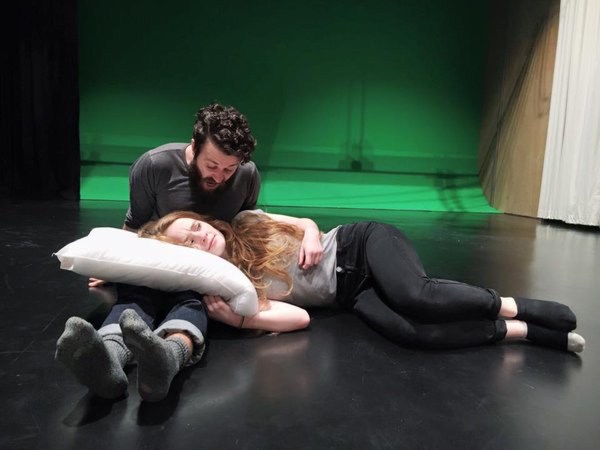
The heaps of white pillows that cover most of the stage make How To Survive a Swarm of Bees look like a slumber party or a kids’ fort, something with a lot of fun and giggles. But Anna Crace’s short play is far from the happy cuddliness implied by the set. With a Scandi aesthetic in both design and dialogue, this austere piece of new writing gives little away except for the looming apocalypse Of a massive storm and a swarm of bees that threatens the existence of two young couples barricaded into their homes. The minimalist text bears more than a passing resemblance to Beckett, but it’s so sparse that there isn’t much depth or substance despite the interesting premise.

The unnamed hetero couples in their early 20s live separately, but their lives and conflicts parallel each other in the moment. Rather than the somewhat disappointing story, the most interesting feature is the intertwining scenes where the characters occasionally swap partners (not that way, pervert) without acknowledging the change. The device is gently disorientating, aiding the distance from reality that creates a state of reflection in the audience. These four are Every Men in the face of a crisis, with fear, anxiety and need that manifest in four different ways. We can relate to them all, but know they are not of our world.

The lack of action and a threadbare story is frustrating, through. The only thing the four do is talk around the problem and argue, and shift pillows around in their confinement. What exactly is going on in the world? Disappearing news broadcasters and friends choosing to live underground are never fully explained. Why is the world reacting so strongly to a storm? Why are these couples fighting about staying in their homes with the buzzing growing ever louder? They allude to consequences of nature creeping into the house and “the nets” failing, but what are these consequences? It’s never revealed, but easily could be by lengthening this script by another twenty minutes or so.

There is some distinction between the different characters, but other than Laurie Ogden’s agoraphobic young woman, the rest are very similar. Should we stay or go? How long can we realistically eat the soup we’ve stockpiled? How will our relationship hold up with our choice? What do we do if one stays and the other leaves? These questions are debated, but never really answered. The end of the play is abrupt and feels like an interval; some audience hang around for a while and then, confused, head into the night.

The four performances are fine, but tend towards minimalist reflection as well. Though inherently theatrical in structure, elements of this script would be great for telly. The intimacy works well in small fringe theatres, but would most likely come across as flat anywhere larger.

Anna Crace is certainly onto some interesting ideas and design concepts in How To Survive a Swarm of Bees, but the need further development and clearer means of communication.

How To Survive a Swarm of Bees runs until 20th March.

The Play’s the Thing UK is committed to covering fringe and progressive theatre in London and beyond. It is run entirely voluntarily and needs regular support to ensure its survival. For more information and to help The Play’s the Thing UK provide coverage of the theatre that needs reviews the most, visit its patreon.
Wonderations, The Canvas Cafe

https://pbs.twimg.com/media/CcvF_vOWEAA7JKp.jpg

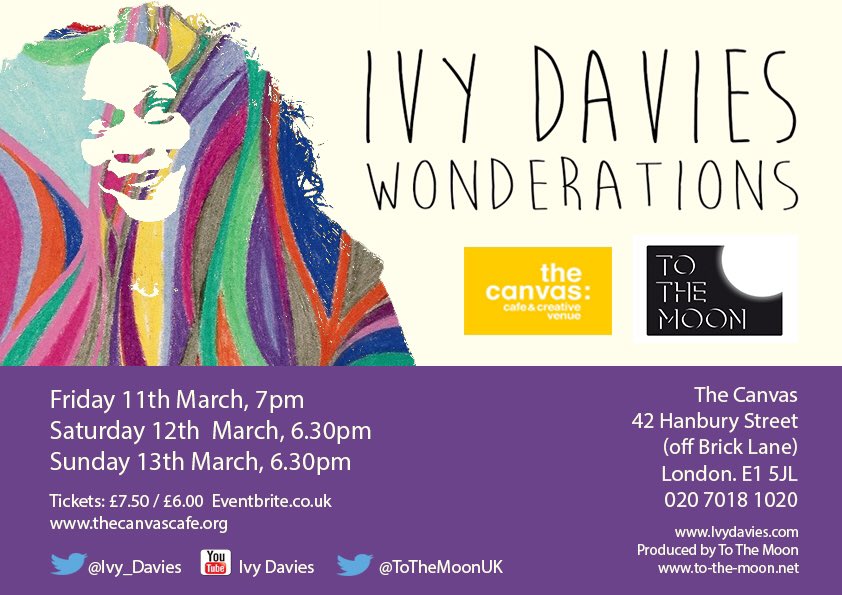
Sunday evening was a night of new discoveries. The Canvas Café, just off Brick Lane, serves homemade cakes and prosecco by the glass. It also has walls you can write on and a cosy downstairs performance space. In that space was Ivy Davies and her show Wonderations, a gentle, joyful blend of spoken word, songs from her EP and questioning whether or not Mickey Mouse is actually God. Though lacking in narrative, Davies’ performance shares issues that are particularly personal: aging and her search for identity and faith. With a touch of live art about it, Wonderations is a lovely celebration of self-acceptance akin to reading Davies’ journal.

This isn’t a visual show, but a totally aural one. It could easily be listened to through headphones or with eyes closed, though her soothing melodies and rhythms could lull you to sleep – it’s that relaxing. There are some powerful sentiments in her lyrics and poetry that deserve full attention, however. As Davies struggles to find her pre-marriage and babies self in theatrical songs and rhymes, one can’t help but to relate to her frustration with finding her true identity buried under all the nonsense life throws at us. We all find ourselves wasting hours on social media focused on constructing an image, or immersing ourselves in work and forgetting to just be present in the world for lengthy periods, but Davies exhorts us to let all of it go. She’s like a life coach, but a gentle one who uses cuddles rather than shouting.

This cabaret-esque structure feels conversational, but is precisely and satisfyingly scripted. There’s no plot to speak of, but with Davies wearing the form like her own skin, it works. Her spoken word isn’t the pounding, angry sort I’m accustomed to; it’s full of flowers, sunshine, rain and claiming her own ground. Davies has an immovable strength and presence, but one that overflows with positivity. Less connected from her celebratory songs and spoken word is what feels like an internal monologue where in looking for faith, she wonders if God is actually Mickey Mouse. He’s been seen around the world at the same time, and has plenty of purchasing power. It’s a wonderfully funny, and pointed, argument, though less clear on it’s place in the show’s structure.

Ivy Davies’ Wonderations is a hard show to pin down, but it doesn’t apologise for that. I’m pretty certain that she’s confident enough to not care what anyone thinks of her work, but the themes it contains are universally human presented in an easily digestible format. An excellent event for a quiet Sunday evening, particularly with a slice of cake and a glass of prosecco.

The Play’s the Thing UK is committed to covering fringe and progressive theatre in London and beyond. It is run entirely voluntarily and needs regular support to ensure its survival. For more information and to help The Play’s the Thing UK provide coverage of the theatre that needs reviews the most, visit its patreon.
RED Women’s Theatre Awards, Greenwich Theatre

red women logo

This year sees the launch of a new playwriting competition, RED Women’s Theatre Awards. Co- produced by Edinburgh-based academic and playwright Effie Samara, Greenwich Theatre and Female Arts, the awards are “aimed at anyone who identifies as female who has an inspirational, questioning and challenging social and political voice.” There are three regional heats in the competition; the first was at Greenwich Theatre with staged readings of four plays. Completely differing in tone and style and at various stages of development, this heat showcases the huge variety of female voices in English playwriting.

I spoke to founder Effie Samara about the awards and her reason for founding them.

What do you hope to achieve with these awards?

When I first spoke about RED to James Haddrell, Artistic Director of Greenwich Theatre, I must admit, I was dreading that it was going to achieve absolutely nothing. As a theatre artist, he engages with that female-led theatre aesthetic by producing Broken Leg, Smooth-Faced Gents and now RED. Is he a revolutionary? I think he is. Is he an exception? He is a valiant exception but we are actually witnessing the beginning of an epoch in politics and in theatre. They follow each other. My view is that the State, its governance, its justice, its policing, its education and its performativity are about to undergo a female-authored revolution. RED positions itself at the forefront of this development.

What criteria did you use when selecting plays for the heat?

The award is for political theatre. Our first concern was to ensure the writer’s engagement with the notions of justice, resistance and her ability to problematise those dramatically.

RED Theatre Awards currently cover the south of England, Wales and Scotland. What are your plans for expansion in the rest of England? Is N. Ireland a goal as well?

Northern Ireland is absolutely a goal. In the first instance, we’re including N. Ireland in the Scottish round. We can’t wait to hear some loud Irish voices! Scotland is also underrepresented on a national level.      

What can theatre makers do now to counteract the gender disparity?

The solution is very simple and I’m afraid it begins with us women. Us, being able to handle our own freedom: express it in the ownership of our person, define it in politics, and dramatise it in our consciousness and on stage. Women who robotically follow institutional missions fuel that gender disparity through their own complicity with these structures. Numbers are on our side in this argument: There are a lot of us. Over 3 billion. If we meant business, if we did this together, actioning solidarity within our cause, this injustice could be culled in no time.

What message do you want to communicate with the RED awards?

Words are loaded pistols. And we, women, can cock a gun way better than any establishment pointing one at us. Throughout the history of humankind we have been told we’re not allowed to fathom our own course, to govern our own person, our own body, its production and reproduction. RED is here to provide a platform for women.

The four plays selected for this heat are Under My Thumb by Cassiah Joski-Jethi, Spurn the Dust by Sian Rowland, Dissonance by Isabella Javor and Gone by Kate Webster. Some are more blatantly topical that others, some look at broader female issues and group dynamics. All are short plays with potential for development and by female voices that have a lot to say.

The Play’s the Thing UK is committed to covering fringe and progressive theatre in London and beyond. It is run entirely voluntarily and needs regular support to ensure its survival. For more information and to help The Play’s the Thing UK provide coverage of the theatre that needs reviews the most, visit its patreon.

Something Something Lazarus, King’s Head Theatre

rsz_unspecified

Musical theatre is growing rapidly on the fringe, thanks to venues that focus on small-scale shows and producers staging lesser-known works. New British musicals are seen less often, with only a handful of producers focusing on bringing audiences this new musical writing. Broken Cabaret, around since 1997, aim to create new kind of musical. Something Something Lazarus is part cabaret, part backstage/play-within-a-play dark comedy, part surreal fantasy. The structure is the most interesting part of the show, with a plot and songs that are sometimes surreally nonsensical. Performances are consistently excellent and whilst there isn’t always the sense that Something Something Lazarus is radically innovative, it has a British quirkiness that US imports, the most commonly produced musicals on the fringe and commercially, lack.

Four characters based on contrasting musical theatre and cabaret stereotypes generate plenty of conflict and more than a few laughs. Daisy Amphlett as Della is a no-nonsense musical director and accompanist with no patience for, well, anything. Amphlett’s powerful voice and ferocious presence is a joy to watch along with her ability to play several instruments. Valerie Cutko as fading star Vee is glamourous, seductive and rather useless, belonging somewhere more than the Midnight Sun cabaret. Daniel (Ralph Bogard) runs the venue with his twink bartender boyfriend and aspiring singer, Jay (Daniel Cech-Lucas). Daniel and Jay don’t have much love for each other; it’s a relationship of boredom and convenience amusingly played by both. When an unexpected delivery from Daniel’s ex arrives, his freewheeling emotions cause a violent eruption that moves the action, and the real cabaret, into Jay’s mind.

Much of the story takes place in real-time before the evening’s show starts. It’s pretty typical meta, backstage fare but with music and dialogue flowing into each other like an actual rehearsal – a lovely change from standard musical theatre structure. Though not innovative, it’s nice to see a more low-key, Kiss Me, Kate type of musical. The action is continuous and the dialogue feels natural, though the characters are more heightened versions of those you typically encounter in this environment. John Myatt’s dialogue is punchy and fun, with plenty of bitchiness. The cabaret-in-my-head section is both surreal and more like an actual cabaret performance – a disorientating but more interesting outcome, and with more memorable songs by Simon Arrowsmith than the first part of the show.

Accompanying the show is Simon and Jonny Arrowsmith’s transmedia, three websites that add further detail to the world of Something Something Lazarus that isn’t clarified within the dialogue and plot. Whilst it’s a great extension of the performances, I’m uncertain how much audiences engage with the work. I expect transmedia will come to be used more and more, what with the legacy it creates and an easy way to further engage with audiences.

Though Something Something Lazarus isn’t as innovative as it makes itself out to be, there are a lot of great elements. The performances are excellent, the transmedia is a nice touch and it’s great to see British theatre makers creating new musical theatre that doesn’t follow American trends.

Something Something Lazarus is at the King’s Head Theatre until 2nd April.

The Play’s the Thing UK is committed to covering fringe and progressive theatre in London and beyond. It is run entirely voluntarily and needs regular support to ensure its survival. For more information and to help The Play’s the Thing UK provide coverage of the theatre that needs reviews the most, visit its patreon.
Correspondence, Old Red Lion Theatre

It’s 2011. Ben and Jibreel are typical teenaged boys – obsessed with video games, worried about girls, school, friends and family. They regularly meet on X-box Live for lengthy gaming sessions and banter, though they’ve never met. Ben lives in Stockport and Jibreel in Daraa, Syria. As Ben learns about the increasing unrest, Jibreel begins to distance himself. Ben eventually takes action to fight the tyrannical regime with the help of a dubious sidekick, but as he carries out his mission, his mental health collapses. Though Correspondence touches on hot-button issues, it has a convoluted, disconnected plot that doesn’t give enough attention to any of the issues it confronts.

This is a play in three completely different parts, none of which flow into the other or have much of a thread. The first third of the play centres on Ben (Joe Attewell) and Jibreel’s (Ali Ariaie) friendship, with the deterioration of Syria discussed in between laddish chatting. Ben charmingly interviews about Syrian life for the school newspaper, and Jibreel wants Ben to help him with his English as they blast their way through Call of Duty. There are plenty of lovely, intimate moments in Lucinda Burnett’s script. We also meet Ben’s divorced parents Joanna Croll and Mark Extance) and pint-sized bully Harriet (Jill Mcausland) at his school, but Ben and Jibreel’s scenes are the focus, and the best ones in the play. It’s a shame the play didn’t follow this path, as it could have a powerful, humanising view of Syrian refugees who are victim of the war.

Unfortunately, Ben’s decision to go to Syria and find Jibreel after he stops showing up for the X-box sessions shifts the action solely to Ben’s fracturing brain. His short trip is sparsely detailed and neglects Jibreel as a character. The same happens in the final third of the play, where hardly anything happens after we suddenly find him back in Stockport. These could be completely separate plays with mental health as the focus, but instead, there’s no depth – just passing comments that feel forced.

The performances are good, though occasionally self-conscious during the sections of Burnett’s dialogue that feel artificial to the moment. Mcausland’s performance is excellent, aided by a clear and touching character journey. Croll and Extance have some great moments of prickly conflict, and Ariaie and Attewell have some gorgeous tender moments over their gaming headsets.

Bethany Well’s dominant white circle of a set looks great with Christopher Nairne’s lighting; it creates some good images but doesn’t contribute much to the story or its excessive number of messages. Blythe Stewart directs, but struggles with the muddle that is the script. 

It’s a most frustrating experience when a play clearly has loads of potential but doesn’t really come close to achieving it. Correspondence, despite good performances and some excellent stand-alone moments, struggles to hold itself together. Lucinda Burnett’s script tries to force too many unrelated issues into 90 minutes, where one will do to create a much more interesting story.

Correspondence runs through 2nd April at Old Red Lion Theatre. 

The Play’s the Thing UK is committed to covering fringe and progressive theatre in London and beyond. It is run entirely voluntarily and needs regular support to ensure its survival. For more information and to help The Play’s the Thing UK provide coverage of the theatre that needs reviews the most, visit its patreon.

The Marvellous Adventures of Mary Seacole, Rosemary Branch Theatre

I had never heard of Mary Seacole until I began working in UK schools, several years after my arrival to the UK. What a woman!  No wonder her entrepreneurial, caring Victorian spirit is on the National Curriculum and she has been the subject of several plays, including Rosemary Branch co-artistic director Cleo Sylvestre’s one-woman show, The Marvellous Adventures of Mary Seacole. With a simple narrative structure, Sylvestre’s piece focuses on characterisation and biography. It is well performed, though some adjustments to the script and tech could make this an even better solo show.

We are never told who we are, but Seacole treats us like a society or club she has come to lecture about her life.  She speaks in the past tense shortly after her return from the Crimea; we hear her life story starting with her childhood in Jamaica, helping her mother run their Hotel, Blundell Hall and learnt about her “remedies” from foraging. Continuing onto her London, Central America and finally The Crimean War, Sylvestre endows her with a confident, charismatic warmth – no wonder she was so popular with soldiers and civilians alike. Her performance peaks when recalling her mother first teachings her about plants, and later memories of battlefields heaving with wounded soldiers – her “boys.” These are lovely moments to witness, but some of the more mundane content is delivered on autopilot.

Structurally, the script is a simple, linear narrative. This would be an excellent piece to tour to primary schools, as it’s easy to follow and has plenty of captivating anecdotes. The content is interesting enough to hold an adult audience’s attention for nearly an hour, but it would be a refreshing experiment to see this piece as episodic, with more lighting and sound than is presently used to highlight pivotal moments. This is not a new show, and solo performance has evolved since its inception. Sylvestre’s imagery-laden work would suit regularly used bigger projections, detailed soundscapes stronger lighting changes. Even though this is an important story, it is not an innovative production, but it certainly has the potential to be.

Cleo Sylvestre’s performance is the highlight of The Marvellous Adventures of Mary Seacole, but this long-running solo performance needs some revisiting to give it an extra burst of life worthy of such a vibrant character.

Running at The Rosemary Branch, 9-11 April.

The Play’s the Thing UK is committed to covering fringe and progressive theatre in London and beyond. It is run entirely voluntarily and needs regular support to ensure its survival. For more information and to help The Play’s the Thing UK provide coverage of the theatre that needs reviews the most, visit its patreon.

The Revenger’s Tragedy, Rose Playhouse

Cross-gender and gender blind casting goes a long way to fight the pervasive gender inequality in theatre. With male characters dominating Elizabethan and Jacobean theatre, these casting approaches, along with all-female productions, are the only way to work towards achieving equality in classical productions. At the Rose Playhouse, director Peter Darney of Em-Lou Productions takes the absurd, vengeful world of Middleton’s The Revenger’s Tragedy and completely swaps genders.

By endowing women with the stereotypically masculine, obsessive fighting and fucking that occurs in the play, the heightened ridiculousness draws attention to our ingrained perceptions of how men and women should and shouldn’t behave. Simultaneously freeing and unsettling, Darney’s production draws attention to imbedded patriarchal expectations of women as caregivers by turning them into ruthless, vengeful machines in a strikingly designed, competently performed production.

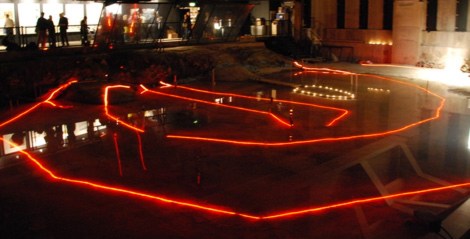
With a black and red colour scheme inspired by the dark pool preserving the Rose’s archeological remains and the red rope lights that outline its foundations, Darney and designer Nicki Martin Harper have imagined the play’s action taking place in a goth/steampunk/BDSM world. Surprisingly, it works incredibly well. The sexually suggestive, alternative look suits these characters driven by sex and violence to seek revenge. There’s a ruthless, devil-may-care mood, and the striking costumes draw attention away from the inability to have much set on the small stage.

Darney, of Five Guys Chillin’ fame, doesn’t shy away from sex and violence. From the start, we see the crime that sparks the cycle of revenge: Junior (Camilla Watson) rapes Lord Antonio (Kit Heanue) with the hell of her stiletto. Staged at the back of the site, the audience is spared any gory detail (though there is plenty to come), but it’s a hell of an image to start with. The murders are similarly graphic, with an electric drill, daggers and poison all wielded with ferocious venom and copious amounts of fake blood. Most of the fights are rather clumsy and simple; a fight choreographer could increase the violence tenfold. There is also plenty of seduction and revealing costume, though some of the 15-strong cast disappointingly resort to playing sexy rather than finding any of their characters’ depth. The script also loses momentum after the first batch of killings and takes some time to pick up again.

Rebecca Tanwen and Allie Croker as evil sisters Ambitioso and Supervacuo give sparky, spunky (albeit posh) performances as they pursue their agenda. More earthy and vindictive are Vindice (a spectacular Annie Nelson) and Hippolita (Brittany Atkins), who have an urban, estate kid urgency and resourcefulness as they go after the Duchess (Deborah Kearne) for previously poisoning Vindice’s father. The rest of the ensemble are generally energetic and confident, handle the text well, and are unafraid to directly address the audience and include them in their bawdiness. Darney and his cast punch the sexual innuendos in the script, adding comedy that, in turn, makes the violence all the more shocking.

With a cast of beautiful people, The Revenger’s Tragedy is visually rich, with an edited storyline that is easy to follow, even to those not particularly familiar with the play. Though some of the performances need developing and the supposedly 90-minute show is actually two hours, it’s an entertaining production that is most valuable for its comment on society’s expectations of women. Seeing an unrestrained depiction of them as selfish seducers and killers is shocking not because of the acts they commit, but that it is women committing them – a sign of ingrained expectations of behaviour that are the root of gender inequality.

Running through 27th March at Rose Playhouse, Bankside.

The Play’s the Thing UK is committed to covering fringe and progressive theatre in London and beyond. It is run entirely voluntarily and needs regular support to ensure its survival. For more information and to help The Play’s the Thing UK provide coverage of the theatre that needs reviews the most, visit its patreon.

Institute, The Place

rsz_gecko-pcte2pct80pct93-institute-e1423864432429

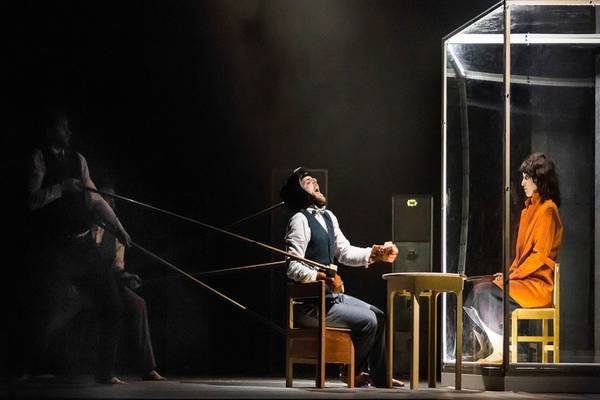
Say your only close friends are people you work with. Can you trust them to help you out if you’re struggling with your health? Martin’s mental health is deteriorating, so Daniel, Louis and Karl try their best to care for him despite their own inner demons and needing to be looked after as well. With a distinctive physical vocabulary and a masculine camaraderie, Gecko’s Institute is an absorbing look at a society made of lonely, needy people without the safety net that family can provide.

Rhys Jarman and Amit Lahav’s deceptively simple set of Victorian wooden filing cabinets is loaded with the possibility of discovery and serves as a convenient place for the characters to store their memories, good and bad. The moments that new items are revealed are a wonderfully surprising juxtaposition to the hulking, boxy structures. Lahav and Chris Swain’s lighting design dark and atmospheric, sharpened by the addition of otherwise unnecessary smoke. Both serve the choreography well, without drawing too much attention onto the design.

Lahav also directs this devised piece, and performs as Martin. Considering he is also the artistic director of the company, it is a true marvel, and a testament to his talent, that none of his production roles suffer. He seemlessly incorporates multiple languages and regular movement sequences that are tightly choreographed and emotive expressions of his characters. The characters puppeteering of each other is a powerfully visualised (and sometimes sinister) metaphor of helplessness at the hands of external forces and the support that peers can offer – or not offer. It’s a visually arresting comment on the support and limitations of others on our individual lives.

The strong sense of brotherhood imbedded in the choreography is a lovely thing to witness. There’s a physical comfort the performers have with each other that blends with the characterisation, making the moments where they treat each other badly all the more shocking. The single female character, Martin’s imaginary girlfriend Margaret, is inventively shown, through costume and movement, but her appearance in a plastic cube is anticlimactic. The whole piece starts to feel too long towards the end, though none of the scenes are gratuitous.

Institute is typical Gecko fare, but the character’s relationships and externalised emotions are the finest features in this physical theatre performance. It’s some of best, most reliable physical theatre work out there at the moment, and Gecko retain the ability to surprise as well as showcase their unique theatrical language.

The Play’s the Thing UK is committed to covering fringe and progressive theatre in London and beyond. It is run entirely voluntarily and needs regular support to ensure its survival. For more information and to help The Play’s the Thing UK provide coverage of the theatre that needs reviews the most, visit its patreon.