Better Together, Brockley Jack Studio

Margaret and her husband Adam own a shipyard in Fife they built up to be the best in the area, after inheriting it from Margaret’s father. They lead a comfortable life in their small town and have two grown daughters. Though on the surface their life is idyllic, deep cracks are concealed under the family’s glossy veneer. Political conflict, local gossip and an unstable economy threaten the foundations of family life in Better Together, the winner of the Brockley Jack’s annual new writing competition and festival. This modern, Scottish kitchen sink drama, like an updated Death of a Salesman, has sibling rivalry, the collapse of an entrepreneurial father who’s stuck in the past and a thematically complex story that mirrors the real family life in modern Britain. Excellent performances and a script instinctively following a course of intimate conflict make this play a true winner.

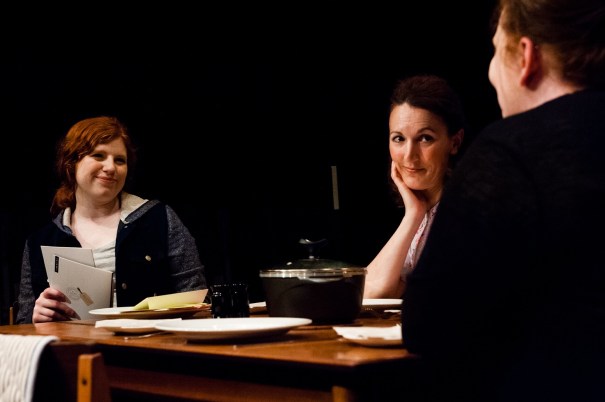
It’s youngest daughter Arlene’s (Eleanor Morton) eighteenth, and she has just received her university offers. Determined to leave Scotland after the country failed to leave the UK, she breaks it to her parents that she’s off to Sweden. Mum (Kate Russell-Smith) is supportive, but dad Adam (Rikki Chamberlain) is most definitely not ok with the prospect of her leaving Scotland. Older sister Shona (Rosalind McAndrew) has enough of her own problems to deal with, what with being a single mum and having a new man every week. Her troubles eventually spread to the rest of the family, the local industry-driven economy collapses, and Adam’s determination to do business how he’s always done it creates a perfect storm of collapse. Personality differences become more pronounced and conflict naturally unfolds as their lives unravel. A climactic, irreparable end is fantastically dramatic but still plausible after the extremes the characters have undergone. No one comes out of it well. In this regard, the plot is much more like real life than its twentieth century predecessors – it’s messy, unresolved and the family has suffered permanent consequences. The linear structure is textbook, but the actual storyline manages several surprises. Structurally, the dramatic arc is watertight, though some of the plot elements are predictable, such as Arlene’s summer employment situation.

The four actors make a fantastically believable family unit and close ensemble, with no one coming across as a weak link or a dominant force. Morton and McAndrew even look alike, adding to the overall believability. Kate Bannister’s direction is commendably invisible save for a few overly-choreographed transitions, and her work is well supported by Moi Tran’s domestic set centreing around the dining table. 

There’s a heavy dose of Scottish working class life in the play, but the themes are abundant and universal, with something for everyone. Progression versus tradition, independence against safety, and old fashioned industry fighting corporate sterility are as present as political difference and familial struggles. It’s a rich tapestry of struggle that manages to avoid being overly dense.

Better Together is some of the best naturalism on the fringe at the moment. Though it follows a formula, it’s an effective and satisfying one. The play’s relevance and layers add depth and further resemblance to real life. Though inevitably tragic, the story’s events are exquisite in their unraveling. It’s a sparky, punchy story that leaves a long lasting glow.

Better Together runs through 28 May.

The Play’s the Thing UK is committed to covering fringe and progressive theatre in London and beyond. It is run entirely voluntarily and needs regular support to ensure its survival. For more information and to help The Play’s the Thing UK provide coverage of the theatre that needs reviews the most, visit its patreon.

27, Battersea Arts Centre

Brian Jones. Jimi Hendrix. Amy Winehouse. Janis Joplin. Jim Morrison. Kurt Cobain. Peter McMaster? No, he didn’t join the “27 Club” but he celebrates the risks and excesses of the age that took so many legends. With co-performer Nick Anderson, they relay personal milestones from birth through the near future amongst displays of risk taking, celebration and sensual interaction with the audience and each other. This encroaching on personal space and copious amounts of dust creates a boundary-less, intimate world with surprising additions of pain and violence – an excellent depiction of the living life on the edge.

McMaster and Anderson’s start wearing skeleton morph suits and masks creates an otherworldly, animalistic effect. A joyful distribution of copious amounts of grey dust cleverly evokes death, subsequent cremation and the Judeo-Christian idea of “from dust you came and to dust you will return”.  This fine, grey powder lingers, soon kicked up into the air and covering both the performers (who are shortly out of their morph suits) and the audience. This isn’t a clean show, but neither are most people’s mid-20s. As glorious and invincible that age might be, death is inevitable and occasionally, not very far away. It’s a powerful metaphor.

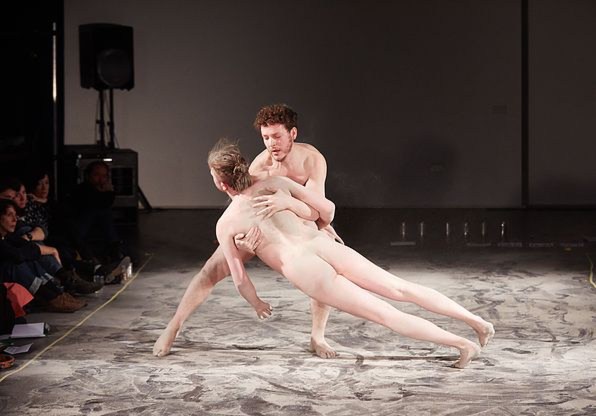
The two performers have nothing on under their morph suits. The totally exposed bodies are vulnerable in their nudity, but simultaneously powerful as the two grapple and slam into each other. Sweaty bits of flesh slap into each other – this isn’t staged fighting, this is two blokes properly going for it. Trust falls become more and more risky even though repetitive and highly choreographed; the potential for harm is thrilling and visceral.

Two long scrolls document the 27 years of the performers’ lives and are read from intermittently. The lists of years and key events start out banal, but as they age, they become wonderfully anecdotal. The teen years are particularly amusing and expressed with a quiet nostalgia. The bodies on stage, what with all the flesh already exposed, seem to grow the more the audience learns about them.

The violence brings an accompanying suspense, but the vulnerability so blatantly on show is the defining feature of 27. The dust that’s kicked up into the air creates a harsh environment, but is a communal experience shared by actors and audience. Like the realities of feeling young and invincible, 27 is a wonderful, messy celebration of the age where we are not bound by societal expectations.

27 ran through 12 May.

The Play’s the Thing UK is committed to covering fringe and progressive theatre in London and beyond. It is run entirely voluntarily and needs regular support to ensure its survival. For more information and to help The Play’s the Thing UK provide coverage of the theatre that needs reviews the most, visit its patreon.
Nude, Hope Theatre

Nude- a play by Paul Hewitt - ©HelenMurray-156

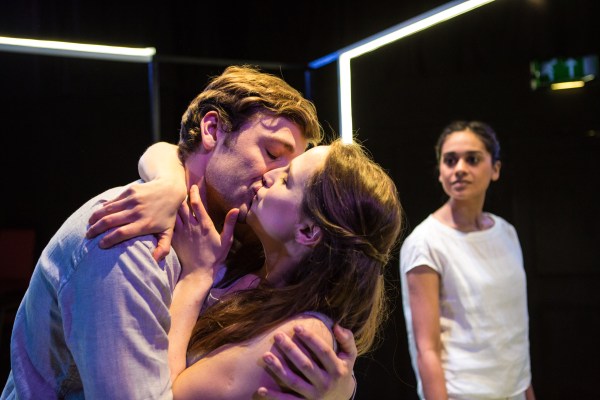
A young couple meet, the relationship blooms, then goes through a rough patch and eventually ends when they are much older. Was it meant to be? Are the events in our lives accidental or controlled by outside forces? Within a standard love story, Nude boldly states that fate has the final word over life, death and love. Playwright Paul Hewitt relies on poetry and narration to tell this tiny, intimate tragedy that feels sadly familiar, like flicking through a dusty photo album of mostly forgotten family members whose memories thrive through stories. Poignant and competently executed, with gaps in the narrative that raise plenty of questions, Hewitt’s script skilfully uses language to depict this couple’s journey and the heavy hand that the personified Fate employs to convince us that we have free will.

Hewitt doesn’t rely on metaphors or overly flowery vocabulary in his rhyming poetry. His language is simple, almost pedestrian, but prettily structured and flows easily from the actors’ mouths. There are a lot of words though, and it’s delivered so quickly that there isn’t much time for in-depth processing. The narrative is a bit chunky with large sections missing and the length of time passing is consequently unclear. His characters are lovely and easy to relate to, though the heteronormative, white, middle class casting of the nameless everyman and woman, that are the focal point of this story, uncomfortably captures the lack of diversity theatre still struggles with. This is countered by a diverse production team and Fate, but romantic leads still lack diversity all to often.

Michelle Fahrenheim and Edward Nash are the charismatic couple controlled by Roshni Rathore as Fate. The three have a relaxed, watchable confidence and natural chemistry, though Fate clearly has the upper hand at all times, even when watching from the peripheral shadows. It creates a great dynamic that’s reminiscent of Prospero or a serious Puck.

Minglu Wang’s minimalist cube that contains the couple in the middle of the space is used well by director Ian Nicholson. Nicholson also incorporates some symbolic black thread, creating a sinister web that further traps the Woman and Man inside their box. This device could have been used more heavily to create a stronger sculptural effect, but was still a nice touch. Creating a space in the round emphasises the idea that the couple are constantly watched and controlled by outside forces – a canny choice.

Though Hewitt’s intention is to focus on a wider philosophical idea, his couple’s story steals the spotlight. Their timeless romance is achingly tragic and well executed textually and through Nicholson’s staging. Nude manages to move the heart even with its small faults, and taps into timeless truths about love, fear and loss.

The Play’s the Thing UK is committed to covering fringe and progressive theatre in London and beyond. It is run entirely voluntarily and needs regular support to ensure its survival. For more information and to help The Play’s the Thing UK provide coverage of the theatre that needs reviews the most, visit its patreon.
 

Hardy Animal, Battersea Arts Centre

https://sites.google.com/a/georgetown.edu/mdarts/_/rsrc/1439559537290/units/unit-3/section-2/performance-laura-dannequin-s-hardy-animal/Dannequin.png

What happens when a dancer and performance maker loses the ability to dance due to chronic pain? She makes a solo dance piece with hardly any dance in it. A mix of emotive description, encounters with medical and health practitioners, and her own research tell the story of an injury and the subsequent pain that wouldn’t leave her body. Pointedly still and so quiet that she needs a mic, Laura Dannequin’s resilience makes a compelling piece of solo storytelling that mourns the dances her body wouldn’t allow her to make.

An impassioned monologue about all of the dances she wants to create is followed by a voiceover describing her dancing, whilst Dannequin stands perfectly still. Though her expression gives away nothing, she exudes a sense of loss; the simplicity and contrast between aural and visual imagery are captivating and heavy with grief. A sequence of small flexing movements of her bare back against a litany of treatments and diagnoses she sought from all over the world creates a similar effect, this one with added existentialism and frustration with a medical community that still knows precious little about the human body and its mechanisms. It’s captivating viewing in its simplicity.

Much of the piece examines Dannequin’s relationship with her body and her pain. It becomes a separate entity that she confronts with a range of emotions and dogged research to understand why hers is so persistent. There’s a scientific lecture on types of pain and her own educated theories, but like the rest of her piece’s components, there’s an emotional undercurrent that carries her words. A cathartic climax celebrates her mysterious recovery and the overarching effect is one of beauty and wonder.

Dannequin miraculously withholds the anger she is more than entitled to feel, instead she shares a grounded story of bodily rebellion imbued with emotion and strength. Hardy Animal is a piece of simple, quiet beauty that doesn’t let itself be bogged down with science or negativity.

Hardy Animal ran from 28-29 April and tours regularly.

The Play’s the Thing UK is committed to covering fringe and progressive theatre in London and beyond. It is run entirely voluntarily and needs regular support to ensure its survival. For more information and to help The Play’s the Thing UK provide coverage of the theatre that needs reviews the most, visit its patreon.

The Destroyed Room, Battersea Arts Centre

Question: do you think people are happier now or in the past?

It’s a big one with no right or wrong answer, but three actors debate it on stage for over an hour in The Destroyed Room with a deliberate diversion to terrorism and the refugee crisis. The extended, semi-improvised conversation is filmed by two live-feed cameras broadcasting to a large screen above the middle class, sanitised lounge and kitchenette that makes up the set. The audience, more like that of a televised political debate, can choose to watch the close up footage or the live wide angle. After the subject matter turns to violence, voyeurism and relationships between the onstage personas break down due to clashing viewpoints, the inescapable reality of the refugee crisis floods the stage in this subtly provocative, highly metaphorical piece of experimental performance that makes the audience reflect on how it perceives these events.

Driven by the idea that we view the world through the lens of the culture we live in, the conversation quickly heads into to the violence bedded into modern life. There’s a pretty clear, scripted signpost to steer the topic in this direction, which although necessary to ensure the conversation hits the points the production wants to make, is disappointing after the promise of improvisation.

Another question: have you ever watched one of those videos by terrorists of them killing someone?

There’s an awful, revealing confession from Barnaby Power that the three discuss for some time; it’s this subject that really starts to press the audience’s emotional buttons. Personalities are revealed, and gloves come off. It’s interesting to consider how much of what we see are characters and how much are the actors’ own selves. Power’s inner conservative conflicts with his liberal exterior, Pauline Goldsmith is flamboyant and brash, Elicia Day is the middle ground between the two and has a secret sensitive to the others’ sweeping generalisations.

An anti-theatricality to this production makes the form both experimental as live performance and occasionally a bit dull. The conversation certainly has a dramatic arc that reads like a script, but even with the live feed projection, there’s little visual variation until the end. The content has merit, but the mind can wonder until the conflict starts to emerge and things fall apart, both literally and metaphorically.

The Destroyed Room is a hard one to pin down, delightfully evading categorisation by being both small and worldly at the same time. Though the amount of time spent in sit down debate feels to long, it accomplishes its goal of reflecting on how we view world events through the lens of Western privilege.

The Destroyed Room runs through 14 May.

The Play’s the Thing UK is committed to covering fringe and progressive theatre in London and beyond. It is run entirely voluntarily and needs regular support to ensure its survival. For more information and to help The Play’s the Thing UK provide coverage of the theatre that needs reviews the most, visit its patreon.

Stowaway, Shoreditch Town Hall

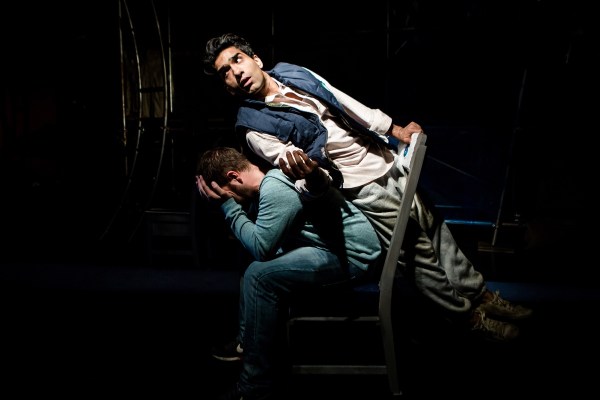
A body falls from the sky, landing in a B&Q car park near Heathrow. Frozen, it explodes on impact. The event makes the news, and is quickly forgotten by everyone other than those directly involved. Andy was getting out of his car when the body landed in front of him. Lisa, a writer, was on that plane. Debbie is Andy’s wife, who has minimal patience for Andy’s trauma. And then there’s Adi, the poetic, aspirational man who fell. The threads of these people’s stories weave through news broadcasts about India’s new space programme that will place the struggling country amongst the world’s elite. Stowaway places Adi’s life in a global context whilst simultaneously giving detail and vibrancy to one of thousands of people who died in their attempts to make a better life. Moving and powerful, the script says a lot in its one act but tries to say too much in the time it has. 
 
A scaffold plane, like a cross section of a whale’s rib cage, holds the plane’s passengers (legitimate and otherwise). This skeleton is also a coastal Indian village, Andy and Debbie’s middle class house, a cafe and B&Q’s car park. Hannah Barker and Lewis Hetherington’s writing and transitions quickly clear up any ambiguity, as does their clever use of angular metal chairs to create a range of sculptural forms acting as furniture and buildings and, well, chairs. The strong metallic lines have the shimmering permanence of skyscrapers the character’s lack – a canny metaphor that fits well with the script’s style and intent.
 
Barker and Hetherington thoroughly examine various sides of the refugee debate through their characters. Adi (Devesh Kishore) wants to see the world and send money home to his family. Andy (Steven Rae) and Debbie (Balvinder Sopal) have a comfortable Western life together, more concerned with their daughter’s progress at school and DIY than the rest of the world. Lisa (Hannah Donaldson) is a successful author who has all the good, liberal intentions of giving voice to the oppressed, but as a privileged white woman, she is limited in experience and access to the research and stories she seeks. The four are excellent microcosmic representations of a good portion of the world that’s more or less likeable, though the extremely conservative, ant-immigration sort are noticeably absent. Their exclusion makes the story more palatable, though a voice from this side could potentially serve to rally greater support to the inclusive left. With or without, the characters and their responses to Adi’s death are powerful political messages.
 
There are a few brief movement sequences that, though lovely in their Frantic Assembly-like fluidity, are so infrequent that they don’t contribute much other than breaking up the emotionally intense writing that is the best feature of this show. More would be welcome. Moments of detailed description devastate; only the hardest of hearts could resist Adi’s charm and poetry that grows from a daydreaming child to a motivated young man. Disconnected telly interview fragments on India’s upcoming Mars mission and the country’s aspirations to be taken seriously cleverly mirror Adi’s hopes for himself and his family, and also obviously question why a nation is launching a rocket when so many of it’s people are destitute – though this doesn’t just apply to India. 
 
Blatantly political, Stowaway uses its well-developed characters to loudly declare support for economic migrants. It’s an emotionally draining but important production, though it could use lengthening in order to make the storyline less dense and convoluted. The performances are good vehicles for the characters’ messages and the scripts’ positive emotional manipulation has potential to be a powerful catalyst for change if the play could be compulsory viewing for the Western populace.
 
Stowaway runs through 30 April.
 
The Play’s the Thing UK is committed to covering fringe and progressive theatre in London and beyond. It is run entirely voluntarily and needs regular support to ensure its survival. For more information and to help The Play’s the Thing UK provide coverage of the theatre that needs reviews the most, visit its patreon.
This Room, Battersea Arts Centre

https://i0.wp.com/40.media.tumblr.com/0de2b8a4c234adfa06d227487f497f1a/tumblr_nkr4q4aw501r8bp0ao8_1280.jpg

Laura Dean has Obsessive Compulsive Disorder. She’s afraid she’s going to kill herself in her sleep so spends at least two hours before bed checking her house for anything she could use to self-harm. Scarves and tights are hidden away, as are knives and other sharp objects. She can’t sleep without her checking routine and after months of exhaustion, she’s had enough. An NHS diagnosis comes with a round of Cognitive Behaviour Therapy sessions that help her recover, but introduce several ideas that make Dean question the nature of her self. This Room is a gently communal experience where Dean provides insight into the recovery process. There are plenty of clinical reports, forms and questionnaires but Dean’s individuality is never drowned out by these or by the condition she fights.

The audience is in Dean’s bedroom with her as she works through the most commonly held thoughts by people suffering from OCD. She confesses that she wants to know what’s going on inside her head so she can understand what’s really wrong with her, something she still hasn’t quantified after the pages of documented appointments she reads at lightening speed. The clinical nature of her recitations is a lovely juxtaposition to the soft, confession-like anecdotes from her treatment, most notably the session where her therapist (with the perfect bottom) visits her at home to confront her fears, represented by a serpentine tangle of tights, head on. The whole piece is intimate, quiet and deeply personal.

Dean has a soft strength that’s immensely watchable, whether she’s sitting silently on the edge of the stage clutching her water bottle, or reading her medical notes into a stand mic. The audience immediately sides with her, and dutifully responds to her questions. The empathy is tangible, and a group hug would not be out of place after the curtain call.

This Room avoids sentimentality or an overabundance of awareness-raising. Instead, it’s a personal account of a treatment process and an individual response to it. Will Dean ever really be well? If so, does that mean she’s not really herself anymore? These are big questions that don’t have an immediate answer, but are examined in a wonderful format that is a privilege to witness.

This Room runs through 27 April.

The Play’s the Thing UK is committed to covering fringe and progressive theatre in London and beyond. It is run entirely voluntarily and needs regular support to ensure its survival. For more information and to help The Play’s the Thing UK provide coverage of the theatre that needs reviews the most, visit its patreon.

Hamlet, Who’s There?, Park Theatre

Some people are so precious about Shakespeare. There’s historical merit in periodic restrained, original practice productions, and modern productions with superficial concepts add a degree of variation, but neither approach progresses contemporary Shakespeare performance practice. The first folio texts, those regarded closest to Shakespeare’s intentions, still may be quite distant from what may have come from the actors in the moment. Scholars can only speculate on performance style, staging and most other production elements due to a dearth of primary sources. Considering all of that, theatre makers should mess about with Shakespeare more. 

Kelly Hunter does that with her Hamlet, Who’s There? by reconfiguring the original timescale and characters to place her adaptation firmly in the present. As two frivolous, tacky families with more money than sense drunkenly celebrate a wedding, a disregarded son suffers a psychotic episode that triggers their collective downfall. Six actors focus the tragedy on the familial element, making this more of a kitchen sink drama than a grandiose spectacle. This is a Hamlet that’s easy to relate to but still be horrified by. The intimacy is well performed and powerful, and Hunter’s script, whilst dramatically different from the original, still contains its visceral, conflicted essence.

Mark Quartley is Hamlet, an angsty, tormented young man disgusted by his elders. He excellently embodies the grief that tips him into Schizophrenia, making him believe he is his dead father. This device carries him forward on a mad quest for revenge. Quartley’s Hamlet is a victim, not just of his surroundings but also his own mind. Kelley Hunter is his drunk mother Gertrude, sloppy and self-absorbed. She’s a great contrast to Quartley, and also to her manipulative new husband Claudius (Tom Mannion), who keeps her well-lubricated throughout the story. The second family is a hapless Polonius (Steven Beard) and two children. Laertes (Finlay Cormack) has been wonderfully reimagined as Hamlet’s best friend, using lines from Rosencrantz and Guildenstern. Their brief encounters are intimate and warming, alleviating Hamlet’s otherwise relentless agony. The language comes easily to the cast, managing to not jar with the modern story. 

Though the performances are excellent, the highlight of this production is Hunter’s script. Pared down, it’s more Eastenders than Stratford, and the use of identifiable mental health issues and familial conflict help move it away from Shakespeare’s fantastical ghosts and dated duels. Ophelia’s madness is logically clarified through wonderfully disturbing staging, with Hunter also directing. The gravedigger scene is still present, but somehow fits in with the concept. Though the end is rushed and heavily changed from the original, it cuts a striking image. 

Hamlet, Who’s There? As a title also suits Hamlet’s mental health struggles as he searches for himself and the father that takes over his mind. Hunter’s set is sparse, but symbolic items and copious amount of blood are visually dynamic. The venue’s lighting balcony and ladder up to it are also cleverly employed.

Flute Theatre and Kelly Hunter’s script bring Hamlet firmly into the present with Hamlet, Who’s There?. It’s firm proof that Shakespeare can be made even more relevant through radical reinterpretations and confident textual adaptations. There’s no need to slavishly follow Shakespeare’s original scripts all the time, but still respect the integrity of the language and story. This is a fantastic production at the forefront of contemporary Shakespeare practice.

Hamlet, Who’s There? Is touring the UK and Europe through the summer.

The Play’s the Thing UK is committed to covering fringe and progressive theatre in London and beyond. It is run entirely voluntarily and needs regular support to ensure its survival. For more information and to help The Play’s the Thing UK provide coverage of the theatre that needs reviews the most, visit its patreon.

Sket, Park Theatre

What sort of trouble would you have got into as a teenager if you were equipped with today’s technology? It’s a frightening thought. What with the teenage brain’s late-developing understanding of consequences and a world outside their own immediate gratification, it’s no wonder sexting is a thing. Insecure teenagers wanting to impress their crushes, an over-inflated sense of self and peer pressure brews a potentially deadly, life ruining combination in the presence of a smart phone. Maya Sondhi’s Sket is a snapshot of the perils of urban, working class teenaged life and the consequences of poverty, boredom and hormones constantly plugged into the Internet. A cast of seven depict a pretty spot-on representation of young people’s emotional lives, but Sondhi’s play seems to take a dim view of troubled teens and the adults that work with them. Painting her young people as a bunch of sex-crazed, badly behaved tearaways and their teacher as useless and boundary crossing is not only hugely generalised but a potentially harmful stereotype.

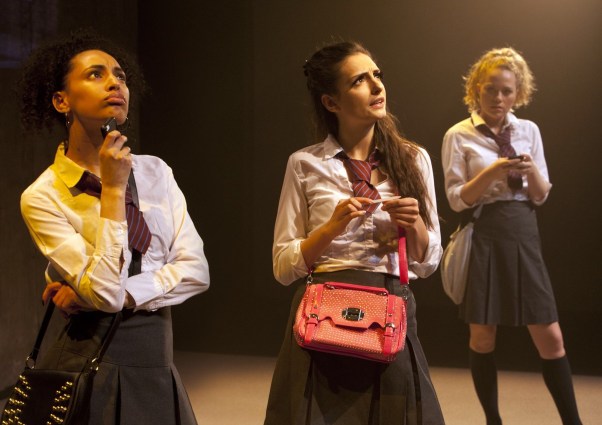
JC (Tom Ratcliffe) has a cousin who runs a porn site, and JC helps him out by manipulating his female school mates into sending him explicit photos and videos. Emily (Laura Gardiner), Daisy (Olivia Elsden) and Tamika (Tessie Orange-Turner) are friends who are just as bad as each other, but quick to judge and pair up against the odd one out of the three. JC’s backed up by the charmingly insecure Adam (Dave Parry) and Leo (Romario Simpson), who know what JC is doing is wrong, but aren’t confident enough to stand up for themselves. The six young actors are believable London estate kids most of the time, and have some nice moments of conflict and comraderie. There are a few accent slips into middle class Home Counties, but these are rare. It’s typical teenaged tribal warfare, but when the girls discover their photos and videos are online, they aren’t strong enough to maintain a tough facade. Their teacher Miss (Anna O’Grady) tries to get information out of them, but manages to be completely inappropriate most of the time and makes no mention of referring the girls to a higher power what with the information she does glean from them – a huge misrepresentation of teachers and support workers, who proactively combat the consequences of sexting.

A horrific end reinforces how brutal children can be towards each other, but it is needlessly bleak. A lack of resolution indicates that these kids will never escape the boys vs. girls revenge cycle and grow up into functional adults. Considering most kids are decent human beings trying to get through life regardless of their backgrounds, Sket paints them at their worst. A few moments of kinship and tears aren’t enough amongst the horror. Whilst sexting and revenge porn is certainly a problem, Sondhi doesn’t show any of the work that is done to fight it by schools, police and social services. The distrustful relationship between teenagers and their teachers is also hugely inaccurate. Individual scenes are well-written and the characters are otherwise believable, but the overall message the script communicates is frankly wrong.

That said, it’s a good production otherwise. Director Prav MJ keeps her staging simple in order to focus on the characters and their conflicts. Simple projections indicate location, and school uniforms reinforce the characters’ youth. There’s no set, but it isn’t particularly needed in a small venue. The script could certainly do with a wider range of material in order to diffuse the negativity and to add is some degree of resolution, but it wouldn’t take much to turn around the play’s attitude and make a really great story.

Sket runs until 14 May.

The Play’s the Thing UK is committed to covering fringe and progressive theatre in London and beyond. It is run entirely voluntarily and needs regular support to ensure its survival. For more information and to help The Play’s the Thing UK provide coverage of the theatre that needs reviews the most, visit its patreon.
Blue on Blue, Tristan Bates Theatre

There’s been a lot of attention on the lack of diversity in theatre lately. White, middle class, able-bodied males dominate theatre and the industry is finally beginning to see that it’s a problem. More diverse work is now creeping into the spotlight, as it should, but it’s usually labelled as “BAME theatre”, “working class theatre”, disabled theatre” or whatever the appropriate qualifier happens to be. That’s all fine in the short term, but if theatre wants to make true progress in diversity, it needs to move away from these labels and have a diverse cast in plays of all genres, time periods and topics. Theatre needs to aspire to be just “theatre” that is blindly inclusive of race, gender, dis/ability.

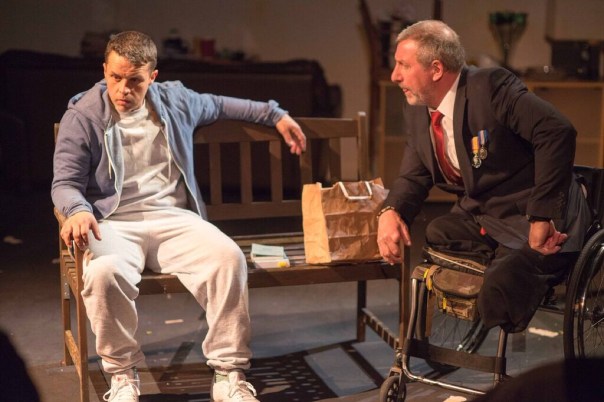
Chips Hardy’s Blue on Blue does just that. The play is fundamentally about mental health in a domestic drama setting, but happens to have a character who’s a double amputee and wheelchair user. It’s not about Moss’ disability, but his relationship with his nephew Carver, who is struggling to build a normal life as a self harmer with OCD. This little, well-made play with great performances is the sort of theatre that truly works towards championing diversity.

Daniel Gentely as Carver is a tormented 30-something trying to put his life back together after falling on hard times. He’s got a job at a garden centre and some carer responsibilities for his uncle whom he lives with, Ronnie Moss (Darren Swift), and things are on the up. But he can’t cope when the world flits beyond his control, even though he desperately tries to engage in “normal” activities, like going out with his mates or fucking Moss’ carer Marta (Ida Bonnast) in Moss’ wheelchair in the middle of the night. His defensive banter and tough guy exterior with Moss eventually give way to a rewardingly vulnerable core. This transition is lovely and shows both Gentely’s range as a performer and validates male emotional need. Swift’s similarly hardened outside, which categorises people into one of the “five kinds of cunts in the world” and wants to be left alone by his overbearing nephew, abruptly gives way to genuine care and warmth. Bonnast also has the opportunity to show some great emotional contrast as the Hungarian care worker studying accountancy who genuinely wants the best for everyone, and the three display a wonderfully consistent chemistry in the hardest and easiest of moments. 

Hardy’s script follows a conventional, linear structure which works well for following his characters’ journeys. It’s a character-driven story that, though just over an hour, has three scenes that are essentially miniature acts. Though the narrative arc is fairly smooth, it’s steep and could adapt well to lengthening. It harks back to Miller, Williams, and the like but doesn’t feel old-fashioned in the least. It’s a current play, with modern issues, families and their messed up baggage. The two scene changes are needlessly long, but other than this, faults are few.

Blue on Blue, though conventional in style still feels progressive with its inclusivity. Hardy’s intuitive dialogue and similar ability from the cast make this a strong play deserving of a solid future.

Blue on Blue runs through 14 May.

The Play’s the Thing UK is committed to covering fringe and progressive theatre in London and beyond. It is run entirely voluntarily and needs regular support to ensure its survival. For more information and to help The Play’s the Thing UK provide coverage of the theatre that needs reviews the most, visit its patreon.