The People Show 124: Fallout, Toynbee Studios

https://i0.wp.com/cdn.paper4pc.com/images/desert-landscape-pictures-wallpaper-2.jpg
Making devised work for the past 50 years, People Show are nothing less than prolific. Their multidisciplinary works are numbered as part of the title; the company’s works now number 132. To celebrate their anniversary, the company’s taken over Toynbee Studios for three days, filling the venue with performances, films and an exhibition celebrating their half a century of work.

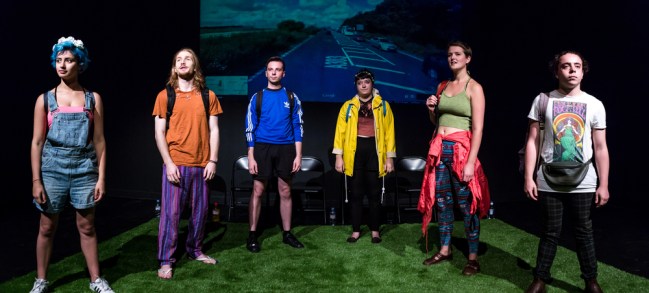
People Show 124: Fallout, first performed in 2013, is resurrected here. The piece deconstructs speeches by public figures and adds light, sound and film; the overall effect is one of provocative absurdity – isolated soundbites lose all meaning, even in a world that’s said to be falling apart. This short piece drives its point home quickly and efficiently and stimulates the senses, but with its message emphasising meaninglessness, it soon becomes repetitive.

Everything in the room is white, even the padded floor is powdered with talc to add an additional layer of frost. Pillows attached to the walls evoke a soothing dreamscape. But soon, pulsing colours disturb the peace as the cast of four fiercely deliver snippets of text. The lights are often so bright they are uncomfortable, even though the colours are childlike and fun. The juxtaposition is clever and sharp, and the switch from austere to saturated is an effective one.

The actors’ tone ranges from gentle to antagonistic, with a decidedly post-apocalyptic bent to the text. Projections of sweeping desert landscapes back up the promises of nuclear fallout, though the dreamy atmosphere from the beginning still lingers – what is real, and what is the product of our subconscious? The disconnect from reality diminishes any potential meaning, making the outcome decidedly absurd, even though the intention seems to want to carry more weight.

This colourful world enhanced with gorgeous projections, bright lights and music is integrated  with the text, though there is a lack of development in the core idea of the piece. If real life is has no purpose and we’re better off in a dream because the world is hellbent on destroying us, that’s fine – but a performance telling us that is not an easy thing to execute and in this case, not done fully effectively.

People Show 124: Fallout is now closed.

The Play’s the Thing UK is committed to covering fringe and progressive theatre in London and beyond. It is run entirely voluntarily and needs regular support to ensure its survival. For more information and to help The Play’s the Thing UK provide coverage of the theatre that needs reviews the most, visit its patreon.

Interview: Mark Brailsford on Staging Shakespeare’s Stories

https://i0.wp.com/www.brightonandhovenews.org/wp-content/uploads/2016/04/DSC01425.jpeg

When Brighton Shakespeare Company’s press release for their Macbeth tour of historical churches in Brighton and Sussex landed in my inbox, I was sorry I couldn’t make it. Shakespeare productions in churches and cathedrals wonderfully hark back to the grandeur of private performances for noblemen and royalty in the 16th century. Shakespeare’s epic stories sit well in the sweeping architecture of these ancient buildings, and on a practical level it’s a great way for companies to save money on sets and reach audiences in rural locations.

Used to the plethora of venues that showcase small-scale, fringe and progressive approaches to Shakespeare in London, I was curious about BSC’s unusually traditional approach. I spoke to artistic director and founder of this new regional company, Mark Brailsford, about the company’s work.

Tell me a bit about Brighton Shakespeare Company and its mission.

The BSC’s ethos takes a character-led approach inspired by Ron Moody and Stephen Berkoff. The company’s aims are to bring individual, characterful actors to the classics in the style of the time the plays were written.

How do you approach Shakespeare? What concepts to you employ?

We are apparently called radical because we set our productions in the period, something not many companies seem to do these days and we’re happy with this label. Many companies, but not all, like to have directors impose their directorial vision onto the plays whereas my approach is to be true to the story and genius of the Bard himself. [I aim] to bring them to life by allowing the story to stand on its own terms. After all, it seems to have worked for 400 years.

Why stage Shakespeare for audiences today?

[The] story. The themes and narratives are as relevant today as they have ever been. Love and loss, pain and laughter, war and peace and the slings and arrows of outrageous fortune. These exist in day-to-day lives all over the world.

What are some of the obstacles you and the company face?

Lack of money! We’re unfunded and back our shows via crowdfunding and box office.

Shakespeare is known for not supporting diversity. What steps are you taking to redress the balance?

This is a myth as there was more diversity in Shakespeare than commonly thought, especially for his time. His women are very strong characters, Othello was black and one of the best take-downs of antisemitism was Shylock’s speech in Merchant of Venice. He also gave prominent parts to working class characters, not a theme of Elizabethan life at the time.*

What do you hope audiences take away from your productions?

Joy, a tingling spine and a thrilling comprehension of the play.

*These views are not representative of those held by The Play’s the Thing UK or its writers.

The Play’s the Thing UK is committed to covering fringe and progressive theatre in London and beyond. It is run entirely voluntarily and needs regular support to ensure its survival. For more information and to help The Play’s the Thing UK provide coverage of the theatre that needs reviews the most, visit its patreon.

World Without Us, Edinburgh Festival Fringe

https://www.thestage.co.uk/wp-content/uploads/2016/08/World-Without-Us-700x455.jpg

Imagine the world if the entire human population disappeared suddenly, without a trace. What would it look like after a day, a month, a century, an era? A lone performer from Belgian company Ontroerend Goed methodically describes how the theatre space we sit in would change as a focal point within the wider world’s transformation. Delivered in a near monotone on a stage bare except for a grey obelisk, World Without Us is a meditative account of our solar system’s lifespan, and humanity’s inconsequence in the great scheme of planetary existence.

Karolien De Bleser quietly narrates this epoch-spanning journey of our planet with matter of fact coolness. What she describes really is remarkable in its compressed state, but the almost total lack of inflection makes the text pedestrian even in its most dramatic moments. Her movement around the space is relaxed and random, to look for meaning in it feels silly what with the story she tells.

With the ability to focus on the story without the mind drifting to topics such as what to have for lunch, the overall effect is a sense of calm acceptance that our lives, whilst impacting the planet immediately, really don’t matter. Our absence has little effect other than the gradual decay and burial of the artefacts we leave behind. Even in periods of environmental turmoil such as we see in the planet’s history, the impact is meaningless.

Even though the sun eventually swells and engulfs the Earth before it dies, all is not lost. Lightyears away, a single human artefact remains with a friendly but assumptive purpose. Its contents are, depending on one’s world view, absurd or incredibly beautiful. Perhaps they are both.The whimsy of human invention is particularly poignant at this moment.

World Without Us is a lovely, contemplative piece of performance and would work particularly well as an audio recording. As theatre, it could come across as flat, or upsetting or remarkable, depending each individual’s world view. Calmly provocative, it is wonderfully wide open to interpretation and effect.

World Without Us is now closed.

The Play’s the Thing UK is committed to covering fringe and progressive theatre in London and beyond. It is run entirely voluntarily and needs regular support to ensure its survival. For more information and to help The Play’s the Thing UK provide coverage of the theatre that needs reviews the most, visit its patreon.


William Shakespeare’s Long Lost First Play (abridged), Edinburgh Festival Fringe

https://i0.wp.com/bloximages.newyork1.vip.townnews.com/southbendtribune.com/content/tncms/assets/v3/editorial/0/fe/0fe0f435-1c5f-5858-af5e-9114b0616351/55c5004c8b770.image.jpg

When I was a teenager, I discovered the Reduced Shakespeare Company’s The Complete Works of William Shakespeare (abridged). My love for Shakespeare had already started to grow, and I thought the script was brilliantly funny and clever. I never saw a professional production of it, or any of the Reduced Shakespeare Company’s subsequent plays, until their newest, William Shakespeare’s Long Lost First Play (Abridged).

I found it hugely disappointing. The humour I found so witty and topical in the mid-90s, though updated, is bound in hackneyed and punny dialogue. The lack of fourth wall is great, but the panto-esque delivery feels cheesy, dated and over long. The script is fine in concept, but its execution is muddy. My tastes have clearly changed over the last twenty years and the Reduced Shakespeare Company’s work is no longer has the impact it once did.

However, the packed house laugh plenty so their style and concept are clearly still popular. Reed Martin and Austin Tichenor’s play is a mashup of most, if not all, of Shakespeare’s plays in one. Found in a Leicester carpark with a pile of bones, this is the never before seen script where Shakespeare tries to fit all his ideas in one in a totally nonsensical story.

Martin, Tichenor and Teddy Spencer are the three performers who play all roles. Their quick changes and timing are most impressive, though they rely on stale stereotypes and basic jokes to generate characters. Ariel from The Tempest becomes the mermaid, a handful of characters are inexplicably gay, and there’s even a joke about Viagra. (Are Viagra jokes even funny anymore?)

The show and the company are still popular after all these years, in spite of shallow, unsophisticated humour. Though the format clearly has staying power and wide appeal, it’s distinctive style in one for those with a penchant for comedy.

William Shakespeare’s Long Lost First Play (abridged) runs through 29th August, then tours.

The Play’s the Thing UK is committed to covering fringe and progressive theatre in London and beyond. It is run entirely voluntarily and needs regular support to ensure its survival. For more information and to help The Play’s the Thing UK provide coverage of the theatre that needs reviews the most, visit its patreon.

Revolt. She Said. Revolt Again., Edinburgh Festival Fringe

https://cdn2.rsc.org.uk/sitefinity/images/productions/2016-shows/Making-Mischief/revolt-2016-production-photos/revolt-she-said-revolt-again-production-photos_-2016_2016_photo-by-richard-lakos-_c_-rsc_201024.tmb-gal-670.jpg?sfvrsn=1

Playwright Alice Birch wants to start a revolution. Revolt. She Said. Revolt Again. seeks to challenge the patriarchal language and social structures that hold woman second place to men. Being polite and socially acceptable isn’t going to achieve this, and the marketing material states that this play is not well behaved.The issue is that it is. The collection of scenarios with chaotic climax and resigned footnote of an ending starts out strong, but quickly loses sight of its goals through a lot of talking but few suggestions for effective action.

The first scene between a heterosexual couple is the most effective as he talks about all the things he wants to do to her body, and she corrects his language from one of his ownership to one of hers. The subject matter is provocative, funny and establishes a model that women can actually use. It’s not badly behaved, though – it’s polite, considerate and a bit uncomfortable, but not revolutionary. Subsequent scenes have less of a practical application; this isn’t a problem in and of itself, but these scenarios are much less of a catalyst in a show about taking action. There is some rejection of social convention, but little seen as radical. A culminating babble of voices largely indistinct from each other goes on entirely too long and due to the challenge of deciphering specific lines has little impact.

A cast of four, three women and one man, play a range of characters though disappointingly, the characters are middle class and English. Surely the issues that are presented – the language of sexual domination, consent, reproduction, family, flexible working – effect working class people as well.

Madeleine Girling keeps her set simple and efficient, using only items that are fully functional to each scene. Lighting designer Claire Gerrens creates angular, starkly delineated spaces that support the simple demand for equality and empowerment.

Birch certainly uses language well and constructs dynamic, interesting characters but the lack of much motivating material creates a lot of bluster with little change. The script also avoids any issues of intersectionality, particularly social class and race, even though one of the actors is black. Her goals are certainly admirable, but Revolt. She Said. Revolt Again.? More like have a chat and then carry on with your life.

Revolt. She Said. Revolt Again. runs through 28th August.

The Play’s the Thing UK is committed to covering fringe and progressive theatre in London and beyond. It is run entirely voluntarily and needs regular support to ensure its survival. For more information and to help The Play’s the Thing UK provide coverage of the theatre that needs reviews the most, visit its patreon.
Declaration, Edinburgh Festival Fringe

rsz_cpgj-xixyaaoghq

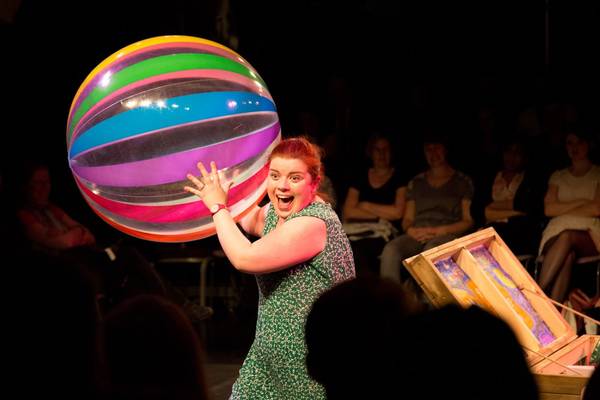
Sarah wants to know everything. She’s inquisitive, gregarious and energetic, the life and soul of any party. But now that she’s in her thirties and wants to start a family, she needs to sort out some of her issues. So, she goes to a doctor to talk through all the behaviour quirks she’s had since childhood – the trouble sleeping, the irrational impulses, the disorganisation, the obsessions.

Diagnosis: ADHD.

Now that she knows what the problem is, does it really solve anything? Will a label help, or hinder? Will medication change the person that she’s always been and actually quite likes? Declaration is an honest, heartwarming solo performance that resonates with those of us who have always felt a bit different or care about people who are a bit weird or quirky. Written and performed by Sarah Emmott, with energy and charisma that’s undeniable, Declaration needs a few minor adjustments to make it an even slicker show.

Emmott’s script has the consistent theme of wanting to please but pesky impulses to do all sorts of irrational things get in the way. As an adult, she has developed coping mechanisms (which she marvelously demonstrates with audience help), but as a child, she was a loose cannon. The story of her childhood picks up once she introduces the superhero personal she invented for herself and a doll, Samantha, who is everything that she never could be. The opening exposition, though having important information, lacks the punch and the belly laughs that these sections have. Additionally, some of her transitions need clarity; consistent use of sound, lighting or changing props would help indicate a scene change.

Emmott develops a marvellous rapport with the audience from the moment they enter the theatre. She has the sort of natural magnetism that cannot be taught in any drama school, an innate quality that actors either have or don’t. Laughing and chatting, her stated need to know everything and everyone is evident. The audience rallies to her wide-eyed wonder, and snarky comments about school, doctors and other frustrations get plenty of laughs.

As Sarah works out how to get through life and a diagnosis has the potential to either change everything or nothing, the audience is with her the entire way. She uses props and audience interaction effectively, though she could use tech to further enhance the theatrical experience. Her lovable on-stage persona is a charming reminder that anyone we know may be struggling with mental health, learning or behaviour issues, and even though a few tweaks could be made to improve the show, she dares us to accept her, flaws and all.

Declaration was a one-off performance.

The Play’s the Thing UK is committed to covering fringe and progressive theatre in London and beyond. It is run entirely voluntarily and needs regular support to ensure its survival. For more information and to help The Play’s the Thing UK provide coverage of the theatre that needs reviews the most, visit its patreon.

“Just let the wind untie my perfumed hair…” or, Who Is Tahirih?, Edinburgh Festival Fringe

https://i0.wp.com/www.ridikulmagazin.hu/cuccok/storages/thumbnails/2014-06-06/153cc8eec7af4dc9e7fe3737d2192f41/680x0.jpg

A woman sings behind a gauzy white curtain. We cannot see her face, but in her soaring cries we hear her passion. This is Tahirih, born in what is now Iran in the early 1800’s (we don’t know her exact date of birth because authorities burned these documents after her execution). She is a poet, theologist and women’s rights activist, and she has enough followers that the country views her as a national threat to the patriarchal Islam that requires women to be veiled in public.

In the days leading up to her execution, Delia Olam plays people from Tahirih’s life, unfolding her biography, teachings and radical actions. These we see plainly, but Tahirih is always behind the curtain, playing and singing. As the revered and reviled woman is sculpted through the accounts of others whilst her face remains hidden, she becomes mythical and hugely powerful, a revolutionary who’s life is tragically cut short.

Olam’s script and performance meld into a fluid solo performance that is a fitting tribute to such a remarkable woman. Her physical and vocal distinction between the handful of characters she plays is detailed and precise. A servant, Tahirih’s father, an executioner, and a female follower are crafted in detail, and all visited by the audience who go to these people to discover more about this woman who is revolutionary, dangerous, or both. This is excellent clarification of the audience/character relationship in solo performance format – it makes sense with the play’s circumstances and embeds the audience in the action. There is none of the talking out into undefined space or invisible characters that alienates the audience and removes the character from reality, something that often occurs in solo performance. Across these characters in different places and with different relationships to Tahirih, there is still a clear, well-proportioned narrative arc building to an awful end.

The scenes themselves are well-crafted and provide a snapshot of the landscape of attitudes towards women in Iran at the time. They are simply staged and prettily enhanced with candlelight, their simple, calming beauty juxtaposes the inevitable prospect of her death. Transitions are a touch slow; some are smoothed with recorded music whereas others have silent gaps as Olam transforms in and out of Tahirih, who sings and plays between characters. The silences make for a choppy disruption, but this is a minor issue easily forgiven in view of the story’s excellent construction and execution.

To learn about such a remarkable woman through a strong show and performance feels as much of a privilege as it is an education. Olam has fantastic instinct for storytelling and character development, and this detailed show needs hardly any improvement. Do not miss it.

“Just let the wind untie my perfumed hair…” or, Who Is Tahirih? runs through 29th August.

The Play’s the Thing UK is committed to covering fringe and progressive theatre in London and beyond. It is run entirely voluntarily and needs regular support to ensure its survival. For more information and to help The Play’s the Thing UK provide coverage of the theatre that needs reviews the most, visit its patreon.
How to Win Against History, Ovalhouse

rsz_copy_of_©rah_petherbridge_photography_-_how_to_win_against_history-_done_3

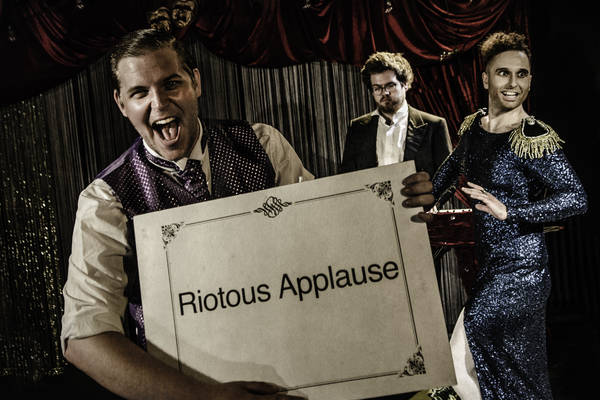
British history is peppered with truly remarkable people. Kings, queens, writers, actors, scientists, athletes and military generals pepper school history books and cultural subconscious. Then there are the people like Henry Paget, fifth Marquis of Anglesey, who are largely forgotten, tucked away in the centuries-old folds of this country’s past. During his brief Victorian life, he became rather infamous for cross-dressing, blowing his family fortune, and turning the chapel of his estate into a 150-seat theatre where he played the leads in his own productions with which he later toured Britain and Europe.

Seiriol Davies’ How to Win Against History chronicles (and fictionalises parts) of Henry’s radical life, focusing on his theatre work and cross dressing, as a fabulous, form-bending cabaret/musical. This little show has a huge heart and needs further script development to smooth out the lumpy narrative, but sequins and silliness, destroying the fourth wall, clowning and contemporary political commentary makes for a powerfully subversive and hilarious production.

The lengthy introduction provides necessary exposition, but as it gives way to a song that focuses on the Marquis’ time at Eton, it becomes too long. The interesting plot points come once the character is of age, and these deserve more attention than they are given. The beginning also sets up the style that’s maintained throughout, of musical theatre songs punctuating scenes that are heavy on the sort of narration and banter that is found in cabaret and drag acts. It’s a wonderful act of genre smashing. Musical theatre, cabaret, vaudeville and pantomime make an engaging, energizing combination that fosters audience participation and celebration. If this is where popular theatre is heading, then bring it on – Seiriol Davies’ script is at the forefront of musical theatre innovation.

Once young Henry finishes school, action starts to pick up. After a mutually beneficial marriage to his cousin (that was reportedly never consummated) and teaming up with a actor Alexander Keith (Matthew Blake), he casts himself in several plays. When no one comes, they take the shows on the road, making hilarious changes as the audience becomes less enamored of his work. More could be made out of his marriage and his increasingly weird theatre productions; they are rushed and little sense of a timescale is provided. Between his awakening as a student to a touring theatre maker, there’s a feeling that a lot of plot is missing. He is suddenly a broken man in Monte Carlo being interviewed by Daily Mail journalist Quentin (a brilliant in-joke!) and whilst this is deliciously funny, there is yet another leap in time and place. More scenes could easily be written to fill in these gaps without disrupting the established style. Even though the cabaret influence comes though in the short sketch-like scenes, as a musical it feels underwritten.

Writer Seiriol Davies plays Henry, the fabulously flamboyant lover of sequined dresses and the theatre. His journey from naïve boy to the ill and impoverished 20-something is lovely and genuine, with songs that in turn capture his enthusiasm and anguish. Energy abounds from the other two performers, making the show feel a lot bigger than it actually is.

Though this new musical needs further development to give it the scale and narrative punch that matches the style, it is fantastically good fun. The political content and deconstructing of style and structure are fly in the face of historical erasure of controversial figures and dramatic conventions. But it evoked engagement and contribution from a willing audience that was eating out of the performers’ hands within the first few minutes and this in and of itself is a huge indicator of excellent work. How to Win Against History could easily have the scale of a West End show, and it deserves the attention that would garner it.

How to Win Against History runs through 28 August in London and Edinburgh.

The Play’s the Thing UK is committed to covering fringe and progressive theatre in London and beyond. It is run entirely voluntarily and needs regular support to ensure its survival. For more information and to help The Play’s the Thing UK provide coverage of the theatre that needs reviews the most, visit its patreon.


Hardy Animal, Battersea Arts Centre

https://sites.google.com/a/georgetown.edu/mdarts/_/rsrc/1439559537290/units/unit-3/section-2/performance-laura-dannequin-s-hardy-animal/Dannequin.png

What happens when a dancer and performance maker loses the ability to dance due to chronic pain? She makes a solo dance piece with hardly any dance in it. A mix of emotive description, encounters with medical and health practitioners, and her own research tell the story of an injury and the subsequent pain that wouldn’t leave her body. Pointedly still and so quiet that she needs a mic, Laura Dannequin’s resilience makes a compelling piece of solo storytelling that mourns the dances her body wouldn’t allow her to make.

An impassioned monologue about all of the dances she wants to create is followed by a voiceover describing her dancing, whilst Dannequin stands perfectly still. Though her expression gives away nothing, she exudes a sense of loss; the simplicity and contrast between aural and visual imagery are captivating and heavy with grief. A sequence of small flexing movements of her bare back against a litany of treatments and diagnoses she sought from all over the world creates a similar effect, this one with added existentialism and frustration with a medical community that still knows precious little about the human body and its mechanisms. It’s captivating viewing in its simplicity.

Much of the piece examines Dannequin’s relationship with her body and her pain. It becomes a separate entity that she confronts with a range of emotions and dogged research to understand why hers is so persistent. There’s a scientific lecture on types of pain and her own educated theories, but like the rest of her piece’s components, there’s an emotional undercurrent that carries her words. A cathartic climax celebrates her mysterious recovery and the overarching effect is one of beauty and wonder.

Dannequin miraculously withholds the anger she is more than entitled to feel, instead she shares a grounded story of bodily rebellion imbued with emotion and strength. Hardy Animal is a piece of simple, quiet beauty that doesn’t let itself be bogged down with science or negativity.

Hardy Animal ran from 28-29 April and tours regularly.

The Play’s the Thing UK is committed to covering fringe and progressive theatre in London and beyond. It is run entirely voluntarily and needs regular support to ensure its survival. For more information and to help The Play’s the Thing UK provide coverage of the theatre that needs reviews the most, visit its patreon.

A Nation’s Theatre: Wail and The Beanfield, Battersea Arts Centre

For two months, theatre makers from across the country are coming to London to celebrate the state of British theatre. One of the A Nation’s Theatre venues is Battersea Arts Centre, currently hosting the double bill of Little Bulb’s Wail and Breach Theatre’s The Beanfield. Wail is an exuberant cabaret about whales and human expression; The Beanfield uses multimedia to examine the impact of police violence on peaceful people and the need to fit in. Though different from each other in content and tone, both Little Bulb and Breach play with performance conventions to create innovative new structures that are at the forefront of theatre performance.

WAIL_Little Bulb Theatre

There’s a lot of science in Wail, and a lot of musical instruments. Actor-musicians Clare Beresford and Dominic Conway, performing as themselves, also have boundless enthusiasm and impressive music repertoires. With material ranging from folk to metal, they share their enthusiasm for whales through songs alternating with monologues of scientific facts. Their charisma and cheer keeps these sections engaging, particularly with the addition of audience interaction. Though the overall energy is light and positive, Beresford’s melancholy for never actually seeing a whale in the flesh provides a bit of contrast to the Male Whale Choir, a hilarious whole-audience exploration of whale songs that males use when on the pull in the coastal waters of Madagascar.

There isn’t as much material on the promised exploration of why humans wail, but a song about why they sing songs is a tender, poignant homage to feeling fragile. This fun, frivolous show is light on the gravitas that a bit more time on this topic could bring, but Wail is still a wonderful, joyful piece as is. The symphonic final number is a fantastic climax wrapping up an excellent contribution to A Nation’s Theatre.

The Beanfield_014_please credit Richard Davenport

The Beanfield by Warwick University’s Breach Theatre wowed audiences at Edinburgh last summer, and understandably so. Drawing on the historic clash between new age travelers heading to Stonehenge and police fresh from the miners’ strikes, they add the framing device of a uni reenactment group researching the event in order to recreate it, and a counter narrative of a group of students going to Solstice. It’s a sophisticated script with plenty of absurdity to lighten the bleak depiction of police violence against unarmed civilians, but still serves as a potent reminder that this happens today in the UK and abroad. Part documentary, interview footage with witnesses on both sides is broadcast liberally; even though the inclusion of police is sympathetic, The Beanfield firmly supports the travelers. Rightly so – pregnant women and children were among the 600 or so attacked with truncheons and projectiles by 1000-odd police.

There is no explicit link between the Beanfield story and that of the contemporary, skeptical students at Solstice, but the inclusion of the latter provides some necessary humour. It’s not a needed subplot though, and detracts from the power behind the political statement of the Beanfield standoff. The script is a great collage of experiences past and present, the sweet naivety of students juxtaposing the atrocities that happened at thirty years previously. The Beanfield, a bit less polished than Wail, is still an excellent piece of theatre with some important thoughts on police brutality.

With multimedia at its forefront, The Beanfield captures the rapid-fire sensory bombardment of present day youth and the desire to instigate change as well as fit in with our peers. Wail, mostly analogue and much less angry, implies the importance of conservation and sympathy for all creatures, human and not. Both shows excellently address concerns of people in this country and experiment with performance, fitting contributions to A Nation’s Theatre.

Wail runs until 23 April, The Beanfield until 21 April then touring.

The Play’s the Thing UK is committed to covering fringe and progressive theatre in London and beyond. It is run entirely voluntarily and needs regular support to ensure its survival. For more information and to help The Play’s the Thing UK provide coverage of the theatre that needs reviews the most, visit its patreon.