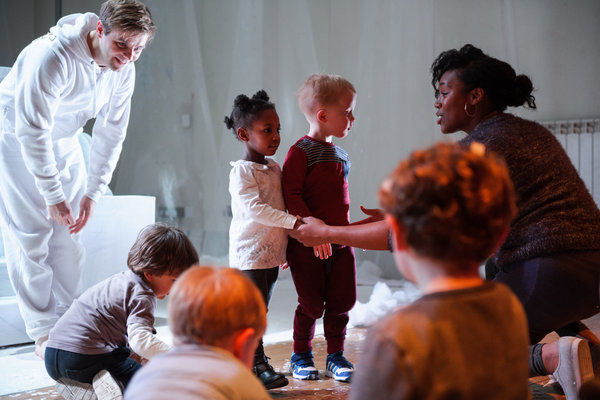
Town Hall Cherubs, Battersea Arts Centre

rsz_c_alex_brenner_strictly_no_usage_without_credit_town_hall_cherubs__battersea_arts_centre__dsc5380

Dear Town Hall Cherubs,

I know we only met yesterday afternoon but I haven’t been able to stop thinking about you since then. Concentrating at work today has been really hard – I couldn’t wait to leave so I could pen this missive, and I’ve been fighting the tiredness that comes with broken sleep filled with golden apples, inflatable little friends, snow and glitter. I’m off somewhere else tonight, but I’m still smiling at the memories of your gentle journey of discovery around Battersea Arts Centre. I’d love to keep you all to myself, but your warm, generous nature shouldn’t be caged, nor is it fair of me to prevent others, young and old, from experiencing the wonderful joy you evoke. So here’s a review for you to share with families far and wide:

❄ ❄ ❄ ❄ ❄ ❄ ❄ ❄ ❄ ❄ ❄ ❄ ❄ ❄ ❄ ❄ ❄ ❄ ❄ ❄ ❄ ❄

The first generation of immersive theatre fans are growing up. The twenty-somethings who discovered Punchdrunk in their early days are 30-somethings. Now immersed in nappies and temper tantrums as well as non-traditional theatre, these new parents will have high expectations of children’s theatre. Pros arch, run-of-the-mill theatre isn’t enough for them, or their progeny. Fortunately, that first wave of immersive theatre makers is also starting families of their own. Merging interactive, immersive and promenade theatre to create a site-specific adventure for 2-5 year olds, Theatre Ad Infinitum and Sarah Golding from Battersea Arts Centre team up to create children’s show Town Hall Cherubs, a winter adventure that brings the building’s distinctive architecture to life among a landscape of sensory-focused design elements.

Dani (Danielle Marshall) gently rallies a group of children, parents and early years teachers in a cozy corner next to the BAC’s grand staircase. Soothing music and colouring in a drawing of a cherub warms the children to her before they head up the stairs to a discovery on the landing. They find a cherub (joyful and wide eyed Barra Collins) and a fabric garland that continues their music-accompanied journey through several rooms; each contains interactive, sturdy set and design. My favourite is a room full of “little friends”, inflatable blobs by Amy Pennington that the children can dance and climb cardboard mounts with, roll, cuddle and any other imaginative play they can create. The children also discover a giant kaleidoscope by Ted Barnes and Amy Pitt, and a replica of the BAC staircase that Deborah Pugh brings to life as Sarah, a dragon-seahorse creature that’s scared of falling down.

Though the kids won’t notice or care, the moral tacked onto the end feels unnecessarily teacher-y, and Cherub’s plan to go on an adventure and then return home could have been clearer at the beginning. These tiny potential improvements certainly don’t detract from the quiet, calming joy of the event.

This isn’t a high energy, raucous performance. It’s intimate, gentle and encouraging with the pace dictated by the group. As an adult without a child there, it was a joy to observe the children’s reactions to their discoveries and freedom to engage with their new surroundings without fear. It’s a powerful reminder to notice the tiny details around us and enjoy the pleasure of experiencing something new beyond our regular routines.

❄ ❄ ❄ ❄ ❄ ❄ ❄ ❄ ❄ ❄ ❄ ❄ ❄ ❄ ❄ ❄ ❄ ❄ ❄ ❄ ❄ ❄

Thank you again, Town Hall Cherubs, for having me along on your gorgeous little adventure.


The Play’s The Thing UK is an independent theatre criticism website maintained voluntarily. Whilst donations are never expected, they are hugely appreciated and will enable more time to be spent reviewing theatre productions of all sizes. Click here to make a donation with PayPal.
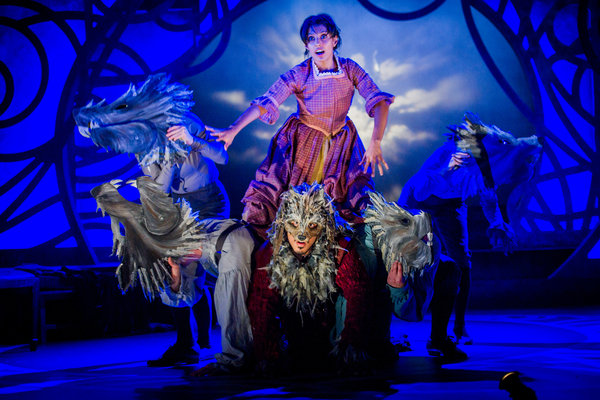
Beauty & the Beast, Polka Theatre

Beauty and the Beast - Polka Theatre - 20 November 2015 Writer - Charles Way Director - Roman Stefanski Designer - Laura McEwen Music - Julian Butler

Cold, dark days make me want to see feel-good theatre, especially in the run up to the holidays. Bonus points if it’s colourful, has some depth and at least some non-formulaic elements, even in a classic story. Polka Theatre’s Beauty & the Beast for ages 6-12 meets these criteria with a surprisingly complex storyline that keeps adult attention as well as kids’. Despite the target age range, there is some great humour and a touch of innuendo adults will appreciate (kids definitely won’t get it), sumptuous set and lighting and an adapted, relevant script. Some of the performances are wooden from the dated language and there are some dodgy movement-based transitions, but the school group audience was quiet and focused for most of the nearly two hours with interval.

Charles Way’s adaptation of the traditional story gives a much wider context than the Disney film and is more relatable to a modern, young audience. Belle is still the main character, but we get to know her father, Mr Godwin (Simon Holmes) and sister Cassandra (Géhane Strehler) well. Belle and Cassandra are complete opposites: Belle’s bookish, a visionary and frightened by most things; Cassandra loves boys, pretty dresses and adventures. The two bicker regularly and their money-driven merchant father is tired of it, a family dynamic that many children will recognize. Beginning in London and moving to the remote countryside when Mr Godwin loses his fortune, the girls also have to cope with big life changes and overcome adversity.

The women’s performances are consistently stronger than the men’s. Ritu Arya’s Belle is convincingly performed with a wonderfully dry sense of humour and an excellent character arc that isn’t overly saccharine. She carries the story and its energy well without being a stereotypical children’s performer, dealing with the old fashioned language brilliantly. Géhane Strehler is great contrast, giving young girls two opposite ideals to potentially relate to. Both have flaws, virtues and detail. Emma Cater is a sinister housekeeper for Jason Eddy’s Beast, a gentle man with stylized physicality and an imposing presence. Eddy doesn’t quite manage to carry that through after his transformation, but it’s so close to the end that it doesn’t matter much.

The set is layers of swirling panels that change colour and glow according to location, with the Beast’s castle the richest of them all. Laura McEwen’s set and Ian Scott’s lighting work together in wonderful harmony, with the occasional addition of puppets. Stage combat from RC Annie also adds a visual component, but the fights are slower that fight speed and brief. Some of the transitions lag and have abstract movement to fill the time, but this doesn’t contribute to the story and usually look pretty naff. Costumes, also by McEwen indicate the characters’ circumstances and changes in social class, but the highlight is the headdress and mask for the Beast.

Though there are still age and gender stereotypes, the adapted script empowers the young female characters. The detail and length will occupy adults as well as children and Way’s story is excellently constructed. With wonderfully visual design and a stirring score by Julian Butler, this is a lovely production harking back to the classical story without the glitz of Disney-fication or the panto cheese, and a solid option for a family holiday show.


The Play’s The Thing UK is an independent theatre criticism website maintained voluntarily. Whilst donations are never expected, they are hugely appreciated and will enable more time to be spent reviewing theatre productions of all sizes. Click here to make a donation with PayPal.

Rise Up, Theatre Centre

Kimisha Lewis in Rise UpMay, 1961. The American south. Segregation has been ruled unconstitutional, but southern states ignore the legislation and the federal government does nothing to enforce it. Activists of all ages and races, sponsored by civil rights organizations, challenge this non-enforcement on public transport and customer services by sending groups of riders, black and white, on interstate bus journeys from Washington DC to New Orleans.
They never get to New Orleans. Over the next several months, in Alabama and Mississippi one bus after another is brutally attacked. The activists, who believe in passive protest, are terribly injured and eventually arrested. President Kennedy, embarrassed by their actions on an international level, urges them to stop but they continue to fight for equality. Rise Up by Lisa Evans uses spoken word, storytelling and multi-rolling to inspire young people to fight for equality in their everyday lives and pay homage to these brave people fighting for justice. A cast of four actor-storytellers with boundless energy plays all the characters with minimal set and props, inciting enthusiasm from both adults and young people alike.

Three metal panels on wheels are the old silver Greyhound buses. A few matching metal stools cleverly create bus seats, jail cells, shop counters and so on. Actors Emma Dennis-Edwards, Sam Kacher, Kimisha Lewis and Edward Nkom set the scenes with an array of accents and physicalities under their belts, plus a few hats and small props to help. The audience consisting mostly of children from the local girls’ school immediately warm to them, both during the production and the post-show “revolution”.

The script is narration-heavy, perhaps too much so, but these monologues feature sections of poetry delivered with a hint of spoken word, but not so much so that the performance style changes and does a disservice to production style continuity. Though more showing than telling would have been welcome, the incidents described are quite graphic and not appropriate to vividly show to school children. This isn’t a particularly visual show, so the students’ attention is a testament to the script and performers’ strength.

Theatre for young people continues to develop in leaps and bounds, creating rich stories and detailed characterization that can appeal to all ages. Rise Up is an example of this, telling a clear story that although set in another era and country, manages to relate to the lives of contemporary young people in Britain feeling the effects of inequality. The staging is simple as is the design, but this serves to focus the audience’s attention on Evans’ excellent script.


The Play’s The Thing UK is an independent theatre criticism website maintained voluntarily. Whilst donations are never expected, they are hugely appreciated and will enable more time to be spent reviewing theatre productions of all sizes. Click here to make a donation with PalPal.

Gorilla, Polka Theatre

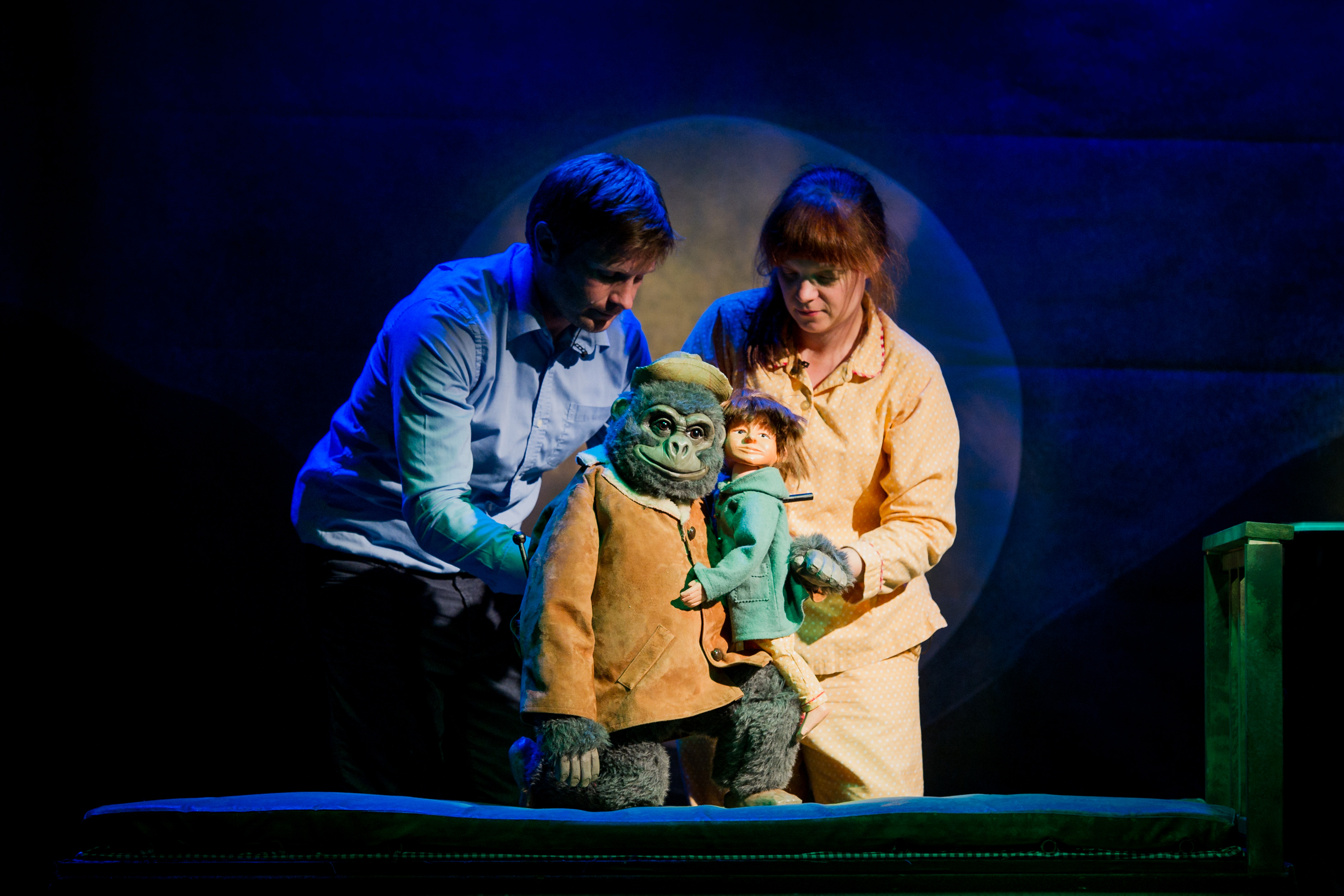
Gorilla Revival - Polka TheatreHannah is a little girl that loves gorillas. She spends all day drawing them, watching programmes about them, and talking about them. She tries to share her love for these wonderful animals with her dad, but he’s too busy. Then, on the night of her birthday she received a small toy gorilla that comes to life and takes her on an adventure, teaching her about kindness and gratitude, and her dad then gives her the best birthday ever. This classic children’s book, Gorilla, is charmingly brought to life with two actors, two puppets and a detailed but lo-tech set for children aged four to eight at Polka Theatre.

The story is a wonderful little adventure, executed quietly and calmly, without special effects and updating to reflect present day. Even the music sounds like it comes from a 1970s lounge bar. Initially I found it all terribly old fashioned, but considering the technology children are bombarded with today, it makes a refreshing change and reminds us that children don’t need an ipad and hi-tech toys to entertain them by the time they’re 3. After Hannah’s introduction, the sequence to establish her day-to-day routine and dad’s busyness is rather repetitive; the children in the audience became a bit fidgety and chatty. Once Hannah’s birthday arrives and the adventure begins through puppet versions of the characters, the audience of little ones becomes quiet and focused. Set changes tend towards the lengthy side, but the reveals that come from the set flips, rope tugs and lighting changes are choreographic in and of themselves.

The puppets suit the design of the set, old fashioned but still detailed and expressive. Actors Ceri Ashcroft and Phil Yarrow are good, with lovely chemistry, though at times it was hard to hear Ashcroft during the songs. The barometer for children’s theatre is the children in the audience though, and these maintained a steady focus once Hannah and her gorilla friend meet. They took some time to settle and weren’t grasped by the beginning exposition, but the rest of the play more than compensated.

There were some lovely staging choices by director Roman Stefanski. Particularly notable are the puppets coming into the audience as it transformed into a cinema and watching the audience as zoo animals from outside the bars of the cage. Transforming the human sized set into a puppet sized one also enchanted the audience, both adult and child. This is particularly praise-worthy as the transitions were quite lengthy and all changes (or most of them) looked operated solely by the performers.

This was my first visit to the Polka. What I found most disappointing was that the house was only half full. The theatre could certainly do with the revenue full houses generate, and this production makes a refreshing change from the fancy bells and whistles of West End family shows. The building emanates a warm sense of community that local families should enjoy more often, and it’s a break from fast and loud modern life. After all, people my age and older thrived in a childhood without the internet and handheld gadgets. Gorilla not only tells a sweet story with a strong female child as a lead, it proves that children today can enjoy live entertainment that quietly focuses on old fashioned adventure storytelling.


The Play’s The Thing UK is an independent theatre criticism website maintained voluntarily. Whilst donations are never expected, they are hugely appreciated and will enable more time to be spent reviewing theatre productions of all sizes. Click here to make a donation with PalPal.