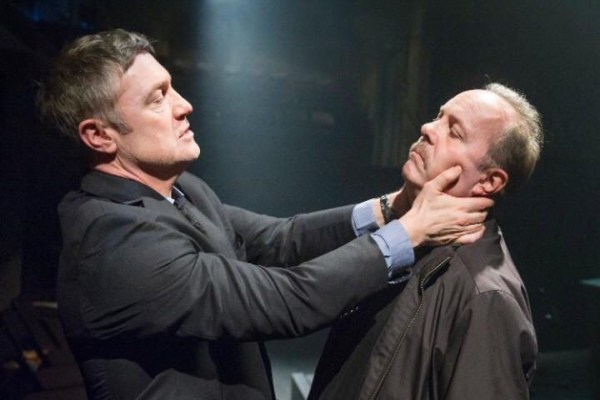
1973, a village in rural England. Fifteen-year-old Dinah is placed in the care of 49-year-old, first time foster mother, Lotte (not ‘Lottie,’ that’s an English name!). As the two navigate the fallout that results from Dinah’s troubled past, Lotte’s life as a war refugee in England parallels Dinah’s experiences of the care system. With more similarities between the two than expected, Transports is a fantastically performed, personal view of the trauma of displaced with excellent design elements.
Juliet Welch (Lotte) and Hannah Stephens (Dinah) are also Lotte’s carer Mrs Weston and Young Lotte respectively, about 35 years ago. Both women showcase great range and emotional truth through scenes of tenderness sharply contrasting their clashes. Writer Jon Welch’s gentle unfolding and blossoming of these women in each other’s lives is more moving than most love stories, and beautifully developed. Lotte is feistier than expected, and Dinah has a fragile heart that eventually opens to Lotte despite her hard exterior. A bittersweet end doesn’t sugarcoat the harsh realities of life as a displaced person, but neither is it too bleak of a forecast – a great choice by Welch.
Welch also directs this two-hander. His careful partitioning of the space with Alan and Jude Munden’s design creates intimacy and a sense of homeliness. Clean, stylised transitions clearly indicate changes in character and time, but these are longer than need be and not consistently accompanied by occasionally projected dates. A video makes up a brief epilogue about Leisl Munden, a poet who was on one of the last Kindertransport trains to England and on whose life Transports is based. Though powerful to see that the story has some truth in it, it also has enough power to stand independently of this bookend.
Two railroad tracks dominate the set, serving as a reminder that none of these women are able to be static and take root in any one place. Projections are laid over the full-scale tracks, hinting at atmosphere rather than displaying it outright. At times this is frustrating, at others, the shadows are more evocative than a clear image. Little details show care and consideration of the characters, like Lotte’s cat figurines and chest of memories from the war. There’s a sweetness in the design, as well as strength and movement. The overarching picture is incredibly dynamic as a result.
Transports occasionally feels like it could be a play for young people, what with the central experiences revolving around teenagers. The message of acceptance and and understanding is a simple one, but the script’s structure adds depth and universality. The story is a lovely one and occasionally sentimental, but by not shying away from frank discussion it finds a good balance – a complete and well-rounded play with a powerful story.

 Shakespeare’s The Tempest is a love story, a swan song and a spectacle of supernatural life. It lends itself well to adaptation what with its complex, intertwining themes. In Mirando: The Gay Tempest, Martin Lewin turns the play into a solo performance told through a gay lens. Completely nude with a liberal coating of silver body spray, Lewin transforms Prospero’s daughter into a son and camps up some of the supporting roles. Though competently performed, there is too little focus on Mirando and Ferdinand’s blossoming love and in a solo performance, the relationships Lewin wants to focus on are difficult to convey. It is certainly an interesting experiment, but one that does not completely follow through on its intentions.



![rsz_img_6902[1]](https://theplaysthethinguk.com/wp-content/uploads/2016/02/rsz_img_69021.jpg?w=646)