First Love is the Revolution, Soho Theatre

https://i0.wp.com/exeuntmagazine.com/wp-content/uploads/love5.jpgRomeo and Juliet gets a modern, interspecies remix by Rita Kalnejais in the south London-set First Love is the Revolution. Awkward, lonely Basti (James Tarpey) is trying to make the best of his teen years in a broken home when he meets Rdeca (Emily Burnett), a sassy fox cub hunting on her own for the first time. With Rdeca’s family not the most functional either, the two black sheep find solace in each other when they discover they understand each other’s speech. Using a bold metaphor for the deliberate choice to alienate or accept of The Other, this urban adventure through back gardens and fox dens is simultaneously funny, brave and disturbing, whilst excellently performed and with writing that keeps the audience on its toes.

The cast of six with a 50/50 gender split is also commendably diverse in age and ethnicity. Hayley Carmichael leads the pack as the fox family’s fierce matriarch. Tarpey and Burnett are the only cast members who do not play multiple roles, though the skill in these young actors is evident in their charming chemistry. Lucy McCormack of performance art acclaim plays a wide array of roles from Rdeca’s hyper but affectionate sister, to the neighbourhood cat that taunts thuggish guard dog Rovis (Samson Kayo) and the prozzie who lives upstairs from Basti. Basti’s dad (Simon Kunz) who wants his meek son to uphold the fighting, womanizing “ideal man” is also Gregor mole and a delightfully gossipy old hen in a cardigan, tweed skirt and wellies on a never ending search for grass seed. Director Steve Marmion’s choice to use animalistic physicalities is just enough of a reminder that not everyone in this play is human, but the movement is not so overpowering that it interferes with the characters’ relationships.

Anthony Lamble’s set design is almost post-apocalyptic; it is certainly grim enough to reinforce the lack of comfort in all of the characters’ lives, human or animal. Human domesticity precariously sits on rolling black slopes that the actors nimbly climb over and tunnels they scurry through. Philip Gladwell’s lighting smoothly morphs through sunsets and sunrises that dictate the wild rhythm of Rdeca and Basti’s all-night adventures.

Kalnejais’ use of the animal/human relationship is a lovely idea, with Basti paralleling the open minds of those willing to see The Other as themselves; he is a citizen opening his home to a refugee rather than labeling her as a pest. The concept harks back to ancient fables and folktales, connecting our often-disconnected present from the rich heritage of our storytelling past. However, whilst I certainly don’t believe she is advocating bestiality, it is the first thing that springs to mind when Basti and Rdeca are caught in a compromising position. It’s not revolutionary, just gross. Maybe it makes me a prude, but I find fox and human sex damages the metaphor rather than reinforces it.

Regardless of acts that would have the RSPCA up in arms, this is a stunning production in Soho Theatre’s main house that brings the emotional scale of Shakespeare to modern day London, with a visceral fervor that celebrates the magic of young love and accepting those that are different from us.


The Play’s The Thing UK is an independent theatre criticism website maintained voluntarily. Whilst donations are never expected, they are hugely appreciated and will enable more time to be spent reviewing theatre productions of all sizes. Click here to make a donation with PayPal.
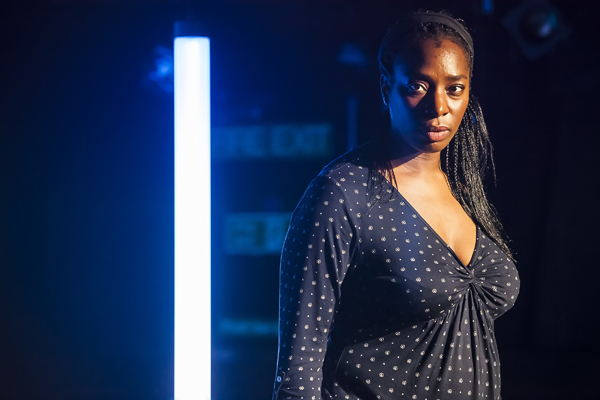
Joanne, Soho Theatre

Joanne2We never meet Joanne. We do however, meet four women who encounter her at different points over a crucial 24-hour period of her life, and one that remembers her as a child. We learn that she cuts a tall, striking figure, makes immediate impact on those she meets and she doesn’t seem to fit in anywhere the world. Joanne is homeless and has just been released from prison. Production company Clean Break, founded by 2 female prisoners in 1979 and still producing, recognizes the importance of sharing stories from vulnerable women prone to falling through society’s cracks. Joanne, written by five female playwrights, has some wonderful writing and is skillfully performed in an intimate space but the brevity of the monologues and talking around Joanne distances rather than fully engages.

Tanya Moodie first plays a key worker, then easily slips into a police officer, an NHS receptionist, a hostel cleaner and a teacher. All were moved by Joanne’s plight and wanted to help her, innately sensing her need for support. These women related to something within Joanne, humanizing her and the thousands of other female prisoners like her. Moodie captures the genuine care these women feel, as well as their conflict – police officer Grace isn’t supposed to get attached to her cases, but alludes to her own struggle with finding a place in the world for her and her daughter. I am particularly touched by Kathleen, on the front line of an NHS hospital for 28 years. She makes some pointed critiques of government legislation’s effects on her workplace and its effects on those most needing care. These stories are much more engrossing than Joanne’s because they’re in front of us, as Joanne herself is a shadowy puzzle that we slowly and satisfyingly piece together.

Through written by five different writers, the monologues seamlessly connect but remain stylistically distinct. Told in the past tense through the sharing of memories, they are fine examples of storytelling that Moodie makes active and varied rather than nostalgic. She owns the distinct characterization of these women, skillfully masking Róisín McBrinn’s direction. Colour changing light-up columns and panels add visual variation, but don’t contribute towards meaning or location. Their presence is unimposing, but unnecessary. The otherwise minimal, black set draws all attention onto Moodie, as it should in this production. Audience focus is on Joanne’s attempted helpers and their capacity to empathise; they are more solid and demanding of immediate attention than the silhouetted subject of their stories who leaves nothing but a memory.


The Play’s The Thing UK is an independent theatre criticism website maintained voluntarily. Whilst donations are never expected, they are hugely appreciated and will enable more time to be spent reviewing theatre productions of all sizes. Click here to make a donation with PayPal.

Barbarians, Tooting Arts Club

Punks Paul, Jan and Louis are working class lads living in south London. School didn’t do much for them and unemployment is high, so they hang around and smoke, nick cars and try to pull girls. They’re bored, angry and frustrated at the lack of opportunities available to poor kids like them. They want to improve their quality of life and feel like they belong in society, but society’s too busy fighting terrorism and racism to pay them any attention so they do their best to get by, or not. It sounds like the present, right? Nope. Barrie Keeffe’s Barbarians premiered in 1977. As London battles the National Front, striking unions and IRA bombs to a soundtrack of The Clash and The Sex Pistols, audiences can’t help but draw parallels between life then and now. It’s unsurprising this Tooting Arts Club/Soho Theatre production will soon be followed by the Young Vic’s, a completely different production of the same play, what with its contemporary social relevance and three fantastic roles for young actors to get stuck into. Though close to three hours long and composed of three self-contained plays at different points in the boys’ lives, the excellent performances, atmospheric venue and socio-political comment make the time well spent.
The long-vacant uni building on Tottenham Court Road used as the performance space for this production is the defining feature of this production, fostering intimacy, interaction and that overused catch-all word, “immersion”. The decaying interior surrounding the audience reinforces the poverty in the the lads’ and how grim it is for them day in and day out. We are in this world too, rather than just observing. Political slogans and graffiti cover the walls. The ceiling’s falling in above the youth club tables and chairs. Barriers herd spectators like cattle at a football match. Discarded furniture lines Notting Hill’s streets during carnival. The audience doesn’t sit on comfortable theatre seats, but on the items that make up the set. We aren’t comfortable, but nor should we be as neither are these guys. The three rooms that are used for the three separate plays contained in Barbarians are small and crowded with people; the actors’ energy rushes around the room, occasionally making contact with those of us watching but we never feel threatened despite the regularly erupting violence. There’s a feeling of claustrophobia created by this space, but also the possibility for the walls to be blown away by all rage. It’s a wonderful, angry whirlwind that encourages our inner “fuck the establishment” punk anarchists and empathy with the characters even though their actions are often abhorrent.

The cast is outstanding. Josh Williams is the aspirational black Louis; his skin colour is often unseen by his mates, and also makes him the victim of their racist “banter” and violence. Williams captures his inner strength and good intentions that eventually grow large enough to stand up for his beliefs. Whilst all of the characters want their lives to have a purpose, Louis doesn’t let leader Paul (Thomas Coombes) turn him into one of his violent minions as they grow up. Coombes’ terrifying Paul still manages to evoke sympathy when he is younger. His need to fit in always tends towards mob violence; the character reminds me of troubled young people from dysfunctional homes with little love around and no other knowledge of how to express frustration. Jake Davies is Jan, the shy mousy one who also tries to make something of himself but doesn’t have the inner strength that Louis does. Unsurprisingly, all three lads come to a horrible end when they meet again after going their separate ways, in the summer heat at Notting Hill Carnival.

Keeffe’s script is excellent and each of the playlets can stand alone and still make their point, but to present all three really drives the message home as the audience can see the effect of a poor quality of life on young people over a longer period of time. I would love to see a female equivalent of this play, as much of what’s contained in Barbarians is stereotypically male, and working class young women’s lives would have been no easier during the late 70s. Regardless, Tooting Arts Club’s production is worth seeing for its use of space and the effects it has on characterization and the energy of the piece. Director Bill Buckhurst’s work here is certainly to be commended in one of my theatrical highlights of this year.


The Play’s The Thing UK is an independent theatre criticism website maintained voluntarily. Whilst donations are never expected, they are hugely appreciated and will enable more time to be spent reviewing theatre productions of all sizes. Click here to make a donation with PayPal.

Chef, Soho Theatre

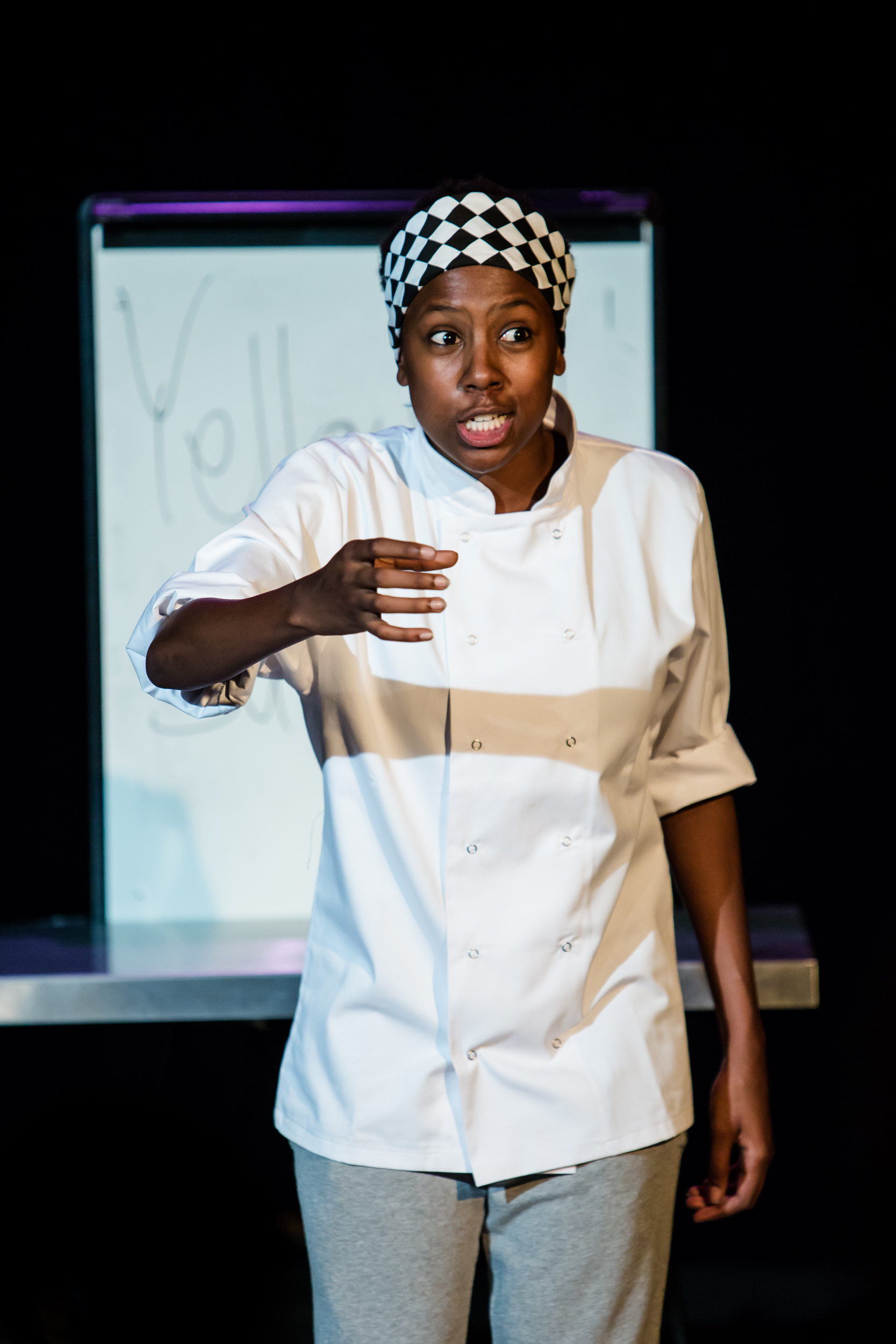
Chef, Ed Fringe 2014, courtesy Richard Davenport 035“Incredible innit, Food.”

Sabrina Mahfouz’s Chef is a one-woman play in the kitchen of a women’s prison. It’s no Orange is the New Black, though. Jade Anouka’s nameless chef shares her passion for food, recipes and stories of broken families and prison life. Anouka’s captivating, nuanced performance and Mahfouz’s poetic, imagery-filled verse holds the audience’s attention for nearly an hour without faltering.

Anouka’s performance is the primary pillar that supports this production’s success. With an innate musicality and unwavering energy, she balances the character’s true love for her work with the traumatic tales of an abusive father, a shady boyfriend and an incident that happened in her prison kitchen yesterday. Her interpretation both honours and personalises Mahfouz’s character, bringing an infectious optimism to a character that has endured so much hardship. Though this play probably works best in intimate theatres like Soho’s upstairs space, it is a great shame to deny larger numbers of people from seeing her performance.

Mahfouz’s writing is the next pillar that makes this story into a great play. Her use of poetry flips back and forth with street slang and swears, a continual reminder that not all inmates have limited vocabulary or intelligence but still keeps her believable. She gives us a truly human character with all flaws and perfections laid bare. She creates devastating empathy for this unnamed young woman doing so well at rising from the ashes of her childhood by becoming a fine dining head chef, only to be locked away for a crime she swears she didn’t commit. (Though all convicts swear their innocence, don’t they?)

Mahfouz and Anouka have worked together previously, on Chef and another play. These two clearly make a fantastic team, but both are excellent, established artists in their own right. Mahfouz is certainly a playwright to watch out for, and Anouka is a performer not to be missed.

Despite the stellar performance and writing, the scene transitions occasionally felt abrupt. Line delivery and technical transitions could have slowed down slightly, though that may have caused energy levels to drop. Another uncertainty is who the audience is in relation to chef. She is in her kitchen alone. They are not questioning her about her suspected involvement in yesterday’s incident, nor do they seem to be fellow inmates. Anouka addresses directly, so they don’t seem to be in her imagination, either. Her story keeps audience focus nonetheless.

As brilliant as Orange is the New Black is, the vibrancy and depth in Mahfouz and Anouka’s chef makes the show feel shallow and stereotyped. Even though it works excellently as a stand-alone short play, this is a character that should be seen again. This is not a production to skip over, despite its diminutive size and the fact it’s a one-woman show.


The Play’s The Thing UK is an independent theatre criticism website maintained voluntarily. Whilst donations are never expected, they are hugely appreciated and will enable more time to be spent reviewing theatre productions of all sizes. Click here to make a donation with PalPal.

La Merda, everything theatre

“After reading the press release and previous star ratings for La Merda, I was very much looking forward to an edgy, raw and arty performance with a strong message that would stay with me for several days…My experience, however, was quite the opposite.

“…dim spotlights illuminated a naked woman (Silvia Gallerano) sitting on a tall platform, quietly singing something Italian into a microphone…she launched into a monologue. It began by telling us we all needed courage, then connected the idea to her father’s courage to commit suicide by throwing himself in front of a train…

“Gallerano’s character then moved onto body image: her unusually large thighs, and her teenage experience with a “beauty parlour” that had tried to reduce them. Whilst I believe body image is an issue that needs to be addressed, every teenager has insecurities about their looks, and theatre has dealt with this before, so the topic is not new, or particularly edgy…

“Gallerano’s character…didn’t develop into anything particularly interesting, or personalised. We never learned much about her other than she was an actress, her dad died when she was thirteen, and she had a slightly unconventional upbringing. I struggled to care about the woman and her issues because her issues weren’t unique. She was just like everyone else…Originally written in Italian for Italian audiences, there was a slight undercurrent of national identity, but unfortunately I missed more of this because I am not Italian…I wondered…why was she still naked?

“The piece was delivered exclusively in three long monologues…Towards the end of each section, she shouted down the microphone, which was physically uncomfortable, but I remained emotionally unmoved. Vague themes were mentioned…but my questions remained: Why was I watching this? What does the writer want us to take away? Why is she naked?”

Read the entire review here.