A Midsummer Night’s Dream in Gotham, Edinburgh Festival Fringe

https://i0.wp.com/www.gannett-cdn.com/-mm-/fc7f555cbf52fb26543e971d5e28e773dc747515/c%3D428-0-4784-3275%26amp%3Br%3Dx408%26amp%3Bc%3D540x405/local/-/media/2016/07/26/LAGroup/Shreveport/636051373770747955-SHR-caddo-magnet-01.JPG

The American High School Theatre Festival is wonderful. It gives school students from the US and Canada the opportunity to perform at the fringe as well as travel abroad, and is often the first chance participants have to travel outside their home country. Teacher-directors also have a platform for showcasing their skills in front of an international audience, so it’s sad that these student productions are often ignored by press. Shakespeare is regularly produced along with a fairly standard programme of musicals and plays for young people, though the bard gives directors more o to be flexible with the text. Whilst these show are far from the standard you’d expect from professionals, they are enthusiastically executed and sheer joy in performing is evident throughout.

A Midsummer Night’s Dream in Gotham by Caddo Parish Magnet High School in Louisiana is one of the festival’s offerings, and whilst it certainly has its issues, it has plenty of merits. A comic book world could certainly work for the action-driven, over-the-top fights and comedy, but director Patti Reeves only consistently applies it to the fairy world. She changes names and locations from Shakespeare’s original which is hard on the ear to begin with, but soon becomes less so. Adapting pronunciation so syllables fit Shakespeare’s verse would minimise this. The lovers remain unadapted – a lost opportunity for an added layer of humour and clashing with the gritty caped crusaders.

Reeves has innate instinct for physical comedy and a clear skill in developing that in her students. There are plenty of chuckles to be had in the mechanicals’ scenes that steal the show. The performances are hammy and over-the-top, but that’s the sort that works best for these characters who are rooted in Commedia stock characters and slapstick. She has some wonderfully confident pupils in her cast, with Echo Patriquin as Helena and Scott Martin as Flute/Thisby the most consistent examples.

Though most of the performances are typically pedestrian school fare and the concept has potential to be developed with further time and resources (something teachers generally lack), the dedication these young people show for Shakespeare is truly inspiring and a great trip down memory lane for anyone who found their love of theatre whilst at school.

A Midsummer Night’s Dream in Gotham runs through 10th August.

The Play’s the Thing UK is committed to covering fringe and progressive theatre in London and beyond. It is run entirely voluntarily and needs regular support to ensure its survival. For more information and to help The Play’s the Thing UK provide coverage of the theatre that needs reviews the most, visit its patreon.

Interview: Chris Hislop on Barker’s Gertrude

https://i0.wp.com/mytheatremates.com/wp-content/uploads/2016/05/600x425Izabella-Urbanowicz-as-Gertrude-Gertrude-The-Cry-at-Theatre-N16-c-Roy-Tan.jpg

“It is impossible – now, at this point in the long journey of human culture – to avoid the sense that pain is necessity…that it is integral to the human character both in its inflicting and in its suffering…” – Howard Barker

Howard Barker is no stranger to sex and violence. His 2002 reimagining of Shakespeare’s Hamlet places the prince’s mother and her sexuality centre stage in a divisive interpretation of the character who receives little attention in the original story. Rarely staged (most likely due to its relentless, sexually explicit subject matter), theatre PR Chris Hislop returns to directing with this upcoming production of Gertrude: The Cry at Theatre N16 in Balham. The play has fostered a huge range of opinions regarding its depiction of women, feminism and female sexuality and its director has a lot to say on the matter.

Why does this play need to be staged?

It’s a vital, powerful and fascinating piece that tackles feminism and sexuality from a very different angle. It’s also a wonderful dissection of Hamlet – considering the Shakespeare 400 celebrations, now is a great time to be giving the Prince of Denmark an overhaul. It’s also a largely forgotten and underperformed piece by a difficult and complex writer. We need more plays like this and writers like Barker, and if this production inspires anybody to think differently, I’ve done my job well.

Opposing views say Barker presents women in an empowering or negative light. What approach are you taking, and why?

Both – my favourite thing about this play is how it was written to empower an underwritten female character, and yet does such a piss-poor job of doing so. Or maybe it doesn’t – maybe Barker’s aggressive sexualising of Gertrude and blatant female nudity throughout is his attempt at female empowerment. Either way, he’s not a misogynist. Barker’s obsession with women has translated into some wonderful parts in his shows, and he’s always trying to write pieces that celebrate and empower them, just through a rather perverse lens. I don’t want to circumnavigate that entirely, just sand down some of the sharper corners.

What’s so appealing about the character of Gertrude in Shakespeare and Barker’s scripts?

She’s an utter mess. She doesn’t know what she wants, she doesn’t know how she’ll achieve it, and she’s governed by her wants and desires. She’s an incredibly human, rounded character. She’s a mother and a lover, neither of which are mutually exclusive.

Would you say this is a feminist play? Why/why not?

I struggle with the word “feminism”. Our world is defined by our language, and by defining an issue by a specific gender we’re generating responses that hinder as well as help. We talk about “racism” – defining someone by their race – so why don’t we call it “genderism”?

Anyway, I digress: I think this is a play about women, the role of women, and women’s sexuality – not exclusively, I think it has a lot to say about sex in general, but the fact that it does so from a female perspective is important. You could say that it’s not even really from a female perspective; it’s a script by a man, and it’s being directed by a man, but I find such comments painfully genderist. I wouldn’t expect only women to like Carol Churchill, or only men to like books by Ross Kemp.

So – is it a feminist play? Yes. Do I think that’s important? Not really. Do I think it tackles important issues around sex and gender? Yes. Is that important? 100%.

Gertrude: The Cry opens 12 June.

The Play’s the Thing UK is committed to covering fringe and progressive theatre in London and beyond. It is run entirely voluntarily and needs regular support to ensure its survival. For more information and to help The Play’s the Thing UK provide coverage of the theatre that needs reviews the most, visit its patreon.

Twelfth Night, Hope Theatre

rsz_web_size-93

Fringe Shakespeare can be terrible, brilliant and everything in between those two ends of the spectrum. The better productions are vivacious and effortlessly handle Shakespeare’s language whether or not they are updated to a more modern setting, edited heavily or otherwise adapted with a concept. Thick as Thieves’ Twelfth Night is one of these good ones. Four versatile actors play all the parts in this bouncy interpretation that incorporates onstage character changes, plenty of music and audience interaction, and some clever character interpretations. At two hours long with an interval, the text doesn’t feel butchered though the interval isn’t particularly needed. With few faults, this is one of the best Twelfth Nights of recent fringe Shakespeare productions.

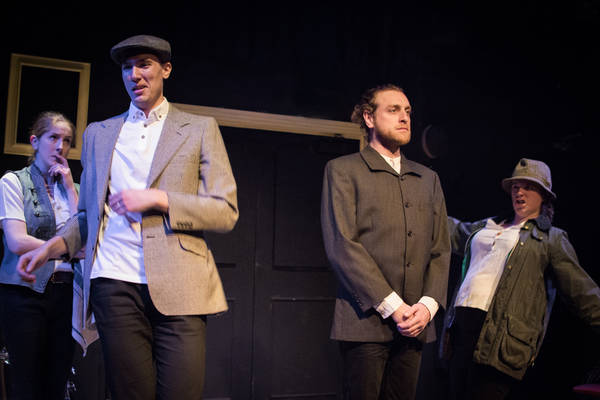
Company co-founder Nicky Diss, in an act of insightful  casting, plays Viola and Toby Belch. Her Viola is intense and boyish; her Belch is a gruff, posh older man. Diss’ presence and versatility are things of wonder, but she doesn’t outshine the rest of the cast. Her fellow co-founder Thomas Judd gives a Sir Andrew Aguecheek that is hapless and posh, a delightful interpretation that works very well; he doubles as a townie Orsino. Completing the quad are Oliver Lavery, particularly excelling as a hippy Feste and slimy Malvolio, and Madeliene MacMahon as a wonderfully frivolous Olivia. The four are all exceedingly good at creating clear, contrasting characters and have an energy that goes well beyond the walls of the tiny Hope Theatre.

There no set to speak of, which is fine for this play that changes location every scene. Costume pieces and musical instruments pepper the walls instead, giving easy access for changes. Hats, jackets and waistcoats over a uniform of black trousers and white shirts assist with character differentiation. It’s a simple but effective device to give visual variation and the lack of set reflects original practice. Occasional fiddly changes distract from the action on stage, but these moments are rare.

Some interesting alterations occur to facilitate the four actors, particularly the Sir Topas/Malvolio scene. Rather than Feste duping the prisoner, the lines are split between Sir Andrew, Toby and Maria. It’s believable enough despite vocal differences and makes no difference to the story.

Of the fringe Shakespeare that’s playing at the moment, the performances make this shoestring Twelfth Night a great one. Thick As Thieves are a talented, instinctual bunch certainly worth watching.

Twelfth Night runs through 30th April.

The Play’s the Thing UK is committed to covering fringe and progressive theatre in London and beyond. It is run entirely voluntarily and needs regular support to ensure its survival. For more information and to help The Play’s the Thing UK provide coverage of the theatre that needs reviews the most, visit its patreon.

Hamlet Peckham, Bussey Building

What happens when a director completely disregards age, gender and nationality in a Shakespeare production, then stages it in a former cricket bat factory with a stripped-back aesthetic and fantastic performers? Shakespeare Peckham. Founded by actor/director/producer Anthony Green, Hamlet Peckham bears more resemblance to the vibrancy and gender bending of Shakespeare’s original productions than most modern conceptual interpretations. Green incorporates several aspects of original practice, which prove that embracing the conventions of Shakespeare’s theatre with a fearless cast is a winning combination.

There are a few concepts that Green adds, such as casting three actors as Hamlet to highlight “the problem, the plan and the solution” of Hamlet’s narrative. He also empowers Polonius, making the father of Laertes and Ophelia the strongest character in the play. There’s loads of direct address and audience interaction, as there was in Elizabethan and Jacobean theatre and as there should always be. The ghost is just a man rather than ethereal or otherworldly, and when Hamlet is played by a woman, he changes all gender pronouns to “she” and “her.” These choices, proving Green’s instinct for excellent theatre and Shakespeare performance, either work well or, at the very least, don’t not work. The only one of these approaches that jars is the textual changes according to gender, but it will have little impact on a viewer who doesn’t know the play well.

The Bussey Building, here configured with the audience on three sides, also has three slender poles along the front of the stage. Though their position prohibits the curving movement that the Globe’s pillars creates, the actors use them – as supports, to hide behind and to propel them. Sight lines are occasionally blocked, but never for long. There is no backstage, so the actors hang out in the dark behind the audience. No feature of this space goes unused, though there are no specific adaptations that warrant the addition of “Peckham” to the show title. This isn’t a site-specific production, but it is certainly wonderfully site-responsive as well as being sensitive to the audience’s energy. Set designer Michael Leopold and lighting designer Adam King create a subtle, harmonising impact on the space with wooden crates, white curtains and colour. The actors’ black and white contemporary costumes looks like their own clothing, but rather than appearing cheap, it comes across as relaxed and accessible.

The cast is phenomenal. Nine of them take on all roles, with only a few not doubling, tripling or more. It’s impossible to chose a few standout performances, but the three Hamlets (Sharon Singh, Max Calandrew and Izabella Urbanowicz) seamlessly blend their interpretations whilst making each moment their own. Gil Sutherland as Polonius is the driving force behind manipulative Claudius (Pete Collis), Daniel Rusteau is a warm, grounded Horatio. Eva Savage is half a dozen characters, particularly excelling as the joyful singing gravedigger. As a whole, they are a well-oiled, energetic and charismatic bunch who have the talent for the world’s biggest stages. Working with Green, each moment is crafted with care and detail, but the effort only shows in the performers’ ease.

Both progressive and ancient, Hamlet Peckham is what contemporary Shakespeare should be – striving for equality in cast and crew, respecting core performance techniques from original Shakespearian theatre practice, and a relaxed, flexible concept that focuses on telling the story with passion and muscularity. This production creates opportunities, showcases great talent and tells Shakespeare’s story with all the energy and life of new play. Don’t miss it.

The Play’s the Thing UK is committed to covering fringe and progressive theatre in London and beyond. It is run entirely voluntarily and needs regular support to ensure its survival. For more information and to help The Play’s the Thing UK provide coverage of the theatre that needs reviews the most, visit its patreon.
Hamlet, The Rose Bankside

The Rose, the tiny fringe theatre built on the remains of its Elizabethan original, is one of the most unique theatres in London. It has its issues, though. Rather than the hierarchy with an artistic director at the top, it is managed by a team of artistic associates, all volunteers. Due to the lack of  an individual’s clear programming vision, the productions here are hit and miss. Their current production of Hamlet, though it has a few moments of invention and effectiveness, largely misses the mark due to poor performances and a huge reduction in length, which hacks the dramatic arc and character journeys to bits.

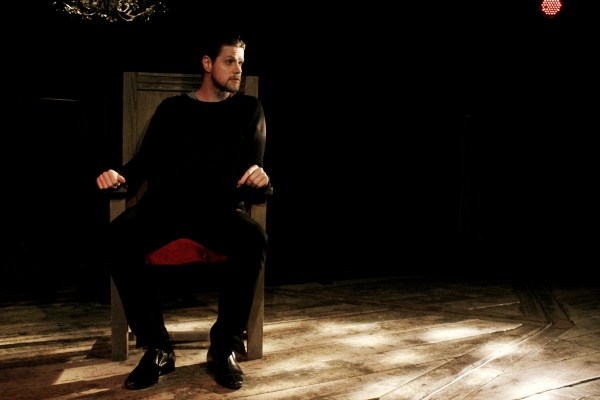
Of the cast of seven, Luke Jasztal as Horatio is the only one with completely consistent characterisation and stage presence. As the confident, loyal friend and member of the court’s inner circle, he holds the plot together and picks up the energy in lagging scenes with warmth and charisma. Chris Clynes in the title role is more believable once Hamlet decides to feign madness. His ‘to be, or not to be’ is simple and honest, and he is full of energy whilst deeming Polonius a fishmonger. Clynes’ initial sullen sulk casts him as an overgrown, spoils teenager rather than a grieving young adult, but fortunately he gets over that quickly. The remaining cast tended towards either completely flat, monotone delivery or overwrought melodrama, with little light and shade between the two performance styles. The verse handling is also hugely inconsistent amongst this cast.

At nearly three hours if left intact, to reduce Shakespeare’s script to 90 minutes removes a lot of action. Though director Diana Vucane’s edit is linguistically seamless, major plot points are inevitably lost. The focus on Hamlet is maintained, but with so much of his dialogue cut, his character choices come across as unjustified. With The Rose’s 90-minute limit on productions, perhaps Hamlet isn’t the most suitable for this venue.

Some of Vucane’s choices were strong, whilst others questionable. Hamlet’s use of puppets in the players’ scene was inventive, but the impact of the scene was diminished with the murder reveal coming from Hamlet rather than strangers. Contemporary dress also worked in this casual, reduced version of the original but the number of costume changes was excessive and pointless. I stopped counting after Ophelia’s dresses numbered four, in as many different scenes. The rich sound design that stood in for the ghost and scene transitions was rich and spooky, but inexplicably gave way to vintage show tunes. (I’ll never know why “The Lonely Goatherd” made an appearance, or Judi Dench’s rendition of “Send in the Clowns” after the evocative introduction.) She utilises the rear of the The Rose rarely, but it is striking and powerful when she does. If she cast the play, she ought to look at her audition process in order to secure more consistent talent. No lighting designer or fight choreographer is credited, but both of these elements are well done and can count towards Vucane’s strengths as a director.

Though the abbreviated length works against the original play, with the performances given it largely goes in this production’s favour. Diana Vucane shows some promise as an emerging director, but her choices need more clarity in their justification. Luke Jasztal is a pleasure to watch, and Chris Clynes gets closer to his level eventually, but this Hamlet, like the Midsummer mechanicals, is tedious brief.

The Play’s the Thing UK is committed to covering fringe and progressive theatre in London and beyond. It is run entirely voluntarily and needs regular support to ensure its survival. For more information and to help The Play’s the Thing UK provide coverage of the theatre that needs reviews the most, visit its patreon.

Shakespeare as You (Might) Like It, Rosemary Branch Theatre

rsz_b551c7178d1c33dd1b480aca6c14387c3b89b05f2301913df15fd10fc38737bf

Four hundred years ago this April, Shakespeare died. A bunch of academics decided to take advantage of this bizarre anniversary and launched Shakespeare 400. It’s a great excuse for a nationwide Shakespeare celebration, but few of the involved events appear to acknowledge that the celebration is of his death and that he most definitely would write no more. Shook Up Shakespeare hasn’t let this fact bypass them, though. Their 45-minute Shakespearian cabaret mash up, Shakespeare As You (Might) Like It, is a quad centenary wake celebrating some of the Bard’s best female roles and the chaotic spirit of Elizabethan and Jacobean performance conventions.

Performer/creators Roseanna Morris and Helen Watkinson energetically and easily flip from Shakespeare’s verse to contemporary audience banter. Their show doesn’t have a plot, but involves party games, cakes, wine, singing and audience interaction as well as some cracking excerpts. In the intimate Rosemary Branch Theatre, it’s hard to hide but after the initial refreshments, party bags and taking a register, it feels more like a group of friends out for a laugh so people willingly volunteer. There’s a hint of The Complete Works of William Shakespeare (abridged) but with less structure, though it doesn’t feel like it needs it at such a short length.

Morris and Watkinson, as well as being friendly, charismatic and unintimidating, are excellent performers. They perform three scenes and at a push, the Desdemona/Emilia scene is the best but the other two are still fantastically endowed with a seemingly-easy commitment. Though not the best of singers, they confidently carry the Willow song. They switch their tone on a pin, which is truly lovely to watch.

Shakespeare As You (Might) Like It is their debut show as a company and as fun as it is, it could use some developing. With more material it will probably need more shaping and a more clearly outlined purpose/message, but Morris and Watkinson are natural talents with clear passion for sharing Shakespeare’s work with joy rather than quiet reverence.

The Play’s the Thing UK is committed to covering fringe and progressive theatre in London and beyond. It is run entirely voluntarily and needs regular support to ensure its survival. For more information and to help The Play’s the Thing UK provide coverage of the theatre that needs reviews the most, visit its patreon.

Macbeth, Young Vic Theatre

Though drastic re-imaginings of Shakespeare’s plays can show the contemporary relevance of his workgroups the use of a clear, justifiable concept, randomly slapping on cool ideas has the opposite effect. Alienating and confusing, the audience can go away with no more understanding of the story than they came in with, and the director’s decisions look masturbatory and self-indulgent. If a new perspective or insight isn’t provided on a play that the audience is likely to already know or have seen, then there is absolutely no point to adding a concept at all. Such is the case with Carrie Cracknell and Lucy Guerin’s Macbeth. With a text cut to ribbons, lengthy contemporary dance sequences inserted, generically quirky witches and inexplicable doubling, this production is a fine example of how contemporary Shakespeare concepts for the sake of edginess fails to communicate anything to the audience.

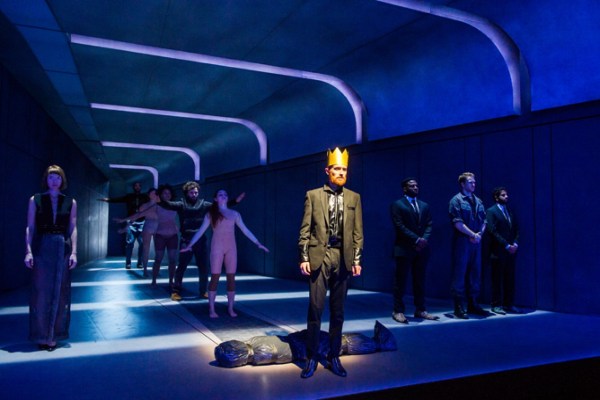
An optical illusion of a set by Lizzie Clachan and Neil Austin’s lighting ensures every moment could make a stunning photograph with stark shadows and forced perspective. This isn’t an art exhibition, though. The cold, industrial feel supports the mood of the play but lacks the sumptuousness that the Macbeths kill for. The rarely changing set doesn’t delineate space or place well, merging this world with the next. In some scenes this works, but it’s hard to follow where the characters are, particularly with the liberal cuts to the text. A home or a Heath? Scotland or England? Bedroom or banquet? It’s easy to lose track, even knowing the play well.

The witches, wearing beige dance wear, twitch and spasm around the space, sometimes with other characters joining in to create a repetitive, robotic movement machine. Why? I genuinely don’t know. There’s a hint of a lack of self-control but the repetition counters that effect. They also double for the child characters, which causes them to lose their power and inhuman-ness. Their movement sequences are entirely too long and lack any support for the narrative, though they are distinct from the other characters.

Fortunately, some of the performances are quite good. John Heffernan as Macbeth is a flawed man we see unravel, though this process is forced due to the cuts in the first half of the play. Anna Maxwell Martin on the other hand is rushed and deadpan, completely disregarding the verse and therefore flattening it. Prasanna Puwanarajah is a good Banquo, though the choice to have his ghost narrate the “out, damn spot” monologue was completely ineffective and nonsensical. Despite a disempowerment of the smaller roles due to the textual edits, the rest of the cast perform with energy and commitment.

There is a litany of further poor choices that show a value of style over substance in this production, and despite the directors’ need for weirdness, the whole thing comes across as generic and pointless. The stylised, lengthy movement sequences make no comment on the world of the play or its inhabitants, and with so much of the text removed, this Macbeth is very much “a tale…full of sound a fury, signifying nothing”.

The Play’s the Thing UK is committed to covering fringe and progressive theatre in London and beyond. It is run entirely voluntarily and needs regular support to ensure its survival. For more information and to help The Play’s the Thing UK provide coverage of the theatre that needs reviews the most, visit its patreon.
Amaluna, Cirque du Soleil at Royal Albert Hall

rsz_bol4

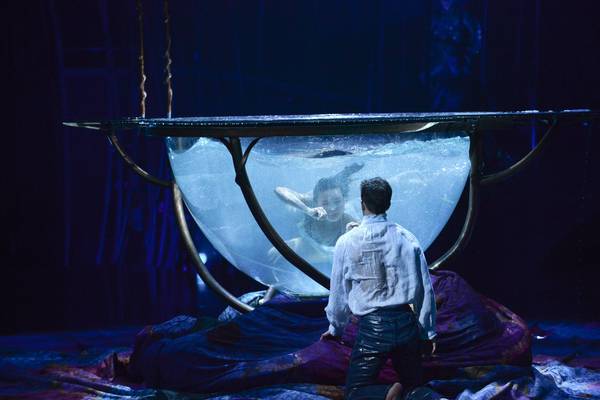
Nearly twenty years ago, I went to my first Cirque du Soleil show in New York. A young teenager and already obsessed with theatre and performance, I was blown away by the colour and spectacle, having never seen anything like it before in the fourteen years that I’d been on this earth. I have no concrete memories of the show, just flashes of light and colour, and feeling impressed. I looked forward to see if Amaluna, inspired by Shakespeare’s The Tempest, would live up to my juvenile memories.

It took a while to find out. First, I had to meet my critic friend, who had invited me as her guest, at door 6 at 7:30. I approached Royal Albert Hall from the side closest to Exhibition Road and found myself at door 3. Not being familiar with the venue, I picked a direction and soon found I was going the wrong way. Considering it’s a circular building and I was early, I carried on and found myself at door 6.

WHAT SHEER HELL IS THIS? At door 6 was Cirque’s version of a red carpet (it was blue), a queue of luxury cars out of which vaguely familiar people emerged in black tie and evening gowns, bright lights and hordes of shouting paparazzi. A few cold looking performers in costume posed for photographs, film crews conducted interviews and vicious looking security guards hovered, ready to move on anyone that looked like they didn’t belong.

I’ve been to a lot of press nights, but this was incomparable. More like a film premiere or awards ceremony, Cirque at some point took the circus outside the venue and into the media and celebrity world. When did this happen? Or more importantly, why? Does Cirque really need the publicity so badly that they pander to the vapid world of Big Brother contestants and paparazzi? And how was I supposed to find my friend in this mess?

Giving wide berth to this bright and shiny, “OK Magazine Live!” shitshow, I carried on to the other side of the large foyer that the blue carpet led to. Fortunately door 6 was duplicated opposite and the nice usher on the door let me wait in the warm. I still managed to be early. The performers across the foyer still looked cold; it dawned on me that they had to be onstage doing acrobatics in less than an hour and that they were either understudies/doubles or Cirque is more interested in photo ops with celebs than the wellbeing of their performers. I desperately hope it’s the former.

Anyway, the show itself. Nearly. We had great seats in a box allocated for press but I didn’t realise at first just how good they were. Or rather, how expensive, until critic friend informed me what they were retailing for. My initial reaction was an inner explosion of flabbergast, “people around us paid HOW MUCH for this show?” Then I realised: press get their tickets free, as does the wafting, gormless army of famous people, so how much is Cirque actually making out of this press gala? Especially considering the post-show reception (we declined our invitation to attend) and the swathes of empty seats in the upper galleries. These are the cheapest seats, but on a press night, why are they empty? Were they marked up so much that they weren’t bought? Are people not interested in Cirque anymore? (In which case, they desperately need the media attention.) Or, did Cirque keep them vacant so plebs didn’t gawp over their famous fellow audience members? Regardless of the reason, none of the prospective answers are positive.

NOW for the show. Really.

I love when theatre and performance makers mess about with Shakespeare. It can prove his work is still relevant and opens the possibility of a new perspective or insight. The programme states that this is a female-driven show: Prospero is now Prospera, and Amaluna is Miranda’s empowering coming-of-age story. The band is entirely female, as is most of the cast. A feminist adaptation of a Shakespeare play for circus? It should be brilliant, and exceed my youthful memories of my last Cirque show.

It’s not brilliant. Sure, it’s bright, colourful and a consistent sensory overload. The skill-set of the performers is top notch. There are acrobats, aerialists of all kinds, clowns, Chinese pole performers, and juggling. It’s technically impressive. It’s easy to get swept away by the spectacle of the whole thing.

There’s little substance, though. They story is a vague framework for the circus acts and spectacle. Most importantly, the supposedly empowering female narrative is anything but. Prospera throws a party for her daughter Miranda, who then bathes in the light of the aerial hoop performing Moon Goddess who bestows her with a gift of a glass sphere. It’s an obvious metaphor for Miranda’s  womanhood/menstrual cycle, and a cringy one at that which doesn’t contribute anything to The Tempest aspect story. Miranda also meets a prince who has washed up on their island in a storm. Called Romeo rather than Ferdinand (dear god, why???), Miranda immediately falls in love with his sculpted, often shirtless body. Her best friend Cali, a half-lizard-half-man creature, is jealous of the man who’s taking away Miranda’s attention from him. The two male characters compete for young Miranda’s attention and the pretty, shipwrecked Romeo was always going to win, gifted with a wedding and all. It was like an old school Disney film. Empowering to women? No, no, NO. The narrative presented was about as disempowering as you can get, particularly when you factor in the creepy plot points of an unseen Romeo watching Miranda bathe and hand balance in white shorts that become nearly transparent from the water (You can see EVERYTHING. I’m pretty sure I could see up into her stomach during the splits.), and Cali abducting her into the heavens to keep her to himself. Also consider for a moment that in Shakespeare’s version, Caliban raped Miranda and is enslaved by her father as consequence. Plus, if this is Miranda’s coming-of-age celebration, she’s how old? Sixteen AT THE OLDEST. And she get married at the end of a story that spans no more than a couple of days? This is supposed to be a piece of performance that empowers women.

There’s also plenty of creeping elsewhere in the show. The two clowns, one a nanny to the young Miranda and one a washed up sea captain. Mainha and Papulya are overtly sexual, and as cringy as the Moon Goddess. There’s classical Commedia influence in the pratfalls and lazzi-like sketches full of groping, arse kissing and manipulation. I get that circus performers have to wear tight clothes for their work, but the men are often topless for no apparent reason and there’s more female flesh on display than needs be.

Ignoring the narrative and theme, the individual acts and the show of it is celebratory, fun and a showcase of skill. However, Cirque as a vast, commercial institution raises some concerns, and the perception of female empowerment and celebration by their creative and marketing team when the reality is the opposite is not only highly disturbing, but a sign of endemic patriarchal complacency about what is an acceptable lens to view womanhood through in the performing arts.

The Play’s the Thing UK is committed to covering fringe and progressive theatre in London and beyond. It is run entirely voluntarily and needs regular support to ensure its survival. For more information and to help The Play’s the Thing UK provide coverage of the theatre that needs reviews the most, visit its patreon.
King & Country, Barbican Centre/RSC

rsz_king-and-country

Shakespeare’s history plays are some of his best. Epic tales with tragedy and comedy, love and war, politics and history are brought to life on stage, with the storyline of some characters spanning years and multiple plays. The RSC and Barbican have, over the last few years, presented the first four as separate productions but to celebrate the 400th anniversary of Shakespeare’s death this year, unite them as a single ticket. King and Country is Richard II, Henry IV part i, Henry IV part ii and Henry V is a marathon package deal of roughly twelve hours of theatre (plus intervals) spread over several days. A large ensemble cast play all roles across the four plays, with the same actors satisfyingly playing the same parts that stretch across multiple productions. Set and design also carry through; this quartet is slick, engaging and brings together original and contemporary practice.

Big names in the cast are an initial draw and live up to their hype (David Tennant, Antony Sher, Julian Glover), but the thirty-strong ensemble are just as good, if not better. Sam Marks as Aumerle, Poins and the Constable of France is excellent, particularly as Prince Hal’s laddish sidekick with a magnetic energy that bounces around the stage and fills the 1,156-seat theatre with youthful vigour. Matthew Needham comically interprets Hotspur; random, extreme outbursts get laughs, making the character’s tragic flaw the reason for his defeat. He also plays Mowbray and Shadow, the latter being a minor role but played with such commendable contrast that he is unrecognisable. Jennifer Kirby is a feisty Lady Percy and a naughty and nice Katherine, endowing both small roles with heaps of personality. The best comedic performances include Oliver Ford Davies as Shallow (also a fantastic Duke of York and Chorus), Emma King as Doll Tearsheet, Sarah Parks as Mistress Quickly and Joshua Gardner as Fluellen.

Tennant is just as exquisite as Richard II as two years ago, and Jasper Britton’s Bolingbroke/Henry IV is endowed with pathos, guilt and an extraordinary character journey. Alex Hassell is delightful as the devil-may-care Prince Hall, but his quieter, matter of fact Henry V is sensitive but less dynamic. He aims for intimacy rather than bombast and arrogance, a unique interpretation but one that is not overly effective due to a lack of power, particularly in his famous speeches. Antony Sher nails Falstaff’s characterisation, but his even, rhythmic delivery lacks variation and harks back to the old fashioned declamatory RSC stage speech – hugely disappointing.

Stephen Bromson Lewis’ set is the same as it was for Richard II’s performance two years ago and has little variation over the four productions. Paired with Tim Mitchell’s lighting, the audience sees austere courts, earthy battlefields and debauched public houses that don’t interfere with the action. The acrylic floor of under lit ploughed furrows is the surprise of the event, not viewable from the stalls closest to the stage but adds a striking dynamic and atmosphere from the gods: a delight for us peasants with the cheapest seats. Costumes (presumably also by Lewis) hint at a time period, but have a contemporary, minimalist touch that please the eye but not dominating.

There are some odd directorial choices by Gregory Doran in these otherwise stunning productions. Rumour (Antony Byrne) is in contemporary dress, accompanied by a projected digital cascade of hashtags and “rumour”. The Chorus (Oliver Ford Davies) is similarly dressed, which makes sense with the text. The token technology reference? Much less so. These are jarring in their modernity, unneeded and contribute nothing to the meaning and aesthetic of the plays. He misses an opportunity to put Henry V on the elevated walkway heavily used in Richard II; instead he lowers him to a wooden cart and diminishes the gravity of the St. Crispan’s Day speech.

It was an utter joy to see Doran incorporate audience interaction; even though there weren’t many of these moments. They unite the audience and actors in a love for Shakespeare’s work, bringing everyone together in a celebration of living, breathing theatre rather than maintaining a distant reverence for it. Henry V’s adorable insecurity in the presence of French princess Katherine leads to asking the audience for advice, and Hassell’s corpsing during a pub scene as Hal (when an audience member loudly blew his nose and another actor acknowledged it within the action) was a delight. His easy confidence with this style of performance clearly stems from his early work with The Factory and The Globe; Doran should have exploited this more, particularly during the character’s youthful exploits. The audience could have easily been his army or his mates down the pub more often.

Though RSC productions have often missed the mark in the past, these four are almost as on it as they can get. They do not force a modern concept that only tenuously relates to the themes in the script, but they are not stuck in a stilted, stuffy style of yore. Doran’s productions are unified, alive and vibrant with stellar design and performances. Here’s hoping they see life in the UK beyond this Barbican run and their international tour this spring.

The Play’s the Thing UK is committed to covering fringe and progressive theatre in London and beyond. It is run entirely voluntarily and needs regular support to ensure its survival. For more information and to help The Play’s the Thing UK provide coverage of the theatre that needs reviews the most, visit its patreon.
Film Review: Muse of Fire

https://i0.wp.com/www.shakespearemagazine.com/wp-content/uploads/2015/10/muse-of-fire-dan-giles-e1444408963909.jpegBaz Luhrmann’s 1996 film Romeo + Juliet transformed a young generation into Shakespeare fans. Dan Poole and Giles Terera were training at Mountview at the time of the film’s release. They previously weren’t keen on Shakespeare’s plays what with their difficult language and having to read them at school. But, Romeo + Juliet changed all that. These avid Shakespeare buffs joined forces to make a documentary that explores why people don’t like Shakespeare, and to make the Bard more accessible to those ruling him out as boring or irrelevant. Over four years, Terera and Poole travelled around the world and interviewed prominent actors, audience members, people on the street and passionate theatre makers about their attitudes towards Shakespeare. Funny and relaxed, Muse of Fire feels more like a goofy road trip with your mates rather than a dry, academic film as the passion and love for Shakespeare’s work always shines through.

A mix of untreated, shaky home video and professionally shot interviews provides a good balance between the lighthearted and the more serious moments. There’s still a sense that a lot of time passes, and the four years was not all sunshine and roses for the pair. At one point when desperately low on cash, Poole takes on some building work to pay the bills. Then the car breaks down on their way to interview Dame Judi Dench. On the other hand, they travel to Germany to watch pioneering Shakespeare work with convicts, meet the great and the good from UK theatre and beyond, and make it to LA to interview the man that converted them to Shakespeare to begin with. It’s a feel-good film with a few overly sentimental moments, but these are forgivable what with their boundless, puppy-like enthusiasm.

The highlights of the 80-odd minutes are definitely the anecdotes and insight from actors like Dench, Tom Hiddleston, Ben Kingsley, Fiona Shaw, Christopher Eccleston, Ian McKellen and many others. Unfortunately, it feels like more of these prominent theatre makers are male than female (though I’d have to watch it again to count those who made it past the final edit). Audience interviews seem more balanced. Their opinions vary as to how to approach a script, deal with iambic pentameter and why they feel the plays are still relevant today but the range of views presented should reach even the most hardened skeptics.

Muse of Fire is a true joy to watch, particularly if you love Shakespeare and the work of some of the best, most established performers in the UK and abroad. Over an hour of extras also back up Poole and Terera’s goal of Shakespeare appealing to everyone, regardless of language, nationality and background.


The Play’s The Thing UK is an independent theatre criticism website maintained voluntarily. Whilst donations are never expected, they are hugely appreciated and will enable more time to be spent reviewing theatre productions of all sizes. Click here to make a donation with PayPal.