Bruce, Edinburgh Festival Fringe

Who knew a block of yellow foam could be such fun? Bruce is the not very bright, cop-turned-novelist-turned-astronaut, stuck in a time warp, lead character of Bruce. Created and controlled by Tim Watts and Wyatt Nixon-Lloyd, Bruce is a rectangular, Sponge Bob-like head with a white pair of hands. All of the other characters are played by the same head and hands, but Watts and Nixon-Lloyd use an array of voices to effectively distinguish them from each other.

The pace is relentless, perhaps too much so at the beginning as the audience starts to work out the story. When the time travel element is introduced at the end, it is similarly a lot to process at speed. The script is wonderfully funny, with a mix of humour styles and jokes catering to a wide variety of tastes. The puppetry is well rehearsed, with the two actors working in smooth tandem without any lag between the one controlling the head and the one playing the hands.

The entire concept is simple, but well executed and without self-referential flourish. The most complex aspect is the script, which has sufficient detail to keep audience interest. Laughs were widespread and regular. There isn’t a deeper level of social comment; Bruce is silly for the sake of it. I generally prefer my comedy with a heavy dose of social commentary, but after the serious shows I’ve seen over the past few days, this is a welcome break.


The Play’s The Thing UK is an independent theatre criticism website maintained voluntarily. Whilst donations are never expected, they are hugely appreciated and will enable more time to be spent reviewing theatre productions of all sizes. Click here to make a donation with PalPal.

Edinburgh Festival Fringe, 13 August: Part One

It’s fair to say that I’m not generally drawn to comedy or light subject matter. My favourite theatre is intense, serious and powerful, often with a heavy dose of suffering and/or death. I might need a break from all the despair after today, though. From mental health to forced prostitution to the government breaking up families, I’ve been put through the emotional wringer. These four productions are radically different in style and execution, catering to diverse audiences, but all are excellent offerings at this year’s fringe.

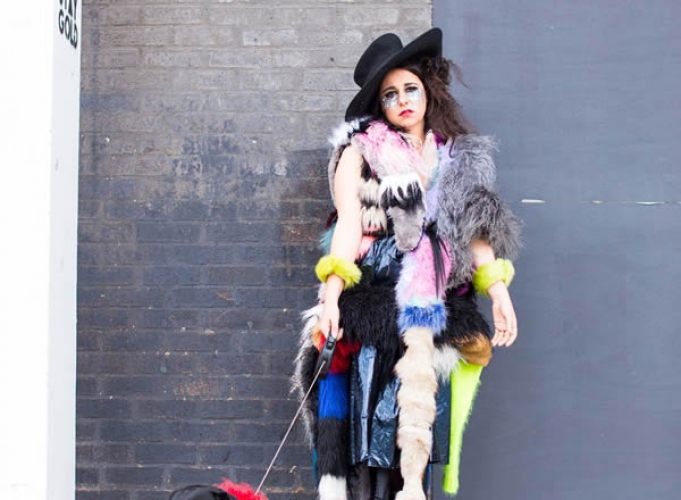
my-beautiful-black-dog_681x500My Beautiful Black Dog at Udderbelly Cowgate is a rock musical/gig/spoken word/live art show created and performed by southeast Londoner Brigitte Aphrodite. It celebrates her depression, or as she calls it in attempt to accept it as part of who she is, Creshendorious. There is glitter and sequins everywhere, emphasizing her party girl highs and contrasting her lows. Aphrodite is honest, frank and a highly skilled wordsmith in her songs and spoken text. Her songs manage to be both dry and celebratory; they create a party-like atmosphere that has the audience dancing and laughing along. It is rough and ready, and intimate, like a secret basement gig by your favourite band. The projected images and song titles added an element of set, but weren’t particularly needed and sometimes hard to see on the theatre’s brick back wall. On stage with her is Quiet Boy, who provides backing vocals, guitar accompaniment and a character who tries to coax her out of the road case she sometimes hides in, but it is very much Aphrodite’s show.

The party vibe abruptly drops when Aphrodite reads a (glittery) letter that explains exactly how she feels when she is fighting her black dog. Her honesty is brutal, but necessary. My Beautiful Black Dog takes a (sequined) tyre iron to the stigma and silence surrounding mental health issues. In these moments, the shine is a shallow sticking plaster, trite and useless. Rather than ending on a somber note, she ends on a song – not a happy ending, but a hopeful one. Aphrodite knows her depression will return, but next time may it be with understanding and acceptance from those around her. This production is difficult to experience, particularly if mental health issues affect you. It forces open a dialogue about mental health issues and even though it a (sparkly) genre mash-up, it is a vital show that could be scaled up to a big show, complete with lights, confetti and the sparkle it deserves.

Blind_Mans_Song,_Edinburgh_Fringe_2015,_courtesy_Francois_Verbeek_1_751x500Blind Man’s Song in Pleasance Dome is Theatre Re’s non-verbal dance theatre offering this year. As blind man Alex Judd plays keyboard and electric violin, a masked Guillaume Pigé and Selma Roth personify the images and emotions in his head. There is love, violence, travel, and a host of other encounters between the characters. There are moments of narrative, but this piece is very much open to individual interpretation. A simple, black set paired with smoke, side lighting and timeless costumes evokes the silent film era or a painting coming to life. The soaring emotion in the blind man’s music could imply that these are his memories or dreams. The mood and music varied enough throughout to maintain audience attention, and the performers’ skills in dance and mime were evident. It’s a captivating watch, if a little long. Sadly, some of the audience members were less appreciative. An older couple noisily left part way through and an American voice a few rows back at one point proclaimed, “This is stupid.” Abhorrent behaviour.

The music is richly augmented by a recorded track, but deliberately repetitive and grating at times. I found my mind wandering occasionally, but this was due to a moment triggering my own imagination. The young boy sitting in front of me had some lovely responses to the piece that drew my eye away from the stage: at times he conducted the music, at others he swayed mirroring the performers on stage, or wiggling abstractly in a dance of his own. Blind Man’s Song certainly triggers strong reactions from its audience though strangely, not all positive. It is a meditative, evocative performance if an individual permits it to be, but perhaps a challenging offering to our short attention spans.


The Play’s The Thing UK is an independent theatre criticism website maintained voluntarily. Whilst donations are never expected, they are hugely appreciated and will enable more time to be spent reviewing theatre productions of all sizes. Click here to make a donation with PalPal.

Jekyll & Hyde, Platform Theatre

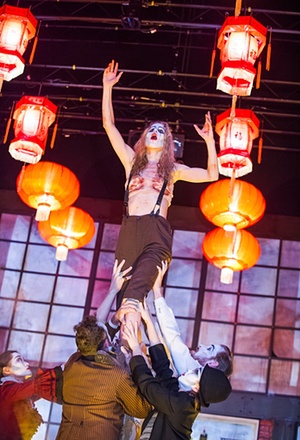
4404a479-e69a-4d92-9600-3d8eb075ff6c-1390x2040Giant red paper lanterns float over a smoky Victorian London alleyway. Six actors in western clothes and eastern whiteface also marry East and West in what initially promises to be a vibrant, transnational reimagining of R. L. Stevenson’s gothic novel Jekyll & Hyde. With the addition of a female Jekyll and a textual deconstruction that incorporates a range of performance styles, there is a lot to process in Jonathan Holloway’s script and staging. Whilst each individual choice has merit, none are fully explored due to the overwhelming array of influences Holloway employs. The sum total creates a muddy hodge-podge of ideas rather less substantial than a focus on the development of one or two of them.

The show begins away from Stevenson’s story, with an older man in Chinese dress (who is not Chinese) sharing the discovery of a wonderful but horrific tale he wants to sell to a young woman in1920s dress, presumably a publisher. To pique her interest, he begins to tell the story contained in the tome’s pages. This unnamed pair reappear regularly as the story is acted out to the audience, using narration to preempt the action and distance the audience by reminding them it is indeed a story. This is one of several Brechtian devices employed; even though it is a useful one in plays addressing social issues, it is unclear what element of the story the alienation is meant to highlight and any contemporary social relevance.

The story that plays out from the old man’s book is the more traditional Victorian story of Dr. Jekyll and Mr. Hyde, but Jekyll is a woman from Eastern Europe and the only woman doctor in the UK. It’s initially a great feminist touch, but the sex-crazed, manipulative Jekyll is hardly an empowering, feminist character. Having escaped war in her home country, she comes to London alone and uses her research to transform into a man. Though well-played by the physically expressive Olivia Winteringham, the character lacks depth and wears a costume that looks like it was put together in Camden Market rather than a costume workshop.

The set and lighting by Neil Irish are fantastic, though. Coordinated to create a horror film effect during particularly disturbing moments, they sumptuously support Holloway’s staging. Jon Nicholls’ sound design is atmospheric and sinister, well integrated with the other production elements. The costumes are somewhat inconsistent, with the men’s outfits appearing more historically accurate than the women’s. It is unsurprising that no costume designer credited.

The performances vary, with one of Chinese actors occasionally struggling to connect to the meaning in the language, creating unintended comedy. As this is a production incorporating two cultures, why shy away from using two languages? Other than a brief bit of either Cantonese or Mandarin at the start, the rest is in English. The story is well known enough to support a mix of languages, though with the melodrama, physical theatre, expressionism and naturalism already present, this would add further excess. As is, this adaptation feels predominantly English, with some East Asian design influence and a couple of Chinese performers. Though gorgeous to look at, the production never quite found the substance behind the façade.


The Play’s The Thing UK is an independent theatre criticism website maintained voluntarily. Whilst donations are never expected, they are hugely appreciated and will enable more time to be spent reviewing theatre productions of all sizes. Click here to make a donation with PalPal.

The Four Fridas, Woolwich Barracks

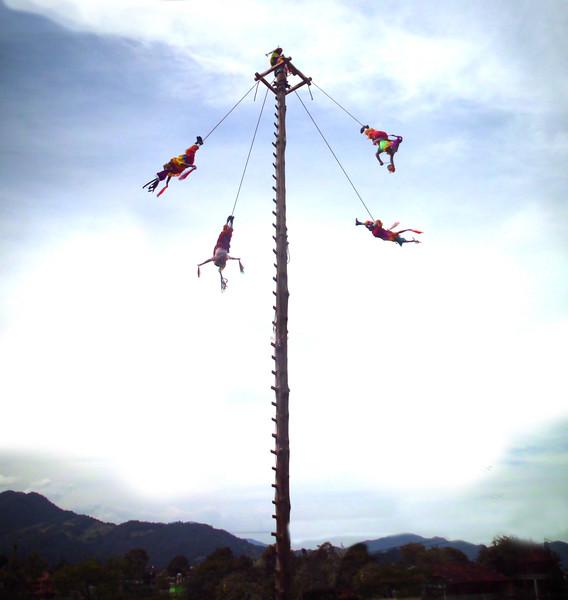
Voladoras_1396b-LWhen she was little, Frida Kahlo yearned to be able to fly. Her parents’ gift of a dress with wings proved disappointing though her dreams of flight remained, particularly following a crippling bus accident that left her with chronic pain and unable to have children. Bedridden for months during her recovery, she channeled her despair and rage into painting. These paintings, along with the ones she made over the rest of her short life, are the inspiration for Bradley Hemmings’ stunning outdoor multimedia event at Greenwich & Docklands International Festival this year. Using pyrotechnics, dance, projections, aerialists, music and the Mexican fertility ritual of the Voladores, The Four Fridas is a visually arresting spectacle but the show that is meant to be a tribute to Kahlo does not provide any particularly unique insight into her life and work.

Divided into for sections that reflect the elements earth, air, water and fire, The Four Fridas chronicles Kahlo’s life. Whilst there were clear acts to the script that took place in different areas of the site, the association with the elements was loose at best. The most sculptural set piece, a bus and tram crash built from metal and crates, was only used briefly towards the beginning. The script itself was fantastical and poetic, but densely written and delivered at a quick, even pace. The language was second rate to the visuals, though what with how impressive they were it would be nigh on impossible to surpass them with any other production element. It was easy to ignore the language in favour of visual performance surrounding the audience allowed to freely wander the performance site.

There were two highlights of the 45-minute long production. The first was an extended projection and aerialist hybrid against a giant screen held up by a crane. The projections were animations based on Kahlo’s work, with the performers against the screen adding texture and further detail. The most exquisite sequence was a flying butterfly, with a performer as the body of the insect. Each aerialist was controlled by a less obvious human counterbalance who scrambled up and down the vertical rigging on the side of the screen. This added an element of puppetry to the performance mediums used. These sections reflected freedom Kahlo felt when painting and her anguish of being trapped in a body that had previously been healthy and unscarred, but made no specific comments on her life.

The second most notable feature was the ancient ritual of the Voladores. Using nothing but rope to ensure their safety, four people climbed a wooden pole without harness, only to fall backwards suspended by their feet. The top section of the pole gently spirals, lowering them to the ground. Whilst this is a Mexican fertility ritual, the vague connections to Kahlo are her inability to bear children and that it also hails from Mexico. Surely it is an affront to an infertile woman to end a performance about her life with hope for children? Nevertheless, it is a remarkable cultural phenomenon to witness.

The free access to an event with such high technical requirements is highly commendable, though the tech is at the mercy of the outdoors. On the last night, part of a scaffolding tower collapsed and had to be removed (fortunately no one was hurt). On a previous night, winds meant that the screen was unable to be used. Whilst this adds to the immediacy of live performance, it also means the performance is shortened. Whilst it was free to stand in the site and watch, bleacher seats came at a price. Those that paid may have felt short changed by the abbreviated length.

Hemmings had set the bar high for this kind of accessible public performance though his work on the Paralympic Games Opening Ceremony and stylistically, work like this should be produced often, up and down the country. It is a shame that the spectacle did not particularly support the woman it is meant to honour. Even with basic knowledge of Kahlo and her work; the opportunity was there to communicate a deeper understanding but that was never reached. Though this kind of theatre is still new and infrequently produced, it should aim to develop more nuance and meaning. I look forward to more artists creating large-scale public performances incorporating a rich combination of performance practice and technology. This is the sort of art that has the potential to capture public affection and encourage them to more fully marry art with day-to-day life.


The Play’s The Thing UK is an independent theatre criticism website maintained voluntarily. Whilst donations are never expected, they are hugely appreciated and will enable more time to be spent reviewing theatre productions of all sizes. Click here to make a donation with PalPal.

So It Goes, Greenwich Theatre

SOITGOES_CMYK_1

Hannah used to love running with her dad. When she was 17, her dad died and Hannah kept on running, silently and alone. She refused to speak about his death with anyone, including her family. So she decided rather than to navigate the burden of speech, she would create a silent play that tells her dad’s story and her process of dealing with his death. So It Goes is a sweet two-hander that manages to avoid over-sentimentality by focusing on the honest, deeply individual story of navigating life after the death of a parent.

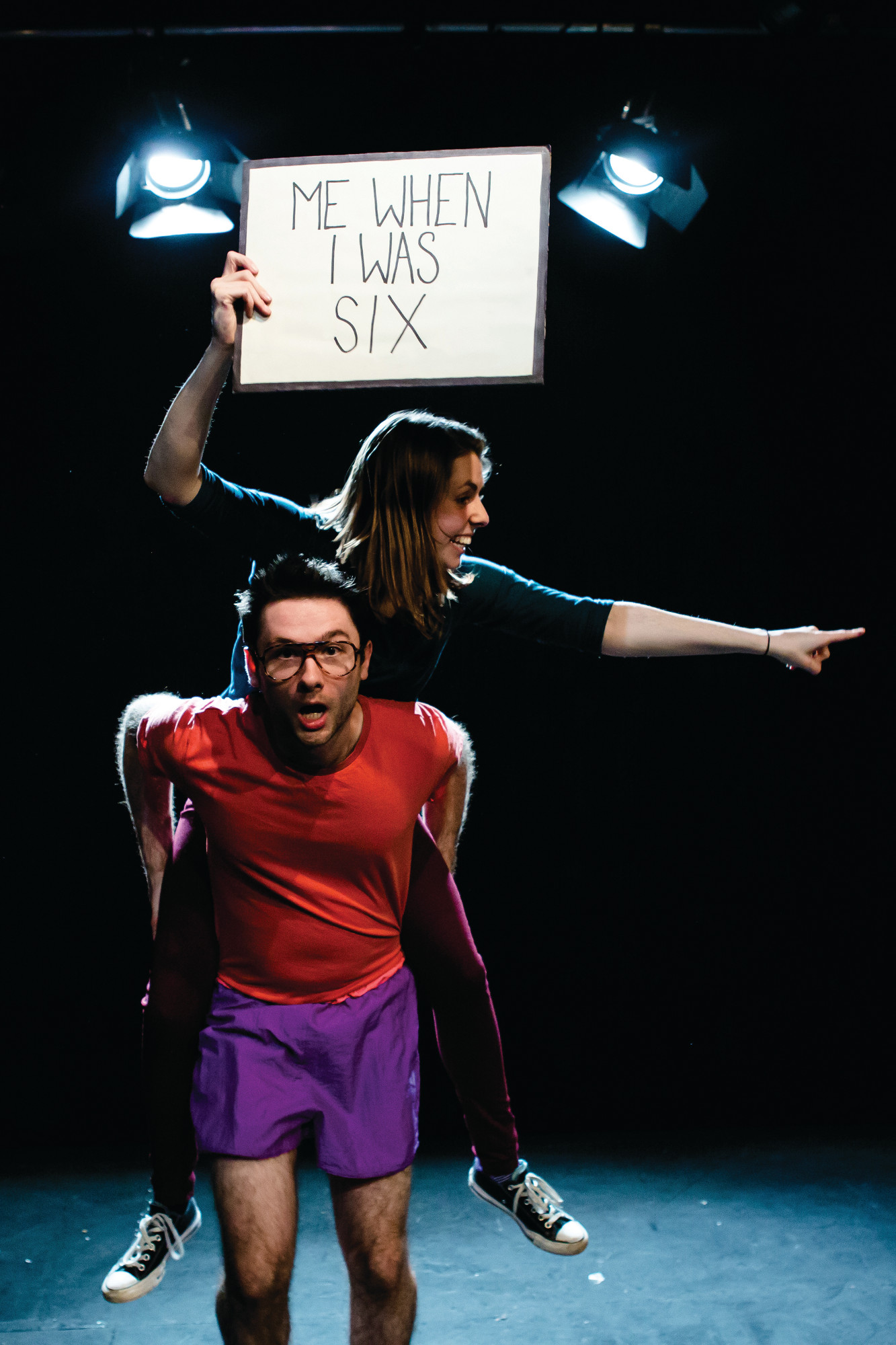
Other than the last line, there is absolutely no speech in this play. All text is written on small whiteboards worn around the actors’ necks or on pre-made signs. This keeps written communication basic; it is rather like watching a comic book or graphic novel being written. This could occasionally feel slow and it was often easy to predict what was coming next on the whiteboard within a scene, but not overly so and not often. The set and props are also simple, with signage and symbolic items representing other characters and jumps in time and place. Most props are drawn outlines of objects, adding humour and a sense of youthful play to the story. The physical performance style matches- it is exaggerated but simplified, physical theatre but not ornate, embellished or for the sole purpose of showing the actors’ physical prowess. So It Goes wants to tell Hannah’s story as clearly and simply as possible, focusing on truthfulness and emotional honesty. The look of the play would certainly appeal to children, but accessing adults’ inner child makes the experience of losing a parent a journey that ends with positive reflection rather than the bitterness of loss.

The performances are equally lovely. Hannah Moss plays herself, and has “help” telling the story from David Ralfe, who plays her Dad and Mum. Ralfe in drag has an initial hit of comedy, but he taps into Mum’s outward expression of hopelessness that soon makes the audience forget that it’s a bloke in a dress. The two actors embody an exaggeration familiar to children’s theatre that is also in keeping with the cartoon aesthetic of the production, but is not crude. If they did not employ the exaggeration or humour in their physical comedy, it would make audiences want to slit their wrists. Instead, there was a lot of sniffling and nose blowing mixed in with laughter.

This is the third play I have seen about death in recent weeks. Each production used a dramatically different approach to convey the same message. Hannah spelled it out for us by writing that her dad “didn’t just die, he lived.” There’s an overabundance of factors in the world that can easily depress us and forget to look for the little moments of daily joy in our own lives, but So It Goes provides a celebratory reminder to do so through a pared down, visual-textual hybrid of physical theatre. Though the tour has now finished of their debut production, On the Run Theatre is certainly a company to watch.

Intention: ☆ ☆ ☆ ☆ ☆

Outcome: ☆ ☆ ☆

Star Rating: ☆ ☆ ☆ ☆


The Play’s The Thing UK is an independent theatre criticism website maintained voluntarily. Whilst donations are never expected, they are hugely appreciated and will enable more time to be spent reviewing theatre productions of all sizes. Click here to make a donation with PalPal.

Domestic Labour, everything theatre

“…the performance was much more theatre than dance. It addressed a range of themes and ideas drawing on the experiences of the Iranian-British male author: feminism, domestic responsibility/burden, motherhood, revolution, sex, bicycles and headscarves…

“…The dark stage was peppered with old-fashioned hoovers and appliances each lit with a small spotlight. It was a striking visual. As the performance started, three women interacted with these props in a range of ways, from cradling them like a baby to holding them like guns. They showed both affection and aggression, much like the emotional life of a vintage housewife. This sequence showed subtle influence by contemporary dance…

“The performance was incredibly visual, though not without some technical hitches. The lighting design seemed well intentioned, but did not always suit the staging. For example, one moment had the performers’ faces in darkness whilst the rest of them was lit. In another, a light box was not big enough to light all three…These problems were countered by stunning moments, such as creating a stationary bicycle using a small heater, a hoover full of dust and a bike…

“The show was non-linear, passing back and forth through time. An Iranian man marries an English woman in the present day, but Iranian women are emancipated in 1936. Several characters experience a revolution and discuss the withdrawal method of birth control. These women, though indistinct characters, still provoked audience empathy…

Read the entire review on everything theatre here.

Shooting With Light, Greenwich Theatre

1930s Paris. Jewish Europeans are moving west to escape the rise of Nazism. Two of them meet: one of them is a Hungarian photographer, the other is a German activist. Both are full of youthful confidence and fearless in pursuit of their goals. Emerging company Idle Motion uses physical theatre, light, sound to tell the story of these young lovers, their legacy and the importance of photography.

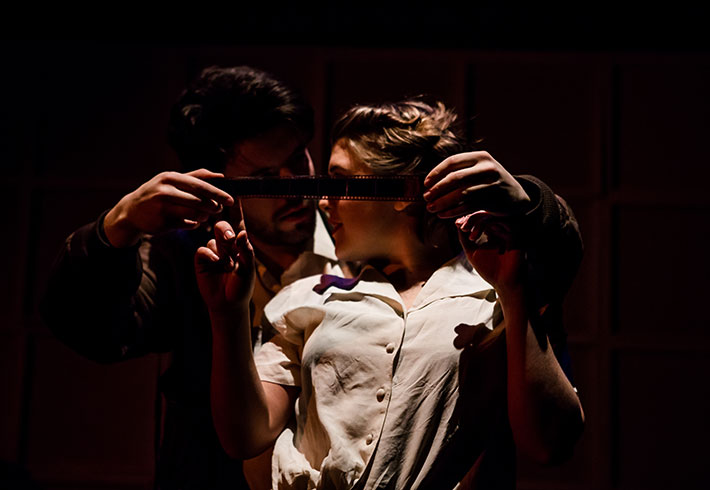
Firstly, Shooting With Light is a loveShooting-With-Light_018 story. Two young people meet, fall in love and take the world by storm before ending in tragedy. These young people are Gerda Taro and partner Robert Capa (after they changed their names), pioneering photojournalists of the Spanish Civil War. Gerda and Robert start working together; Gerda is initially his assistant who supports him in reinventing his persona in order to make the professional contacts he needs to succeed. Her talent overcomes this role however, and she eventually develops an independent reputation for honest, brave documentation. Partly fictionalized but based on Gerta’s brief life, we see Robert teach her to use a camera followed by her passionate rise to renowned photojournalist needing to show the world the reality of life on the front lines. Alternating with this storyline is the time-jumping subplot of Robert’s brother Cornell and his assistant June, seeking to amalgamate Robert’s work after his death. They are frantically searching for a mysterious red suitcase Robert once spoke of in order to complete the archive of Robert’s work.

Interspersing the scenes of historical naturalism are transitions using visual and physical theatre, similar in style to Frantic Assembly. This is an on-trend performance aesthetic, but one that is visually appealing and provides another level of insight into the characters and their struggles. The most effective of these sequences show Taro and Capa falling in love over rolls of negatives towards the beginning, and Taro’s fight to access the front lines with her camera towards the end. The set is simple in appearance as several blocks and a white screen, but they transform using projections, light and a series of doors. Like their narrative, the structure is simple but highly effective and tells an excellent story. Projections of Taro’s work add further historical context and support the world of the play – the audience sees what she sees and experiences.

The company of five twenty-somethings work wonderfully together, and so they should as they met in secondary school. Shooting With Light captures the infectious enthusiasm and ambition of youth, no doubt mirroring their own attitudes that the world is theirs to have and success is a given if they work hard enough. It will be interesting to see how their work develops as they age and experience the challenges and hardships of working in the arts. As visually appealing as their work in now, it needs more depth of human experience. June and Cornell’s quest to locate Capa’s missing work is arguably the more interesting side of the story, but neglected in favour of Taro’s and Capa’s exciting lives and career progression. The ensemble also lacks diversity of age and ethnicity, something that I hope they increase in the future. Idle Motion have an obvious gift for storytelling and integrating various performance styles at this young age, so the world really could be their oyster as they continue to grow.

Intention: ☆ ☆ ☆ ☆

Outcome: ☆ ☆ ☆

Star Rating: ☆ ☆ ☆ 1/2


The Play’s The Thing UK is an independent theatre criticism website maintained voluntarily. Whilst donations are never expected, they are hugely appreciated and will enable more time to be spent reviewing theatre productions of all sizes. Click here to make a donation with PalPal.

Don Q, Greenwich Theatre

Production shot 4 croppedI really struggled to come up with a suitably erudite introduction to this review of Flintlock Theatre’s Don Q. Not because it’s hard to summarize – quite the opposite. The structure works, the message and plot are clear and the performances are excellent in this suitable-for-all-ages appropriation of Cervantes’ Don Quixote. I am chalking my difficulties up to this being such an enchanting and moving play that words aren’t quite capturing that “warm and fuzzy but actually quite sad” feeling I had the entire time. Everything I tried to write came across as cold and clinical. It’s a rare occasion that I go to theatre and nearly forget to take notes because what I am seeing on stage grips me by the proverbials that as a woman, I don’t even have. Seeing Don Q evoked the joy and wonderment I had on my first experience of theatre as a small child.

It’s not a simple show, though. Four actors take on numerous levels of characterization. Like Shakespeare’s A Midsummer Night’s Dream, a group of unrelated characters bookend the play. In this case hapless librarians, frustrated by the council’s efforts to close them down, highlight the importance of storytelling by relating the tale of Norman Vaughan to us. Norman, as we soon find out, is probably their most infamous patron. Norman’s nameless nephew thinks Norman, now 81 years old, has gone mad. You see, Norman loves to read and reenact the stories he reads with his younger friend Sam and anyone else he cajoles into joining him. It is immediately and painfully clear that Norman is completely lucid; he just has a joyful passion for stories and acting them out. The younger generation are so busy being adults that they have forgotten the pleasure of playacting and the power of an absorbing tale. So not only are the audience reminded of the importance of reading and allowing ourselves to be absorbed in a good book, we are also more subtly admonished for not taking the time to listen to our elders and treat them like human beings. So what if Norman (or any other elderly person) loves what he does? As long as no one gets hurt, we are told to leave well enough alone.

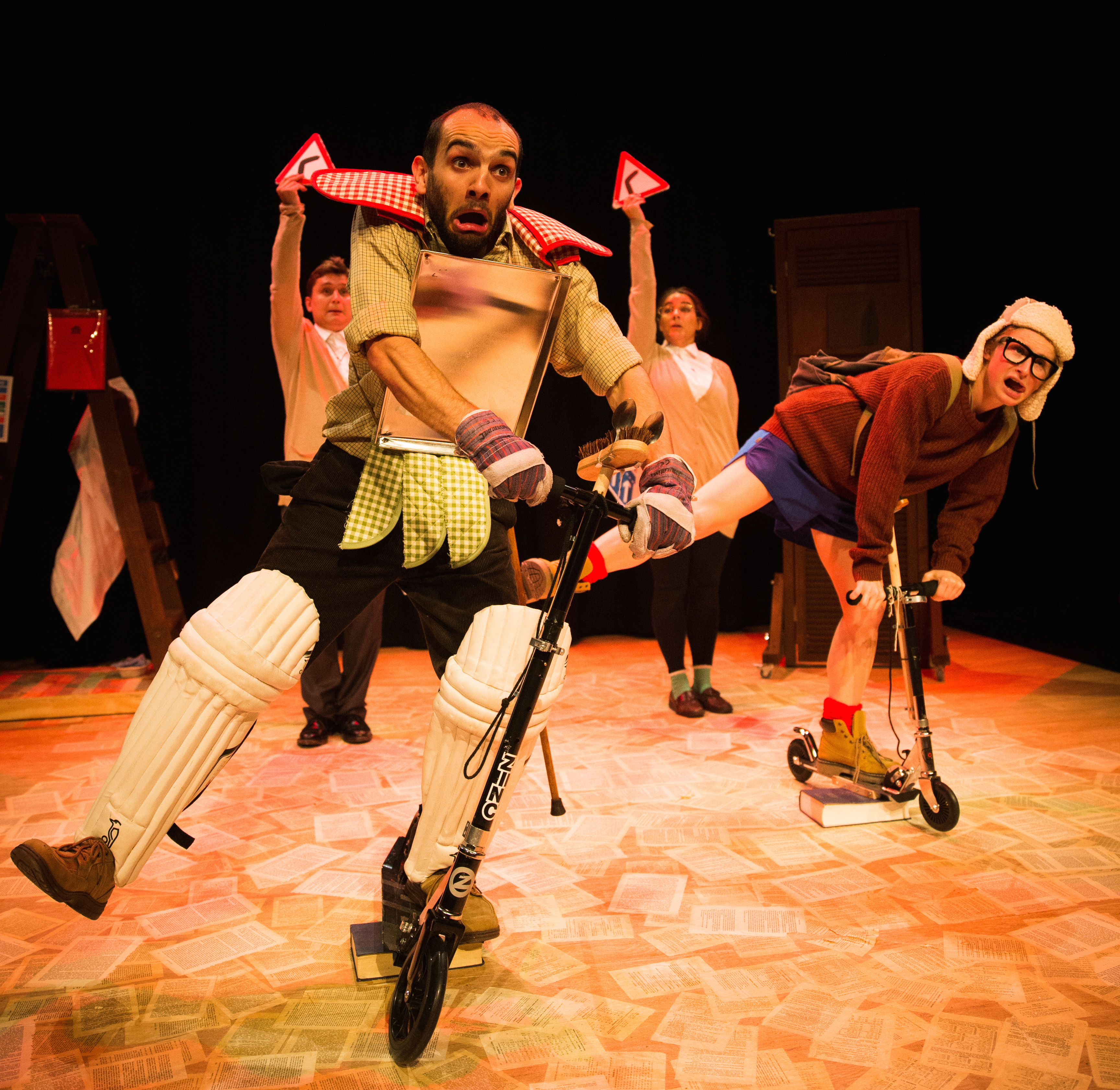
Norman’s nephew, having had enough of Norman’s mishaps and convinced he has gone mad, puts him in a nursing home to be looked after properly. He strictly forbids Norman from having access to any books. Sam, on one of his visits, smuggles in a copy of Don Quixote into the nursing home. A comedy chase results in their escape and an adventure imitating a selection of escapades from the original novel. Sam is a begrudging Sancho Panza, a pair of scooters augmented with push brooms and spoons are their trusty steeds and other people they encounter on the way play other characters (some more willingly than others). Their madcap journey is full of whimsy, spontaneity and emotional turmoil but with a potentially tearful ending for the more sentimental of audience members.

Director Robin Colyer skillfully employs physical theatre sequences to add variation and an atmosphere of a touring troupe of players. This is clearly a well-rehearsed, established production; not a breath was out of time. Objects and costume pieces are used liberally and often comically, in a style reminding me of the West End’s 39 Steps. The set and costumes are simple and rustic, but versatile and thought through. Nothing is excessive, nor sparse; the production design is just right.

The performances unite a fantastic script with heaps of audience interaction, and the great design to create a beautifully polished little show. Some call and response would have made more people feel included, as well as giving costume and lines to those in all parts of the auditorium rather than only those sat in the front row. Actors Jeremy Barlow, Francesca Binefa, Kate Colebrook and Samuel Davies are versatile multi-rollers with outstanding chemistry as an ensemble. Whilst I considered that having an older man play the role of Norman would have brought more to the story, the role is incredibly physically demanding and would be difficult to play at a more advanced age.

Don Q is only at Greenwich Theatre for a brief time, but then continues its national tour. This Oxford-based company is worth seeing no matter what your age, where you are or what you do. They use physical theatre, Brecht, storytelling and meta theatre but in an unobtrusive, charming way to create this lovely, warm, gem of a play.

Intention: ☆☆☆☆☆

Outcome: ☆☆☆☆

Star Rating: ☆☆☆☆ 1/2


The Play’s The Thing UK is an independent theatre criticism website maintained voluntarily. Whilst donations are never expected, they are hugely appreciated and will enable more time to be spent reviewing theatre productions of all sizes. Click here to make a donation with PalPal.

Missing, Battersea Arts Centre

Lily is an ordinary newlywed with a good job, but something isn’t right. She’s reserved, doesn’t join it at parties or nights out and goes through life disconnected, as if it were a treadmill. With the aid of a mysterious doctor-type figure, Lily relives past memories and important life events. A collage of dance, movement, light and sound, Missing bombards audiences with one character’s family history and rediscovery of her repressed self.

The predominant element of this production is movement. Some sequences have a strong dance influence, others are more abstract, capturing relationship dynamics between two people. Still others are violently fitful as Lily wrestles with parts of herself she would rather forget. Coloured backlighting creates faceless, silhouetted dancers who form the world around Lily. Her movements, in contrast, are usually restrained or awkward, including the duet with her new husband in their marital home as they navigate space with the newfound addition of the other. Memories of her mother, a sensual nightclub dancer, further emphasize how uncomfortable Lily is in her own skin. A particularly striking scene shows Lily at work with her glowing laptop, coffee cup and other daily items that just won’t sit still as she tries to work. They tentatively settle, then fly around the room, always just out of reach. In Lily’s life, everything moves confidently around her and she struggles to keep up. The audience empathizes because like Lily, we all experience moments in life where we feel disconnected from everything around us, as if we live in a grotesque dream world.

Lily decides to see some sort of doctor, a psychologist, perhaps. In a more literal interpretation of the counseling process, he removes a glowing light from her, placing it in a cardboard box. On a further visit, the doctor creates a storyboard of images from Lily’s past and presents them to her without judgement. These events provoke extended memory sequences from Lily’s childhood, with toddler Lily as a bunraku-style puppet. All of her memories take place in glowing frames, with performers behind. The effect created is one is one of large-scale Polaroid photographs that move across the stage. The lighting skillfully conceals the performers holding the frames and the space around them so the frames and their contents appear to float in the darkness. It is a powerful nostalgic effect, akin to watching fragments of one’s own retro ghosts on 1980s VHS home movies.

Two treadmills add a flowing quality to the set and choreography; the performers quickly slide them about to rearrange the stage space and direction of movement through space. Lily is at times caught up in this flow and cannot get off, other times she observes the pace of those around her whilst she herself is not travelling. This is one of the most unique features of the production and one that thoroughly enhances the visual and metaphorical production elements.

Sound is constant or near enough so, either cheerful and musical or a high, droning tone. Dialogue is not an important feature; often the sound drowns out the speakers so that the audience can hear speech but not discern what is being said. Several languages are used: German, Spanish, English and others. None of them is predominant, but the language is not the focus of this piece and it is easy to discern what is happening from the movement. The speech often adds another layer to the soundscape, enhancing the universality of Lily’s inner turmoil.

Missing is a feast of the senses and I struggle to find fault with any visual aspect of the production, though I would have liked to get to know the characters in more detail. The episodic, dreamlike structure leaves the story open to interpretation and to personally connect with several themes and issues presented.

I went with the year 10 GCSE Drama students at the school where I teach part time. Most of the students go to the theatre regularly but none of them had seen anything like Gecko’s Missing before. Each of them had their own interpretation of the production, further proof that Gecko’s work speaks to each of us on a deeply personal level.


The Play’s The Thing UK is an independent theatre criticism website maintained voluntarily. Whilst donations are never expected, they are hugely appreciated and will enable more time to be spent reviewing theatre productions of all sizes. Click here to make a donation with PalPal.

Light, for everything theatre

“…At the start of the show, an announcement warns us that the ushers will be watching us at all times should we have any trouble with flashing lights. This announcement, whilst concerned with health and safety on the surface, suitably forecasts the world of the play where the government monitors the thoughts of every citizen.

…Light is inspired by Edward Snowden’s revelations of government spying. It gives us a world where technology is king and the government supposedly keeps us safe from terrorism. The story follows Agent Dearden in a world where speech is redundant, as every human being has an implant that allows him or her to transmit thoughts directly to the receiver’s brain…

“Whilst the story itself is typical example dystopian Big Brother fare, it balances a wider worldview with an intimate portrayal of one family. What makes this production truly compelling and unlike anything I have ever seen is its use of light and sound…The actors use precise and detailed movements to indicate character, and location, often appearing to manipulate the beams of light…Surtitles, rather than speech, contribute to the lighting element and add character and plot information, though this is used only when absolutely necessary.

“This production is part of the London International Mime Festival for a short time and then goes on tour nationwide. To experience innovative theatre that takes the art form to new heights, see this show.”

Intention: ☆☆☆☆☆

Outcome: ☆☆☆☆☆

Star Rating: ☆☆☆☆☆

Read the entire review on everything theatre: http://everything-theatre.co.uk/2015/01/light-the-pit-at-the-barbican-review.html