Perfect Lovers, Theatro Technis

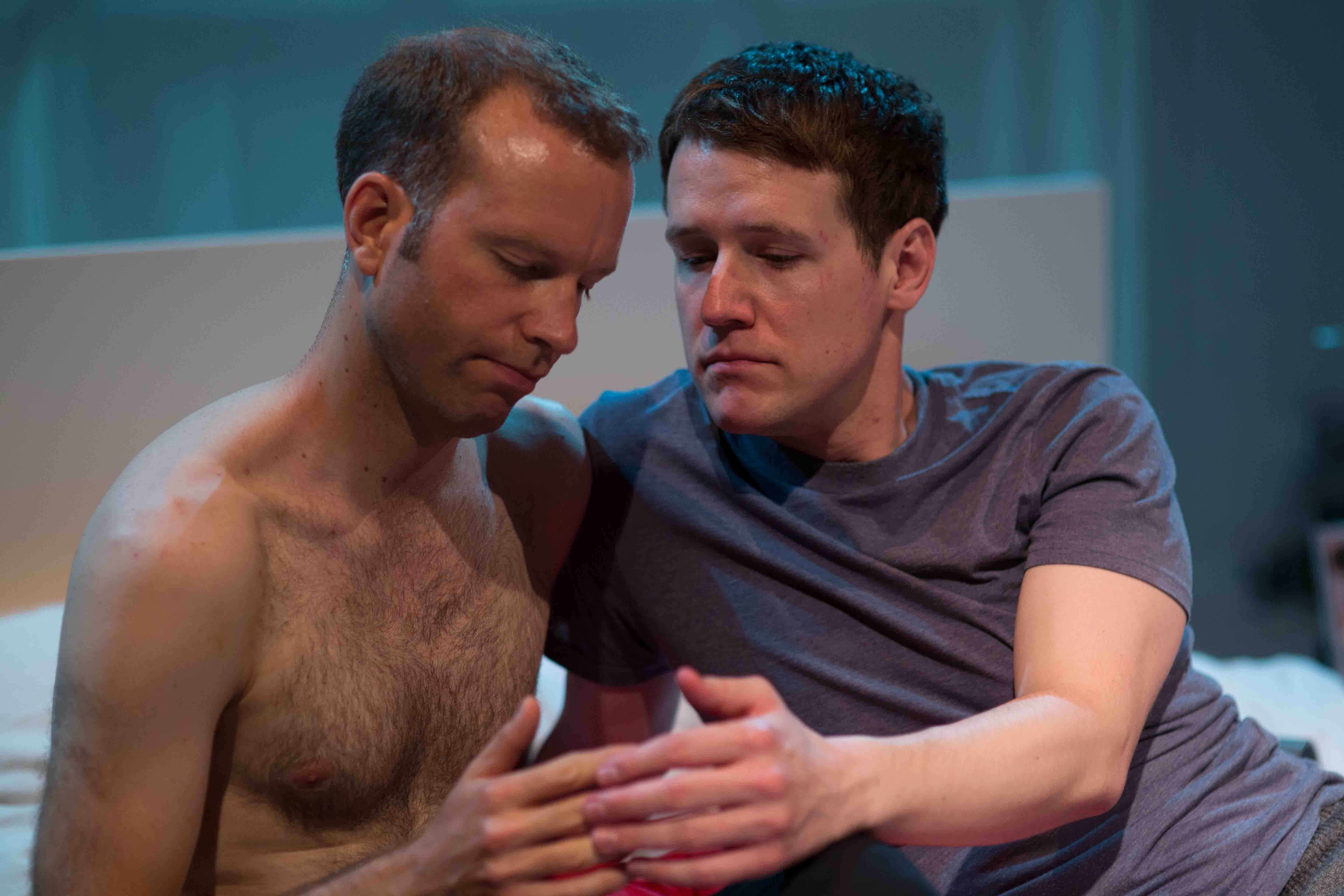
Four men, two clocks and all po_N2A6465ssible relationship dynamics meet within different moments, in one bed. Scenes bounce back and forth across time supported by symbolic projections and lighting, each one intimately presenting a different couple combination. Individuals meet and connect for a brief moment in time, then inevitably move on. La Montanya’s Perfect Lovers is a new play that explores the ups, downs and transience of gay relationships, proving they are no different than straight ones. We all seek that perfect relationship even though no such thing exists.

This is the second play by Jazz Martinez-Gamboa. It episodically documents the dysfunctional but well-intentioned connections of four characters at different points in their lives. There was some detailed writing with good instinct for both comedy and pathos. After the first couple of scenes the rhythm settled into a consistency that needed more variation, but the director and actors could solve this easily through delivery. The script is a one act, but its current structure lends itself to easy expansion. It would need more of a plot arc to add variation of pace, and the characters are robust enough to withstand closer examination of their lives.

The performances are generally good, though energy and pace dipped at points. There were too many pauses, though it isn’t clear whether this is due to the script or the direction. Actors Chris Hoskins, Oliver Hewett, Joe Leather and Craig Deucher are a tight ensemble with seemingly natural chemistry. They contrast each other without playing to any particular gay stereotypes; instead they focused on individual loneliness and their characters’ need for meaningful connection.

The design is excellent. Richard Hillier’s lighting design blends seamlessly with Alex Wells’ projections. Two adjacent, synchronised clocks racing through time are a motif influenced by artist Felix Gonzalez Torres, emphasising our own transience as well as the temporary nature of our bonds with others. Characters cling to digital photo albums of their past lovers, friends and families as they continue to search for that perfect man who will change their lives forever. The set is a never-changing bed. An adjacent nightstand becomes more and more cluttered with the characters’ detritus ranging from tea lights ,to cups of tea, to lines of cocaine. The amount of action the room sees results in a set resembling Tracy Emin’s My Bed.

Even though this production can be categorised as LGBT theatre, that is far from its end message, merely a vehicle of communication. These characters could have been straight couples; in fact, it has strong parallels with Patrick Marber’s Closer though without a linear narrative. We are all people: broken, malfunctioning people, who reach for meaning in one another. It rarely works. But that’s what makes us gloriously human, which Martinez-Gamboa presents to audiences as if he stands before us and holds up a mirror.


The Play’s The Thing UK is an independent theatre criticism website maintained voluntarily. Whilst donations are never expected, they are hugely appreciated and will enable more time to be spent reviewing theatre productions of all sizes. Click here to make a donation with PalPal.

Chef, Soho Theatre

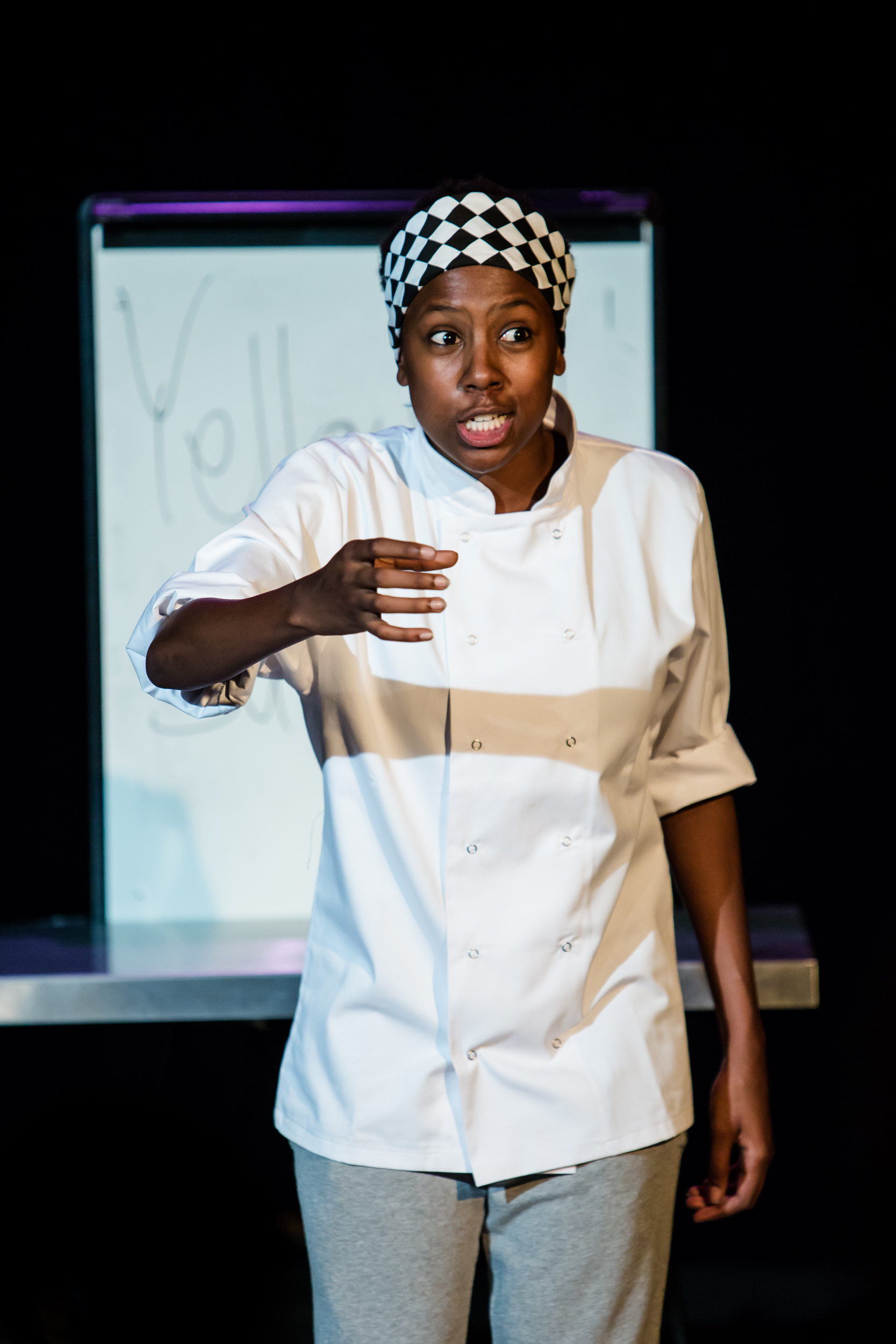
Chef, Ed Fringe 2014, courtesy Richard Davenport 035“Incredible innit, Food.”

Sabrina Mahfouz’s Chef is a one-woman play in the kitchen of a women’s prison. It’s no Orange is the New Black, though. Jade Anouka’s nameless chef shares her passion for food, recipes and stories of broken families and prison life. Anouka’s captivating, nuanced performance and Mahfouz’s poetic, imagery-filled verse holds the audience’s attention for nearly an hour without faltering.

Anouka’s performance is the primary pillar that supports this production’s success. With an innate musicality and unwavering energy, she balances the character’s true love for her work with the traumatic tales of an abusive father, a shady boyfriend and an incident that happened in her prison kitchen yesterday. Her interpretation both honours and personalises Mahfouz’s character, bringing an infectious optimism to a character that has endured so much hardship. Though this play probably works best in intimate theatres like Soho’s upstairs space, it is a great shame to deny larger numbers of people from seeing her performance.

Mahfouz’s writing is the next pillar that makes this story into a great play. Her use of poetry flips back and forth with street slang and swears, a continual reminder that not all inmates have limited vocabulary or intelligence but still keeps her believable. She gives us a truly human character with all flaws and perfections laid bare. She creates devastating empathy for this unnamed young woman doing so well at rising from the ashes of her childhood by becoming a fine dining head chef, only to be locked away for a crime she swears she didn’t commit. (Though all convicts swear their innocence, don’t they?)

Mahfouz and Anouka have worked together previously, on Chef and another play. These two clearly make a fantastic team, but both are excellent, established artists in their own right. Mahfouz is certainly a playwright to watch out for, and Anouka is a performer not to be missed.

Despite the stellar performance and writing, the scene transitions occasionally felt abrupt. Line delivery and technical transitions could have slowed down slightly, though that may have caused energy levels to drop. Another uncertainty is who the audience is in relation to chef. She is in her kitchen alone. They are not questioning her about her suspected involvement in yesterday’s incident, nor do they seem to be fellow inmates. Anouka addresses directly, so they don’t seem to be in her imagination, either. Her story keeps audience focus nonetheless.

As brilliant as Orange is the New Black is, the vibrancy and depth in Mahfouz and Anouka’s chef makes the show feel shallow and stereotyped. Even though it works excellently as a stand-alone short play, this is a character that should be seen again. This is not a production to skip over, despite its diminutive size and the fact it’s a one-woman show.


The Play’s The Thing UK is an independent theatre criticism website maintained voluntarily. Whilst donations are never expected, they are hugely appreciated and will enable more time to be spent reviewing theatre productions of all sizes. Click here to make a donation with PalPal.

So It Goes, Greenwich Theatre

SOITGOES_CMYK_1

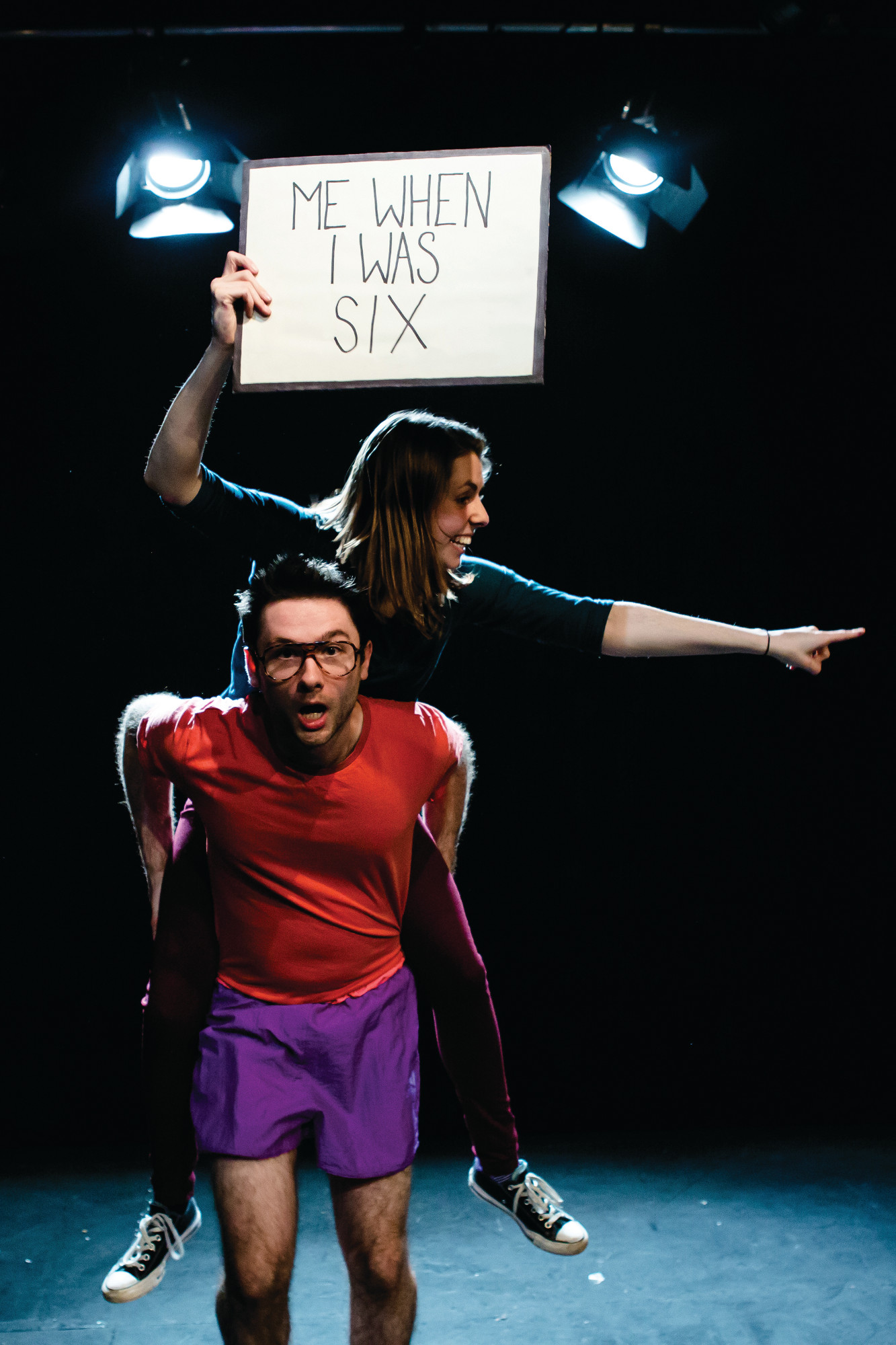
Hannah used to love running with her dad. When she was 17, her dad died and Hannah kept on running, silently and alone. She refused to speak about his death with anyone, including her family. So she decided rather than to navigate the burden of speech, she would create a silent play that tells her dad’s story and her process of dealing with his death. So It Goes is a sweet two-hander that manages to avoid over-sentimentality by focusing on the honest, deeply individual story of navigating life after the death of a parent.

Other than the last line, there is absolutely no speech in this play. All text is written on small whiteboards worn around the actors’ necks or on pre-made signs. This keeps written communication basic; it is rather like watching a comic book or graphic novel being written. This could occasionally feel slow and it was often easy to predict what was coming next on the whiteboard within a scene, but not overly so and not often. The set and props are also simple, with signage and symbolic items representing other characters and jumps in time and place. Most props are drawn outlines of objects, adding humour and a sense of youthful play to the story. The physical performance style matches- it is exaggerated but simplified, physical theatre but not ornate, embellished or for the sole purpose of showing the actors’ physical prowess. So It Goes wants to tell Hannah’s story as clearly and simply as possible, focusing on truthfulness and emotional honesty. The look of the play would certainly appeal to children, but accessing adults’ inner child makes the experience of losing a parent a journey that ends with positive reflection rather than the bitterness of loss.

The performances are equally lovely. Hannah Moss plays herself, and has “help” telling the story from David Ralfe, who plays her Dad and Mum. Ralfe in drag has an initial hit of comedy, but he taps into Mum’s outward expression of hopelessness that soon makes the audience forget that it’s a bloke in a dress. The two actors embody an exaggeration familiar to children’s theatre that is also in keeping with the cartoon aesthetic of the production, but is not crude. If they did not employ the exaggeration or humour in their physical comedy, it would make audiences want to slit their wrists. Instead, there was a lot of sniffling and nose blowing mixed in with laughter.

This is the third play I have seen about death in recent weeks. Each production used a dramatically different approach to convey the same message. Hannah spelled it out for us by writing that her dad “didn’t just die, he lived.” There’s an overabundance of factors in the world that can easily depress us and forget to look for the little moments of daily joy in our own lives, but So It Goes provides a celebratory reminder to do so through a pared down, visual-textual hybrid of physical theatre. Though the tour has now finished of their debut production, On the Run Theatre is certainly a company to watch.

Intention: ☆ ☆ ☆ ☆ ☆

Outcome: ☆ ☆ ☆

Star Rating: ☆ ☆ ☆ ☆


The Play’s The Thing UK is an independent theatre criticism website maintained voluntarily. Whilst donations are never expected, they are hugely appreciated and will enable more time to be spent reviewing theatre productions of all sizes. Click here to make a donation with PalPal.

No Take Backs, everything theatre

“What do you do when you’ve lost your dad, your girlfriend dumps you and a stranger breaks into your new flat, handcuffing you to the radiator? Engage in a battle of wits for your freedom of course!

“…Emily (Lucy Litchfield) is handcuffed to a radiator whilst the Lara Croft-esque Megan (Rachel Eireann) lords over her…The pace is almost akin to Beckett, and there are a few moments when I wonder if the action is going to progress…

“During their conversation it emerges that both of these young women carry lots of issues and baggage. The dialogue is mostly rapid fire and both characters are highly intelligent, if emotionally damaged. Power shifts again when Emily’s brother (Daniel Farley) enters the scene and recognises Megan after she beats him up. Things spiral out of control, and after the boss (Sylvie England) has cleaned up the mess the truth behind the whole hostage situation is made amusingly clear…

“The writing is tight, though playwright Michael Eckett could have easily shaved fifteen minutes from the beginning to make it even more pacy. He has a great sense of comic timing and a great understanding of sound dramatic structure, even if the twist at the end felt slightly formulaic…No Take Backs is a strong one-act offering for this years’ Camden Fringe Festival, and shows that not all good theatre relocates to Edinburgh for the summer!”

Read the entire review on everything theatre here.

Respawn, Hackney Attic

logosrespawnI really want to like Stars or Mars latest sci-fi offering, Respawn. Not because I like science fiction – quite the opposite. I really don’t enjoy the genre in any form, be it films, books or television. There isn’t much sci-fi theatre out there, though. The only sci-fi production I can ever recall seeing is Theatre Ad Infinitum’s Light. Light has the distinction of being my first five-star review, and it had nothing to do with the genre. I want to continue bucking my own trend by liking science fiction theatre (if you can call loving one show “bucking a trend”), but it can’t happen with Respawn.

The primary issue with this play is the script, a combination of Pinteresque vagueness and Beckettian lack of action set in a technology-ridden future. I’m sure playwright Susan Gray has an idea in her head of what she wants to communicate to the audience, but it struggles to transfer from page to stage. Her script is set in a world where people become artificial intelligences (AIs) when they die, but no clear message came through the muddled story. Characters were not named, instead referred to with pronouns. This added to the confusion. The programme states that two actors played multiple characters, but not all of the characters were clearly distinguished. Gray herself is credited with playing three roles, but two were so similar they seemed to be the same person. Melanie Crossey had a much clearer performance, playing an AI as a voiceover that lives in a hotel and interacts with living people, and the AI “in person”. Another structural issue lies in this occurrence: if the AIs don’t have bodies, why are we seeing them wearing Phantom of the Opera masks and performed as otherwise completely naturalistic characters? Even if the storyline were to be a clear-cut narrative, there is no overriding theme other than the idea that the AIs want to be human again, but can’t be. It is an interesting idea, but one that can serve as a starting point rather than the crux of an entire play.

Crossey’s performance is a saving grace of this production. With a confident but relaxed stage presence, she holds this convoluted one-act together. She is obviously a skilled performer that deserves the challenge of meaty, contemporary characters. A sound designer is credited, but no director, lighting director or script advisor. These creative roles would be a wise addition to the company’s upcoming Camden Fringe productions.

The Hackney Attic is an unconventional venue, more of a cabaret or comedy venue that a theatre. At the top of a cinema, it is a long, white room with tables rather than rows of seats and a staffed bar in the room. The stage lights are either on or off, the dressing rooms can be seen through a curtain, and a paint job is needed in order to achieve blackout. The space needs some alterations to become suitable for a wider range of performance styles, but the location is great. There was also no signage warning audiences of the strobe light effect that occurred several times in the play.

Furthering the sci-fi theatre genre is certainly a noble pursuit, as it is a genre sorely neglected. LA has Sci-Fest, but London is only this year bringing a celebration of the genre to the fringe at Chelsea Theatre in October. There is huge potential to reach a brand new audience base who spend their weekends at comicons and cosplay events rather than at the theatre. I admire Gray’s aim of developing science fiction theatre, but first she needs to continue refining her own craft.


The Play’s The Thing UK is an independent theatre criticism website maintained voluntarily. Whilst donations are never expected, they are hugely appreciated and will enable more time to be spent reviewing theatre productions of all sizes. Click here to make a donation with PalPal.

Super Premium Soft Double Vanilla Rich (LIFT Festival), everything theatre

“One of the first things that struck me about Arts Depot’s main theatre is how comfortable the seats are…It may seem trivial, but after seeing numerous productions in hot pub theatres on benches with straight backs…comfort does become important. The set was austere: two screen printed flats placed at a right angle showing the shelves of a modern convenience store and a small screen above for the projected surtitles…

“We quickly meet the two main characters. These young men work at the convenience store…Whilst there is no traditional narrative structure, we see snapshots of shop life…The absurdity of this corporate environment is obvious and makes me shudder to think how easy it is to be sucked in as a young person seeking purpose…

“This same absurdity comes through in the customers, we see one young woman who, upon discovering her favourite ice cream has been discontinued, has a meltdown…It is an existence of small tragedies, self-importance and the need to cling onto any kind of meaning in a cold, corporate world.

“Whilst the dialogue in the play tends to realism, the movement is abstract, expressionist and constant. It is mostly light and flowing; resembling tai chi…it loses meaning quickly and can be distracting…

“…It is a good piece of physical theatre and an excellent ambassador for the LIFT Festival.”

Read the entire review on everything theatre here.

Mugs Arrows, everything theatre

“…Visually striking yet incredibly simple, it immediately creates tension that carries on through the entire play and keeps the audience watching. The lights then come up on two men tensely playing a game of darts without speaking…As dialogue slowly starts, we gather that the two have just been to the funeral of a dear friend…Both Rhys King (Pat) and Eddie Elks (Ed) are clearly excellent performers who can skilfully use naturalism to create highly developed characters.

“What you perceive to be true is turned upside down when Sarah (Chiara Wilde) enters in a wedding dress and joins in darts game. Rather than a funeral, Pat and Ed have lost their best mate another way…With an inevitable violent end and convincing stage combat by Lyndall Grant, I thought the play had ended.

“But, no! Writer Eddie Elks surprises us. A final, joyfully weird scene takes everything you perceive to be real within the action and turns it upside down. You will leave with a head full of questions, but truly innovative theatre will have that effect...Whilst an incredible show for theatre folk, those who like their theatre conventional and commercial would struggle to watch this play…

“Go see this show before it closes if cutting edge independent theatre is your thing.”

Read the entire review here on everything theatre.

The Verb, To Love and Portia Coughlan, Old Red Lion

Love, loss and obsession: Aria Entertainment’s double bill explores these themes with dramatically different outcomes. New British musical The Verb, To Love follows college lecturer Simon’s attempts to find a lasting relationship after breaking up with his boyfriend of 23 years. Mid-90’s Irish play Portia Coughlan shows the title role’s failure to function in day-to-day life whilst clinging to memories of her twin brother who drowned 15 years previously. Both productions, which can be seen singly or one after the other, depict emotion in its most raw, desperate state with committed performances and unique design elements.

The Verb, To LThe Verb, 'To Love', Old Red Lion Theatre, 29 April - 23 May 2015. Copyright Claire Bilyard -16ove by Andy Collyer is a two-hander but focuses almost exclusively on Simon (Martin Neely). He falls in love with fellow teacher, the wide-eyed, much younger Ben (Gareth Bretherton) after a breakup. Simon sings us the story of their friendship progressing to a reluctant confession of love, but there is no happily ever after. Several years later after building a successful career, Ben decides its time to move on even though doting Simon would do anything for his “baby boy”. Simon’s songs then journey through the stages of grief and forays in online dating until he finds peace with his houseplants.

Though billed as a musical there is little spoken dialogue. The contemporary musical theatre songs continuously flow into each other with few breaks and Ben doesn’t enter until he breaks up with Simon halfway through the show. Until their breakup, we hear their story exclusively from Simon’s perspective. Ben doesn’t interject often after he arrives, making this almost a one-man show. Even though it was only an hour, it’s a long time for Neely to sing almost continuously, which he does splendidly.

This is clearly a musical under development, but it has plenty of potential. Simon’s character is detailed and well developed; Neely adds plenty of nuance. The songs have enough variation to not sound too similar, but with a strong motif. It would not take much to make this a full-length show: more scenes, more Ben, and possibly some other characters – though The Last 5 Years proves a two-hander works beautifully, particularly when telling the rise and fall of a relationship. More substance will also help dilute the sentimentality, though it was never cloying. Focusing the bulk of the story on Ben and Simon’s relationship gave the show a sturdy narrative arc rather than showing a snapshot from Simon’s life. There was no dancing, lighting changes corresponded with emotional intensity and the flowery parkland set reminded the audience that there is light at the end of every tough time. I look forward to seeing The Verb, To Love develop and hope Aria Entertainment stages it again in a more fully formed state.

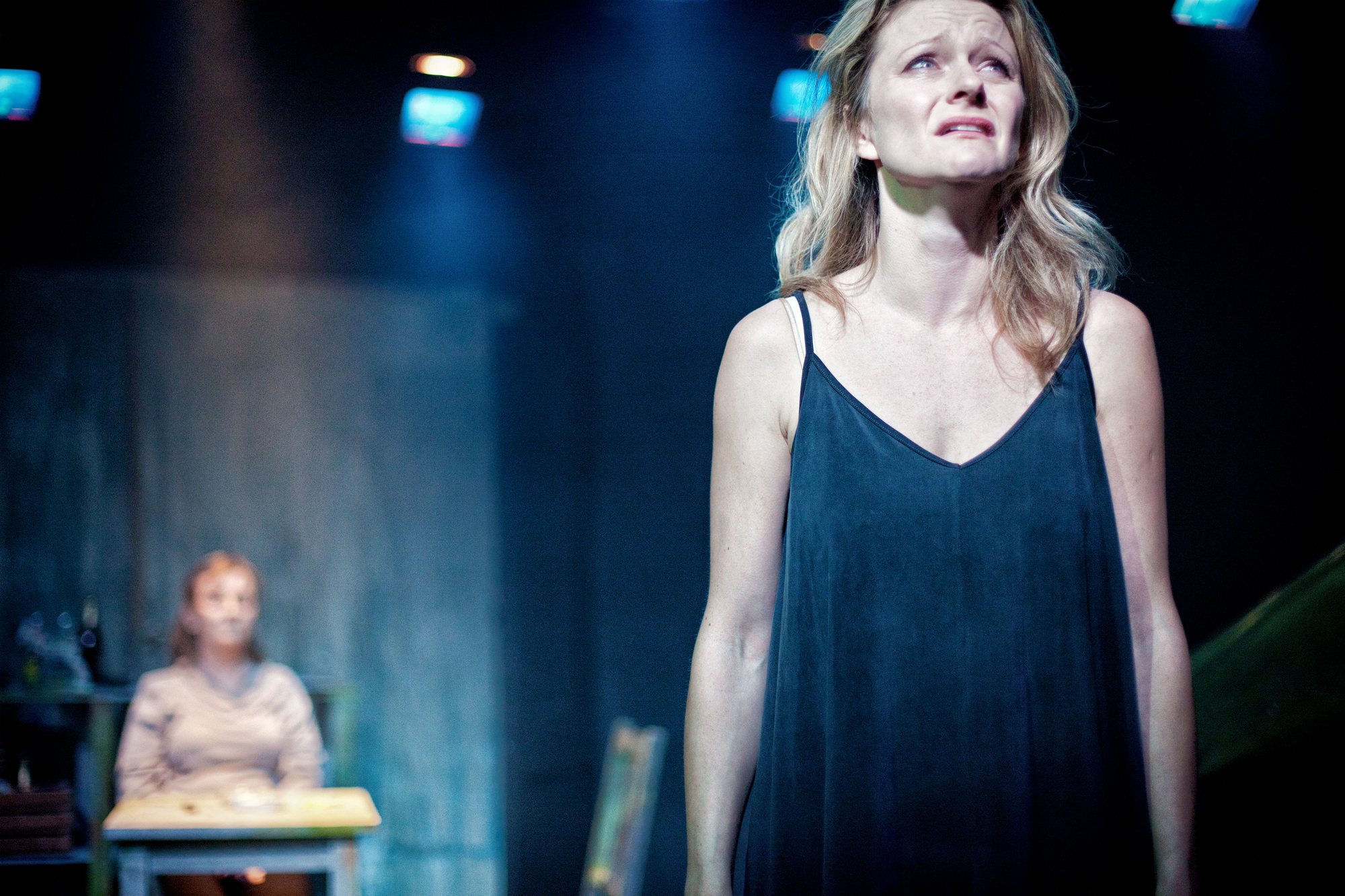
Marina Carr’s Portia Coughlan is mPortia Coughlan, Old Red Lion Theatre, 28 April - 23 May 2015. Copyright Claire Bilyard -42uch darker and more complete fare. Set in rural Ireland, Portia celebrates her thirtieth birthday. Fifteen years ago tomorrow, her twin brother drowned in the Belmont River that runs behind her father’s farm. She never recovered from his death, despite having a life that reads perfectly on paper: a wealthy husband, close family and three sons. Susan Stanley plays tortured Portia with a coiled spring intensity that never relents, even when drinking and flirting in the local pub. The verdant, grassy floor from The Verb, to Love remains, but a pool of water is Belmont River and a rustic kitchen set is her country home. The lighting is darker and ethereal music draws attention to the appearances of Portia’s ghostly brother, Gabriel.
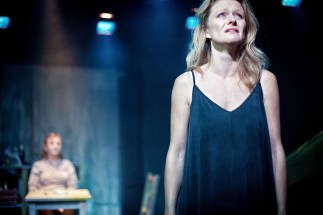
Similarly broken people with hidden family secrets inhabit Portia’s world. Her parents pop in uninvited and berate her for not fulfilling her wifely duties. Her paternal grandmother abuses her and her mother relentlessly. Her best friend Stacia helps Portia with the kids, but only has one eye and needs of her own. Her patient husband Raphael (Ben Mulhern) does his best to look after their children when Portia says she wants nothing to do with them, as she’s afraid she’ll harm them. She never wanted to be a mother. She never wanted to marry Raphael. She doesn’t really want anything to do with this world at all, instead dwells on her brother’s death. She tries to distract herself with love affairs, to no avail. The day after her birthday has a predicable outcome halfway through the play, but then the action jumps back in time for more horrific familial revelations.

A cast of eleven creates Portia’s intimate, oppressive world of family, lovers and friends. Most have good intention in their hearts, but none of their efforts can save Portia from her deteriorating mental stability and Grabriel’s increasingly frequent, haunting presence. The dialogue is frank, but taps into an innate Irish poetry and spirit world of Celtic mythology. Though these characters simultaneously evoke pity and disdain, there is a grounded earthiness about them and their connections to each other. The ensemble work is excellent, particularly from those playing Portia’s family, though the other roles are certainly to be commended. Veronica Quilligan and James Holmes as older family friends, the Doorley’s, provide some comic relief and comfort amongst the abuse. Portia’s lovers Damus Halion (Alan Devally) and Fintan Goolan (Conan Sweeny) both barely conceal pent up rage and disdain for Portia. Even though she does not help herself, Portia is framed as a tragic hero, the victim of circumstances beyond her control. Carr’s writing is outstanding captures the often stark isolation of village life. Director Bronagh Lagan successfully captures the tone and mood of the play as it barrels towards its inevitable end. This is a production that would benefit from a larger venue and more space to create an even more atmospherically complex set.

Though radically different in tone, these two productions show desperate characters on the brink of collapse. Simon has a much more supportive, comfortable life and manages to pull himself back from edge after some facebook stalking and late night phone calls to Ben. Portia’s brother eventually catches up with her, but no one in her village is functional enough to save her. We could all to easily find ourselves in similar circumstances, but I hope we tend more towards Simon than Portia. The pairing of these two pieces shows great insight and intuition in producer Katy Lipson of Aria Entertainment. An accomplished young producer who focuses on British musicals, she made a wise choice to pair The Verb, To Love with Portia Coughlan.


The Play’s The Thing UK is an independent theatre criticism website maintained voluntarily. Whilst donations are never expected, they are hugely appreciated and will enable more time to be spent reviewing theatre productions of all sizes. Click here to make a donation with PalPal.

 

Eclipsed, Gate Theatre

Issues surrounding modern war and conflict are rarely simple. Feminism certainly isn’t, either. Neither are families, romantic relationships, child soldiers, or individual identity. Danai Gurira’s Eclipsed rolls all of these deeply complex themes into a five-character play set in the Liberian civil war, but does so with brilliant writing and a raw, close-up view of characters in a world torn apart.

Eclipsed focuses almost completely on the lives of the four “wives” of the Commanding Officer of one of the rebel factions, living communally and enjoying a life of privilege. Their privilege consists of not being raped by other soldiers, instead only having to go to the C.O. when he summons them from offstage with booming handclaps. The women enjoy looted clothing, and mostly get along. Though all have names, they refer to each other by their rank: number 1, number 2, and so on, with number 1 being in charge. Number 2’s the outcast of the four as a soldier fighting Charles Taylor’s government, but she still periodically returns to the hut bearing gifts and aggravation. Though they all have lost family and hide their real names, these women feel incredibly privileged because they’re alive, and don’t have to be raped by anyone other than the C.O.

The dialogue flows easily, but was deeply uncomfortable to experience from the position of Western privilege. Moments of levity are stepping stones that prevent the audience from drowning in the bleak circumstances that drive the play. I find this level of audience discomfort is rare in theatre, but one that is absolutely vital. Actually, theatre needs more of it – the majority of regular theatregoers are middle class and have no experience of life in a war zone other than watching the news. These audiences need to be shaken, hard, and reminded that whilst we have lots of nice things in our lives, many more people in the world don’t. Particularly women trying to survive in war zones.

This is, without question, a feminist play. My initial instinct is to say it’s radically feminist, but on reflection I believe that thought came from the exotic “otherness” of the production rather than any particular issue. Childbirth, education and reproductive consent are at the forefront, which are pretty mainstream feminist topics. Sisterhood is ever present, with its bonding and conflict. Less common and utterly horrific is Number 2’s belief that being an armed soldier empowers young women and keeps them safe from rape. The downside is that you then have to kill the enemy and give the surviving women and girls to your side’s own soldiers. Sorry, there’s my privilege showing again.

This otherness also contributes to the excellence of the overall production; I have never seen a play so simultaneously brutal and brilliant. The production values are flawless in that the production needs no alteration or development. It’s raw, in-yer-face, and will linger with you and your privileged guilt for a long time. All five performances are a masterclass in acting. The design is strikingly simple with an inclusive audience arrangement. There are belly laughs. There are moments you feel like your guts are being slowly tugged from your body and your eyes are held open. With all the terror Eclipsed lays bare, it should be a legal requirement for everyone living a comfortable life away from war to see this play. The world would be a better place.

Intention: ☆☆☆☆☆

Outcome: ☆☆☆☆☆

Star Rating: ☆☆☆☆☆


The Play’s The Thing UK is an independent theatre criticism website maintained voluntarily. Whilst donations are never expected, they are hugely appreciated and will enable more time to be spent reviewing theatre productions of all sizes. Click here to make a donation with PalPal.

Significant Other; Object of Affection, Tristan Bates Theatre

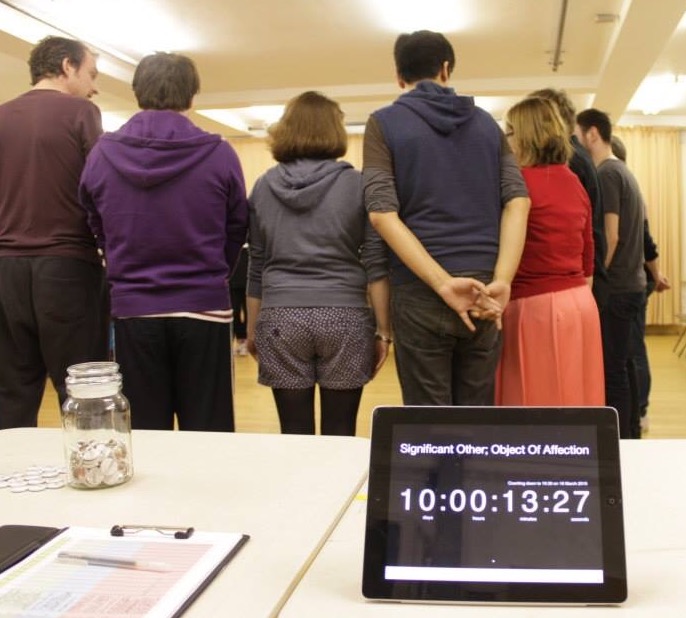
FullSizeRenderWhat do you get when you give ten playwrights, ten directors and twenty actors ten days to make some theatre? (This isn’t a Maths question.) You’ll have The Pensive Federation’s annual collection of ten, ten-minute plays, Significant Other. Inspired by modern relationships, The Pensive Federation celebrates the ups and downs of our human connections with this event. This year, each writer was given an object that had to be included in the scene and serves as the short plays’ titles. On the whole, they were funny, touching and well performed, especially considering the playwright had only five days to write the script and the director and actors had five days to rehearse them. One of the scenes was even a musical, with songs and choreography.

The relationships presented run the gamut from flatmates, sisters, straight couples, mates to co-workers. Whilst most of the plays dealt with romantic relationships, others confront familial complexities and troublesome colleagues. As it’s an issue commonly ignored in an industry that favours youth, Panties commands attention for being the sole play focusing on older characters. Here, a couple try to find the love and excitement in their relationship again now that their children are grown. All provided objects were completely random; some writers worked them into the plot more effectively than others did. My particular favourite was a life-sized cardboard cut-out of Harrison Ford, absurdly fought over by a couple who both fancied him.

As for the scripts, some are certainly stronger than others. None of them are poor and some had potential to be brilliant. Of note, Blu-Ray (by Anna Forsyth), Shirt (by Joseph Lidster and composed by Griffinn Candey), Ring (by Leah Cowan) and Life-size Cardboard Cut-out (by Breman Rajkumar) have the most potential and can certainly stand up to further development. Direction is simple but effective in all plays, with minimal set used and a focus on characters and their relationships. Of the performances, though all are consistent, Catherine Nix-Collins and Jeremy Donovan particularly shone as best friends and flatmates in Blu-Ray, with Jeremy’s character about to move in with his boyfriend and Catherine’s coming to terms with him leaving. Anthony Couzens in Cash evoked pity with his washed up underground ticket seller who fancies his much younger colleague.

Singling out one of the plays as a favourite, or “best,” is impossible. Stylistically, most are initially grounded in reality with subject matter that the audience can relate to, even if on a basic level. Rather than being complete plays, most were snapshots of a larger issue and well-rounded characters. This really is an event that appeals to everyone: gay, straight, young, old, people with children, people who work, people who have friends and people who have families. The default was comedy rather than drama, with some excellent execution of comic timing and sensibility. Performances could become quite heightened, but the emotions matched. Despite the comedic bent, there was plenty of poignancy across the board as well. Including a focus on an object draws attention to the attachment we have to material goods, particularly when we associate them with someone we love, or hate, or otherwise feel strongly about. The only play where this idea could be more fully realised is Oil Can (by Giles Fernando) but the tension created between two former schoolmates is commendable.

This is an enjoyable evening in The Actors’ Centre Tristan Bates Theatre. Plenty of comedy and writing that couldn’t be fresher help ease the predictability of the format in an evening that could do with being a couple of plays shorter. The Pensive Federation clearly have a great instinct for discovering and showcasing new talent and will should develop some these micro-plays further.

Intention: ☆☆

Outcome: ☆☆☆☆

Star Rating: ☆☆☆


The Play’s The Thing UK is an independent theatre criticism website maintained voluntarily. Whilst donations are never expected, they are hugely appreciated and will enable more time to be spent reviewing theatre productions of all sizes. Click here to make a donation with PalPal.