Declaration, Edinburgh Festival Fringe

rsz_cpgj-xixyaaoghq

Sarah wants to know everything. She’s inquisitive, gregarious and energetic, the life and soul of any party. But now that she’s in her thirties and wants to start a family, she needs to sort out some of her issues. So, she goes to a doctor to talk through all the behaviour quirks she’s had since childhood – the trouble sleeping, the irrational impulses, the disorganisation, the obsessions.

Diagnosis: ADHD.

Now that she knows what the problem is, does it really solve anything? Will a label help, or hinder? Will medication change the person that she’s always been and actually quite likes? Declaration is an honest, heartwarming solo performance that resonates with those of us who have always felt a bit different or care about people who are a bit weird or quirky. Written and performed by Sarah Emmott, with energy and charisma that’s undeniable, Declaration needs a few minor adjustments to make it an even slicker show.

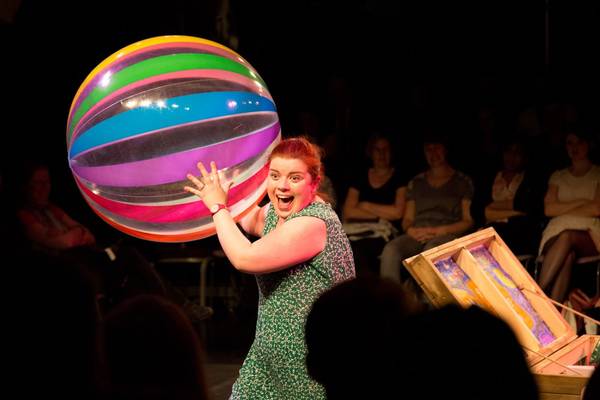
Emmott’s script has the consistent theme of wanting to please but pesky impulses to do all sorts of irrational things get in the way. As an adult, she has developed coping mechanisms (which she marvelously demonstrates with audience help), but as a child, she was a loose cannon. The story of her childhood picks up once she introduces the superhero personal she invented for herself and a doll, Samantha, who is everything that she never could be. The opening exposition, though having important information, lacks the punch and the belly laughs that these sections have. Additionally, some of her transitions need clarity; consistent use of sound, lighting or changing props would help indicate a scene change.

Emmott develops a marvellous rapport with the audience from the moment they enter the theatre. She has the sort of natural magnetism that cannot be taught in any drama school, an innate quality that actors either have or don’t. Laughing and chatting, her stated need to know everything and everyone is evident. The audience rallies to her wide-eyed wonder, and snarky comments about school, doctors and other frustrations get plenty of laughs.

As Sarah works out how to get through life and a diagnosis has the potential to either change everything or nothing, the audience is with her the entire way. She uses props and audience interaction effectively, though she could use tech to further enhance the theatrical experience. Her lovable on-stage persona is a charming reminder that anyone we know may be struggling with mental health, learning or behaviour issues, and even though a few tweaks could be made to improve the show, she dares us to accept her, flaws and all.

Declaration was a one-off performance.

The Play’s the Thing UK is committed to covering fringe and progressive theatre in London and beyond. It is run entirely voluntarily and needs regular support to ensure its survival. For more information and to help The Play’s the Thing UK provide coverage of the theatre that needs reviews the most, visit its patreon.
bare., Courtyard Theatre

rsz_clbw12owyaau3v8

Three young women, three short solo performance pieces, three stories of vulnerability make bare., a thematically linked evening of new writing. Each of the three mini-plays has a distinct style and is performed by the writer. They vary in the quality of writing and inventiveness, and feel very new – more like scratch performances rather than finished pieces. bare. is a lovely concept – short, female solo performances that reveal hopes, fears, aspirations and conflict. It could easily become a regular event, giving women the chance to try out one-person work in front of an audience. As is, these pieces certainly need development but the three writer/performers show much promise and commendable initiative that, with development and experience, will certainly improve their work.

Kat Ronson is first, performing ‘IBZ’. This fragmented work follows a young woman’s journey from singledom into a loving relationship. The wild, drug fueled club nights transform into something more gentle and intimate, but her story does not end happily ever after. The young woman’s transformation is lovely, but the choppy writing makes for an unclear narrative and timeline. Ronson uses comedy punch lines and moments of reflective sincerity effectively, but this doesn’t balance out the vague writing. This piece would benefit from dramaturgical support and a hefty re-write, but the concept and central character are certainly workable.

American Steffanie Freedoff shows that yanks can handle their poetry and spoken word with ‘in the beginning there was Word’, a biographical monologue in verse about hating poetry as a teenager and growing to love it as an adult. This is also a coming-of-age story, but a much more positive one on self-discovery and confidence. It’s a bit cheesy and motivational, but the two stand-alone poems she ends on are angry, provocative and polished. The focus is on these pieces, which feel disconnected from the first part of the performance but add variation in style and tone. This second mini-play also needs development and shaping to find its overarching message, but it feels like it could be lengthened without becoming dull.

Madeleine Dunne brings a strong character piece to the trio with ‘Mind the Gap’, a piece that looks at the struggle of overcoming mental health issues. Lucy is a little girl terrified of breaking the rules and a young adult still limited by these fears. Told in two parts, Dunne’s gift for transformation is revealed in these two naturalistic monologues. It’s not clear who she is talking to and why in either section, but the character is a suitably interesting one. Lucy could also work well as the protagonist in a full play with multiple characters, perhaps even better with others to respond to rather than limited in a solo performance.

A quiet, sung finale wraps up the evening, a nice touch that adds some unity to these unrelated plays. bare. still feels like a scratch or showcase with a range in quality, but as a themed performance event, it is poignant and well curated. All three pieces need refining and/or expansion, though each shows at least some element of promise.

bare. runs through 16 July.

The Play’s the Thing UK is committed to covering fringe and progressive theatre in London and beyond. It is run entirely voluntarily and needs regular support to ensure its survival. For more information and to help The Play’s the Thing UK provide coverage of the theatre that needs reviews the most, visit its patreon.

This Room, Battersea Arts Centre

https://i0.wp.com/40.media.tumblr.com/0de2b8a4c234adfa06d227487f497f1a/tumblr_nkr4q4aw501r8bp0ao8_1280.jpg

Laura Dean has Obsessive Compulsive Disorder. She’s afraid she’s going to kill herself in her sleep so spends at least two hours before bed checking her house for anything she could use to self-harm. Scarves and tights are hidden away, as are knives and other sharp objects. She can’t sleep without her checking routine and after months of exhaustion, she’s had enough. An NHS diagnosis comes with a round of Cognitive Behaviour Therapy sessions that help her recover, but introduce several ideas that make Dean question the nature of her self. This Room is a gently communal experience where Dean provides insight into the recovery process. There are plenty of clinical reports, forms and questionnaires but Dean’s individuality is never drowned out by these or by the condition she fights.

The audience is in Dean’s bedroom with her as she works through the most commonly held thoughts by people suffering from OCD. She confesses that she wants to know what’s going on inside her head so she can understand what’s really wrong with her, something she still hasn’t quantified after the pages of documented appointments she reads at lightening speed. The clinical nature of her recitations is a lovely juxtaposition to the soft, confession-like anecdotes from her treatment, most notably the session where her therapist (with the perfect bottom) visits her at home to confront her fears, represented by a serpentine tangle of tights, head on. The whole piece is intimate, quiet and deeply personal.

Dean has a soft strength that’s immensely watchable, whether she’s sitting silently on the edge of the stage clutching her water bottle, or reading her medical notes into a stand mic. The audience immediately sides with her, and dutifully responds to her questions. The empathy is tangible, and a group hug would not be out of place after the curtain call.

This Room avoids sentimentality or an overabundance of awareness-raising. Instead, it’s a personal account of a treatment process and an individual response to it. Will Dean ever really be well? If so, does that mean she’s not really herself anymore? These are big questions that don’t have an immediate answer, but are examined in a wonderful format that is a privilege to witness.

This Room runs through 27 April.

The Play’s the Thing UK is committed to covering fringe and progressive theatre in London and beyond. It is run entirely voluntarily and needs regular support to ensure its survival. For more information and to help The Play’s the Thing UK provide coverage of the theatre that needs reviews the most, visit its patreon.

One Under, Vault Festival

rsz_img_6902[1]

Amy Fleming’s dad committed suicide when she was four years old. Fleming struggles with mood swings and wonders if she’s “mental,” like her dad. Luckily, she studied Molecular Medicine before becoming an actor so she understands how genetics dictates our characteristics. She also knows that talking about our problems and developing positive habits helps us overcome them. Combining her science and performance backgrounds, Fleming’s One Under is part conversational lecture, part interactive game. She relies on narration, humour and audience involvement to share her message, but the piece as a whole feels unfinished. It’s a nice idea, but it lacks theatricality and detail.

There’s no character, just Fleming and her generally cheerful honesty. She relaxes the audience straight away and easily facilitates discussion. After a frank introduction about her childhood and how genes are passed from parents to child; there’s some framing by her biography and a multi-round game/quiz with easily answerable mental health questions. These two elements aren’t solidly connected to each other, and the piece’s message isn’t spelled out until the very end. Structurally, it’s weak. By that point though, the message is less interesting that the journey we took to get there and the camaraderie that emerges en route.

This solo show isn’t very theatrical, but it’s lovely for its warm cuddliness and playful approach to form. Fleming is clearly passionate about helping people improve their quality of life and their mental health, which is a commendable mission. Her openness and her anti-performance make me feel uncomfortable writing any sort of negative judgement – it’s such a personal piece. But at an hour long, glossing over parts of her past with some audience debate over quiz questions about how to approach mental health issues at work, there’s a noticeable lack of depth.

The Play’s the Thing UK is committed to covering fringe and progressive theatre in London and beyond. It is run entirely voluntarily and needs regular support to ensure its survival. For more information and to help The Play’s the Thing UK provide coverage of the theatre that needs reviews the most, visit its patreon.

Give Me Your Love, Battersea Arts Centre

I’ve grown up always having pet cats and it’s absolutely true that cats love being in cardboard boxes. I stumbled on a Buzzfeed or similar article recently that says cats seek out boxes or other encloses spaces when they’re stressed or in need of comfort. Humans have similar instincts, really. Think about the last time you were upset or stressed: did you want to hide under a duvet, make a pillow fort or crawl into a small, dark space? Or at least curl up into as small of a ball as you could? Observations and life experience indicate we’re pretty similar to our felines in that way. So it would make sense that someone suffering from grief or trauma might hide in a box and never come out.

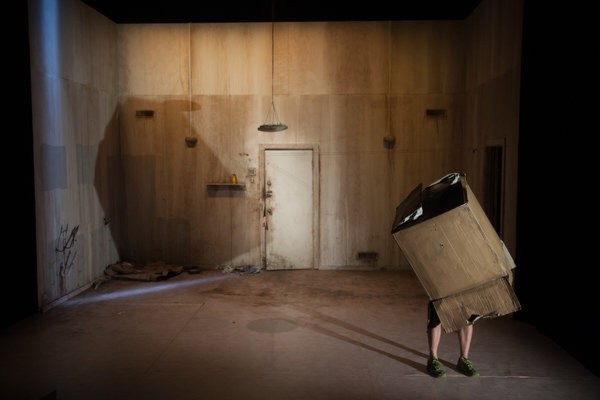
Zach (David Woods) does just that with feline stubbornness and rejection of direct human contact. An Iraq veteran suffering from Post-Traumatic Stress Disorder (PTSD) living with an unsympathetic wife (convincingly voiced offstage by Jon Haynes), we never see Zach’s face, or anyone else’s, in Give Me Your Love. This quiet, tiny show looks empty but brims with feeling in a sophisticated script, discusses cutting edge medical research without boring the audience and shares the horrors of PTSD that many of our vets are left to contend with, unsupported. A talking cardboard box and a patient drug dealer behind a chained door captivate for about an hour with flawless, sensitive performances and detailed dialogue that delicately balances humour and pathos.

Though it’s easy to focus on Woods as the central character, Haynes wonderfully supports and opposes him as wife Carol and friend/drug dealer Ieuan. Carol opposes Zach’s desire to explore MDMA’s potential to cure his PTSD, Ieuan, not unfamiliar with trauma himself, encourages Zach whilst displaying genuine, moving care for him. There’s a brotherly intimacy here that’s lovely to watch, and is perfectly captured by the pair of actors.

Jacob Williams’ set is super-realistic: there are no metaphors here, just the sparse filth that Zach lives in. The detail is in the tiniest things: the way masking tape curls at the edges, the holes in the box for Zach’s arms, the stains on the walls. The lack of people on stage calls for other means of  visual stimulation, and Williams’ work exceeds this tall order very well. Give Me Your Love is never boring, visually or otherwise.  Sound and light by March Cher-Gibard and Richard Vabre match the set’s naturalism, then toy with the audience’s perception of reality through abstract and expressionistic approaches. It’s a jarring transition, but manages to compliment Zach’s turmoil and experimental recovery instead of feeling stuck on and questions what is objective reality and what is in Zach’s head. 

The inclusion of using Ecstasy in PTSD therapy is fascinating research that doesn’t go too much in depth, but can feel extraneous to Zach’s struggle. It’s not about the recovery, but the day-to-day existence and paralysis that can result from action solders experience on the front line. The dialogue still flows, but the research informs the play rather than being the centre of it. This certainly isn’t a bad thing at all because the script could easily end up a lecture; the focus is very much on Zach’s mental and emotional health. The clever use of humour prevents it from becoming a drag, and exquisitely balances the brutality and debilitation of mental health conditions. This is a vital theatrical contribution to the mental health dialogue and de-stigmatisation, and one executed with delicate, detailed skill and a moving emotional journey. A fantastic watch.

The Play’s the Thing UK is committed to covering fringe and progressive theatre in London and beyond. It is run entirely voluntarily and needs regular support to ensure its survival. For more information and to help The Play’s the Thing UK provide coverage of the theatre that needs reviews the most, visit its patreon.

Auld Acquaintance, Bread & Roses Theatre

Imogen and Jake are a trendy, young couple with a new born daughter. It’s nearly Christmas and they are at their mother’s house with Jake’s brother Rob and his wife, Natasha. Everything should be perfect, but it’s far from it: Jake and Rob’s mum is dying in a hospice, Imogen has fallen out of love with Jake whilst struggling with post-natal depression, Rob and Imogen hate each other but Imogen and Natasha are old school friends with an intimate secret.

This one act play by Natalie Audley, newly re-worked for London after a 2014 run at Brighton Fringe, still needs some refining. There are some killer one-liners and painfully spot-on insight on fertility and relationships, but an abrupt ending and wordy lines that uncomfortably stumble from the actors’ mouths give the script a weight that goes against it comedic instincts. The pace varies, but feels slower than it ought to. Audley clearly leans towards poetry and language-driven plays, but some trimming here and there would go a long way.

Performances are mixed and take some time to find their rhythm. Charlie Lees-Massey is by far the best of the cast of four as Natasha. Her moment of surrender to Imogen (Emily Ambler) is sexy as hell, and she maintains a consistent energy and believability throughout. Ambler’s best moments are with Lees-Massey, as are Tom Everatt’s at Rob. Matthew Corbett as Jake seems awkward throughout, though this could be a character choice. Director Courtney Larkin deftly moves her actors around the tiny stage without it feeling crowded or blocking sight lines.

There’s still a clunkiness to the script but further expansion and chiselling will refine the dialogue and turn this into a polished piece of contemporary naturalism. The issues presented are crucial ones to examine on stage, especially as they are told from a female perspective and with a 50/50 gender split cast, but more development is crucial to give them the power they deserve.

The Play’s the Thing UK is committed to covering fringe and progressive theatre in London and beyond. It is run entirely voluntarily and needs regular support to ensure its survival. For more information and to help The Play’s the Thing UK provide coverage of the theatre that needs reviews the most, visit its patreon.