
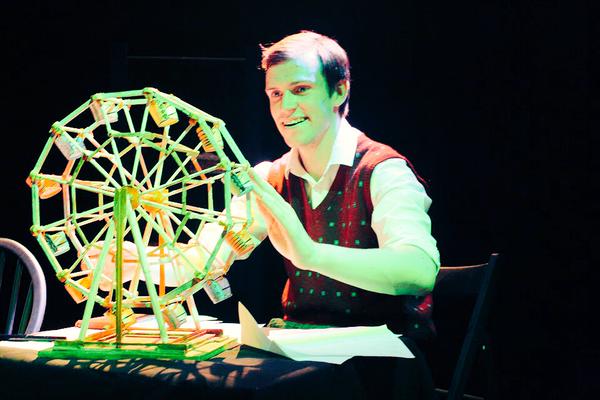
 Siblings Joanna and Lawrence live in 1950s New York City, a place brimming with promise and excitement for its younger residents. They don’t take advantage of it, though. Lawrence never leaves their little apartment; instead he lives vicariously through Joanna’s “adventures” to the market and her encounters in the corridor with their landlady “Pruneface” who has said they need to move out soon. Pruneface doesn’t like that Joanna’s pregnant, and with good reason. It’s Lawrence’s baby and the two refer to each other as husband and wife as often as they do brother and sister. Home Free!, whilst not a scary addition to the London Horror Festival, is a disturbing, excellently performed one-act showing the forgotten and invisible underbelly of an otherwise glamourous city. Untreated mental illness and agoraphobia has enormous consequences for these two innocent twenty-somethings, with Home Free! raising bigger questions about societies that let such a pair slide, unnoticed and unsupported, into catastrophe.
Lanford Wilson’s dialogue is deliberately circular and repetitive, serving to emphasise the cycle of fear that dominates Joanna and Lawrence’s lives. Though necessary, the repetition becomes predictable but this is fortunately a play in a single act. Wilson fully forms the imaginary friends the two have, Claypole and Edna, and Lawrence truly believes they are real – an unsettling device with a surprising impact on the play’s climax. Wilson was one of the pioneers of the New York City fringe theatre scene in the 1960s and it shows in this well-formed play, perfect for a tiny venue like the Etcetera.
This two-hander is adeptly handled by Lindsey Huebner and Rob Peacock, with direction by Courtney Larkin. Larkin focuses on Lawrence’s childlike mannerisms and instinct to see everything in his world as something to play with, occasionally emerging as aggressive attempts to get Joanna into bed despite her protestations. The two have some genuinely sweet moments, particularly when they give each other gifts from their “surprise box” that lives on the bookcase, made all the more unnerving by the awareness that they are brother and sister.
International company Theatrum Veritatus seeks to merge North American and British theatre traditions through their productions, a worthwhile effort in this American play performed in a pub theatre – a quintessential British venue. This production of Home Free! is a good one of a play rarely-staged here, but it’s inclusion in the London Horror Festival is an interesting choice. The horror this play contains is not the kind most familiar to Halloween. There are no ghosts, gouls, or things that go bump in the night. Instead, there’s incest, pathology and no support structure for vulnerable young people. Now that’s a truly frightening thing to imagine.
The Play’s The Thing UK is an independent theatre criticism website maintained voluntarily. Whilst donations are never expected, they are hugely appreciated and will enable more time to be spent reviewing theatre productions of all sizes. Click here to make a donation with PayPal.
 Willem is 34. He moved from Amsterdam to New York City 12 years ago. After an inconveniently timed phone call from his mother on a cold New York morning, he goes home for his younger brother Pauli’s funeral. He is greeted by his father’s disappointment, his sister’s lectures and the disorientation of not knowing where “home” is anymore. Much has changed, yet so much has remained the same.
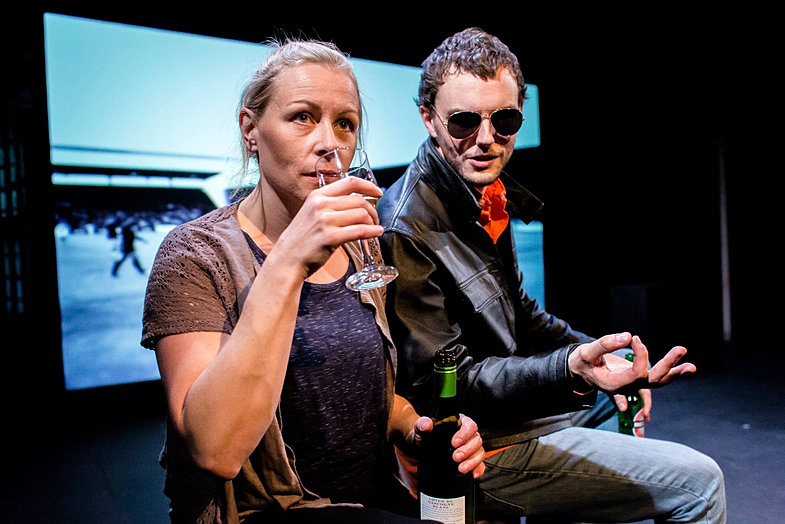 Carol (Holly Joyce) moved to a village in Carcassonne to rebuild her life after a devastating divorce and her son had grown up. She is convinced that in a past life, she was a medieval troubadour called Guy in the time of the Cathars. Raymond (Danny Solomon) is an actor working in the second-rate tourist attraction that Carol stalks, and longs for a life in the more exciting London. With a poetic, reflective script by Nick Wood and direction by Natasha Wood, Consolation has riveting moments between these two damaged, conflicting characters as they travel on parallel journeys of self-discovery, but at two and a half hours with a lengthy, slow-burning beginning, the production could use a trim. The slow development and several sub-plots lend a real-life complexity to the story, though the last to be introduced has insufficient expositional time considering its importance to the play’s conclusion. Despite the script’s need for additional development, this is a moving character piece unsentimentally following two individuals as they come to terms with the insubstantiality of their dreams.
 The Play's The Thing UK